
THE MONGOL IMPERIAL CAMPAIGN IN WESTERN ASIA
By Altanbagana Baatar
DBA Candidate| Independent Historian
ImperialGG Historical Research Seriers
17 November 2026
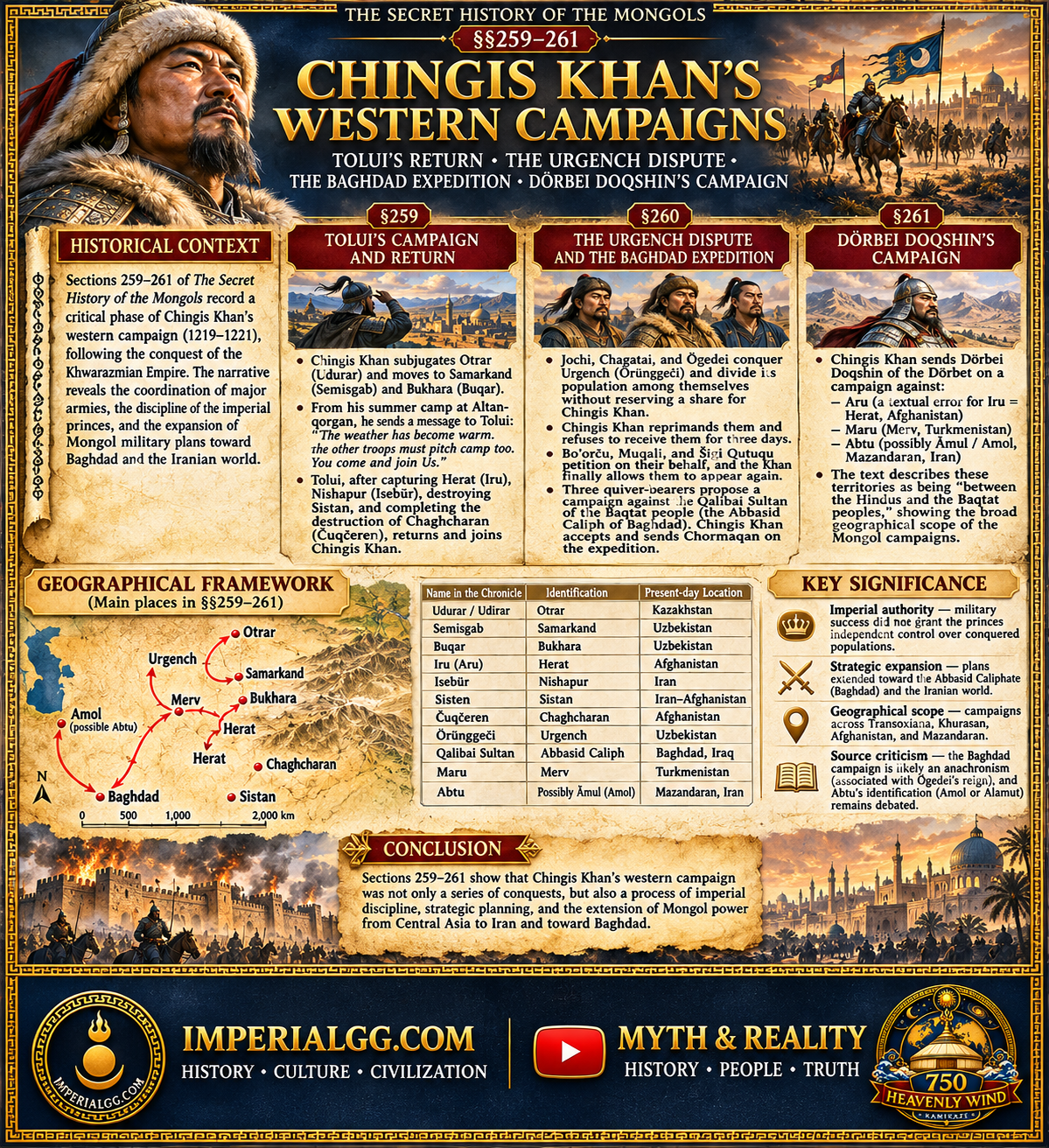
TOLUI’S RETURN, THE URGENCH DISPUTE, THE DECISION TO ATTACK BAGHDAD, AND DÖRBEI DOQŠIN’S WESTERN EXPEDITION
An Academic Study of §§259–261 of The Secret History of the Mongols
ABSTRACT
Sections 259–261 of The Secret History of the Mongols describe a critical phase in the expansion of Mongol military power across Central Asia and western Asia. The narrative begins with Chingis Khan’s movement from Otrar to Samarkand and Bukhara, followed by his summons to Tolui, who was completing military operations in Khurasan. It then records the confrontation between Chingis Khan and his three sons—Jochi, Chagatai, and Ögedei—after they divided the conquered population of Urgench among themselves without reserving a share for their father. The episode is followed by a proposal to campaign against the Qalibai Sultan of the Baqtat people, identified by the chronicle’s commentator with the Abbasid Caliph of Baghdad, and the dispatch of Chormaqan. Section 261 subsequently names Dörbei Doqshin and identifies three western targets: Aru, Maru, and Abtu.
These passages are particularly valuable for understanding the relationship between military command, imperial authority, and the geographical extension of Mongol campaigns. They also present several important historical problems. The identification of Abtu remains disputed, while the Baghdad expedition attributed to Chingis Khan appears chronologically anachronistic when compared with other historical sources. Similarly, the geographical sequence in §261 seems to combine references to separate military operations rather than preserve a single continuous campaign itinerary.
This article examines the narrative in its original sequence, distinguishes the statements of the chronicle from modern historical reconstruction, and evaluates the geographical and chronological problems through the commentary of Igor de Rachewiltz and other scholarship.
1. INTRODUCTION: THE WESTERN CAMPAIGN AND THE EXPANSION OF MONGOL IMPERIAL POWER
The Mongol conquest of the Khwarazmian Empire fundamentally changed the political geography of Central Asia and western Asia. Beginning in 1219, the campaign brought major urban centres under Mongol control, destroyed the military and political authority of Sultan Muhammad II, and opened new routes toward Khurasan, northern Iran, and the territories of the Abbasid Caliphate.
The events in §§259–261 of The Secret History of the Mongols must be understood within this wider historical transformation. The preceding section, §258, had already established the distribution of military responsibilities. Chingis Khan assigned the conquest of Urgench to his three sons, Jochi, Chagatai, and Ögedei, while Tolui was directed toward Iru, Isebür, and other cities. Chingis Khan himself moved against Otrar.
When the three princes asked whose command they should follow, Chingis Khan instructed them to obey Ögedei. This detail is essential for understanding the subsequent dispute at Urgench: the princes had received a collective military assignment, but their actions after the conquest were still subject to the authority of their father.
Sections 259–261 then present four connected developments:
Chingis Khan’s movement from Otrar through Samarkand to Bukhara and his establishment of a summer headquarters.
Tolui’s completion of his operations in Khurasan and his return to join the Great Khan.
The reprimand of Jochi, Chagatai, and Ögedei, followed by the proposal to campaign against the Abbasid Caliph of Baghdad and the dispatch of Chormaqan.
The assignment of Dörbei Doqshin against Aru, Maru, and Abtu.
The sequence is not merely a record of military victories. It provides insight into the political organization of the Mongol Empire, the authority of the ruling family, and the strategic thinking behind the extension of Mongol power toward the western Islamic world.
THE SECRET HISTORY OF THE MONGOLS+2
2. SECTION 259: CHINGIS KHAN’S MOVEMENT THROUGH TRANSOXIANA
2.1 THE SUBMISSION OF OTRAR AND THE ADVANCE TO SAMARKAND AND BUKHARA
Section 259 begins with the submission of Otrar. After bringing the city under his authority, Chingis Khan leaves Otrar and establishes his camp at Semisgab. He subsequently moves from Semisgab to Buqar.
Igor de Rachewiltz identifies these names as follows:
Udurar / Udirar: Otrar, in present-day Kazakhstan.
Semisgab: Samarkand, in present-day Uzbekistan.
Buqar: Bukhara, in present-day Uzbekistan.
The chronicle records: “Then Chinggis-qahan, having brought the city of Udurar (Utrār) to submission, set out from the city of Udurar and pitched camp at the city of Semisgab. Setting out from the city of Semisgab, he pitched camp at the city of Buqar.”
— The Secret History of the Mongols, §259, trans. Igor de Rachewiltz.
THE SECRET HISTORY OF THE MONGOLS+1
The movement from Otrar toward Samarkand and Bukhara represented the penetration of Mongol military power into the central urban region of Transoxiana. These cities were important centres of trade, agricultural production, Islamic scholarship, craftsmanship, and regional administration.
Otrar occupied a strategic position near the Syr Darya, connecting the steppe world with the settled agricultural and commercial centres farther south. Samarkand and Bukhara were among the most prominent cities of the medieval Islamic world. Their occupation therefore represented not simply the capture of fortified settlements but the establishment of Mongol authority over important political and economic centres.
The historical chronology places the fall of Bukhara in February 1220 and the capture of Samarkand in March 1220. The order in which the Secret History names these places should be read as the narrative sequence of the chronicle rather than as a complete military timetable.
Yumpu+2
Figure 1. Otrar, Samarkand, and Bukhara. Modern archaeological and historical views of the major urban centres associated with the campaign.
2.2 THE SUMMER HEADQUARTERS AT ALTAN-QORGAN
After moving through Samarkand and Bukhara, Chingis Khan establishes his summer camp at the ridge of Altan-qorgan, described in the text as the former summer quarters of the Sultan. The chronicle states that he waited there for Bala and spent the summer at this location. The exact modern identification of Altan-qorgan is not securely established in the passage. It is therefore important not to assign it a modern geographical position without further evidence.
The reference to the former summer quarters of the Sultan is nevertheless historically meaningful. The Mongol ruler was now occupying territory and a seasonal residence associated with the defeated Khwarazmian ruler. The political geography of the region had changed: the former territory of Sultan Muhammad had become part of the Mongol military sphere.
The establishment of a summer headquarters also provides the context for the next episode. Chingis Khan was not simply moving continuously from one city to another. He was organizing a central camp from which he could communicate with military forces operating across a broad territory.
2.3 CHINGIS KHAN SUMMONS TOLUI
From his summer headquarters, Chingis Khan sent messengers to Tolui with an instruction to return and join him.
The message is recorded as: “The weather has become warm. The other troops must pitch camp too. You come and join Us.”
— The Secret History of the Mongols, §259.
THE SECRET HISTORY OF THE MONGOLS
This instruction reveals the relationship between Tolui’s separate military assignment and the central headquarters. Tolui was operating independently in Khurasan, but his campaign remained part of the larger military strategy directed by Chingis Khan.
The reference to the warm weather is also significant. Seasonal conditions affected the movement of armies, the availability of pasture, the maintenance of horses, and the establishment of camps. The message indicates that the other troops were also preparing to establish camp and that Tolui was expected to rejoin the main force.
The chronicle does not explain the logistical details behind the decision. Nevertheless, it clearly connects Tolui’s return with the seasonal organization of the wider army.
2.4 TOLUI’S CAMPAIGN IN KHURASAN BEFORE HIS RETURN
When the messengers reached Tolui, he had already captured the cities of Iru, Isebür, and other settlements. He had destroyed Sisten and was in the process of destroying Čuqčeren. After receiving his father’s message, Tolui completed the operation against Čuqčeren, established camp, and returned to join Chingis Khan.
The passage reads: “When he sent this message, Tolui had captured the cities of Iru, Isebür and others, had destroyed the city of Sisten and was just destroying the city of Chuǧcheren (Chukhcharān). When the messengers gave him this message, Tolui, having destroyed the city of Chuǧcheren, returned to pitch camp and joined Chinggis-qahan.”
— The Secret History of the Mongols, §259, trans. Igor de Rachewiltz.
THE SECRET HISTORY OF THE MONGOLS
The place-names require careful treatment.
Iru and Isebür are identified in the earlier geographical discussion of the campaign. In de Rachewiltz’s commentary, Iru is associated with Herat, while Isebür is associated with Nishapur. The latter identification should be distinguished from the separate geographical references in §261.
Sisten corresponds to Sistan, a historical region extending across parts of present-day southeastern Iran and southwestern Afghanistan.
Čuqčeren, also transcribed as Chukhcharān or Chughcharan, is associated with the modern Chaghcharan area in Ghor Province, Afghanistan.
The text therefore places Tolui’s operations across a substantial area of eastern Iran and western Afghanistan. These were not isolated settlements. They formed part of the historical region of Khurasan and its surrounding territories, where cities, agricultural oases, and trade routes connected Central Asia with the Iranian plateau.
The most important detail in this passage is the sequence of Tolui’s actions. He did not abandon the campaign immediately upon receiving the message. He completed the destruction of Čuqčeren and then returned to the main headquarters. This suggests that military commanders exercised operational discretion while remaining responsible for obeying the strategic orders of the Great Khan.
Figure 2. Historical geography of Tolui’s operations in Khurasan. The modern photographs illustrate the regional landscape and urban locations.
3. SECTION 260: THE CONQUEST OF URGENCH AND THE REPRIMAND OF THE THREE PRINCES
3.1 THE CAPTURE OF ÜRÜNGGEČI
Section 260 moves from Tolui’s return to the actions of the three sons of Chingis Khan: Jochi, Chagatai, and Ögedei. The three princes had been assigned the conquest of Ürünggeči, identified with Urgench, the major urban centre of Khwarazm.
The chronicle states: “Jochi, Cha’adai and Ögödei, these three sons of Chinggis-qahan, subjugated the city of Örünggechi (Urgench): they shared the people of the cities among all three of them, but did not give Chinggis-qahan a share.”
— The Secret History of the Mongols, §260, trans. Igor de Rachewiltz.
THE SECRET HISTORY OF THE MONGOLS+1
Urgench was a major political and economic centre of the Khwarazmian state. Its location in the lower Amu Darya region connected it with the agricultural settlements and commercial routes of the Aral Sea basin.
The capture of the city was a major military achievement. However, the chronicle does not focus primarily on the tactics of the siege. Instead, it emphasizes the political consequences of the princes’ actions after the conquest.
The three brothers divided the conquered population among themselves but did not reserve a share for their father. This action became the central issue in the confrontation that followed.
3.2 THE DIVISION OF THE POPULATION AND THE QUESTION OF IMPERIAL AUTHORITY
The text’s wording is important. It states that the princes divided the people of the conquered cities among themselves. It does not provide a detailed description of the legal or administrative form of this division. The passage should not automatically be interpreted as a formal land grant, a census, or a fully developed taxation arrangement. The source does not specify the precise categories of people involved or the administrative procedures through which the division was implemented.
What it does establish is that the three princes distributed the conquered population among themselves without recognizing their father’s superior position in the allocation of the spoils of conquest.
This was a political problem. The princes were members of the ruling family and commanders of major armies, but their military authority did not place them above the Great Khan.
The earlier instruction in §258 is especially relevant. When the three princes asked whose command they should follow, Chingis Khan instructed them to obey Ögedei. Their authority at Urgench therefore derived from an assignment made by their father. Their victory did not give them independent sovereignty over the conquered city.
3.3 THE THREE-DAY REPRIMAND
When the three princes returned and established their camp, Chingis Khan reprimanded them. He refused to receive them for three days. This was not merely a personal disagreement between a father and his sons. The episode concerned the political hierarchy of the Mongol ruling house and the authority of the Great Khan over conquered territories and populations.
Three senior figures—Bo’orču, Muqali, and Šigi Qutuqu—then approached Chingis Khan and petitioned him on behalf of the princes.
Their argument emphasized that the Mongol army had defeated the Sultan of the Sarta’ul people and captured his cities and population through the collective strength of the empire. The city of Urgench, they argued, belonged to Chingis Khan, together with the sons who had conquered it.
They also reminded the ruler that the army was celebrating its victory. The princes had recognized their mistake and were afraid of their father’s anger. The petitioners asked Chingis Khan to allow them to appear before him again.
The imagery used in the petition is particularly revealing. The princes are compared to young falcons who are still learning. The senior commanders warn that excessive punishment could discourage them and weaken their willingness to perform their duties.
The argument was therefore not that the princes had done nothing wrong. Rather, the petitioners sought to restore the relationship between the ruler and his sons while preserving the authority of the Great Khan.
Chingis Khan eventually accepted their petition and permitted the three princes to appear before him. The narrative nevertheless records that he continued to reprimand them severely.
Chapter XI+2
3.4 THE POLITICAL SIGNIFICANCE OF THE EPISODE
The Urgench episode illustrates an important principle of Mongol imperial government: military success did not create unrestricted political authority.
Jochi, Chagatai, and Ögedei were powerful princes, but their authority remained subordinate to their father. The distribution of conquered populations was not simply a private decision made by victorious commanders. It was a matter of imperial authority.
The intervention of Bo’orču, Muqali, and Šigi Qutuqu is also significant. These senior figures acted as mediators between the ruler and the princes. Their role demonstrates that the stability of the ruling family and the cohesion of the military leadership were important concerns within the imperial system.
The episode also provides insight into the political character of The Secret History of the Mongols. The chronicle does not simply celebrate military victory. It uses the conduct of the princes to communicate a lesson about obedience, responsibility, and the limits of individual authority within the ruling house.
Figure 3. Artistic reconstruction of a Mongol imperial court. This image is illustrative, not a contemporary representation of the Urgench episode.
4. SECTION 260: THE DECISION TO CAMPAIGN AGAINST THE QALIBAI SULTAN OF BAGHDAD
4.1 THE PETITION OF THE THREE QUIVER-BEARERS
After the petition concerning the three princes, the narrative introduces three quiver-bearers:
Qongqai Qorči
Qongtaqar Qorči
Chormaqan Qorči
They approached Chingis Khan and declared that enemies existed across the lands from the setting sun to the rising sun. If the Khan sent them on a campaign, they promised to return with enemy populations, gold, silver, satin, goods, and subjects.
They then proposed a western target: “Here in the west there is one called the Qalibai Soltan of the Baqtat people. Let us move against him!”
— The Secret History of the Mongols, §260, trans. Igor de Rachewiltz.
THE SECRET HISTORY+1
The phrase Qalibai Soltan is interpreted by de Rachewiltz as a form of Khalifa Sultan, meaning “Sultan-Caliph.” He identifies this ruler with the Abbasid Caliph of Baghdad.
The reference to the Baqtat people is therefore associated with the political authority centred in Baghdad. The proposal represents a new strategic direction: the Mongol leadership was considering military action beyond the territories of the defeated Khwarazmian state and toward the Abbasid political centre.
The petition also reveals the material objectives of conquest. The three quiver-bearers specifically mention gold, silver, satin, goods, and subject populations. Their proposal was not expressed solely in ideological or religious terms. It was framed as a campaign that would expand the resources and human base of the Mongol Empire.
4.2 CHINGIS KHAN’S DECISION AND THE DISPATCH OF CHORMAQAN
Chingis Khan accepted the proposal but did not send all three petitioners away. He ordered Qongqai of the Adargin and Qongtaqar of the Dolonggir to remain at his side. Chormaqan of the Ötegen was sent on the campaign against the Baqtat people and the Qalibai Sultan.
The distinction is important. The chronicle records the dispatch of Chormaqan, not the departure of all three quiver-bearers. It also records a military order, not the capture of Baghdad. The passage should therefore be understood as an account of a proposed and authorized campaign against the Abbasid Caliphate.
4.3 BAGHDAD AND THE ABBASID CALIPHATE
Baghdad was the political and religious centre of the Abbasid Caliphate. Although the caliph’s territorial power had diminished considerably compared with earlier centuries, the institution retained substantial religious prestige and political importance.
The Abbasid Caliph was not the same political figure as Sultan Muhammad II of Khwarazm. The Khwarazmian Sultan exercised authority over a large territory in Central Asia and Iran, while the Abbasid Caliph represented a separate institution based in Baghdad.
The identification of the Qalibai Sultan with the Abbasid Caliph is supported by de Rachewiltz’s commentary. He identifies Baghdad as the target and explains the meaning of the title as “Sultan Caliph.”
THE SECRET HISTORY
Figure 4. Baghdad and the Abbasid political world. The illustrations provide historical context and should not be mistaken for contemporary images of the campaign.
4.4 A MAJOR CHRONOLOGICAL PROBLEM: WAS THE BAGHDAD CAMPAIGN REALLY ORDERED BY CHINGIS KHAN?
One of the most important scholarly problems in §260 concerns the chronology of Chormaqan’s expedition. The Secret History of the Mongols presents the dispatch of Chormaqan against the Qalibai Sultan as an order issued by Chingis Khan. However, de Rachewiltz identifies a chronological difficulty.
He notes that the Abbasid Caliph reigning at the time of Chingis Khan’s death in 1227 was al-Nasir, who ruled from 1180 to 1225. The caliph relevant to the later Mongol campaign was al-Mustansir, who ruled from 1226 to 1242.
De Rachewiltz argues that the historical campaign associated with Chormaqan belongs to the reign of Ögedei rather than the final years of Chingis Khan. He further notes that the Mongol attack on the neighbourhood of Baghdad occurred in 1238, when the forces of al-Mustansir repelled the Mongol army.
He therefore identifies the reference in §260 as an anachronism. Chormaqan’s campaign during Ögedei’s reign is also mentioned later in §270 of The Secret History.
THE SECRET HISTORY+1
This problem is not merely a disagreement over a few years. It affects the historical interpretation of the entire passage.
The chronicle appears to place an event associated with a later stage of Mongol expansion into the narrative of Chingis Khan’s reign. The passage may therefore preserve a historical memory of Chormaqan’s western campaign while presenting it within an earlier chronological framework.
Christopher P. Atwood’s study of the dating and composition of The Secret History of the Mongols also discusses the reference to Chormaqan’s campaign against Baghdad as a chronological anomaly. Atwood notes that other sources place the campaign in 1228 or 1229, during the reign of Ögedei.
IUScholarWorks
This distinction is essential for an academic interpretation:
What the chronicle says: Chingis Khan accepted the proposal and sent Chormaqan against the Baqtat people and the Qalibai Sultan.
What the historical comparison suggests: The campaign belongs to the reign of Ögedei, not Chingis Khan.
What remains important: The passage preserves the Mongol historical memory of the western campaign and its association with Chormaqan.
The later Mongol conquest of Baghdad in 1258 under Hülegü must also be distinguished from this earlier campaign. The two events belong to different generations and different stages of Mongol expansion.
5. SECTION 261: DÖRBEI DOQSHIN’S CAMPAIGN AND THE GEOGRAPHY OF ARU, MARU, AND ABTU
Section 261 is short, but its geographical and historical implications are considerable.
The chronicle states: “Further, Chinggis-qahan sent Dörbei Doqshin of the Dörbet on a campaign against Aru, Maru and the city of Abtu of the Madasari people between the Hindus people and the Baqtat people.”
— The Secret History of the Mongols, §261, trans. Igor de Rachewiltz.
altaica.ru+1
Three place-names are particularly important:
Aru
Maru
Abtu
De Rachewiltz provides a detailed discussion of these names in his commentary. His analysis also identifies a major problem: §261 appears to combine references to separate historical events.
5.1 ARU: A TEXTUAL ERROR FOR IRU — HERAT, AFGHANISTAN
De Rachewiltz identifies Aru as an error for Iru, the place-name mentioned earlier in the chronicle. Iru is identified with Herat, in present-day western Afghanistan.
Herat occupies a fertile valley near the Hari Rud River. Its location connected the Iranian plateau with eastern Khurasan, Central Asia, and the routes leading toward Sistan and the Hindu Kush.
The city was an important political and commercial centre throughout the medieval period. Its position gave it strategic significance for armies moving between western Afghanistan, eastern Iran, and Central Asia.
The identification of Aru with Iru and Iru with Herat is supported by de Rachewiltz’s commentary. However, he also questions why Herat appears in §261 when Tolui had already conquered the city during his earlier operations in Khurasan.
He suggests that the name may have been inserted into this passage by mistake because Iru and Maru formed a familiar geographical pair in Mongol usage.
THE SECRET HISTORY+1
Figure 5. Herat, present-day Afghanistan. The modern city preserves the geographical location of the historical urban centre.
5.2 MARU: MERV, PRESENT-DAY TURKMENISTAN
The second name, Maru, is identified with Merv, also written Marv or Marw.
Merv was located in the Murghab oasis in present-day Mary Region, Turkmenistan. It was one of the most important urban centres of medieval Khurasan and played a major role in the political, commercial, and cultural history of the Iranian and Central Asian worlds.
The city’s importance was connected with its location along routes linking Central Asia with Iran and the wider Islamic world. Its oasis supported agricultural production, while its successive urban settlements reflected different periods of political and cultural development.
The archaeological landscape of Ancient Merv includes several major walled settlements, including Erk Kala, Gyaur Kala, and Sultan Kala. These remains demonstrate the long-term importance of the oasis as an urban centre.
The identification of Maru with Merv is accepted by de Rachewiltz and supported by other historical scholarship.
THE SECRET HISTORY+2
Figure 6. Ancient Merv in present-day Turkmenistan. The archaeological remains document the historical importance of the Murghab oasis.
5.3 ABTU: ALAMUT OR ĀMUL? THE PROBLEM OF MAZANDARAN
The third place-name, Abtu, is the most difficult to identify. The chronicle describes it as a city of the Madasari people. De Rachewiltz discusses two possible interpretations in his commentary. The first was proposed by Japanese scholar Masaji Murakami, who identified Abtu with Alamut, the famous fortress of the Ismailis in the mountainous region of northern Iran. Murakami also identified Madasari with Mazandaran.
His proposed linguistic development was:
Alamut → an intermediate form resembling Amtu → Abtu.
Mazandaran → an intermediate form resembling Madanzaran → Madazari → Madasari.
De Rachewiltz accepts the identification of Madasari with Mazandaran but does not accept Murakami’s identification of Abtu with Alamut. His objection is historical as well as linguistic: he argues that there is no clear evidence for a Mongol attack on Alamut at this particular point in the narrative.
Instead, de Rachewiltz proposes that Abtu may be a corrupted form of Āmul, a city in Mazandaran that was sacked by Mongol forces at the end of 1220 or early 1221. He suggests that a form such as Āmulu could have been confused with Abtu during the transmission of the Mongolian text.
THE SECRET HISTORY
This is an important distinction. The identification of Abtu with Āmul is not a direct statement in the chronicle. It is a scholarly reconstruction proposed by de Rachewiltz.
5.4 ĀMUL / AMOL: THE MODERN GEOGRAPHICAL LOCATION
The historical city of Āmul, commonly written Amol, is located in Mazandaran Province in northern Iran. Its approximate geographical coordinates are:
Amol, Mazandaran Province, Iran
36°25′ N
52°35′ E
Approximate coordinates cited in Encyclopaedia Iranica
عکس؛ سفر به تاریخ؛ چشم انداز زیبا و متفاوت شهر «آمل» در دوران ناصرالدین شاه
The region historically known as Mazandaran was part of the wider historical area of Tabaristan. Its political and geographical identity differed from the central Iranian plateau and the Khurasan region farther east.
The identification of Abtu with Amol is plausible because the chronicle explicitly associates Abtu with the Madasari people, whom de Rachewiltz identifies with Mazandaran. However, the surviving form Abtu does not independently prove that the city was Amol.
Encyclopaedia Iranica+2
Figure 7. Modern Amol and the geographical landscape of Mazandaran. The location is presented as a possible identification of Abtu, following de Rachewiltz.
5.5 WHY DE RACHEWILTZ QUESTIONS THE SEQUENCE OF SECTION 261
The most important part of de Rachewiltz’s commentary is not simply the identification of the place-names. It is his argument that §261 is historically confused and anachronistic.
He points out that Dörbei Doqshin had already been mentioned in connection with the campaign against Jalal al-Din beyond the Indus in 1221–1222. Meanwhile, Merv, Herat, and other cities in Khurasan had already been conquered by Tolui earlier in 1221. This creates a chronological problem. If Tolui had already conquered Herat and Merv, why does §261 present these cities as targets of Dörbei Doqshin’s campaign?
De Rachewiltz suggests that Dörbei may have been one of the commanders stationed at Nasaf, also known as Naxšab, who participated in suppressing a revolt at Merv in the latter part of 1222. He further argues that Herat may have been inserted into the passage by mistake, possibly because Iru and Maru were a familiar pair of place-names.
His final conclusion is that §261 appears to combine two separate historical events:
A campaign associated with Dörbei Doqshin.
Attacks on towns in Khurasan and Mazandaran.
The passage may have been inserted at this point in the chronicle because of its connection with the preceding reference to the Baqtat people.
THE SECRET HISTORY
This interpretation changes how the passage should be read. It would be incorrect to draw a single continuous military route from Herat to Merv and then to Amol and claim that the chronicle provides a precise itinerary for Dörbei Doqshin. The text preserves a historical association, but its arrangement may not correspond to the exact sequence of military operations.
6. THE GEOGRAPHICAL FRAMEWORK OF THE THREE SECTIONS
The geographical references in §§259–261 extend across a large part of Central Asia, Afghanistan, Iran, and Iraq.
The following table distinguishes the names appearing in the chronicle from their modern geographical identifications.
Name in the chronicle | Historical identification | Present-day location |
|---|---|---|
Udurar / Udirar | Otrar | Kazakhstan |
Semisgab | Samarkand | Uzbekistan |
Buqar | Bukhara | Uzbekistan |
Iru | Herat | Afghanistan |
Isebür | Nishapur | Iran |
Sisten | Sistan | Iran–Afghanistan region |
Čuqčeren | Chukhcharān / Chaghcharan | Afghanistan |
Örünggeči | Urgench | Uzbekistan |
Qalibai Sultan | Abbasid Caliph of Baghdad | Baghdad, Iraq |
Aru | Textual error for Iru / Herat | Afghanistan |
Maru | Merv | Turkmenistan |
Abtu | Possibly Āmul / Amol; alternatively Alamut has been proposed | Mazandaran, Iran |
The map provides a geographical overview of the places named in the three sections. It does not represent a verified route taken by a single Mongol army. The chronicle does not provide enough information to reconstruct the precise itinerary of every commander.
The distinction is particularly important for §261, where the geographical sequence may combine separate events.
7. IMPERIAL COMMAND AND THE EXPANSION OF THE MONGOL WESTERN CAMPAIGNS
Read together, §§259–261 reveal three important features of Mongol imperial organization.
7.1 THE CENTRAL AUTHORITY OF CHINGIS KHAN
Tolui’s return demonstrates that commanders conducting separate campaigns remained accountable to the central headquarters. Although Tolui had considerable operational freedom in Khurasan, he was expected to respond to his father’s summons.
The Urgench episode reinforces the same principle in a different context. Jochi, Chagatai, and Ögedei had successfully conquered a major city, but they were reprimanded for dividing the conquered population without recognizing the superior authority of Chingis Khan.
The two episodes reveal the same political principle: military responsibility could be delegated, but supreme authority remained centralized.
7.2 THE ROLE OF THE RULING FAMILY AND SENIOR COMMANDERS
The three princes were central military figures, but their authority operated within a hierarchy. The petition of Bo’orču, Muqali, and Šigi Qutuqu demonstrates the role of senior commanders in maintaining political stability within the ruling family.
The three quiver-bearers, meanwhile, demonstrate another dimension of imperial organization. Military initiatives could be proposed by members of the ruler’s immediate entourage. Chingis Khan evaluated the proposal and assigned Chormaqan to the campaign. The chronicle therefore depicts the imperial headquarters as a centre of military decision-making, where campaigns were proposed, authorized, and assigned.
7.3 THE GEOGRAPHICAL EXTENSION OF MONGOL MILITARY POWER
The references to Baghdad, Herat, Merv, and Mazandaran show that the western campaign was no longer confined to the immediate conquest of Khwarazm. The Mongol leadership was considering operations against political authorities farther west, including the Abbasid Caliphate. At the same time, the campaigns in Khurasan and northern Iran demonstrate the geographical breadth of Mongol military activity.
However, the chronological problems in §§260–261 warn against treating the narrative as a perfectly ordered military record. The Secret History preserves important information about Mongol campaigns, but its narrative sequence sometimes combines events from different periods.
8. AUTHOR’S THESIS
Sections 259–261 demonstrate that the Mongol conquest of western Asia was simultaneously a military expansion and a process of imperial consolidation.
The return of Tolui after completing operations in Khurasan reveals the coordination between separate military commands and the central authority of Chingis Khan. The confrontation with Jochi, Chagatai, and Ögedei shows that the princes’ military achievements did not grant them unrestricted authority over conquered populations. Their actions remained subject to the political supremacy of the Great Khan.
The proposal to campaign against the Qalibai Sultan of Baghdad reveals the expanding geographical horizon of Mongol military planning. Nevertheless, the chronological discrepancy identified by de Rachewiltz and Atwood requires the Baghdad expedition to be treated critically. The Secret History attributes the order to Chingis Khan, while the comparison with other historical sources places Chormaqan’s campaign within the reign of Ögedei.
Section 261 provides another example of the need for source criticism. The identifications of Herat and Merv are relatively secure, but Abtu remains disputed. De Rachewiltz’s proposal that it refers to Āmul in Mazandaran is plausible, while Murakami’s earlier identification with Alamut represents an alternative scholarly interpretation. The apparent combination of separate historical events further demonstrates that the narrative should not be treated as a precise military itinerary.
The central historical argument is therefore that the Mongol western campaigns cannot be understood simply as a succession of conquered cities. They reveal a political system in which military assignments, princely authority, the distribution of conquered populations, and the expansion of imperial territory were connected through the central authority of Chingis Khan and his successors.
9. CONCLUSION
Sections 259–261 preserve an important account of the Mongol Empire at a moment when the conquest of Khwarazm was opening into a wider programme of western expansion.
Section 259 records Chingis Khan’s movement through Otrar, Samarkand, and Bukhara, followed by his summons to Tolui. Tolui completed the operation against Čuqčeren before returning to join his father.
Section 260 describes the conquest of Urgench by Jochi, Chagatai, and Ögedei, the division of its population, and Chingis Khan’s three-day refusal to receive his sons. The intervention of Bo’orču, Muqali, and Šigi Qutuqu demonstrates the importance of political discipline and the maintenance of unity within the ruling family.
The same section then records the proposal to campaign against the Qalibai Sultan of Baghdad and the dispatch of Chormaqan. The chronological problem surrounding this expedition is significant: the chronicle places the order within Chingis Khan’s reign, while the historical comparison associates the campaign with Ögedei’s period.
Section 261 records Dörbei Doqshin’s campaign against Aru, Maru, and Abtu. The identification of Aru with Herat and Maru with Merv is supported by the commentary, while the identification of Abtu with Amol remains a scholarly hypothesis. De Rachewiltz’s analysis further suggests that the passage combines references to separate military operations.
Together, these three sections reveal an empire expanding geographically while maintaining a centralized structure of command. They also demonstrate why the Secret History of the Mongols must be studied through close textual reading, comparison with other historical sources, and careful geographical reconstruction.
NOTES AND REFERENCES
PRIMARY SOURCE
1. Igor de Rachewiltz, The Secret History of the Mongols: A Mongolian Epic Chronicle of the Thirteenth Century, vol. 1, translated with historical and philological commentary (Leiden: Brill, 2004), Chapter XI, §§259–261. Consult the complete scholarly edition.
2. Igor de Rachewiltz, trans., The Secret History of the Mongols, English translation in Papers on Far Eastern History, Chapter XI, §§259–261. Read §§259–261.
3. Urgunge Onon, trans., The Secret History of the Mongols: The Life and Times of Chinggis Khan (London and New York: RoutledgeCurzon, 2001), Chapter XI, §§259–261. Consult the Onon translation.
SECONDARY SCHOLARSHIP
4. Christopher P. Atwood, “The Date of the ‘Secret History of the Mongols’ Reconsidered,” Journal of Song-Yuan Studies 37 (2007). Read the article.
5. Igor de Rachewiltz, commentary on §260, especially the identification of the Qalibai Sultan, Baghdad, al-Nasir, al-Mustansir, and the chronological problem concerning Chormaqan’s expedition. Read the relevant commentary.
6. Igor de Rachewiltz, commentary on §261, especially the discussion of Aru, Maru, Abtu, Alamut, Āmul, and the possible conflation of separate events. Read the geographical and chronological commentary.
7. Clifford Edmund Bosworth, “Āmol,” Encyclopaedia Iranica. Read the entry.
8. UNESCO World Heritage Centre, “State Historical and Cultural Park ‘Ancient Merv’.” Read the UNESCO description.
SOURCE-CRITICAL NOTES
The article uses Chingis Khan consistently rather than the specialist transliteration “Činggis Qa’an.”
The chronicle’s reference to the Baghdad campaign is presented separately from the later historical reconstruction of Chormaqan’s campaign under Ögedei.
The identification of Abtu with Amol follows de Rachewiltz’s proposal; Murakami’s alternative identification with Alamut is also acknowledged.
The geographical sequence in §261 is not treated as a verified single military route.
Medieval casualty figures and unsupported claims about the exact number of troops or dates have been excluded.
IMPERIALGG.COM — HISTORY • CULTURE • CIVILIZATION
MYTH & REALITY — HISTORY • PEOPLE • TRUTH