
THE OTRAR CATASTROPHE OF 1218
By Altanbagana Baatar
DBA Candidate| Independent Historian
ImperialGG Historical Research Seriers
16 November 2026
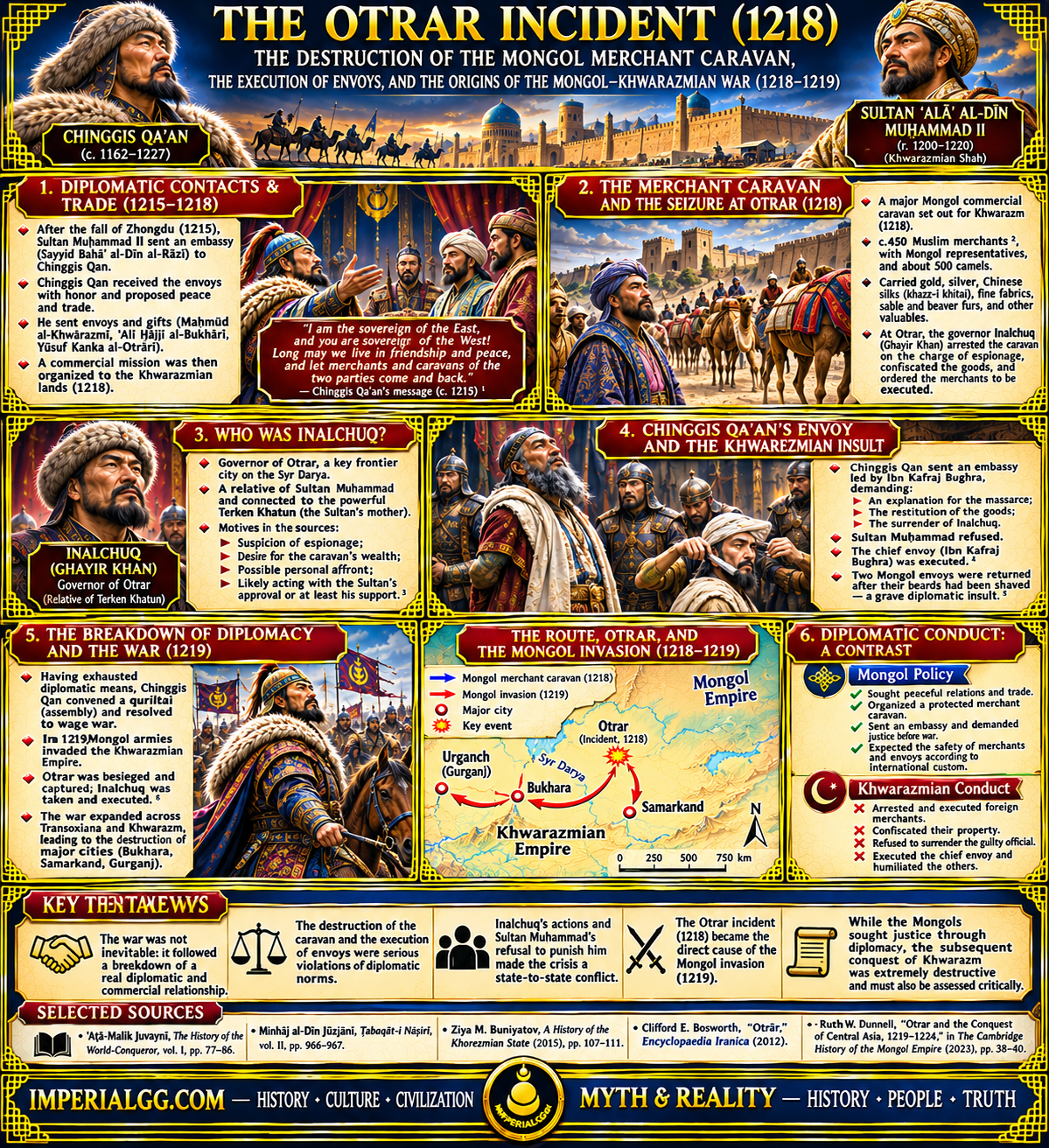
INALCHUQ, THE DESTRUCTION OF THE MERCHANT CARAVAN, AND THE BREAKDOWN OF MONGOL–KHWARAZMIAN DIPLOMACY
Trade, diplomatic immunity, the execution and humiliation of envoys, and the origins of the Mongol conquest of Khwarazm, 1218–1219
ABSTRACT
The Mongol invasion of the Khwarazmian Empire in 1219 was preceded by a diplomatic and commercial relationship that had initially offered the possibility of peaceful exchange between Chinggis Qan and Sultan ʿAlāʾ al-Dīn Muḥammad II. Following the Khwarazmian embassy to the Mongol court in 1215, Chinggis Qan sent diplomatic representatives and organized a major commercial expedition to the Sultan’s territories. In 1218, a caravan carrying valuable merchandise, accompanied by Muslim merchants and Mongol representatives, reached the frontier city of Otrar on the Syr Darya. Its governor, Inalchuq, also known as Inal Khan and Ghayir Khan, detained the merchants, confiscated their goods, and ordered or caused their execution. The exact circumstances and the degree of Sultan Muḥammad’s prior authorization remain disputed among the medieval accounts. Chinggis Qan did not immediately begin a full-scale invasion. He first sent an embassy demanding an explanation, restitution, and the surrender of Inalchuq. The Sultan refused to surrender the governor and ordered the execution of the chief Mongol envoy, Ibn Kafraj Bughra. In one influential account, the two accompanying Mongol envoys were returned after their beards had been shaved, a humiliating act that violated diplomatic convention. This article examines the Otrar incident through Persian, Arabic, Mongolian, and modern scholarly sources. It argues that the destruction of the caravan and the subsequent treatment of the envoys transformed a commercial and diplomatic dispute into a major imperial conflict. It also emphasizes that the historical record does not support a simplistic contrast between uniformly civilized Mongol diplomacy and uniformly barbarous Khwarazmian conduct: responsibility must be assigned to specific officials and political decisions, while the later Mongol invasion and its extensive destruction must also be examined critically.
Keywords: Chinggis Qan; Otrar; Inalchuq; Ghayir Khan; Terken Khatun; Sultan Muḥammad II; Ibn Kafraj Bughra; Mongol diplomacy; Silk Road; merchant caravan; diplomatic immunity; Khwarazmian Empire; 1218; 1219.
INTRODUCTION: A COMMERCIAL RELATIONSHIP BEFORE THE WAR
At the beginning of the thirteenth century, the Khwarazmian Empire had become one of the major political powers of Central Asia and the Iranian world. Under Sultan ʿAlāʾ al-Dīn Muḥammad II (r. 1200–1220), its territories extended across Khwarazm, Transoxiana, much of Iran, and regions reaching toward the Indus. Its principal political and commercial centers included Gurganj, Bukhara, Samarkand, Otrar, and other cities connected through the caravan routes of Central Asia.[1]
At the same time, Chinggis Qan’s state had expanded across Mongolia and northern China. The conquest of the Jin capital, Zhongdu, in 1215 had brought the Mongol court into possession of enormous resources and increased its interest in long-distance commerce. The relationship between the Mongols and the Khwarazmian ruler therefore developed in a context where trade, diplomatic recognition, and strategic competition were closely connected.
The Otrar incident of 1218 is often presented as the immediate cause of the Mongol–Khwarazmian War. Yet it is important to understand that the incident did not occur in an environment of complete diplomatic isolation. The two rulers had already exchanged envoys, gifts, and proposals for commercial relations. The destruction of the caravan and the treatment of the subsequent Mongol embassy represented a breakdown of an existing diplomatic relationship, not simply the beginning of contact between two previously unknown powers.[2]
Figure 1. The commercial and geographical setting of the Otrar incident. Otrar stood near the Syr Darya, in a strategic position connecting the steppe routes with the settled cities of Transoxiana. The archaeological remains of Otrar and the historical Silk Road network provide the material and geographical context for the events of 1218.[3]
1. THE FIRST DIPLOMATIC CONTACTS: CHINGGIS QAN’S PROPOSAL FOR PEACE AND TRADE, 1215–1218
One of the most important early diplomatic exchanges followed the Khwarazmian embassy led by Sayyid Bahāʾ al-Dīn al-Rāzī, which reached the Mongol court after the capture of Zhongdu in June 1215. According to Ziya Buniyatov’s study, Chinggis Qan received the envoy with honor, presented valuable gifts for the Khwarazmian ruler, and conveyed a message proposing peaceful relations and commercial exchange.[4]
The message, as transmitted in Buniyatov’s account, presented the two rulers as sovereigns of the eastern and western regions and proposed that merchants and caravans should travel freely between their territories:
“I am the sovereign of the East, and you are sovereign of the West! Long may we live in friendship and peace, and let merchants and caravans of the two parties come and back.”[5]
This statement is important for understanding the political framework of the later commercial mission. Chinggis Qan was not simply sending merchants without diplomatic preparation. The exchange was accompanied by a proposal for peaceful relations and the development of trade routes.
The Mongol ruler also ordered the placement of guards, known as qaraqchi, along the principal trade routes leading westward to protect commercial traffic. This detail suggests that the security of merchants and caravans was an issue of state policy rather than merely a private concern.[6]
In the subsequent diplomatic exchange, Chinggis Qan sent representatives including Maḥmūd al-Khwārazmī, ʿAlī Ḥājjī al-Bukhārī, and Yūsuf Kanka al-Otrārī. They carried gifts and a personal message for Sultan Muḥammad. The gifts reportedly included precious metals, musk, nephrite, walrus tusk, and garments made from white camel wool.[7]
Buniyatov also reproduces a conversation attributed to the Khwarazmian court in which Sultan Muḥammad objected to Chinggis Qan addressing him as a “dearest son.” The Sultan interpreted the expression as implying a subordinate relationship. The exchange illustrates an important diplomatic difference: a form of address that Chinggis Qan may have understood as a conventional expression of hierarchy and friendly patronage could be interpreted by Muḥammad as an affront to his independent sovereignty.[8]
Nevertheless, the Sultan agreed to maintain peaceful relations and exchange commercial caravans. This agreement formed the immediate background to the caravan that subsequently reached Otrar.
Figure 2. A Persian miniature depicting a medieval diplomatic audience. It is an illustrative representation of courtly diplomacy, not a contemporary portrait of Chinggis Qan, Sultan Muḥammad, or their envoys.
2. THE GREAT CARAVAN OF 1218: MERCHANTS, CAMELS, GOLD, SILVER, AND VALUABLE GOODS
Following the exchange of diplomatic missions, Chinggis Qan organized a major commercial caravan to the Khwarazmian territories. The caravan was led by four merchants whose names are preserved in Buniyatov’s account:
ʿUmar Khwāja al-Otrārī;
al-Jamāl al-Marāghī;
Fakhr al-Dīn al-Dīzaqī al-Bukhārī;
Amīn al-Dīn al-Haravī.[9]
The caravan included approximately 450 Muslim merchants, according to the account based on Juvaynī and Rashīd al-Dīn. Buniyatov reports that two or three representatives from Mongol tribes accompanied the merchants, while another version gives approximately one hundred Mongol representatives and associates. The Cambridge history notes that the figure of 450 for the entire delegation has been questioned by scholars, who have preferred a figure of approximately one hundred persons based on the account of the Khitan official Yelü Chucai.[10]
The number of camels is also significant. Buniyatov records a caravan of 500 camels carrying valuable merchandise. The cargo included:
Gold and silver;
Chinese patterned silk, known as khazz-i khitai;
Fine and lightweight silk fabrics;
Sable furs;
Beaver furs;
Other rare and valuable commodities.[11]
These were not ordinary provisions carried by a small group of travelers. The caravan represented a substantial commercial undertaking and an important opportunity to establish regular trade between the Mongol and Khwarazmian territories.
Figure 3. The commercial world represented by the 1218 caravan: camel transport, fine textiles, precious metals, and long-distance trade. The images are illustrative rather than photographs of the actual cargo.
The cargo’s value should not obscure the political significance of the mission. The merchants were traveling under the protection and authority of Chinggis Qan’s state. The caravan was therefore both an economic expedition and an expression of diplomatic confidence. Its destruction would have consequences beyond the financial loss of individual traders.
3. OTRAR: THE FRONTIER CITY AND THE AUTHORITY OF INALCHUQ
The caravan reached Otrar, a strategically important city located near the middle course of the Syr Darya, known historically as the Jaxartes. Otrar occupied a frontier position between the settled territories of Transoxiana and the steppe routes to the northeast. Its location gave it considerable importance in the movement of merchants, military forces, and political communications.[12]
At the time of the incident, the city was governed by Inalchuq, also known as Inal Khan or Ghayir Khan. He was a relative of Sultan Muḥammad and was connected to the powerful political network surrounding the Sultan’s mother, Terken Khatun. The governor’s relationship with the ruling family is important because it helps explain why the Sultan later refused to surrender him to Chinggis Qan.[13]
Figure 4. The archaeological remains of Otrar, present-day southern Kazakhstan. The site includes the raised citadel and urban settlement known as Otrartobe. Archaeological research has established that Otrar was a substantial urban center with a long history of occupation, rather than merely a military outpost.[14]
When the caravan arrived, Inalchuq detained its merchants and reported to Sultan Muḥammad that they were spies. Medieval merchants frequently gathered information about markets, roads, prices, political conditions, and the security of routes as part of their commercial activities. The fact that merchants possessed information about foreign territories did not, by itself, prove that they were military spies. The distinction between commercial intelligence and espionage is essential when interpreting the accusation.[15]
The sources offer several possible explanations for Inalchuq’s actions:
Suspicion of espionage: He claimed that the merchants were collecting information for a future Mongol invasion.
Desire for wealth: The caravan carried valuable merchandise, and Inalchuq confiscated the goods.
Personal affront: Juvaynī’s account includes a story that one merchant who had known Inalchuq addressed him by his personal name rather than by his honorific title, Ghayir Khan, thereby offending his pride.
Political authorization: Some sources suggest that Sultan Muḥammad approved or ordered the arrest; others distinguish between the Sultan’s order to detain the caravan and Inalchuq’s decision to execute the merchants.[16]
The personal-insult explanation is especially difficult to verify. It appears in the narrative tradition of Juvaynī, but it should not be treated as an established fact. It may preserve a genuine courtly conflict, or it may be a literary explanation of an event whose political and economic motives were more complicated.
4. THE MASSACRE OF THE MERCHANTS AND THE CONFISCATION OF THE CARAVAN
The Otrar incident escalated when Inalchuq ordered or caused the merchants to be killed and their property confiscated. Clifford Edmund Bosworth’s Encyclopaedia Iranica identifies the event as the massacre of 450 Muslim merchants in 1218. It states that Inalchuq arrested the merchants, confiscated their goods, and slaughtered them, apparently with the agreement of the Khwarazmian ruler.[17]
Buniyatov’s reconstruction similarly identifies the merchants as approximately 450 Muslims and describes the confiscation of their property. The exact number of those killed and the number of accompanying Mongol representatives, however, are not consistently reported across the sources. The figure of 450 is widely repeated, but it should be attributed to the relevant Persian historical tradition rather than presented as an independently verified census.[18]
The material consequences were substantial. The goods included gold, silver, Chinese silk, and valuable furs. The confiscation therefore represented not merely the loss of individual merchandise but the seizure of a major commercial investment organized under the authority of the Mongol ruler.
One person reportedly escaped and carried news of the massacre back to the Mongol court. The Cambridge history identifies the survivor as a single man; its note, drawing on the account of Minhāj al-Dīn Jūzjānī, identifies him as a camel driver.[19]
The survival of this witness was crucial. Without his return, the Mongol court might not have received immediate information about the fate of the caravan. His report transformed the incident from a commercial loss into a matter requiring an official response.
Figure 5. The fortified remains of Otrar. The archaeological landscape helps illustrate the city’s strategic role as a frontier center, but it cannot independently establish the precise sequence of arrests and executions in 1218.
5. CHINGGIS QAN’S RESPONSE: A DEMAND FOR JUSTICE BEFORE THE INVASION
The destruction of the caravan did not lead immediately to a full-scale Mongol invasion. Chinggis Qan first sought an explanation and a diplomatic settlement. He dispatched another embassy to Sultan Muḥammad, demanding that Inalchuq be surrendered and that the confiscated goods be returned or compensated.[20]
This response is historically important. Chinggis Qan’s first action after receiving the report was not simply to launch an attack on the Khwarazmian territories. He sent an official mission to the Sultan’s court and sought accountability for the governor’s conduct.
The demand involved two distinct issues:
The return or compensation of the merchants’ confiscated property;
The surrender of Inalchuq, the official held responsible for the massacre.
The request to surrender the governor was not merely a demand for financial compensation. It was a demand that the Khwarazmian ruler acknowledge the authority and protected status of the Mongol commercial mission and punish the official responsible for violating it.
According to the account presented by Buniyatov, the Mongol embassy was led by Ibn Kafraj Bughra. Chinggis Qan’s message accused Sultan Muḥammad of failing to protect the merchants and demanded the surrender of Inalchuq. The message warned that refusal would bring war.[21]
The historical importance of this embassy lies in the fact that Chinggis Qan was still pursuing a diplomatic remedy. The demand provided Sultan Muḥammad with an opportunity to distance himself from Inalchuq’s conduct, return the confiscated property, and prevent the dispute from escalating into war.
6. THE HUMILIATION AND EXECUTION OF THE MONGOL ENVOYS
Sultan Muḥammad refused to surrender Inalchuq. His refusal was closely connected to the political position of the governor within the Khwarazmian ruling family. Inalchuq was related to Terken Khatun, the Sultan’s mother, and his family connections extended into the military and political elite of the state.[22]
The Khwarazmian ruler’s decision to protect Inalchuq had consequences beyond the original incident. The Mongol embassy was not merely dismissed. The chief envoy, Ibn Kafraj Bughra, was executed according to the account reproduced by Buniyatov. The two accompanying Mongol envoys were reportedly sent back after their beards had been shaved.[23]
This point requires an important correction to a common retelling. It is not accurate to state without qualification that two envoys were executed and one survived. In the version preserved in The Literary History of Persia, the Muslim envoy Bughrā was killed, while the two Mongol envoys were returned after their beards had been shaved. Buniyatov, drawing on a different reconstruction of the diplomatic episode, reports that Ibn Kafraj Bughra was killed together with his companions. The accounts therefore differ over the fate of the accompanying envoys.[24]
Figure 6. A historical-style illustration of a diplomatic audience in the medieval Islamic and Central Asian world. It is an artistic reconstruction, not a contemporary portrait of Ibn Kafraj Bughra or the Mongol envoys.
The shaving of the envoys’ beards was a serious humiliation in the social and diplomatic context of the period. The beard was associated with adult male dignity, honor, and public standing. To shave the beards of foreign representatives and send them back in that condition was therefore not a neutral administrative act. It communicated contempt and the rejection of their diplomatic standing.
The execution of the chief envoy was even more serious. Medieval diplomatic practice depended on the expectation that representatives carrying messages between rulers would be protected. Although the precise legal institutions varied across regions and political cultures, the killing of an envoy was widely understood as a grave violation of diplomatic convention.
The Mongol response must be understood in this context. Chinggis Qan had sent envoys to demand restitution and the surrender of the official responsible for the massacre. The Khwarazmian court responded by executing the chief envoy and humiliating the others. The diplomatic channel that might have prevented war was therefore destroyed by the Sultan’s decision.
7. MONGOL DIPLOMACY AND THE PRINCIPLE OF PROTECTED MERCHANTS AND ENVOYS
The Otrar incident reveals the importance of commercial security and diplomatic representation in the political culture of the Mongol Empire.
The caravan was not an isolated group of private merchants acting without state support. It had been organized under the authority of Chinggis Qan, accompanied by representatives, and sent following diplomatic exchanges between the two rulers. The goods carried by the merchants were intended for commercial exchange, and their movement was part of a broader effort to establish secure trade routes between East and West.[25]
The Mongol court’s response also followed a recognizable diplomatic sequence:
The ruler received information about the incident.
He sent an official embassy to the responsible sovereign.
The embassy demanded an explanation, restitution, and the surrender of the official responsible.
It warned of the consequences of refusal.
Only after the diplomatic effort failed did the Mongol leadership proceed toward a major military campaign.
This sequence does not prove that Mongol diplomacy was always peaceful or that Mongol forces never violated the rights of other peoples. The subsequent conquest of Khwarazm involved extensive destruction, killing, deportation, and enslavement. Nevertheless, the Otrar episode demonstrates that the Mongol court treated the safety of its merchants and envoys as a matter of state authority and expected other rulers to respect that status.
Ruth W. Dunnell’s chapter in The Cambridge History of the Mongol Empire emphasizes that the Mongols actively promoted trade and employed merchants in a variety of capacities. She also notes that merchants often gathered information about markets and political conditions as part of their commercial activities. This observation helps explain why a Khwarazmian governor might have suspected the caravan of collecting intelligence, but it does not justify the massacre of its members.[26]
The distinction between information gathering and espionage is particularly important. A merchant who learned about roads, prices, markets, taxation, or political conditions was not necessarily acting as a military agent. The sources do not establish that all the merchants were spies or that the entire caravan was a disguised army.
8. THE KHWAREZMIAN COURT: INALCHUQ, TERKEN KHATUN, AND SULTAN MUḤAMMAD II
The refusal to surrender Inalchuq cannot be understood solely as a personal decision by the Sultan. It was connected to the internal structure of the Khwarazmian ruling elite.
Inalchuq was related to Terken Khatun, the powerful mother of Sultan Muḥammad. She came from the Qangli political and tribal network, which supplied a significant number of commanders and officials to the Khwarazmian state. The Sultan’s dependence on this network restricted his freedom of action in dealing with Inalchuq.[27]
Figure 7. A Persian-style depiction of a medieval ruler. The image is illustrative and should not be treated as a verified portrait of Sultan ʿAlāʾ al-Dīn Muḥammad II.
The Khwarazmian court was characterized by overlapping lines of authority. Sultan Muḥammad was the formal sovereign, but Terken Khatun maintained considerable influence over appointments, military officials, and the distribution of resources. Ziya Buniyatov argues that this dual structure weakened the coherence of the state administration. The relationship between the Sultan and his mother was therefore not simply a family matter; it affected the government’s capacity to make and enforce decisions.[28]
Inalchuq’s family connection gave the Sultan a strong political reason to protect him. However, the decision to refuse the Mongol demand had consequences for the entire kingdom. It converted a frontier incident into an interstate crisis and removed the possibility of resolving the matter through the surrender of one official.
The political question was not simply whether Inalchuq deserved punishment. It was whether Sultan Muḥammad could enforce his authority over a powerful relative and whether he was willing to accept responsibility for the conduct of an official acting within his territory.
The evidence is not sufficient to prove that the Sultan personally ordered the initial massacre in every version of the story. Some accounts place greater responsibility on Inalchuq; others describe the Sultan as complicit. What is clearer is that Muḥammad refused to surrender Inalchuq after the Mongol embassy arrived, and the Cambridge history records that he subsequently executed the Mongol envoy.[29]
9. THE FINAL BREAKDOWN OF DIPLOMACY AND THE DECISION FOR WAR, 1219
After the execution of the Mongol envoy, Chinggis Qan no longer had a realistic diplomatic path toward resolving the Otrar incident. The killing of merchants, confiscation of their property, refusal to surrender the responsible governor, and execution or humiliation of the subsequent envoys had accumulated into a major political crisis.
The Mongol leadership then convened a quriltai, or general assembly, to plan the campaign against the Khwarazmian Empire. Ruth Dunnell identifies the Otrar incident and the Sultan’s execution of the Mongol envoy as the immediate trigger for the invasion. Preparations for war began after the diplomatic process had failed.[30]
Figure 8. The Mongol campaign against the Khwarazmian Empire, beginning in 1219. The invasion developed along multiple axes, with Otrar, Bukhara, Samarkand, and other cities becoming major military objectives.
The first major Mongol forces reached the Syr Darya region in 1219. Otrar, the city where the original incident had occurred, became one of the first major targets. Its siege lasted several months. After the city fell, Inalchuq was captured and executed, according to Juvaynī’s account as summarized by Bosworth.[31]
The campaign that followed was far larger than a punitive expedition against one governor. Mongol armies advanced into Transoxiana and Khwarazm, capturing major cities and dismantling the political and military structure of Sultan Muḥammad’s state.
This development should be understood as the result of both the Otrar crisis and broader political conditions. The Mongol–Khwarazmian frontier had become increasingly tense following the collapse of the Qara Khitai buffer state, the expansion of both powers, and the Sultan’s concerns about Mongol military activity near his eastern territories. The Otrar incident was therefore the immediate trigger of the war, but it was not the only factor shaping the conflict.[32]
10. HISTORICAL ASSESSMENT: DIPLOMATIC CONDUCT, POLITICAL RESPONSIBILITY, AND THE LIMITS OF A ONE-SIDED NARRATIVE
The Otrar incident is often narrated as a simple moral contrast: Mongol merchants and envoys were attacked by a greedy Khwarazmian governor, and Chinggis Qan responded according to the principles of diplomatic justice. This interpretation captures an important part of the evidence, but it must be developed with greater precision.
First, the Mongol court had already engaged in diplomatic exchanges and had organized a major commercial mission. The caravan was part of an effort to establish trade relations, and the subsequent embassy sought restitution and accountability before the invasion began.
Second, Inalchuq’s actions were not simply the conduct of an isolated local official. His relationship to Terken Khatun and the political structure of the Khwarazmian court made the Sultan’s response decisive. Muḥammad’s refusal to surrender him transformed the incident into a conflict between sovereign authorities.
Third, the sources differ over the precise number of merchants, the exact number of Mongol representatives, the degree of the Sultan’s prior involvement, and the fate of the envoys. These differences should be acknowledged rather than concealed.
Fourth, the Mongol invasion that followed was itself extraordinarily destructive. Contemporary Muslim historians, including Ibn al-Athir, describe the devastation of cities and populations in language of profound grief. Their accounts must be read critically, but they cannot be excluded from a balanced assessment of the war. The fact that the Mongol court had grounds for protest over the Otrar incident does not justify every subsequent act committed by Mongol armies.
The most defensible historical conclusion is therefore that the Otrar massacre and the treatment of the Mongol embassy constituted serious violations of the commercial and diplomatic relationship between the two states. They provided Chinggis Qan with a direct and politically powerful reason to initiate war. The responsibility for the breakdown of diplomacy must be assigned to the decisions of Inalchuq and Sultan Muḥammad, while the destruction of Khwarazm must also be assessed as a separate and consequential chapter of Mongol imperial expansion.
CONCLUSION
The Otrar catastrophe of 1218 was a decisive turning point in the relationship between the Mongol Empire and the Khwarazmian state. The commercial mission had emerged from diplomatic exchanges initiated several years earlier. Chinggis Qan had proposed peaceful relations, encouraged the movement of merchants, and organized a caravan carrying valuable goods to the Sultan’s territories. Its destruction by Inalchuq, followed by the confiscation of its property, transformed a commercial undertaking into a matter of imperial responsibility.
Chinggis Qan’s subsequent decision to send an embassy demanding restitution and the surrender of Inalchuq demonstrates that he initially pursued a diplomatic solution. Sultan Muḥammad’s refusal, the execution of Ibn Kafraj Bughra, and the humiliation of the accompanying envoys destroyed the remaining possibility of settlement. The Mongol decision to invade in 1219 followed this diplomatic breakdown.
The incident also reveals the political weaknesses of the Khwarazmian court. Inalchuq’s relationship with Terken Khatun, the influence of the Qangli elite, and Sultan Muḥammad’s dependence on powerful relatives complicated the enforcement of royal authority. The Sultan’s decision to protect Inalchuq ultimately exposed his entire state to the consequences of the conflict.
The central historical lesson of Otrar is that commercial security and diplomatic immunity were not peripheral matters in thirteenth-century international relations. They were closely connected to sovereign authority, political legitimacy, and the ability of rulers to maintain peaceful relations. The destruction of the caravan and the killing of the envoy transformed a dispute over trade and property into a war that reshaped Central Asia.
At the same time, historical accuracy requires us to distinguish the diplomatic conduct of the Mongol court before the invasion from the extensive violence of the subsequent conquest. The Otrar incident explains an immediate cause of the war; it does not, by itself, justify every military action that followed.
FOOTNOTES
1. Ruth W. Dunnell, “Otrar and the Conquest of Central Asia, 1219–1224,” in The Cambridge History of the Mongol Empire, ed. Michal Biran and Hodong Kim (Cambridge: Cambridge University Press, 2023), pp. 39–40. See also Clifford Edmund Bosworth, “Otrār,” Encyclopaedia Iranica, updated November 8, 2012.
PagePlace+1
2. Dunnell, “Otrar and the Conquest of Central Asia,” pp. 38–40.
PagePlace
3. Bosworth, “Otrār”; Katie Campbell, “The City of Otrar, Kazakhstan: Using Archaeology to Better Understand the Impact of the Mongol Conquest of Central Asia,” University of Cambridge Repository, 2020.
Encyclopaedia Iranica+1
4. Ziya M. Buniyatov, A History of the Khorezmian State under the Anushteginids, 1097–1231, trans. Ali Efendiyev, ed. Shahin Mustafayev and Thomas Welsford (Samarkand: International Institute for Central Asian Studies, 2015), pp. 107–108.
212 p.
5. Buniyatov, A History of the Khorezmian State, p. 107. The quotation is reproduced in Buniyatov’s English translation of the diplomatic message.
212 p.
6. Ibid., p. 107. Buniyatov records the use of qaraqchi guards along the western trade routes.
212 p.
7. Ibid., pp. 107–108. The names of the envoys and the gifts are recorded in Buniyatov’s account.
212 p.
8. Ibid., p. 108. Buniyatov reproduces the reported private conversation between Sultan Muḥammad and Maḥmūd al-Khwārazmī. Since the conversation is transmitted through a later historical account, it should not be treated as a verbatim diplomatic transcript.
212 p.
9. Ibid., p. 108. The four merchants are named as ʿUmar Khwāja al-Otrārī, al-Jamāl al-Marāghī, Fakhr al-Dīn al-Dīzaqī al-Bukhārī, and Amīn al-Dīn al-Haravī.
212 p.
10. Dunnell, “Otrar and the Conquest of Central Asia,” p. 39, note 89; Buniyatov, pp. 108–109. The figure of 450 is associated with Juvaynī and Rashīd al-Dīn; the smaller figure of approximately 100 is supported by Yelü Chucai’s account and preferred by some modern scholars.
PagePlace+1
11. Buniyatov, p. 107. The account lists gold, silver, Chinese patterned silk, light silk, sable, beaver, and other valuable goods; it also records 500 camels.
212 p.
12. Bosworth, “Otrār,” Encyclopaedia Iranica.
Encyclopaedia Iranica
13. Dunnell, “Otrar and the Conquest of Central Asia,” p. 40, note 96; Buniyatov, pp. 104–105, 110.
PagePlace+1
14. Katie Campbell, Ali Seraliyev, Davit Naskidashvili, and Serik Akylbek, “Urbanism under Turco-Mongol Rule: Excavations at Otrar, Kazakhstan,” International Scientific Journal of Humanities 1 (2022).
ora.ox.ac.uk+1
15. Dunnell, “Otrar and the Conquest of Central Asia,” p. 40. Dunnell notes that merchants did gather information as part of their commercial activities, but this does not establish that the entire caravan was a military intelligence mission.
PagePlace
16. Juvaynī, The History of the World-Conqueror, trans. J. A. Boyle (Manchester: Manchester University Press, 1958), vol. I, pp. 77–80; Dunnell, p. 40; Buniyatov, pp. 109–110.
Encyclopaedia Iranica+2
17. Bosworth, “Otrār.”
Encyclopaedia Iranica
18. Buniyatov, pp. 108–110; Dunnell, p. 39, note 89.
212 p.+1
19. Dunnell, p. 40, note 94, citing Jūzjānī, Ṭabaqāt-i Nāṣirī, trans. H. G. Raverty, vol. II, pp. 966–967.
PagePlace
20. Dunnell, p. 40; Buniyatov, pp. 110–111.
PagePlace+1
21. Buniyatov, p. 110.
212 p.
22. Dunnell, p. 40, note 96; Buniyatov, pp. 104–105.
PagePlace+1
23. Buniyatov, p. 111.
212 p.
24. E. G. Browne, A Literary History of Persia, vol. II (Cambridge: Cambridge University Press, 1906), chapter VII, section on the Mongol invasion; Buniyatov, p. 111. Browne’s version states that Bughrā was killed and the two Mongol envoys were returned after their beards were shaved. Buniyatov’s reconstruction reports the killing of Ibn Kafraj Bughra together with his companions.
Packhum+1
25. Buniyatov, pp. 107–110; Dunnell, pp. 38–40.
212 p.+1
26. Dunnell, p. 39.
PagePlace
27. Dunnell, p. 40, note 96; Buniyatov, pp. 104–105.
PagePlace+1
28. Buniyatov, pp. 104–105.
212 p.
29. Dunnell, p. 40; Buniyatov, pp. 110–111.
PagePlace+1
30. Dunnell, p. 40; Browne, A Literary History of Persia, vol. II, chapter VII.
PagePlace+1
31. Bosworth, “Otrār”; Juvaynī, History of the World-Conqueror, vol. I, pp. 82–86.
Encyclopaedia Iranica
32. Dunnell, “Otrar and the Conquest of Central Asia,” pp. 38–40.
PagePlace
BIBLIOGRAPHY AND PRIMARY-SOURCE ACCESS
Primary and medieval sources
ʿAlāʾ al-Dīn ʿAṭā-Malik Juvaynī. The History of the World-Conqueror. Translated by J. A. Boyle. 2 vols. Manchester: Manchester University Press, 1958. Especially vol. I, pp. 77–86.
Minhāj al-Dīn Jūzjānī. Ṭabaqāt-i Nāṣirī. Translated by H. G. Raverty. 2 vols. London, 1881.
Shihāb al-Dīn Muḥammad al-Nasawī. Sīrat al-Sulṭān Jalāl al-Dīn Mankubirnī. Edited by Mojtabā Minovi. Tehran, 1965.
Yelü Chucai. “Description of the Journey to the West” (Xiyou ji 西遊記), cited in the modern scholarship on the Otrar incident.
Modern scholarly studies
Bosworth, Clifford Edmund. “Otrār.” Encyclopaedia Iranica. Read the Otrar historical entry.
Buniyatov, Ziya M. A History of the Khorezmian State under the Anushteginids, 1097–1231. Samarkand: IICAS, 2015. Read the full book.
Dunnell, Ruth W. “Otrar and the Conquest of Central Asia, 1219–1224.” In The Cambridge History of the Mongol Empire. Cambridge University Press, 2023. Read the Cambridge History of the Mongol Empire.
Campbell, Katie. “The City of Otrar, Kazakhstan: Using Archaeology to Better Understand the Impact of the Mongol Conquest of Central Asia.” University of Cambridge Repository, 2020. Read the archaeological study.
Browne, E. G. A Literary History of Persia. Vol. II. Cambridge: Cambridge University Press, 1906. Read the digitized text.
IMPERIALGG.COM — HISTORY • CULTURE • CIVILIZATION
MYTH & REALITY — HISTORY • PEOPLE • TRUTH