THE HORSES THAT RAN HOME
By Altanbagana Baatar
DBA Candidate| Independent Historian
ImperialGG Historical Research Seriers
30 August 2026
BUDAN BUURAL AND BURKHAN ZEERD: A DOCUMENTED JOURNEY FROM SELENGE TO BAYANKHONGOR
INTRODUCTION: WHEN “HOME” IS NOT WHERE THE HORSE IS KEPT
Among Mongolian pastoralists, the idea that a horse may leave a foreign place and return to its former nutag—its accustomed homeland or home territory—is not a recent romantic invention.
It appears in oral testimony, songs, ethnographic accounts, and, increasingly, in documentary projects that have attempted to observe the phenomenon directly. The conceptual distinction is important: Mongolian pastoral knowledge does not necessarily treat the horse as a passive animal that simply follows its owner. Ethnographic research on Mongolian herding describes zön as a culturally recognized form of animal disposition or agency, closely related to an animal’s familiarity with its environment and its capacity to act within it.[1] The accompanying concept of nutag is likewise not simply a geographical coordinate. It can describe a shared human–animal living space and an environment to which animals become accustomed.[2]
The question, therefore, is not simply whether Mongolians have believed that horses return home.
The more interesting question is:
What happens when a Mongolian horse that has spent years in a distant environment is actually released and observed on its return journey?
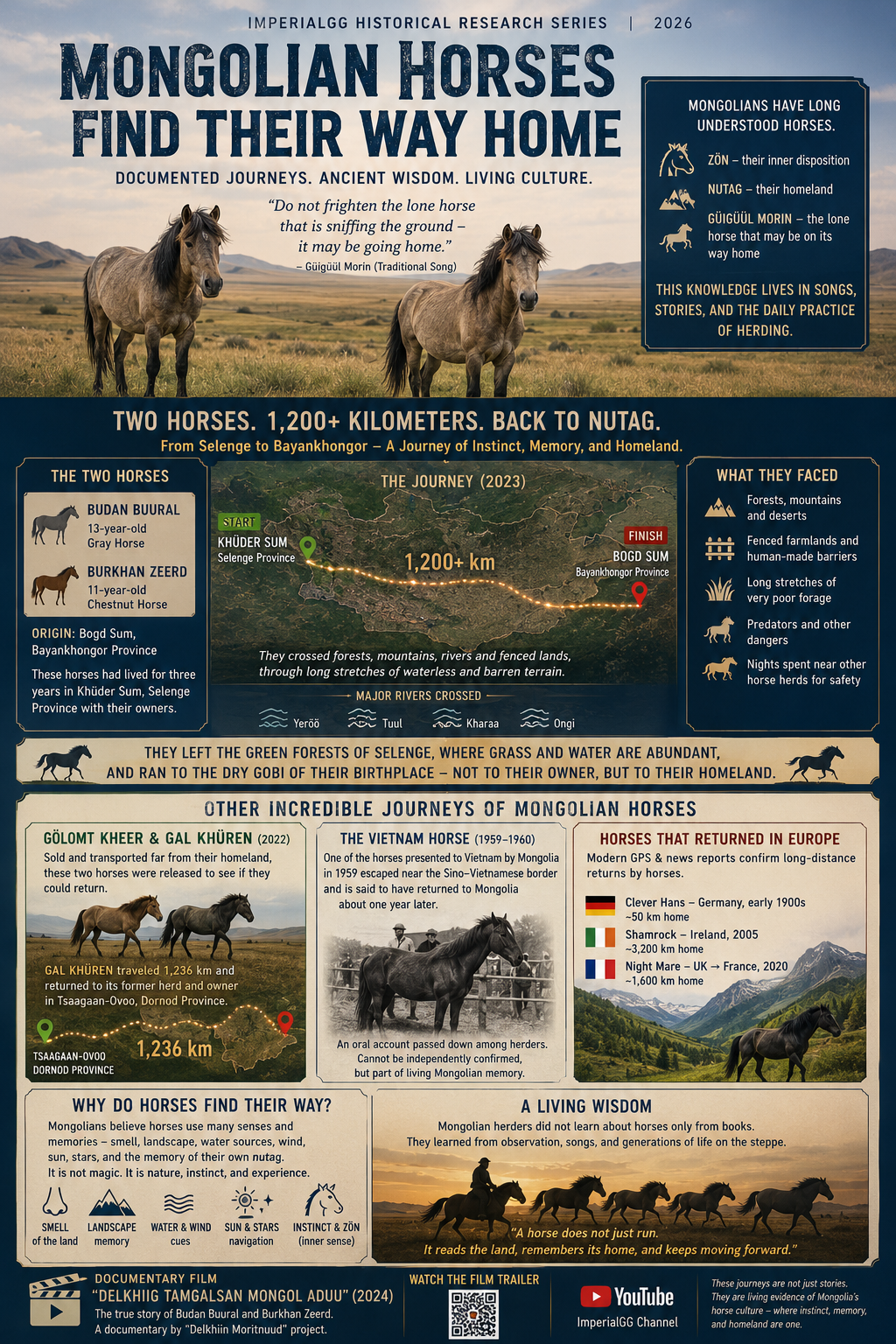
One of the most striking recent attempts to document this question involved two horses moved from Khüder sum of Selenge Province to Bogd sum of Bayankhongor Province, their ancestral home. Their story was subsequently made into the documentary Delkhiig Tamgalsan Mongol Aduu (“The Mongolian Horse That Stamped the World”).
FROM THE FORESTS OF SELENGE TO THE DESERT OF BAYANKHONGOR
The horses came from a family originally belonging to Bogd sum, Bayankhongor Province. The family had moved with its livestock to Khüder sum, Selenge Province, for a three-year period of seasonal migration (otor). The horses therefore did not merely travel temporarily: they had spent years in a completely different ecological environment.
According to project initiator Yu. Unenbüren, four horses had remained with the family after some animals had already been transported back to their original region. Of those four, two repeatedly attempted to return toward Bayankhongor. Local people had apparently become familiar with their behavior and would sometimes catch and tether them when they saw them attempting to leave.[3]
The project team selected these two horses and released them for the journey from Khüder, Selenge Province, to Bogd, Bayankhongor Province.[3]
The 2023 interview identifies them descriptively as:
- a 13-year-old gray horse, and
- an 11-year-old chestnut horse.[4]
The later documentary description gives the horses personal names:
- Budan Buural, and
- Burkhan Zeerd.[5]
This distinction should be preserved in an academic treatment. The 2023 interview provides the ages and coat colors, while the 2024 documentary description provides the names. The sources therefore complement one another rather than being silently merged into a single undifferentiated record.
THE JOURNEY WAS CONDUCTED IN 2023
The expedition belongs to the 2023 phase of the “Delkhiin Moriitnuud” (“World Horsemen”) project.
The project team had already conducted an earlier experiment in 2022, involving the horses Golomt Kheer and Gal Khüren, who were released toward their former home regions after having been transported elsewhere. Those journeys were documented in the film Gaikhamshigt Mongol Aduu (“The Marvelous Mongolian Horse”).[3]
The second project was designed partly because the researchers wanted to know whether the earlier journeys had been exceptional cases or whether the behavior could be observed again.
The 2023 interview explicitly states that the team therefore sought two additional horses and released them from Selenge toward Bayankhongor.[3]
The resulting film, Delkhiig Tamgalsan Mongol Aduu, was published in May 2024, with the available film description specifically identifying Budan Buural and Burkhan Zeerd as the horses that ran from the forested, green environment of Khüder to their home region in the Bayankhongor Gobi.[5]
An important limitation: the sources I found establish the year of the expedition (2023) and the release/publication period of the documentary (2024), but they do not provide a sufficiently reliable exact number of days for the entire journey. An academic article should therefore not invent a travel duration.
THE MOST STRIKING CONTRAST: THEY LEFT GREEN SELENGE FOR THE GOBI
The ecological contrast was extreme.
Khüder sum is described by the project leader as having abundant grass and water—indeed, as one of the most favorable environments in Mongolia.[3]
Their destination, Bogd sum of Bayankhongor, was described in the same interview as a far more arid landscape, with extensive sandy and sparsely vegetated terrain.[3]
This creates one of the most revealing elements of the case. The horses were not apparently choosing the destination because it offered better immediate forage. The project leader’s own interpretation was precisely the opposite: the horses were leaving an exceptionally favorable environment and moving toward a much harsher one because it was their home region.[3]
This is why the case became important to the project’s central question:
Was the horse returning to its owner, to its herd, or to its homeland?
In the first experiment, the horses had been sold and transported away from their former territories. In the second, however, these horses had followed their owners away from their original homeland and later attempted to return without their owners.[3] That difference matters.
THE HORSES DID NOT SIMPLY RUN ACROSS AN EMPTY LANDSCAPE
The journey was not a straight, obstacle-free ride across open steppe. The project team reported that the horses encountered forests, rivers, cultivated land, fences, and long stretches with almost no available vegetation.[3]
They crossed, among other waterways:
- Yeröö River
- Tuul River
- Kharaa River
- Ongi River.[3]
Human-modified landscapes created additional difficulties. In Selenge and Töv provinces, agricultural land had been plowed and fenced. According to the project leader, the horses sometimes entered fenced areas and became unable to find their way out.[3]
This is an important observation. The traditional Mongolian image of a horse moving freely across an open steppe cannot simply be transferred to the modern landscape.
The horse’s environment has changed.
Fences, cultivated fields, roads, settlements, and other human structures can interfere with animal movement. The project therefore provides an unexpected insight:
The difficulty was not necessarily finding a direction. At times, the difficulty was navigating a landscape increasingly modified by humans.
THE TWO HORSES FACED LONG WATERLESS AND BARREN STRETCHES
The project leader described particularly difficult portions of the journey. From Jargalant in Töv Province, the horses crossed approximately 90 kilometers of terrain with virtually no grass. Later, in Övörkhangai Province, they reportedly encountered another stretch of approximately 170–180 kilometers with similarly poor vegetation.[3]
These figures should not be confused with the total length of the journey. They describe specific difficult sections, not the complete Selenge–Bayankhongor distance. That distinction is important because the publicly available interview does not provide a reliable total GPS distance for Budan Buural and Burkhan Zeerd.
THE HORSES WERE NOT ALWAYS ALONE
Another observation from the expedition is particularly relevant to the traditional Mongolian understanding of a horse traveling alone. According to the project leader, the two horses did not simply spend every night isolated from other animals.
They reportedly sought out local herds and spent nights near another family’s stallion or horse group. When predators or other dangers approached, they appeared to move toward other horses.[3] This observation is important because it complicates the image of a horse as a solitary navigator.
A horse traveling toward its former home may simultaneously make use of:
- other horses,
- available water,
- grazing opportunities,
- landscape features,
- human settlements,
- and places of relative safety.
In other words, returning home does not necessarily mean traveling alone. It may mean navigating through a social and ecological landscape.
THE HORSES WERE ALREADY THIN WHEN THEY STARTED
The 2023 interview also records an important methodological difference between the first and second documentary projects. The first two horses had been prepared and conditioned before their journey. Budan Buural and Burkhan Zeerd were not.
The team stated that they had no opportunity to fatten or condition the horses beforehand and released them while they were still grazing normally. The 13-year-old gray and 11-year-old chestnut were therefore described as relatively thin when they began.[4]
This makes the case more difficult to interpret simply as an athletic demonstration. The journey was not a race. The horses were not being trained for a competition. The objective was to observe whether they would actually return to their former homeland.
THE TEAM ALMOST FEARED FOR THEIR LIVES
The journey also involved genuine physical risk. The project leader recalled moments when the team feared that the horses might die, particularly the chestnut horse, because of exhaustion and lack of forage.[3] At some points the team reportedly considered stopping the experiment and transporting the horses back. Instead, the horses continued.
Eventually, both arrived at their destination, and the team later found them in substantially better condition after reaching their home environment.[3]
This point is significant. The documentary should therefore not be reduced to a simplistic story of a horse possessing an extraordinary internal compass. The journey involved:
endurance, environmental adaptation, navigation, social behavior, risk management, and persistent directional movement.
THE MOST IMPORTANT OBSERVATION: THEY WERE NOT RETURNING TO THEIR OWNER
This is perhaps the most important difference between this case and an ordinary story of a lost animal returning home. According to the project leader, the horses had moved away from their owners and toward their original homeland.[3]
The interview therefore gives the project’s conclusion in unusually direct terms:
the horses appeared to be oriented toward their homeland rather than simply toward their owner or former herd.[3]
That conclusion is the project’s interpretation, not an independently demonstrated biological law. But the observation itself is important. The horses had been moved to a distant environment. They had lived there for years. They were not being led home by a rider. They were not being transported. They were released. And they moved toward Bogd sum in Bayankhongor.
“DON’T FRIGHTEN THE LONE HORSE THAT IS SNIFFING THE GROUND”
This modern documentary case gives new significance to an older Mongolian cultural expression.
The song “Güigüül Morin” contains the well-known line:
“Gazar ünerlen … gants moriig bitgii ürgee.”
Literally, the image is of a lone horse moving while “smelling the ground,” accompanied by the warning:
Do not frighten it.
The song continues with the image of a foal sold before birth and leaving its companions to run toward its homeland.[6]
This should not be treated as proof that horses possess a supernatural navigational ability. But culturally, the formulation is remarkable. A lone horse moving purposefully across the landscape is not necessarily interpreted as a lost animal.
It may be:
a horse going home.
The 2023 documentary project provides an unusually concrete modern context in which to reconsider that traditional observation.
“ZÖN”: A MONGOLIAN CONCEPT OF ANIMAL AGENCY
This is where ethnography becomes especially important. Dulam Bumochir, Byambabaatar Ichinkhorloo, and Ariell Ahearn have examined Mongolian pastoral knowledge through concepts including zön, taa, and buyan.[1]
In this framework, animals are not simply passive objects controlled by humans. They possess dispositions, tendencies, and forms of agency that experienced herders observe and work with. The Mongolian pastoral practice of zöngöör n mallakh can be understood as herding in accordance with the animal’s own disposition or inclination.[1]
This does not mean that Mongolian pastoralists traditionally believed horses possessed a literal supernatural GPS.
Rather, it suggests something more subtle:
the horse itself is recognized as an active participant in the pastoral environment. That distinction is crucial.
NUTAG IS MORE THAN A COORDINATE
Research on Mongolian pastoralism similarly demonstrates that nutag cannot be reduced to a point on a modern map. It can refer to a lived environment shared by humans and animals, including familiar grazing territories and places to which animals become accustomed.[2]
This makes the Budan Buural–Burkhan Zeerd journey especially interesting. The horses did not return to the place where they were currently living. They left a relatively favorable environment. They crossed difficult landscapes. They moved through human-modified terrain. And they eventually reached the region identified as their original homeland. Thus, the documentary case fits remarkably well with the cultural concept of nutag as a lived, remembered, multispecies space.
FROM ORAL MEMORY TO DOCUMENTARY EVIDENCE
The Budan Buural and Burkhan Zeerd journey belongs to a much larger Mongolian cultural pattern.
The idea of the güigüül mori—a horse running back toward its homeland—appears in oral accounts, songs, literature, and documentary projects.[7]
Earlier documentary work involved Golomt Kheer and Gal Khüren, horses that were released toward their former home regions after being transported elsewhere. The latter reportedly covered 1,236 kilometers before reaching its former herd and owner in Dornod Province.[8]
The significance of the second experiment was precisely that it attempted to test whether the earlier cases were exceptional. The project leader explained that the team wanted additional evidence rather than relying upon only two horses.[3] That is methodologically important. It does not transform the project into a controlled scientific experiment. But it does create a sequence of documented observational cases.
THE VIETNAM STORY: AN EARLIER ETHNOGRAPHIC LAYER
There is also an older oral account. A 2020 Inner Asia article records a story concerning horses presented to Vietnam during Ho Chi Minh’s 1959 visit to Mongolia. According to the account, one horse escaped near the Sino-Vietnamese border and was said to have returned to Mongolia approximately a year later.[9]
The researchers explicitly caution that the story cannot be independently confirmed or disproved. That is precisely how it should be presented. It is ethnographic testimony, not laboratory evidence.
Yet it is significant because the story belongs to the same cultural category as the modern documentary cases:
a horse transported away → separation from its original environment → movement back toward Mongolia.
THE CULTURAL MEMORY IS OLDER THAN GPS
The importance of the modern documentaries is therefore not that they “prove” an ancient Mongolian belief in one stroke. Their importance is that they provide opportunities to measure and observe a phenomenon that Mongolian pastoral culture had already described in its own vocabulary.
The sequence is striking:
oral knowledge
→ zön
→ nutag
→ güigüül mori
→ songs and stories
→ eyewitness testimony
→ documentary observation
→ GPS and modern tracking technologies.
The uploaded research draft makes the same methodological distinction: traditional Mongolian knowledge and modern measurement should not be treated as mutually exclusive systems; rather, modern technology can document movements that pastoralists had long recognized through observation.
WHAT THE BUDAN BUURAL–BURKHAN ZEERD CASE ACTUALLY SHOWS
It is important not to claim more than the evidence permits.
The case does not scientifically prove that:
- every Mongolian horse can return to its birthplace;
- horses possess a supernatural directional sense;
- horses navigate exclusively by smell;
- Mongolian horses have a unique biological ability found nowhere else;
- or horses possess a literal internal GPS.
Those would require controlled comparative research.
What the documentary evidence does establish is more modest and, in some ways, more interesting:
- Two horses originally associated with Bogd sum, Bayankhongor, spent years in Khüder sum, Selenge.[3]
- Two of four horses in that group were known locally for repeatedly attempting to return toward their former homeland.[3]
- The project released a 13-year-old gray and an 11-year-old chestnut in 2023.[4]
- The later documentary identifies the horses as Budan Buural and Burkhan Zeerd.[5]
- They traveled through forests, rivers, cultivated and fenced landscapes, and extensive areas of poor forage.[3]
- They ultimately reached their former home region in Bogd sum.[3][5]
- Their journey was documented as part of a deliberate documentary project rather than existing only as oral tradition.[3]
That is already a remarkable body of evidence.
THE REAL SCIENTIFIC QUESTION IS STILL OPEN
The project leader himself asked the question that researchers should now take seriously:
How do the horses maintain direction over such distances?[3]
That is the scientific question.
Not:
“Do Mongolians have magical horses?”
But:
WHAT INFORMATION DOES A HORSE USE TO NAVIGATE TOWARD A FORMER HOME RANGE?
Possible mechanisms include:
- visual recognition of landscape;
- olfactory information;
- geomagnetic cues;
- memory of previous routes;
- environmental gradients;
- water systems;
- wind patterns;
- learned spatial associations;
- social interaction with other horses;
- and combinations of these mechanisms.
The present documentary evidence cannot determine which mechanism—or combination of mechanisms—is responsible. That requires controlled ethological and GPS-based research. And that is exactly why these Mongolian cases are worth studying rather than dismissing.
FROM SELENGE TO BAYANKHONGOR: WHY THIS CASE MATTERS
Budan Buural and Burkhan Zeerd did not perform a race. They were not trained athletes. They were not guided by riders. They were not transported toward their destination. They were released from a distant environment in which they had lived for years. And they moved toward the region described as their original homeland.
The journey crossed radically different ecological zones—from the forested, well-watered north toward the dry landscapes of Bayankhongor. The horses encountered rivers, fences, cultivated land, barren stretches and predators. They sometimes sought the protection of other horses. They became exhausted. Yet they continued. And they arrived.
This is precisely the kind of case in which traditional Mongolian knowledge and modern scientific inquiry can meet.
The Mongolian herder says:
“The horse knows its nutag.”
The ethnographer asks:
“What does nutag mean in a multispecies pastoral landscape?”
The ethologist asks:
“What sensory and cognitive mechanisms permit long-distance homing?”
The GPS researcher asks:
“What exact route did the horse take?”
And the documentary filmmaker asks:
“Can we witness the journey ourselves?”
These are not competing questions. They are different approaches to the same phenomenon.
CONCLUSION: THE HORSE DID NOT MERELY RETURN — IT REVEALED A MONGOLIAN IDEA OF HOME
The story of Budan Buural and Burkhan Zeerd is important not because it proves a supernatural theory.
It is important because it connects three different forms of knowledge.
FIRST — PASTORAL KNOWLEDGE.
For generations, Mongolian herders have recognized that animals possess their own dispositions and relationships with familiar landscapes.
SECOND — CULTURAL MEMORY.
That understanding survived in songs, oral histories, poetry and the figure of the güigüül mori.
THIRD — MODERN DOCUMENTATION.
The 2023 Selenge–Bayankhongor expedition deliberately released two horses and recorded their return, producing a documentary that was published in 2024.[3][5]
The strongest conclusion is therefore not:
“Mongolian horses have a mysterious GPS.”
It is this:
Mongolian pastoral culture preserved a sophisticated observation of the horse as an active, environmentally embedded animal with a relationship to its former homeland—and modern documentary work has begun to turn that traditional observation into a question that can be measured scientifically.
And perhaps this is why one old Mongolian line remains so powerful:
“DO NOT FRIGHTEN THE LONE HORSE THAT IS SNIFFING THE GROUND.”
Perhaps the Mongolian herder did not need to know the neurological mechanism behind the horse’s journey. He only needed to recognize what he was seeing: a horse that was not lost. A horse that was going home.
FOOTNOTES
[1] Dulam Bumochir, Byambabaatar Ichinkhorloo, and Ariell Ahearn, “Herd Agency: Rethinking Herd–Herder Relations in Mongolia and Qinghai, China,” Inner Asia 22, no. 2 (2020): 183–198. The study examines Mongolian pastoral concepts including zön and the role of animal agency in herding practice.
[2] Ariell Ahearn et al., Nomadic Pastoralism among the Mongol Herders: Multispecies and Spatial Ethnography in Mongolia and Transbaikalia (Cambridge University Press, 2021), especially the discussion of nutag as a shared human–animal spatial environment.
[3] Yu. Unenbüren, interview, iSee.mn, September 27, 2023. The interview documents the second “Güigüül Morin” project, the horses’ origin in Bogd sum, their three-year relocation to Khüder sum, their repeated attempts to return, the 2023 release, environmental obstacles, rivers crossed, barren stretches, nocturnal association with other horse herds, and eventual arrival in Bayankhongor.
[4] The same 2023 interview identifies the two horses by age and color as a 13-year-old gray and an 11-year-old chestnut. The interview itself does not give their individual names.
[5] The 2024 documentary description identifies the two horses as Budan Buural and Burkhan Zeerd, describing them as horses from Khüder sum, Selenge Province, that ran toward their home in Bogd sum, Bayankhongor Province. The documentary was published May 13, 2024.
[6] The 2023 iSee interview reproduces the Güigüül Morin lyric containing the image of a lone horse “smelling the ground” and the warning not to frighten it. Because this is a reproduced online lyric rather than a verified archival edition, it should be treated as a cultural-text source rather than an authoritative critical edition.
[7] Dulam Bumochir, “The Animalification of Nationalist Sentiments: Horse, Herder and Homeland Relations in the Construction of Nationalism in Mongolia,” Acta Mongolica 21 (541) (2023): 127–146. The study examines Mongolian cultural representations of horses, homeland, return, stories, poetry and film. The uploaded research draft also summarizes this cultural continuity.
[8] The earlier documentary project involved Golomt Kheer and Gal Khüren. The 2023 interview states that the horses were released toward their former regions and that they traveled more than 1,000 km; separate reporting gives Gal Khüren’s journey as 1,236 km to Tsaгаан-Овоо, Dornod Province, where it rejoined its former herd.
[9] Bumochir, Ichinkhorloo & Ahearn, Inner Asia 22, no. 2 (2020), discussing an account based on S. Dulam’s earlier work: a horse presented to Vietnam in 1959 reportedly escaped near the Sino-Vietnamese border and returned to Mongolia approximately one year later. The authors explicitly note that the account cannot be independently confirmed or disproved. The distinction between oral testimony and independently verified evidence is essential.
[10] The 2023 expedition should not be assigned an exact total travel distance or exact number of travel days unless the documentary’s full production records or GPS logs establish them. The published interview provides specific difficult sections—approximately 90 km without meaningful forage and another 170–180 km of similarly poor terrain—but these are not the total journey distance.
SOURCE-CRITICAL NOTE
The strongest evidence in this case is not all of one type. The 2023 interview is a contemporary project account; the 2024 documentary description supplies the horses’ names; the ethnographic literature supplies the concepts of zön and nutag; and the traditional song provides cultural memory. None of these, alone, proves a biological mechanism for long-distance homing. The academically defensible conclusion is narrower: the Selenge–Bayankhongor case documents a deliberate modern observation of two horses returning to a former homeland, within a cultural tradition that has long recognized such behavior.