KHABUL KHAN’S MONGOL STATE
By Altanbagana Baatar
DBA Candidate| Independent Historian
ImperialGG Historical Research Seriers
31 August 2026
THE MONGOL KINGDOM BEFORE CHINGGIS KHAN
INTRODUCTION: THE MONGOL STATE DID NOT BEGIN IN 1206
The history of the Mongol state is often presented as beginning in 1206, when Temüjin was proclaimed Chinggis Khan at a great assembly. That year was undoubtedly a decisive turning point. Yet it should not be mistaken for the absolute beginning of Mongol statehood.
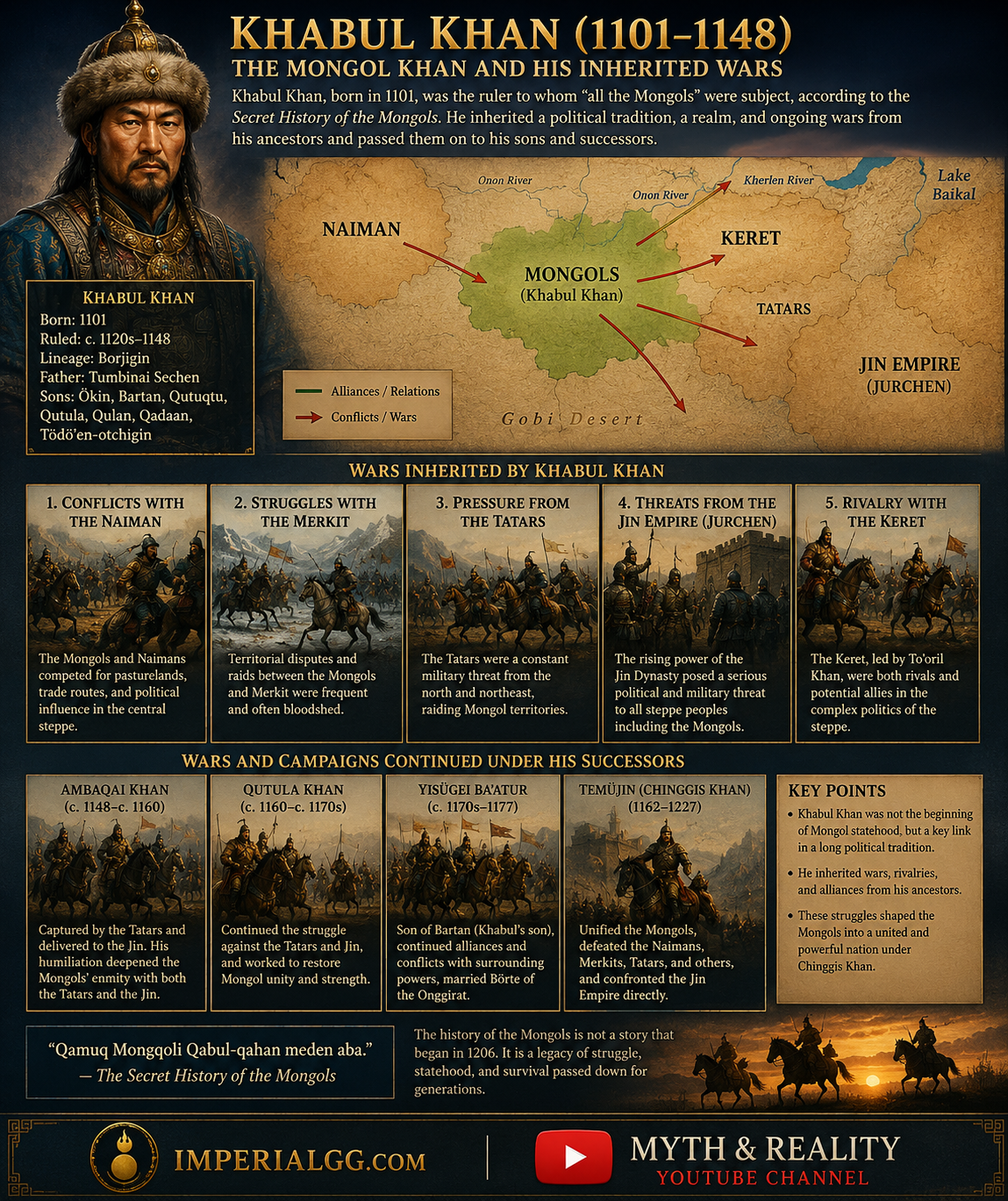
Long before 1206, the sources preserve the memory of Khabul Khan, a ruler who stood at the head of the Mongols in the first half of the twelfth century. Khabul is traditionally dated to 1101–1148, although the precise chronology of his life remains difficult to establish from the surviving sources.
The Secret History of the Mongols explicitly states:
“Qamuq Mongqoli Qabul-qahan meden aba.”
That is, “Qabul Qahan ruled over all the Mongols.” This statement is fundamental. It means that the political history of the Mongols cannot responsibly be reduced to the claim that a Mongol state suddenly appeared in 1206. Rather, 1206 should be understood as a moment of transformation and imperial expansion built upon an earlier Mongol political tradition.
WHO WAS KHABUL KHAN?
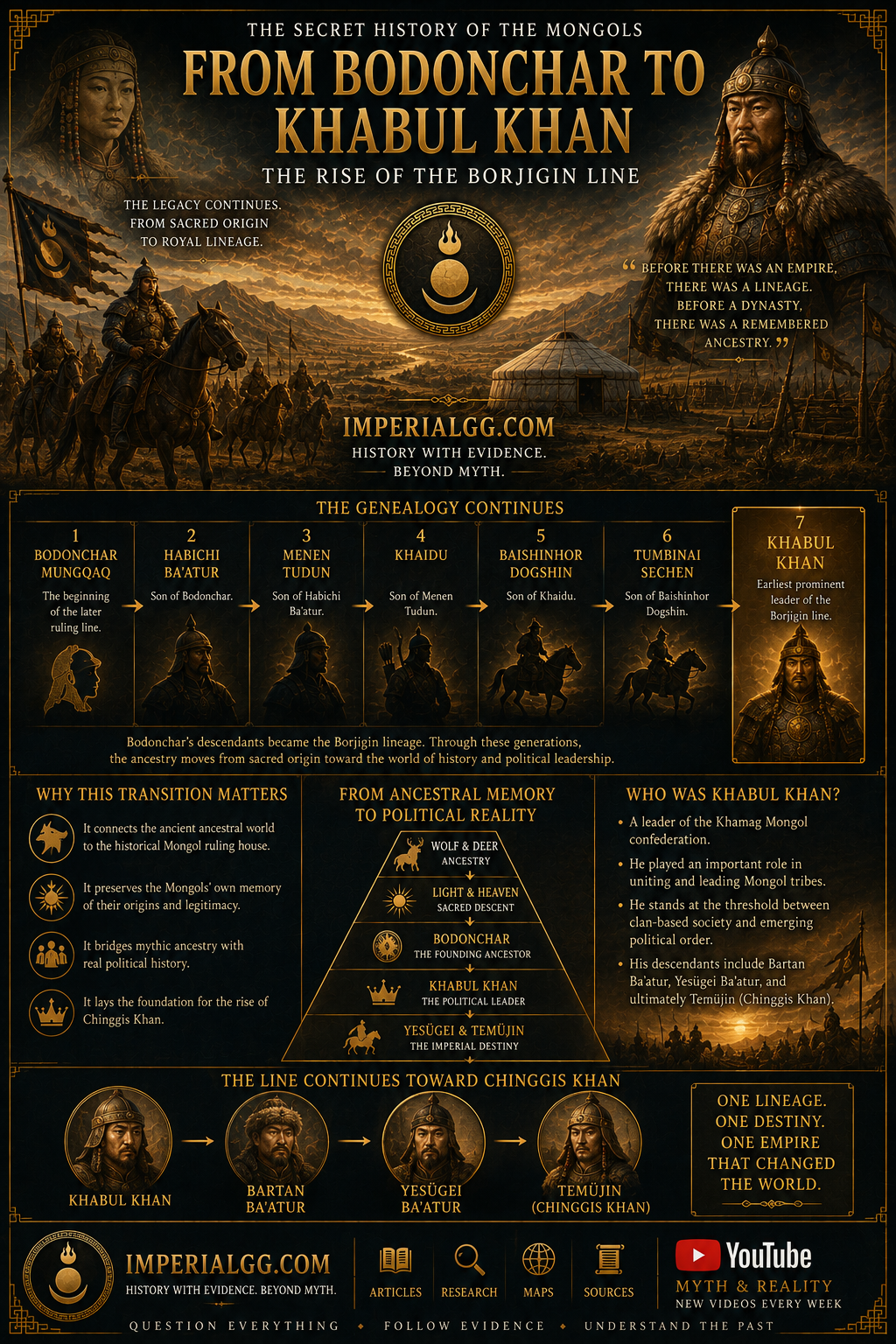
Khabul Khan belonged to the Borjigin lineage and was the son of Tumbinai-sechin. The Secret History of the Mongols records seven sons of Khabul:
- Ökin-barqaq
- Bartan-ba’atur
- Qutuqtu-mönggür
- Qutula Qahan
- Qulan
- Qada’an
- Tödö’en-otchigin.
Among these descendants was Bartan-ba’atur, whose son was Yisügei-ba’atur, the father of Temüjin. Thus Khabul was not merely a remote genealogical ancestor of Chinggis Khan. He belonged to the generation in which the political identity of the Mongols was already being organized around a khan and a wider political community.
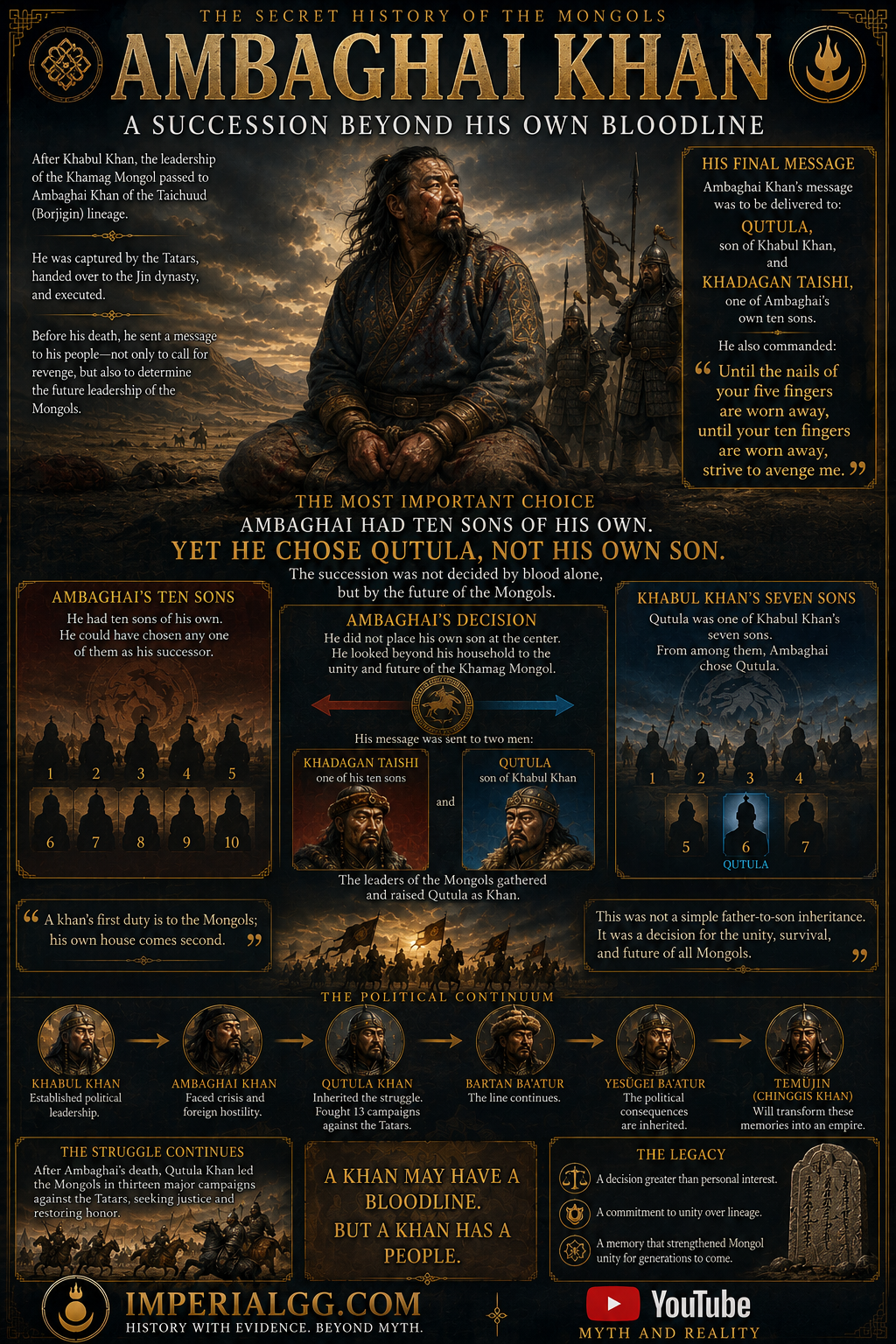
The Secret History gives the succession a particularly important form. Khabul had seven sons, yet Ambaqai, the son of Senggüm-bilge, succeeded him by Khabul’s own decision. This is significant because it shows that succession was not simply an automatic father-to-son inheritance. The authority of the khan was embedded in a broader political order.
“ALL THE MONGOLS” — NOT SIMPLY ONE CLAN
The expression Qamuq Mongqol, literally “all the Mongols,” is central to understanding the political world described by the Secret History. The text does not say merely that Khabul ruled his own household or one small lineage. It says that he ruled all the Mongols.
The following succession of Ambaqai and Qutula continues this political terminology. A scholarly study of the passage notes that the text describes Khabul as ruling all the Mongols, Ambaqai as succeeding him, and later the Mongols and Taichi’ut gathering at Qorqonaq Valley to make Qutula khan.
This provides evidence for a pre-Chinggis Mongol khanate with a political center, a recognized khan, a body of followers, military power, and mechanisms through which supreme leadership was determined. Therefore, the political history of the Mongols before 1206 should not be dismissed as nothing more than an unstructured collection of tribes.
THE MONGOL KINGDOM AND THE POLITICAL WORLD AROUND IT
The Mongol polity did not exist in isolation. It was part of a complex Inner Asian political system in which several powerful kingdoms existed simultaneously. To the west and southwest were the Naiman and Kereit kingdoms. To the north and northeast were the Merkit and other powerful peoples. To the east and southeast were the Tatars and the growing influence of the Jin dynasty. These were not simply “tribes” in the modern sense. The Kereit had their own khan, To’oril, later famous as Wang Khan.
The Naiman had their own khan, Tayang Khan. The Mongols had their own khans. These rulers commanded military forces, exercised authority over territories and dependent populations, made alliances, fought wars, exchanged envoys and entered into political marriages. The political map of twelfth-century Inner Asia was therefore not a world without states. It was a world of competing khanates and kingdoms.
THE KEREIT KINGDOM
The Kereit kingdom represents one of the clearest examples. Its ruler To’oril Khan, later known in Chinese and Mongolian sources as Wang Khan, was not merely a tribal elder. He ruled the Kereit and their subjects and possessed an independent political and military base.
Christopher Atwood’s work on early Mongol political organization specifically treats To’oril as a khan who ruled the Kereit and their subjects, placing him within the wider system of khanly authority that also included Khabul, Ambaqai and Qutula. The later relationship between To’oril and Temüjin therefore needs to be understood as a relationship between major political powers—not simply as a quarrel between neighboring clans.
THE NAIMAN KINGDOM
The same principle applies to the Naiman, the end of the twelfth century, the Naiman constituted one of the strongest political powers of Inner Asia. Their ruler Tayang Khan possessed his own court, military forces, territory and political following. When Temüjin eventually confronted the Naiman, the conflict was not merely an internal Mongol dispute.
It was the conquest of a major neighboring kingdom. The incorporation of the Naiman into the expanding Mongol Empire therefore represented a transformation of the political map of Inner Asia.
THE MERKITS
The Merkit likewise occupied an important political position in the northern steppe and forest-steppe world. Their conflict with the Mongols was deeply connected with the history of Ö’elün and Börte and with the early political career of Temüjin. The struggle between the Mongols and Merkit should therefore not be reduced to a simple clan feud.
It involved territory, political authority, military power, marriage alliances, revenge, captives and shifting alliances. The Mongol conquest of the Merkit was part of the wider process through which Temüjin transformed a fragmented political landscape into a centralized empire.
KHAN, ARMY, TERRITORY AND POLITICAL AUTHORITY
The twelfth-century Mongol state should not be measured by the institutional standards of a modern nation-state. There were no modern ministries, constitutional borders or bureaucratic nation-state institutions. But that does not mean that state organization was absent.
A medieval Inner Asian khanate could possess:
- a khan as supreme ruler;
- a recognized ruling lineage;
- a military organization;
- territorial authority;
- dependent populations;
- diplomatic relations;
- systems of alliance and submission;
- mechanisms of succession;
- the ability to wage war and conclude peace.
Khabul’s Mongolia fits into this political environment. The Kereit kingdom fits into it. The Naiman kingdom fits into it. The Merkit political order also belongs to this world. The correct comparison is therefore not:
“modern state versus primitive tribe.”
It is:
“different forms of medieval state organization within Inner Asia.”
THE QURULTAI AND THE CHOICE OF A KHAN
One of the most important features of Mongol political culture was collective political deliberation among the ruling elite. The later institution known as the qurultai played an important role in the selection or enthronement of khans and in major political decisions. It should not be mechanically equated with a modern parliament. Nevertheless, it demonstrates that the khan’s authority existed within a wider political structure involving other powerful members of the ruling elite.
The succession from Khabul to Ambaqai is especially important. Khabul had seven sons, yet Ambaqai was selected as his successor. Later, after Ambaqai’s death, the Mongols and Taichi’ut gathered at Qorqonaq Valley and made Qutula khan. Thus the political system could accommodate collective recognition and selection of supreme leadership. This tradition would later become particularly visible in the elevation of Temüjin in 1206.
KHABUL AND THE JIN DYNASTY
Khabul’s political significance becomes even clearer when his relations with the Jin dynasty are considered. The Jurchens established the Jin dynasty in 1115 and rapidly became the dominant power over northern China and Manchuria. The Mongols lived directly within this geopolitical environment.
Khabul’s conflicts with the Jurchens and the Jin are preserved in later historical traditions, while Chinese sources independently preserve Khabul under the transcription Gebulühan (葛不律寒). This independent Chinese record is important. Khabul was therefore not merely a figure created in a much later Mongol genealogical tradition. His name and political position also entered the Chinese dynastic record.
AMBAQAI KHAN AND THE DEFENSE OF MONGOL POLITICAL AUTONOMY
After Khabul came Ambaqai Khan.
The Secret History of the Mongols explicitly continues the political succession and describes Ambaqai as ruler of all the Mongols. His capture by the Tatars and subsequent delivery to the Jin court became one of the foundational memories of Mongol resistance to the Jin-Tatar political order. This episode also demonstrates something crucial:
The Mongols were already acting as a political community whose khan could become the object of interstate manipulation and conflict.
The issue was no longer merely the rivalry of individual families. It involved the political survival of the Mongol kingdom.
QUTULA KHAN AND THE CONTINUITY OF THE KHANATE
Following Ambaqai, Qutula Khan continued the line of Mongol khans.
The Secret History records that the Mongols and Taichi’ut gathered together and made Qutula khan.
This sequence is crucial:
Khabul Khan
↓
Ambaqai Khan
↓
Qutula Khan
↓
Temüjin / Chinggis Khan
This is not the genealogy of a single family alone.
It is the succession of a political institution.
The office of khan survived the death of individual rulers.
The political community survived changes in leadership.
And the Mongol polity continued to exist within a hostile Inner Asian environment.
1206: FOUNDATION OR TRANSFORMATION?
This leads to the central historical question. What happened in 1206?
The answer should not be:
“The Mongol state was created from nothing.”
Temüjin inherited an older political tradition. But neither should we say that the 1206 state was simply identical to Khabul’s polity.
Temüjin fundamentally transformed the political order.
He:
- united previously competing Mongol groups;
- defeated or incorporated neighboring kingdoms;
- reorganized the military;
- weakened older clan-based political structures;
- centralized authority;
- established a new imperial hierarchy;
- and created the institutional foundation for an empire extending far beyond the Mongolian Plateau.
Thus 1206 was both continuity and revolution. The earlier Mongol khanate provided historical and political foundations. Temüjin transformed those foundations into the Great Mongol State and, subsequently, the Mongol Empire.
CONCLUSION: BEFORE THE EMPIRE, THERE WAS A MONGOL KHANATE
The historical significance of Khabul Khan should therefore not be reduced to the fact that he was Chinggis Khan’s ancestor.
He was remembered as the ruler who:
ruled all the Mongols, possessed supreme khanly authority, stood within an established political succession, commanded military power,and confronted the major powers of Inner Asia.
Around the Mongols existed other independent kingdoms:
Kereit — To’oril Khan
Naiman — Tayang Khan
Merkit — Togta Behi
Jin — the Jurchen imperial state
and numerous other political communities.
These powers did not simply exist as “tribes” waiting for modern states to emerge. They formed a complex Inner Asian interstate world in which war, diplomacy, marriage, allegiance, tribute, succession and military power determined political survival. The Mongol Empire of Chinggis Khan therefore emerged from this world. It did not emerge from a political vacuum. The historical sequence is better understood as:
KHABUL KHAN’S MONGOL STATE
↓
AMBAQAI KHAN
↓
QUTULA KHAN
↓
TEMÜJIN’S REUNIFICATION
↓
1206 — THE GREAT MONGOL STATE
↓
THE MONGOL EMPIRE
1206 was not the birth of Mongol political identity. It was the moment when an existing Mongol political tradition was transformed into an imperial system of unprecedented scale.
ACADEMIC NOTES
[1] The Secret History of the Mongols, §§48–53. The genealogy identifies Tumbinai-sechin’s son as Qabul Qahan and lists his seven sons.
[2] The Secret History states: “Qamuq Mongqoli Qabul-qahan meden aba” — “Qabul Qahan ruled over all the Mongols.” The following passage describes Ambaqai’s succession.
[3] The dating 1101–1148 is found in several modern reference traditions, while other scholarly/reference sources give approximately 1100–1148. Because the surviving contemporary evidence does not establish a precise birth year, 1101 should be presented as a traditional/commonly cited date rather than an absolutely certain date.
[4] The Secret History records Qutula’s enthronement after the gathering of the Mongols and Taichi’ut at Qorqonaq Valley.
[5] Christopher P. Atwood’s work on early Mongol political organization discusses the meaning and political function of the title khan and places Khabul, Ambaqai, Qutula and To’oril within the pre-imperial political order.
[6] The Chinese textual tradition preserves Khabul under the name 葛不律寒 (Gebulühan) and records that he succeeded Tumbinai.
[7] The terms Mongol, Kereit, Naiman, Merkit, Tatar and Jin refer here to historical peoples and political formations of medieval Inner Asia. They should not be retroactively equated with modern national identities or modern state borders.
[8] “Mongol State” and “Mongol Kingdom” are analytical English designations used in this article to describe the political formation ruled by Khabul and his successors. They do not claim that the polity possessed the constitutional form of the modern state of Mongolia.
[9] The argument for political continuity from Khabul to 1206 is an historical interpretation based on the documented succession of Mongol khans and the political structures described in the surviving sources. It does not imply that every institution of Khabul’s period remained unchanged under Chinggis Khan.
[10] The distinction between Khamag Mongol as a source-term and “Mongol State” as an analytical designation should be maintained throughout the series. The primary source’s wording “all the Mongols” is retained where the text itself warrants it.