
THE DEATH OF CHINGIS KHAN
By Altanbagana Baatar
DBA Candidate| Independent Historian
ImperialGG Historical Research Seriers
20 November 2026
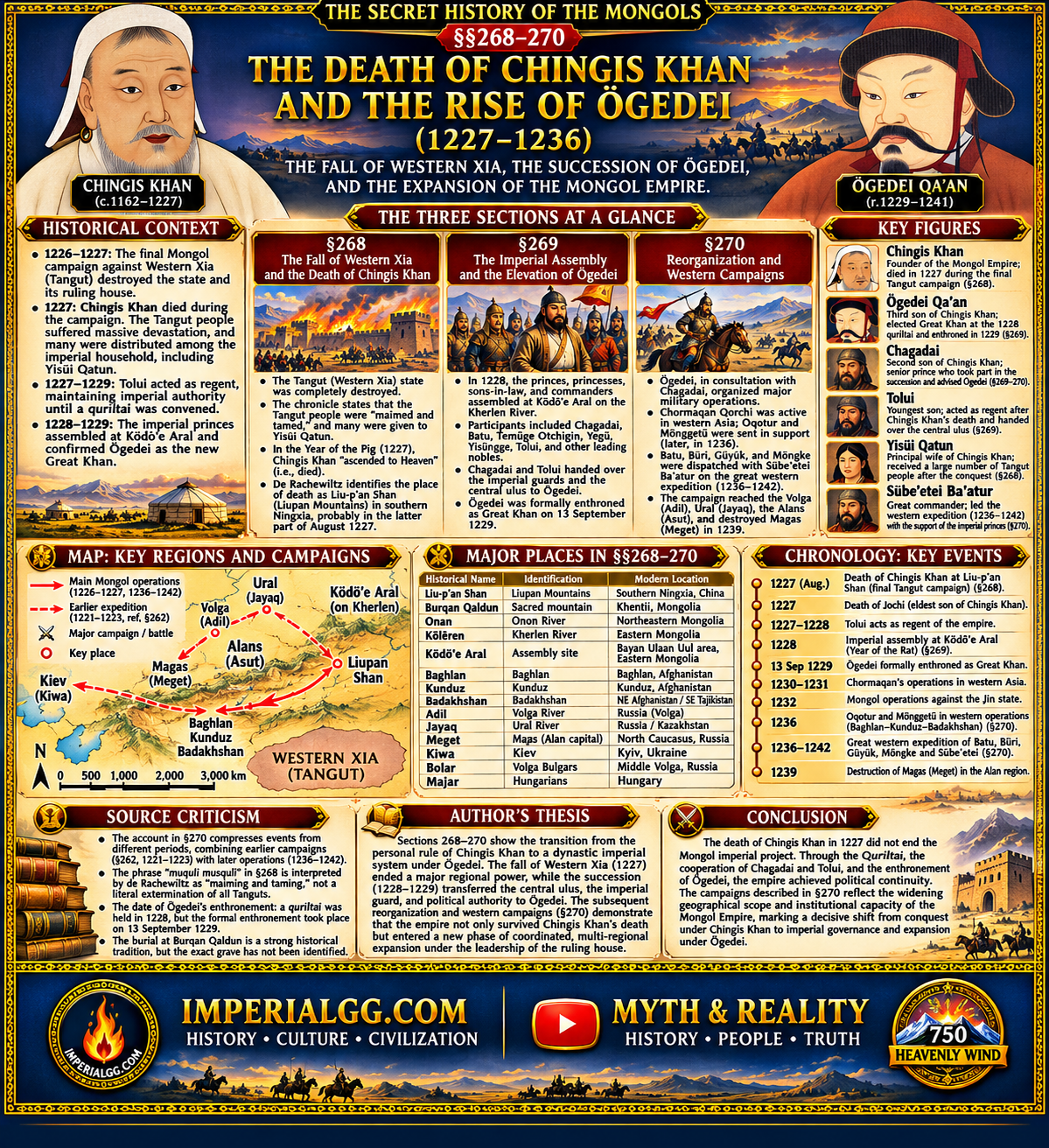
THE SUCCESSION OF ÖGEDEI, AND THE REORGANIZATION OF THE MONGOL EMPIRE (1227–1236)
ABSTRACT
Sections 268–270 of The Secret History of the Mongols form a transition between the death of Chingis Khan and the consolidation of imperial authority under his successor, Ögedei Qa’an. They preserve three distinct but interconnected historical developments: the final destruction of the Tangut state and the death of Chingis Khan in 1227; the assembly of the Mongol imperial princes at Ködö’e Aral and the succession of Ögedei in 1228–1229; and the reorganization of Mongol military operations in western Asia and Eastern Europe, including the campaigns associated with Chormaqan Qorchi and Sübe’etei Ba’atur.
The final section of the Tangut campaign is particularly important because the Secret History uses a striking expression to describe the destruction of the Tangut population, while also recording the allocation of a substantial number of Tanguts to Yisüi Qatun. The chronicle then states that Chingis Khan “ascended to Heaven” in the Year of the Pig, corresponding to 1227. De Rachewiltz argues that Chingis Khan died at Liu-p’an Shan, in modern southern Ningxia, in the latter part of August 1227, and that his body was subsequently transported to Mongolia for burial. The exact cause of death remains uncertain.
Section 269 records the assembly at Ködö’e Aral on the Kelüren River, where the imperial princes, princesses, sons-in-law, and military commanders gathered to establish the succession. The section names Chagadai, Batu, the princes of the right hand, the princes of the left hand, and Tolui, who was acting as regent. The text states that Ögedei was raised to the throne in accordance with Chingis Khan’s prior designation. However, comparative evidence indicates that the assembly was convened in 1228 and that the formal enthronement took place on 13 September 1229.
Section 270 introduces the military and administrative developments of Ögedei’s reign. It records the appointment of Oqotur and Mönggetü to support Chormaqan Qorchi in western Asia, as well as the dispatch of Batu, Büri, Güyük, and Möngke in support of Sübe’etei Ba’atur. De Rachewiltz demonstrates that the chronicle has compressed events from different campaigns. The operations against the Caliphate of Baghdad and the campaigns of Sübe’etei in the west belong to different chronological contexts, while the great western expedition of 1236–1242 is presented through material that also recalls the earlier expedition of 1221–1223.
This study argues that §§268–270 should be understood as an account of the transition from the personal rule of Chingis Khan to a more territorially extensive imperial system under Ögedei. The succession was not merely a family matter: it involved the transfer of the central ulus, the imperial bodyguard, and the political authority required to coordinate military operations across Eurasia.
1. INTRODUCTION: THE HISTORICAL AND TEXTUAL SIGNIFICANCE OF §§268–270
The death of Chingis Khan in 1227 created a political situation that had no exact precedent in the newly established Mongol Empire. During his lifetime, the Great Khan had united the Mongolian tribes, defeated major neighbouring states, and established an imperial structure extending from northern China to Central Asia. His death did not automatically determine how this enormous political and military system would be governed.
The succession had already been discussed during Chingis Khan’s lifetime. In §255 of The Secret History of the Mongols, Ögedei had been designated as the intended successor. Nevertheless, the designation did not eliminate the need for an imperial assembly or the participation of the other branches of the ruling family. The death of Jochi in 1227 further complicated the political balance among the sons of Chingis Khan.
Sections 268–270 are therefore important for understanding how the Mongol ruling elite managed the transition. Section 268 closes the account of Chingis Khan’s final campaign against Western Xia. Section 269 describes the gathering of the imperial family and the elevation of Ögedei. Section 270 moves beyond the immediate succession and presents the expansion and organization of military operations under the new ruler.
The text must, however, be treated critically. De Rachewiltz considers the entire section on Ögedei, §§269–281, to be a later addition or interpolation in the historical composition of the Secret History. This is part of a wider debate about the date and editorial history of the chronicle. Christopher P. Atwood, for example, challenges the view that the text is simply a collection of additions and argues for a more unified interpretation of its political and historical composition. The question remains debated, and the present article does not treat the textual structure as settled.
THE SECRET HISTORY+2
2. SECTION 268: THE FINAL DESTRUCTION OF THE TANGUT STATE AND THE DEATH OF CHINGIS KHAN
2.1 THE DESTRUCTION OF THE TANGUT POPULATION
Section 268 begins by describing the final destruction of the Tangut people. The text uses the expression muquli musquli, a difficult phrase whose precise meaning was no longer understood by some early translators.
De Rachewiltz examines the linguistic evidence and argues that the expression conveys the idea of “maiming and taming” or “maiming and coercing.” He connects the first element with the Mongolian verb muqu- and the second with musqu-, associated with twisting, coercion, or subjugation. The Chinese sectional summary, however, gives the general sense of annihilation or complete destruction.¹
THE SECRET HISTORY
This difference in interpretation is significant. The chronicle’s wording should not be treated as a simple statement that every Tangut person was physically killed. Its expression may refer to the destruction, coercion, and subjugation of the population as a whole. The passage must be read alongside the preceding sections, which describe the killing of the military elite, the capture of ordinary people, and the distribution of conquered populations among the Mongol ruling family and commanders.
The historical context also matters. The Mongol campaign of 1226–1227 had destroyed the military and political independence of Western Xia. The principal cities and defensive centres had fallen, the ruling authority had been forced into submission, and the Tangut state could no longer function as an independent power.
The Secret History presents this destruction in the language of total victory. Yet the historian must distinguish the rhetoric of conquest from the demographic reality. The Tangut population did not disappear entirely. Tangut communities, descendants, and cultural traditions continued to exist under Mongol rule, and Tangut documents and material culture survived beyond the fall of the dynasty.
Figure 1. Tangut manuscripts, inscriptions, and archaeological remains. Their survival demonstrates that the destruction of the Tangut state did not mean the disappearance of all Tangut cultural and linguistic communities.
2.2 THE ALLOCATION OF TANGUT PEOPLE TO YISÜI QATUN
Immediately after describing the destruction of the Tangut people, §268 records that many Tanguts were given to Yisüi Qatun.
This is a significant continuation of the distribution practices described in the earlier sections. Conquered populations were not only treated as prisoners or spoils of war; they could be allocated to members of the ruling family and incorporated into the economic and political organization of the empire.
Yisüi Qatun had accompanied Chingis Khan during the final Tangut campaign. Her role in §265 was also important when she informed the princes and commanders of the Great Khan’s illness after his fall from his horse.
The allocation of Tangut people to Yisüi Qatun therefore connects the final campaign with the political and economic privileges of the imperial household. De Rachewiltz refers to scholarship on the distribution of conquered peoples and their territories among the Mongol princes and princesses, and specifically to Yisüi’s apanage.²
THE SECRET HISTORY
The word apanage is useful here because it describes the allocation of resources, populations, and rights to members of the ruling dynasty. However, it should not be assumed that every person assigned to Yisüi became a household servant in the same legal or social condition. The exact organization of the group is not fully described in §268.
2.3 THE DEATH OF CHINGIS KHAN IN THE YEAR OF THE PIG
The final sentence of §268 records: “In the Year of the Pig, he ascended to Heaven.”
— The Secret History of the Mongols, §268, trans. Igor de Rachewiltz.³
THE SECRET HISTORY
The Year of the Pig corresponds to 1227.
The phrase “ascended to Heaven” is the chronicle’s conventional and ideologically significant expression for the death of Chingis Khan. It does not provide a medical description of his death, nor does it specify the exact day.
The expression reflects the political and religious language through which the Mongol court represented the death of its ruler. Chingis Khan was not simply described as having died; his death was framed as an ascent to Heaven, consistent with the chronicle’s wider conception of Eternal Heaven as the source of imperial legitimacy.
2.4 THE PLACE OF DEATH: LIU-P’AN SHAN
The Secret History does not name the precise location where Chingis Khan died in §268.
De Rachewiltz identifies the place as Liu-p’an Shan (六盤山), in modern southern Ningxia, northwestern China. He places the death in the latter part of August 1227.⁴
THE SECRET HISTORY
Figure 2. The Liupan Mountains in southern Ningxia, the location identified by de Rachewiltz for the death of Chingis Khan.
The identification of Liu-p’an Shan is important because it places the death within the geographical setting of the final Tangut campaign. It also demonstrates that Chingis Khan had not returned to Mongolia before his death, despite the narrative wording in the Secret History that he “came back.”
De Rachewiltz argues that the chronicle’s expression of return was probably intended to present Chingis Khan as returning home victoriously. In historical terms, however, the war against Western Xia had not yet fully concluded when he died.⁵
THE SECRET HISTORY
2.5 THE CAUSE OF DEATH: WHAT CAN BE ESTABLISHED?
The cause of Chingis Khan’s death remains uncertain.
De Rachewiltz considers it possible that internal injuries caused by the fall from his horse in 1225, combined with the physical strain of the military operations, contributed to his death.⁶
THE SECRET HISTORY
This interpretation must be treated as a hypothesis rather than a proven medical diagnosis.
The Secret History records the fall from Josotu Boro, the subsequent pain and fever, and the continuation of the campaign. It does not establish that the injury directly caused his death nearly two years later.
Other historical traditions offer different explanations, but their reliability varies. The accounts of Chingis Khan’s death in later Persian and European narratives should therefore be compared rather than combined into a single unverified explanation.
The most defensible historical statement is that Chingis Khan died in 1227, probably in the latter part of August, in the region of Liu-p’an Shan during the final Tangut campaign. The precise medical cause cannot be established from the surviving evidence.
2.6 THE BODY AND THE BURIAL TRADITION
De Rachewiltz states that Chingis Khan’s body was transported to Mongolia and buried on Burqan Qaldun, near the sources of the Onon and Kelüren rivers.⁷
THE SECRET HISTORY
Figure 3. Burqan Qaldun and the upper river landscapes of northeastern Mongolia.
Burqan Qaldun was already central to the political and spiritual history of Chingis Khan. In the earlier chapters of the Secret History, the mountain is associated with his survival, his reverence for the landscape, and the origins of his political authority.
The burial tradition therefore connects the death of Chingis Khan with the sacred geography of his homeland.
Nevertheless, the exact burial site has not been archaeologically established. Burqan Qaldun is an important historical and traditional identification, but the location of the grave itself remains unknown.
This distinction is essential: the historical tradition of burial at Burqan Qaldun should not be presented as an excavated and verified tomb.
3. SECTION 269: THE IMPERIAL ASSEMBLY AT KÖDÖ’E ARAL AND THE SUCCESSION OF ÖGEDEI
3.1 THE POLITICAL SITUATION AFTER THE DEATH OF CHINGIS KHAN
The death of Chingis Khan in 1227 created a succession problem that had to be resolved through the participation of the ruling family and the principal commanders of the empire.
Although Chingis Khan had previously designated Ögedei as his successor, the empire was not governed by an automatic system of hereditary succession in which the eldest surviving son necessarily became Great Khan.
The Mongol ruling house contained several politically powerful branches, each with its own military following, territorial interests, and senior members. The death of Jochi in 1227 was particularly important because it removed the eldest son of Chingis Khan from the succession debate.
The four principal sons were:
Jochi, the eldest son, who died in 1227.
Chagadai, the second son.
Ögedei, the third son and designated successor.
Tolui, the youngest son, who inherited the central family territory and acted as regent after Chingis Khan’s death.
The political problem was therefore not simply to identify the successor. It was to obtain the agreement of the major branches of the imperial family and transfer the institutions necessary for governing the empire.
3.2 THE DEATH OF JOCHI AND ITS CONSEQUENCES
Jochi’s death in 1227 preceded the formal enthronement of Ögedei.
His death had important consequences for the political organization of the empire because his descendants continued to possess a major territorial and military base in the western steppe.
The Secret History identifies Batu, Jochi’s second son, among the princes of the right hand who attended the imperial assembly.
Batu’s presence was significant because he represented the Jochid branch of the ruling family. Although Jochi himself was absent, his descendants retained a place in the imperial political structure.
The later role of Batu in the western campaign would demonstrate the growing importance of the Jochid territories in the expansion of the empire.
3.3 KÖDÖ’E ARAL: THE PLACE OF THE IMPERIAL ASSEMBLY
Section 269 states that the princes, princesses, sons-in-law, and military commanders assembled at Ködö’e Aral on the Kelüren River.
The Kelüren is the modern Kherlen River, which flows through eastern Mongolia.
Figure 4. The Kherlen River and the eastern Mongolian steppe associated with the imperial assembly.
The place name Ködö’e Aral is also written in different transliteration systems as Ködö’e Aral or Köde’ü-aral.
Urgunge Onon’s translation identifies the modern name of the location as Bayan Ulan Uul, meaning “Rich Red Mountain,” and associates it with the eastern Mongolian landscape.⁸
jigjids.wordpress.com
The location is important because it was not a random meeting place. It belonged to the political and geographical heartland of the Mongol ruling family.
The assembly brought together the representatives of the major branches of the imperial family and the commanders responsible for the military organization of the empire.
3.4 THE PARTICIPANTS: THE PRINCES OF THE RIGHT HAND, LEFT HAND, AND CENTRE
The chronicle describes three major political groupings.
The princes of the right hand
These included Chagadai, Batu, and the other princes associated with the right-hand division.
Chagadai was the second son of Chingis Khan and the senior surviving brother of Ögedei. Batu represented the Jochid branch.
The princes of the left hand
These included Temüge Otchigin, Yegü, Yisüngge, and other princes associated with the left-hand division.
Temüge Otchigin was Chingis Khan’s youngest brother and an important member of the ruling family.
The princes of the centre
These included Tolui and the representatives of the central family territory.
Tolui had an especially important political position because he was the youngest son of Chingis Khan and had been entrusted with the central ulus.
The assembly also included princesses, sons-in-law, and commanders of the ten-thousand and thousand households.
This broad participation demonstrates that the succession was not merely a private decision among the four sons. It involved the wider imperial elite.
3.5 THE POLITICAL POSITION OF CHAGADAI
Chagadai’s participation deserves particular attention.
As the eldest surviving son after Jochi’s death, he possessed seniority within the ruling family. His political position was therefore stronger than that of Ögedei in terms of age and dynastic precedence.
However, Chingis Khan had already designated Ögedei as his successor in §255.
The Secret History therefore presents the succession as the fulfilment of the Great Khan’s prior decision, while also recording the participation of Chagadai and the other princes.
De Rachewiltz notes that Chinese sources indicate disagreement among the branches of the ruling family during the succession process. The supporters of Chagadai, Tolui, and Ögedei did not necessarily share the same political preferences.⁹
THE SECRET HISTORY
The eventual selection of Ögedei was therefore not simply a formal recognition of an uncontested decision. It was the result of a political process involving dynastic seniority, the designation of Chingis Khan, and the agreement of the imperial elite.
3.6 TOLUI AS REGENT AND THE TRANSFER OF IMPERIAL AUTHORITY
After Chingis Khan’s death, Tolui acted as regent of the empire.
This position was connected with his responsibility for the central family territory and the institutions that had been directly associated with Chingis Khan.
The Secret History records that after Ögedei’s elevation, Chagadai and Tolui handed over the imperial guards and the central ulus to him.
The transfer included:
The night guards.
The quiver-bearers.
The sentries.
The ten-thousand personal guards who had served Chingis Khan.
The central territory and population of the empire.
This is a particularly important passage because it demonstrates that the succession involved the transfer of concrete political and military institutions.
The central ulus was not merely a geographical territory. It included the people, resources, and military organization associated with the Mongol heartland.
De Rachewiltz explains that the traditional centre of the Mongol political system lay around the Onon and Kherlen rivers, although the centre of imperial power was gradually moving westward toward the Orkhon basin.¹⁰
THE SECRET HISTORY
3.7 THE DATE OF ÖGEDEI’S ENTHRONEMENT
One of the most important chronological problems in §269 concerns the date of Ögedei’s enthronement.
The Secret History places the assembly in the Year of the Rat, corresponding to 1228.
However, de Rachewiltz distinguishes between the assembly and the actual enthronement.
He argues that the quriltai was convened in 1228, but Ögedei was formally raised as the supreme ruler on 13 September 1229, a Year of the Ox.¹¹
THE SECRET HISTORY
This distinction is essential.
The assembly of 1228 and the formal enthronement of 1229 should not be collapsed into one event.
The delay between the death of Chingis Khan and the formal enthronement of Ögedei reflects the political and logistical difficulties of assembling the imperial princes and securing agreement across a vast empire.
The princes and commanders had to travel from distant territories, and the ruling family had to resolve the political arrangements that would govern the empire after Chingis Khan.
The formal enthronement therefore represented the completion of a process that had begun with the death of the Great Khan.
3.8 THE ELECTION AND THE IMPERIAL BODYGUARD
The transfer of the imperial guards was one of the most important acts described in §269.The bodyguard was not simply a ceremonial institution. It was central to the security of the ruler, the organization of the imperial court, and the enforcement of political authority.
The night guards, quiver-bearers, and sentries had served directly around Chingis Khan. Their transfer to Ögedei symbolized the continuity of imperial authority. The transfer also prevented the central military institution from remaining divided among the competing branches of the ruling family.
The passage therefore demonstrates that the succession involved both symbolic legitimacy and the practical control of the institutions necessary to govern.
Figure 5. The imperial military and court institutions transferred to Ögedei after his enthronement.
4. SECTION 270: THE REORGANIZATION OF THE MONGOL MILITARY SYSTEM AND THE WESTERN CAMPAIGNS
4.1 THE POLITICAL CONTEXT OF ÖGEDEI’S EARLY REIGN
Section 270 moves from the succession to the military organization of the empire. The chronicle states that after being raised as Khan and receiving the central ulus and the imperial guard, Ögedei consulted with his elder brother Chagadai.
This detail is important because it demonstrates the continued political influence of Chagadai after the enthronement. Although Ögedei had become the supreme ruler, the senior members of the ruling family remained influential in imperial decision-making.
The section then describes military operations in western Asia and the campaigns associated with Sübe’etei Ba’atur. However, the narrative compresses events from different years. De Rachewiltz demonstrates that some of the operations described in §270 belong to the campaigns of 1236 and later, rather than immediately following the enthronement in 1229.¹²
THE SECRET HISTORY+1
4.2 CHORMAQAN QORCHI AND THE CAMPAIGN AGAINST THE CALIPHATE OF BAGHDAD
Section 270 refers to Chormaqan Qorchi, a major Mongol commander operating in western Asia. The passage mentions a campaign against the ruler of Baghdad, referred to in the text as the Qaliqai Soltan.
The name is connected with the Caliph of Baghdad. This campaign must be interpreted carefully because the Secret History combines the earlier operations of Chormaqan against Jalal al-Din Khwarazmshah with later military activity involving Baghdad.
De Rachewiltz identifies this as a chronological confusion in the chronicle. The Mongol campaign against Jalal al-Din and the later attack on Baghdad did not occur as a single continuous operation immediately after Ögedei’s enthronement.¹³
THE SECRET HISTORY
The historical importance of Chormaqan lies in his role as the commander responsible for establishing and maintaining Mongol military power in western Asia.
His operations formed part of the broader expansion of the Mongol Empire beyond Iran and into the territories surrounding the Abbasid Caliphate.
4.3 OQOTUR AND MÖNGGETÜ: THE AUXILIARY COMMANDERS
Section 270 records that Ögedei sent Oqotur and Mönggetü to serve as a rearguard or supporting force for Chormaqan. The names are significant because they reveal the use of auxiliary commanders and regional military contingents in the western campaign.
De Rachewiltz explains that the expedition of Oqotur and Mönggetü belongs to the military operations of 1236, not to the immediate period after Ögedei’s enthronement in 1229.
According to the Persian sources, Mönggetü was placed in command of two tümen in the region of Baghlan, Kunduz, and Badakhshan, near the frontier of India. After his death, command passed to Oqotur.¹⁴
THE SECRET HISTORY
The geographical references are important:
Baghlan: in modern northern Afghanistan.
Kunduz: in northeastern Afghanistan.
Badakhshan: a historical region extending across northeastern Afghanistan and southeastern Tajikistan.
Figure 6. Baghlan, Kunduz, and Badakhshan, the frontier region associated with the forces of Mönggetü and Oqotur.
The region was strategically important because it connected the Mongol military system in Central Asia with the approaches toward the Indian subcontinent.
The appointment of commanders in this area demonstrates the growing need for regional military administration as the empire expanded beyond its original steppe territories.
4.4 THE GREAT WESTERN EXPEDITION OF 1236–1242
The second major military development described in §270 is the campaign led by the princes supporting Sübe’etei Ba’atur.
The chronicle names:
Batu, son of Jochi.
Büri, grandson of Chagadai.
Güyük, son of Ögedei.
Möngke, son of Tolui.
These princes were sent with military forces to support Sübe’etei Ba’atur.
The operation belongs to the great western expedition of 1236–1242.
De Rachewiltz explains that the chronicle’s account repeats many of the peoples and geographical names already mentioned in §262, including the Qanglin, Kipchaks, Bashkirs, Rus’, Alans, and other western populations.¹⁵
THE SECRET HISTORY
The expedition was a major imperial operation involving several branches of the ruling family and one of the most experienced Mongol commanders.
Figure 7. The Mongol western expedition of 1236–1242 and the principal commanders associated with it.
The campaign was not simply a continuation of the earlier raid led by Jebe and Sübe’etei in 1221–1223. It was a much larger military undertaking designed to establish Mongol supremacy over the populations of the western steppe and Eastern Europe.
4.5 THE VOLGA AND URAL RIVERS
Section 270 refers to the crossing of two major rivers:
Ejil / Adil: the Volga River.
Jayaq: the Ural River.
The Volga was one of the most important geographical corridors in the western steppe. It connected the northern forest zone with the Caspian region and the territories of the Volga Bulgars.
The Ural River formed another major geographical boundary between the European and Asian steppe regions.
The crossing of these rivers was therefore not merely a military movement across water. It represented the expansion of Mongol military authority into the western Eurasian steppe.
4.6 THE DESTRUCTION OF MEGET AND THE IDENTIFICATION WITH MAGAS
The chronicle records the destruction of Meget, a place name that has been interpreted in different ways. Earlier scholarship proposed identifying Meget with Moscow. However, de Rachewiltz follows the identification advanced by Vladimir Minorsky, who argued that Meget should be identified with Magas, the capital of the Alans in the North Caucasus.
Magas was destroyed by Mongol forces in 1239.¹⁶
THE SECRET HISTORY
This identification is important because it changes the geographical interpretation of the campaign.
Rather than indicating an early Mongol attack on Moscow, the passage refers to the destruction of an important Alan political centre in the Caucasus.
Figure 8. The historical Alan region in the North Caucasus, associated with the destruction of Magas.
The Alans were an Iranian-speaking population with a long history in the North Caucasus. Their territories were strategically important because they controlled routes connecting the Caspian region, the Caucasus Mountains, and the northern Black Sea steppe.
The destruction of Magas was therefore part of the wider Mongol effort to secure the Caucasus and the western approaches to the Caspian region.
4.7 THE WESTERN PEOPLES NAMED IN §270
The chronicle lists several populations and cities encountered during the western campaign.
These include:
Asut: the Alans.
Sesüt: a people whose name is associated with the Circassian or related Caucasian populations in the broader textual tradition.
Bolar: the Volga Bulgars.
Mankerman: a city associated with the Kiev region.
Kiwa: Kiev.
Majar: the Hungarians.
Sergesüt: Circassians.
De Rachewiltz emphasizes that these names repeat material from §§262 and 274 and that the chronicle has combined information from different campaigns.¹⁷
THE SECRET HISTORY
The historical geography must therefore be reconstructed carefully. The names do not all refer to cities. Some are ethnonyms identifying peoples, while others refer to urban centres or political territories. This distinction is essential when interpreting the military operations.
4.8 THE ROLE OF BATU AND THE IMPERIAL PRINCES
The participation of Batu, Büri, Güyük, and Möngke demonstrates the collective character of the western expedition. The princes represented different branches of the ruling family:
Prince | Dynastic affiliation | Political significance |
|---|---|---|
Batu | Son of Jochi | Representative of the Jochid branch |
Büri | Grandson of Chagadai | Representative of the Chagadaid branch |
Güyük | Son of Ögedei | Representative of the ruling Great Khan’s branch |
Möngke | Son of Tolui | Representative of the Toluid branch |
Their participation was important because the campaign extended beyond the military responsibilities of a single commander. It involved the mobilization of the imperial family and the coordination of forces from different uluses. The appointment of Sübe’etei Ba’atur as the senior commander further demonstrates the continuity of Mongol military expertise from the campaigns of Chingis Khan into the reign of Ögedei. The expedition therefore combined dynastic participation with professional military leadership.
5. HISTORICAL GEOGRAPHY OF §§268–270
The geographical references in these three sections cover three distinct regions: the final Tangut campaign in northwestern China, the imperial heartland in eastern Mongolia, and the western military frontier extending from Afghanistan to the Volga and North Caucasus. These regions should not be represented as one continuous military route. They belong to different campaigns and different chronological periods.
5.1 THE PRINCIPAL LOCATIONS
Historical name | Identification | Modern location | Historical significance |
|---|---|---|---|
Liu-p’an Shan | Liupan Mountains | Southern Ningxia, China | Place where Chingis Khan died, according to de Rachewiltz |
Burqan Qaldun | Sacred mountain | Khentii, Mongolia | Traditional burial location |
Onan | Onon River | Northeastern Mongolia | Mongol ancestral homeland |
Kölüren | Kherlen River | Eastern Mongolia | Location of the imperial assembly |
Ködö’e Aral | Ködö’e Aral / Bayan Ulan Uul tradition | Eastern Mongolia | Assembly of the imperial princes |
Qara Qorum | Karakorum | Övörkhangai, Mongolia | Later imperial centre |
Baghlan | Baghlan | Northern Afghanistan | Military region associated with Mönggetü |
Kunduz | Kunduz | Northeastern Afghanistan | Military and administrative region |
Badakhshan | Badakhshan | Afghanistan and Tajikistan | Frontier region near India |
Ejil / Adil | Volga River | European Russia | Western military corridor |
Jayaq | Ural River | Russia and Kazakhstan | Western steppe frontier |
Meget | Magas | North Caucasus | Alan political centre destroyed in 1239 |
Mankerman | Kiev region | Ukraine | Western campaign geography |
Bolar | Volga Bulgars | Middle Volga, Russia | Political and commercial power |
Majar | Hungarians | Hungary | Population encountered during western campaigns |
Asut | Alans | North Caucasus | Caucasian population encountered by Mongol forces |
The map presents the principal geographical areas, not an exact route of a single army. The movements associated with the Tangut campaign, the succession assembly, and the western campaigns must remain chronologically separate.
5.2 THE THREE DIFFERENT GEOGRAPHICAL CENTRES
The historical geography of §§268–270 reveals a transformation in the organization of the Mongol Empire. The first centre was the Tangut frontier, where Chingis Khan died during the final campaign. This region represented the conclusion of the Great Khan’s military expansion in northwestern China.
The second centre was the Mongolian heartland, particularly the Kherlen and Onon river regions. Ködö’e Aral became the meeting place for the imperial family and the political process through which Ögedei assumed the supreme office.
The third centre was the western military frontier. Under Ögedei, Mongol forces operated across Afghanistan, Central Asia, the Caucasus, the Volga region, and Eastern Europe.
The transition between these three regions illustrates how the empire moved from the personal military leadership of Chingis Khan toward a system requiring permanent coordination among different branches of the ruling family.
6. THE CHRONOLOGY OF §§268–270: A CRITICAL RECONSTRUCTION
One of the most important requirements in studying these sections is distinguishing the sequence of the chronicle from the actual dates of the events.
The following chronology reflects the comparative reconstruction based principally on de Rachewiltz’s commentary.
Date | Historical event | Source-critical qualification |
|---|---|---|
1227, August, probably second half | Death of Chingis Khan | De Rachewiltz places it at Liu-p’an Shan |
1227 | End of Chingis Khan’s reign | Tangut war continued after his death |
1227 | Death of Jochi | Important for the succession debate |
1227–1228 | Tolui acts as regent | Maintains central imperial authority |
1228 | Imperial assembly at Ködö’e Aral | Year of the Rat in §269 |
13 September 1229 | Formal enthronement of Ögedei | Date given by de Rachewiltz |
1230–1231 | Chormaqan’s western expedition | Separate from the later Baghdad operation |
1232 | Mongol operations against the Jin state | Not to be confused with the 1236 western expedition |
1236 | Major western expedition begins | Sübe’etei and the imperial princes |
1236 onward | Oqotur and Mönggetü in western operations | Not immediately after Ögedei’s enthronement |
1239 | Destruction of Magas | Alan capital in the North Caucasus |
1236–1242 | Great Western Campaign | Broader operation represented in §270 |
The most important correction is that the account of §270 does not describe a single expedition launched immediately after the enthronement of Ögedei in 1229. It combines material from several military operations, especially the western campaign of 1236–1242.
THE SECRET HISTORY+2
7. HISTORICAL INTERPRETATION: FROM PERSONAL RULE TO IMPERIAL INSTITUTIONS
7.1 THE DEATH OF CHINGIS KHAN DID NOT END THE MONGOL IMPERIAL PROJECT
The death of Chingis Khan in 1227 was a decisive event, but it did not result in the immediate fragmentation of the empire. The political institutions established during his lifetime continued to operate. The imperial family retained its authority, the military organization remained intact, and the conquered populations continued to be administered through the structures developed under the Great Khan.
Section 269 demonstrates that the succession was managed through the participation of the ruling family and the transfer of the central ulus and imperial guards. The Mongol Empire therefore possessed mechanisms for maintaining political continuity even after the death of its founder.
7.2 THE SUCCESSION WAS A POLITICAL AGREEMENT, NOT SIMPLY A FAMILY INHERITANCE
The selection of Ögedei illustrates the importance of the prior designation made by Chingis Khan. Nevertheless, the formal enthronement required the participation of the imperial princes and commanders.
Chagadai’s seniority, Tolui’s position as regent, Batu’s representation of the Jochid branch, and the presence of the other princes demonstrate that the succession involved negotiations among politically powerful groups. The role of the Khuriltai was therefore essential. The assembly provided a framework through which the ruling family could confirm the succession and transfer the institutions of government.
7.3 THE TRANSFER OF THE CENTRAL ULUS
The central ulus was one of the most important elements transferred to Ögedei. De Rachewiltz explains that the central ulus consisted of the people and territory belonging to the central portion of the empire. Its traditional heartland was associated with the Onon and Kherlen river regions.
However, the centre of imperial power was gradually moving toward the Orkhon basin, where Karakorum later developed into the principal imperial centre. The transfer of the central ulus therefore represented both political legitimacy and the practical control of the empire’s core resources.
THE SECRET HISTORY
7.4 THE IMPERIAL BODYGUARD AS AN INSTITUTION OF SOVEREIGNTY
The transfer of the imperial bodyguard was equally important. The guards had served directly around Chingis Khan and were responsible for protecting the ruler, maintaining the security of the palace, and enforcing the authority of the central government.
Their transfer to Ögedei demonstrated that the new ruler inherited not merely a title but also the military institutions necessary to exercise sovereign authority. This is a key point in understanding the continuity of the Mongol Empire.
7.5 THE WESTERN CAMPAIGNS AS A NEW PHASE OF IMPERIAL EXPANSION
Section 270 demonstrates that Ögedei’s reign was characterized by the expansion of Mongol military operations into territories far beyond the original Mongolian heartland.
Chormaqan’s operations in western Asia and Sübe’etei’s campaigns in the western steppe were part of a broader process through which the Mongol Empire attempted to establish political supremacy over distant populations. The participation of Batu, Büri, Güyük, and Möngke demonstrates the growing role of the imperial princes in leading military operations. This system connected the military expansion of the empire with the political organization of the ruling dynasty.
7.6 THE PROBLEM OF HISTORICAL MEMORY IN §270
The geographical and chronological compression in §270 is especially revealing.
The chronicle repeats the names of peoples and places from §262, which describes the earlier expedition of Jebe and Sübe’etei in 1221–1223.
It also includes material associated with the western expedition of 1236–1242.
De Rachewiltz argues that the account has combined memories of earlier campaigns, later operations against the Qipchaqs, and the broader western expansion.
THE SECRET HISTORY
This is important for the interpretation of the Secret History as a historical source. The chronicle preserves valuable information, but it does not always present events in a strict chronological sequence. The historian must therefore distinguish between the historical information preserved in the text and the chronological framework imposed by its narrative structure.
8. AUTHOR’S THESIS
Sections 268–270 reveal the transformation of the Mongol Empire from the personal military and political authority of Chingis Khan into a dynastic imperial system under Ögedei.
Section 268 records the final destruction of the Tangut political order and the death of Chingis Khan in 1227. The destruction of Western Xia was not simply the conclusion of a military campaign. It eliminated an independent state that had occupied a strategically important position between the Mongolian steppe and northern China. The allocation of Tangut people to Yisüi Qatun also demonstrates that the consequences of conquest were incorporated into the economic and political organization of the imperial household.
The death of Chingis Khan created a major political challenge. Although he had designated Ögedei as his successor, the transfer of imperial authority required the participation of the other branches of the ruling family. The death of Jochi, the seniority of Chagadai, and the regency of Tolui shaped the political environment in which the succession was resolved.
Section 269 demonstrates that the succession was not merely a ceremonial act. The assembly at Ködö’e Aral brought together the princes, princesses, sons-in-law, and military commanders of the empire. The transfer of the central ulus and imperial bodyguard provided Ögedei with the institutional foundations required to govern.
The distinction between the 1228 assembly and the formal enthronement in September 1229 is essential. It reveals that the transition required time and political coordination, rather than occurring automatically upon the death of Chingis Khan.
Section 270 illustrates the military consequences of this political transition. The operations associated with Chormaqan, Oqotur, Mönggetü, and Sübe’etei demonstrate the growing geographical reach of Mongol military power. The participation of Batu, Büri, Güyük, and Möngke connected the western campaigns with the dynastic structure of the empire.
The central argument of this study is that the death of Chingis Khan did not mark the end of Mongol expansion. Instead, it marked the beginning of a new stage in which imperial authority had to be maintained through dynastic cooperation, institutional continuity, and the coordinated deployment of military forces across Eurasia.
Sections 268–270 therefore document a decisive transition: from the conquest-centred leadership of Chingis Khan to the broader imperial administration and military expansion of the reign of Ögedei.
9. CONCLUSION
Sections 268–270 form a significant historical sequence connecting the final Tangut campaign with the establishment of Ögedei’s rule and the subsequent expansion of the Mongol Empire.
Section 268 describes the final destruction of the Tangut state, the allocation of conquered Tangut populations to Yisüi Qatun, and the death of Chingis Khan in the Year of the Pig, corresponding to 1227. The location of death is identified by de Rachewiltz as Liu-p’an Shan in modern southern Ningxia. His burial is traditionally associated with Burqan Qaldun, although the exact grave has not been archaeologically established.
Section 269 records the imperial assembly at Ködö’e Aral on the Kherlen River. It describes the participation of Chagadai, Batu, Tolui, the other princes, princesses, sons-in-law, and military commanders. The transfer of the central ulus and the imperial bodyguard to Ögedei demonstrates the institutional character of the succession.
The formal enthronement must be dated to 13 September 1229, rather than being treated as an event that took place automatically at the 1228 assembly.
Section 270 describes the expansion of Mongol military operations under Ögedei. It refers to Chormaqan’s campaigns in western Asia, the activities of Oqotur and Mönggetü, and the great western expedition led by Sübe’etei with the participation of Batu, Büri, Güyük, and Möngke.
The section contains chronological compression and must be read alongside the Persian and Chinese historical traditions.
Taken together, the three sections reveal the institutional and military continuity of the Mongol Empire after the death of its founder. The empire survived because its political authority was transferred through the ruling family, its military institutions remained operational, and its commanders continued to conduct campaigns across distant territories.
The historical importance of §§268–270 lies precisely in this transition: the end of Chingis Khan’s personal rule and the emergence of a new imperial order under Ögedei.
FOOTNOTES AND BIBLIOGRAPHY
PRIMARY SOURCES
1. Igor de Rachewiltz, The Secret History of the Mongols: A Mongolian Epic Chronicle of the Thirteenth Century, Vol. I, translated with a historical and philological commentary (Leiden: Brill, 2004), §268; Vol. II, commentary on §268, pp. 978–979. The interpretation of muquli musquli is discussed in detail.
THE SECRET HISTORY
2. De Rachewiltz, Vol. II, commentary on §268, p. 984. For the distribution of conquered peoples and the apanage of Yisüi Qatun.
THE SECRET HISTORY
3. De Rachewiltz, Vol. I, §268. See also Urgunge Onon, The Secret History of the Mongols: The Life and Times of Chinggis Khan (London and New York: RoutledgeCurzon, 2001), Chapter XII, §268.
jigjids.wordpress.com+1
4. De Rachewiltz, Vol. II, commentary on §268, p. 979.
THE SECRET HISTORY
5. Ibid. The discussion of the expression “came back” and the chronology of the final Tangut campaign.
6. Ibid. The possible relationship between the earlier fall from Josotu Boro and Chingis Khan’s final illness.
7. Ibid. For the tradition associating the burial with Burqan Qaldun and the sources of the Onon and Kherlen rivers.
8. Urgunge Onon, The Secret History of the Mongols, Chapter XII, §269, and note 687.
jigjids.wordpress.com
9. De Rachewiltz, Vol. II, commentary on §269, p. 984. For the 1228 assembly and the 1229 enthronement.
THE SECRET HISTORY
10. De Rachewiltz, Vol. II, commentary on §269, pp. 987–988. For the central ulus and the geographical shift of the Mongol imperial centre.
THE SECRET HISTORY
11. De Rachewiltz, Vol. II, commentary on §269, p. 984. The formal enthronement date is given as 13 September 1229.
THE SECRET HISTORY
12. De Rachewiltz, Vol. II, commentary on §270, p. 989.
THE SECRET HISTORY
13. Ibid. For the confusion between the earlier campaign against Jalal al-Din and the later operations involving Baghdad.
14. Ibid. For the appointment of Mönggetü and the transfer of command to Oqotur.
15. De Rachewiltz, Vol. II, commentary on §270, pp. 989–990. For the western expedition of 1236–1242 and its relationship with §262.
THE SECRET HISTORY
16. De Rachewiltz, Vol. II, commentary on §270, p. 990; V. Minorsky, “The Alans and the Mongols,” for the identification of Meget with Magas.
THE SECRET HISTORY
17. De Rachewiltz, Vol. II, commentary on §270, pp. 989–990.
THE SECRET HISTORY
SECONDARY SCHOLARSHIP
18. Christopher P. Atwood, “The Date of the ‘Secret History of the Mongols’ Reconsidered,” Journal of Song-Yuan Studies 37 (2007): 1–48. This article is important for the debate about the composition and editorial history of the Secret History.
scholarworks.iu.edu
19. Thomas T. Allsen, Culture and Conquest in Mongol Eurasia (Cambridge: Cambridge University Press, 2001). For the relationship between conquest, the allocation of subject populations, and imperial administration.
20. ʿAṭā-Malik Juvaini, The History of the World-Conqueror, trans. J. A. Boyle, 2 vols. (Manchester: Manchester University Press, 1958). For the succession of Ögedei and the western campaigns.
21. Rashid al-Din, The Successors of Genghis Khan, trans. John Andrew Boyle (New York: Columbia University Press, 1971). For the succession and the campaigns under Ögedei.
22. Yuan shi (元史), compiled under the early Ming dynasty. For comparison with Chinese historical traditions concerning the Mongol succession and military campaigns.
23. Igor de Rachewiltz, The Secret History of the Mongols, Vol. II, Introduction and commentary on §§269–270.
THE SECRET HISTORY+2
IMPORTANT SOURCE-CRITICAL QUALIFICATIONS
The expression muquli musquli in §268 is linguistically difficult. “Maiming and taming” follows de Rachewiltz’s interpretation; it should not be converted into an unsupported claim that every Tangut was killed.
The allocation of Tangut people to Yisüi Qatun is recorded in the chronicle, but the precise legal and social status of all those people is not specified.
Chingis Khan’s death is dated to 1227. De Rachewiltz identifies Liu-p’an Shan as the location and places the death in the latter part of August.
The cause of death is not established. The possible connection with the earlier horse accident is a hypothesis.
The burial tradition associates Chingis Khan with Burqan Qaldun, but the precise burial site remains unverified archaeologically.
The assembly at Ködö’e Aral is dated to 1228 in the Secret History. The formal enthronement of Ögedei is dated to 13 September 1229 by de Rachewiltz.
Chagadai is used consistently in this article, following the requested spelling.
Jochi’s death in 1227 is essential to understanding the dynastic context, but the exact circumstances and date should be treated separately from the assembly account.
The operations of Oqotur and Mönggetü described in §270 belong to the later western campaign, not immediately after the enthronement in 1229.
The reference to Baghdad in §270 reflects chronological compression in the chronicle.
The great western expedition of 1236–1242 must be distinguished from the earlier expedition of Jebe and Sübe’etei in 1221–1223.
Meget is identified with Magas in the North Caucasus, not Moscow, following the interpretation discussed by de Rachewiltz and Minorsky.
The names of peoples in §270 are not all city names; several are ethnonyms and must be interpreted accordingly.
IMPERIALGG.COM — HISTORY • CULTURE • CIVILIZATION
MYTH & REALITY — HISTORY • PEOPLE • TRUTH