
THE FINAL TANGUT CAMPAIGN OF CHINGIS KHAN
By Altanbagana Baatar
DBA Candidate| Independent Historian
ImperialGG Historical Research Seriers
19 November 2026
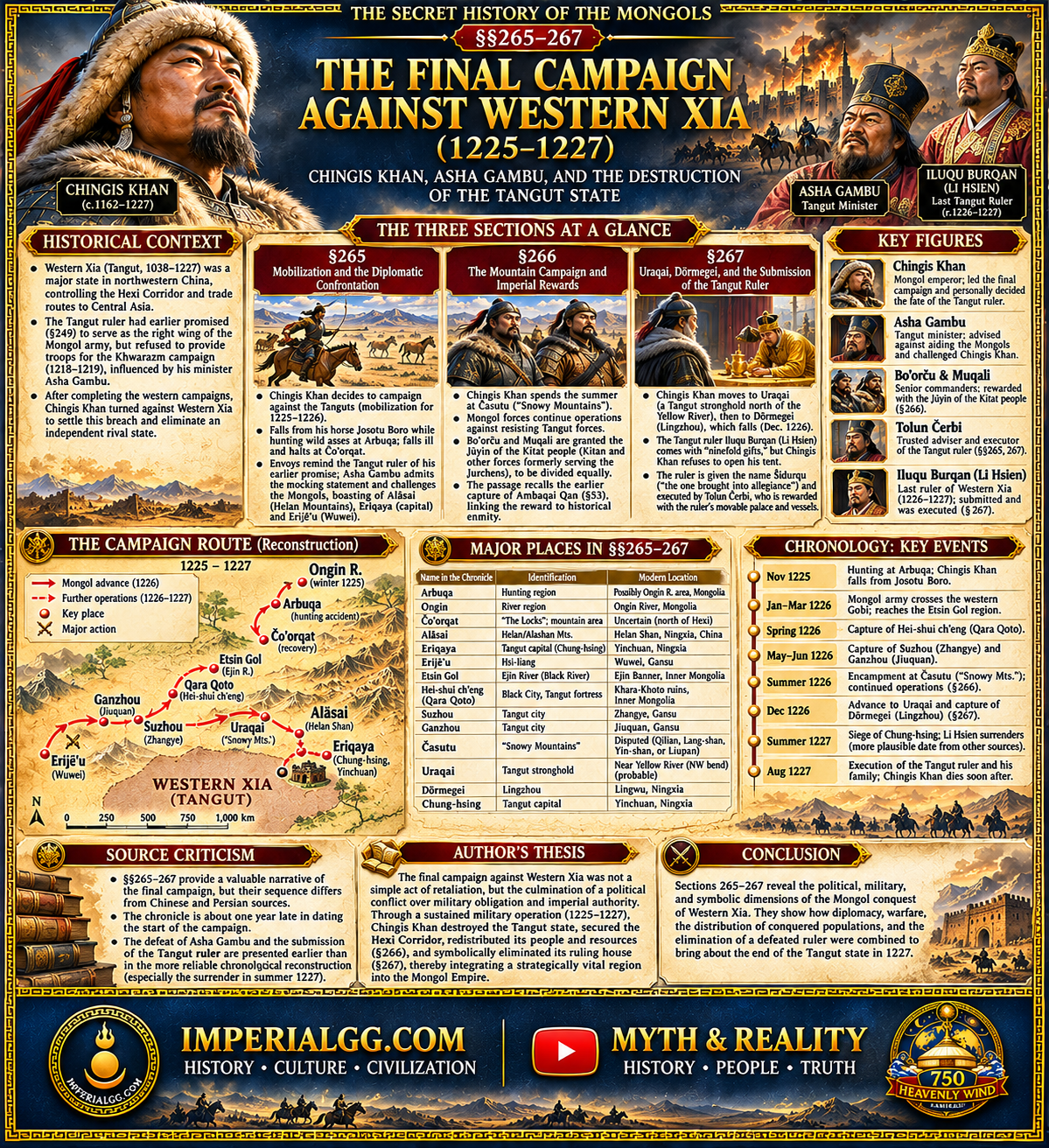
THE DEFEAT OF ASHA GAMBU, THE DESTRUCTION OF XI XIA, AND THE FATE OF THE TANGUT RULER
Military Strategy, Political Conflict, Historical Geography, and the Collapse of the Tangut Dynasty in §§265–267 of The Secret History of the Mongols
ABSTRACT
The final campaign of Chingis Khan against the Tangut state of Western Xia (Xi Xia, 西夏) in 1225–1227 was the culmination of a prolonged political and military confrontation between the Mongol Empire and one of the principal states of northwestern China. Sections 265–267 of The Secret History of the Mongols provide a distinctive account of this campaign, recording the earlier diplomatic dispute over Tangut military assistance, the intervention of the Tangut minister Asha Gambu, Chingis Khan’s fall from his horse during a hunt, the military operations against Tangut strongholds, the distribution of conquered populations, and the submission and execution of the last Tangut ruler.
The narrative, however, presents considerable chronological and geographical difficulties. Its account of the defeat and capture of Asha Gambu places the event before the Mongol summer encampment in the Alashan region, whereas the reconstruction based on Chinese, Persian, and Mongolian sources indicates that the Mongol army was operating in the Etsin Gol–Ganzhou region during the first half of 1226 and did not advance into the Alashan region until later. Similarly, the chronicle places the submission of the Tangut ruler near the fall of Lingzhou in 1226, while the Chinese and Persian sources indicate that Li Hsien surrendered during the siege of the Tangut capital in the summer of 1227.
This article examines the three sections as a connected historical account rather than as independent episodes. It reconstructs the campaign’s geographical framework, identifies the principal locations where possible, and distinguishes the chronicle’s narrative sequence from the chronology established through comparative source criticism. Particular attention is given to the Etsin Gol (modern Ejin River), the Tangut fortress of Hei-shui ch’eng (Qara Qoto), Suzhou, Ganzhou, the Helan Mountains, Uraqai, Lingzhou, and the Tangut capital Chung-hsing.
The article argues that the final campaign was not simply a punitive expedition resulting from a diplomatic insult. It was a sustained military operation directed against a strategically important state whose political independence had become incompatible with the Mongol imperial order. The campaign also demonstrates the relationship between military conquest, the appropriation of populations and resources, and the symbolic subordination of defeated rulers.
1. INTRODUCTION: THE MONGOL–TANGUT CONFLICT BEFORE THE FINAL CAMPAIGN
The Tangut kingdom of Western Xia occupied a strategically important position between the Mongolian steppe, the Gobi Desert, the Hexi Corridor, and the northern Chinese political world. Established in 1038 under Li Yuanhao, Western Xia controlled a network of agricultural settlements, fortified cities, commercial routes, and military installations across the northwestern frontier of China. Its political and economic importance derived not only from its territorial extent but also from its position along the routes connecting northern China with Central Asia.
Figure 1. Western Xia: the territorial and cultural setting of the Tangut kingdom.
The Mongol–Tangut relationship had begun before the conquest of the Khwarazmian Empire. During the earlier campaigns of Chingis Khan, the Tangut ruler had submitted to Mongol authority and entered into a political relationship with the emerging Mongol imperial power. In §249 of The Secret History of the Mongols, the Tangut ruler promised that his people would serve as the right wing of Chingis Khan’s army. This promise was more than a declaration of friendship: it established an expectation of military assistance within the Mongol political and military hierarchy.
The relationship deteriorated during the confrontation with Khwarazm in 1218–1219. After the Otrar incident and the subsequent breakdown of Mongol–Khwarazmian diplomacy, Chingis Khan prepared a major western campaign. He requested military assistance from the Tangut ruler, expecting the earlier commitment to be fulfilled. The Tangut court, however, refused to provide the requested forces. According to the Secret History, the refusal was encouraged by the minister Asha Gambu, who expressed contempt for the Mongol military position and made statements that Chingis Khan later regarded as insulting.
The Mongol ruler did not immediately attack Western Xia. He was already committed to the Khwarazmian campaign and had to direct his military resources toward Central Asia. Nevertheless, the Tangut refusal remained unresolved. The Secret History presents Chingis Khan as declaring that he would return to settle the matter after completing his western operations.
The final campaign therefore emerged from the intersection of three political circumstances: the Tangut ruler’s earlier promise of military assistance, the failure to fulfil that promise during the Khwarazmian campaign, and the deliberate challenge issued by Asha Gambu. Igor de Rachewiltz identifies this dispute as the immediate political background to the final Tangut expedition.¹
The purpose of the present study is to examine how these circumstances developed into the final Mongol invasion of Western Xia and how the chronicle’s narrative can be reconciled—or, where necessary, not reconciled—with the independent historical evidence.
2. SECTION 265: THE MOBILIZATION OF THE MONGOL ARMY AND THE INCIDENT OF JOSOTU BORO
2.1 THE DECISION TO CAMPAIGN AGAINST WESTERN XIA
Section 265 opens with Chingis Khan’s declaration that he will campaign against the Tangut people. The chronicle states: “After spending the winter there, Chinggis-qahan said, ‘I shall set forth against the Tang’ut people.’ He counted his troops anew and, in the autumn of the Year of the Dog, Chinggis-qahan set forth against the Tang’ut people.”
— The Secret History of the Mongols, §265, trans. Igor de Rachewiltz.²
The Year of the Dog corresponds to 1226. Nevertheless, the date given in the chronicle does not accurately represent the complete chronology of the campaign. De Rachewiltz, comparing the Mongolian account with Chinese historical records and other sources, concludes that the mobilization began in the latter part of 1225, while the actual attack on Western Xia was launched in the spring of 1226. The chronicle is therefore approximately one year late in its presentation of the sequence of events.³
The statement that Chingis Khan “counted his troops anew” is particularly significant. The Mongolian expression refers to a fresh enumeration of the effective strength of the army. It suggests that the ruler was preparing a major military operation requiring the reassessment and organization of available forces.
Chingis Khan took Yisüi Qatun with him on the expedition. Her presence becomes important later in the same section because she was responsible for informing the princes and commanders of the Great Khan’s physical condition after his fall from his horse.
The expedition was not an isolated raid. It was a major campaign against a state possessing fortified settlements, established agricultural production, and a complex defensive network. The Mongol army would have to cross the Gobi, secure important routes and river corridors, capture frontier strongholds, and move against the principal political and economic centres of Western Xia.
2.2 THE HUNTING INCIDENT AT ARBUQA
During the initial movement toward Tangut territory, Chingis Khan encountered a region called Arbuqa, which the chronicle describes as being rich in wild asses.
The wild ass, identified by de Rachewiltz as Equus hemionus, is known in Mongolian as qulan. The animal was native to the dry steppe and desert environments of Central Asia and the Gobi region.
Figure 2. The kulan or Asiatic wild ass, the animal hunted during the journey described in §265.
The chronicle records that the wild asses passed close to the Mongol hunting party. Chingis Khan’s horse, named Josotu Boro, became frightened and bolted. Chingis Khan fell from the animal and suffered severe bodily pain. He subsequently halted at a place called Čo’orqat.
The name Josotu Boro is translated by de Rachewiltz as “Reddish-Grey.” This is not an incidental detail. The horse is identified by name because the accident becomes relevant to the later account of Chingis Khan’s final illness and death.
The chronicle does not describe the precise anatomical nature of the injury. It states that Chingis Khan experienced severe pain and later developed a fever. Consequently, it would be historically unjustified to identify a particular fracture or internal injury solely from this passage.
The importance of the incident lies in its immediate political consequences. Chingis Khan’s physical condition created uncertainty within the Mongol leadership concerning the continuation of the expedition. The princes and commanders had to consider whether the campaign should proceed while the Great Khan was seriously ill.
2.3 THE LOCATION OF ARBUQA: THE ONGİN RIVER HYPOTHESIS
The geographical identification of Arbuqa is uncertain. De Rachewiltz notes that several scholars, including René Grousset and Pérlée, placed it in the Alashan Desert in southeastern Ningxia. This identification was based partly on attempts to connect Arbuqa and Čo’orqat with localities in the Ordos region.⁴
De Rachewiltz rejects this identification as unconvincing for both linguistic and chronological reasons. If the accident occurred during the winter of 1225–1226, and the Mongol invasion of Western Xia began in spring 1226, it is unlikely that Chingis Khan had already travelled deep into Tangut territory as far south as the Alashan region.
Instead, he considers more plausible the reconstruction proposed by Martin, following earlier observations by F. Grenard: the Mongol army had left the Tuul region and temporarily halted near the Ongin River, where Chingis Khan went hunting for wild asses. The accident probably occurred in November 1225.⁵
This reconstruction has significant implications for understanding the campaign. It places the incident in Mongolia, during the initial stage of the southern movement, rather than in the Tangut heartland.
The geographical sequence would therefore be:
Departure from the Mongolian imperial encampment.
Movement southward toward the Tangut territories.
Temporary halt near the Ongin River.
Hunting in the Arbuqa region.
Chingis Khan’s fall from Josotu Boro.
A temporary interruption of the campaign while the Great Khan recovered and diplomatic contact with the Tangut court was pursued.
The precise location of Arbuqa remains unresolved. The Ongin River reconstruction is a scholarly hypothesis, not an established archaeological identification.
2.4 ČO’ORQAT: THE PLACE OF THE GREAT KHAN’S RECOVERY
After the accident, Chingis Khan halted at Čo’orqat.
De Rachewiltz explains that the name is a plural form meaning “The Locks.” Paul Pelliot suggested that it might refer figuratively to a strong defensive position and could be connected with the mountain mentioned in the Chinese Yuan shi as Hun-ch’ui.⁶
The geographical identification is complicated by differences among the historical sources.
Martin proposed that Hun-ch’ui corresponded to the Qilian Mountains south of Suzhou in Gansu. Ruth W. Dunnell, however, suggested that the location might have been north of the Hexi Corridor, between Edzina and Wulahai. De Rachewiltz notes that the two names appear to be associated with the same mountainous region, but he does not regard the exact location as established.⁷
The Secret History describes Čo’orqat as the place where Chingis Khan remained after the fall. During this period, his illness became apparent.
Yisüi Qatun informed the princes and commanders that the Great Khan was suffering from fever and that his condition was serious. This intervention is important because the campaign’s continuation was no longer simply a question of military strategy. It had become a question of imperial leadership and the physical capacity of the ruler.
2.5 TOLUN ČERBI’S STRATEGIC PROPOSAL
The princes and commanders assembled to discuss the situation. Tolun Čerbi of the Qongqotan proposed that the Mongol army should withdraw temporarily.
His argument was based on the characteristics of Tangut society. The Tanguts were a settled population living in permanent towns and fortified settlements. Unlike mobile pastoral communities, they could not easily abandon their urban centres and move elsewhere.
Tolun Čerbi argued that the Mongols could return later, when Chingis Khan had recovered, because the Tangut cities would remain in place.
The strategic distinction is important. The Mongol army had developed its military system around mobility, speed, and the ability to operate over long distances. The Tangut state, by contrast, relied on fortified cities and permanent agricultural settlements. The two systems presented different military challenges.
The Secret History therefore preserves an internal discussion about the nature of the enemy, the condition of the ruler, and the timing of military operations.
Chingis Khan did not accept a simple withdrawal. He feared that the Tanguts would interpret the retreat as a sign of weakness. Instead, he decided to send envoys to demand an explanation of the Tangut ruler’s earlier conduct.
This decision temporarily transformed the campaign from a military operation into a diplomatic confrontation.
3. THE DIPLOMATIC CONFRONTATION WITH THE TANGUT COURT
3.1 THE EARLIER PROMISE OF THE RIGHT WING
The message sent by Chingis Khan reminded the Tangut ruler of his earlier promise: “We, the Tang’ut people, shall be your right wing.”
— The Secret History of the Mongols, §265.⁸
This statement refers back to §249. It is important because it establishes that the Mongol ruler understood the relationship as one involving an explicit military obligation.
The Tangut ruler had previously promised that his forces would serve as the right wing of the Mongol army. When Chingis Khan requested troops for the campaign against Khwarazm, the Tangut court failed to provide them.
The message also referred to the Mongol proposal sent to Sultan Muhammad after the Otrar incident. De Rachewiltz explains that the expression concerning the failure of the Sarta’ul people to accept the proposal refers to the demand for reparations following the destruction of the Mongol merchant caravan at Otrar in 1218.⁹
The Tangut refusal therefore occurred within a broader international crisis. Chingis Khan was preparing for war against Khwarazm, and the failure of the Tangut court to fulfil its commitment was interpreted as a breach of the existing political relationship.
3.2 ASHA GAMBU AND THE RESPONSIBILITY FOR THE INSULT
The chronicle distinguishes between the Tangut ruler and the minister Asha Gambu. The ruler, identified as Burqan, denied responsibility for the mocking statement. Asha Gambu then admitted that he had spoken the words. This distinction is essential. The Secret History does not present the original insult as a statement made directly by Burqan. It attributes the challenge to Asha Gambu.
Asha Gambu’s response was confrontational. He invited the Mongols to come and fight in the Tangut territories and boasted of the wealth and resources available to his people. His challenge referred to the Alāsai region and to the two important Tangut cities of Eriqaya and Erijë’u.
The episode is significant because it shows how the Tangut minister converted a diplomatic dispute into an explicit military challenge. Chingis Khan’s response was to declare that he would hold Burqan accountable for the earlier promise and the words spoken by his minister.
3.3 THE IDENTIFICATION OF ALĀSAI
The name Alāsai is one of the most important geographical references in §265.
The Chinese interlinear gloss identifies it as the name of the Ho-lan Mountains, the modern Helan Shan range, which extends parallel to the Yellow River west of Yinchuan in present-day Ningxia.
The range was historically known as the Alashan Mountains. Its geographical position made it an important defensive zone on the western side of the Tangut capital region.¹⁰
Figure 3. The Helan Shan (Alashan Mountains), west of the Tangut capital region.
The connection between Alāsai and the Helan Mountains is stronger than the earlier proposals concerning Arbuqa and Čo’orqat. The text itself contains a geographical gloss identifying the mountain range.
Nevertheless, the chronicle’s description of the battle against Asha Gambu in this region creates a chronological problem. De Rachewiltz points out that the Mongol army was still operating in the Etsin Gol–Ganzhou region during the first half of 1226 and did not move into the Alashan region until later in the year.
Consequently, the chronicle’s placement of Asha Gambu’s defeat before the summer encampment cannot be accepted without qualification.
3.4 ERIQAYA AND ERIJË’U: THE PRINCIPAL CITIES OF WESTERN XIA
Asha Gambu’s challenge mentions two wealthy Tangut cities. Eriqaya was the Mongolian form of the Tangut name of the capital of Western Xia. It corresponds to the city known in Chinese as Chung-hsing fu (中興府), located in the modern Yinchuan region of Ningxia.
The city had served as the Tangut capital since approximately 1020. Its strategic and political importance made it the central objective of the final Mongol campaign. Erijë’u corresponds to the Tangut name of Hsi-liang (西涼), identified by de Rachewiltz with modern Wuwei County in Gansu.
Figure 4. Yinchuan, the former Tangut capital, and Wuwei in Gansu, identified with Erijë’u.
These two places were among the principal and wealthiest cities of Western Xia. Their inclusion in Asha Gambu’s message was therefore politically significant: he was boasting not merely of military resistance but also of the economic resources and material wealth available to the Tangut state.¹¹
The identification of Eriqaya and Erijë’u is particularly useful because it connects the literary exchange in §265 with the historical geography of Western Xia.
3.5 THE MEANING OF THE CHALLENGE
Asha Gambu’s message should not be reduced to an ordinary exchange of insults. It was a declaration that the Tangut state was prepared to resist the Mongols and that the Mongol ruler would have to demonstrate his military superiority on Tangut territory.
Chingis Khan’s response was shaped by the Mongol understanding of political legitimacy. He invoked Eternal Heaven as the ultimate judge and interpreted victory as confirmation of the legitimacy of Mongol imperial authority.
The Secret History therefore presents the conflict through a combination of diplomatic obligation, personal authority, and the ideological concept of Heaven’s protection.
However, this ideological presentation should not replace the practical historical explanation. The Mongols also had strategic reasons for eliminating an independent state that controlled important routes and fortified cities along the northwestern frontier of China.
4. THE ACTUAL MILITARY CAMPAIGN OF 1226: THE WESTERN GOBI, THE EJIN RIVER, AND THE HEXI CORRIDOR
The military route of the final campaign is essential to understanding the geographical problems in §265.
De Rachewiltz reconstructs the Mongol advance through the western Gobi and the Etsin Gol region, followed by the capture of several Tangut frontier centres. The campaign was not confined to the Helan Mountains or the area surrounding Yinchuan.
4.1 THE MONGOL ADVANCE ACROSS THE WESTERN GOBI
According to de Rachewiltz, the Mongol army departed from its winter encampment on the Ongin River and crossed the western Gobi during the first lunar month of 1226, corresponding approximately to 30 January–27 February. The army reached the Etsin Gol region during the second lunar month, approximately 28 February–30 March.¹²
The Etsin Gol, also written Ejin Gol, is the river system associated with the modern Ejin River in the western part of Inner Mongolia. In Chinese historical terminology, it is connected with the Hei-shui, or “Black River.”
Figure 5. The Ejin River system, historically known as Etsin Gol, in the western Gobi.
This river system was strategically important because it provided water and access to the oasis settlements and fortified towns of the Tangut frontier.
The Mongol army’s movement along this route was not random. The campaign required the capture of fortified settlements and control of the water and communication corridors that supported Tangut military operations.
4.2 HEI-SHUI CH’ENG: QARA QOTO, THE BLACK CITY
One of the important Tangut strongholds captured during the campaign was Hei-shui ch’eng (黑水城), meaning “Black River City.”
The Mongols called it Qara Qoto, also meaning “Black City.”
It is associated with the archaeological site of Khara-Khoto in the Ejin region of modern Inner Mongolia.
Figure 6. Khara-Khoto, the Tangut fortress known in Chinese sources as Hei-shui ch’eng and in Mongolian as Qara Qoto.
The city was an important Tangut outpost controlling the Etsin Gol region. Its capture gave the Mongol army access to the wider network of settlements and routes leading toward the Hexi Corridor.
The Tangut name is recorded in Chinese transcription as I-chi-nai. De Rachewiltz discusses its possible relationship with the forms Izina or Ezina and identifies it with the “Eçina” mentioned by Marco Polo.¹³
The archaeological importance of Khara-Khoto is considerable. The site has produced Tangut documents, manuscripts, religious materials, and objects that provide direct evidence of the administrative and cultural life of Western Xia.
Its capture should therefore be understood as more than the occupation of a frontier fortress. It represented the seizure of an important administrative and logistical centre.
4.3 SUZHOU AND GANZHOU
Following the capture of Hei-shui ch’eng, the Mongol army moved upstream along the Etsin Gol and advanced toward the Hexi Corridor.
The principal cities named by de Rachewiltz are:
Suzhou (肅州): identified with modern Zhangye County in Gansu.
Ganzhou (甘州): identified in the older geographical terminology with modern Jiuquan County in Gansu.
The historical spellings and modern administrative boundaries have changed over time. Therefore, these identifications should be understood as historical-geographical correspondences rather than as a claim that the medieval cities were identical in extent to modern urban districts.
Figure 7. Zhangye and Jiuquan in the Hexi Corridor, associated with Suzhou and Ganzhou in the historical sources.
These cities were important because the Hexi Corridor connected the Chinese interior with the western regions of Central Asia.
Control of this corridor enabled the Mongols to disrupt the Tangut state’s western communications and to seize major urban and agricultural centres. De Rachewiltz places the capture of these cities in the summer of 1226, approximately May–June.¹⁴
4.4 THE SUMMER ENCAMPMENT IN THE MOUNTAINS
After the operations in the Etsin Gol–Ganzhou region, Chingis Khan moved to a mountainous area to escape the summer heat. The Secret History calls the location Časutu Mountain(s), while the Chinese Yuan shi refers to Hun-ch’ui (渾垂), glossed as Hsüeh-shan (雪山), meaning “Snowy Mountain(s).” De Rachewiltz considers the two names likely to refer to the same general mountainous area. However, the precise location remains disputed.
Possible identifications include:
The Qilian Mountains south of Suzhou.
The Lang-shan range.
The Yin-shan range.
A mountainous area north of the Hexi Corridor.
The Liupan Mountains, according to an alternative proposal discussed by Pelliot.
The geographical problem arises from the relationship between the mountain encampment and Uraqai. If Časutu was located between the Etsin Gol region and Uraqai, the route described in the Secret History appears difficult to reconcile with the campaign’s other movements.
De Rachewiltz ultimately concludes that the available evidence does not permit a definitive identification.¹⁵
This uncertainty must remain visible in any historical reconstruction. The name Časutu should not be assigned to a precise modern mountain range on a poster or map without a qualification.
5. THE DEFEAT OF ASHA GAMBU: THE CHRONICLE’S ACCOUNT AND THE CHRONOLOGICAL PROBLEM
The Secret History places the defeat and capture of Asha Gambu in the Alashan region before the summer encampment. According to its account, Chingis Khan advanced toward Alāsai, fought Asha Gambu, defeated him, and forced him to barricade himself in a stronghold in the mountains.
The Tangut forces were subsequently scattered, and the Mongol army seized their property and captives. However, de Rachewiltz emphasizes that this sequence is not plausible when compared with the broader campaign chronology.
During the spring and early summer of 1226, Chingis Khan was operating in the Etsin Gol–Ganzhou region. The Mongol army did not move into the Alashan region until later in the year.¹⁶
This creates a significant discrepancy:
Event | Narrative in the Secret History | Reconstruction from comparative sources |
|---|---|---|
Chingis Khan’s accident | Before the diplomatic exchange | Probably November 1225 near the Ongin River |
Start of the invasion | Presented as autumn 1226 | Actual attack began in spring 1226 |
Capture of Hei-shui ch’eng | Not described in detail in §§265–267 | Spring 1226 |
Capture of Suzhou and Ganzhou | Not described in detail | Summer 1226 |
Defeat of Asha Gambu | Placed before the summer encampment | The stated sequence is geographically and chronologically problematic |
Advance into Alashan | Presented as part of the earlier confrontation | Mongol army entered the region later in 1226 |
The defeat and capture of Asha Gambu are not recorded in the same form in the Chinese sources. De Rachewiltz therefore treats the Secret History as the principal source for this episode, while warning that its chronology cannot be accepted without qualification.¹⁷
The important historical conclusion is not that the episode must be rejected. Rather, its place within the campaign needs to be reconsidered.
The chronicle may preserve an authentic tradition concerning Asha Gambu’s challenge and capture, but its narrative sequence appears to have compressed or rearranged the actual military operations.
6. SECTION 266: THE CAMPAIGN IN THE MOUNTAINS AND THE REWARDING OF BO’ORČU AND MUQALI
6.1 ČASUTU AND THE CONTINUATION OF THE CAMPAIGN
Section 266 begins by stating that Chingis Khan spent the summer on Časutu Mountain. The text then records that Mongol troops were sent against the Tangut forces that continued to resist. The campaign involved plundering and the destruction of the remaining Tangut resistance.
The Mongolian expression used in this passage has been interpreted differently by translators. De Rachewiltz notes that the phrase describing the operation literally conveys the idea of carrying out the plundering according to an established reckoning or plan.¹⁸
The passage therefore does not describe a single isolated battle. It records a broader military operation against the Tangut forces that had not yet submitted.
The mountain environment is relevant. The Tangut forces could use the terrain to maintain resistance after losing important towns and strongholds. The Mongol army consequently had to continue operations beyond the principal urban centres.
6.2 THE MEANING OF THE JÜYIN OF THE KITAT PEOPLE
The second major theme of §266 is the reward granted to Bo’orču and Muqali. Chingis Khan allowed the two commanders to take as much booty as they judged their strength could carry. He then assigned them the Jüyin of the Kitat people, which they were to divide equally.
This expression requires careful interpretation. De Rachewiltz explains that the Kitat Jüyin referred to the Kitan and other auxiliary forces serving the Jurchens. The passage is therefore connected with the earlier political and military history of the Jin dynasty rather than simply with the Tangut population captured during the 1226 campaign.¹⁹
The term Kitat is used in the Mongolian historical context for the Khitan people and, in some passages, more broadly for populations associated with the northern Chinese political system.
The Jüyin were a group or population attached to the former Jurchen military structure. The grant of this population to Bo’orču and Muqali should be understood within the broader Mongol system of distributing subject peoples and resources among trusted commanders.
6.3 BO’ORČU AND MUQALI: LOYALTY AND IMPERIAL REWARD
Bo’orču and Muqali occupied exceptionally important positions in the Mongol military system. Bo’orču had been one of Temüjin’s earliest companions. His loyalty dated back to the formative period of Temüjin’s political and military career.
Muqali, meanwhile, had played a major role in the Mongol campaigns against the Jin dynasty in northern China. He was entrusted with extensive military responsibilities in the region.
Their appearance together in §266 is therefore significant. The passage presents them as trusted companions who had not previously received an equivalent share of the Kitat population. Chingis Khan now grants them the Jüyin equally, recognizing their loyalty and service. The historical significance of this reward is reinforced by the chronicle’s reference to Ambaqai Qan.
6.4 THE REFERENCE TO AMBAQAI QAN
The chronicle recalls that the ancestors of the Mongols had been destroyed by the Kitat-related Jüyin.
De Rachewiltz identifies this statement with the capture of Ambaqai Qan, who was delivered by the Tatars to the Altan Qan of the Kitat, identified in the chronicle with the Jurchen ruler. This event is described earlier in §53.²⁰
An important distinction must be made here. In §53, the Jüyin responsible for the capture of Ambaqai Qan are of Tatar origin. In §266, the Kitat Jüyin refers to the Kitan and other auxiliary forces serving the Jurchens.
The chronicle connects these historical memories through the broader political history of the Mongol ancestors and their enemies. It should not be assumed that the two groups were identical.
The reward to Bo’orču and Muqali therefore carries a historical and symbolic dimension. It connects their military service with the earlier suffering of the Mongol ruling lineage and the defeat of the political powers responsible for the capture of Ambaqai Qan.
6.5 THE DISTRIBUTION OF PEOPLE AS AN IMPERIAL INSTITUTION
The passage also provides evidence of the political economy of Mongol conquest. The distribution of captured people was not simply an incidental consequence of warfare. It was a mechanism through which the imperial government rewarded commanders and redistributed labour and resources.
The wording concerning the sons and daughters of the conquered population is particularly revealing. De Rachewiltz explains that the passage implies taking possession of them and turning them into servants of the recipients.²¹
This is an important historical fact and should not be softened into a general description of military compensation.
The Mongol imperial system included the redistribution of populations, property, livestock, and other resources as a means of rewarding loyalty and strengthening the authority of the ruling elite.
7. SECTION 267: URAQAI, DÖRMEGEI, AND THE SUBMISSION OF THE TANGUT RULER
7.1 THE MONGOL ADVANCE TOWARD URAQAI
Section 267 records Chingis Khan’s movement from Časutu to Uraqai. The name appears in Chinese sources in several forms, including Wu-la-hai, Wu-lang-hai, and Wo-lo-hai.
De Rachewiltz identifies Uraqai as a town in Inner Mongolia, north of the Yellow River. It had previously been captured by Mongol forces during campaigns in 1207 and 1209 and was among the northernmost Tangut strongholds.²²
The exact location has been debated. Ruth W. Dunnell proposes that Uraqai was situated near the Yellow River, probably along the outer loop of its northwestern bend. Her argument is based partly on the fact that the Secret History does not mention a river crossing between the preceding locations and Uraqai.²³
Figure 8. The northwestern bend of the Yellow River, the geographical region associated with Uraqai.
The identification is plausible, but the exact archaeological location remains uncertain.
7.2 DÖRMEGEI: LINGZHOU AND MODERN LINGWU
From Uraqai, Chingis Khan moved toward Dörmegei.
De Rachewiltz identifies Dörmegei as the Mongolian name for Lingzhou (靈州), located in the modern Lingwu region of Ningxia. The city was an important Tangut stronghold near the Yellow River.²⁴
Figure 9. The Lingzhou–Lingwu region, identified with Dörmegei.
The city fell in early December 1226 according to de Rachewiltz’s reconstruction. The geographical sequence described in the sources suggests that the Mongol army followed the Yellow River upstream while moving southward from the northern Tangut frontier. The conquest of Lingzhou opened the way toward the central political and economic regions of Western Xia.
7.3 THE TANGUT RULER: ILUQU BURQAN AND LI HSIEN
The ruler who appeared before Chingis Khan is identified in the Secret History as Iluqu Burqan. De Rachewiltz identifies him with Li Hsien (李憲), who had recently been enthroned as the Tangut ruler in 1226–1227.²⁵ The title Burqan should not be treated as the personal name of the ruler. It is a title used in the chronicle.
The distinction between the ruler and Asha Gambu is essential:
Asha Gambu was the Tangut minister who admitted making the mocking statement and challenged Chingis Khan.
Iluqu Burqan was the Tangut ruler who later came to submit with gifts.
Li Hsien is the Chinese historical identification of the ruler called Iluqu Burqan in the Mongolian chronicle.
The ruler’s appearance before Chingis Khan is one of the most important episodes in §267 because it marks the collapse of the Tangut court’s independent political position.
7.4 THE NINEFOLD GIFTS AND THE CEREMONIAL ACT OF SUBMISSION
The Tangut ruler appeared with a large collection of gifts. The chronicle lists golden images of Buddha, gold and silver vessels, boys and girls, horses, camels, and other objects arranged in groups of nine.
The repeated use of nine is significant in the ceremonial and symbolic context of Mongolian political culture. De Rachewiltz notes that the number nine had an established symbolic value and that the phrase “nine and nine” refers to repeated groups of nine.²⁶
Figure 10. Tangut Buddhist art and metalwork, illustrating the material culture represented among the gifts described in §267.
The presentation of these objects was intended to demonstrate submission and acknowledge the superiority of the Mongol ruler.
The gifts also reveal the economic and artistic resources of the Tangut court.
However, the political meaning of the ceremony was fundamentally altered by Chingis Khan’s response.
7.5 THE REFUSAL TO OPEN THE TENT
The chronicle records that Chingis Khan did not open the entrance to his tent. The Tangut ruler remained outside while attempting to present his homage.
De Rachewiltz describes this refusal as the ultimate form of rejection. In the diplomatic culture of the time, allowing a ruler to approach with gifts but refusing to receive him was an explicit denial of his status.²⁷
This detail is central to the political interpretation of the episode. The Tangut ruler had once represented an independent state capable of negotiating with the Mongol leadership. By the time he appeared before Chingis Khan, he was no longer treated as an equal sovereign. The closed tent symbolized the complete transformation of the relationship: the Tangut ruler was now a defeated monarch whose political authority depended entirely on the decision of the Mongol conqueror.
7.6 THE NAME ŠIDURQU AND THE POLITICAL STATUS OF THE DEFEATED RULER
The chronicle records that Chingis Khan gave the Tangut ruler the name Šidurqu before ordering his execution. The ordinary meaning of the word is associated with “straight,” “upright,” “honest,” “sincere,” or “loyal.”
De Rachewiltz notes, however, that the related Mongolian verb šidurquta- can mean “to bring into allegiance” or “to subdue.”²⁸ The name may therefore have had a political meaning: the defeated ruler was now someone who had been brought into submission. The renaming also replaced the title Burqan, which carried religious significance.
De Rachewiltz discusses the possibility that the name was intended to establish a continuing relationship of loyalty between the defeated ruler and Chingis Khan even after death. In medieval Mongolian belief, the spiritual power of an enemy of noble birth could be transformed into a beneficial influence for the victor and his descendants if properly subordinated.²⁹ This explanation is a scholarly interpretation, not a motive explicitly stated by the chronicle. The source itself records the renaming and execution. The religious interpretation is De Rachewiltz’s reconstruction of the possible ideological background.
7.7 THE EXECUTION BY TOLUN ČERBI
Chingis Khan ordered Tolun Čerbi to seize and execute the Tangut ruler. Tolun Čerbi had already appeared in §265 as an adviser during the discussion concerning the Great Khan’s illness. His role in §267 demonstrates that he was a trusted member of Chingis Khan’s immediate circle.
De Rachewiltz observes that Chingis Khan generally avoided executing defeated enemies personally and delegated the task to trusted subordinates.³⁰
The chronicle records that Tolun Čerbi carried out the order and subsequently reported the execution. He was rewarded with the Tangut ruler’s movable palace and vessels. The episode therefore demonstrates that the submission ceremony did not guarantee the survival of the defeated ruler. The presentation of gifts, the act of homage, and the renaming were followed by execution.
7.8 THE CHRONOLOGICAL PROBLEM OF THE TANGUT RULER’S SUBMISSION
The most important chronological discrepancy in §267 concerns the date and place of Li Hsien’s surrender. The Secret History places the submission in the context of the Mongol operations around Dörmegei, or Lingzhou, in late 1226. However, the Chinese and Persian accounts do not support this chronology.
De Rachewiltz argues that Li Hsien almost certainly surrendered when the Tangut capital, Chung-hsing, was under siege and close to capitulation. This occurred in the summer of 1227, when Chingis Khan was already gravely ill and encamped south of the Liupan Mountains.³¹
The discrepancy is important because the final Tangut ruler’s surrender was not simply an isolated event near Lingzhou. It was connected with the siege of the capital and the final collapse of the Tangut political system.
The historical sequence is therefore more plausibly reconstructed as follows:
Mongol forces captured major frontier cities and strongholds in 1226.
Lingzhou fell in December 1226.
The Mongol campaign continued into 1227.
The Tangut capital Chung-hsing was besieged.
Li Hsien surrendered in the summer of 1227.
The Tangut ruling family was executed shortly before or soon after Chingis Khan’s death in August 1227.
This reconstruction is not identical to the narrative order of the Secret History. The distinction must be maintained in any serious academic treatment.
8. THE CAMPAIGN’S GEOGRAPHICAL FRAMEWORK
The final Tangut campaign extended across a broad region of northwestern China and the Mongolian frontier. The following table distinguishes the historical names in §§265–267 from their modern geographical identifications.
Name in the chronicle | Historical identification | Modern geographical reference | Assessment |
|---|---|---|---|
Arbuqa | Region rich in wild asses | Possibly near the Ongin River | Uncertain |
Ongin | River region associated with the initial halt | Ongin River, Mongolia | Probable |
Čo’orqat | Place of Chingis Khan’s recovery | Uncertain; possibly north of the Hexi Corridor | Disputed |
Alāsai | Helan/Alashan Mountains | Helan Shan, Ningxia, China | Strong |
Eriqaya | Tangut capital | Yinchuan, Ningxia, China | Strong |
Erijë’u | Hsi-liang | Wuwei, Gansu, China | Strong |
Etsin Gol | Ejin River | Ejin Banner, Inner Mongolia, China | Strong |
Hei-shui ch’eng | Qara Qoto, Black City | Khara-Khoto ruins, Inner Mongolia, China | Strong |
Suzhou | Tangut city in the Hexi Corridor | Zhangye, Gansu, China | Strong |
Ganzhou | Tangut city in the Hexi Corridor | Jiuquan, Gansu, China | Strong |
Časutu | “Snowy Mountain(s)” | Possibly Qilian, Lang-shan, Yin-shan, or Liupan region | Disputed |
Uraqai | Tangut stronghold | Near the northwestern bend of the Yellow River | Probable |
Dörmegei | Lingzhou | Lingwu, Ningxia, China | Strong |
Chung-hsing | Tangut capital | Yinchuan region, Ningxia, China | Strong |
Huang-ho | Yellow River | Northern China | Strong |
The map identifies the principal geographical areas discussed in the sources. It is not a definitive reconstruction of the army’s exact route. In particular, the location of Časutu and the precise sequence of the movements around Uraqai remain disputed.
9. THE HISTORICAL SIGNIFICANCE OF THE FINAL TANGUT CAMPAIGN
9.1 THE END OF TANGUT POLITICAL INDEPENDENCE
The final campaign eliminated the independent political authority of Western Xia. The Mongol army captured important frontier strongholds, disrupted the Tangut communications network, occupied major cities, and ultimately forced the ruling house into submission.
The execution of the final ruler and his family removed the political leadership that could have organized further resistance. The destruction of Western Xia was therefore not simply the defeat of a military force. It was the elimination of an independent state structure.
9.2 THE STRATEGIC IMPORTANCE OF THE HEXI CORRIDOR
The campaign also secured an important geographical corridor. The Hexi Corridor connected the Chinese interior with Central Asia and the western regions of the Mongol Empire. The capture of Suzhou, Ganzhou, and other centres gave the Mongols control over important agricultural and commercial settlements.
This strengthened the Mongol position along the northwestern frontier of China and improved their ability to move forces and resources between the steppe and the western regions.
9.3 THE DISTRIBUTION OF CONQUERED POPULATIONS
Section 266 demonstrates that the conquest involved the redistribution of people and property. The Jüyin of the Kitat people was granted to Bo’orču and Muqali. Section 267 also records the presentation of servants, horses, camels, and other valuable goods by the Tangut ruler. These episodes reveal the material dimension of Mongol imperial expansion. Conquest produced not only territorial control but also the transfer of populations, labour, livestock, and wealth into the hands of the imperial elite.
9.4 THE SYMBOLIC SUBORDINATION OF THE TANGUT RULER
The refusal to receive the Tangut ruler inside the tent, followed by his renaming and execution, reveals the symbolic dimension of Mongol imperial authority. The ruler was not permitted to preserve the appearance of an equal diplomatic relationship. The act of homage was accepted only as a demonstration of submission, not as a guarantee of political survival. The episode illustrates how the Mongol imperial system could combine formal submission with the complete destruction of the defeated ruling authority.
9.5 THE PROBLEM OF THE CHRONICLE’S NARRATIVE ORDER
The discrepancies in §§265–267 are not minor editorial details. They affect the reconstruction of the campaign’s actual chronology. The Secret History preserves valuable information about the political dispute, the names of places, the actions of commanders, and the ceremonial aspects of the final Tangut ruler’s submission.
However, its narrative order cannot be treated as an exact chronological record. The comparison with Chinese and Persian sources reveals that several events were compressed, displaced, or presented in a sequence that differs from the reconstruction supported by other evidence. The historical value of the chronicle is therefore enhanced, not diminished, by careful source criticism.
10. AUTHOR’S THESIS
The final Tangut campaign of Chingis Khan should be understood as the culmination of a prolonged struggle over political allegiance, military obligation, and control of the northwestern Chinese frontier.
The refusal of the Tangut court to provide military assistance during the Khwarazmian campaign was not merely a failure to honour a diplomatic request. It challenged the hierarchical relationship that had been established through the Tangut ruler’s earlier promise to serve as the right wing of the Mongol army. Asha Gambu’s open defiance gave this political disagreement a more direct military dimension.
The fall of Chingis Khan from Josotu Boro during the initial stage of the campaign reveals the physical vulnerability of the ruler and the importance of collective military decision-making. The discussion among the princes and commanders demonstrates that the Mongol leadership recognized the difference between a mobile steppe opponent and a settled state defended by fortified towns.
The subsequent campaign across the western Gobi and the Etsin Gol region reveals the strategic importance of water routes, frontier strongholds, and the Hexi Corridor. The capture of Qara Qoto, Suzhou, and Ganzhou disrupted the Tangut defensive system and opened the way toward the central territories of Western Xia.
The defeat of Asha Gambu, as narrated in the Secret History, reflects the political meaning of the campaign, but the exact chronological position of the event remains uncertain. The chronicle’s sequence cannot be reconciled fully with the independently reconstructed movements of the Mongol army in 1226.
Section 266 reveals that conquest also involved the distribution of people and resources. The reward granted to Bo’orču and Muqali demonstrates the connection between personal loyalty, military service, and the redistribution of conquered populations. The reference to Ambaqai Qan further connects the final campaign with the historical memory of earlier Mongol conflicts with the Jurchen political order.
Section 267 presents the final political subordination of the Tangut ruling house. The appearance of Iluqu Burqan with ninefold gifts, the refusal of Chingis Khan to receive him inside the tent, the renaming of the ruler as Šidurqu, and his execution by Tolun Čerbi reveal the destruction of the Tangut ruler’s independent political status.
The central argument of this study is that the final campaign was not simply a war of retaliation. It was the final stage of a process through which the Mongol Empire removed a politically independent state that controlled strategically important territories and had failed to fulfil its military obligations.
The campaign demonstrates the relationship between diplomatic hierarchy, military conquest, the appropriation of populations and resources, and the symbolic elimination of defeated political authority.
At the same time, the discrepancies between the Secret History, Chinese records, and Persian accounts demonstrate why the historical reconstruction of the campaign must distinguish the narrative structure of a chronicle from the chronology of the events themselves.
11. CONCLUSION
Sections 265–267 preserve one of the most important accounts of the final military operations of Chingis Khan. Section 265 describes the political origins of the campaign, the mobilization of the Mongol army, the hunting accident involving Josotu Boro, the intervention of Yisüi Qatun, and the diplomatic confrontation with Asha Gambu. It also provides important geographical information concerning Arbuqa, Čo’orqat, Alāsai, Eriqaya, and Erijë’u.
Section 266 records the continuation of military operations in the mountainous regions and the distribution of the Jüyin of the Kitat people to Bo’orču and Muqali. The passage reveals the relationship between conquest, loyalty, and the redistribution of subject populations.
Section 267 describes the Mongol advance toward Uraqai and Dörmegei, the submission of the Tangut ruler Iluqu Burqan, the presentation of ninefold gifts, and his execution by Tolun Čerbi.
The campaign’s actual geographical and chronological sequence is more complex than the narrative order of the Secret History. The Mongol army crossed the western Gobi, advanced through the Etsin Gol region, captured Qara Qoto, Suzhou, and Ganzhou, and subsequently moved toward the Yellow River and the principal Tangut cities. The final surrender of the Tangut ruler is more plausibly connected with the siege of Chung-hsing in the summer of 1227 than with the earlier fall of Lingzhou.
The destruction of Western Xia marked the end of an independent Tangut political order and secured a strategically important region for the Mongol Empire.
These three sections therefore reveal the final stage of a transformation that had begun decades earlier: the expansion of Mongol power from the steppe into the settled political and economic systems of northern China and Central Asia.
NOTES AND REFERENCES
PRIMARY SOURCE
1. Igor de Rachewiltz, The Secret History of the Mongols: A Mongolian Epic Chronicle of the Thirteenth Century, Vol. I: Translation; Vol. II: Commentary (Leiden and Boston: Brill, 2004), §§249, 265–267. Read the complete Brill edition and commentary.
2. De Rachewiltz, The Secret History of the Mongols, §265, Vol. I, Chapter XII. Read the English translation of §265.
3. De Rachewiltz, Vol. II, commentary on §265, pp. 966–971; §266, pp. 971–973; §267, pp. 973–978. Read the commentary on §265; Read the commentary on §§266–267.
SECONDARY SCHOLARSHIP
4. Ruth W. Dunnell, “The Hsi Hsia,” in The Cambridge History of China, Vol. 6, Alien Regimes and Border States, 907–1368, ed. Herbert Franke and Denis Twitchett (Cambridge: Cambridge University Press, 1994), pp. 154–214.
5. Ruth W. Dunnell, “The Fall of the Hsi Hsia,” in the historical scholarship on the Tangut kingdom and Mongol conquest, particularly the geographical discussion of Uraqai and Časutu cited in de Rachewiltz’s commentary.
6. Paul Pelliot, Notes on Marco Polo, Vol. I, pp. 309–317, discussion of Arbuqa, Čo’orqat, and the geography of the final Tangut campaign.
7. Thomas T. Allsen, Culture and Conquest in Mongol Eurasia (Cambridge: Cambridge University Press, 2001), for the relationship between Mongol conquest, political authority, and the distribution of conquered populations.
8. Juvaini, The History of the World-Conqueror, trans. J. A. Boyle (Manchester: Manchester University Press, 1958), particularly the account of Chingis Khan’s final campaign and death.
9. Rashid al-Din, The Successors of Genghis Khan, trans. John Andrew Boyle (New York: Columbia University Press, 1971), for the final campaign against Western Xia and the events surrounding Chingis Khan’s death.
SOURCE-CRITICAL NOTES
The mobilization began in the latter part of 1225; the actual invasion of Western Xia began in spring 1226. The Secret History is approximately one year late in its presentation of the sequence.
Arbuqa has not been securely identified. The Ongin River region is a proposed location for the hunting incident.
Čo’orqat is not securely identified. Its possible association with Hun-ch’ui and the “Snowy Mountains” remains debated.
Alāsai is identified in the Chinese interlinear gloss with the Helan/Alashan Mountains.
Eriqaya is identified with the Tangut capital Chung-hsing, in the Yinchuan region.
Erijë’u is identified with Hsi-liang, modern Wuwei in Gansu.
The Mongol capture of Hei-shui ch’eng/Qara Qoto, Suzhou, and Ganzhou is reconstructed from comparative historical evidence and is not narrated in detail in §§265–267.
The Secret History places the defeat of Asha Gambu before the summer encampment, but this sequence is inconsistent with the broader military chronology reconstructed by de Rachewiltz.
Časutu is associated with the Hun-ch’ui Mountains and the term “Snowy Mountains,” but its exact location remains uncertain.
Uraqai is identified with a Tangut stronghold north of the Yellow River, probably near the northwestern bend.
Dörmegei is identified with Lingzhou, modern Lingwu in Ningxia.
The Tangut ruler Iluqu Burqan is identified with Li Hsien (李憲).
The Chinese and Persian sources place Li Hsien’s surrender in the summer of 1227 during the siege of Chung-hsing, rather than at the time suggested by the narrative sequence of the Secret History.
De Rachewiltz proposes that the execution of the Tangut royal family occurred shortly before or soon after Chingis Khan’s death in August 1227.
The interpretation of Šidurqu as a designation associated with submission and the afterlife is a scholarly hypothesis, not an explicit explanation given by the chronicle.
IMPERIALGG.COM — HISTORY • CULTURE • CIVILIZATION
MYTH & REALITY — HISTORY • PEOPLE • TRUTH