
TEMÜJIN’S WORDS: FROM RECONCILIATION TO POLITICAL CONFRONTATION
By Altanbagana Baatar
DBA Candidate| Independent Historian
ImperialGG Historical Research Seriers
13 October 2026
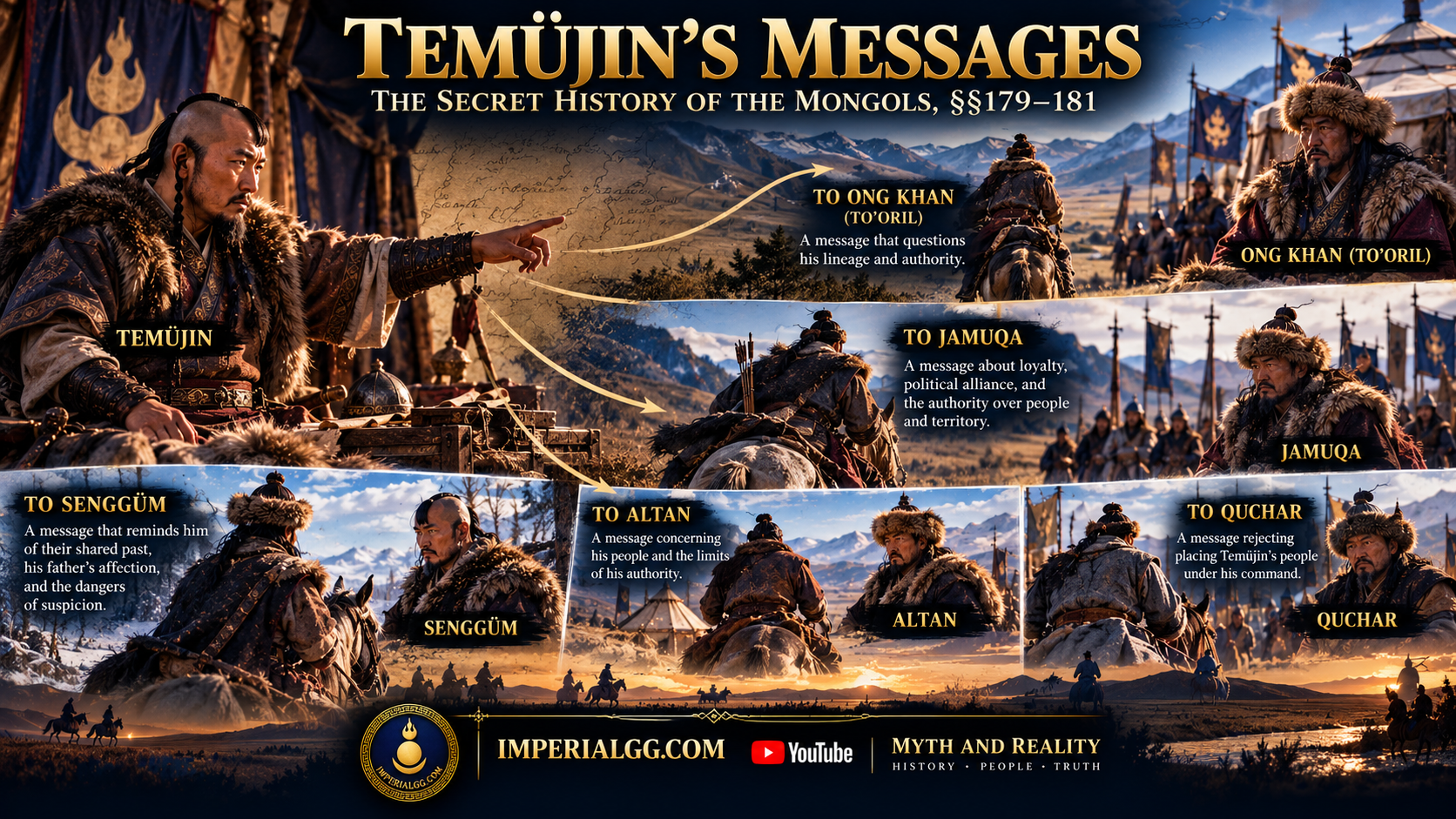
The Secret History of the Mongols, §§179–181
ABSTRACT
Sections 179–181 of The Secret History of the Mongols recount Temüjin’s messages, delivered through envoys, to Jamuqa, Ong Khan (To’oril), Senggüm, Altan, and Quchar. These passages reveal more than personal resentment or diplomatic disagreement. They expose the growing conflict over political authority, lineage, loyalty, and the future of alliances that had once connected these figures. Read together, the three sections show Temüjin addressing different audiences through distinct arguments: political sovereignty and territorial authority, an attack on Ong Khan’s lineage, and an appeal to the relationship between Ong Khan and his son Senggüm. The passages mark a transition from attempts to preserve personal bonds toward an increasingly explicit political confrontation.
Keywords: Temüjin, Ong Khan, Jamuqa, Senggüm, Altan, Quchar, lineage, diplomacy, political rhetoric, The Secret History of the Mongols.
I. SECTION 179 — THE MESSAGE TO JAMUQA, ALTAN, AND QUCHAR
Temüjin’s message in this section should not be interpreted merely as an expression of personal hostility toward Jamuqa. It also concerns the political relationship among Jamuqa, Altan, Quchar, and Temüjin, particularly the question of who possesses the authority to command people and control territory.
The passage concerning the headwaters of the Three Rivers carries political significance. It concerns more than the physical occupation of land: it expresses Temüjin’s determination to defend his own political base and his authority over the people associated with him. The territorial language thus becomes part of a broader assertion of sovereignty.
The distinction between personal friendship and political authority is especially important here. Temüjin and Jamuqa had previously been bound by the relationship of anda, or sworn companion. Yet such a bond did not eliminate competition over leadership. Their former personal relationship increasingly confronted a political question: who would command the people and determine the direction of their collective future?
This section therefore presents a conflict in which the obligations of an earlier alliance are being challenged by competing claims to authority.
II. SECTION 180 — WHY DOES TEMÜJIN CALL HIM “YOUNGER BROTHER TO’ORIL”?
One point must first be established clearly: “Younger Brother To’oril” refers to Ong Khan, the Kereyid ruler also known as Wang Khan. It does not refer to another person named To’oril.
In S. Damdinsüren’s Mongolian text, Temüjin explains why he has called Ong Khan duu, or “younger brother,” and proceeds to recount a genealogy that begins with a slave named Ogda and traces the lineage through successive generations. Christopher P. Atwood translates the expression as “younger brother To’oril,” preserving the distinction between the form of address and the genealogical argument that follows.
The passage does not establish that Temüjin regarded Ong Khan as his literal younger brother. Rather, Temüjin uses the term within a deliberately disparaging account of Ong Khan’s ancestry. The genealogical narrative is therefore central to the insult: it challenges Ong Khan’s standing by invoking the origins of his lineage.
The political significance becomes clearer when the passage is read in sequence. Temüjin first explains the insulting designation through Ong Khan’s genealogy and then turns to the question of political authority, rejecting the idea that his own people could be placed under the control of Altan and Quchar.
The two elements reinforce one another. The attack on Ong Khan’s lineage is not an isolated personal insult; it forms part of a broader refusal to recognize the political position from which his rivals appear to speak.
The term “younger brother” must consequently be read in its immediate context. It is not an expression of familial affection. It is a rhetorical device through which Temüjin challenges Ong Khan’s status and authority.
III. SECTION 181 — THE MESSAGE TO SENGGÜM: FATHERLY AFFECTION AND SUSPICION
Temüjin’s message to Senggüm adopts a different tone. Rather than concentrating on genealogy or territorial authority, it invokes the relationship between Senggüm and his father, Ong Khan.
Temüjin contrasts himself, who was born clothed, with Senggüm, who was born naked, and recalls that Ong Khan raised them both. The contrast is preserved in Igor de Rachewiltz’s translation and forms part of Temüjin’s argument about their respective relationships with Ong Khan.
The significance of this comparison lies not simply in the circumstances of their birth. Temüjin invokes their shared upbringing to challenge the suspicion that he intends to displace Senggüm or take his position beside Ong Khan. He presents himself as someone whose relationship with Ong Khan was established through shared history and mutual assistance, rather than through an ambition to replace the ruler’s son.
At the same time, the message exposes the insecurity surrounding Senggüm’s position. The possibility that Temüjin might become more influential than Ong Khan’s own son could turn an established alliance into a rivalry over proximity to power and future succession.
Temüjin’s argument therefore operates on two levels. It reminds Senggüm of their shared relationship with Ong Khan, while also exposing the fear and suspicion that threaten that relationship. The political conflict is no longer confined to the relationship between Temüjin and Ong Khan; it has entered the ruler’s own family circle.
IV. COMPARING THE FOUR TRANSLATIONS
A comparative reading of S. Damdinsüren, Christopher P. Atwood, Urgunge Onon, and Igor de Rachewiltz should prioritize the meaning and sequence of the Mongolian text rather than assume that different English renderings are interchangeable.
| Translation | Main point of comparison |
|---|---|
| S. Damdinsüren | The Mongolian wording, genealogical sequence, and the precise use of To’oril duu provide the textual foundation for the analysis. |
| Christopher P. Atwood | The rendering “younger brother To’oril” makes the form of address explicit, while the following genealogy clarifies the disparaging argument. |
| Urgunge Onon | His translation provides another English rendering against which the narrative structure and political relationships can be checked. |
| Igor de Rachewiltz | The comparison between Temüjin’s and Senggüm’s births, and Ong Khan’s relationship with both, is particularly relevant to §181. |
The broad interpretive pattern is clear: Temüjin does not deliver the same message to every recipient. His argument changes according to the political position and personal relationship of each individual. Nevertheless, the precise wording of each passage must be verified against the full Mongolian text and the corresponding passages in all four editions before making claims about every translation’s specific choices. A comparative study should distinguish verified textual differences from broader historical interpretation.
V. FROM PERSONAL COVENANT TO POLITICAL CONFRONTATION
These three sections become particularly significant when read alongside §§177–178. In the preceding passage, Temüjin reminded Ong Khan of their agreement to meet face to face and resolve disputes rather than allow malicious words to divide them. Sections 179–181, however, show Temüjin addressing a wider circle of political actors through messages tailored to their different positions.
To Jamuqa and the figures associated with him, the question concerns political allegiance and authority over people and territory. To Ong Khan, Temüjin directs an attack on lineage and standing. To Senggüm, he invokes their shared relationship with Ong Khan and challenges the suspicion that threatens to turn them into rivals.
This change in rhetoric suggests that the earlier attempt to preserve their personal covenant has entered a more difficult phase. Temüjin is no longer addressing the dispute solely as a disagreement between two men bound by a father–son relationship. He is confronting a network of political relationships in which each individual’s interests, loyalties, and fears affect the wider conflict.
It would nevertheless be premature to conclude that reconciliation has become entirely impossible. The passages establish an intensification of political confrontation, but they do not, by themselves, prove that every avenue of negotiation has been abandoned. Their importance lies in showing how the terms of the conflict are changing.
AUTHOR’S THESIS
Sections 179–181 demonstrate how Temüjin adapts his political rhetoric to the vulnerabilities and interests of different audiences. He challenges Ong Khan through genealogy and status, defends his own authority in relation to Altan and Quchar, and addresses Senggüm through the language of shared upbringing, paternal affection, and suspicion.
The sequence reveals a transition from the language of personal reconciliation to a more explicit struggle over political authority. Earlier bonds of sworn companionship, mutual assistance, and father–son affiliation remain important, but they no longer guarantee political trust.
The passage’s central historical insight is that personal relationships could provide the foundation for political alliances without being sufficient to preserve them. Once questions of command, status, and succession became dominant, the same relationships could be recast as sources of rivalry and vulnerability.
CONCLUSION
Sections 179–181 of The Secret History of the Mongols present Temüjin’s words as instruments of political argument. He invokes territory and authority in addressing Jamuqa and his associates, uses Ong Khan’s genealogy to undermine his standing, and reminds Senggüm of their shared relationship with Ong Khan while exposing the suspicions that threaten it.
These are not identical accusations. Each is directed toward a different political and personal relationship, and their combined significance lies in the way they reveal an alliance system under growing strain.
The central lesson is that political alliances cannot always be sustained by personal affection, past assistance, or sworn promises alone. When authority, lineage, and succession become contested, the very relationships that once supported cooperation can become instruments of political confrontation.
SOURCES
S. Damdinsüren, Mongolian text of The Secret History of the Mongols, §§179–181.
Christopher P. Atwood, The Secret History of the Mongols (2023), corresponding sections.
Urgunge Onon, The Secret History of the Mongols: The Life and Times of Chinggis Khan, corresponding sections.
Igor de Rachewiltz, The Secret History of the Mongols: A Mongolian Epic Chronicle of the Thirteenth Century, corresponding sections.