
DIPLOMACY AS DECEPTION: TEMÜJIN’S STRATEGIC MOVE AGAINST ONG KHAN
By Altanbagana Baatar
DBA Candidate| Independent Historian
ImperialGG Historical Research Seriers
14 October 2026
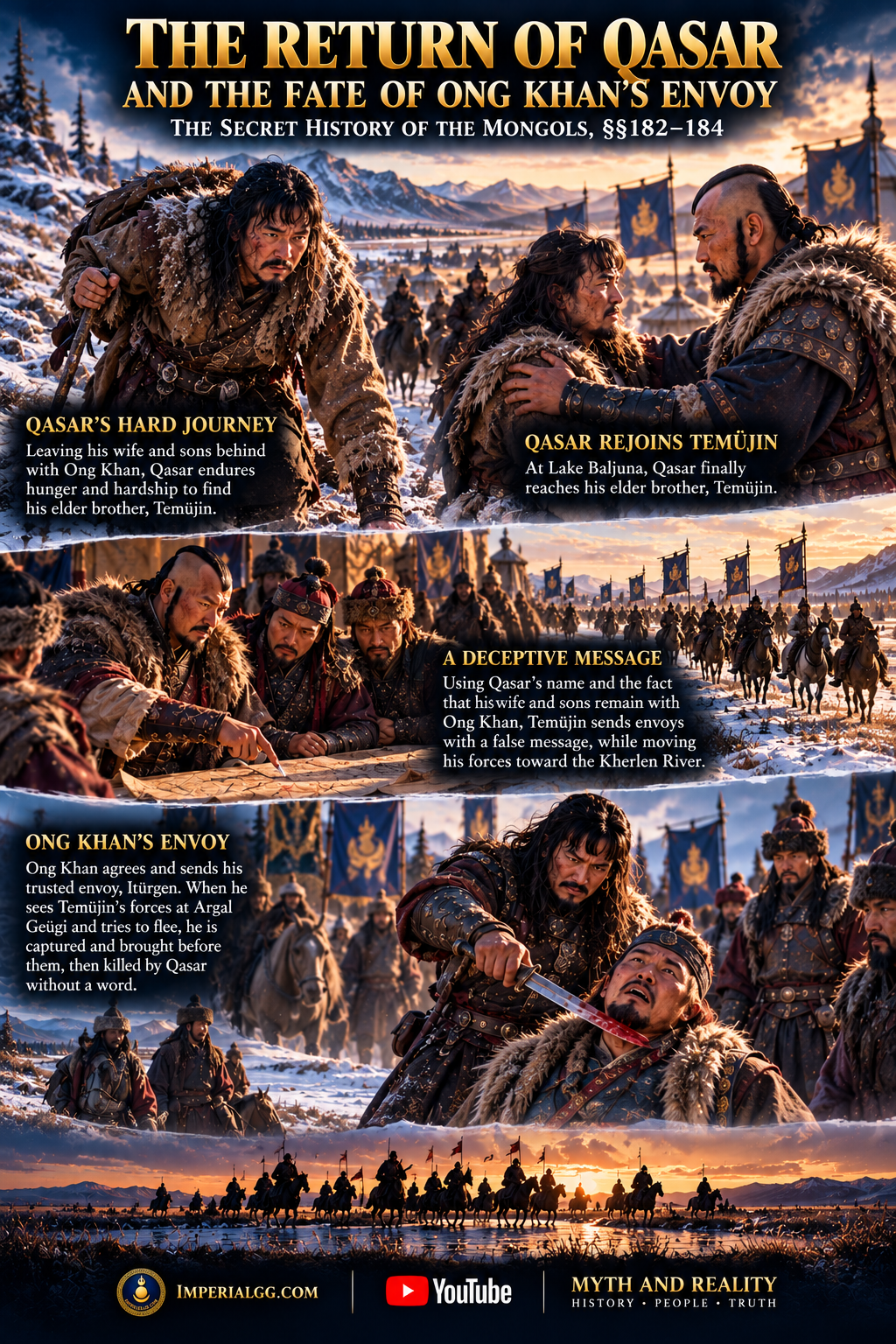
The Secret History of the Mongols — Sections 182–184
INTRODUCTION
In Sections 182–184 of The Secret History of the Mongols, the narrative presents a carefully coordinated operation in which communication, family ties, and military movement become parts of a single political strategy. The episode begins at Lake Baljuna, where Temüjin’s followers gather and Qasar returns to his elder brother. It then moves from a message ostensibly sent in Qasar’s name to a rendezvous on the Kherlen River, where Ong Khan’s trusted envoy, Itürgen, encounters evidence that exposes the danger concealed behind the apparent diplomatic exchange.
Read as a connected sequence, these sections are not simply a story of family reunion or an attempt to restore peaceful relations. They show Temüjin using the appearance of negotiation to conceal a military movement. The message gives Ong Khan a reason to believe that Qasar may return to him, while Temüjin and his forces move toward the agreed meeting place.
The distinction between what Ong Khan is led to believe and what Temüjin is actually doing is central to understanding the episode.
I. LAKE BALJUNA: THE REASSEMBLANCE OF TEMÜJIN’S FOLLOWING
The account first describes people arriving at Temüjin’s camp at Lake Baljuna. Among them is Tsoos Tsagaan of the Gorlos, who comes and joins him. The narrative also recounts the arrival of Hasan, a Sartaul merchant associated with a thousand sheep obtained from Alaqush-digith Quri of the Ongud. Hasan comes to water his flock at Baljuna and meets Temüjin.
These details establish the setting in which Temüjin’s political and military position is being reconstituted. The camp is not merely a temporary refuge. It is a place where followers, regional connections, and new opportunities converge at a moment of uncertainty.
Yet the most consequential arrival is that of Qasar. His return brings Temüjin into possession of a personal connection that can also be used in the wider political struggle with Ong Khan.
II. QASAR’S ABSENCE AND THE MESSAGE SENT IN HIS NAME
Qasar had remained in Ong Khan’s sphere of influence, with his wife and sons there. He eventually leaves them behind and sets out with several companions to search for Temüjin. After failing to find his brother’s trail in the mountains of Kharaun Jidun, he endures severe hardship before finally reaching him.
The narrative records Temüjin’s joy at Qasar’s return. But the political significance of the reunion emerges in what follows.
Temüjin arranges for Qali’udar and Čaqurqan to approach Ong Khan with a message presented as Qasar’s own words. The message describes Qasar’s unsuccessful search for his elder brother, his hardship, and his present condition. It also reminds Ong Khan that Qasar’s wife and sons remain with him. Qasar is represented as willing to return if Ong Khan will send someone whom he can trust.
The message is effective precisely because it draws on an existing relationship and a plausible personal predicament. Qasar’s family remains in Ong Khan’s possession or sphere of control, and the message offers a seemingly credible explanation for why Qasar might seek a way back.
But the reader knows something Ong Khan does not: Qasar has already reached Temüjin. The message is therefore not a straightforward account of Qasar’s current intentions. It is a diplomatic pretext constructed to produce a particular response from Ong Khan.
III. THE RENDEZVOUS AT ARGAL GEÜGI
The most revealing detail appears in the transition from the message to military action. After arranging the words to be delivered in Qasar’s name, Temüjin directs the envoys to meet him at Argal Geügi on the Kherlen River. He also sends Jürčedei and Arqai ahead to reconnoitre and immediately moves out from Lake Baljuna with his forces.
This sequence matters. Temüjin does not simply dispatch envoys and wait for Ong Khan’s answer. He coordinates their diplomatic mission with a military movement and establishes a rendezvous ahead of the main force’s arrival.
The operation thus has two simultaneous dimensions. On the surface, the envoys are carrying a message that appears to concern Qasar’s possible return. In practice, their mission forms part of a larger movement whose military purpose is not disclosed to Ong Khan.
The narrative does not require us to assume that every detail of the plan is explained openly. Its structure is enough to reveal the contrast: the message creates one expectation, while Temüjin’s actions prepare for another outcome.
IV. ONG KHAN’S RESPONSE AND ITÜRGEN’S FLIGHT
When Qali’udar and Čaqurqan reach Ong Khan, he is feasting in his Golden Tent, unaware of the military movement taking place elsewhere. Hearing the message presented as Qasar’s, he agrees that Qasar may come and sends his trusted man Itürgen as a guarantor or person of trust.
From Ong Khan’s perspective, the exchange appears to be a response to Qasar’s request. The dispatch of Itürgen gives the arrangement a formal and personal dimension: Ong Khan is not merely sending back an answer but entrusting a representative to accompany the envoys.
The deception begins to unravel when the party approaches the rendezvous at Argal Geügi. Itürgen sees signs of a large force in the distance and turns back in flight. His reaction reveals that the situation at the meeting place does not match the expectations created by the message.
The envoys pursue him, and he is eventually brought before Temüjin. The narrative then records that Temüjin orders him taken to Qasar, who kills him without first engaging him in conversation.
For the purposes of this analysis, the crucial point is not to turn Itürgen’s death into a separate study of Qasar’s character. That question deserves its own examination. Here, the incident functions as the culmination of the failed concealment: the trusted representative sent by Ong Khan encounters the military reality that the message had hidden.
V. THE POLITICAL LOGIC OF DECEPTION
The episode illustrates how diplomatic communication can be used not to restore a relationship but to manipulate an opponent’s expectations.
First, the message exploits a credible personal circumstance. Qasar’s wife and children remain with Ong Khan, making the proposed return plausible within the circumstances described by the chronicle.
Second, the message gives Ong Khan a reason to respond without treating the encounter as an imminent military confrontation. His decision to send Itürgen follows from the information he has received.
Third, Temüjin’s simultaneous movement of troops and deployment of scouts demonstrates that the diplomatic exchange is embedded in military preparation. The meeting place is not merely a neutral location for discussion; it is part of the operational sequence.
Finally, Itürgen’s flight exposes the gap between the apparent purpose of the mission and the situation he discovers. The text does not state that every element of Temüjin’s wider plan succeeded exactly as intended, and the episode should not be treated as proof of an entirely predictable outcome. It does, however, present a coordinated effort to conceal military movement behind a message of personal reconciliation.
VI. WHAT THE CHRONICLE ESTABLISHES—and WHAT IT DOES NOT
A careful reading must distinguish the narrative’s explicit statements from historical interpretation.
The chronicle explicitly describes Qasar’s return, the message delivered in his name, the agreement on a rendezvous, the dispatch of scouts, Temüjin’s movement with his forces, Ong Khan’s decision to send Itürgen, and the envoy’s flight after seeing the signs of a large force.
The interpretation that these actions form a coordinated deception is supported by their sequence and by the contrast between the message and Temüjin’s actual movement. The text does not need to label the operation with a modern military term for the strategic logic to be visible.
At the same time, the passage does not provide a full operational plan or explain every motive behind each decision. It is therefore more accurate to describe the episode as a deceptive diplomatic maneuver accompanying military preparations than to claim that the chronicle records every detail of a fully developed battle plan.
This distinction preserves the force of the evidence without attributing more to the source than it says.
CONCLUSION
Sections 182–184 portray a moment when the language of family loyalty becomes an instrument of political strategy. Temüjin uses a message attributed to Qasar to induce a response from Ong Khan, while arranging a rendezvous, sending scouts ahead, and moving his forces from Lake Baljuna toward the Kherlen River.
Ong Khan’s decision to send Itürgen demonstrates that the message has achieved its immediate purpose: it has elicited a response based on the expectation that Qasar may return. But the envoy’s flight at Argal Geügi reveals the danger concealed behind that expectation.
The episode is therefore not best understood as a failed attempt at diplomatic reconciliation. It is a narrative of deception in which a plausible personal appeal masks military preparation. Its significance lies in the coordination of message, movement, and timing—and in the vulnerability of a political leader who acts on information that has been deliberately shaped for him.
AUTHOR’S THESIS
In Sections 182–184 of The Secret History of the Mongols, Temüjin turns the circumstances of Qasar’s family separation into the basis of a deceptive diplomatic message. While Ong Khan is led to believe that Qasar may return, Temüjin arranges a rendezvous, sends scouts ahead, and moves his forces toward the Kherlen River. The arrival of Itürgen exposes the discrepancy between the apparent diplomatic purpose and the military reality. These sections reveal a central feature of Temüjin’s political strategy: diplomacy could serve not only to negotiate with an adversary, but also to shape the adversary’s expectations while military preparations proceeded out of view.
Primary source: The Secret History of the Mongols, §§182–184. The interpretation above follows the sequence of events in the chronicle, with modern strategic terminology used analytically rather than as a claim that the text itself employs such terminology.
IMPERIALGG.COM
MYTH AND REALITY — HISTORY • PEOPLE • TRUTH