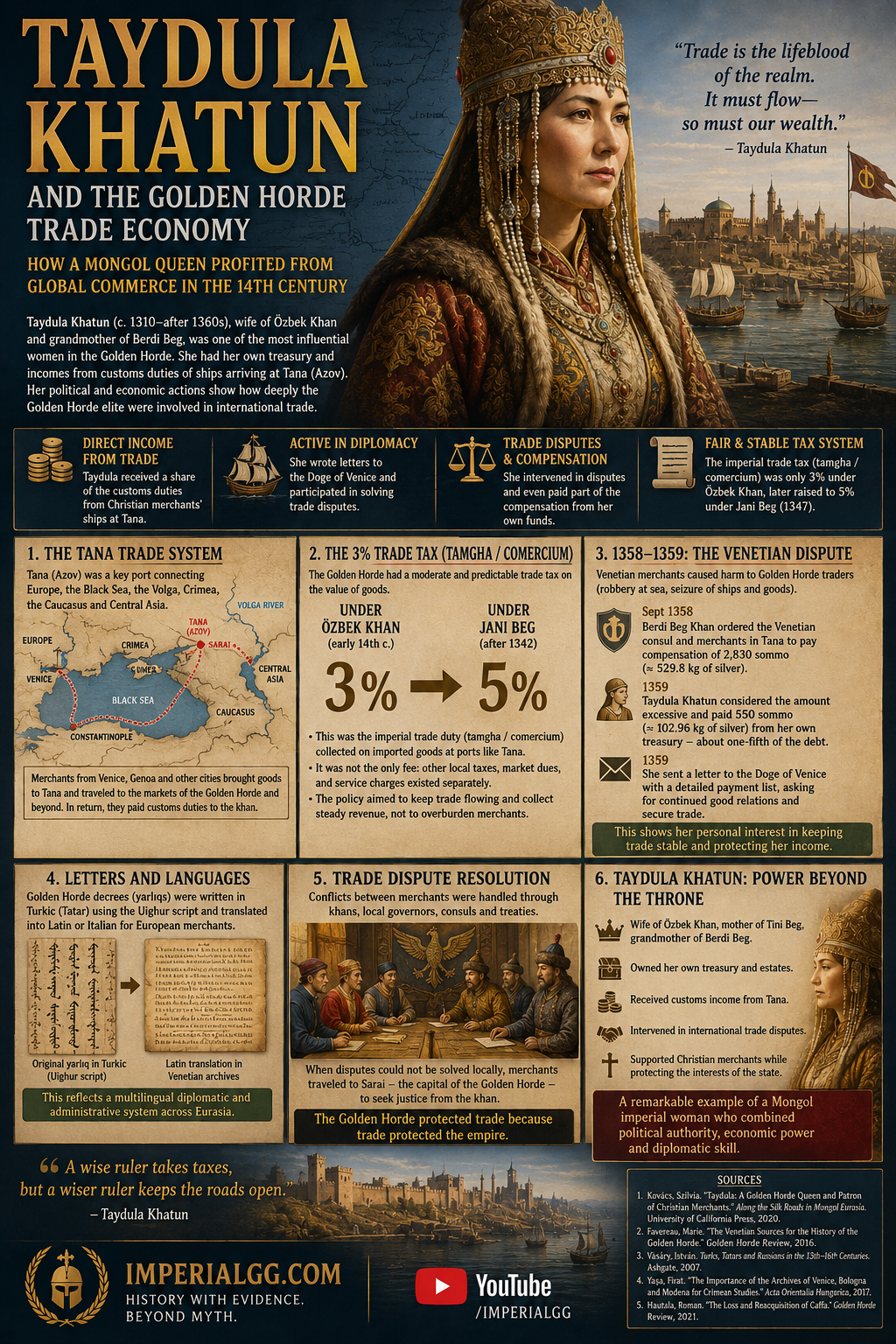
TAYDULA KHATUN AND THE GOLDEN HORDE’S TRADE ECONOMY
By Altanbagana Baatar
DBA Candidate| Independent Historian
ImperialGG Historical Research Seriers
12 August 2026
Trade Duties, Venetian Merchants, and Commercial Policy in the Fourteenth Century
The history of the Golden Horde in the fourteenth century cannot be understood solely through wars, dynastic succession, and political relations with European states. The Black Sea commercial network was one of the important foundations of the Jochid state’s economy, and women of the ruling dynasty could also participate actively in this system both economically and politically. Taydula Khatun, the wife of Özbek Khan and a woman who retained influence during the reigns of Jani Beg and Berdi Beg, provides one of the clearest examples. Modern scholarship views her not simply as a royal woman, but as an influential member of the Jochid court who possessed her own wealth and financial resources and who could participate directly in commercial affairs.[1]
Taydula and the Trade of Tana
One of the major commercial centers of the Golden Horde in the Black Sea region was Tana (Azaq/Azov), located at the mouth of the Don River. Venetian merchants and other Christian traders arrived there, connecting Black Sea maritime commerce with the Volga, Crimea, the Caucasus, Iran, and the inland routes of Eurasia. During the fourteenth century, these trade routes connected Sarai, Urgench, Almaliq, and the wider Central Asian world with the Black Sea ports, linking the markets of Europe with the commercial networks of the Eurasian interior.[2]
Taydula’s economic interests were directly connected to this commercial network. According to the research of Szilvia Kovács, a portion of the import customs revenue collected from Christian merchant ships arriving at Tana was allocated to Taydula’s own treasury. In 1358, her grandson Berdi Beg issued an order concerning the transfer of a specified amount from Taydula’s customs revenues to cover the expenses of the khan’s customs officials, providing direct evidence for the nature of her income.[3]
This demonstrates that Taydula had a direct financial interest in the prosperity of Black Sea commerce, rather than merely a political interest in it. The more stable the commercial flow, the more stable her income became. Consequently, protecting merchants, maintaining the functioning of the port, and resolving commercial disputes were closely connected to her own economic interests.[4]
What Was the “3 Percent Tax”?
One of the most interesting figures in the history of Golden Horde commercial policy is 3 percent. However, this should not be understood as meaning that “the Golden Horde imposed only a 3 percent tax on all trade.” The figure refers specifically to a royal commercial customs duty known as the tamgha, referred to in European documents as comercium.[5]
During the reign of Özbek Khan, the import customs duty imposed on Christian merchant ships at Tana was 3 percent, according to the surviving evidence. After Jani Beg came to power in 1342, this rate was increased to 5 percent.[6]
Therefore, the statement that “the Golden Horde had a 3 percent trade tax” is historically defensible if it is properly qualified. It would be incorrect, however, to state that “all taxes in the Golden Horde were 3 percent.” Other charges existed within the commercial environment, including fees associated with weighing, port services, and other customs or local payments. Research on the commercial policies of the Jochid state suggests that one important characteristic of the system was the use of relatively moderate charges to generate revenue from the continuous circulation of goods rather than imposing excessively high one-time burdens on merchants.[7]
The economic logic is straightforward. Instead of discouraging merchants with excessive taxation, maintaining commercial circulation and generating revenue from repeated transactions could provide a more stable source of income for both the state and the ruling elite.
Taydula and Venice
One of the most important pieces of evidence for Taydula’s direct involvement in international commerce is a letter she sent to the Doge of Venice in 1359. Among the Jochid documents preserved in Venetian archives are Taydula’s letter and records relating to the payments associated with it; the letter was translated into Latin for Venetian use.[8]
The correspondence arose from a dispute concerning damage inflicted on Golden Horde merchants by Venetian traders in 1353–1354. In September 1358, Berdi Beg ordered the Venetian consul and merchants at Tana to pay compensation. According to the research, the amount was 2,830 sommo, equivalent to approximately 529.8 kilograms of silver.[9]
Taydula considered the payment excessively burdensome for the Venetian trading community. She therefore paid 550 sommo, approximately 103 kilograms of silver, from her own treasury, assuming part of the financial burden herself. This represented roughly one-fifth of the total compensation.[10]
It would be insufficient to interpret Taydula’s intervention simply as an act of personal generosity. Her action demonstrates the intersection of political authority, commercial interests, and private financial considerations. Reducing the burden on Venetian merchants could help maintain the flow of commerce through Tana, while continued commercial activity was also beneficial to Taydula because she received income connected to customs duties.[11]
Her letter to the Doge of Venice also included a detailed account of the payments and the individuals to whom they had been made. The research indicates that the payment list survives separately from the letter but is clearly connected to it.[12]
Language, Script, and Multilingual Administration
These documents provide evidence not only for taxation and commerce but also for the multilingual administrative environment of fourteenth-century Eurasia.
Decrees and yarlıqs issued by the Golden Horde to Venice, Genoa, and other commercial centers were generally produced in Turkic using the Uighur script and could subsequently be translated into Latin or Italian for European merchants. István Vásáry has demonstrated that European archival records sometimes referred to the language of these documents as “Uighur,” although the actual language was a Turkic or Tatar language written in the Uighur script.[13]
One document associated with Taydula contains the formula “ex voluntate Berdibech,” meaning “by the will” or “with the consent of Berdi Beg.” This demonstrates that although Taydula could intervene directly in official matters, her authority operated within the framework of the khan’s political authority.[14]
Rather than simply stating that medieval interpreters were “multilingual geniuses,” it is more accurate academically to say that the Golden Horde operated within a multilingual and multi-script administrative environment. Translation and linguistic expertise were important institutional components of Mongol imperial administration.[15]
Who Resolved Commercial Disputes?
The Golden Horde’s commercial system did not merely collect taxes. It also regulated the rights and obligations of merchants through yarlıqs and agreements. Venetian and Genoese commercial communities negotiated privileges with the khans that established their trading rights, protection, and taxation arrangements. Marie Favereau’s research on Venetian sources demonstrates that Jochid elites did not regard merchants merely as taxpayers; members of the ruling elite also participated directly in commerce and finance.[16]
It would nevertheless be too broad to claim that the Golden Horde possessed a single, formal “international commercial arbitration council.” The surviving evidence instead indicates that commercial disputes could be handled at several levels, including the khan’s administration, local governors, the institutions of merchant communities, and consular authorities. Later fourteenth-century agreements in Crimea, for example, defined the jurisdictions of the Genoese consul, the authorities of Caffa, and the governor of Solkhat.[17]
This suggests that the Golden Horde’s commercial system was relatively institutionalized. Merchants’ rights were regulated not only through coercion but through contracts, taxation rules, administrative jurisdiction, and diplomatic relations.
Conclusion
Taydula’s history provides an exceptional window into the economic structure of the Golden Horde in the fourteenth century. As a royal woman, she was involved in political affairs, but she also received income connected to customs duties collected from Christian merchant ships at Tana. The prosperity of Black Sea commerce was therefore directly connected to her own financial interests.[18]
The surviving evidence indicates that the import customs duty on trade was 3 percent under Özbek Khan and later increased to 5 percent under Jani Beg. This should be understood as a specific commercial customs duty rather than the total tax burden imposed by the Golden Horde.[19]
Taydula’s 1359 letter to the Doge of Venice, her contribution of 550 sommo toward compensation, the customs revenues from Tana, the Jochid yarlıqs, and the Latin translations preserved in Venetian archives together reveal an important picture.
The Golden Horde did not merely tax merchants. It had an economic interest in ensuring that commerce continued to flow.
For Taydula, this relationship was particularly visible. Her income was connected to trade. Commercial disputes could create political problems. Those disputes therefore had to be resolved. The khatun was willing even to use her own resources to reduce the burden on merchants and maintain diplomatic relations with Venice.
The evidence challenges the image of the Golden Horde as merely a military power of the steppe.
It was also a commercial and diplomatic state deeply connected to the Black Sea, Europe, the Caucasus, Central Asia, and the wider Eurasian economy.
Taydula Khatun provides one of the clearest individual examples of this system.
Footnotes
[1] Szilvia Kovács, “Taydula: A Golden Horde Queen and Patron of Christian Merchants,” in Michal Biran, Jonathan Brack, and Francesca Fiaschetti, eds., Along the Silk Roads in Mongol Eurasia: Generals, Merchants, and Intellectuals (Berkeley: University of California Press, 2020), 194–212. Kovács emphasizes the political and economic independence of Mongol imperial women and Taydula’s direct involvement in trade and patronage.
[2] Kovács, “Taydula,” 194–199. The chapter identifies Tana as an important Black Sea trading center and places it within the wider commercial routes connecting the Golden Horde with Central Asia, Iran, and China.
[3] Ibid., 199. A 1358 decree of Berdi Beg required Taydula to transfer a specified amount of her customs income from Christian ships docking at Tana for the equipment of the khan’s customs collectors.
[4] Kovács argues that Taydula had a direct economic interest in the prosperity of Tana’s maritime trade because part of the import duties belonged to her treasury.
[5] Roman Hautala, “The Loss and Reacquisition of Caffa: The Status of the Genoese Entrepôt within the Borders of the Golden Horde,” Golden Horde Review 9, no. 2 (2021): 247–263. The study identifies the imperial trade duty as khan tamghasy and discusses its relation to the European term comercium.
[6] The customs rate was 3 percent during Özbek Khan’s reign and increased to 5 percent after Jani Beg came to power in 1342. See also the reconstruction of Jani Beg’s 1342 and 1347 yarlıqs to Venetian merchants.
[7] Marie Favereau, “The Venetian Sources for the History of the Golden Horde: New Research Perspectives,” Golden Horde Review 4, no. 1 (2016): 39–54. Favereau emphasizes the contractual framework governing trade and the active economic participation of Jochid elites.
[8] Firat Yaşa, “The Importance of the Archives of Venice, Bologna and Modena for Crimean Studies,” Acta Orientalia Academiae Scientiarum Hungaricae 70 (2017). The study records Taydula’s 1359 letter to the Venetian Doge and notes that Latin translations of Golden Horde documents were preserved in Venetian chancery collections.
[9] Kovács, “Taydula,” 199. In September 1358 Berdi Beg ordered the Venetian consul and merchants of Tana to pay compensation; Kovács gives the amount as 2,830 sommo, approximately 529.8 kg of silver.
[10] Ibid. Taydula paid 550 sommo, approximately 102.96 kg of silver, amounting to roughly one-fifth of the Venetian debt described in the source.
[11] Kovács interprets Taydula’s intervention as potentially serving several purposes: strengthening her reputation as a patron of Christians, improving relations between Venice and the Golden Horde, and possibly protecting her own economic interests in Black Sea trade.
[12] The 1359 letter was accompanied by a detailed payment list. Kovács notes that the letter and payment list are preserved separately but are clearly connected; the list records payments made by Taydula to various recipients.
[13] István Vásáry, Turks, Tatars and Russians in the 13th–16th Centuries (Aldershot: Ashgate, 2007), discussion of Golden Horde chancery documents and their Latin translations. Vásáry explains that the original Turkic/Tatar documents were written in Uighur script, while European records sometimes misleadingly referred to the language itself as “Uighur.”
[14] Vásáry notes the formula “ex voluntate Berdibech” in one Taydula document, demonstrating that her official intervention operated within the authority of Berdi Beg.
[15] Vásáry emphasizes the exceptionally multilingual character of Mongol imperial administration and the institutional importance of interpreters and translators.
[16] Favereau, “The Venetian Sources for the History of the Golden Horde,” 39–54. Venetian and Genoese agreements with the Jochid rulers established the legal status of foreign merchants and their commercial activities.
[17] A. V. Dzhanov, “The Tatar-Genoese Treaties of 1380 and 1381,” Golden Horde Review 8, no. 4 (2020): 675–713. The treaties specify different jurisdictions involving the Genoese consul, Caffa authorities, and the governor of Solkhat.
[18] Kovács, “Taydula,” 194–212.
[19] The 3 percent figure should therefore be described specifically as a trade/customs duty, not as the total tax burden imposed by the Golden Horde. The rate changed to 5 percent under Jani Beg, while other charges and fixed duties existed separately.