
Mongolia Marks World Horse Day with One of the Largest Mounted Gatherings in Modern History
By Altanbagana Baatar
DBA Candidate| Independent Historian
ImperialGG Historical Research Seriers
14 July 2026
Mongolia's World Horse Day 2026: A Historic Celebration of the World's Oldest Equestrian Tradition
Published: 15 July 2026
Category: Culture | History | Mongolia | Nomadic Civilization
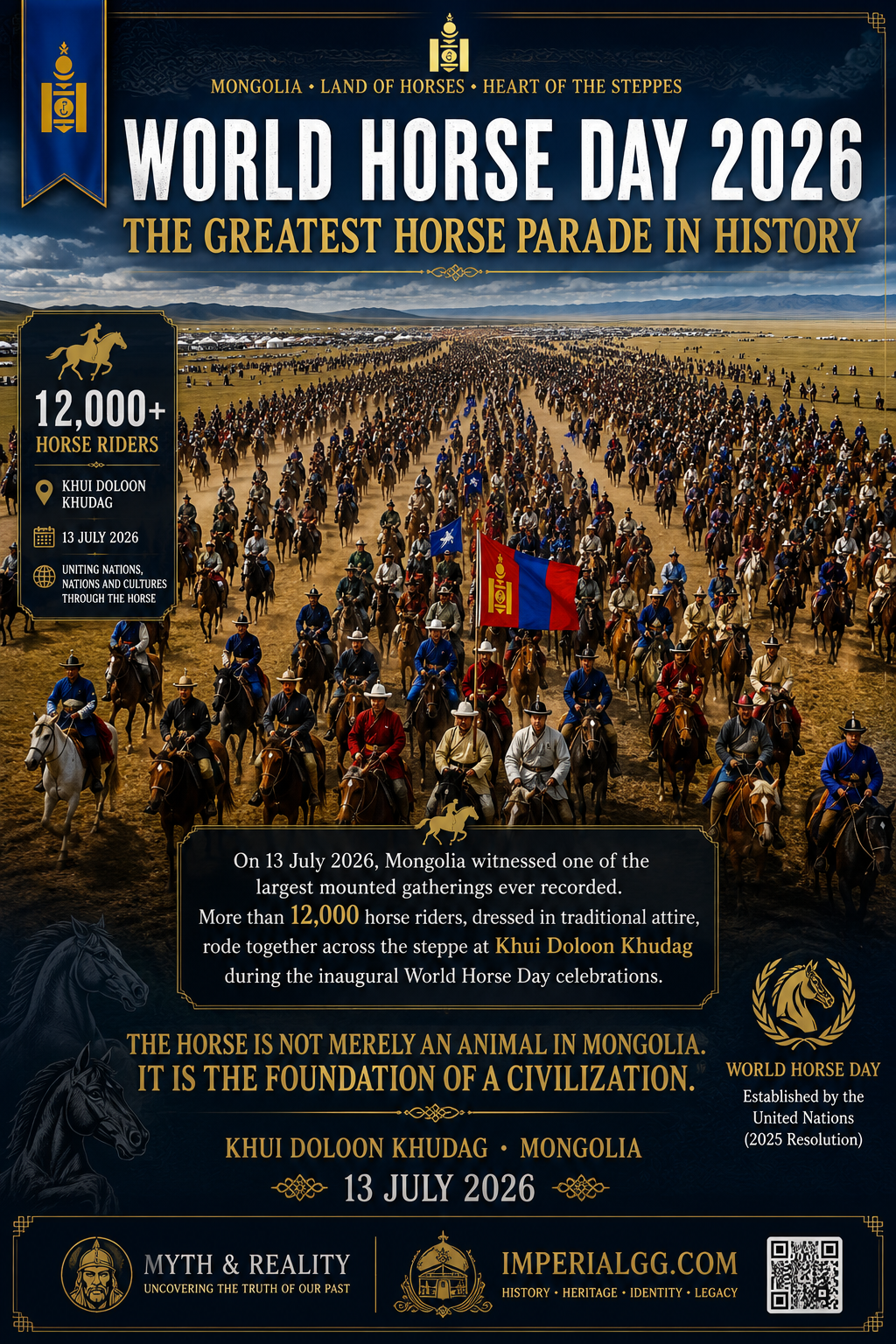
On 13 July 2026, Mongolia hosted one of the most remarkable equestrian events of the twenty-first century. At Khui Doloon Khudag, thousands of horse riders gathered for the inaugural World Horse Day, presenting a spectacular demonstration of a tradition that has shaped the history, identity, and civilization of the Mongolian people for millennia.
The gathering brought together riders from every corner of the country, representing different provinces, communities, and generations. Dressed in traditional Mongolian attire and mounted on the hardy horses that have accompanied the nomadic peoples of the Eurasian steppe for centuries, they created an unforgettable scene that attracted worldwide attention.
Although remarkable for its scale, the event’s true significance lies not in the number of participants, but in what it represents: the enduring relationship between the Mongolian people and the horse.
The Horse as the Foundation of a Civilization
Few societies have depended upon the horse as profoundly as Mongolia.
Across the vast grasslands of Inner Asia, mobility was essential for survival. Long before the emergence of modern transportation, the horse enabled families to migrate seasonally, herd livestock across immense distances, maintain communication between distant communities, and adapt to one of the world’s most demanding natural environments.
For Mongolians, the horse has never been regarded merely as an animal of transport. It has been a trusted companion, a source of livelihood, a military partner, and an enduring symbol of freedom.
Children traditionally learn to ride from an early age, and horsemanship remains a defining feature of rural life. Skills developed over generations continue to be passed from parents to children, preserving customs that have survived despite dramatic political, economic, and technological change.
Horses and the Rise of the Steppe Empires
The history of the Eurasian steppe cannot be understood without understanding the horse.
From the early pastoral cultures of Mongolia to the rise of the Xiongnu Confederation, successive nomadic societies built political systems capable of governing enormous territories. Their mobility allowed rapid communication, effective military organization, and economic integration across thousands of kilometers.
This tradition reached its greatest expression during the thirteenth century with the expansion of the Mongol Empire under Chinggis Khan and his successors.
The remarkable speed with which Mongol armies travelled astonished contemporary observers. Imperial messengers crossed continents through the famous Yam postal network, while cavalry units moved with extraordinary efficiency over terrain that challenged sedentary armies.
The Mongolian horse made these achievements possible.
Small but exceptionally resilient, capable of enduring severe winters, long-distance travel, and limited forage, the native Mongolian horse became one of history’s most effective military and transport animals. Its endurance transformed the political geography of Eurasia and contributed to the creation of the largest contiguous land empire in world history.
A Living Tradition, Not a Museum Exhibit
Unlike many ancient traditions that survive only through archaeological remains or historical documents, Mongolia’s horse culture remains a living reality.
Across the country, families continue to raise horses using traditional pastoral methods. Seasonal migrations, long-distance riding, horse racing, and herding remain integral parts of everyday life in many rural communities.
The annual Naadam Festival continues to celebrate horse racing as one of Mongolia’s “Three Manly Games,” while local festivals throughout the country preserve regional riding traditions, saddle craftsmanship, and equestrian customs.
This continuity is one of Mongolia’s greatest cultural achievements.
Rather than reconstructing an ancient tradition, Mongolians continue to live it.
World Horse Day and International Recognition
The 2026 celebration demonstrated that Mongolia’s equestrian heritage is increasingly recognized as part of humanity’s shared cultural legacy.
The gathering at Khui Doloon Khudag brought international attention to the historical importance of horses in human civilization and highlighted Mongolia’s unique contribution to preserving one of the world’s oldest continuous horse cultures.
In an era of rapid urbanization and technological change, such events remind the global community that cultural heritage is not confined to monuments or museums. Living traditions, practiced by ordinary people, are equally worthy of preservation and appreciation.
World Horse Day therefore serves not only as a celebration of Mongolia but also as a tribute to the profound relationship between humans and horses throughout history.
Why the Mongolian Horse Still Matters
Modern technology has replaced horses in most aspects of transportation and warfare.
Yet in Mongolia, the horse remains deeply woven into national identity.
It appears in literature, music, oral tradition, state symbolism, sports, and everyday language. It continues to represent endurance, independence, resilience, and the intimate connection between people and the natural world.
For historians, the Mongolian horse also offers a reminder that geography, environment, and culture can shape the course of world history as profoundly as kings, generals, or political institutions.
Without the horse, the story of Inner Asia—and indeed much of Eurasian history—would have been fundamentally different.
Looking Toward the Future
The success of the 2026 World Horse Day celebration demonstrates that Mongolia’s equestrian heritage continues to inspire audiences far beyond its borders.
As interest in cultural heritage, sustainable traditions, and nomadic history continues to grow, Mongolia possesses a unique opportunity to share its living horse culture with the world through education, scholarship, tourism, cultural exchange, and international cooperation.
The image of thousands of riders crossing the open steppe is more than an impressive spectacle.
It is a reminder that some of humanity’s oldest traditions remain alive—not as relics of the past, but as vibrant expressions of cultural identity in the present.
Conclusion
The gathering at Khui Doloon Khudag on 13 July 2026 was more than a record-setting equestrian event.
It was a celebration of continuity between past and present, honoring a partnership between humans and horses that has endured for thousands of years.
For Mongolia, the horse remains far more than a symbol.
It is the foundation upon which a civilization was built.
As the riders crossed the steppe beneath the vast Mongolian sky, they carried forward a tradition that continues to connect generations, preserve history, and remind the world that some of civilization’s greatest achievements began on horseback.
About ImperialGG
ImperialGG.com is dedicated to exploring the history, heritage, archaeology, and civilizations of the Eurasian Steppe. Through scholarly research and accessible storytelling, we seek to present the rich historical legacy of Mongolia and its neighboring cultures to a global audience.
Myth & Reality is ImperialGG’s educational series examining historical narratives through evidence-based research, archaeology, and comparative historical analysis.