
From Moghulistan to the Successor Khanates
By Altanbagana Baatar
DBA Candidate| Independent Historian
ImperialGG Historical Research Seriers
14 July 2026
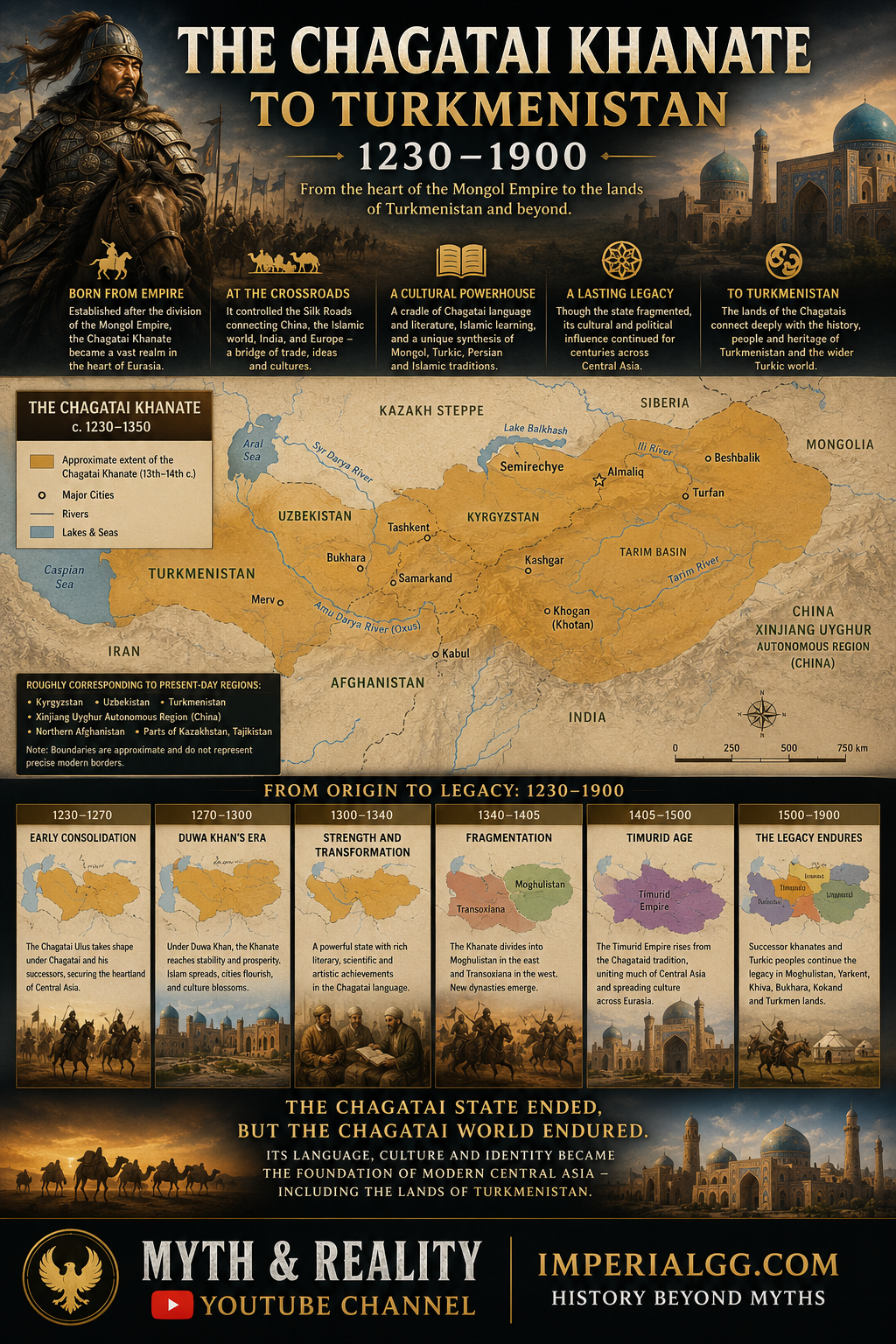
The fragmentation of the Chagatai world did not mark its disappearance. Instead, it gave rise to a series of successor states that reshaped the political landscape of Central Asia.
The Kazakh Khanate emerged in the mid-fifteenth century when Kerei Khan and Janibek Khan led groups of nomads from the Uzbek Khanate into eastern Moghulistan, where they received the support of Esen Buqa II. From this new base, they established a polity that gradually evolved into the Kazakh Khanate.
At the same time, other successor states—including the Yarkent Khanate, the Uzbek Khanate, the Khanate of Bukhara, the Khanate of Khiva, and later the Khanate of Kokand—developed within the broader political and cultural environment shaped by the Chagataid world.
Although these states followed different historical paths, they inherited many institutions, traditions of Chinggisid legitimacy, and political cultures that had evolved during the centuries of Chagatai rule.
The Chagatai state disappeared, but the Chagatai world continued to shape Central Asia for centuries.
Historical Timeline
- 1348 – Moghulistan established.
- 1465–1466 – Kerei and Janibek founded the Kazakh Khanate in eastern Moghulistan.
- 1514 – Yarkent Khanate established by Sultan Said Khan.
- 1500 – Uzbek rule consolidated under Muhammad Shaybani Khan.
- 1599 – Khanate of Bukhara under the Janid (Astrakhanid) dynasty.
- 1511 – Khiva emerged as an independent khanate under the Arabshahids.
- 1709 – Khanate of Kokand founded in the Fergana Valley.
Esen Buqa II and the Birth of the Kazakh Khanate
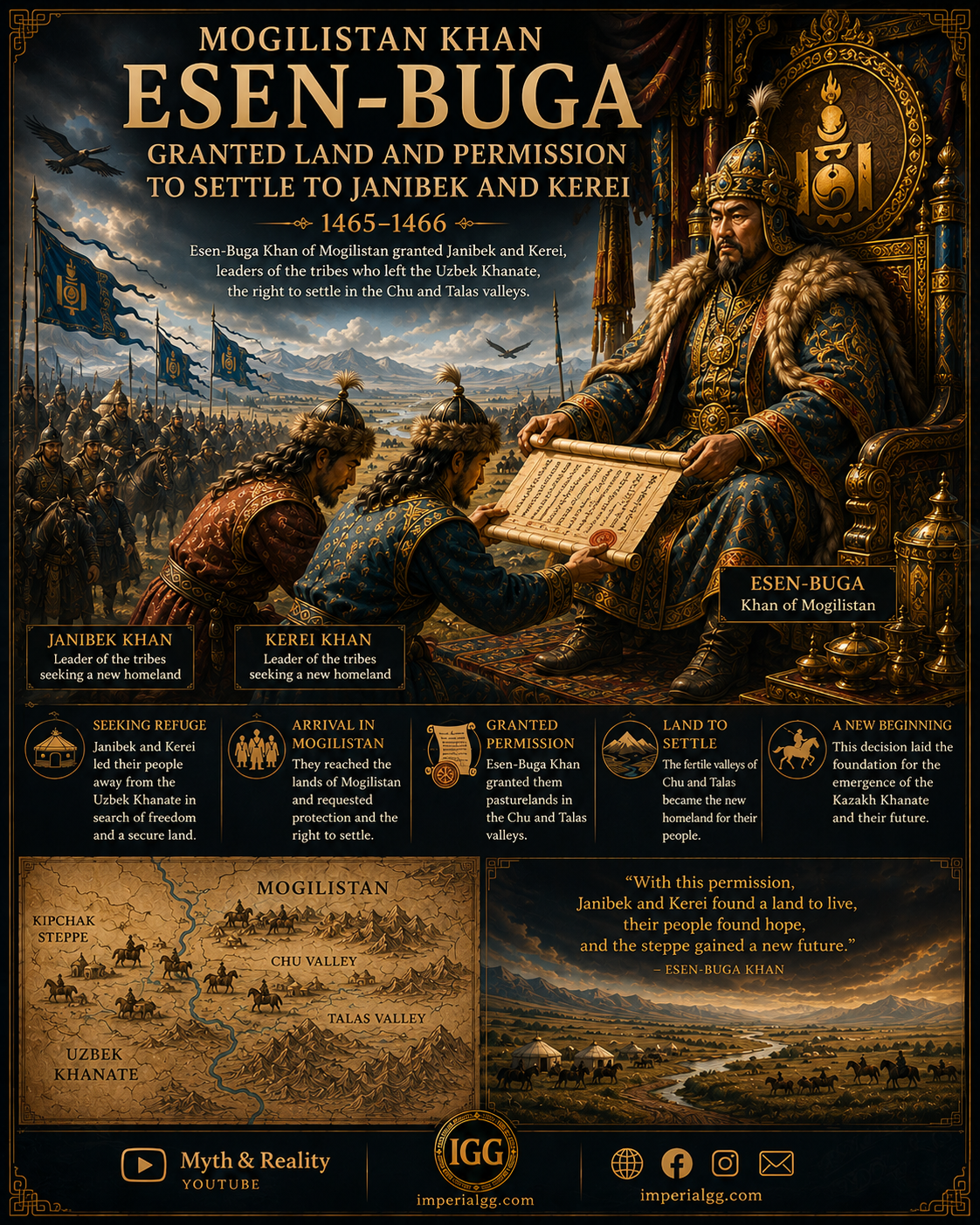
The emergence of the Kazakh Khanate in the fifteenth century was closely connected to the political decisions of Esen Buqa II, the ruler of the eastern Chagatai Khanate (Moghulistan). During the 1450s and early 1460s, the steppe was dominated by the powerful Uzbek ruler Abu’l-Khayr Khan, whose authority faced increasing opposition from several Chinggisid princes.
Among those who rejected Abu’l-Khayr’s rule were Janibek and Kerei, descendants of Urus Khan. Accompanied by thousands of followers, they migrated eastward into the territory of Moghulistan, seeking both refuge and political support. Recognizing an opportunity to weaken his rival, Esen Buqa II welcomed the two princes and granted them pasturelands in the Chu and Talas valleys.
Although the grant was primarily a strategic decision intended to counter Abu’l-Khayr’s growing influence, it had consequences far beyond regional diplomacy. From their new base in the Chu region, Janibek and Kerei consolidated their supporters, attracted additional nomadic tribes dissatisfied with Abu’l-Khayr’s rule, and established an independent political community.
Following Abu’l-Khayr Khan’s death in 1468, the authority of Janibek and Kerei expanded rapidly. Their polity evolved into what historians generally recognize as the Kazakh Khanate, traditionally dated to 1465–1466. Over the following centuries, it became one of the principal successor states of the Golden Horde and a dominant political force across the Kazakh steppe.
Esen Buqa II’s decision illustrates how alliances and political calculations often produced unintended historical consequences. What began as a measure to balance power between rival steppe rulers ultimately facilitated the rise of a new khanate whose legacy continues to shape the history and identity of Kazakhstan.
Historical Significance
- Esen Buqa II provided refuge and territory to Janibek and Kerei after their break with Abu’l-Khayr Khan.
- The Chu–Talas region became the nucleus of the emerging Kazakh political community.
- The migration of Janibek and Kerei marked the beginning of an independent Kazakh state.
- The establishment of the Kazakh Khanate reshaped the political landscape of Central Asia and became a defining chapter in the history of the Eurasian steppe.
The Chagatai Khanate (1270–1300): Consolidation in Central Asia
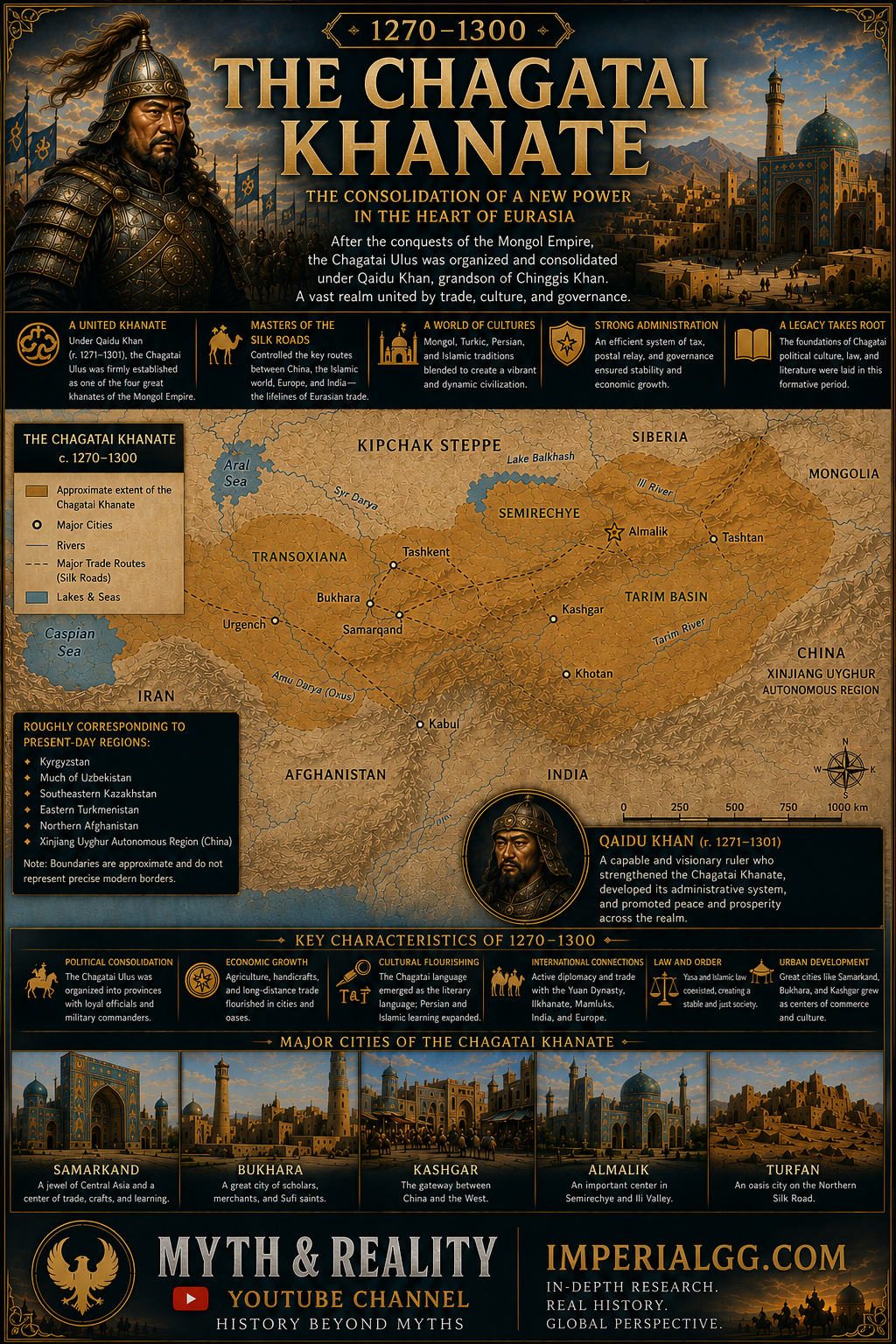
Between 1270 and 1300, the Chagatai Khanate emerged as one of the four major successor states of the Mongol Empire. Founded upon the lands originally assigned to Chagatai, the second son of Genghis Khan, the khanate stretched across much of Central Asia, including modern Kazakhstan, Kyrgyzstan, Uzbekistan, Tajikistan, southern Kazakhstan, eastern Turkmenistan, and parts of western China.
During this period, the Chagatai Khanate underwent significant political transformation. The accession of Duwa Khan in 1282 marked the beginning of a more stable era after decades of internal succession struggles. An able statesman and military leader, Duwa strengthened central authority, restored political cohesion, and expanded the khanate’s influence throughout Central Asia.
The Chagatai rulers maintained control over the vital caravan routes of the Silk Road, linking East Asia with the Islamic world and Europe. Cities such as Almaliq, Kashgar, Samarkand, Bukhara, and Otrar flourished as centers of commerce, diplomacy, scholarship, and cultural exchange. Trade in silk, horses, precious metals, textiles, spices, and other luxury goods generated considerable wealth and reinforced the khanate’s strategic importance.
Relations with neighboring Mongol states were often shaped by rivalry and shifting alliances. The Chagatai Khanate competed with the Yuan Dynasty in China, the Ilkhanate in Persia, and the Golden Horde across the western steppe, while also seeking to preserve the political legacy of the Mongol Empire. Conflicts over frontier regions, commercial routes, and influence in Central Asia remained common throughout the late thirteenth century.
Despite these rivalries, the Chagatai Khanate preserved many institutions established under Genghis Khan. The Mongol aristocracy continued to dominate military and political affairs, while the Yassa, customary steppe traditions, and administrative practices inherited from the empire remained influential. At the same time, interaction with settled Muslim populations encouraged increasing cultural and economic integration, laying the foundations for the gradual Islamization of the khanate during the fourteenth century.
By 1300, the Chagatai Khanate had become a stable and influential power at the heart of Eurasia. Its strategic location, control of transcontinental trade, and preservation of Mongol political traditions made it a crucial bridge between East and West, ensuring that the legacy of the Mongol Empire continued to shape the history of Central Asia long after the death of Genghis Khan.
The Chagatai Khanate (1300–1340): Power, Trade, and Transformation
The first four decades of the fourteenth century marked a period of both strength and gradual transformation for the Chagatai Khanate. Occupying the heart of Central Asia, the khanate remained one of the principal successor states of the Mongol Empire, controlling a vast territory that connected the Eurasian steppe with the prosperous oasis cities of Transoxiana and the Silk Road.
Following the reign of Duwa Khan (1282–1307), his successors sought to preserve political stability while maintaining influence over the trade routes linking China, the Middle East, and Europe. Although succession disputes occasionally weakened central authority, the Chagatai rulers retained control over strategically important regions, including the Ili Valley, Semirechye, the Chu and Talas basins, Kashgar, and much of Transoxiana.
The khanate prospered through long-distance commerce. Merchants traveled safely across Mongol-controlled territories under the protection of the Pax Mongolica, transporting silk, horses, textiles, precious metals, spices, paper, and luxury goods. Major cities such as Samarkand, Bukhara, Kashgar, Almaliq, and Otrar became thriving centers of trade, craftsmanship, diplomacy, and intellectual exchange, linking East Asia with the Islamic world.
Politically, the Chagatai Khanate maintained complex relations with the Yuan Dynasty, the Ilkhanate, and the Golden Horde. Alliances and rivalries shifted according to changing regional interests, while disputes over frontier territories and commercial routes remained common. Despite these challenges, the Chagatai rulers continued to regard themselves as legitimate heirs of Genghis Khan and upheld the prestige of the Borjigin dynasty.
The early fourteenth century also witnessed important cultural developments. While the Mongol elite preserved many traditional steppe institutions and the legal principles associated with the Yassa, increasing contact with the predominantly Muslim populations of Central Asia encouraged greater cultural integration. Islamic influence steadily expanded among the nobility, administrators, and urban communities, setting the stage for the more extensive Islamization that would characterize the khanate later in the century.
By 1340, however, signs of political fragmentation had begun to emerge. Rival branches of the royal family competed for power, and the balance between nomadic aristocrats and the wealthy urban centers became increasingly fragile. These internal tensions would eventually contribute to the division of the khanate into eastern and western spheres during the mid-fourteenth century.
Despite these growing challenges, the Chagatai Khanate remained one of the most influential powers in Central Asia between 1300 and 1340, preserving the political traditions of the Mongol Empire while serving as a vital crossroads of commerce, culture, and diplomacy across Eurasia.
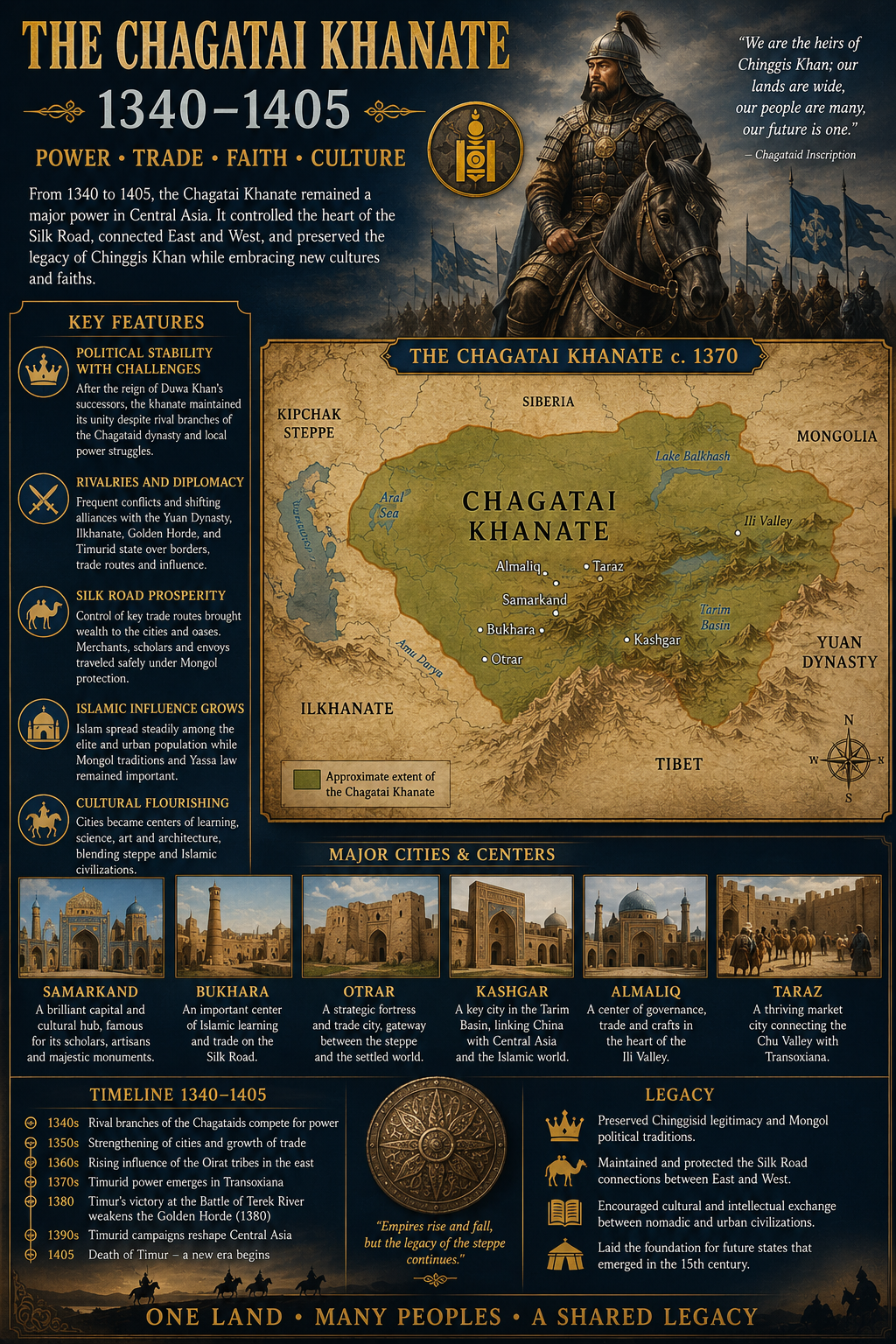
The Chagatai Khanate (1340–1405): Decline, Division, and the Rise of Timur
The period between 1340 and 1405 was one of the most turbulent chapters in the history of the Chagatai Khanate. Once a unified successor state of the Mongol Empire, the khanate experienced political fragmentation, regional rivalries, and the emergence of powerful new leaders who transformed the balance of power across Central Asia.
By the mid-fourteenth century, disputes among rival branches of the Chagataid royal family had weakened central authority. The vast territory of the khanate gradually divided into two distinct political regions. In the west, Transoxiana came under the growing influence of powerful tribal amirs, while the eastern territories developed into what became known as Moghulistan, where Chagataid khans continued to rule with the support of nomadic tribes.
One of the most significant turning points came with the rise of Timur (Tamerlane). Although not a descendant of Genghis Khan, Timur secured political legitimacy by ruling in the name of Chagataid puppet khans while exercising real military and administrative authority. Beginning in the 1370s, he united Transoxiana and launched a series of campaigns that established one of the largest empires of the late medieval world.
Timur’s armies defeated rival powers across Central Asia, Persia, the Caucasus, northern India, and the Near East. His victory over Tokhtamysh of the Golden Horde at the Battle of the Terek River (1395) dramatically altered the political landscape of the Eurasian steppe, weakening the Golden Horde and strengthening Timurid influence throughout the region.
Meanwhile, eastern Moghulistan remained under the Chagataid dynasty. Although frequently challenged by Timur’s campaigns and internal tribal rivalries, the eastern khans preserved the political traditions of the House of Chagatai and continued to control important routes linking Central Asia with China.
Despite continuous warfare, the great cities of Samarkand, Bukhara, Kashgar, Almaliq, and Otrar remained vital centers of commerce and culture. Under Timur, Samarkand was transformed into an imperial capital renowned for its magnificent architecture, scholarship, and international trade. The movement of merchants, artisans, and scholars across Eurasia continued to strengthen cultural exchange despite ongoing political conflict.
The death of Timur in 1405 marked the end of an extraordinary era. Although his empire remained under the Timurids, the political landscape of Central Asia had been permanently reshaped. The unified Chagatai Khanate had disappeared, yet its dynastic traditions, institutions, and Chinggisid legacy continued to influence both the Timurid rulers and the emerging states that would dominate Central Asia during the fifteenth century.
Historical Significance
- The Chagatai Khanate divided into western Transoxiana and eastern Moghulistan.
- Timur rose to power while governing through Chagataid legitimacy.
- The Timurid Empire became the dominant power in Central Asia.
- Moghulistan preserved the eastern branch of the Chagataid dynasty.
- The political and cultural legacy of the Chagatai Khanate continued to shape Central Asian history long after the khanate itself ceased to exist.
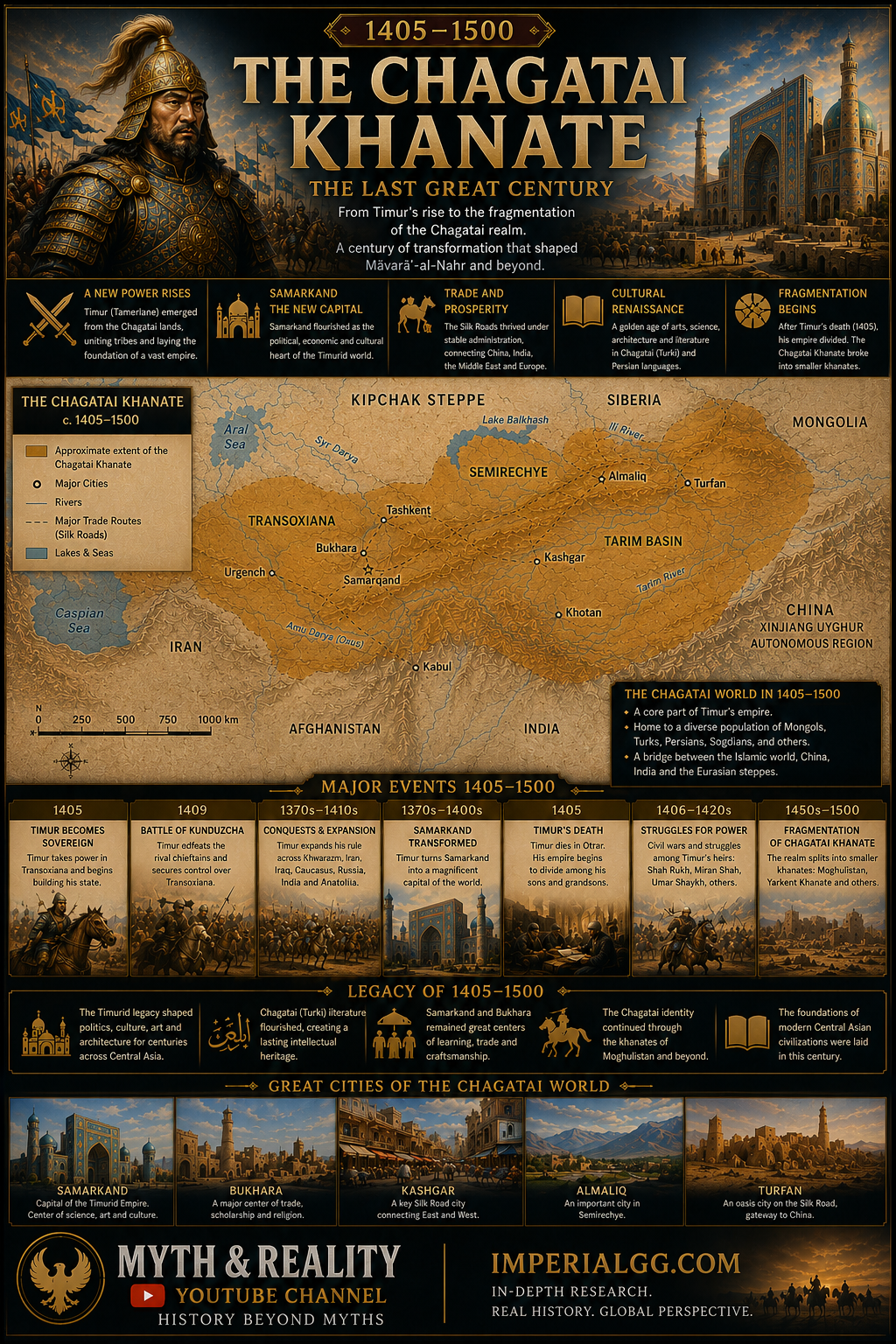
Central Asia After Timur (1405–1500): The Chagatai Legacy and the Rise of New Khanates
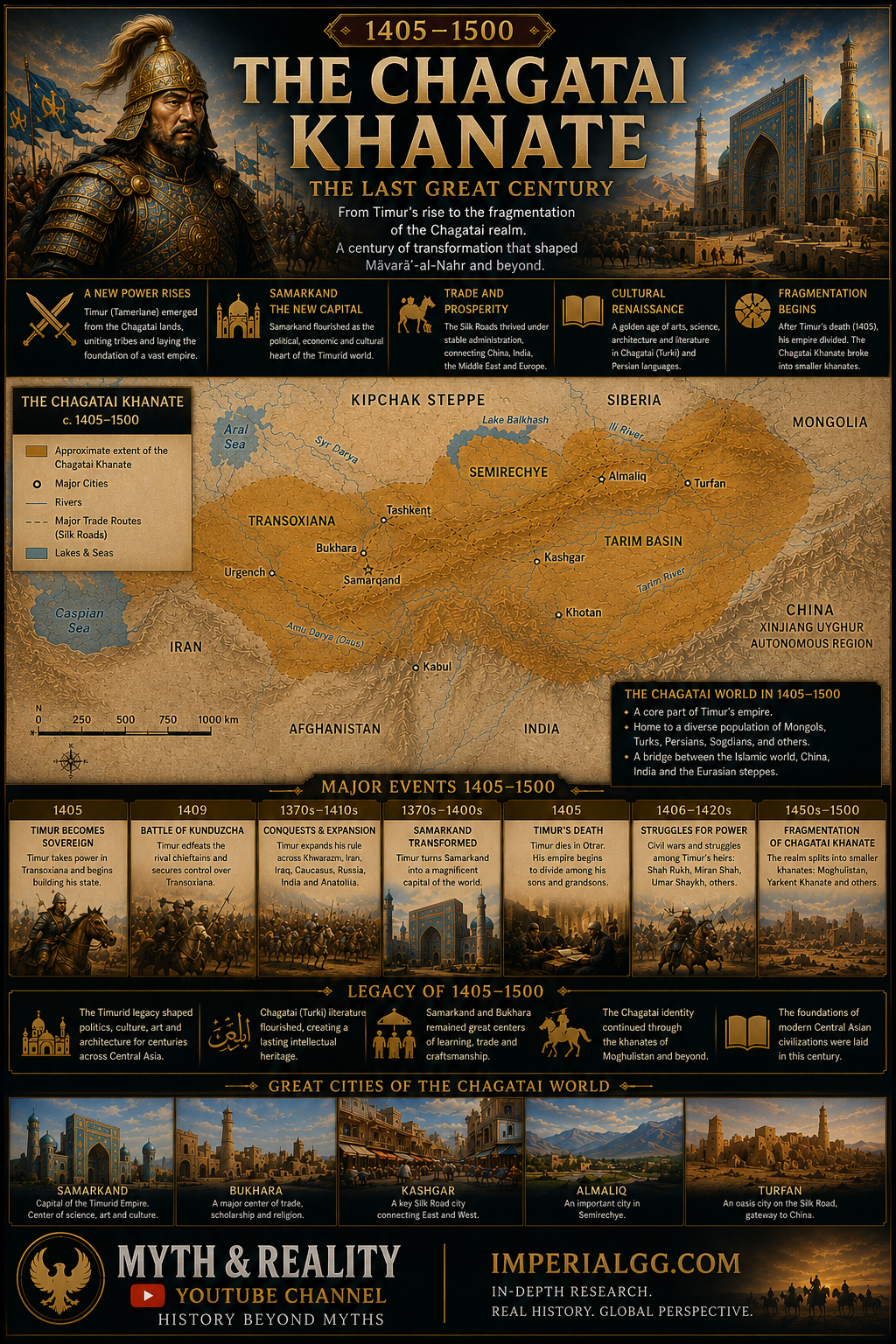
The death of Timur (Tamerlane) in 1405 marked the beginning of a new political era in Central Asia. Although the Timurid Empire remained a major power under Timur’s descendants, authority over the former lands of the Chagatai Khanate became increasingly fragmented. Chinggisid legitimacy continued to play a central role in regional politics, and rulers frequently claimed descent from Genghis Khan to strengthen their authority.
In the eastern regions, Moghulistan, often regarded as the eastern successor of the Chagatai Khanate, remained under Chagataid rulers. The khans governed the Ili Valley, Semirechye, and parts of the Tarim Basin, relying on alliances with powerful nomadic tribes while competing with neighboring states for control of trade routes and pasturelands. Although political authority fluctuated, the Chagataid dynasty remained an important symbol of legitimacy throughout the fifteenth century.
Western Central Asia was dominated by the Timurid Empire, whose rulers transformed cities such as Samarkand and Herat into renowned centers of architecture, science, literature, and Islamic scholarship. At the same time, Timurid princes engaged in frequent dynastic struggles, weakening the empire and creating opportunities for new political powers to emerge across the steppe.
One of the most significant developments of the fifteenth century was the rise of Abu’l-Khayr Khan, who united many of the nomadic Uzbek tribes into a powerful confederation. His growing influence extended across much of the western steppe, but opposition among several Chinggisid princes eventually led to a major political realignment.
During the 1450s and early 1460s, the princes Janibek and Kerei, descendants of Urus Khan, departed from Abu’l-Khayr’s realm with thousands of followers. They found refuge in Moghulistan, where Esen Buqa II granted them pasturelands in the Chu and Talas valleys. From this new base, they established an independent political community that is traditionally recognized as the beginning of the Kazakh Khanate around 1465–1466.
Meanwhile, the eastern Chagataid rulers continued to compete with the Oirats, the Timurids, and other regional powers. Despite political fragmentation, Mongol traditions of governance, Chinggisid legitimacy, and the interconnected trade networks of Central Asia remained influential throughout the century.
By 1500, the political landscape of Central Asia had been fundamentally reshaped. The Timurid Empire had entered a period of decline, the Kazakh Khanate had emerged as a major power in the steppe, the Uzbek Khanate under Muhammad Shaybani was expanding into Transoxiana, and Moghulistan continued to preserve the eastern branch of the Chagatai legacy. Although the unified Chagatai Khanate no longer existed, its political institutions, dynastic traditions, and cultural influence continued to shape the history of Central Asia for generations.
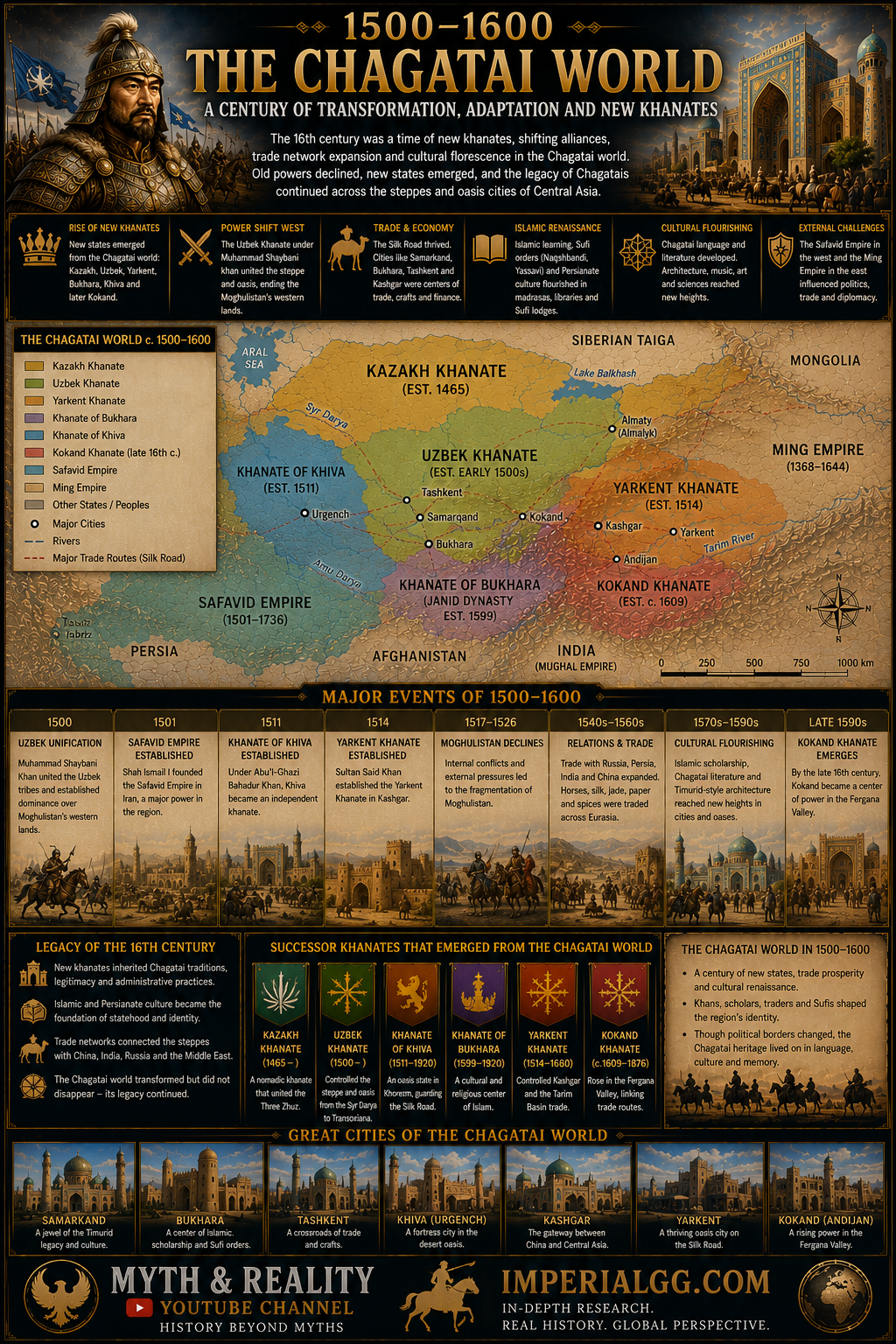
Central Asia (1500–1600): The Legacy of the Chagatai Khanate
The sixteenth century witnessed the emergence of a new political order in Central Asia. Although the Chagatai Khanate had ceased to exist as a unified state, its dynastic traditions, administrative institutions, and Chinggisid legitimacy continued to shape the region. Successor states, including the Moghul Khanate (Moghulistan), the Kazakh Khanate, and the Shaybanid Uzbek Khanate, all claimed political authority through their connections to the Mongol imperial heritage.
At the beginning of the century, Muhammad Shaybani Khan united the Uzbek tribes and conquered Transoxiana, capturing Samarkand and Bukhara from the Timurids. The Shaybanids established a powerful Uzbek state that dominated much of present-day Uzbekistan and neighboring regions. Bukhara gradually emerged as one of the leading political, commercial, and religious centers of Central Asia.
To the east, the descendants of the Chagatai dynasty continued to rule the Moghul Khanate, centered in the Ili Valley, Semirechye, and the Tarim Basin. Although their authority fluctuated because of tribal rivalries and external pressures, the Chagataid rulers remained influential throughout eastern Central Asia. During the sixteenth century, Islam became firmly established within the ruling elite, while many traditional Mongol political customs continued alongside Islamic institutions.
The Kazakh Khanate expanded significantly during this period, particularly under Qasym Khan (r. c. 1511–1523) and later Haqnazar Khan (r. 1538–1580). The Kazakh khans consolidated control over vast areas of the steppe, strengthened their political institutions, and emerged as one of the principal powers of Central Asia. Their state traced its origins to Janibek and Kerei, who had established an independent khanate in the Chu–Talas region during the fifteenth century.
Trade remained a defining feature of Central Asian life. Although maritime commerce increasingly redirected global trade toward the oceans following European voyages of exploration, the Silk Road continued to facilitate regional exchange. Cities such as Bukhara, Samarkand, Kashgar, Yarkand, and Tashkent remained vibrant centers of commerce, Islamic scholarship, craftsmanship, and diplomacy, connecting China, India, Persia, and the Eurasian steppe.
Throughout the sixteenth century, Central Asia was also shaped by competition among several major powers. The Shaybanids contended with the Safavid Empire for control of Khorasan, while the Moghul Khanate maintained complex relations with the Ming Dynasty, the Oirats, and neighboring nomadic confederations. These rivalries influenced the political balance of Inner Asia and contributed to the formation of new regional alliances.
By 1600, Central Asia had evolved into a landscape dominated by independent khanates rather than a single Mongol empire. Nevertheless, the legacy of the Chagatai Khanate remained unmistakable. Chinggisid political legitimacy, steppe traditions of governance, and the cultural connections fostered by centuries of transcontinental trade continued to influence the region long after the original Chagatai state had disappeared.
Historical Significance
- The Chagatai Khanate survived through its political and dynastic legacy rather than as a unified state.
- The Shaybanid Uzbek Khanate became the dominant power in Transoxiana.
- The Moghul Khanate preserved the eastern branch of the Chagataid dynasty.
- The Kazakh Khanate expanded into one of the largest states of the Eurasian steppe.
- Central Asia remained a crossroads of trade, Islamic scholarship, and steppe political traditions, linking the Mongol imperial past with the early modern era.
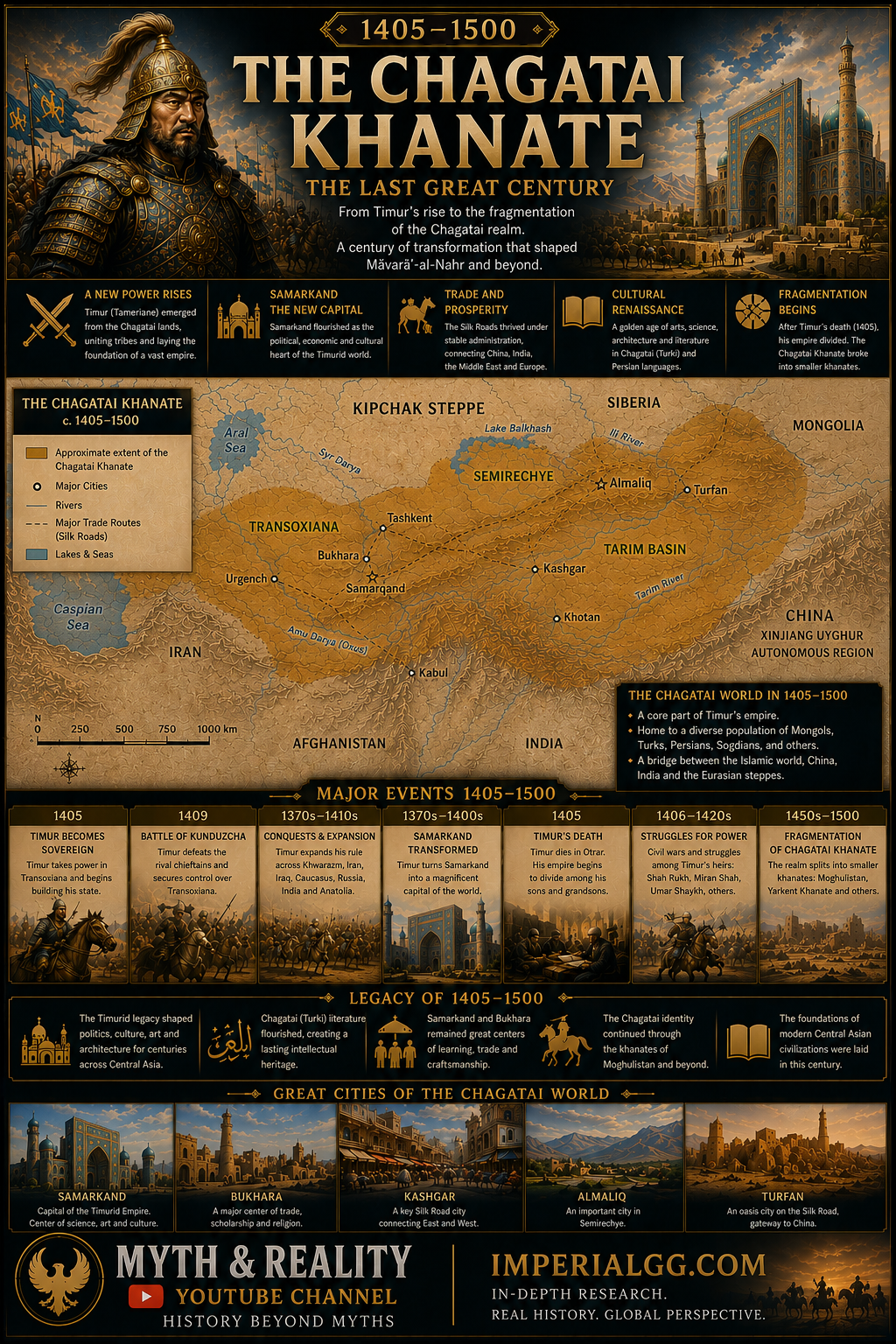
Central Asia (1600–1700): The Enduring Legacy of the Chagatai World
The seventeenth century was a period of political competition, commercial adaptation, and cultural continuity across Central Asia. Although the Chagatai Khanate had disappeared more than two centuries earlier, its political traditions, Chinggisid legitimacy, and administrative heritage continued to influence the region. Successor states—including the Bukhara Khanate, the Yarkent (Yarkand) Khanate, and the Kazakh Khanate—all preserved important elements of the Chagatai legacy while adapting to new political realities.
The Bukhara Khanate, ruled first by the Shaybanids and later by the Janid (Astrakhanid) dynasty, emerged as one of the leading powers of Transoxiana. Bukhara remained a renowned center of Islamic learning, diplomacy, and commerce, attracting scholars, merchants, and travelers from across the Muslim world. Although the great era of the Silk Road had declined, regional trade continued to flourish through networks linking Central Asia with Persia, Russia, India, and China.
In eastern Central Asia, the Yarkent Khanate, ruled by descendants of Chagatai Khan, controlled much of the Tarim Basin. The khanate maintained close commercial ties with China, Tibet, and neighboring nomadic peoples while preserving Chinggisid political traditions. During the late seventeenth century, however, internal rivalries and religious conflicts weakened the state, making it increasingly vulnerable to external intervention.
The Kazakh Khanate remained one of the dominant nomadic powers of the Eurasian steppe. Its territory extended across much of present-day Kazakhstan, where the khans governed through alliances with tribal leaders and the traditional institutions of steppe society. Throughout the century, the Kazakhs faced repeated conflicts with the expanding Oirat confederation, particularly the rising Dzungar Khanate, whose military strength transformed the balance of power in Inner Asia.
The rise of the Dzungar Khanate became one of the defining developments of the seventeenth century. Established by the Oirats in the western Mongolian and Junggar regions, the Dzungars built a centralized and militarily powerful state that challenged the Kazakh Khanate, the Yarkent Khanate, and later the Qing Empire. Their expansion marked the emergence of a new political force in Central Asia after the decline of the Chagataid successor states.
During this period, Russia steadily expanded southward across Siberia, establishing forts and trading posts that increased contact with the peoples of Central Asia. At the same time, the Qing Dynasty consolidated control over China and began to pay closer attention to developments in Mongolia and the western frontier. These expanding empires would play an increasingly significant role in Central Asian affairs during the eighteenth century.
By 1700, the political landscape of Central Asia had been transformed. The age of the great Mongol successor empires had given way to a system of competing khanates and expanding neighboring empires. Yet the legacy of the Chagatai world endured through Chinggisid legitimacy, steppe institutions, Islamic scholarship, and the enduring cultural connections that had linked Central Asia for centuries.
Historical Significance
- Chinggisid legitimacy remained the foundation of political authority in many Central Asian states.
- The Bukhara, Yarkent, and Kazakh khanates carried forward important aspects of the Chagatai political tradition.
- The Dzungar Khanate emerged as the dominant military power in Inner Asia.
- Russian expansion into Siberia and the growing influence of the Qing Dynasty introduced new geopolitical dynamics.
- Despite changing political boundaries, Central Asia remained a crossroads of commerce, religion, and the enduring heritage of the Mongol Empire.
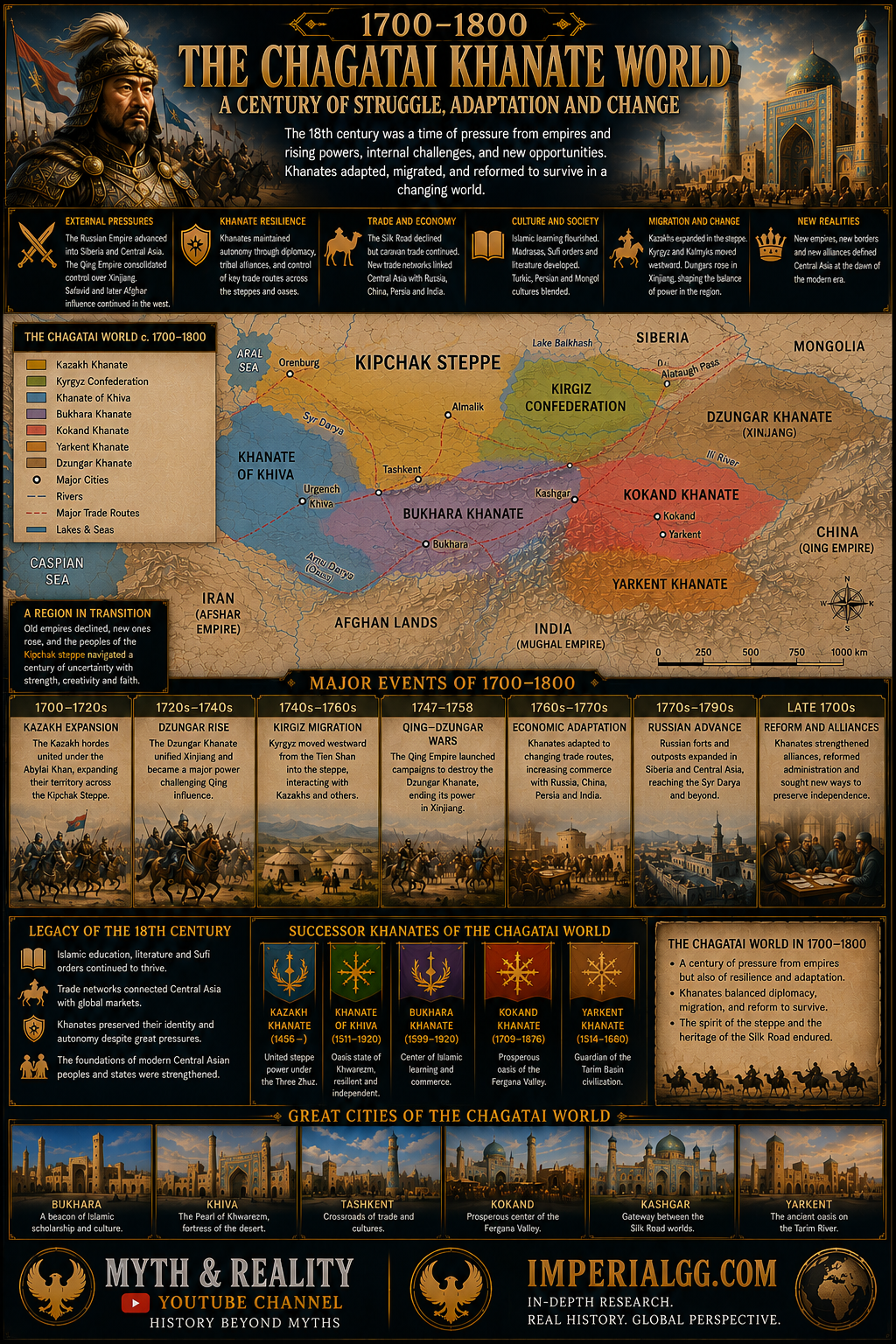
Central Asia (1700–1800): Empires, Khanates, and the Final Transformation of the Chagatai Legacy
The eighteenth century marked one of the most dramatic periods in the history of Central Asia. The political order inherited from the Mongol Empire and the Chagatai Khanate faced its greatest challenges as regional khanates struggled against expanding imperial powers. By the end of the century, the balance of power across Inner Asia had been fundamentally transformed.
At the beginning of the century, the Kazakh Khanate remained the largest nomadic state on the Eurasian steppe. However, it faced relentless attacks from the Dzungar Khanate, whose disciplined cavalry and centralized government made it the dominant military power in Inner Asia. The prolonged Kazakh–Dzungar wars devastated large areas of the steppe and forced many Kazakh tribes to migrate. This period, remembered in Kazakh history as the “Great Disaster” (Aktaban Shubyryndy) of the 1720s, became one of the defining tragedies in the nation’s historical memory.
Meanwhile, the Dzungar Khanate reached the height of its power, controlling much of present-day western Mongolia, Xinjiang, and parts of eastern Kazakhstan and Kyrgyzstan. Its rulers sought to dominate the trade routes linking Central Asia, Tibet, and China while competing with both the Kazakh khans and the rapidly expanding Qing Empire.
The decisive turning point came during the 1750s, when the Qing Dynasty launched a series of military campaigns against the Dzungars. By 1758, the Qing had destroyed the Dzungar Khanate and incorporated much of present-day Xinjiang into the empire. The fall of the Dzungars permanently altered the political geography of Inner Asia and ended the last great nomadic empire founded by the Oirats.
In western Central Asia, the Bukhara Khanate, the Khanate of Khiva, and the Khanate of Kokand emerged as the principal settled states of the region. These khanates competed for influence over trade routes, fertile agricultural lands, and strategic oasis cities. Bukhara, Samarkand, Khiva, and later Kokand remained important centers of Islamic scholarship, craftsmanship, and regional commerce despite the decline of long-distance Silk Road trade.
The Kazakh Khanate increasingly sought diplomatic relations with the Russian Empire to counter the Dzungar threat. Beginning in the 1730s, several Kazakh rulers accepted varying degrees of Russian protection while retaining considerable internal autonomy. This gradual expansion of Russian influence marked the beginning of a long process that would eventually bring much of the Kazakh steppe under imperial administration during the nineteenth century.
Although the political institutions of the original Chagatai Khanate had long disappeared, its legacy remained visible throughout the eighteenth century. Chinggisid descent continued to provide legitimacy for many Central Asian rulers, while steppe traditions of governance, nomadic military organization, and the cultural memory of the Mongol Empire endured across the region.
By 1800, Central Asia stood at the threshold of a new era. The destruction of the Dzungar Khanate, the expansion of the Qing Empire into Xinjiang, and the growing influence of the Russian Empire had reshaped the geopolitical landscape. The age of independent Mongol successor states had largely come to an end, but the political and cultural legacy of the Chagatai world continued to influence Central Asian society well into the modern period.
Historical Significance
- The Kazakh Khanate survived prolonged wars against the Dzungar Khanate.
- The Qing Empire destroyed the Dzungar Khanate and annexed Xinjiang in the 1750s.
- Bukhara, Khiva, and Kokand became the principal khanates of western Central Asia.
- Russian influence expanded steadily across the Kazakh steppe through diplomacy and protectorate agreements.
- The Chagatai legacy endured through Chinggisid legitimacy, steppe political traditions, and the shared historical heritage of Central Asia.
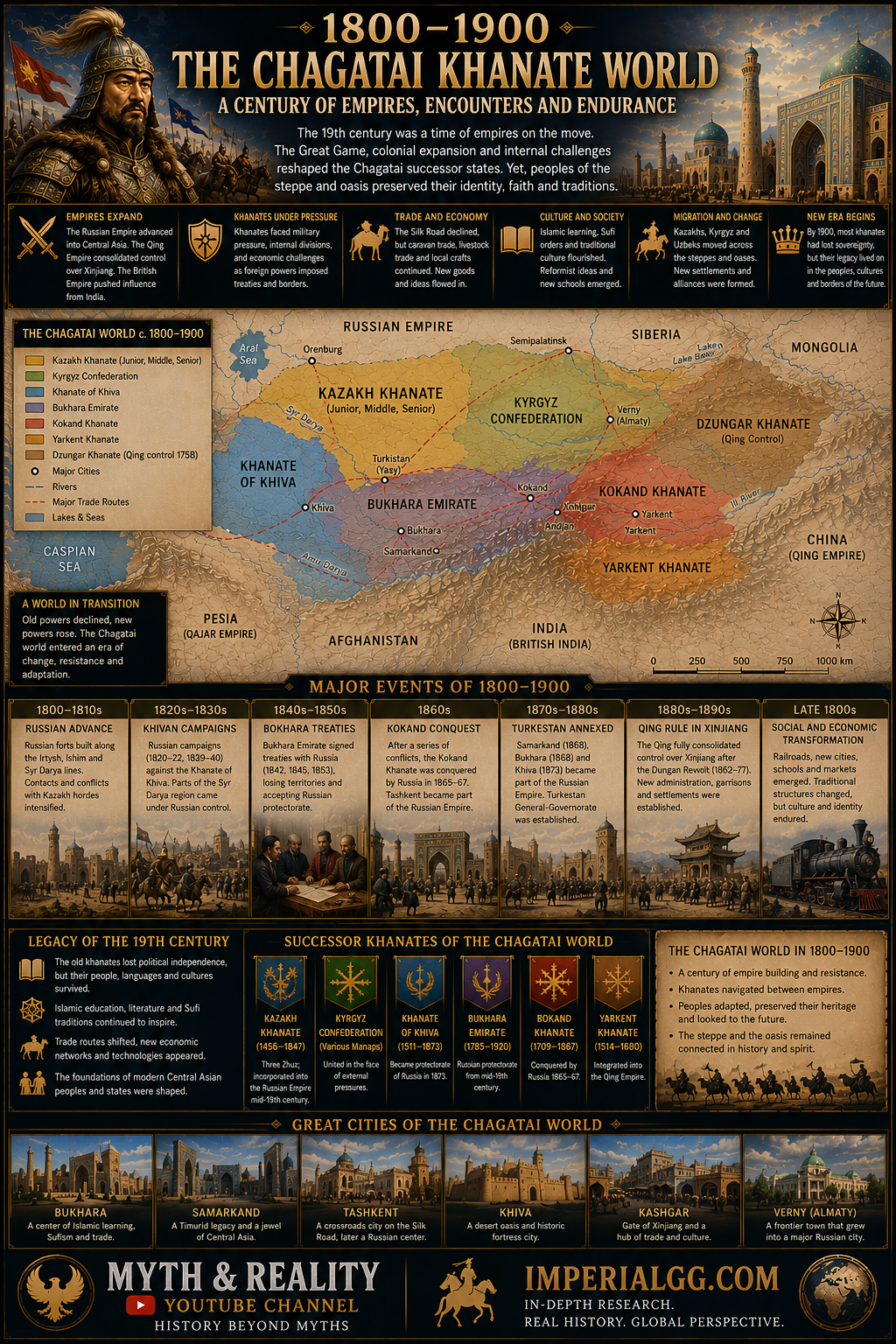
Central Asia (1800–1900): The End of the Khanates and the Age of Empire
The nineteenth century transformed Central Asia more profoundly than any period since the Mongol conquests. The independent khanates that had inherited the political traditions of the Chagatai world faced growing pressure from expanding imperial powers. By the end of the century, nearly all of Central Asia had come under the control of either the Russian Empire or the Qing Dynasty, bringing an end to centuries of independent steppe and oasis rule.
At the beginning of the century, the Khanates of Bukhara, Khiva, and Kokand dominated western and central portions of the region. These states remained important centers of Islamic scholarship, commerce, and regional politics. Bukhara, Samarkand, Khiva, and Kokand continued to flourish as cities connected by caravan trade linking Central Asia with Persia, Afghanistan, India, and western China. Although the great Silk Road no longer served as the world’s principal trade network, regional commerce remained vital to the economy.
The Kazakh steppe experienced profound political change during the first half of the nineteenth century. Russian influence, which had begun through protectorate agreements in the eighteenth century, steadily expanded into direct administration. Fortifications, military settlements, and new administrative districts were established across the steppe, gradually reducing the authority of the Kazakh khans. In 1847, the death of Kenesary Kasymov, the last major Kazakh khan to lead a large-scale resistance against Russian expansion, symbolized the end of the traditional Kazakh khanate.
Russian expansion accelerated during the second half of the century in what became known as the Great Game, the geopolitical rivalry between the Russian and British Empires for influence in Central Asia. Russian forces conquered Tashkent in 1865, occupied Samarkand in 1868, and established protectorates over the Emirate of Bukhara and the Khanate of Khiva. By 1876, the Khanate of Kokand had been abolished and incorporated into the Russian Empire as the Fergana Oblast.
Meanwhile, eastern Central Asia experienced equally dramatic changes. During the Dungan Revolt (1862–1877), Qing authority temporarily collapsed in Xinjiang, allowing Yakub Beg to establish an independent state centered on Kashgar. His government gained limited international recognition but survived for only a decade. Following Yakub Beg’s death, Qing armies reconquered the region, and in 1884 Xinjiang was formally established as a province of the Qing Empire.
Despite imperial expansion, Central Asia remained culturally vibrant. Islamic schools, Sufi brotherhoods, and scholarly traditions continued to flourish, while merchants maintained commercial networks that connected Russia, China, India, and the Middle East. New technologies, including railways, telegraph lines, and modern postal systems, gradually transformed communication and trade, integrating Central Asia into broader imperial economies.
Throughout the nineteenth century, the political legacy of the Chagatai Khanate remained visible. Chinggisid ancestry continued to carry prestige among ruling elites, and many traditional institutions of steppe governance survived within local society even after formal political authority had passed to imperial administrations. The historical memory of the Mongol Empire continued to shape regional identities across Kazakhstan, Kyrgyzstan, Uzbekistan, and Xinjiang.
By 1900, the independent khanates that had once carried forward the traditions of the Chagatai world had largely disappeared. Russian rule dominated most of western Central Asia, while the Qing Empire controlled Xinjiang. Nevertheless, the cultural, linguistic, and political heritage inherited from the Mongol and Chagatai eras endured, influencing the peoples of Central Asia well into the twentieth century.
Historical Significance
- Russian expansion ended the political independence of most Central Asian khanates.
- The Great Game reshaped the strategic importance of Central Asia.
- The Qing Dynasty reestablished control over Xinjiang after the Dungan Revolt and created Xinjiang Province in 1884.
- Traditional Chinggisid legitimacy gradually gave way to imperial administration, but Mongol political and cultural traditions remained influential.
- By the end of the nineteenth century, the Chagatai political world had disappeared, yet its historical legacy continued to shape the identities and institutions of Central Asia.
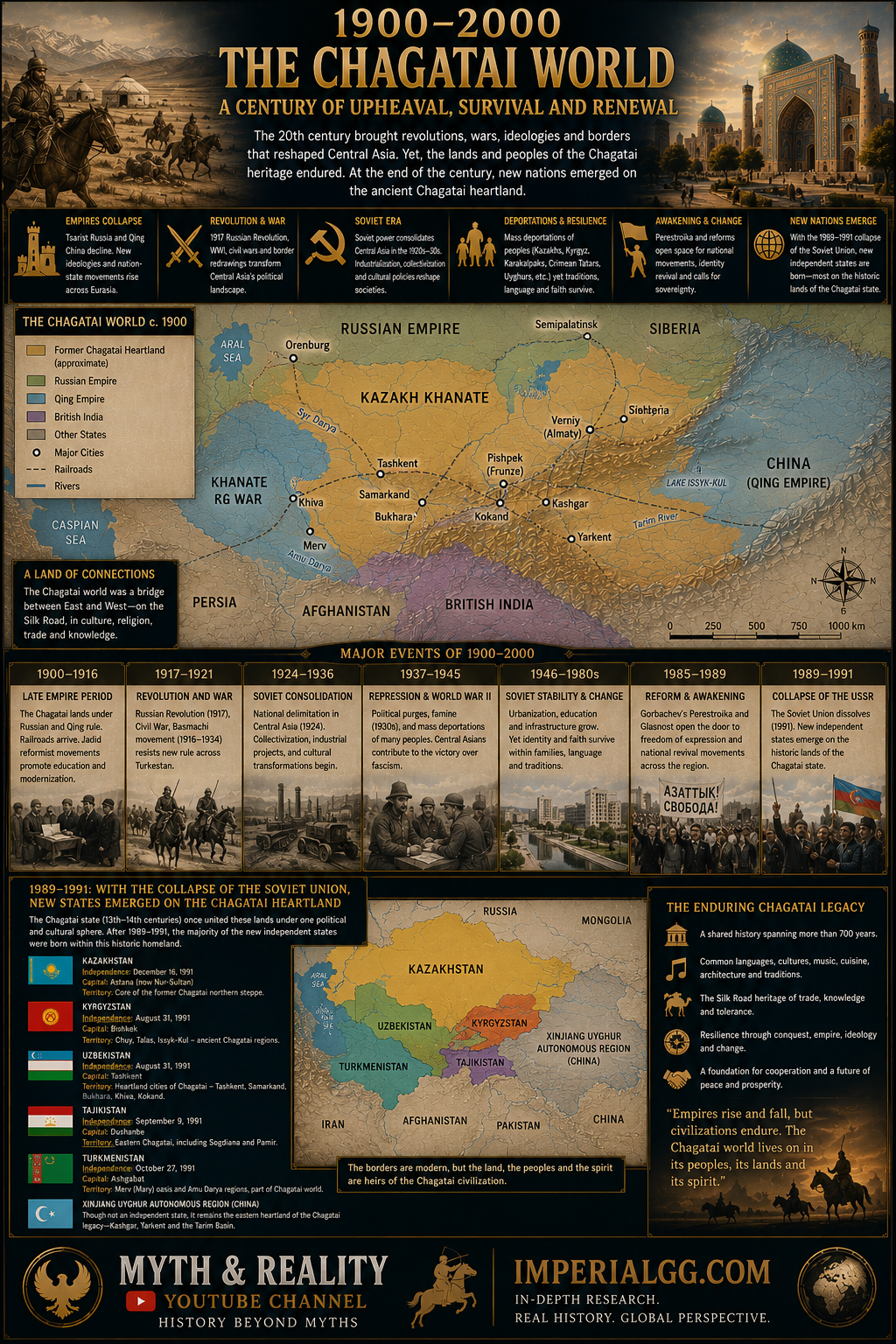
Central Asia (1900–2000): Revolution, Soviet Rule, and National Independence
The twentieth century brought unprecedented political, social, and economic transformation to Central Asia. The region experienced the collapse of imperial rule, revolutionary upheaval, Soviet governance, and, by the century’s end, the emergence of independent nation-states. Although the political institutions of the Chagatai world had long disappeared, its historical legacy remained deeply embedded in the cultures, languages, and identities of Central Asia.
At the beginning of the century, most of Central Asia was divided between the Russian Empire and the Qing Dynasty. The Emirate of Bukhara and the Khanate of Khiva continued to exist as Russian protectorates, while Xinjiang remained under Qing administration. The collapse of the Qing Dynasty in 1911 and the Russian Revolution of 1917 fundamentally altered the political landscape of the region.
During the Russian Civil War, Central Asia became the scene of fierce military and political struggles. The Basmachi movement, composed of local resistance groups, fought against Bolshevik rule throughout the 1920s and early 1930s. Although ultimately defeated by Soviet forces, the movement reflected widespread opposition to rapid political change and foreign domination.
Following the consolidation of Soviet power, the region underwent extensive administrative reorganization. During the 1920s and 1930s, the Soviet government established the Kazakh, Kyrgyz, Uzbek, Turkmen, and Tajik Soviet Socialist Republics, creating the foundations of the modern national borders of Central Asia. Large-scale industrialization, collectivization of agriculture, and state-directed economic planning profoundly transformed both urban and rural society.
These changes came at a tremendous human cost. Forced collectivization contributed to the devastating Kazakh Famine of 1931–1933, in which millions of people perished or were displaced. Political repression during the Great Purge targeted intellectuals, religious leaders, and former political elites across Central Asia. Traditional nomadic life was largely dismantled as Soviet authorities encouraged permanent settlement and centralized economic control.
During the Second World War, Central Asia became an important industrial and logistical base for the Soviet Union. Hundreds of factories were relocated eastward, and millions of civilians were evacuated to the region. After the war, continued industrial development, mining, irrigation projects, and scientific research accelerated modernization but also contributed to significant environmental challenges, including the catastrophic shrinkage of the Aral Sea.
In eastern Central Asia, Xinjiang experienced repeated political upheaval. The region briefly witnessed the establishment of the Second East Turkestan Republic (1944–1949) before coming under the control of the newly founded People’s Republic of China in 1949. Thereafter, Xinjiang underwent major political, economic, and demographic changes under Chinese administration.
The final decade of the century witnessed another historic transformation. The collapse of the Soviet Union in 1991 led to the independence of Kazakhstan, Kyrgyzstan, Uzbekistan, Turkmenistan, and Tajikistan. These new republics inherited borders established during the Soviet era while simultaneously seeking to revive national histories, languages, and cultural traditions that predated Soviet rule. Across the region, renewed interest in the legacy of the Turkic and Mongol empires, including the Chagatai heritage, became an important element of national historical identity.
By 2000, Central Asia had entered a new era as a region of independent states positioned between Russia, China, the Middle East, and South Asia. While modern political systems differed greatly from those of the medieval steppe, the historical legacy of the Chagatai Khanate continued to be reflected in language, culture, historical memory, and the enduring influence of Chinggisid traditions across the region.
Historical Significance
- The Russian and Qing empires gave way to revolutionary governments during the early twentieth century.
- Soviet rule transformed Central Asia through industrialization, collectivization, and national delimitation.
- The creation of the Central Asian Soviet republics established the foundations of today’s independent states.
- Xinjiang became part of the People’s Republic of China in 1949 after decades of political instability.
- The independence of the Central Asian republics in 1991 marked the beginning of a new chapter while preserving the region’s rich historical heritage rooted in the Chagatai and Mongol past.
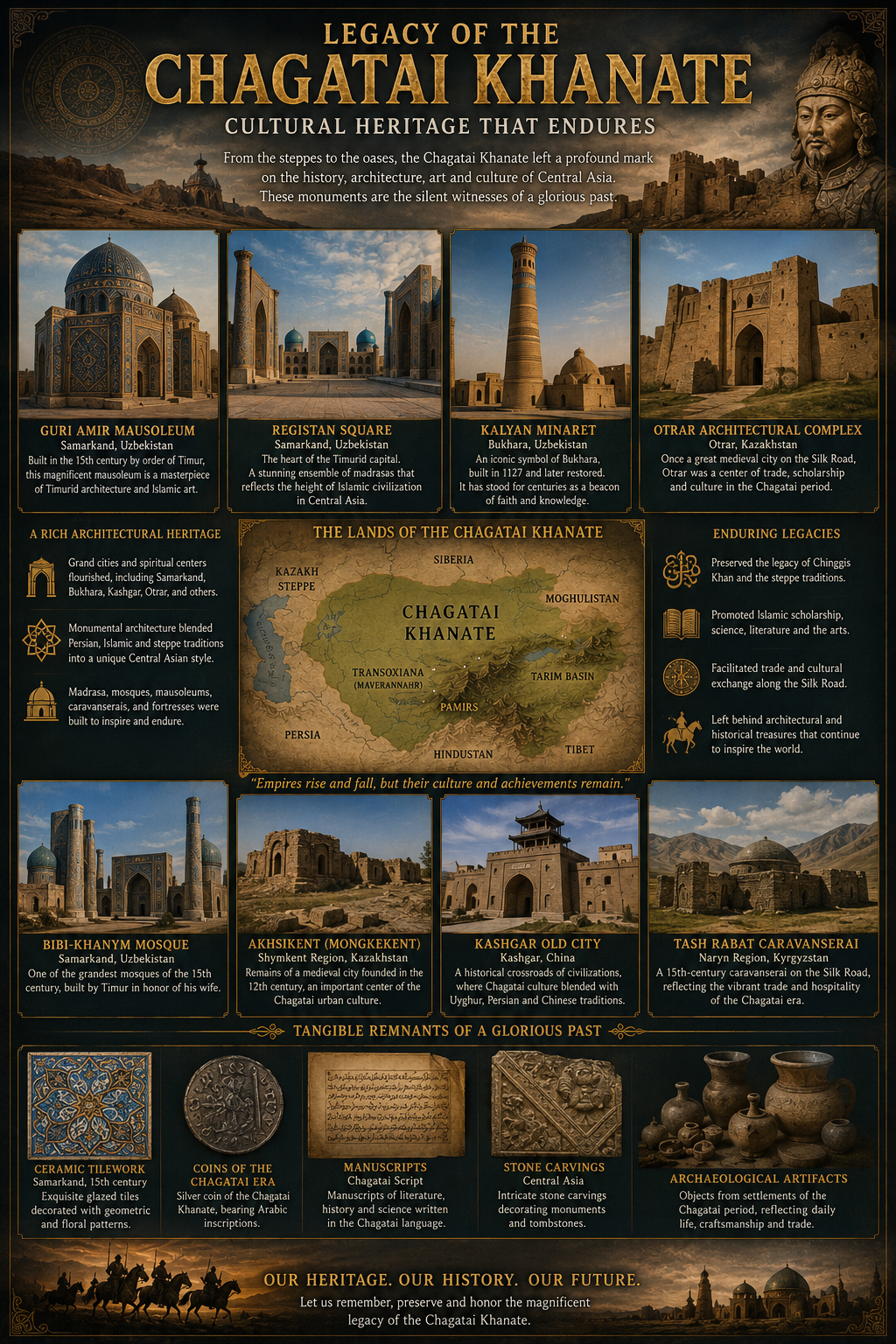
tHE cHAGADAI WORLD (1400-2000
A Legacy Across Six Centuries
The fifteenth century marked the political fragmentation of the Chagatai Khanate, but not the end of the Chagataid world. Instead, its political traditions, Chinggisid legitimacy, and cultural heritage continued through a succession of Central Asian states.
During the fifteenth and sixteenth centuries, Moghulistan, the Yarkent Khanate, the Kazakh Khanate, the Uzbek Khanate, the Khanate of Khiva, and the Khanate of Bukhara emerged from the political landscape shaped by the Chagataids. Although these states developed independently, they inherited many institutions, traditions, and identities rooted in the Chagatai world.
Throughout the seventeenth and eighteenth centuries, these successor states remained the dominant powers of Central Asia, preserving the region’s Turkic-Islamic civilization, Silk Road cities, and Chinggisid political traditions while adapting to new regional challenges.
The nineteenth century brought increasing pressure from expanding empires. The Russian Empire advanced across the Kazakh Steppe and Transoxiana, while the Qing Empire consolidated control over Xinjiang. By the late nineteenth century, most of the successor khanates had lost their political independence.
The twentieth century witnessed revolutions, Soviet rule, and profound political transformation. Yet despite changing borders and governments, the historical and cultural legacy of the Chagatai world endured. When the Soviet Union dissolved in 1991, the newly independent republics of Kazakhstan, Uzbekistan, Kyrgyzstan, Turkmenistan, and Tajikistan emerged largely within territories that had once formed the core of the Chagatai world. In China’s Xinjiang Uyghur Autonomous Region, many cities that flourished under the Chagataids—such as Kashgar, Yarkand, and Turpan—remain important cultural centers today.
The Chagatai Khanate disappeared as a state, but the Chagatai world survived for centuries through its peoples, languages, political traditions, and civilizations. Its legacy continues to shape the heart of modern Central Asia, making the Chagatai world one of the longest-enduring historical inheritances of Eurasia.
KAZAKHS AND THE KAZAKH KHANATE
The Emergence of a People and a Chinggisid Steppe Polity
The history of the Kazakhs cannot be assigned to a single date. Like many peoples of the Eurasian Steppe, the Kazakh people emerged through a long process of political reorganization, migration, intermarriage, tribal affiliation, language change, and the consolidation of new forms of collective identity.
The important distinction is between the history of the populations that eventually became Kazakh, the emergence of the Qazaq ethnonym and political identity, and the establishment of the Kazakh Khanate. These were related processes, but they were not identical.
From the Kipchak Steppe to the post-Mongol world
Long before the appearance of a specifically Kazakh political identity, the territory of present-day Kazakhstan was inhabited by numerous steppe populations connected to the wider Turkic and later Turco-Mongol world. Kipchak-speaking groups were particularly important across the Dasht-i Qipchaq, while the Mongol conquests of the thirteenth century incorporated these populations into the political structures of the Chinggisid Empire.
The Mongol period did not simply replace the existing population with Mongols. Rather, Chinggisid rule reorganized political authority across a region already characterized by considerable linguistic and tribal diversity. Over subsequent generations, Mongol ruling houses became deeply integrated with predominantly Turkic-speaking steppe populations.
This post-Mongol environment became crucial for the later emergence of the Kazakh polity.
What did “Qazaq” originally mean?
The word qazaq has a much older history than the Kazakh ethnic group itself. Historical linguistics generally treats qazaq as a Turkic term associated with a condition of being unattached to a particular authority, and it acquired a range of related meanings in different contexts, including free, independent, wandering, or politically separated. Modern scholarship emphasizes that qazaq originally functioned as a social and political term rather than an exclusive ethnic name.
This distinction is essential.
A medieval individual described as qazaq was not necessarily a member of the later Kazakh ethnic community. The word could describe a political or social status. Only through a historical process did the term become associated with a particular people and political community.
Research on the transformation of the term in the eastern Dasht-i Qipchaq specifically examines how qazaq developed from a broader term into an ethnonym associated with the emerging Kazakh community.
The fifteenth century: the decisive transformation
The political fragmentation of the Jochid world during the fifteenth century created the conditions in which a new political identity could emerge.
The descendants of Jochi continued to dominate the steppe, but competing Chinggisid branches, tribal elites, and regional political groupings struggled for authority. One important center of this political world was the state of Abu’l-Khayr Khan.
It was within this environment that Kerei and Janibek, Chinggisid princes, separated from Abu’l-Khayr’s political sphere and moved with their followers toward Moghulistan and the Zhetisu (Semirechye) region.
This migration was not the sudden creation of an entirely new population. Rather, it represented the political regrouping of existing steppe communities under a new Chinggisid leadership.
The formation of the Kazakh Khanate is conventionally dated to approximately 1465–1466, although the exact chronology and character of its early formation remain subjects of scholarly discussion.
Cambridge’s History of Inner Asia places the formation of the Qazaq Khanate and the emergence of a distinct Qazaq ethnic and political identity in the late fifteenth and early sixteenth centuries, centered initially in Zhetisu.
Kerei and Janibek
Kerei and Janibek therefore occupy a central position in Kazakh historical memory, but their importance should be understood politically rather than through the idea that they suddenly “created” the Kazakh people.
They belonged to the Chinggisid ruling elite and drew followers from the broader political and tribal world of the eastern Dasht-i Qipchaq. Their movement created a new political center from which the Qazaq polity could consolidate.
The resulting Kazakh Khanate was therefore both:
- a Chinggisid successor polity, because its ruling dynasty claimed descent from Chinggis Khan through Jochi; and
- an emerging Qazaq political community, because increasingly larger groups came to identify themselves with the new khanate.
This is one of the most important points in understanding Kazakh history: Kazakh identity did not emerge outside the Chinggisid world. It emerged within the political transformation of that world.
From a political community to an ethnic identity
During the sixteenth century, the Kazakh Khanate expanded its influence across substantial portions of the steppe. Under rulers such as Qasym Khan, the khanate became a major political force.
At the same time, the term Qazaq increasingly acquired an ethnic and political meaning. The distinction between political allegiance, tribal affiliation, genealogy, language, and ethnic identity was not identical to the modern concept of nationality.
Modern scholarship therefore tends to treat the emergence of the Kazakhs as a process of ethnogenesis, rather than a single founding event. One Cambridge study describes Kazakh ethnogenesis in broad pre-Turkic, Turkic, and Turco-Mongolian stages, emphasizing the deep chronological roots of the populations that eventually formed the Kazakh people.
Another important study notes that the formation of Qazaq ethnic and political identity was closely connected to the establishment and consolidation of the Qazaq Khanate during the fifteenth and sixteenth centuries.
The Kazakh Khanate was not a modern nation-state
It is equally important not to project the modern nation-state backward.
The Kazakh Khanate was not the Republic of Kazakhstan. It was a medieval/early modern Chinggisid steppe polity governed by a khan, aristocratic lineages, tribal confederations, and customary political institutions.
Likewise, a sixteenth-century Qazaq should not automatically be understood as possessing the same concept of national identity as a Kazakh citizen today.
Modern nationalism developed much later. In particular, scholars examining the early twentieth-century Alash movement have shown how Kazakh intellectuals under the Russian Empire reformulated existing ethnic and historical identities into the language of the modern nation.
Thus, there is both continuity and transformation between the medieval Qazaq community and the modern Kazakh nation.
A historical sequence
The development can therefore be summarized as:
Ancient and medieval Steppe populations
↓
Turkic and Kipchak political-cultural world
↓
Chinggisid conquest and Jochid political order
↓
Post-Golden Horde political fragmentation
↓
Qazaq groups and political identity
↓
Kerei & Janibek’s migration to Zhetisu
↓
Kazakh Khanate — c. 1465–1466
↓
Sixteenth-century consolidation of Qazaq political identity
↓
Later transformation under Russian imperial and Soviet rule
↓
Modern Kazakh nation and Republic of Kazakhstan
The central historical point
The emergence of the Kazakhs should therefore neither be reduced to “the Kazakhs existed unchanged since antiquity” nor to “the Kazakhs appeared suddenly in 1991.”
Both formulations oversimplify the evidence.
The stronger historical interpretation is that the Kazakh people emerged through a long ethnogenetic and political process, with the decisive formation of a recognizable Qazaq political and ethnic identity occurring in the fifteenth and sixteenth centuries within the post-Mongol, Jochid, and Chinggisid world.
The Kazakh Khanate, established in the era of Kerei and Janibek, became the principal political framework through which this emerging identity consolidated.
In this sense, Kazakh history is not separate from the history of the Mongol and post-Mongol world. It is one of the historical transformations that emerged from it.