FROM BÖRTE CHINO TO BODONCHAR: THE EARLY GENEALOGY OF THE MONGOL RULING LINE
By Altanbagana Baatar
DBA Candidate| Independent Historian
ImperialGG Historical Research Seriers
01 September 2026
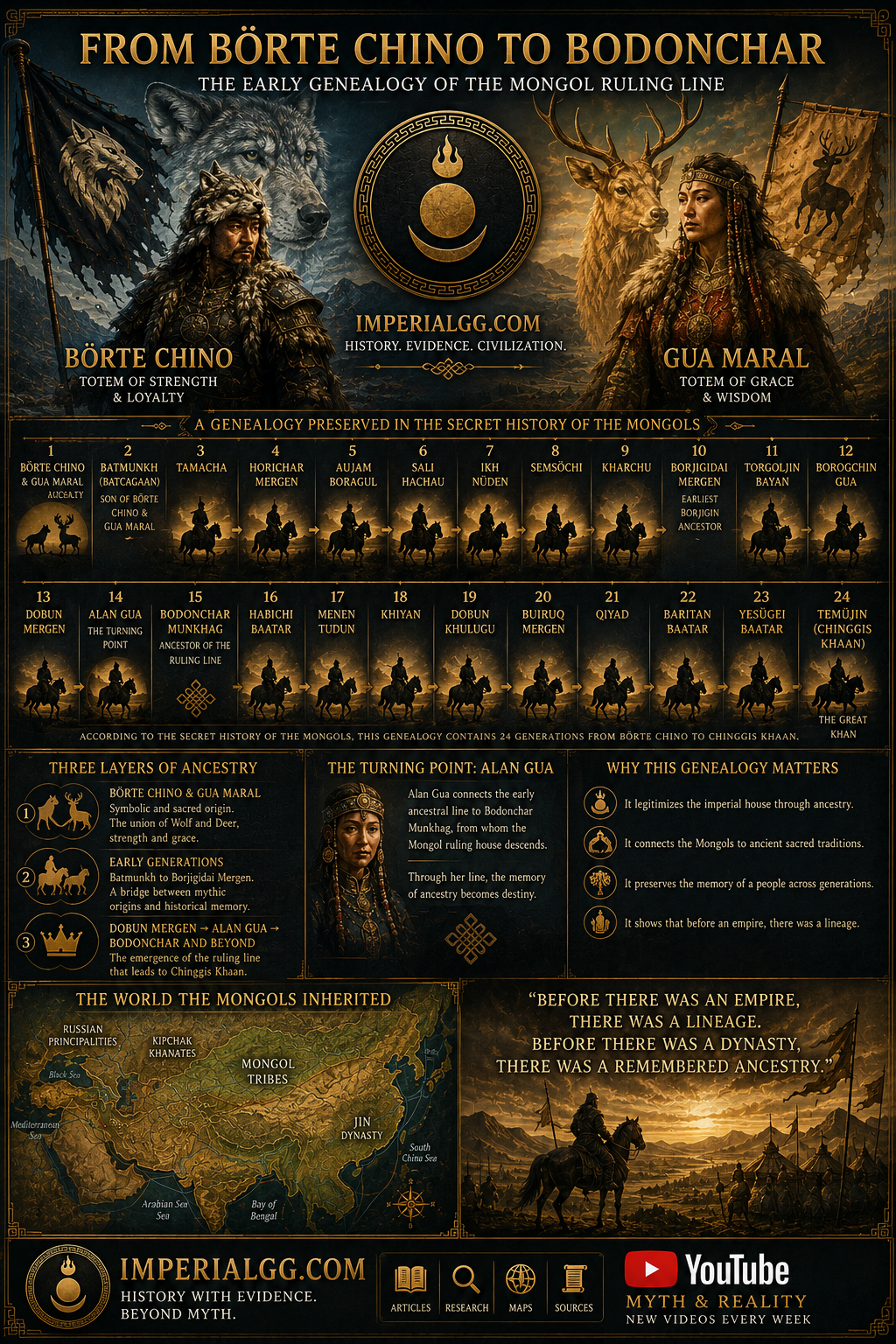
The Secret History of the Mongols does not move directly from the ancestral pair Börte Chino and Gua Maral to the historical Mongol rulers. Instead, it preserves a long chain of successive generations.
According to the opening genealogy, their son was Batmunkh (Batcaγan), followed by Tamacha, Horichar Mergen, Aujam Boragul, Sali Hachau, Ikh Nüden, Semsöchi, and Kharchu. The genealogy then reaches Borjigidai Mergen, one of the earliest figures explicitly associated with the Borjigin lineage.
This sequence is important because the Secret History presents ancestry not as an isolated legend, but as a continuous chain of descent. The early names form a bridge between the symbolic ancestral world of Börte Chino and Gua Maral and the later historical lineage of the Mongol ruling house.
With Borjigidai Mergen, the genealogy becomes more detailed. His wife is named Mongoljin Gua, and their son is Torgolj in Bayan. Torgoljin Bayan is then associated with Borogchin Gua, and their lineage continues toward Dobun Mergen and Alan Gua.
The appearance of Alan Gua is particularly significant. Her story marks another major transition in the genealogy: from the remembered ancestry of early generations toward the emergence of Bodonchar Munkhag, whose descendants eventually form the ruling line from which Chinggis Khan emerges.
Thus, the opening genealogy can be understood as a gradual movement through three layers:
BÖRTE CHINO & GUA MARAL
ancestral and symbolic origin
↓
EARLY GENERATIONS
Batcaγan → Tamacha → Horichar → … → Borjigidai
↓
DOBUN MERGEN → ALAN GUA → BODONCHAR
the emergence of the later ruling lineage
The significance of this structure is that Chinggis Khan’s legitimacy is presented through ancestry and continuity, rather than beginning with his own lifetime.
The Secret History therefore asks the reader to look backward before looking forward: before there was an empire, there was a lineage; before there was a dynasty, there was a remembered ancestry.
ALAN GUA AND BODONCHAR: THE TURNING POINT OF THE GENEALOGY
The genealogy of the Secret History of the Mongols reaches a decisive turning point with Alan Gua and her youngest son, Bodonchar Mungqaq.
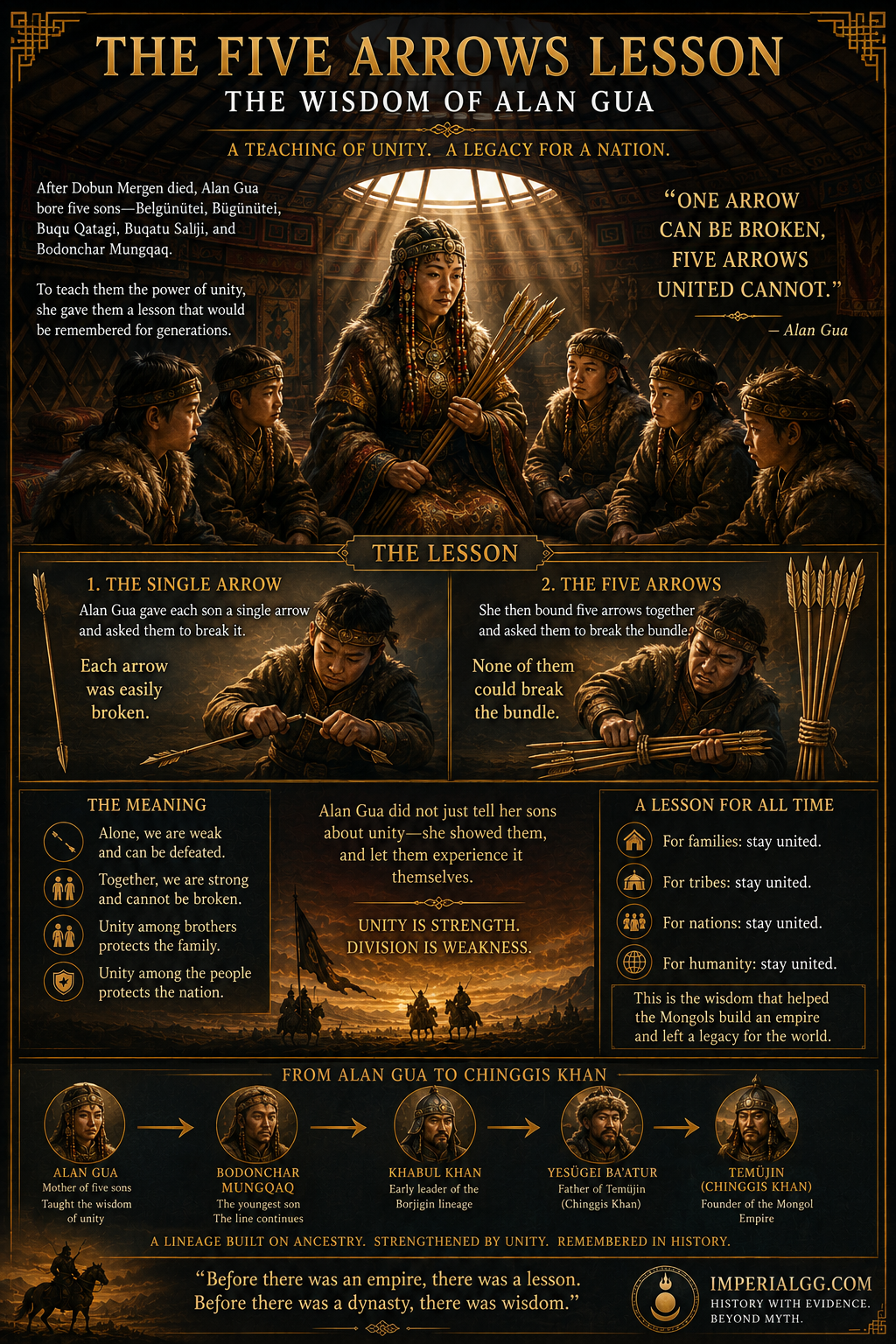
Alan Gua was the wife of Dobun Mergen. During Dobun Mergen’s lifetime, she bore two sons, Belgünütei and Bügünütei. After his death, she gave birth to three more sons—Buqu Qatagi, Buqatu Salji, and Bodonchar. The two elder sons questioned the origin of their younger brothers, since their father was already dead. Alan Gua responded with the famous account of a radiant figure entering her ger through the roof opening and declared that the three younger sons were “sons of Heaven.”
Yet Mongolian scholarship has long recognized that this episode may preserve a deeper historical memory.
One interpretation holds that among early Mongolian aristocratic communities, when a man died and left a widow, an aristocratic male of the ruling or Golden Lineage could be designated to continue the deceased man’s lineage. Such a man was said to visit the widow discreetly, traditionally around dawn, so that the continuation of the lineage remained protected. This interpretation provides a possible social background for the otherwise mysterious conception of Alan Gua’s three younger sons.
This does not prove that a particular historical man was the father of Buqu Qatagi, Buqatu Salji, and Bodonchar. The Secret History deliberately preserves the father’s identity in symbolic language. What matters is that the narrative itself emphasizes that these sons were not ordinary descendants, but belonged to a special ancestral line.
Here the interpretation of academician Sh. Bira becomes important. Bira connected the story with the ancient steppe conception of heavenly rulership, noting that Xiongnu rulers were described as being “born of Heaven” and associated with Heaven, Earth, the sun, and the moon. He argued that the “theory of light” (гэрлийн үзэл) represented a more developed and abstract form of thought than earlier totemic concepts, and that it was closely connected with the idea of the ruler as the “Son of Heaven.”
This creates an important progression in the genealogy:
WOLF & DEER
totemic ancestry
↓
LIGHT & HEAVEN
sacred and aristocratic ancestry
↓
BODONCHAR
the emerging ruling lineage
↓
CHINGGIS KHAN
the imperial house
The story therefore may preserve two layers at once. On one level, it is a sacred genealogy explaining the heavenly origin of a royal lineage. On another, it may preserve a memory of an older social institution in which the continuation of an aristocratic bloodline was considered important enough to be protected even after the death of its male head.
Alan Gua’s story thus stands at the intersection of myth, social memory, and political legitimacy.
The Secret History does not tell us who the mysterious visitor actually was. But its choice of light, Heaven, secrecy, and royal ancestry is significant. By the time of Chinggis Khan, this ancestral memory had become part of the ideological foundation of the ruling house.
The wolf and deer represent the ancient language of ancestry.
The light represents the language of Heaven.
Bodonchar represents the lineage that carries that memory forward.
AUTHOR’S THESIS
What makes Alan Gua remarkable is not merely the lesson itself, but the way she taught it.
She transformed an abstract political principle—unity—into something her children could see, test, and experience for themselves. Rather than demanding obedience through authority, she created a simple physical demonstration that allowed her sons to discover the conclusion independently.
In this sense, Alan Gua appears not simply as an ancestral mother, but as a deliberate teacher of political intelligence.
Her lesson operates on several levels at once: family solidarity, protection of the lineage, cooperation among brothers, and the recognition that divided strength can be defeated while united strength becomes difficult to overcome.
This is particularly significant within the genealogy of the Mongol ruling house. The five sons were not merely children in a family story; they represented the potential branches of a future lineage. Alan Gua’s demonstration therefore functions as a lesson in how a lineage survives through unity.
The story of the radiant visitor and the story of the five arrows consequently belong together.
The first establishes sacred ancestry.
The second teaches social cohesion.
Together, they connect ancestry, legitimacy, and political intelligence.
Among her five sons, Bodonchar Mungqaq becomes especially important in the later genealogy. Through his descendants, the Secret History eventually reaches the ruling lineage associated with Chinggis Khan.
The genealogy can therefore be read as a progression:
BÖRTE CHINO & GUA MARAL
Wolf and Deer — ancestral symbolism
↓
ALAN GUA
Heavenly descent and political wisdom
↓
BODONCHAR
The lineage continues
↓
KHABUL KHAN
The emergence of political leadership
↓
YESÜGEI → TEMÜJIN
The historical Mongol ruling house
Alan Gua’s place in this genealogy is therefore unusually important. She does not merely give birth to another generation. She interprets ancestry, protects the continuity of the lineage, and teaches the principle of unity through an exceptionally concrete and memorable demonstration.
Whether read as historical memory, political allegory, or a combination of both, the five-arrow episode preserves an enduring image of Alan Gua as a woman who understood that a powerful lineage requires more than ancestry—it requires cohesion.
And perhaps that is the deeper meaning of her position in the Secret History:
A lineage may inherit blood.
A dynasty must learn how to remain united.
FROM BODONCHAR TO KHABUL KHAN: THE RISE OF THE BORJIGIN LINE
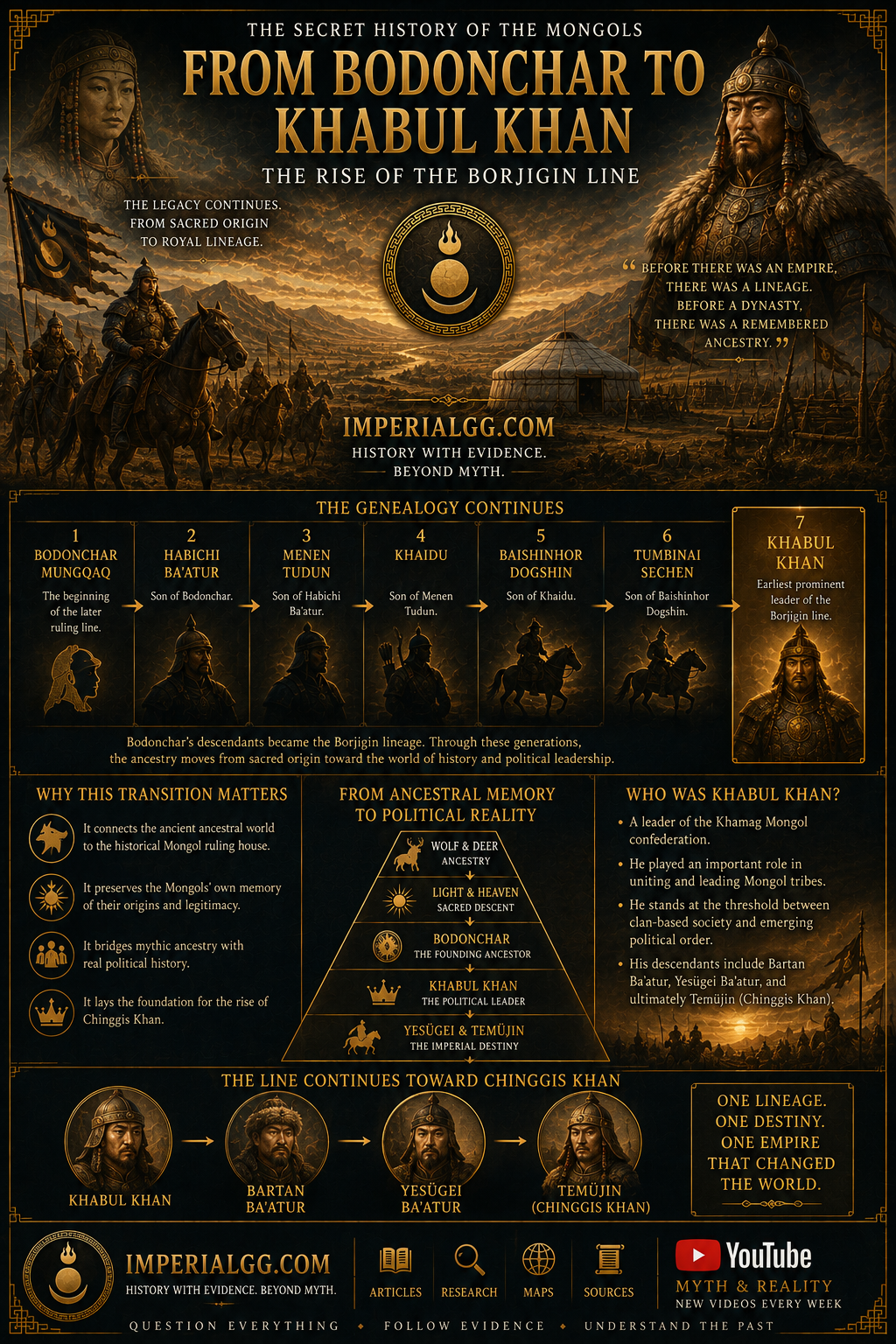
The story of Bodonchar Mungqaq marks the beginning of a new stage in the genealogy preserved by the Secret History of the Mongols. From this point onward, the narrative gradually moves away from the remote ancestral world and toward identifiable political ancestors of the Mongol ruling house.
The Secret History states that Bodonchar’s descendants became the Borjigin lineage. His son was Habichi Ba’atur, followed by Menen Tudun. Menen Tudun had several sons, and through one of these branches the genealogy continued through Khaidu, Baishinhor Dogshin, and Tumbinai Sechen.
With Tumbinai Sechen, the genealogy approaches a more recognizably political world. His descendants include Khabul Khan, who became one of the earliest historically prominent leaders of the Mongol ruling lineage. Khabul is traditionally associated with the Khamag Mongol confederation and stands much closer to the historical period in which the Mongol political order begins to take recognizable form.
The transformation can therefore be represented as:
BODONCHAR
ancestral foundation
↓
HABICHI BA’ATUR → MENEN TUDUN
the lineage continues
↓
KHAIDU → BAISHINHOR DOGSHIN → TUMBINAI SECHEN
the genealogy approaches the historical era
↓
KHABUL KHAN
the emergence of a political Mongol lineage
This transition is significant because the Secret History does not suddenly create the Mongol ruling house with Chinggis Khan. It constructs legitimacy through a long remembered chain of descent, gradually moving from ancestral and sacred narratives toward figures associated with actual political authority.
At the same time, the genealogy should not be treated as a modern genealogical register in which every generation can be independently verified. It is a medieval historical tradition that combines genealogy, oral memory, political legitimacy, and symbolic ancestry. The value of the sequence lies precisely in how it preserves the Mongols’ own understanding of their past.
By the time we reach Khabul Khan, the narrative is approaching the world immediately preceding the rise of Chinggis Khan.
From here, the line becomes much easier to follow:
KHABUL KHAN → BARTAN BA’ATUR → YESÜGEI BA’ATUR → TEMÜJIN
And this is where the ancestral narrative finally enters the historical life of Chinggis Khan.
The genealogy began with wolf and deer.
It passed through Heaven and Bodonchar.
It became a ruling lineage under Khabul Khan.
And one generation later, it reached Yesügei—and Temüjin.
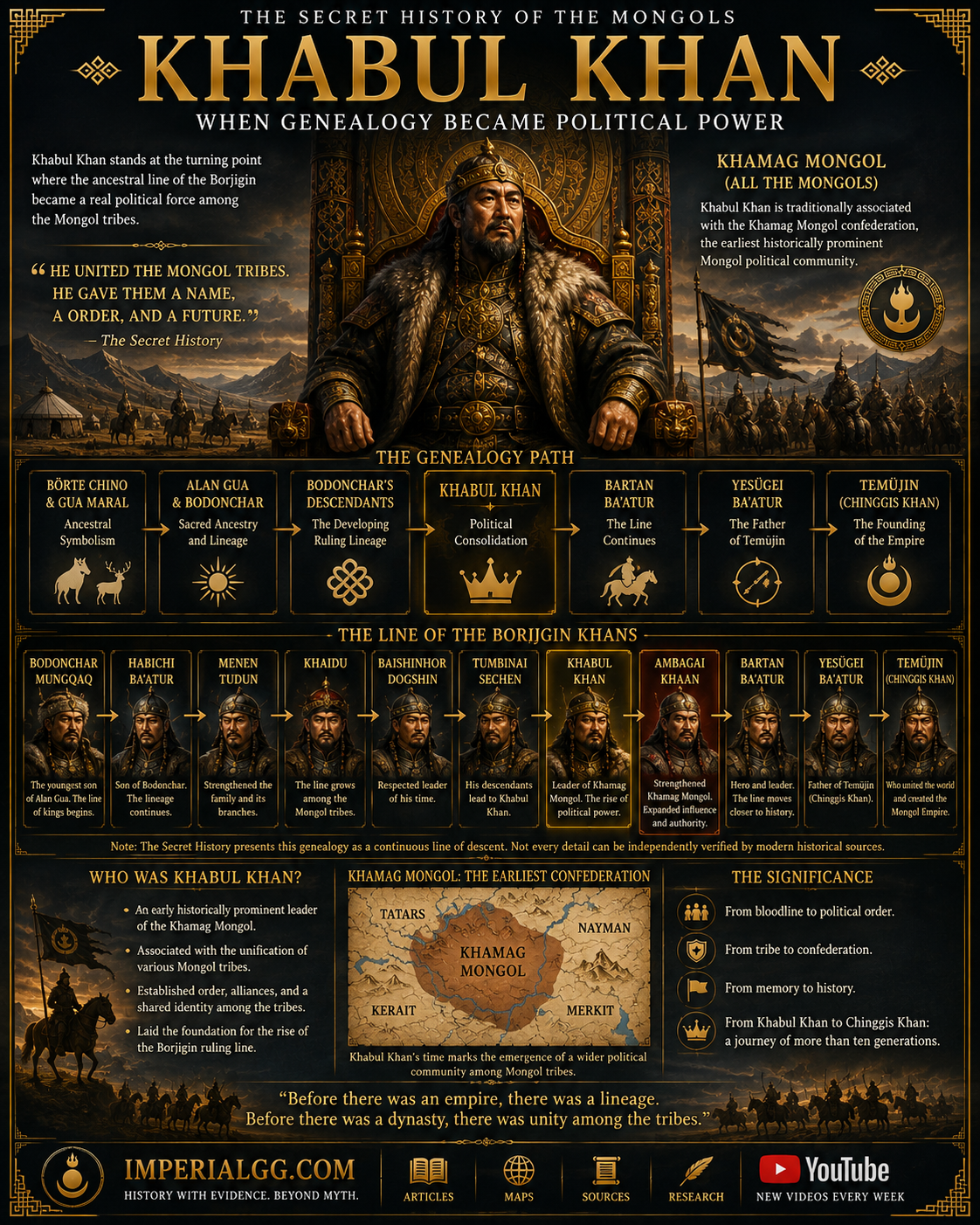
KHABUL KHAN: WHEN GENEALOGY BECAME POLITICAL POWER
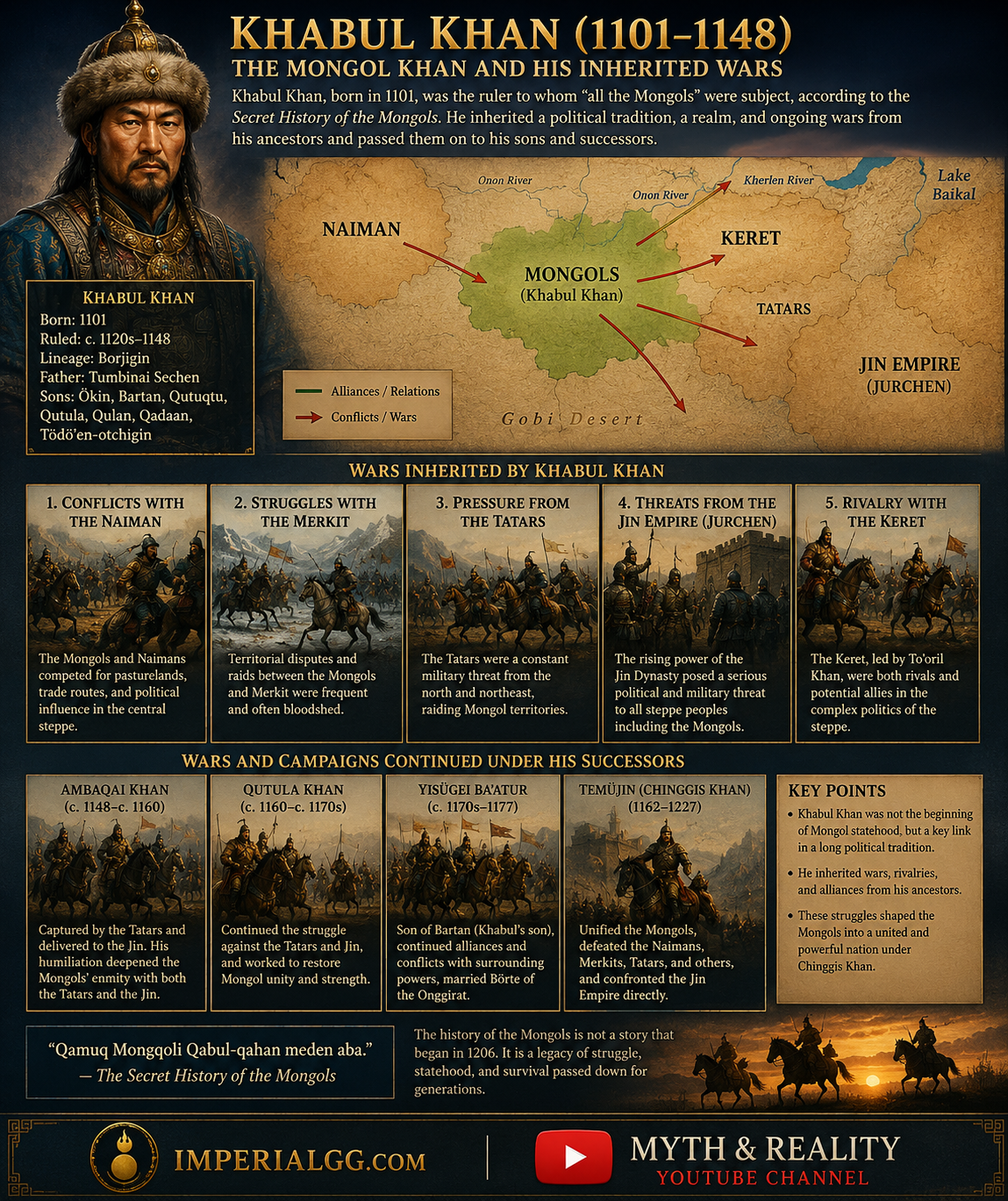
The genealogy preserved in the Secret History of the Mongols gradually moves from ancestral memory into a world of identifiable political leaders. Khabul Khan stands at this important threshold.
According to the genealogical tradition, Khabul descended from Bodonchar Mungqaq through a succession of generations—Habichi Ba’atur, Menen Tudun, Khaidu, Baishinhor Dogshin, and Tumbinai Sechen. With Khabul, however, the genealogy is no longer concerned only with ancestry. It begins to describe a man associated with the political organization of the Mongol tribes.
Khabul Khan is traditionally associated with the Khamag Mongol (“All the Mongols”) confederation and is regarded as its earliest historically prominent khan. His importance lies not simply in his position within the Borjigin genealogy, but in the emergence of a wider political community around Mongol tribal groups.
This represents a fundamental transition:
BÖRTE CHINO & GUA MARAL
ancestral symbolism
↓
ALAN GUA & BODONCHAR
sacred ancestry and lineage
↓
BODONCHAR’S DESCENDANTS
the developing ruling lineage
↓
KHABUL KHAN
political consolidation
↓
BARTAN BA’ATUR → YESÜGEI BA’ATUR → TEMÜJIN
The importance of Khabul is therefore not that he suddenly “created” the Mongols. Rather, he represents a stage at which genealogical identity was becoming political organization.
The Secret History itself is particularly valuable here because it preserves a Mongol perspective on ancestry, leadership, social organization, and political legitimacy. Modern scholarship treats the work as the earliest surviving native Mongolian narrative source, while also recognizing that its genealogy combines historical memory with literary and ideological elements.
Khabul’s place in this sequence is consequently significant:
BODONCHAR gave the lineage continuity.
KHABUL gave the lineage political weight.
By the generation of Bartan Ba’atur and Yesügei Ba’atur, the genealogy is approaching the lifetime of the man who would transform that inherited political world: Temüjin.
And this is the final step before the story leaves genealogy behind and enters biography.
From Börte Chino to Khabul Khan, the story remembered where the lineage came from.
From Khabul to Yesügei, it began to show how that lineage exercised power.
With Temüjin, that lineage would become an empire.