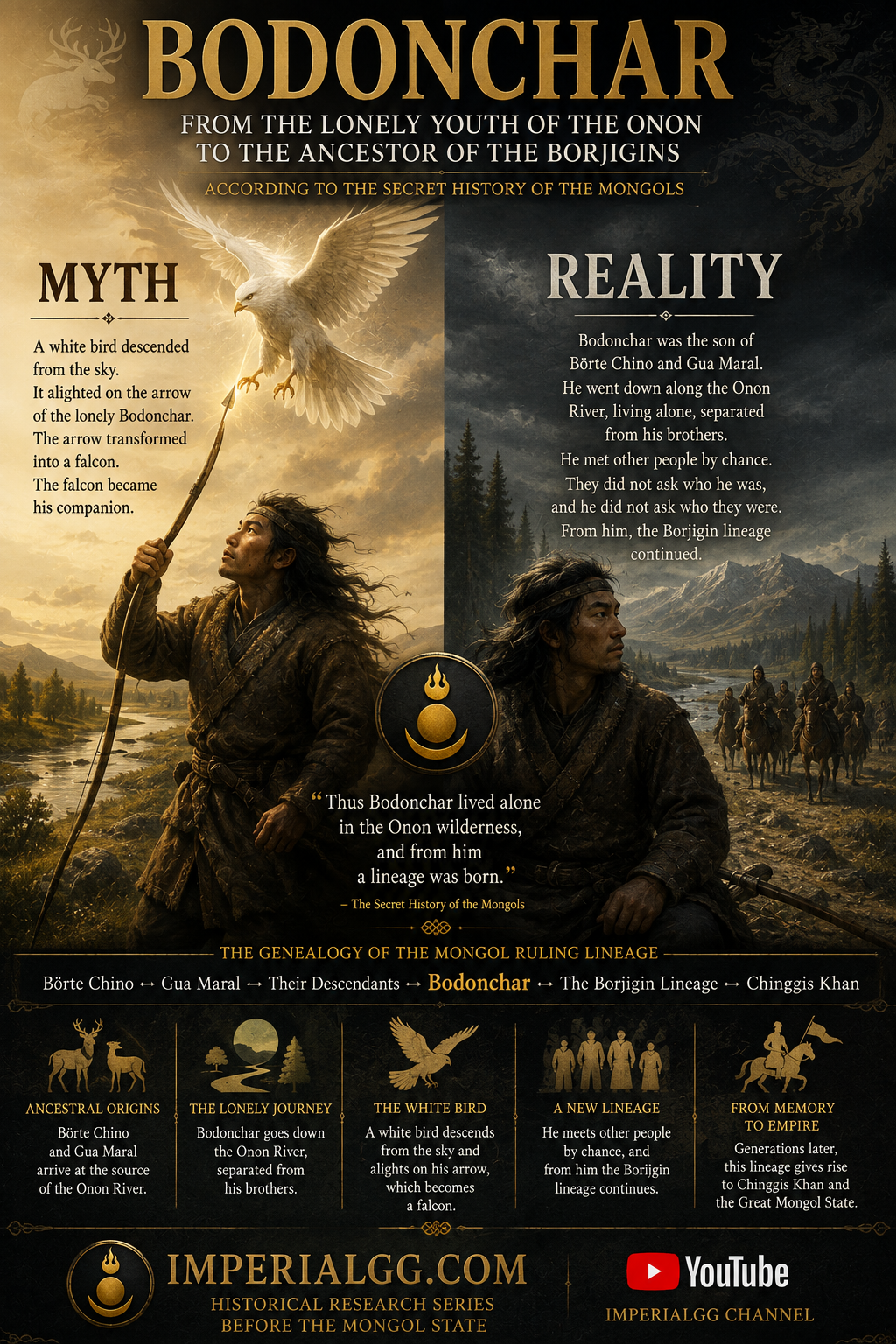
BODONCHAR: THE LONELY ANCESTOR WHO BECAME THE FATHER OF THE BORJIGINS
By Altanbagana Baatar
DBA Candidate| Independent Historian
ImperialGG Historical Research Seriers
02 September 2026
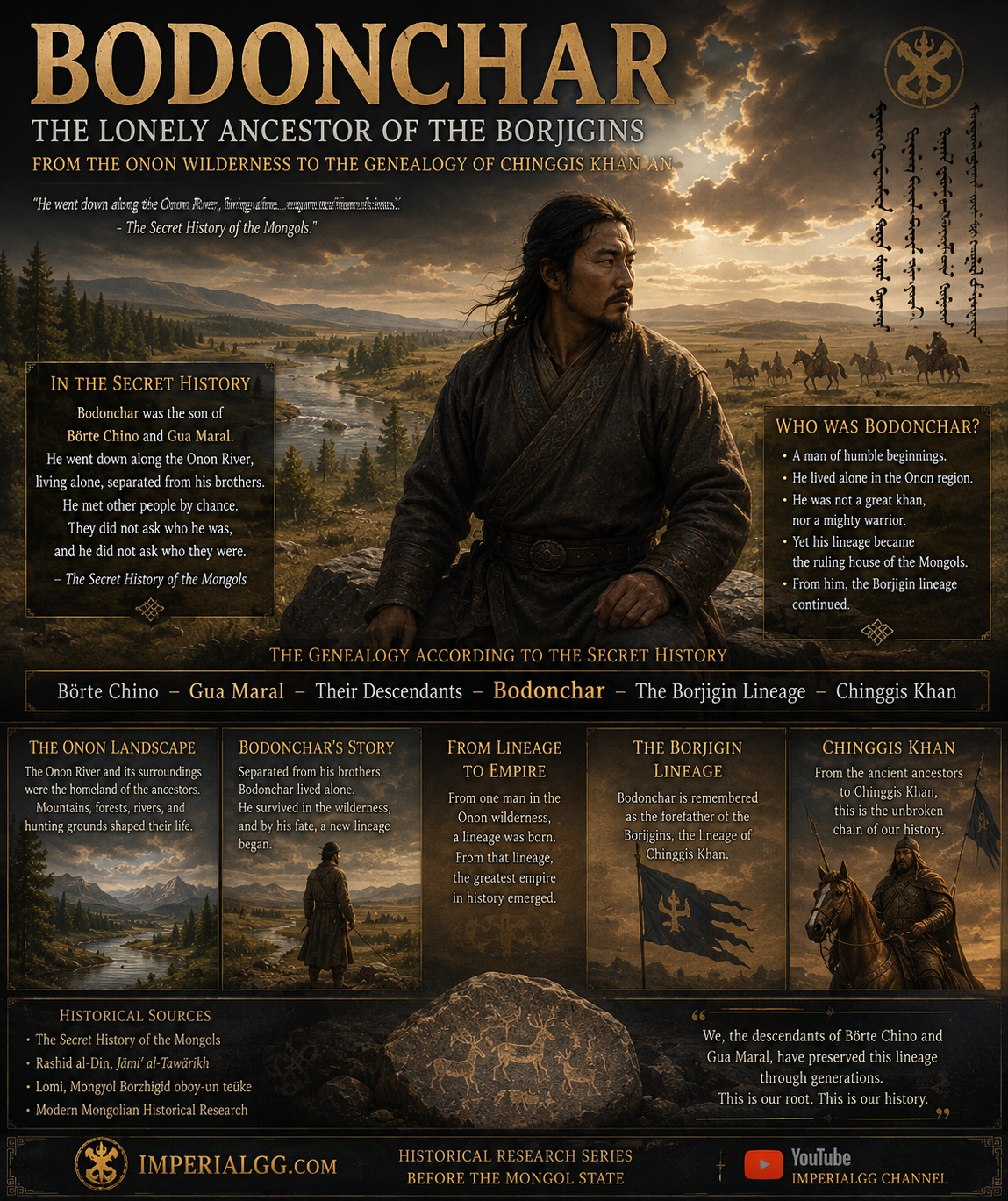
From the Onon wilderness to the political genealogy of Chinggis Khan
ImperialGG Historical Research Series | Before the Mongol State
The history of the Mongols cannot be reduced to the appearance of Chinggis Khan in the twelfth century. Behind the historical Mongol state stood a much older genealogical tradition, and at the center of that tradition stands one remarkable figure: Bodonchar Mungqaq.
In the Secret History of the Mongols, Bodonchar is not introduced as a powerful khan commanding an established state. He appears first as an isolated young man, separated from his brothers and living alone along the Onon River. His story marks a crucial transition between the ancestral world of Börte Chino and Gua Maral and the later political genealogy from which Chinggis Khan emerged.
FROM BÖRTE CHINO TO BODONCHAR
The Secret History begins the genealogy of Chinggis Khan with Börte Chino and Gua Maral, who come to the region of the Onon and establish the ancestral line from which the later Borjigin rulers descend. Several generations later comes Bodonchar. This genealogy is important because Bodonchar is not merely another name in a long list. Later Mongolian historical traditions identify him as the ancestor of the Borjigin lineage, the ruling lineage to which Chinggis Khan belonged. Modern scholarship likewise treats Bodonchar as a central figure in the formation of the Borjigin genealogy.
Thus the traditional sequence can be represented as:
BÖRTE CHINO & GUA MARAL
↓
… SEVERAL GENERATIONS …
↓
BODONCHAR
↓
DUTUM MENEN
↓
KHAIDU
↓
…
↓
YESÜGEI
↓
CHINGGIS KHAN
The genealogy is therefore functioning as more than family history. It is a political genealogy.
THE MAN ALONE BESIDE THE ONON
One of the most striking passages of the Secret History concerns Bodonchar’s separation from his brothers. He travels down the Onon River, living apart from his relatives. Eventually he encounters another group of people living in the region. They do not initially ask who he is or what clan he belongs to, and he does not ask them who they are. This passage is unusually revealing. Bodonchar is presented outside an established social network. He has no powerful army. No recognized political title. No great territory. He is essentially one man in the landscape. Yet this isolated figure becomes an ancestor of the dynasty that would eventually rule the Mongol Empire. That transformation is one of the most powerful narrative structures in the Secret History.
BODONCHAR AND THE ONON LANDSCAPE
The geographical setting is also significant. Bodonchar’s story takes place around the Onon River, the same river system that occupies such an important position in the opening genealogy of the Secret History. The Onon is therefore not merely background scenery. It is a genealogical landscape.
The Mongol ancestral tradition repeatedly returns to:
- the Onon;
- Burkhan Khaldun;
- the forest-steppe;
- hunting territories;
- seasonal movement;
- and the communities living along the river systems of eastern Mongolia.
The landscape itself becomes part of the genealogy. This is one reason the transition from Börte Chino → Onon → Bodonchar deserves attention.
WHO WAS BODONCHAR?
The name appears in several forms in Mongolian historical sources. The Secret History calls him Bodončar Mungqaq. Later traditions preserve the name in somewhat different forms. Modern scholarship has also examined the etymology and meaning of Bodonchar-Mungqaq. Enkhbat Avirmed, for example, has argued for a possible interpretation of Bodon-char and discussed the historical and linguistic dimensions of the name.
The epithet Mungqaq, traditionally translated along the lines of “fool” or “simpleton,” is particularly interesting. Yet this label should not be interpreted too literally. The narrative subsequently depicts Bodonchar as capable of independent action, observation, hunting, negotiation, and eventually establishing a new lineage. The “fool” therefore becomes an ancestor. That apparent contradiction may itself be deliberate.
THE OUTSIDER WHO BECOMES AN ANCESTOR
Bodonchar’s story contains a recurring theme in Mongolian origin traditions: The future ruling lineage emerges from a marginal position.
Bodonchar begins alone. He is separated from his brothers. He survives through the landscape. He encounters people outside his own immediate family. He gradually establishes relationships. And eventually his descendants become one of the principal ruling lineages of the Mongol world. This is not the narrative of an already established royal house. It is a narrative of lineage formation.
BODONCHAR AND THE FORMATION OF THE BORJIGIN
The importance of Bodonchar becomes clearer when we compare the different genealogical traditions.
Christopher P. Atwood’s recent study of pre-Chinggisid genealogies demonstrates that Rashīd al-Dīn preserved multiple genealogical traditions concerning the ancestors of Chinggis Khan, and that Bodonchar occupies a particularly important position within these competing genealogical schemes. This is important because it shows that the genealogy was not necessarily transmitted in one perfectly uniform form.
Different Mongolian genealogical traditions could preserve different versions of:
- Bodonchar’s brothers;
- his sons;
- the descendants of those sons;
- and the precise relationship between certain early ancestors.
Therefore, the historian must distinguish between:
the existence of a strong Bodonchar tradition
and
the precise historical reconstruction of every genealogical relationship. The first is very well established as a feature of Mongolian historical memory. The second remains a subject of source criticism.
RASHĪD AL-DĪN AND MONGOLIAN GENEALOGY
Rashīd al-Dīn is particularly valuable because his Jāmiʿ al-Tawārīkh incorporated substantial Mongolian source material.
Christopher Atwood’s research demonstrates that Rashīd al-Dīn drew upon Mongolian genealogies, chronicles, biographies, oral reports, and other materials rather than relying exclusively on Persian or Islamic historical traditions. This makes his treatment of Bodonchar especially important. But it also reminds us that Rashīd al-Dīn’s work should be read critically.
He was compiling, comparing, organizing, and interpreting different traditions. Consequently, disagreements between the Secret History and Rashīd al-Dīn are not necessarily evidence that one source is simply “true” and the other “false.” They can reveal the complexity of Mongolian genealogical memory itself.
BODONCHAR WAS NOT YET A “MONGOL EMPIRE”
This distinction is essential. Bodonchar should not be transformed into a twelfth- or thirteenth-century Mongol ruler. The political institutions of Chinggis Khan’s empire did not yet exist. There was no Mongol imperial bureaucracy. No unified Mongol ulus on the scale of 1206. No imperial military organization. Bodonchar belongs to a much earlier layer of the genealogy. His historical significance lies in the fact that later Mongol traditions placed him at the root of the Borjigin ruling lineage.
This is why Bodonchar is more appropriately studied through the concepts of: lineage formation, ancestral memory, clan organization and political genealogy.
FROM LINEAGE TO POLITICAL POWER
The later genealogy becomes increasingly political. After Bodonchar comes a succession of ancestors through whom the lineage eventually reaches Khaidu, and then the historically more visible pre-Chinggisid Mongol rulers.
The process can be understood as: ANCESTRAL MEMORY – LINEAGE – CLAN – POLITICAL HOUSE – KHANATE – MONGOL STATE
This is why Bodonchar matters. He represents one of the earliest recognizable points at which the genealogical tradition begins to connect ancestry with a specific political lineage.
WHY BODONCHAR MATTERS TO THE HISTORY OF MONGOL STATEHOOD
If we begin Mongolian state history only with 1206, we lose the long political development that preceded Chinggis Khan. If we begin only with Khabul Khan, we still miss the genealogical and social traditions through which the later ruling house understood itself.
Bodonchar therefore occupies an important intermediate position. He belongs to the world before the Mongol state, but his descendants eventually become the ruling house of that state. This is precisely why the study of the pre-Chinggisid period matters. The empire did not emerge from an historical vacuum.
BODONCHAR AND THE IDEA OF CONTINUITY
The Mongol genealogical tradition presents a striking sense of continuity: Börte Chino – Gua Maral – their descendants – Bodonchar – the Borjigin lineage – Chinggis Khan. The genealogy transforms biological descent into political legitimacy.
The later ruler does not simply say: “I have conquered this land.” He stands within a remembered chain of ancestors. This is one of the foundations upon which Mongol political legitimacy was constructed.
A CAUTION ABOUT GENEALOGICAL TIME
There is, however, a major methodological problem. The Secret History gives a genealogy, but a genealogy is not automatically a modern chronological register. Some generations may represent real ancestral memories; others may have been reorganized, compressed, expanded, or attached to political lineages over time. Modern scholarship has demonstrated that different pre-Chinggisid genealogies circulated and that Rashīd al-Dīn himself preserved more than one version. Therefore, we should not simply assign a precise calendar year to every figure from Börte Chino to Bodonchar.
The stronger historical approach is to ask: What social and political memory did the genealogy preserve?
THE BORJIGIN LINEAGE AS HISTORICAL MEMORY
Later Mongolian traditions went even further, treating Bodonchar as the forefather of the Borjigin. A modern review of Mongolian historical writing notes that works such as Lomi’s Mongγol Borzhigid oboγ-un teüke specifically begin their treatment of Borjigin history with Bodonchar, demonstrating the enduring importance of this figure within Mongolian genealogical historiography.
Thus Bodonchar survived not merely as an ancestor in a medieval text. He became a structural pillar of Mongolian historical identity.
FROM THE LONELY MAN TO THE IMPERIAL HOUSE
The power of Bodonchar’s story lies in its simplicity. A man stands alone beside the Onon. He has been separated from his family. He has no empire. No capital. No army. Yet the genealogy remembers him because his descendants eventually become the lineage from which Chinggis Khan emerges.
This is an extraordinary transformation: FROM A SINGLE MAN IN THE ONON LANDSCAPE TO THE ANCESTOR OF THE HOUSE THAT WOULD RULE THE LARGEST CONTIGUOUS EMPIRE IN HISTORY.
Whether every detail of the story represents literal eighth-, ninth-, or tenth-century history cannot be demonstrated. But the tradition itself is unquestionably historical evidence—evidence of how Mongols remembered their ancestry, organized their lineages, and explained the legitimacy of their rulers.
CONCLUSION: BODONCHAR IS THE BRIDGE
Bodonchar is therefore best understood as a bridge between ancestral legend and political history. Behind him stands the primordial genealogy of Börte Chino and Gua Maral. Before him lies the emerging lineage of the Borjigins.
Far ahead lies: Khaidu – Khabul Khan – Ambaqai – Qutula – Yesügei and ultimately Temüjin — Chinggis Khan. The Mongol state of 1206 did not create this genealogy. Rather, 1206 transformed an old genealogical and political tradition into an imperial state. And at the heart of that transition stands Bodonchar Mungqaq. He was not yet the founder of an empire.
He was the ancestor of the lineage that would eventually found one. That distinction is precisely what makes Bodonchar historically important.
FOOTNOTES
[1] The Secret History of the Mongols, §§1–29. The text establishes the ancestral genealogy beginning with Börte Chino and Gua Maral and later narrates Bodonchar’s separation from his brothers and his life along the Onon.
[2] Christopher P. Atwood, “Six Pre-Chinggisid Genealogies in the Mongol Empire,” discusses the multiple genealogical traditions preserved concerning the ancestors of Chinggis Khan and the differing presentations of Bodonchar and his descendants.
[3] Christopher P. Atwood, “Rashīd al-Dīn’s Ghazanid Chronicle and Its Mongolian Sources,” in New Approaches to Ilkhanid History, pp. 53–121. The study demonstrates the importance of Mongolian genealogies, chronicles, oral reports, and other Mongolian materials in Rashīd al-Dīn’s historical project.
[4] Bulat R. Zoriktuev, “Formation of the Mongolian Kin of Bordzhigin,” The New Research of Tuva. The study specifically examines the formation of the Borjigin kin and identifies Bodonchar as a central figure in the genealogy of Chinggis Khan.
[5] Enkhbat Avirmed, “About the Name of the ‘Bodonçar-Munghah’,” Journal of International Social Research 3, no. 11 (2010), p. 79. The article examines the linguistic and cultural interpretation of the name Bodonchar-Mungqaq.
[6] E. Kalan, “Classical Era Mongolian History Writing and a Review of Mongolian Sources,” Golden Horde Review. The discussion of Lomi’s Mongγol Borzhigid oboγ-un teüke demonstrates the continued centrality of Bodonchar within later Mongolian Borjigin historiography.
IMPERIALGG HISTORICAL RESEARCH SERIES
ERGÜNE KÜN
↓
BÖRTE CHINO & GUA MARAL
↓
BODONCHAR
↓
KHAIDU
↓
KHABUL KHAN
↓
AMBAQAI — QUTULA
↓
YISÜGEI
↓
TEMÜJIN
↓
1206 — THE GREAT MONGOL STATE. From ancestral memory to Mongol statehood.