
FROM ANDA TO FATHER AND SON
By Altanbagana Baatar
DBA Candidate| Independent Historian
ImperialGG Historical Research Seriers
05 October 2026
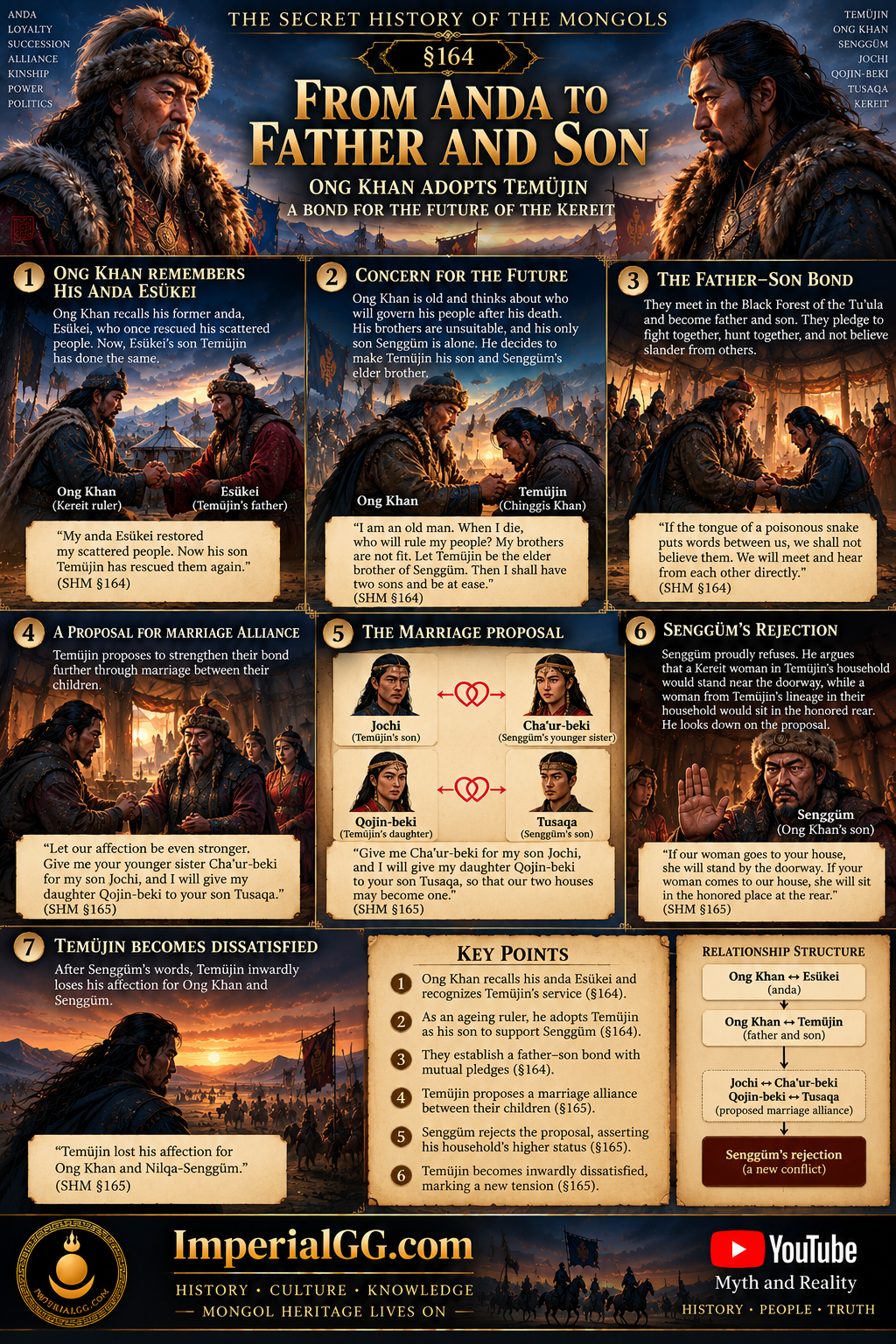
Kinship, Political Alliance, and the Failed Marriage Proposal between Chinggis Khan and the Kereit Ruling House
The Secret History of the Mongols, §§164–165
Abstract
Sections 164–165 of The Secret History of the Mongols present a significant transformation in the political relationship between Chinggis Khan and Ong Khan. Following the rescue of Ong Khan and the recovery of his people by Chinggis Khan’s four külüg or “steeds,” Ong Khan recalls his former anda relationship with Yisügei, Temüjin’s father, and interprets Temüjin’s assistance as a continuation of the service once rendered by his father. Facing old age and concerned about the future of his only son Senggüm, Ong Khan proposes to make Temüjin Senggüm’s elder brother and thereby establishes a father–son relationship with him. The relationship is subsequently formalized through mutual promises of military cooperation and an explicit commitment not to permit slander to divide them. Chinggis Khan then seeks to strengthen this relationship through a reciprocal marriage alliance: Jochi is to marry Senggüm’s younger sister Cha’ur-beki, while Chinggis Khan’s daughter Qojin-beki is to marry Senggüm’s son Tusaqa. Senggüm rejects the proposal, expressing a hierarchical view of the two households through the spatial symbolism of the Mongolian ger. This refusal marks an important change in the political relationship. Whereas Ong Khan recognizes Temüjin’s increasing importance and seeks to incorporate him into the Kereit ruling household, Senggüm interprets the proposed alliance through status and household hierarchy. Sections 164–165 therefore illuminate the interaction of anda alliance, fictive fatherhood, political succession, and marriage alliance in the formation and subsequent destabilization of the relationship between Temüjin and the Kereit ruling house.
Keywords: Chinggis Khan; Temüjin; Ong Khan; Yisügei; Senggüm; anda; quda; Kereit; marriage alliance; Secret History of the Mongols
Introduction
The relationship between Temüjin and Ong Khan in the Secret History of the Mongols cannot be adequately understood as a simple sequence of friendship, betrayal, and military conflict. Sections 164–165 reveal a more complex political structure in which relationships are repeatedly reformulated across generations. The narrative moves from the earlier anda relationship between Yisügei and Ong Khan to a father–son relationship between Ong Khan and Temüjin and then, at Temüjin’s initiative, toward a proposed marriage alliance between their descendants. The sequence is significant because each stage represents a different mechanism through which political relationships could be strengthened and reproduced. Internet History Sourcebooks
The immediate background is the rescue of Ong Khan recorded at the end of §163. When Ong Khan was attacked by the Naiman commander Kökse’u-Sabraq and his people and possessions were scattered, Chinggis Khan responded by sending Bo’orču, Muqali, Boroqul, and Čila’un-ba’atur. The four commanders rescued Senggüm and restored Ong Khan’s people, clans, wives, and children. Ong Khan then explicitly compared Temüjin’s service with that of Temüjin’s father, Yisügei, who had earlier restored his scattered people. Aziz Yardımlı
Sections 164–165 develop the political implications of this comparison. The central question is not merely why Ong Khan was grateful to Temüjin, but how an existing relationship between two older political actors could be transferred to the next generation and transformed into a new structure of political kinship.
1. Yisügei and Ong Khan: The Memory of the Anda Relationship
Section 164 begins with Ong Khan recalling his relationship with Yisügei-ba’atur. He states that his sworn brother Yisügei had previously restored his scattered people, while Temüjin, Yisügei’s son, has now performed a comparable service. The Mongolian text explicitly places the two men within a generational sequence: the father and son have both supported and restored Ong Khan’s people. Scribd
This formulation is important because Ong Khan does not treat Temüjin’s assistance as an isolated military favor. He understands it through the memory of his relationship with Yisügei. The political value of the service therefore becomes hereditary in a social and relational sense: the son has continued a relationship established by the father.
The concept of anda is central here. In the social and political world represented by the Secret History, anda was not simply equivalent to modern friendship. It could establish a relationship of mutual obligation and political solidarity between men who were not biological brothers. In §164, the earlier relationship between Yisügei and Ong Khan provides the conceptual foundation for the new relationship between Ong Khan and Temüjin.
The narrative thus establishes a generational transition:
Yisügei ↔ Ong Khan
anda
↓
Temüjin ↔ Ong Khan
father–son
This transition is not presented as an arbitrary invention. Ong Khan explicitly bases his relationship with Temüjin upon his earlier relationship with Yisügei. Cleaves likewise translates the passage as an explanation that Ong Khan had previously declared himself anda with Yisügei, the father of Chinggis Khan. Scribd
2. Ong Khan’s Age and the Problem of Succession
Ong Khan’s decision is also connected to his perception of his own mortality and the future of his political order. He describes himself as having grown old and asks who will govern his people after his death. He dismisses his younger brothers as lacking the necessary moral qualities and describes Senggüm, his only son, as effectively insufficient on his own. He therefore proposes to make Temüjin Senggüm’s elder brother: by doing so, he would have two sons and could be at ease. Aziz Yardımlı
This passage deserves particular attention because it places Temüjin’s incorporation into the Kereit ruling household within a problem of political continuity.
Ong Khan is not merely saying: “Temüjin helped me, therefore I love him.”
His reasoning is more political. He is an aging ruler considering the future of his people and the position of his son. Temüjin has already demonstrated military effectiveness and political usefulness, and his relationship with Ong Khan carries the inherited legitimacy of Yisügei’s earlier alliance. Incorporating Temüjin as an elder son therefore provides a way of strengthening the political household around Senggüm.
The source does not explicitly state that Ong Khan adopted Temüjin because he feared Temüjin’s growing power. That would be an interpretation rather than a textual fact. The evidence does, however, establish that Temüjin had acquired substantial political importance and that Ong Khan chose to integrate this increasingly consequential ally into his own household.
The distinction is important for an academic interpretation. It is more defensible to state that Ong Khan recognized Temüjin’s increasing political importance and sought to incorporate that relationship into a familial and political structure than to claim that the Secret History explicitly says Ong Khan was afraid of Temüjin.
3. From Anda to Father and Son
The two leaders subsequently meet in the Black Forest of the Tu’ula and declare themselves father and son. The Secret History immediately explains the basis of the relationship: Ong Khan had previously been anda with Yisügei, Temüjin’s father. Scribd
This is a crucial passage for understanding the social logic of the episode. The new relationship does not replace the old one so much as extend its political meaning across generations.
Ong Khan becomes a symbolic father to the son of his former anda, while Temüjin becomes an adopted or fictive son within Ong Khan’s political household. The relationship is therefore simultaneously personal, political, and genealogically symbolic.
Their agreement also carries concrete obligations. They promise to act together when confronting numerous enemies and to hunt together when pursuing game. The relationship is thus expressed through shared military and economic activity rather than through kinship terminology alone. AnyFlip
Most significantly, they explicitly recognize the danger of third-party manipulation. They agree that if malicious speech or slander enters between them, they will not simply accept it. They will meet and verify the matter “by mouth and tongue,” rather than allowing hostile speech to destroy their relationship. AnyFlip
This pledge becomes narratively significant because later events will violate precisely this principle.
4. “Over and Above Friendship”: Temüjin’s Marriage Proposal
After establishing the father–son relationship, Temüjin seeks to strengthen it further. Section 165 begins with the idea that, “over and above friendship, let there be double friendship.” Atwood translates the proposal in these terms, while Cleaves similarly renders the expression as an effort to make their existing relationship doubly secure. Internet History Sourcebooks
Temüjin proposes a reciprocal marriage alliance between the two households.
He asks for Cha’ur-beki (Чаур бэхи), Senggüm’s younger sister, for his son Jochi (Зүчи). In exchange, he offers his daughter Qojin-beki (Хожин бэхи) to Tusaqa (Тусаха), Senggüm’s son. The Mongolian text confirms this reciprocal structure. Scribd
The proposal therefore creates a third stage in the development of the relationship:
Anda → Father and Son → Marriage Alliance
The first relationship connects Yisügei and Ong Khan. The second connects Ong Khan and Temüjin. The third would have connected the children of the two households.
If accepted, the proposed marriages would have transformed a political relationship between two rulers into a multi-generational alliance between their descendants.
This is why the proposal should not be treated as a private family matter. Marriage in this context was a mechanism through which political relationships could be reproduced and institutionalized across generations.
5. Senggüm’s Rejection and the Politics of Household Status
Senggüm rejects the proposal. The Secret History introduces his response with a direct characterization: Senggüm “thought highly of himself” or, in the Mongolian text, bie-e ih-emsiglen seregüü—he regarded himself as highly important and superior. He then explains his refusal through the spatial hierarchy of the Mongolian ger. If a woman from his lineage went to Temüjin’s household, she would stand near the doorway and face toward the rear of the tent; if a woman from Temüjin’s lineage came to his household, she would sit in the rear and face toward the doorway. Internet History Sourcebooks
Cleaves preserves the same structure and explains the significance in his annotation: Senggüm’s imagery means that a Kereit woman in Temüjin’s household would occupy a subordinate position near the entrance, whereas a woman from Temüjin’s lineage in Senggüm’s household would occupy the honored position at the rear. Monumenta Altaica
The Mongolian text is even more explicit. Senggüm does not merely decline the proposal; he is said to speak with arrogance and contempt, and he refuses to give his younger sister Cha’ur-beki. Scribd
This is one of the most revealing moments in §§164–165 because it exposes a fundamental difference between Ong Khan’s and Senggüm’s perceptions of Temüjin.
6. Ong Khan Recognizes Temüjin; Senggüm Measures Status
Ong Khan’s decision in §164 is based upon service, continuity, and political necessity. He remembers Yisügei, observes Temüjin’s service, considers his own age, and seeks to provide Senggüm with a capable elder brother.
Senggüm approaches the same relationship through hierarchy.
For Ong Khan: Temüjin’s value makes him worthy of incorporation.
For Senggüm: Temüjin’s incorporation threatens the established hierarchy of the Kereit household.
This contrast should not be reduced to the simplistic statement that Ong Khan was “wise” while Senggüm was merely “jealous.” Senggüm had a genuine political interest in preserving his own position as Ong Khan’s biological son. The adoption of Temüjin as an elder son necessarily altered the internal structure of the ruling household.
Atwood’s translation and notes are particularly useful here because his treatment of the episode connects Senggüm’s response to the status implications of Temüjin’s adoption. FlipHTML5
Thus Senggüm’s arrogance has a political dimension. His rejection expresses a refusal to accept the social equality implied by Temüjin’s proposed marriage alliance.
7. The Ger as a Political Space
Senggüm’s metaphor deserves further consideration because the Secret History does not express hierarchy abstractly. It represents hierarchy spatially.
The doorway/fire area and the rear of the ger are transformed into symbols of relative status.
His argument is effectively:
Their woman in our household → honored position.
Our woman in their household → subordinate position.
The spatial metaphor therefore becomes a statement about political rank.
Senggüm is refusing the premise that the two households have reached a relationship of sufficient equality to exchange women on reciprocal terms.
This is why the rejection is politically consequential. Temüjin had proposed mutual exchange. Senggüm answers with asymmetry.
The proposed relationship: “Let our two houses become doubly connected.”
is rejected in favor of: “Our house occupies the higher position.” The difference is fundamental.
8. From Failed Marriage Alliance to Political Estrangement
The final sentence of §165 records the consequence. Because of Senggüm’s words, Chinggis Khan inwardly loses his affection for Ong Khan and Nilqa-Senggüm. Internet History Sourcebooks
The wording is important. The rupture is not yet an open military conflict. It begins as an internal change in political sentiment.
The sequence is therefore:
Ong Khan’s recognition → father–son relationship → mutual pledge → marriage proposal → Senggüm’s rejection → Chinggis Khan’s loss of affection
The relationship that appeared to be moving toward greater integration has instead acquired a new source of tension. This is precisely why §165 should be read together with §164. Section 164 constructs the strongest form of political intimacy available to the participants; §165 demonstrates how quickly that intimacy can be weakened when questions of status and hierarchy intervene.
9. The Irony of the §§164–165 Sequence
There is a striking structural irony in these sections. When Ong Khan and Chinggis Khan become father and son, they explicitly promise not to allow slander to divide them. They agree that if hostile speech enters between them, they will meet directly and determine the truth themselves. AnyFlip
Immediately afterward, however, Senggüm’s words produce precisely the kind of political estrangement that their earlier pledge was designed to prevent. The narrative therefore establishes a principle and then tests it.
The principle is: Do not allow hostile speech to come between us.
The subsequent political reality is: Status, speech, and resentment begin to come between them.
This becomes even more significant in §166, when Jamuqa learns that Chinggis Khan has become dissatisfied with Ong Khan and Senggüm and begins to exploit the division. The Mongolian text itself places the beginning of this sequence immediately after the failed marriage proposal. Монголын нууц товчоо
Conclusion
Sections 164–165 of The Secret History of the Mongols document a sophisticated transformation of political relationships within the steppe aristocratic order. Ong Khan begins by remembering his anda relationship with Yisügei and recognizing that Yisügei’s son Temüjin has now rendered a comparable service. Faced with old age and concerned about the future of his only son Senggüm, Ong Khan incorporates Temüjin into his political household as an elder son. The relationship is then reinforced by mutual promises of military cooperation and by an explicit commitment to resist slander and verify accusations directly.
Temüjin subsequently seeks to extend this relationship through reciprocal marriage. His proposal for Jochi to marry Cha’ur-beki and for Qojin-beki to marry Tusaqa would have transformed the father–son relationship between the two leaders into a durable alliance between their descendants. The proposal therefore represents an attempt to convert political friendship into multi-generational kinship.
Senggüm’s rejection, however, reveals a different conception of the relationship. His spatial metaphor of the ger expresses a hierarchy in which the Kereit ruling household occupies the superior position. The rejection therefore cannot be understood simply as a refusal of marriage. It is a rejection of the implied equality between the two political houses.
The contrast between Ong Khan and Senggüm is consequently central to the historical interpretation of these sections. Ong Khan recognizes Temüjin’s growing political importance and seeks to incorporate him into the Kereit ruling household; Senggüm experiences that same incorporation as a potential alteration of his own position and responds by asserting hierarchy. The Secret History does not explicitly say that Ong Khan adopted Temüjin because he feared his rising power, and such a claim should therefore remain an interpretation. What the text does establish is that Temüjin had become important enough for Ong Khan to regard him as necessary to the future stability of his political household.
The failure of the marriage proposal marks the first clear internal fracture after the father–son relationship has been established. The significance of §§164–165 therefore lies in their presentation of anda, fictive fatherhood, political succession, and marriage alliance as interconnected mechanisms of steppe political organization—and in showing how the same mechanisms could become sources of conflict when the participants no longer perceived their relative status in the same way.
Notes / Sources
- Ц. Дамдинсүрэн, Монголын нууц товчоо, §§164–165. The Mongolian text records Ong Khan’s recollection of Yisügei, his concern for Senggüm’s future, the father–son relationship with Temüjin, the marriage proposal, Senggüm’s response, and Chinggis Khan’s resulting loss of affection. Scribd
- Christopher P. Atwood, The Secret History of the Mongols: A Mongolian Epic Chronicle of the Thirteenth Century, §§164–165. Atwood’s translation emphasizes Ong Khan’s concern over succession and Senggüm’s status, and translates the marriage proposal as an attempt to create “double friendship.” Internet History Sourcebooks
- Francis W. Cleaves, The Secret History of the Mongols, §§164–165. Cleaves preserves the explanation of the father–son relationship and provides an important note explaining Senggüm’s ger imagery as a statement about relative household status. Monumenta Altaica
- Urgunge Onon, The Secret History of the Mongols: The Life and Times of Chinggis Khan, §§163–165, Routledge. Onon likewise presents the transition from Ong Khan’s rescue to his recognition of Temüjin and the subsequent marriage proposal. Aziz Yardımlı
Suggested article thesis: Sections 164–165 demonstrate how the political relationship between Ong Khan and Chinggis Khan evolved from the inherited memory of an anda alliance into fatherhood and a proposed marriage alliance, while Senggüm’s rejection exposed the unresolved hierarchy within the Kereit ruling house and transformed Temüjin’s growing political importance from a source of alliance into a potential source of conflict