
FROM DIPLOMATIC SUSPICION TO POLITICAL CONSPIRACY
By Altanbagana Baatar
DBA Candidate| Independent Historian
ImperialGG Historical Research Seriers
06 October 2026
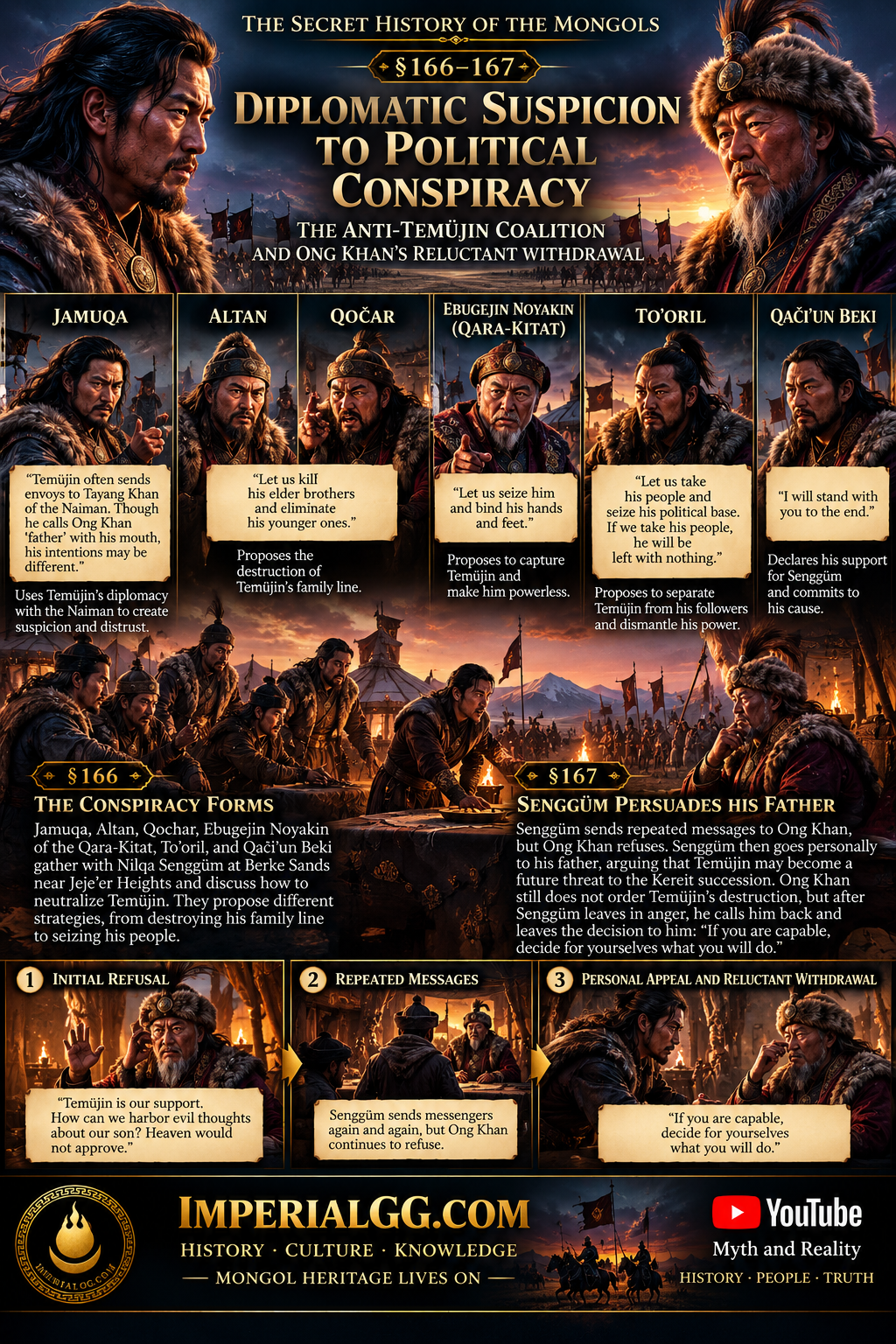
THE ANTI-TEMÜJIN COALITION AND ONG KHAN’S RELUCTANT WITHDRAWAL
The Secret History of the Mongols, §§166–167
ABSTRACT
Sections 166–167 of The Secret History of the Mongols mark a decisive stage in the deterioration of the relationship between Temüjin and the Kereit ruling house. Following the failure of the proposed marriage alliance between Temüjin’s family and the family of Nilqa Senggüm, Jamuqa and several political figures gather with Senggüm and begin to transform personal resentment and political anxiety into an organized conspiracy. Jamuqa presents Temüjin’s repeated exchange of envoys with Tayang Khan of the Naiman as evidence that his professed father–son relationship with Ong Khan may conceal a different political intention. The other conspirators then propose different methods of neutralizing Temüjin: the elimination of his elder and younger brothers, the binding of his hands and feet, the seizure of his people and political base, and continued support for Senggüm. These statements reveal that the objective was not merely to discredit Temüjin but to destroy or incapacitate the political structure that sustained his growing power.
Section 167 is equally significant because Ong Khan does not initially accept these accusations. Senggüm repeatedly communicates the conspirators’ arguments to his father, but Ong Khan refuses to act against Temüjin and explicitly describes him as a source of strength. He invokes Heaven and the moral obligation of the father–son relationship as reasons not to harm him. Only after repeated attempts through messengers does Senggüm go personally to his father and intensify the argument by presenting Temüjin as a future threat to the Kereit succession. Even then, Ong Khan does not directly order Temüjin’s destruction. His eventual decision to send Senggüm back and effectively leave the matter to him represents not an original endorsement of the conspiracy, but a gradual withdrawal of resistance that allows Senggüm and his faction to proceed.
Keywords: Secret History of the Mongols; Temüjin; Chinggis Khan; Ong Khan; Nilqa Senggüm; Jamuqa; Naiman; Tayang Khan; Kereit; political conspiracy; diplomacy; succession.
I. FROM FAILED MARRIAGE ALLIANCE TO POLITICAL CONSPIRACY
The political crisis of §§166–167 cannot be separated from the preceding breakdown in the relationship between Temüjin and the Kereit ruling household. Temüjin had proposed reciprocal marriages between the two families, linking Jochi with Cha’ur-beki and Qojin-beki with Tusaqa. Senggüm rejected the proposal, and the rejection created a new atmosphere of distrust between Temüjin and the Kereit ruling family.
It is in this atmosphere that Jamuqa and his associates move toward Senggüm. The Secret History describes Jamuqa, Altan, Qočar, Ebugejin Noyakin of the Qara-Kitat, Süge’etei-To’oril, and Qači’un Beki moving together to the Berke Sands near Jeje’er Heights, where they meet Senggüm. studylib.net
The physical act of moving together and gathering around Senggüm is politically significant. The passage is no longer concerned merely with individual hostility toward Temüjin. Several political actors are now forming a common position around the Kereit prince.
The conspiracy therefore develops in stages:
personal resentment → political suspicion → coalition-building → proposed action against Temüjin.
II. JAMUQA: TURNING DIPLOMACY INTO SUSPICION
Jamuqa provides the central political argument. He tells Senggüm that Temüjin, although speaking of Ong Khan as his “father,” has repeatedly exchanged envoys with Tayang Khan of the Naiman. He then asks whether Temüjin can truly be trusted and warns that delay could bring disastrous consequences. studylib.net
This statement requires an important distinction between source fact and political interpretation. The existence of communication with Tayang Khan is presented within Jamuqa’s speech. But the Secret History does not establish in this passage that Temüjin’s communication with the Naiman constituted treason against Ong Khan.
Jamuqa transforms the existence of diplomacy into a political accusation: Diplomatic contact → suspicion → distrust → fear of future betrayal → justification for war.
This is one of the most important political mechanisms in the passage. Temüjin’s communication with the Naiman also indicates that his diplomatic horizon extended beyond his immediate relationship with the Kereit. He was not politically confined to a single external relationship. Yet the passage does not establish a formal Naiman alliance. The academically safer interpretation is that Temüjin maintained a broader diplomatic network, and Jamuqa exploited that network rhetorically as evidence of disloyalty. The accusation therefore tells us as much about Jamuqa’s political strategy as it does about Temüjin’s diplomacy.
III. ALTAN AND QOČAR: THE DESTRUCTION OF TEMÜJIN’S FAMILY LINE
After Jamuqa, Altan and Qočar express a considerably more radical position. Their proposal extends beyond Temüjin himself. They advocate killing his elder brothers and eliminating the younger members of his family. This is a crucial detail because it demonstrates that the conspirators understood Temüjin’s power as something larger than the individual man.
His political strength rested upon:
- his family,
- his sons and brothers,
- his followers,
- his military organization,
- and the political loyalty surrounding him.
Therefore, eliminating members of his family could prevent the restoration of his political power even if Temüjin himself survived. The proposal can thus be understood as an attempt at political eradication rather than simple military defeat.
The distinction is important:
To defeat Temüjin would be to defeat him in the present.
To destroy his family line would be to prevent the political movement from recovering in the future.
IV. EBUGЕJIN NOYAKIN AND THE PROPOSAL TO BIND TEMÜJIN
Ebugejin Noyakin of the Qara-Kitat and his associate propose another solution: to seize Temüjin physically and bind his hands and feet. studylib.net
This proposal differs from that of Altan and Qočar. Altan and Qočar contemplate elimination. Ebugejin Noyakin and his associate propose physical incapacitation. The distinction reveals that the conspirators did not necessarily possess a single operational plan. They shared an objective but differed over the method.
Their common political calculation, however, remained the same: Temüjin must be prevented from acting independently.
The proposal to bind him is therefore not merely a personal act of violence. It is a political strategy designed to remove the central actor around whom a rapidly expanding political coalition had formed.
V. TO’ORIL: TAKE TEMÜJIN’S PEOPLE, NOT MERELY TEMÜJIN
To’oril proposes another strategy: to take Temüjin’s people and political base. This is perhaps the most structurally sophisticated proposal in the discussion. Temüjin’s authority was not simply a matter of personal prestige. It depended upon people who followed him, fought under his command, and participated in his political organization. Therefore, if his people could be taken away, Temüjin could be deprived of the material foundation of his authority.
The logic is:
seize the people → destroy the political base → isolate Temüjin → neutralize his power.
This demonstrates that the conspirators recognized an essential feature of steppe politics: political authority was inseparable from the people and military resources attached to a ruler.
VI. QAČI’UN BEKI: LOYALTY TO SENGGÜM
Qači’un Beki does not propose a separate operational strategy. Instead, he declares his support for Senggüm and indicates that he will stand with him. His position is nevertheless important because it demonstrates that the gathering around Senggüm was becoming a political coalition.
The participants did not all have identical motivations or strategies. They were nevertheless converging around one political objective: Temüjin’s growing power must be checked.
Thus §166 presents not a perfectly unified conspiracy from the beginning, but a coalition of political actors whose different interests converge around the removal or neutralization of Temüjin.
VII. THE CONSPIRATORS’ POSITIONS
The statements of the individual participants can therefore be summarized as follows:
| Figure | Political position |
|---|---|
| Jamuqa | Uses Temüjin’s Naiman diplomacy to construct a case of distrust |
| Altan & Qočar | Advocate eliminating members of Temüjin’s family |
| Ebugejin Noyakin and his associate | Propose physically capturing and binding Temüjin |
| To’oril | Proposes taking Temüjin’s people and destroying his political base |
| Qači’un Beki | Commits himself to Senggüm’s cause |
The diversity of these proposals is itself historically significant. The conspirators are not merely gossiping about Temüjin. They are discussing specific mechanisms for removing his political capacity.
VIII. §167: THE CONSPIRACY REACHES ONG KHAN
Section 167 changes the political setting.
The question is no longer what Jamuqa and Senggüm’s supporters want to do.
The question becomes: Will Ong Khan permit it?
Senggüm communicates the accusations to his father through a messenger. Ong Khan initially rejects the argument. His response is remarkable because he does not describe Temüjin as an enemy. Instead, he regards Temüjin as a source of support and rejects the idea that he should be treated as an adversary. Ong Khan also invokes Heaven.
His reasoning therefore operates on two levels: political: Temüjin is useful and important to the Kereit; moral/cosmic: harming a son-like political subordinate without justification would violate a larger moral order. This is the first major obstacle to Senggüm’s conspiracy.
IX. SENGGÜM’S REPEATED MESSAGES
Senggüm does not accept his father’s refusal. He sends messages repeatedly. Ong Khan continues to resist. The significance of this repetition should not be underestimated. It demonstrates that the transition from Ong Khan’s protection of Temüjin to Senggüm’s hostility toward him was not immediate. There is a sustained period of political pressure.
The sequence is:
Senggüm sends a message → Ong Khan refuses.
Senggüm sends another → Ong Khan still refuses.
Senggüm persists → Ong Khan remains reluctant.
Only after these attempts fail does Senggüm decide to approach his father personally. This makes the episode a struggle inside the Kereit ruling household itself.
X. SENGGÜM APPEARS BEFORE HIS FATHER
Unable to persuade Ong Khan through messengers, Senggüm goes personally to him. His argument now becomes more powerful because he changes the nature of the threat.
Jamuqa had emphasized: Temüjin communicates with Tayang Khan.
Senggüm emphasizes: What will happen to us when you are gone?
This is a major transformation. Jamuqa constructs an accusation of present disloyalty. Senggüm constructs a fear of future succession. His argument is essentially that Ong Khan may still possess authority now, but Temüjin’s growing strength could eventually make Senggüm and the Kereit ruling family politically vulnerable. The question therefore becomes not simply whether Temüjin is loyal today, but whether the Kereit ruling house can safely allow him to continue increasing in power.
XI. ONG KHAN REFUSES AGAIN
Even after Senggüm comes personally, Ong Khan does not immediately agree. He again resists the idea of harming Temüjin. This repeated refusal is essential for interpreting the passage accurately. The Secret History does not present Ong Khan as the original mastermind of the conspiracy.
Instead, the narrative establishes a gradual process: Jamuqa initiates the political accusation.
Senggüm adopts and develops it.
The conspirators propose concrete measures.
Senggüm attempts to obtain Ong Khan’s approval.
Ong Khan repeatedly refuses.
Senggüm continues pressing him.
Ong Khan finally stops actively opposing the plan.
That progression is far more nuanced than simply saying that Ong Khan “decided to betray Temüjin.”
XII. SENGGÜM LEAVES IN ANGER
When Ong Khan again refuses to accept Senggüm’s position, Senggüm becomes angry and leaves. This is the emotional and political climax of §167. At this moment, Ong Khan still has the ability to block Senggüm. But instead of allowing the rupture between father and son to continue, Ong Khan calls Senggüm back. This detail is extremely important.
Ong Khan does not call Senggüm back because he has suddenly decided that Temüjin must be destroyed. He calls him back because the conflict within his own household has reached a dangerous point. The political question has now become intertwined with the father–son relationship between Ong Khan and Senggüm.
XIII. “YOU DECIDE WHAT YOU WILL DO”
The final position of Ong Khan is therefore deliberately ambiguous. He does not issue a direct order: “Capture Temüjin.”
Nor does he say: “Kill Temüjin.” Instead, he effectively tells Senggüm and his supporters to decide for themselves what they are capable of doing. This is one of the most consequential moments in the narrative.
Ong Khan moves from: active protection of Temüjin to: refusal to authorize violenceand finally to: withdrawal from actively preventing Senggüm’s actions. This is not the same as initiating the conspiracy. It is better understood as the withdrawal of political resistance. And that distinction becomes decisive in the following sections.
XIV. THE POLITICAL MEANING OF ONG KHAN’S DECISION
Ong Khan’s final response creates the political space in which Senggüm can act. Before this moment, Senggüm must overcome his father. After this moment, he no longer needs to persuade him. That is the critical transition.
The political structure has therefore changed from: Ong Khan → protects Temüjin to: Ong Khan → no longer actively prevents Senggüm.
The initiative passes to Senggüm. This explains why §§168–169 follow so naturally. Once Senggüm possesses freedom of action, the conspiracy can move from argument to operational planning.
XV. THE STRUCTURE OF §§166–167
The two sections can therefore be understood as a carefully constructed political sequence:
§166 — THE CONSPIRACY FORMS
Jamuqa
→ creates suspicion through Temüjin’s Naiman diplomacy
Altan & Qočar
→ propose destruction of Temüjin’s family
Ebugejin Noyakin and his associate
→ propose capture and restraint
To’oril
→ proposes taking Temüjin’s people
Qači’un Beki
→ commits himself to Senggüm
§167 — THE CONSPIRACY SEEKS LEGITIMATION
Senggüm sends messengers
→ Ong Khan refuses
Senggüm sends again
→ Ong Khan refuses again
Senggüm goes personally
→ Ong Khan still resists
Senggüm becomes angry and leaves
→ Ong Khan recalls him
Ong Khan finally withdraws his opposition
→ “Decide for yourselves what you will do.”
This is the bridge between conspiracy and action.
CONCLUSION
Sections 166–167 should not be read merely as an episode in which Jamuqa and Senggüm decide to oppose Temüjin. They represent a more complex political transformation.
First, Temüjin’s wider diplomatic activity becomes the object of suspicion. His repeated communications with Tayang Khan of the Naiman demonstrate that his political horizon extended beyond the immediate Kereit relationship. Yet Jamuqa converts this diplomatic reality into an accusation that Temüjin’s father–son relationship with Ong Khan is merely verbal.
Second, the accusation becomes a coalition. Each participant contributes a different strategy: destruction of Temüjin’s family, physical capture, seizure of his people, or unconditional support for Senggüm. Their proposals demonstrate that the objective was not simply to defeat Temüjin in battle but to break the political structure that enabled his rise.
Third, and most importantly, the conspiracy encounters resistance from Ong Khan.
Ong Khan refuses repeatedly. He regards Temüjin as a source of support. He questions Jamuqa’s credibility. He invokes Heaven against the idea of harming Temüjin. Even when Senggüm appears personally before him, Ong Khan does not immediately authorize action. The decisive change therefore occurs not when Ong Khan orders Temüjin’s destruction, but when he finally ceases to prevent Senggüm from acting. This distinction is essential to understanding the political tragedy that follows.
The movement of the narrative can be summarized as: DIPLOMATIC CONTACT → POLITICAL SUSPICION → CONSPIRACY → PRESSURE ON ONG KHAN → REPEATED REFUSAL → SENGGÜM’S PERSONAL APPEAL → ONG KHAN’S WITHDRAWAL OF OPPOSITION → POLITICAL ACTION
The significance of §§166–167 therefore lies in the transformation of suspicion into organized political action. Jamuqa supplies the accusation, the conspirators supply competing strategies, Senggüm supplies persistent political pressure, and Ong Khan’s eventual withdrawal removes the final internal obstacle.
The next stage, §§168–169, is consequently not an abrupt change in the story. It is the direct consequence of the political process established here: once Senggüm no longer needs to obtain his father’s active approval, the conspiracy can become an operational plan to capture Temüjin.
AUTHOR’S THESIS
Sections 166–167 demonstrate how Temüjin’s expanding diplomatic horizon was transformed into a political accusation and then into an organized conspiracy. Jamuqa recast Temüjin’s repeated contacts with Tayang Khan of the Naiman as evidence of disloyalty; the conspirators proposed different methods of destroying or neutralizing Temüjin’s political base; and Senggüm repeatedly attempted to obtain Ong Khan’s approval. Yet Ong Khan initially and repeatedly refused. His eventual decision to cease actively opposing Senggüm did not make him the architect of the conspiracy; rather, it marked the critical moment when political initiative passed from the Kereit ruler to his son and his faction.