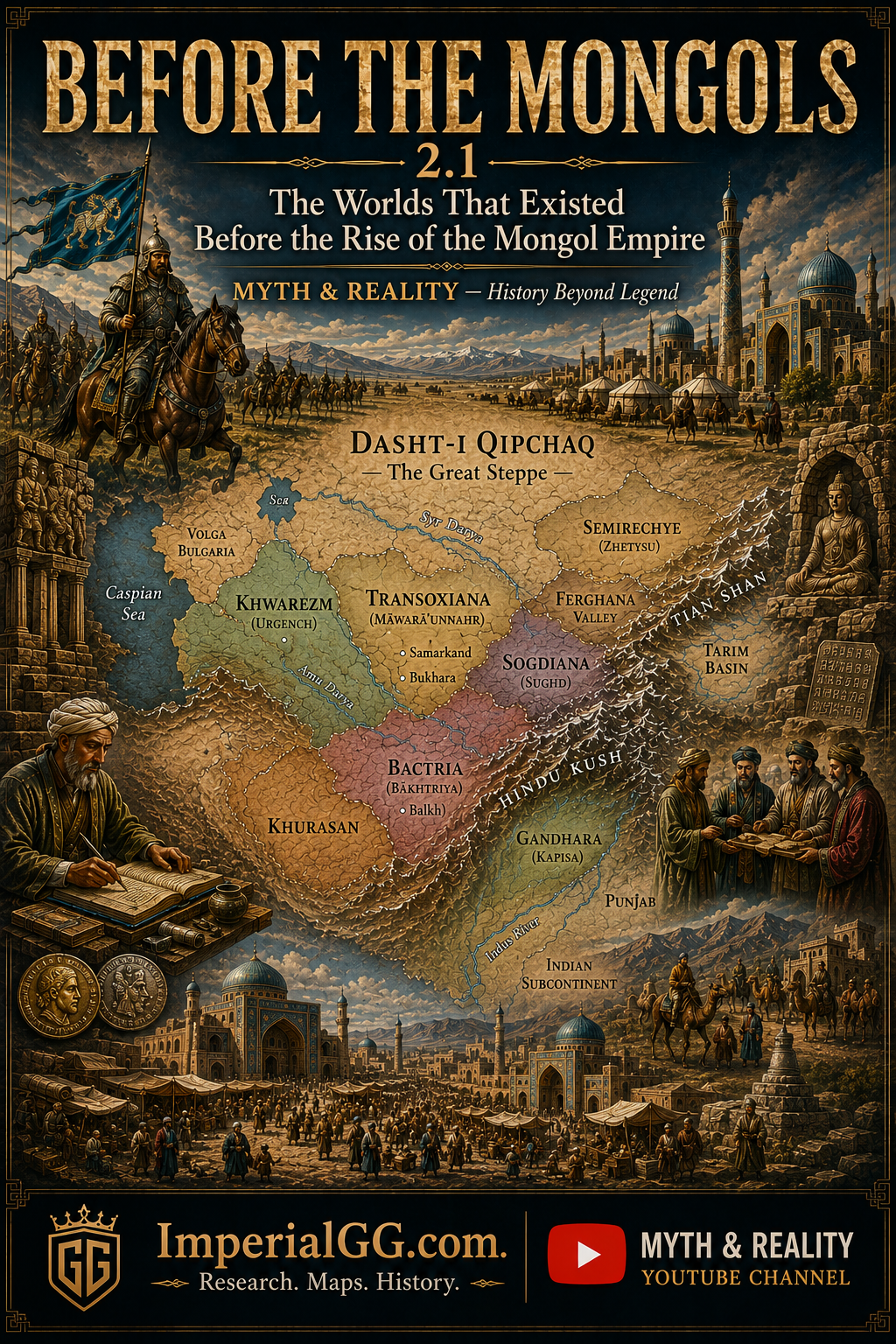
BEFORE THE MONGOLS — II: CENTRAL ASIA
BEFORE THE MONGOLS — II: CENTRAL ASIA 2.1
By Altanbagana Baatar
DBA Candidate| Independent Historian
ImperialGG Historical Research Seriers
17 July 2026
The Civilizations, Empires, and Peoples of Inner Eurasia Before the Mongol Conquests
Long before the armies of Chinggis Khan entered Central Asia in the early thirteenth century, the vast region stretching from the Kazakh steppe to Transoxiana, from the mountains of Kyrgyzstan and Tajikistan to the oases of Turkmenistan, and from Afghanistan to the northwestern approaches of the Indian subcontinent had already been one of the great historical centers of Eurasia. Today this immense geographical world is divided among Kazakhstan, Uzbekistan, Kyrgyzstan, Tajikistan, Turkmenistan, Afghanistan, and Pakistan, but for most of history these modern borders did not exist. Rivers, mountain passes, deserts, grasslands, and caravan routes connected the peoples of the region far more powerfully than later political boundaries divided them.
Central Asia was never simply an empty space between China, India, Persia, and Europe. It was itself a historical world in which pastoral societies and urban civilizations continuously interacted, where great migrations transformed political landscapes, where merchants connected distant economies, and where religions and intellectual traditions crossed continents. The region contained some of the most important cities and trade routes of the ancient and medieval worlds, but it also opened northward into the enormous Eurasian steppe, where mobile political powers repeatedly emerged and reshaped the history of the settled south.
At the center of this interconnected world stood several distinct but closely related geographical zones. The Kazakh steppe formed part of the great northern grassland corridor extending across Eurasia, while the valleys and mountains of present-day Kyrgyzstan and Tajikistan connected the steppe with the oasis civilizations farther south. Transoxiana developed around the great river systems of the Amu Darya and Syr Darya, Khwarazm flourished around the lower Amu Darya, and Bactria occupied territories extending across northern Afghanistan and southern Central Asia. Farther southeast, the mountain corridors of Afghanistan connected this world with the Indus basin and the territories of present-day Pakistan, creating a historical geography in which Central and South Asia were never completely separate.
These regions were rarely united under a single political authority for long, but they belonged to an interconnected historical system in which armies, merchants, migrants, scholars, religious communities, and ruling dynasties moved continuously across geographical boundaries. To understand the Central Asia encountered by the Mongols, it is therefore necessary to look beyond any single modern country or civilization and reconstruct the larger historical world that existed before modern borders divided it.
The Ancient Foundations of Central Asia
The foundations of Central Asian civilization reach deep into the Bronze Age, when communities across the northern steppe, mountain valleys, and southern oases developed increasingly complex systems of pastoralism, agriculture, metallurgy, and long-distance exchange. Across much of present-day Kazakhstan and neighboring regions, archaeological cultures associated with the broader Andronovo horizon participated in networks extending across enormous distances, while farther south the oasis civilizations associated with the Bactria-Margiana Archaeological Complex developed sophisticated settlements in territories corresponding largely to modern Turkmenistan, southern Uzbekistan, and northern Afghanistan.
These different cultural worlds were never completely isolated from one another. Metals, livestock, horses, technologies, agricultural products, and cultural practices moved between the steppe and the settled regions, creating patterns of interaction that would remain characteristic of Central Asian history for thousands of years. The distinction between the pastoral north and the agricultural south was important, but it was never an absolute civilizational boundary, because both worlds depended upon exchange and repeatedly influenced one another politically, economically, and militarily.
The territories of present-day Afghanistan and Pakistan were equally important within these ancient networks. The Hindu Kush did not merely separate Central Asia from South Asia but also provided mountain corridors through which people, commodities, armies, and ideas moved between Bactria and the Indus basin. These connections developed thousands of years before the Mongol period and ensured that the history of Central Asia was continuously linked with the historical development of northern South Asia.
The growing importance of the horse further transformed the political geography of Inner Eurasia by increasing the mobility of pastoral societies and allowing military and political networks to operate across distances that sedentary states often found difficult to control. Central Asia consequently became one of the principal regions in which mobile steppe societies encountered the wealth, institutions, and populations of the great agricultural civilizations surrounding them.
The Saka and the Great Steppe World
During the first millennium BCE, much of the territory of modern Kazakhstan and parts of Kyrgyzstan, Uzbekistan, Tajikistan, Afghanistan, and the surrounding regions were inhabited by populations conventionally described in ancient sources as Saka or Scythians. These names referred to a diverse and changing world of mobile and semi-mobile societies rather than to a single unified political nation, and different ancient sources applied different names to populations living across the enormous Eurasian interior.
The Saka occupied a strategically important position between the great northern steppe and the agricultural civilizations of Central Asia and the Iranian world. Their mounted military traditions allowed them to operate across immense territories, while archaeological discoveries demonstrate sophisticated traditions of metallurgy, social hierarchy, burial practice, and artistic production. The celebrated animal-style art found across large parts of Inner Eurasia reflects extensive cultural connections that stretched far beyond any single political frontier.
The territory of modern Kazakhstan was particularly important within this wider steppe world because its vast grasslands formed one of the principal continental corridors connecting eastern Inner Asia with the Caspian and Black Sea regions. Political movements across this zone repeatedly influenced the history of Central Asia, while populations associated with the Saka world also moved southward and interacted with Bactria, Sogdiana, and the Iranian plateau.
Some of these movements extended through Afghanistan toward the northwestern regions of the Indian subcontinent, demonstrating that the political history of the steppe could have consequences far beyond the grasslands themselves. Central Asian history therefore cannot be divided neatly into separate histories of nomadic northern peoples and sedentary southern civilizations, because interaction between these worlds formed one of the fundamental structures of the region’s development.
The Achaemenid Empire and Southern Central Asia
By the sixth century BCE, much of southern Central Asia had entered the political sphere of the Achaemenid Persian Empire, connecting regions such as Bactria and Sogdiana to an imperial system stretching from Central Asia across Iran and Mesopotamia to Egypt and the Mediterranean. Khwarazm also belonged at various periods to the broader Achaemenid political world, while the northeastern frontier of the empire remained in continuous interaction with the Saka populations of the steppe.
Bactria, centered largely in territories now divided between Afghanistan, Tajikistan, and Uzbekistan, occupied an especially important strategic position between the Iranian world, the Central Asian interior, and the routes leading toward northern India. Sogdiana, centered around the Zeravshan and Kashkadarya valleys of modern Uzbekistan and Tajikistan, similarly connected the agricultural regions of the south with the steppe frontier farther north.
Achaemenid imperial administration integrated these regions into wider military, political, and economic networks without eliminating their local identities. Central Asian populations served within imperial armies and participated in systems of taxation and exchange that connected distant provinces, yet imperial authority became increasingly difficult to maintain toward the northern steppe, where political mobility and geography limited the ability of sedentary empires to establish permanent control.
The frontier between the Achaemenid world and the steppe was therefore not a fixed boundary separating two isolated civilizations but a broad zone of warfare, diplomacy, migration, military recruitment, and economic exchange. This relationship between powerful sedentary empires and politically mobile populations beyond their frontiers would recur throughout the later history of Central Asia.
Alexander, Bactria, and Sogdiana
When Alexander of Macedon destroyed the Achaemenid Empire in the late fourth century BCE, his conquest of Central Asia became one of the most difficult phases of his campaigns. Bactria and Sogdiana resisted fiercely, forcing Alexander to conduct prolonged military operations across territories corresponding to modern Afghanistan, Uzbekistan, and Tajikistan, where local resistance took advantage of mountains, river valleys, fortified settlements, and extensive regional networks.
The difficulty of the campaigns revealed a recurring problem faced by outside conquerors in Central Asia. Capturing major cities did not necessarily provide control over mountain valleys, desert corridors, or mobile populations, and military victories could therefore fail to produce stable political authority across the wider region. Alexander eventually combined force with political accommodation, attempting to incorporate Central Asian elites into his imperial system while establishing military settlements to strengthen his position.
His marriage to Roxana, a woman belonging to the aristocratic world of Bactria or Sogdiana, became one of the most famous symbols of this attempt to unite Macedonian imperial power with local political elites. Although Alexander’s empire did not survive intact after his death, the Hellenistic presence established during his campaigns left important political and cultural legacies across southern Central Asia and Afghanistan.
Greco-Bactria and the Road Toward the Indus
During the third century BCE, Bactria broke away from Seleucid authority and became the center of an independent Greco-Bactrian kingdom whose rulers controlled territories across parts of modern Afghanistan, Tajikistan, and Uzbekistan. From these Central Asian bases, several rulers expanded southward across the Hindu Kush toward the lands of present-day Pakistan and northern India, creating political connections between Central Asia and the Indian subcontinent on an unprecedented scale.
The resulting world became one of the most remarkable cultural environments of antiquity. Greek political and artistic traditions interacted with Iranian, Central Asian, and South Asian societies, while cities and trade centers became meeting places for populations originating from different regions. The later Indo-Greek kingdoms extended these connections deeper into the territories of present-day Pakistan, particularly the wider Gandharan world.
These developments demonstrate why Afghanistan and Pakistan cannot be treated as entirely separate from the historical development of Central Asia. For centuries, the mountain passes of the Hindu Kush connected rather than permanently divided these regions, allowing states based north of the mountains to expand southward and political powers originating in South Asia to influence the lands beyond them.
The Yuezhi and the Rise of the Kushan Empire
During the second century BCE, political transformations in the eastern steppe produced major population movements toward Central Asia. The Yuezhi, displaced westward amid conflicts involving the Xiongnu and other powers of Inner Asia, eventually entered Bactria, where a new political order gradually emerged from which the Kushan Empire developed.
The Kushans created one of the great transregional empires of ancient Eurasia, connecting territories in modern Uzbekistan, Tajikistan, Afghanistan, and Pakistan with northern India. Their political position allowed them to participate in commercial networks extending toward China, Iran, and the Roman world, while the routes passing through their territories became increasingly important channels of cultural and religious exchange.
Buddhism flourished within this interconnected environment, particularly in Gandhara and neighboring regions of present-day Pakistan and Afghanistan, where artistic traditions developed through the interaction of multiple cultural influences. From these regions, Buddhist ideas and artistic forms traveled northward through Central Asia and the Tarim Basin toward China, demonstrating the central role of the region in the transmission of religions across Eurasia.
The Kushan world illustrates one of the defining characteristics of Central Asian history: political forces generated by movements across Inner Asia could establish states that connected the steppe, the Iranian world, and South Asia within a single imperial network, while the geographical position of Central Asia allowed those political systems to influence civilizations far beyond the region itself.
Sogdiana and the Commercial Networks of Eurasia
Among the most influential peoples of pre-Mongol Central Asia were the Sogdians, whose principal urban centers lay in territories corresponding largely to modern Uzbekistan and Tajikistan. Samarkand became one of the great cities of Eurasia, while Sogdian merchants created commercial communities extending across Central Asia, through the Tarim Basin, and deep into China.
These merchants carried far more than commodities. Languages, religious traditions, artistic forms, technologies, political information, and cultural practices traveled through the same networks, allowing Buddhism, Zoroastrian traditions, Manichaeism, and Christianity to circulate across the wider Central Asian commercial world. Sogdian communities became important intermediaries between different political and cultural systems precisely because they operated across borders that rarely remained stable for long.
The routes connecting Sogdiana with the north passed through territories belonging today to Kazakhstan and Kyrgyzstan, while southern corridors extended through Afghanistan toward the Indian subcontinent and western routes led toward Iran and the Caspian world. The commercial geography later summarized under the term “Silk Road” was therefore not a single road running simply from east to west but a vast network of intersecting routes connecting the steppe, the oasis cities, the mountains, and the surrounding civilizations of Eurasia.
The Rise of the Turkic World
The sixth century CE brought one of the most important transformations in Central Asian history with the rise of the Türk Khaganate. Originating in the eastern Inner Asian steppe, the Turks established an enormous political system that eventually extended across much of Eurasia, bringing the territories of modern Kazakhstan and Kyrgyzstan into the heart of a new imperial order while creating direct political connections between the eastern steppe and Transoxiana.
The western Turkic world became particularly important in Central Asia, where the great grassland corridors of Kazakhstan connected eastern and western regions and the valleys around the Tian Shan and Semirechye developed into major political and commercial centers. Turkic political and military elites increasingly interacted with Sogdian merchants and Iranian-speaking urban populations, producing a complex relationship between mobile imperial power and established commercial civilizations.
This process did not represent the sudden replacement of one population by another. Instead, Turkic languages and political traditions gradually spread across increasingly large parts of Kazakhstan, Kyrgyzstan, Uzbekistan, and Turkmenistan, while Persian and other Iranian languages remained deeply influential across Transoxiana, Tajikistan, Afghanistan, and the major cities of the region.
The resulting interaction created the foundations of the Turkic-Persian world that would characterize much of medieval Central Asia. Political power, language, religion, and culture did not follow identical boundaries, and the region increasingly became a place where Turkic dynasties could rule Persian-speaking cities, Iranian cultural traditions could flourish under steppe-origin military elites, and both worlds could participate within larger Islamic and Eurasian networks.
The Arab Conquests and the Transformation of Transoxiana
The collapse of the Sasanian Empire and the expansion of the Arab caliphates brought another major transformation to Central Asia during the seventh and eighth centuries. Muslim armies advanced toward Transoxiana, but the conquest of the region was neither immediate nor uncontested, as local rulers resisted, Turkic powers intervened, and alliances repeatedly shifted across a frontier that connected the cities of the south with the steppe and mountain worlds farther north.
Bukhara and Samarkand became major centers of political struggle, while territories now divided among Uzbekistan, Tajikistan, Kazakhstan, and Kyrgyzstan formed part of a wider contest involving Arab armies, local rulers, Turkic powers, and the expanding influence of Tang China. The Battle of Talas in 751 later acquired enormous symbolic importance as an encounter between Abbasid and Tang political spheres, although the transformation of Central Asia resulted from a much longer process than any single military confrontation.
Over time, direct Tang influence west of the Tian Shan declined while Islamic political and cultural influence expanded across Transoxiana. Islamization itself remained a gradual historical process in which older religious communities and local traditions continued to exist for generations, but Islam eventually became deeply rooted in the cities, political institutions, and intellectual life of much of Central Asia.
The Samanids and the Persian Cultural World
The ninth and tenth centuries witnessed the rise of the Samanid dynasty, centered on Bukhara and ruling much of Transoxiana and Khurasan. The Samanid age became one of the great periods of intellectual and cultural development in Central Asian history, during which cities such as Bukhara and Samarkand flourished as centers of scholarship, commerce, religion, and literary production.
Persian language and literature experienced a major revival within this political environment, while the broader cultural world of the Samanids extended across territories now divided among Uzbekistan, Tajikistan, Turkmenistan, Afghanistan, and Iran. The medieval Persian-speaking cultural world cannot be confined within modern national boundaries, but its development remains especially important for understanding the historical foundations of the Persian and Tajik traditions of Central Asia.
The Samanid state also depended increasingly upon Turkic military forces drawn from the wider Central Asian world. This relationship between Persian administrative and literary culture and Turkic military power foreshadowed a major transformation in which Turkic dynasties would increasingly become rulers of Islamic states while continuing to patronize and participate in Persianate civilization.
The Karakhanids and the Turkic-Islamic Transformation
By the tenth century, the Karakhanids had emerged as a major Turkic Muslim power across territories now belonging to Kazakhstan, Kyrgyzstan, Uzbekistan, and the wider Tian Shan region. Their conversion to Islam represented a profound transformation because Turkic political powers were no longer simply external forces interacting with the Islamic cities of the south but had become major participants within Islamic civilization itself.
In 999, the Karakhanids captured Bukhara and brought Samanid political rule in Transoxiana to an end, but the change of dynasty did not destroy Persian cultural influence. Instead, Central Asia increasingly developed a distinctive Turkic-Persian political and cultural synthesis in which Turkic dynasties ruled many states, Persian remained a major language of administration and high culture, and Arabic retained its central role in religion and scholarship.
This political and cultural synthesis became one of the defining characteristics of medieval Central Asia and would survive repeated dynastic changes. By the centuries immediately preceding the Mongol conquests, the distinction between a purely “Turkic” political world and a purely “Persian” urban civilization had become increasingly inadequate for describing a region in which both traditions had been interacting for generations.
The Oghuz, the Seljuks, and the Turkmen World
The western regions of Central Asia underwent equally important transformations as Oghuz Turkic populations occupied territories around the Aral Sea, the Caspian approaches, and areas associated with present-day Kazakhstan and Turkmenistan. From this broader Oghuz world emerged the Seljuks, whose expansion eventually transformed the political history of Iran, Iraq, Anatolia, and much of the Middle East.
Although the political center of the Seljuk Empire shifted far beyond Central Asia, its origins demonstrated the continuing ability of the steppe and frontier regions to generate military and political powers capable of reshaping distant civilizations. The movement of Oghuz populations also contributed over the longer term to the historical formation of the Turkmen world, although modern national identities should not be projected directly backward onto medieval populations whose political and social identities operated according to very different structures.
The rise of the Seljuks also strengthened the broader pattern through which Turkic military dynasties became rulers of states deeply embedded within Persianate and Islamic civilization. This pattern would remain fundamental across Central Asia, Iran, Afghanistan, and eventually much of northern India in the centuries leading toward the Mongol conquests.
Afghanistan and Pakistan Between Central and South Asia
Throughout the medieval period, the territories of modern Afghanistan and Pakistan remained essential components of the wider political system connecting Central and South Asia. The Hindu Kush was a formidable geographical barrier, but its mountain passes also served as major corridors through which armies, merchants, dynasties, scholars, and religious traditions moved between Transoxiana, Khurasan, Afghanistan, and the Indus basin.
The rise of the Ghaznavids demonstrated this connection particularly clearly. Emerging from a Turkic military background within the eastern Islamic world, the Ghaznavids established their political center at Ghazni in present-day Afghanistan and expanded across Iran, Central Asia, and the Indian subcontinent. Lahore became an important center within their political world, while Persian court culture, Turkic military traditions, and Islamic institutions moved across regions that modern geography often treats separately.
The Ghurids later emerged from the mountainous regions of Afghanistan and extended their power deep into northern India, further demonstrating the political continuity between Central Asian, Afghan, and South Asian history. The territories of present-day Pakistan repeatedly became part of states whose political centers lay beyond the Hindu Kush, while developments in the Indian subcontinent also influenced the economic and strategic calculations of rulers based in Afghanistan and Central Asia.
The Qara Khitai and the Return of an Eastern Imperial Power
The twelfth century brought another major political transformation when the collapse of the Liao dynasty in northern China drove the Khitan prince Yelü Dashi and his followers westward into Central Asia. They established the Qara Khitai, or Western Liao, which became a powerful imperial state extending across territories associated with modern Kazakhstan, Kyrgyzstan, Xinjiang, and parts of Transoxiana.
The Qara Khitai often ruled indirectly through existing political structures, allowing Muslim rulers and local dynasties to remain in place while recognizing a higher imperial authority. Their state therefore represented another example of the layered political systems that repeatedly emerged in Central Asia, where imperial sovereignty could coexist with substantial local autonomy.
In 1141, the Qara Khitai defeated the Seljuk Sultan Sanjar at the Battle of Qatwan near Samarkand, dramatically transforming the political balance of Central Asia. Their rise demonstrated once again that developments originating in the eastern regions of Inner Asia could rapidly reshape the political order of Transoxiana, while their later decline created the conditions for the emergence of another great power centered farther west.
Khwarazm and the Last Great Empire Before the Mongols
The Khwarazmian Empire emerged from the lower Amu Darya region, corresponding largely to parts of modern Uzbekistan and Turkmenistan, and expanded rapidly under Tekish and his son Muhammad II. By the beginning of the thirteenth century, the Khwarazmshahs controlled Transoxiana, much of Afghanistan and Khurasan, and extensive territories across Iran, creating one of the largest political powers in Eurasia immediately before the Mongol conquests.
Samarkand and Bukhara came under Khwarazmian authority, while the empire’s political influence extended southward toward the frontiers of the Indian subcontinent and northward toward the steppe worlds of Kazakhstan. On the map, the empire appeared formidable, but its internal political structure contained significant tensions involving the shah, regional governors, military elites, and the powerful political network surrounding Muhammad’s mother, Terken Khatun.
Turkic and Qangli military groups remained influential within the empire, demonstrating the continuing integration of steppe political power into the structures of the settled Central Asian state. Khwarazm was therefore itself the product of centuries of interaction between Persian urban civilization, Islamic political institutions, Turkic military traditions, and the wider dynastic networks of the Eurasian steppe.
The Mongols Reach the Borders of Central Asia
At the beginning of the thirteenth century, the unification of the Mongolian Plateau under Chinggis Khan created a new imperial power east of Central Asia. The Mongols initially entered the immediate political world of the region through conflicts inherited from the eastern steppe, particularly after the defeated Naiman prince Küchlüg fled westward and eventually seized power within the declining Qara Khitai realm.
In 1218, the Mongol commander Jebe defeated Küchlüg, bringing much of the former Qara Khitai political sphere under Mongol influence and creating a direct frontier between the expanding Mongol Empire and the Khwarazmian state. Chinggis Khan initially sought commercial and diplomatic relations with Khwarazm, but the seizure of a Mongol-sponsored caravan at Otrar and the subsequent killing of a Mongol envoy transformed a potentially commercial relationship into an imperial confrontation.
The war that followed was therefore not the first moment in which Central Asia encountered the wider Eurasian world. It was the collision of two political systems that had themselves emerged from centuries of interaction among the steppe, the oasis cities, the Iranian world, and the great commercial networks connecting the continent.
1219 and the End of the Pre-Mongol Political Order
When Mongol armies entered the Khwarazmian Empire in 1219, they entered one of the most historically layered regions on earth. The territories they encountered had been shaped by Bronze Age civilizations, Saka steppe societies, Achaemenid administration, Hellenistic kingdoms, Kushan imperial networks, Sogdian merchants, Turkic khaganates, Islamic conquests, Persian cultural traditions, and centuries of interaction between mobile and settled populations.
The Mongol campaigns transformed the political map of Central Asia and brought the Khwarazmian imperial order to an end, while major cities including Bukhara and Samarkand fell during a campaign conducted on a scale that the existing political system proved unable to withstand. The destruction associated with the conquest was severe in many regions, yet the arrival of the Mongols did not suddenly connect an isolated Central Asia with the rest of the world.
Central Asia had already connected the Kazakh steppe with Transoxiana, the mountains of Kyrgyzstan and Tajikistan with the oases of Uzbekistan and Turkmenistan, and Afghanistan with the Indus world of present-day Pakistan for thousands of years. The region had served as a meeting place of steppe societies, Persian civilizations, South Asian states, Chinese empires, and long-distance commercial networks long before the rise of Chinggis Khan.
What the Mongols transformed was therefore not the existence of these connections but their political scale. Under the Mongol Empire and its successor states, much of this ancient network would become incorporated into a new imperial order extending across an unprecedented portion of the Eurasian continent.
The World the Mongols Inherited
By the eve of the Mongol conquests, the lands that today form Kazakhstan, Kyrgyzstan, Uzbekistan, Tajikistan, Turkmenistan, Afghanistan, and Pakistan possessed distinct regional traditions, but their histories had never developed in isolation from one another. The Kazakh steppe had served as one of the great corridors of Inner Eurasian mobility, the valleys of Kyrgyzstan had connected the Tian Shan with the steppe and Transoxiana, and the cities of Uzbekistan had formed major centers of Sogdian, Islamic, and Turkic-Persian civilization. The mountains and valleys of Tajikistan had remained deeply connected to the Iranian and Persian-speaking cultural worlds of Central Asia, while Turkmenistan linked Khwarazm and Khurasan with the Caspian and the Oghuz steppe. Afghanistan formed a major bridge between Central Asia, Iran, and South Asia, while the territories of present-day Pakistan repeatedly became the southern extension of political and commercial systems whose influence crossed the Hindu Kush.
These were not seven separate national histories waiting for the creation of modern borders, but overlapping regions within a larger Eurasian historical world whose peoples, dynasties, languages, religions, and economies continuously crossed one another’s territories. Steppe confederations moved southward, urban empires expanded toward the north, merchants traveled in every direction, and armies repeatedly crossed the mountains connecting Central and South Asia.
The Mongol conquest did not erase this older world but inherited its cities, roads, administrative traditions, commercial networks, religious communities, political rivalries, and accumulated knowledge. The Mongols also inherited the ancient relationship between the steppe and the settled civilizations that had shaped Central Asia for thousands of years, and they would eventually reorganize many of these older structures within a new imperial framework extending across much of Eurasia.
The history of Central Asia before the Mongols is therefore not merely a preface to the conquests of Chinggis Khan. It is the history of one of the great formative regions of Eurasia, a world in which civilizations met, political systems rose and disappeared, languages and religions crossed continents, and the boundaries between nomad and settler, east and west, and Central and South Asia were repeatedly transformed. When the Mongols arrived in the early thirteenth century, they did not discover the crossroads of Eurasia; they conquered a crossroads that had already existed for millennia and incorporated it into an imperial system of unprecedented continental scale.
BEFORE THE MONGOLS
The Worlds That Existed Before the Rise of the Mongol Empire
MYTH & REALITY — History Beyond Legend
ImperialGG.com — Research. Maps. History.