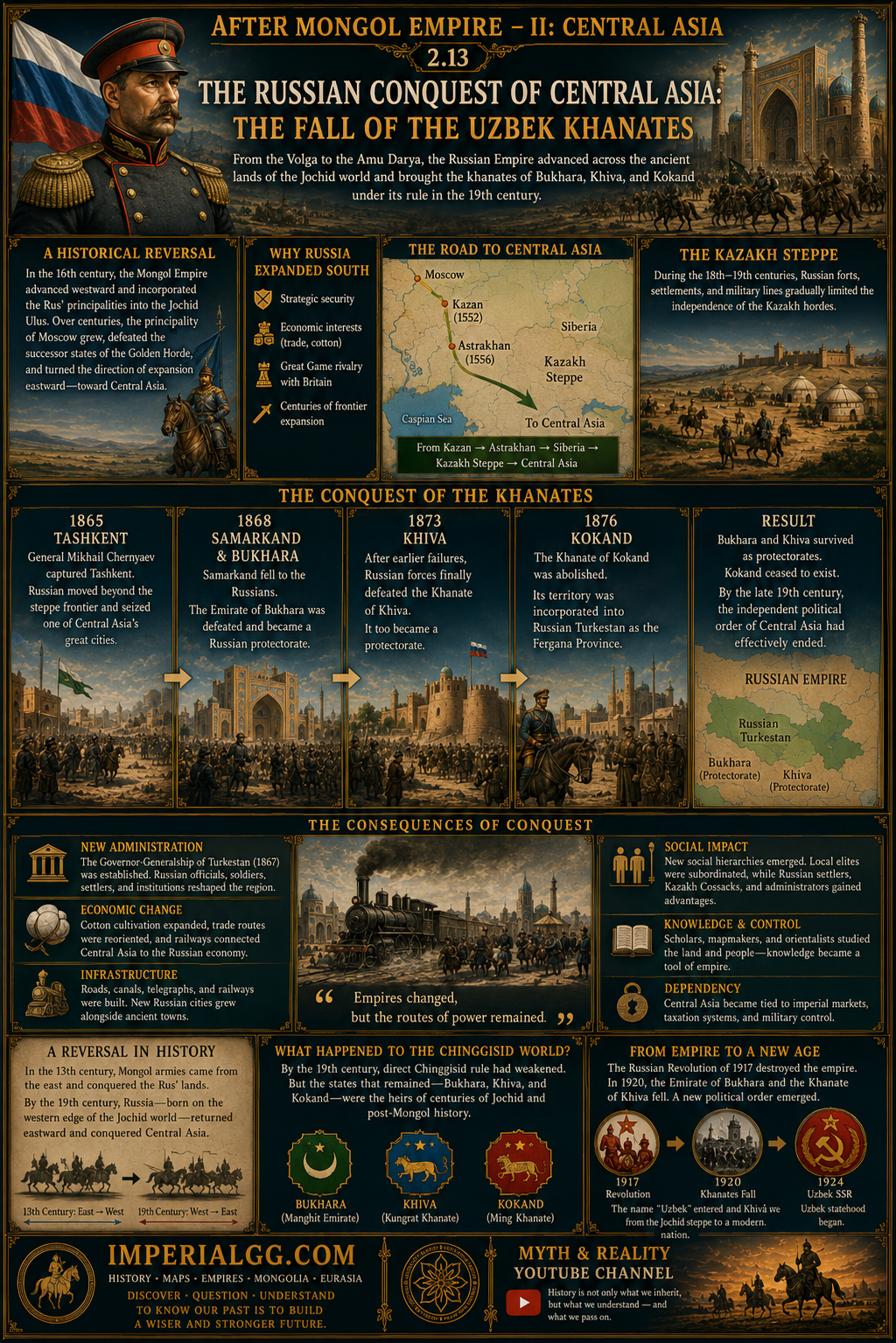
2.13 — THE RUSSIAN CONQUEST OF CENTRAL ASIA: THE FALL OF THE UZBEK KHANATES
By Altanbagana Baatar
DBA Candidate| Independent Historian
ImperialGG Historical Research Seriers
16 July 2026
By the nineteenth century, the political world of Central Asia had changed many times since the armies of Chinggis Khan first crossed the region in the early thirteenth century. The Mongol Empire had fragmented into separate uluses, the descendants of Jochi and Chagatai had created new states, Timur had built his own empire, the Shibanids had carried the Uzbek political name from the Jochid steppe into Transoxiana, and Bukhara, Khiva, and Kokand had emerged as the principal states of the later Central Asian order. Yet another transformation was now approaching from the north. The Russian Empire, whose distant political origins lay partly within the world once dominated by the Jochid Ulus, had expanded across the Volga, conquered the khanates of Kazan and Astrakhan, crossed Siberia, and gradually extended its military frontier across the Kazakh steppe. By the middle of the nineteenth century, Russian armies were approaching the ancient cities of Central Asia itself.
From the perspective of the long history followed throughout this series, there is a remarkable reversal in this movement. In the thirteenth century, the armies of the Mongol Empire had advanced westward across Eurasia and incorporated the Rus’ principalities into the political sphere of the Jochid Ulus. Moscow was then only one relatively minor principality among many competing centers of the Rus’ world. Over the following centuries, however, Moscow accumulated power, incorporated rival principalities, absorbed important political practices from the Eurasian environment in which it had developed, defeated the successor states of the Golden Horde, and expanded eastward and southward across territories that had once belonged to the wider Mongol imperial world. By the nineteenth century, the direction of imperial expansion had been reversed. The state that had once stood on the western edge of the Jochid political system was now advancing toward the heart of Central Asia.
This was not a simple act of historical revenge, nor should the Russian conquest be reduced to a continuation of medieval conflicts between Russians and Mongols. Centuries separated these events, and both Russia and Central Asia had been profoundly transformed. The Russian advance was driven by the strategic, economic, military, and ideological forces of an expanding nineteenth-century empire. Nevertheless, the geographical continuity is impossible to ignore. Kazan, Astrakhan, Siberia, the Kazakh steppe, Tashkent, Bukhara, Khiva, and eventually the approaches to Afghanistan formed successive stages in a Russian expansion across much of the same Eurasian space that had once been connected through the Mongol imperial system.
From Moscow to the Volga
The road toward the conquest of Central Asia had begun centuries earlier. The rise of Moscow fundamentally altered the balance of power in the western territories of the former Jochid world. After the fragmentation of the Golden Horde, several successor states continued to control strategic regions of the Volga, the Black Sea steppe, and western Siberia. Moscow did not immediately dominate this political landscape. During the fifteenth and early sixteenth centuries, it remained one power among several competing states that had emerged from the transformation of the medieval Eurasian order.
The conquest of Kazan in 1552 and Astrakhan in 1556 under Ivan IV marked a decisive change. For the first time, Moscow permanently absorbed two major successor states of the Jochid Ulus and gained control over much of the Volga corridor. The conquest opened routes toward the Caspian Sea and brought the expanding Russian state into increasingly direct contact with the Nogai steppe, the peoples of the Urals, and the political networks leading toward Central Asia. The Russian advance into Siberia followed. Beginning in the late sixteenth century, Cossack expeditions and Russian military forces challenged the Siberian Khanate, another state rooted in the post-Jochid political world. The defeat of Khan Kuchum did not immediately establish complete Russian control over all Siberia, but it opened a vast frontier. Over the seventeenth century, Russian forts, settlements, tribute systems, and military expeditions extended across northern Eurasia toward the Pacific. By the eighteenth century, the Russian Empire had become a continental power on a scale that the medieval rulers of Moscow could scarcely have imagined, and Central Asia was now much closer to its expanding frontier.
The Kazakh Steppe Becomes the Road South
Between the Russian Empire and the khanates of Central Asia stretched the enormous Kazakh steppe. This region was not an empty corridor waiting to be crossed. It was the political homeland of the Kazakh hordes, whose own history had emerged from the same fifteenth-century transformation of the eastern Jochid world that had produced the Uzbek political confederations of Abulkhair Khan. Russian expansion into the Kazakh steppe developed gradually rather than through a single conquest. During the eighteenth century, some Kazakh rulers entered relationships with the Russian Empire in search of protection, political advantage, or support against rival powers, including the Dzungars. Russian authorities interpreted and expanded these relationships as claims of imperial sovereignty, while forts and military lines increasingly restricted the political independence of the steppe.
Over time, the empire constructed a network of fortified settlements along the northern and northeastern frontiers of the Kazakh world. Orenburg became a major gateway between Russia and Central Asia, while other forts and administrative centers extended Russian influence deeper into the steppe. Trade accompanied military expansion, but commerce and conquest were never completely separate. Merchants required security, forts protected routes, administrators imposed new political structures, and military power gradually transformed relationships that had originally been presented as alliances or forms of protection. During the nineteenth century, the autonomy of the Kazakh hordes was systematically dismantled. The abolition of khanly authority and the expansion of direct imperial administration opened the road toward the Central Asian khanates. Russia no longer faced Central Asia from a distant frontier; its military positions now stood at the gates of the region.
Why Russia Wanted Central Asia
Russian expansion into Central Asia had several causes, and no single explanation is sufficient. Strategic security was one important factor. Imperial officials repeatedly viewed the steppe frontier as unstable and believed that permanent security required control over territories beyond the existing border. This logic created a recurring pattern of expansion: each new frontier produced another supposedly insecure frontier farther south. Economic interests were also important. Central Asia was connected to valuable commercial networks, and Russian merchants sought greater access to regional markets. Cotton became increasingly significant during the nineteenth century, particularly as industrial demand grew within the Russian Empire. Control of trade routes, markets, and agricultural production gradually became part of the imperial relationship with Central Asia.
The international rivalry commonly known as the Great Game also influenced Russian policy. As Russia advanced southward and the British Empire consolidated its control over India, both powers became increasingly concerned about the strategic space between their imperial frontiers. Central Asia and Afghanistan acquired enormous geopolitical importance. Yet Russian expansion should not be explained only as a reaction to Britain. The empire had been advancing across the Volga, Siberia, and the steppe long before the nineteenth-century Anglo-Russian rivalry reached its height. The conquest of Central Asia was the continuation of a much older continental expansion, now intensified by the military and political conditions of the imperial age.
The Road to Tashkent
By the middle of the nineteenth century, Russian forces had established positions from which they could directly challenge the Khanate of Kokand. Kokand controlled important territories in the Ferghana Valley and had expanded northward into parts of the Kazakh steppe. This brought its frontier into direct contact with the advancing Russian Empire. Russian military operations gradually captured a series of Kokandian fortifications and strategic positions. The conquest of Aq Masjid in 1853, later renamed Fort Perovsky, was an important stage in this advance. Russian forces continued pushing southward, while military columns approaching from different frontier lines gradually connected their positions.
Tashkent became the decisive objective. The city was one of the largest and most strategically important centers of Central Asia. It stood between the steppe and the settled regions of Transoxiana and controlled routes leading toward the Ferghana Valley, Samarkand, and the broader Central Asian interior. In 1865, Russian forces under General Mikhail Chernyaev captured Tashkent. The conquest represented a major turning point. Russia had moved beyond the frontier fortresses of the steppe and taken control of one of Central Asia’s great cities, and the political balance of the region could never again return to what it had been.
Tashkent and the Creation of Russian Turkestan
After the conquest of Tashkent, the Russian Empire began constructing a new administrative system for its Central Asian territories. In 1867, the Governor-Generalship of Turkestan was established, with Tashkent as its administrative center. This development was more than a military occupation. Russia was creating a permanent colonial structure in Central Asia. Imperial administrators, soldiers, settlers, merchants, engineers, scholars, and officials entered the region. New roads and later railways connected Central Asia more closely with the Russian imperial economy.
At the same time, the empire generally preserved certain existing local institutions where they served administrative purposes. Islamic courts, local elites, and established forms of community organization continued to function in modified forms. Russian colonial rule therefore combined direct imperial authority with selective preservation of local institutions. The result was a divided political order. Russian officials occupied the highest levels of colonial administration, while indigenous society continued to operate through institutions increasingly subordinated to imperial power. The conquest had begun militarily, but its consequences would reach far beyond the battlefield.
The Fall of Samarkand and the Defeat of Bukhara
The Russian advance soon brought the empire into direct conflict with the Emirate of Bukhara. By this period, Bukhara was no longer ruled by a Chinggisid dynasty. The Manghit emirs had established their own political authority, but the state they governed remained one of the principal heirs to the centuries of Central Asian political development that had followed the Shibanid conquest. War between Russia and Bukhara culminated in a series of defeats for the emirate. In 1868, Russian forces captured Samarkand, the ancient city that had once served as the imperial capital of Timur and had later become one of the central cities contested by Babur and Muhammad Shaybani.
The symbolism of this moment was enormous. Samarkand had passed through many empires. Achaemenid, Hellenistic, Iranian, Turkic, Islamic, Mongol, Timurid, and Uzbek rulers had all shaped its history. Now it entered the expanding political world of the Russian Empire. Following military defeat, the Emirate of Bukhara lost territory and became effectively subordinate to Russia. It was not immediately abolished or fully incorporated into the empire. The emir remained on his throne, and Bukhara continued to exist formally as a separate political entity. In reality, however, its independence was severely limited. Russia controlled its external political environment and increasingly dominated its economy and strategic position. Bukhara had become a protectorate in all but the complexities of formal legal terminology, and the khanate-centered political order of Central Asia was beginning to collapse.
Khiva and the Long Road to the Lower Amu Darya
Khiva presented a different challenge. The Khanate of Khiva was protected by deserts and difficult geography, and earlier Russian attempts to reach it had ended disastrously. The most famous failure occurred during the expedition of 1717, while another major campaign under General Perovsky in 1839–1840 collapsed under severe winter conditions. By the nineteenth century, however, the balance of power had changed dramatically. Russian military positions now surrounded Central Asia from several directions, logistical capabilities had improved, and the empire could organize coordinated campaigns on a much larger scale.
In 1873, Russian forces advanced on Khiva from multiple directions. The khanate was defeated and forced to accept Russian domination. Like Bukhara, Khiva was not immediately abolished. The khan remained in place, but the state became a Russian protectorate and lost genuine independence in foreign affairs. Territory was ceded, Russian economic influence expanded, and the political survival of the khanate now depended upon imperial power. There was a deep historical irony in this outcome. Khiva’s ruling dynasty at the time was Qungrat, carrying a name with ancient connections to the wider Mongol historical world, while the state itself occupied Khwarazm, one of the first great civilizations conquered by the armies of Chinggis Khan in Central Asia. More than six centuries after the Mongol conquest of Khwarazm, another continental empire had arrived from the north.
The End of the Kokand Khanate
Kokand followed a different fate from Bukhara and Khiva. The khanate had already lost important northern territories during the Russian advance, but political instability continued within the state. Rival factions competed for power, rebellions broke out, and Russian intervention became increasingly direct. In 1876, the Russian Empire abolished the Khanate of Kokand entirely, and its territory was incorporated into Russian Turkestan as the Ferghana Province.
This marked the disappearance of one of the three major Central Asian states that had dominated the region during the preceding centuries. Bukhara survived as a protectorate, Khiva survived as a protectorate, while Kokand ceased to exist as a state. By the late nineteenth century, the independent political order of Central Asia had effectively been destroyed.
The Meaning of the Russian Conquest
The Russian conquest fundamentally changed Central Asia, but its consequences were complex. Imperial rule created new administrative boundaries, transformed trade patterns, expanded cotton production, introduced new infrastructure, and connected the region more closely to the economic system of the Russian Empire. Railways eventually altered the geography of Central Asia. Goods, soldiers, officials, settlers, and ideas could move more rapidly than ever before. New Russian colonial cities developed alongside older urban centers, creating social and spatial divisions that reflected the unequal structure of imperial rule.
The expansion of cotton cultivation increasingly connected Central Asian agriculture to Russian industrial demand. This brought economic opportunities for some groups but also created new dependencies and altered patterns of land and water use. Russian scholars, military officers, archaeologists, and orientalists also studied the region extensively. Their work produced important records of Central Asian languages, monuments, manuscripts, and cultures, but knowledge itself existed within the colonial context. Mapping, classification, ethnography, and administration were often closely connected. Central Asia was being incorporated not only militarily but intellectually into the categories of a European empire.
A Reversal Across the Eurasian Continent
From the perspective of the long history of the Mongol world, the Russian conquest of Central Asia represents one of the most extraordinary reversals in Eurasian history. In the thirteenth century, Mongol armies crossed the steppe westward and conquered the Rus’ principalities. The Jochid Ulus became the dominant power across much of the western Eurasian steppe, while the Rus’ principalities operated within its political and tributary system. Moscow was one of those principalities.
Over centuries, Moscow rose within this environment, defeated its rivals, consolidated the northeastern Rus’ lands, and gradually challenged the political successors of the Golden Horde. Kazan fell in 1552. Astrakhan fell in 1556. Russian expansion entered Siberia. The Kazakh steppe was gradually incorporated. Tashkent fell in 1865. Samarkand was taken in 1868. Khiva was subordinated in 1873. Kokand was abolished in 1876. The direction of imperial movement had been reversed across Eurasia.
But this should not be interpreted as a simple story in which the conquered eventually conquered their former conquerors. The historical reality was far more complex. The Russian state that expanded into Central Asia was not the same political society that had faced the Mongol armies in the thirteenth century. Likewise, the Uzbek khanates of the nineteenth century were not the Mongol Empire. Centuries of cultural interaction, political transformation, migration, religious change, and state formation stood between them. Nevertheless, the geographical sequence reveals a remarkable continuity in the strategic importance of the Eurasian corridor. Empires changed, but the routes of power remained.
What Happened to the Old Chinggisid World?
By the time Russia conquered Central Asia, the political system based upon direct Chinggisid legitimacy had already weakened significantly. Bukhara was ruled by the Manghit emirs, Khiva was ruled by the Qungrat dynasty, and Kokand was ruled by the Ming dynasty. Yet the historical landscape in which these states existed had been deeply shaped by the centuries following the Mongol Empire.
The Uzbek political name had emerged from the Jochid steppe. The Shibanids had conquered Transoxiana. Other Jochid dynasties had ruled Bukhara and Khwarazm. The Kazakh khanates had emerged from the same political division that had transformed Abulkhair’s Uzbek confederation. The Russian Empire therefore did not conquer a surviving Mongol Empire. It conquered a Central Asian world that had evolved through many layers of post-Mongol history. That distinction is essential. Historical continuity does not mean that nothing changes; it means that new political worlds are often built from the structures, populations, institutions, and memories of those that came before them.
From Imperial Conquest to a New Political Age
By the end of the nineteenth century, most of the territory associated with modern Uzbekistan had been brought under Russian imperial domination, either through direct administration or through the protectorates of Bukhara and Khiva. Yet the old states had not entirely disappeared. The emir of Bukhara and the khan of Khiva remained in power under Russian supremacy until the revolutionary upheavals of the early twentieth century. Their final collapse would come not from another nineteenth-century imperial campaign but from the transformation of Russia itself.
The Russian Revolution of 1917 destroyed the empire that had conquered Central Asia. Civil war spread across the former imperial territories, revolutionary forces entered the region, and the political order established during the Russian conquest began to collapse. In 1920, the Emirate of Bukhara fell, and in the same year the Khanate of Khiva was overthrown. The last surviving states of the old Central Asian order disappeared. But another question now emerged: what would replace them?
The answer would eventually be the Soviet national republics, including the Uzbek Soviet Socialist Republic created in 1924. For the first time, the political name “Uzbek” would become attached to a territorially defined modern republic whose borders would eventually form the foundation of independent Uzbekistan. The journey of the name had entered its final major transformation: from the Jochid steppe, to the confederation of Abulkhair, to the conquests of Muhammad Shaybani, to the khanates of Central Asia, through Russian imperial rule, and finally toward the creation of modern Uzbekistan.