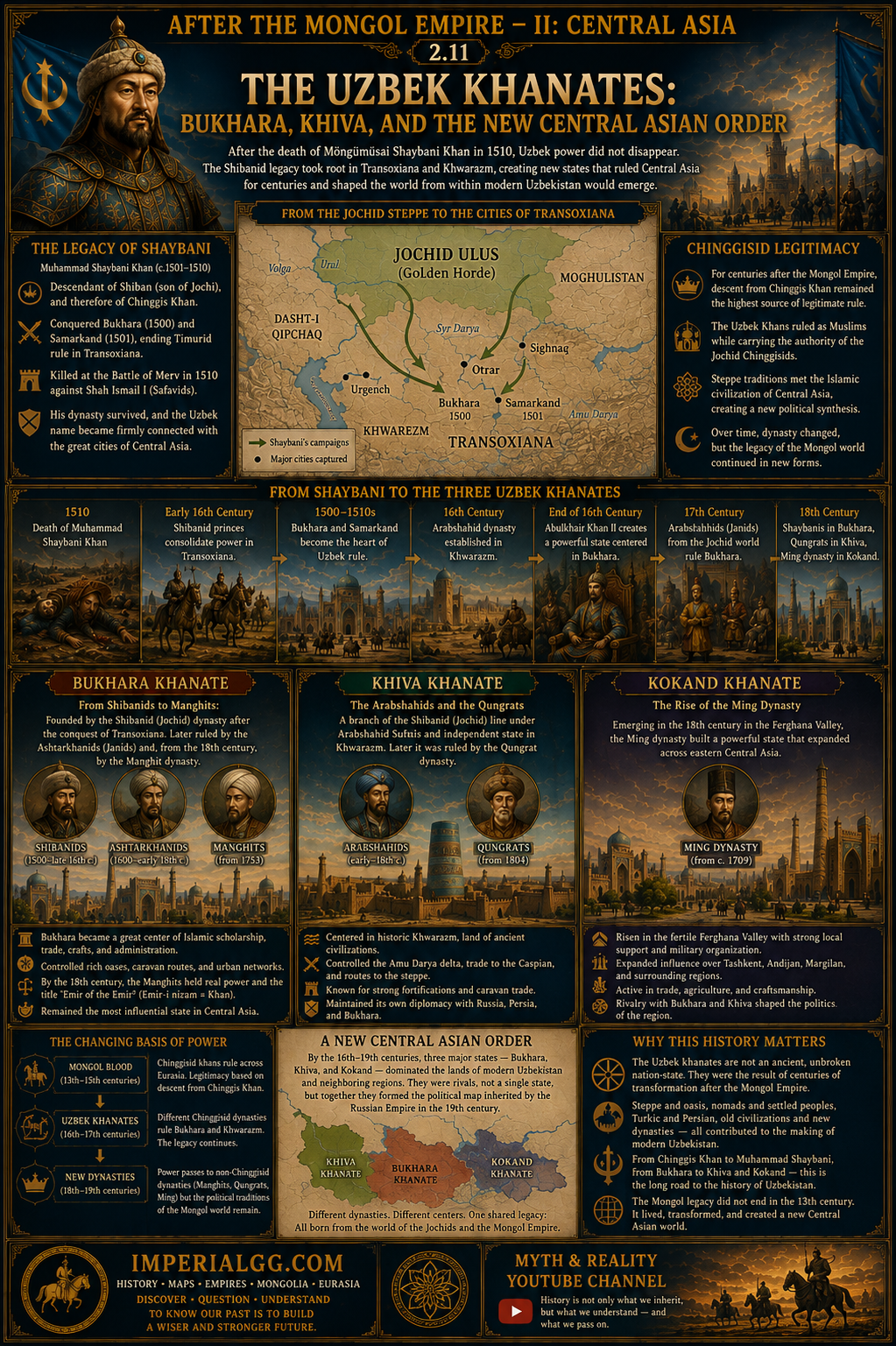
2.12 — THE UZBEK KHANATES: BUKHARA, KHIVA, AND THE NEW CENTRAL ASIAN ORDER
The death of Muhammad Shaybani Khan at the Battle of Merv in 1510 was a dramatic moment, but it did not reverse the transformation he had begun. The Uzbek political forces that had entered Transoxiana from the Jochid steppe did not retreat northward after their leader was killed. The Shibanid dynasty remained in Central Asia, reorganized its power, and established a political order that would shape the region for centuries. What had begun as the movement of a steppe confederation under the descendants of Jochi was becoming a permanent system of states centered upon some of the oldest cities and agricultural regions of Central Asia.
This transformation marks an important stage in the history of modern Uzbekistan. The political name “Uzbek,” which had developed within the wider world of the Jochid Ulus and had been carried southward by the followers of Abulkhair and Muhammad Shaybani, was now becoming firmly connected with Transoxiana and Khwarazm. At the same time, the descendants of the Mongol imperial political order were adapting to a completely different environment. The mobile political traditions of the steppe were merging with Persianate administration, Islamic institutions, urban economies, agricultural taxation, and the ancient commercial networks of Central Asia.
The result was neither simply a continuation of the Mongol Empire nor a complete break from it. A new Central Asian political order was emerging from the transformation of the old one.
After Shaybani: The Dynasty Survives
Muhammad Shaybani had been the driving force behind the conquest of Transoxiana, but the Shibanid dynasty was larger than one ruler. After his death, other members of the ruling family continued to control much of the territory he had conquered. This dynastic structure reflected an older political tradition inherited from the Mongol imperial world, in which different members of a ruling lineage could possess their own territories and political followings while recognizing a broader dynastic order.
This system could provide flexibility, but it could also create intense competition. Samarkand, Bukhara, Tashkent, Balkh, and other important centers became associated with different members of the Shibanid family at various times. Political authority was therefore often divided among princes whose legitimacy rested upon their shared descent from Chinggis Khan but whose personal interests could bring them into conflict.
The Shibanids nevertheless succeeded in preserving Uzbek political power in Transoxiana. The Timurid attempt to recover the region did not permanently dislodge them, and the Uzbek ruling elite gradually became embedded within the political, economic, and cultural life of Central Asia.
This was a decisive historical change. The Uzbek political world was no longer primarily a steppe confederation looking toward the cities of the south. Its rulers now governed those cities.
Bukhara Becomes the Center of a New Political World
During the sixteenth century, Bukhara increasingly emerged as the principal political center of the Shibanid state. The rise of Bukhara reflected both dynastic developments and the city’s enormous economic and cultural importance. Located within the fertile oasis system of Transoxiana and connected to major commercial routes, Bukhara possessed deep traditions of Islamic scholarship, trade, craftsmanship, and urban administration.
Under Abdullah Khan II, who became the dominant ruler of the later sixteenth-century Shibanid world, the state achieved a significant degree of political consolidation. His reign represented one of the strongest periods of Uzbek rule in Transoxiana. Bukhara became the center of a state whose influence extended across much of the region, while trade and diplomacy connected it with Iran, India, Russia, the steppe, and other parts of the Islamic world.
The political character of this state demonstrates how far the descendants of the Jochid steppe had adapted to their new environment. The rulers remained Chinggisids, and their ancestry continued to provide fundamental dynastic legitimacy, but they governed through institutions shaped by centuries of Islamic and Persianate political culture. Religious scholars, administrators, merchants, landholders, tribal leaders, and military elites all participated in the political system.
The steppe had entered the city, but the city had also transformed the steppe conquerors.
Chinggisid Legitimacy in an Islamic Central Asian State
One of the most important continuities between the Mongol imperial age and the Uzbek khanates was the continuing prestige of Chinggisid descent. More than three centuries after the rise of Chinggis Khan, membership in his lineage remained a powerful foundation for legitimate sovereignty across much of Central Eurasia.
The Shibanids did not treat their ancestry as a distant historical curiosity. They ruled because they belonged to the lineage of Jochi and Chinggis Khan. Their claim to the title of khan was rooted in a political tradition that had survived the fragmentation of the Mongol Empire, the Islamization of the Jochid world, the rise and fall of Timur, and the emergence of new political identities across Central Asia.
Yet this Chinggisid legitimacy now operated within an overwhelmingly Islamic political environment. The rulers of Bukhara presented themselves as Muslim sovereigns, supported religious institutions, and governed populations whose political and social life was deeply connected to Islamic law and scholarship.
There was no necessary contradiction between these identities. By the sixteenth century, the descendants of Chinggis Khan had been ruling Muslim populations for generations. The political traditions of the Mongol Empire had become part of the history of Islamic Central Asia itself.
This is one reason why describing the Mongol legacy simply as a period of foreign conquest is historically inadequate. The descendants of the empire did not remain permanently outside the societies they ruled. They became part of those societies and were transformed by them, while simultaneously leaving their own political traditions within the institutions that followed.
Khwarazm and the Rise of the Khiva Khanate
While the Shibanid rulers of Transoxiana consolidated their power around Bukhara, another Uzbek political center emerged in Khwarazm. This ancient oasis region, located around the lower Amu Darya, had possessed its own political identity for thousands of years. It had been the heartland of the Khwarazmian Empire before the Mongol conquest and later became part of the political struggles among the descendants of the Mongol Empire.
In the early sixteenth century, a separate Uzbek dynasty established itself in Khwarazm. The dynasty descended from Arabshah, another descendant of Shiban, son of Jochi. Thus, the Uzbek ruling houses of Transoxiana and Khwarazm belonged to different branches of the broader Shibanid-Jochid genealogical world.
The political state that developed in Khwarazm is commonly known in later history as the Khanate of Khiva, although its political centers and territorial organization changed over time. Khiva itself eventually became the principal capital and one of the most famous cities of the region.
The emergence of this khanate demonstrates that the Uzbek political expansion into Central Asia did not produce a single permanently unified state. Different branches of the Jochid dynasty established separate political centers, each developing according to its own geography, economy, tribal alliances, and relations with neighboring powers.
Bukhara looked toward Transoxiana, the steppe, Iran, and Afghanistan. Khwarazm occupied a strategic position between the lower Amu Darya, the Aral region, the Caspian world, and the routes leading northward toward the Eurasian steppe.
Both, however, remained connected to the political transformations that had followed the fragmentation of the Jochid Ulus.
Two Worlds of Uzbek Statehood
The development of Bukhara and Khwarazm created two major centers of Uzbek political power. Although both were ruled by dynasties connected to the Shibanid branch of the descendants of Jochi, they followed increasingly separate political paths.
This division should not be understood as a simple territorial split within a modern nation-state. The political world of sixteenth- and seventeenth-century Central Asia was structured through dynastic authority, tribal alliances, oasis economies, urban centers, religious institutions, and shifting military relationships. Borders were often fluid, and rulers competed not only for territory but also for cities, trade routes, populations, and the loyalty of powerful groups.
The populations governed by these states were equally diverse. The political label “Uzbek” had become increasingly important, but it did not erase older identities or immediately create a uniform modern national community. Persian-speaking urban populations, Turkic-speaking settled communities, nomadic and semi-nomadic tribal groups, religious elites, merchants, artisans, and agricultural populations all inhabited the region.
Modern Uzbekistan would eventually emerge from this complex historical world, but it should not be projected backward unchanged into the sixteenth century.
The Uzbek khanates were part of the process through which later identities developed. They were not modern nation-states before their time.
The End of the Shibanid Line in Bukhara
By the end of the sixteenth century, the direct Shibanid ruling line in Bukhara faced a succession crisis. Abdullah Khan II died in 1598, and his son Abd al-Mu’min was killed shortly afterward. The political order built by the earlier Shibanid rulers entered a period of instability.
Yet the end of the Shibanid dynasty did not mean the end of Chinggisid rule.
Power passed to another dynasty known as the Ashtarkhanids, or Janids. Their origins lay in the Jochid political world of the Volga region. They descended from the ruling house associated with Astrakhan, which had itself emerged from the fragmentation of the Golden Horde.
This transition is historically remarkable.
A dynasty rooted in the Jochid steppe had conquered Transoxiana under Muhammad Shaybani. When that dynasty’s direct line ended, another Jochid-Chinggisid house, displaced from the Volga region by the expansion of Moscow, became established in Bukhara.
The political geography had changed enormously since the thirteenth century, but the descendants of Jochi continued to move across and rule different parts of Eurasia.
The Ashtarkhanid rise therefore connected the history of Bukhara directly with the same broader transformation that was reshaping Kazan, Astrakhan, Crimea, Siberia, and the expanding Muscovite state.
The post-Golden Horde world remained interconnected.
The Ashtarkhanids: Another Jochid Dynasty in Bukhara
The Ashtarkhanids ruled Bukhara through much of the seventeenth and early eighteenth centuries. Like the Shibanids before them, they possessed Chinggisid ancestry and therefore could claim the title of khan according to the political traditions of the region.
Their rule demonstrates the extraordinary longevity of the political system created by the Mongol imperial age. Nearly five hundred years after Chinggis Khan, his descendants still occupied thrones across parts of Central Asia.
Yet the balance of political power was changing. Tribal confederations, military elites, religious authorities, and powerful administrative families increasingly influenced the state. The khan might possess the highest dynastic legitimacy, but effective political power could depend upon other groups.
This gradual transformation would eventually produce a fundamental change in Bukhara.
The Chinggisid khan would remain symbolically important, but actual political authority would pass into the hands of a dynasty that did not descend from Chinggis Khan.
That dynasty was the Manghit.
The Manghits and the Transformation of Political Legitimacy
The rise of the Manghit dynasty in Bukhara during the eighteenth century marks one of the most important transitions in the political history of post-Mongol Central Asia. The Manghits emerged from a tribal and military background connected with the broader steppe world, but unlike the Shibanids and Ashtarkhanids, they were not Chinggisids.
Under the traditional political order, this created a problem. The title of khan carried a deep association with descent from Chinggis Khan. A ruler without Chinggisid ancestry could possess enormous military and political power, but claiming the same form of dynastic sovereignty was more complicated.
The early Manghit rulers therefore operated within a political environment in which Chinggisid legitimacy still retained symbolic power. Eventually, however, the dynasty established its own form of sovereignty, and the rulers of Bukhara adopted the title of emir rather than relying upon the traditional Chinggisid title of khan.
This transition was historically significant. It demonstrated that the political system inherited from the Mongol Empire was finally changing at its foundations.
For centuries, dynasties had risen and fallen while the principle of Chinggisid legitimacy survived. Now political authority could be openly organized around a different basis.
The Mongol imperial political order was not suddenly erased, but one of its longest-lasting institutions was gradually losing its exclusive authority.
Khiva Follows Its Own Path
Khwarazm followed a different dynastic trajectory. The Arabshahid dynasty, descended from the Shibanid-Jochid line, ruled for centuries before political power eventually passed to the Qungrat dynasty.
The Qungrats themselves carried a name deeply rooted in the medieval Mongol world. The Qongirat had been one of the most important tribal groupings associated with the Mongol imperial aristocracy, and the marriage relationship between the Chinggisid house and Qongirat women played a major role in the history of the empire.
However, historical continuity of a tribal name should not be confused automatically with an unchanged ethnic identity across many centuries. The Qungrat political groups of later Central Asia had passed through generations of migration, political transformation, linguistic change, and integration with different populations.
Nevertheless, their rise demonstrates another form of continuity between the medieval steppe world and the later khanates of Central Asia.
As in Bukhara, actual political power gradually shifted away from direct Chinggisid rule. Yet the institutions, titles, genealogical traditions, and political culture inherited from the post-Mongol world continued to influence the state.
Khiva therefore developed as both an ancient Khwarazmian oasis civilization and a political successor to the transformations created by the Mongol and Jochid eras.
These were not mutually exclusive histories. They were layers of the same historical landscape.
THE RISE OF KOKAND
The third major Uzbek political state of the later period emerged in the Ferghana Valley. During the eighteenth century, the Khanate of Kokand developed under the Ming dynasty.
The rise of Kokand reflected another transformation in Central Asian politics. Unlike the earlier Shibanid and Ashtarkhanid dynasties, the Ming rulers were not securely established as direct descendants of Chinggis Khan. Their legitimacy developed through control of territory, military strength, political alliances, and the growing importance of the Ferghana Valley.
Kokand eventually became a powerful regional state, expanding its influence across Ferghana and toward Tashkent and parts of what are now Kyrgyzstan and southern Kazakhstan.
By this period, the political map of Central Asia had become fundamentally different from that of the Mongol imperial age. Yet many of the populations, routes, tribal names, institutions, and political relationships still carried traces of the older Eurasian world.
Bukhara, Khiva, and Kokand became the three principal khanates associated with the territory and political history that would later contribute to modern Uzbekistan.
They did not emerge simultaneously, and they did not share identical dynastic origins. But together they represented the mature political landscape that developed after centuries of transformation following the Mongol conquest.
FROM ONE EMPIRE TO MANY STATES
Looking across the centuries from Chinggis Khan to the Uzbek khanates reveals a remarkable historical transformation.
The Mongol Empire had once created a political system extending across most of Eurasia. After its fragmentation, the Ulus of Jochi, the Chagatai Ulus, the Ilkhanate, and the Yuan developed along different paths. Those states themselves later fragmented, producing new dynasties and political communities.
In Central Asia, the process was especially complex. The Chagatai political world divided. Timur created a new empire while ruling within the shadow of Chinggisid legitimacy. Moghulistan preserved an eastern Chagatai dynasty. The Jochid steppe produced the political communities associated with the Uzbeks and Kazakhs. Muhammad Shaybani carried Shibanid power into Transoxiana. His successors established the Bukhara-centered state, while another Shibanid line ruled Khwarazm.
Later, Ashtarkhanids from the western Jochid world ruled Bukhara. Manghits replaced them. Qungrats rose in Khiva. The Ming dynasty established Kokand. This was not a straight line from the Mongol Empire to modern Uzbekistan. It was a historical tree with many branches. Yet the roots of several of those branches reached directly into the political world created by Chinggis Khan and his descendants.
THE THREE KHANATES
By the eighteenth and nineteenth centuries, Bukhara, Khiva, and Kokand dominated much of the political landscape associated with modern Uzbekistan and neighboring regions. Each possessed its own dynasty, political structure, economic interests, and relations with surrounding peoples.
Bukhara developed into an emirate under the Manghits and remained a major center of Islamic scholarship and regional commerce. Khiva continued the political traditions of Khwarazm under the Qungrat dynasty. Kokand emerged as an expanding power in the Ferghana Valley and competed for influence across the eastern regions of Central Asia.
These states were rivals as often as they were partners. They fought wars, competed over cities and trade routes, and formed shifting alliances. There was no unified Uzbek nation-state encompassing all three.
Yet the centuries during which these khanates existed contributed profoundly to the formation of the political, cultural, linguistic, and territorial world from which modern Uzbekistan would eventually emerge.
The Uzbek identity itself continued to evolve. What had once been a political designation associated with sections of the Jochid steppe had become deeply rooted in the settled civilization of Central Asia. The descendants of steppe confederations lived alongside and intermarried with older populations. Languages changed. Tribal identities persisted in some contexts while broader cultural identities developed in others.
The meeting of the steppe and the oasis, which had begun long before the Mongol Empire, entered another historical stage.
A MONGOLIAN VIEW OF THE CENTRAL ASIAN KHANATES
From a Mongolian historical perspective, the history of the Uzbek khanates reveals something larger than the history of one modern nation. It demonstrates the extraordinary duration of the political transformations initiated by the Mongol Empire.
The empire did not simply conquer Central Asia and disappear. Its political structure reorganized the entire region. The descendants of Jochi and Chagatai remained rulers for centuries. Chinggisid legitimacy survived dynastic collapse, religious transformation, migration, and the rise of entirely new political identities.
The people who eventually became known as Uzbeks were not simply “Mongols,” nor can the ancient civilizations of Uzbekistan be reduced to the history of the Mongol Empire. Such a claim would ignore thousands of years of Central Asian history.
But the opposite simplification is equally misleading.
The Mongol imperial period was not merely an interruption between earlier and later Central Asian civilizations. It was one of the great historical processes through which the later political landscape of the region was formed.
The Shibanids who conquered Transoxiana were descendants of Jochi. The Arabshahids of Khwarazm belonged to the same broader Chinggisid world. The Ashtarkhanids who later ruled Bukhara came from another branch of the Jochid political sphere. Even after direct Chinggisid rule weakened, the states that replaced it continued to operate within political landscapes shaped by centuries of post-Mongol development.
From the perspective of Mongolia, these histories should not be understood as claims of ownership over the histories of other peoples. They are instead part of the shared history of Eurasia created by the movement, transformation, and integration of peoples across the continent.
WHY THIS HISTORY MATTERS
The emergence of Bukhara, Khiva, and Kokand explains how the political world created by the Uzbek conquest of Transoxiana developed into the Central Asian order encountered by the Russian Empire in the nineteenth century.
Between Muhammad Shaybani and the Russian conquest lay more than three centuries of political development. During that period, dynasties changed, capitals shifted, identities evolved, and the old Chinggisid system gradually lost its monopoly over legitimate sovereignty. Yet historical continuity remained visible.
The Uzbek political name had travelled from the Jochid steppe into Transoxiana. Chinggisid dynasties had transformed themselves from rulers of mobile confederations into sovereigns of ancient cities. The states they established had then evolved further under new dynasties that no longer required direct descent from Chinggis Khan.
By the nineteenth century, Bukhara, Khiva, and Kokand represented a Central Asian world very different from the empire created in the thirteenth century. Nevertheless, the long road connecting those two worlds remained embedded within their dynastic traditions, political institutions, tribal histories, and historical memory. The next great transformation would come from outside this regional system.
From the north, the Russian Empire was advancing deeper into the Eurasian steppe. The Kazakh steppe was gradually being absorbed, Russian military fortifications were moving southward, and the independent khanates of Central Asia increasingly faced an imperial power whose expansion would ultimately destroy the political order that had developed over the previous centuries. The story that began with the arrival of the Mongol armies in Central Asia was entering another age.