HORMUZ AND THE MONGOL WORLD
By Altanbagana Baatar
DBA Candidate| Independent Historian
ImperialGG Historical Research Seriers
14 August 2026
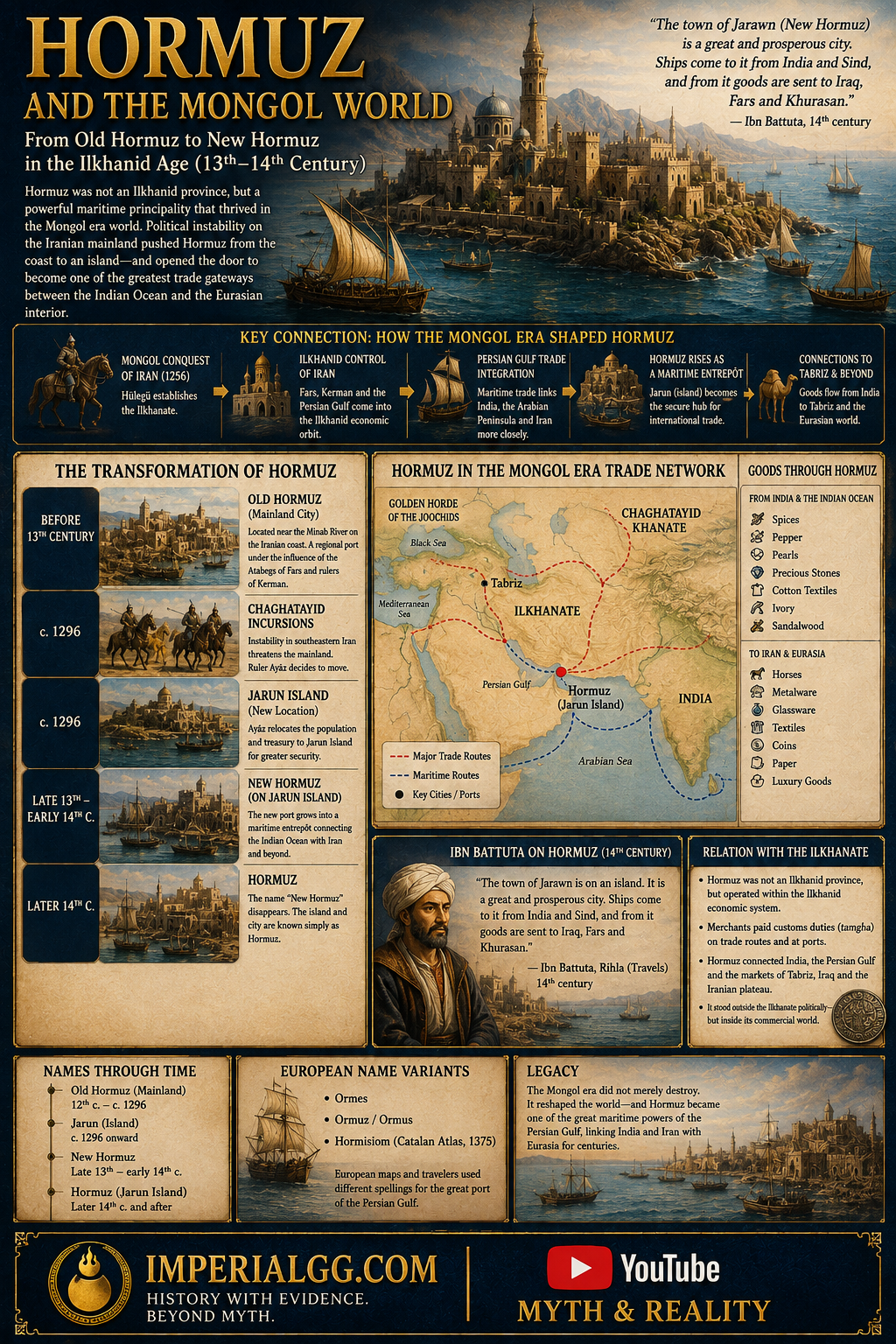
From Old Hormuz to New Hormuz in the Ilkhanid Age
The history of Hormuz during the Mongol period offers an important example of how the expansion of the Mongol Empire transformed not only political boundaries but also the geography of long-distance commerce. Hormuz was not a province of the Ilkhanate, nor was its ruling dynasty simply absorbed into the Mongol state. Instead, it remained a distinct Persian Gulf principality whose rulers operated within the changing political environment created by the Ilkhanate, the Chaghatayid Khanate, and the regional powers of Fars and Kerman.
The relationship was therefore indirect but economically significant. The Mongol conquest of Iran brought the Persian Gulf into a wider political and commercial system connecting Iran with Central Asia, the Black Sea, India, and China. Within that system, Hormuz became increasingly important as a maritime gateway between the Indian Ocean and the Iranian interior.
Hormuz Before the Mongols
The original city of Hormuz was not located on the island that today bears its name. The medieval settlement known as Old Hormuz was situated on the mainland near the Minab River, approximately 60 kilometers from the later island center. From around the beginning of the twelfth century, Hormuz was governed by a local dynasty whose rulers controlled territories on both sides of the Persian Gulf, including ports on the coast of Oman.
The principality was strategically positioned at the entrance to the Persian Gulf. Its rulers depended on the political circumstances of neighboring powers, particularly the Atabegs of Fars and the rulers of Kerman. In 1228, the ruler of Hormuz conquered Qays (Kish) Island on behalf of the Atabegs of Fars, demonstrating the importance of the island and maritime routes even before the Mongol period. By the late thirteenth century, Hormuz was already a significant commercial center. Marco Polo visited the city in 1272 and again in 1293 and described its flourishing trade, although he also commented on its difficult climate.
The Mongol conquest therefore did not create Hormuz’s commercial importance from nothing. Rather, it transformed the political environment in which its merchants and rulers operated.
The Ilkhanate and the Persian Gulf
Hülegü’s conquest established a new Chinggisid state in Iran and Iraq. By approximately 1261–1262, the Mongol Empire had fragmented into several major political centers, including the Ilkhanate in Iran and Iraq, the Chaghatayid Khanate in Central Asia, and the Golden Horde.
The Ilkhanate did not directly govern Hormuz. Instead, Hormuz remained connected to the political authorities of Fars and Kerman, while the Ilkhanid state controlled the larger Iranian political environment. This distinction is essential. It was an autonomous or semi-autonomous maritime principality operating beside the Ilkhanate and interacting with the political powers that controlled the Iranian mainland.
Nevertheless, the economic relationship was substantial. The Persian Gulf became part of a commercial system in which goods could move from the Indian Ocean through Hormuz and onward toward the Iranian plateau and the markets of the Ilkhanid realm. Studies of Mongol-period commerce show that Persian Gulf maritime routes connected India with Iraq and the Iranian interior, while merchants from Kish and other Gulf centers participated actively in these networks.
The Chaghatayid Threat and the Move to Jarun
The most dramatic connection between Mongol-era politics and the history of Hormuz came at the end of the thirteenth century. In 1296, Amir Bahāʾ al-Dīn Ayāz took control of Hormuz with support from Fars. At this time, southeastern Iran was increasingly affected by Chaghatayid incursions. The military instability of the mainland created a serious security problem for the Hormuz principality.
Ayāz responded by making a remarkable strategic decision. He moved the population and possessions of Old Hormuz to the small island of Jarun, which he acquired from the rulers of Fars. This migration represented much more than a change of residence. It changed the geographical foundation of the Hormuz state.
The old city had been located on the mainland, where it was exposed to military incursions. The island of Jarun, by contrast, offered greater protection from steppe-based attacks. Although the island lacked fresh water and local agricultural resources, its strategic position in the Persian Gulf compensated for these disadvantages. Supplies could be brought from the mainland, Oman, and nearby Qeshm Island. The new settlement became known as New Hormuz.
For a period, therefore, the historical geography consisted of:
Old Hormuz — mainland city
↓
Jarun — island
↓
New Hormuz — new commercial center
Over time, the adjective “New” disappeared. The city and island eventually became known simply as Hormuz, while the name Jarun was transferred to another settlement on the mainland.
From Mainland Port to Maritime Power
The relocation to Jarun had profound economic consequences. According to research on the Catalan Atlas and the history of Hormuz, the relocation allowed the rulers of Hormuz to take greater advantage of maritime transit. The island’s position allowed the Hormuz rulers to direct shipping through their own port and capture revenue from the movement of goods between the Indian Ocean and the Persian Gulf.
This was a major transformation. Old Hormuz had been a commercial city on the mainland. New Hormuz increasingly became a maritime entrepôt whose prosperity depended on controlling the movement of ships.
The island’s disadvantages—lack of fresh water, limited agriculture, and extreme heat—were offset by its strategic location. It was difficult for inland armies to attack, while ships could reach it directly from the Arabian Sea and Indian Ocean. This transformation illustrates an important feature of Mongol-era Eurasia: political instability could simultaneously disrupt existing trade routes and encourage merchants and states to develop new ones.
Hormuz and the Indian Ocean
By the fourteenth century, New Hormuz had become an important link between the Indian Ocean and the Iranian interior. Ibn Battuta, who visited the region during the fourteenth century, distinguished between the mainland city of Hormuz and New Hormuz on the island, whose town he called Jarawn. He described the island city as a large commercial center with busy markets and identified it as the port from which goods from India and Sind were dispatched toward Iraq, Fars, and Khurasan.
This description is particularly important for understanding Hormuz’s role in the Mongol-era economy. The island was not merely serving local Persian Gulf commerce. It was connecting the Indian Ocean with the major commercial centers of the Iranian plateau. Research on Mongol-period merchants likewise shows that the Persian Gulf route linking South and West India with Iraq was closely connected to the wider commercial networks of Fars and the Ilkhanid world.
Another study of the routes leading to Tabriz emphasizes the importance of Hormuz as the principal exchange point for goods moving from India toward the Iranian interior. Indian merchants supplied spices, pearls, precious stones, textiles, and ivory, while Iranian markets supplied horses and other goods in return.
Thus, Hormuz and Tabriz formed two complementary nodes:
Hormuz — maritime gateway
Tabriz — continental market
Between them lay a network of roads through Fars, Kerman and central Iran.
The Ilkhanid Economic World
The Ilkhanate’s significance for Hormuz therefore lies less in direct political control than in the creation of a vast interconnected economic environment. The Mongol conquest brought Iran into the political structure of the Chinggisid world. Although the empire eventually fragmented into competing khanates, long-distance commercial connections continued across political boundaries.
The Ilkhanid state itself imposed customs duties known generally as tamgha. These could vary considerably by location and period. Under the Ilkhanids, customs were collected not only on roads but also at ports, and by the early fourteenth century different rates were applied to different categories of merchants and goods. This wider fiscal system is important when considering Hormuz.
The island’s rulers were not simply moving goods through the Persian Gulf. They were operating in a region where customs, transit charges, port revenues, and political protection were fundamental components of international commerce. Hormuz’s rise therefore cannot be separated completely from the commercial structures of the Ilkhanid age.
A Persian Gulf Link to China?
The Mongol imperial system also created possibilities for connections extending far beyond Iran. The Persian Gulf route linked India with Iraq and Iran, while the wider Mongol world connected the Ilkhanate to Central Asia and Yuan China. Archaeological and documentary research on Mongol-period maritime commerce demonstrates that Indian Ocean trade formed part of a much broader Eurasian commercial network.
Hormuz consequently occupied an important position at one end of this system. It was not necessary for the Yuan court in China to control Hormuz for Hormuz to participate in the Mongol-era world economy. Its importance came precisely from its position between political systems. The Ilkhanate controlled the Iranian interior. The Chaghatayids dominated Central Asian territories.
The Yuan court controlled China. Hormuz controlled a crucial maritime gateway. Merchants connected these worlds.
Conclusion
The history of Hormuz during the Ilkhanid period is therefore a story of indirect Mongol influence rather than direct Mongol rule.
The Mongols did not transform Hormuz into an Ilkhanid province. Instead, the political instability generated by the competing Chinggisid states affected the strategic choices of Hormuz’s rulers. Chaghatayid incursions into southeastern Iran contributed to Ayāz’s decision around 1296 to abandon the vulnerable mainland city and relocate the population to Jarun Island. That decision ultimately transformed the history of Hormuz.
Old Hormuz was a mainland port.
New Hormuz became an island entrepôt.
The new location enabled the rulers of Hormuz to exploit maritime transit more effectively, connecting India and the Indian Ocean with Fars, Kerman, Iraq, Khurasan, and eventually the wider Eurasian commercial system. The deeper historical significance is therefore not that the Mongols “ruled Hormuz.” They did not.
Rather, the Mongol transformation of Iran and Central Asia altered the political and economic environment in which Hormuz developed into one of the great maritime commercial centers of the Persian Gulf. Hormuz stood outside the Ilkhanate politically—but increasingly within its wider economic world.
Footnotes
[1] Willem M. Floor, “Hormuz II. Islamic Period,” Encyclopaedia Iranica. Floor describes Hormuz as a separate principality whose rulers were variously vassals of the Atabegs of Fars or rulers of Kerman, rather than an Ilkhanid province.
[2] On the fragmentation of the Mongol Empire and the emergence of the Ilkhanate in Iran and Iraq, see “Mongols,” Encyclopaedia Iranica.
[3] Floor, “Hormuz II.” The original Hormuz was located on the mainland near the Minab River, while the later city developed on Jarun Island.
[4] Floor notes that Marco Polo visited Hormuz in 1272 and 1293 and described its flourishing commercial activity.
[5] Floor records that Ayāz assumed control of Hormuz in 1296 and, because of continued Chaghatayid incursions into southeastern Persia, moved the population and possessions of Old Hormuz to Jarun Island.
[6] See also the study of the Catalan Atlas and Hormuz around 1300, which connects the relocation of Hormuz to Chaghatayid incursions and describes the subsequent transformation of the island into the center of Hormuz’s commercial activity.
[7] Floor, “Hormuz II.” The island lacked fresh water and agricultural resources but possessed a strategically protected location; supplies had to be imported from Oman, the Persian mainland, and Qeshm.
[8] Floor explains that the new settlement and harbor were initially known as New Hormuz, while the designation “New” was eventually dropped and the city and island became known simply as Hormuz.
[9] On the relocation and its commercial consequences, see the study of the Catalan Atlas and Hormuz around 1300. The relocation allowed the rulers of Hormuz to benefit from maritime transit and direct shipping toward the island.
[10] Ibn Battuta, Travels, describes New Hormuz as an island city called Jarawn and identifies it as the port through which goods from India and Sind were sent toward Iraq, Fars, and Khurasan.
[11] Roxani Eleni Margariti, “The Maritime and Continental Networks of Kīsh Merchants under Mongol Rule,” Journal of the Economic and Social History of the Orient 62 (2019): 428–463. The study reconstructs the Persian Gulf and Red Sea commercial networks connecting India with Iraq and demonstrates the importance of maritime commerce during the Mongol period.
[12] Thomas A. Sinclair, research on eastern trade and the Mediterranean in the Middle Ages, identifies Hormuz as a major exchange point for goods moving from India toward Tabriz and the Iranian interior.
[13] “Customs Duties,” Encyclopaedia Iranica. Under the Mongols and Ilkhanids, customs duties were generally categorized under tamgha; rates varied according to location, period, and type of merchant or merchandise.
[14] Floor, “Hormuz II,” and Margariti, “The Maritime and Continental Networks of Kīsh Merchants under Mongol Rule.” Together these sources demonstrate the distinction between Hormuz’s political independence and its participation in the wider commercial environment of the Mongol period.
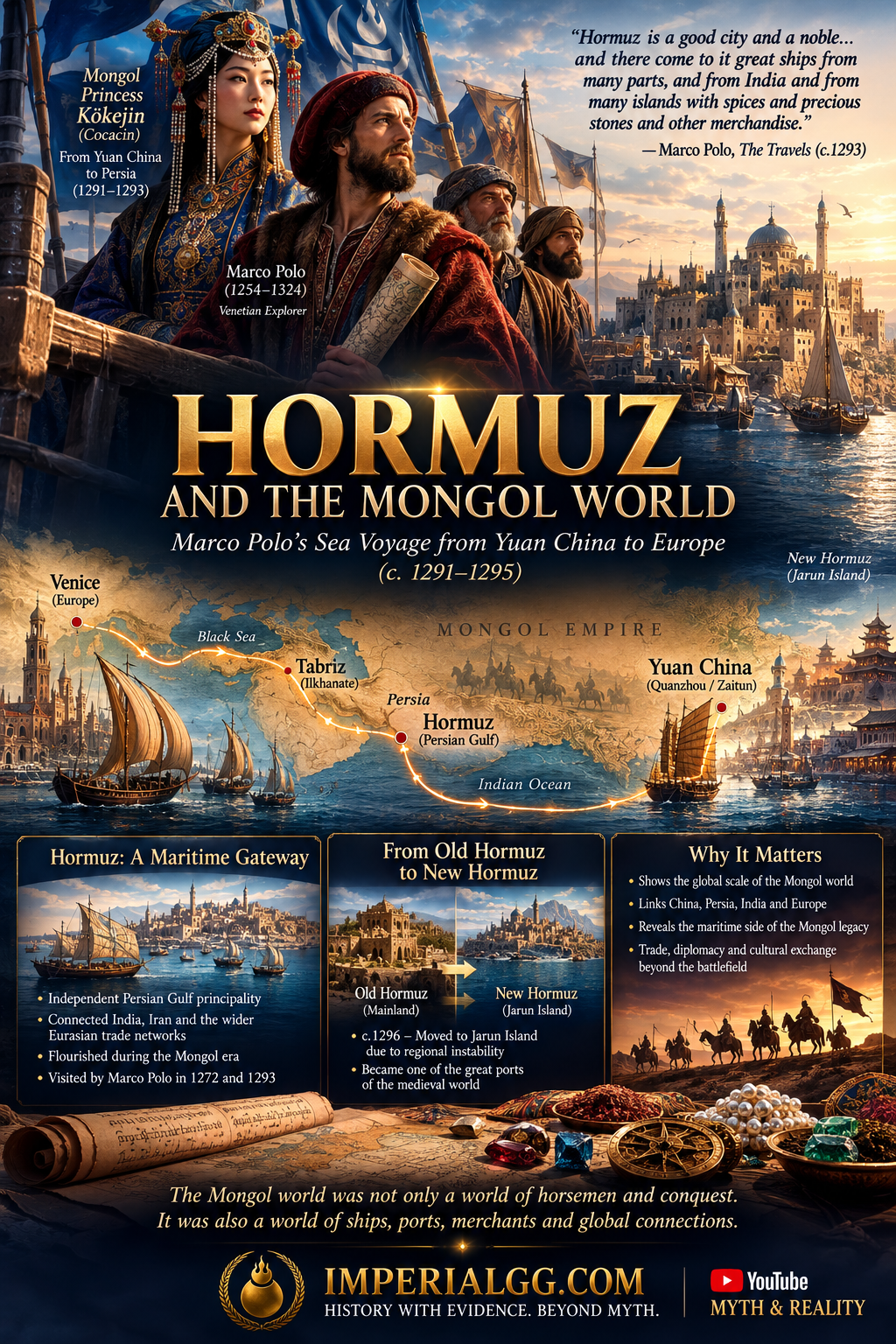
Marco Polo’s Sea Voyage from Yuan China to Europe
In the final years of the thirteenth century, one of the most remarkable journeys across the Mongol world passed through a small but strategically important port in the Persian Gulf: Hormuz.
Marco Polo, together with his father Niccolò and uncle Maffeo, left Yuan China by sea in 1291. Their return journey did not follow the familiar overland routes across Central Asia. Instead, they sailed from Quanzhou (Zaytun) across the Indian Ocean, reached Hormuz, and then continued overland through Persia toward the Black Sea and Europe. Marco Polo eventually returned to Venice in 1295.
But this was not simply a merchant family’s journey home.
The Polos were travelling as part of a much larger Mongol-era diplomatic movement.
A Mongol Princess on the Indian Ocean
The voyage was connected with Kökejin (Cocacin), a princess of the Bayaut lineage who was being sent from Yuan China to Persia to marry the Ilkhanid ruler Arghun Khan.
The journey began from Quanzhou, one of the great maritime ports of Yuan China. According to Encyclopaedia Iranica, the party travelled by sea from Quanzhou to Hormuz during 1291–1293, and Marco Polo accompanied the expedition on his return to Europe. There was an unexpected complication. By the time the party reached Persia, Arghun Khan had died. Kökejin therefore did not marry Arghun. She eventually married his successor, Ghazan Khan, another major ruler of the Ilkhanate. This single voyage therefore connected three major parts of the Mongol world:
Yuan China → Indian Ocean → Ilkhanid Persia
And at the center of that maritime route stood Hormuz.
Why Hormuz Mattered
Hormuz was not an Ilkhanid province. This distinction is important. The rulers of Hormuz maintained their own principality and had their own political interests. They interacted with the rulers of Fars and Kerman and operated within the complex political environment of southern Iran. Yet Hormuz was economically connected to the wider world created by Mongol expansion.
Its geographical position made it one of the most important gateways between the Indian Ocean and the Iranian plateau.
Ships arriving from India and other parts of the Indian Ocean could reach Hormuz before goods continued toward Fars, Kerman, Iraq, and the interior of Iran. From the Iranian mainland, commercial routes extended toward major centers such as Tabriz, the capital of the Ilkhanid political world. Thus, Hormuz did not need to belong politically to the Ilkhanate in order to participate in its wider economic environment. It was a maritime gateway to the Ilkhanid world.
Marco Polo Had Already Seen Old Hormuz
Marco Polo’s connection with Hormuz was particularly interesting because he appears to have encountered the old mainland city. Hormuz had been an established commercial principality since approximately the twelfth century. The original settlement was located on the mainland near the Minab River rather than on the island that today carries the name Hormuz.
Marco Polo visited Hormuz in 1272 and again in 1293, and his account emphasizes its commercial prosperity despite its difficult climate. This places him at Hormuz during a period of extraordinary transition. Only a few years later, political instability would transform the geography of the Hormuz state.
From Old Hormuz to New Hormuz
Around 1296, Amir Bahāʾ al-Din Ayāz took control of Hormuz. At precisely this time, southeastern Iran was experiencing continued incursions by Chaghatayid forces. The mainland location of Old Hormuz was increasingly vulnerable to political and military instability.
Ayāz responded by moving the population and possessions of Old Hormuz to the small island of Jarun. This decision changed the future of Hormuz. The new settlement became known as New Hormuz. The sequence can therefore be understood as:
Old Hormuz — mainland city
↓
Jarun Island — new location
↓
New Hormuz — emerging maritime center
↓
Hormuz — later name of the island city
The island had obvious disadvantages. It lacked abundant fresh water and agricultural resources. Yet its strategic location in the Persian Gulf provided an enormous advantage: it was much more difficult for inland armies to threaten, while ships could reach it directly from the Indian Ocean.
The political instability associated with the Mongol-era Iranian frontier therefore indirectly contributed to one of the most important transformations in the history of the Persian Gulf.
Hormuz as a Bridge Between Worlds
By the fourteenth century, the new Hormuz had developed into a major maritime entrepôt. The significance of the port was not simply local.
It connected different economic zones:
India → Hormuz → Iran → Iraq → Tabriz
At the same time, maritime routes connected Hormuz with the Arabian Peninsula, East Africa, and the wider Indian Ocean. This created an important relationship between maritime and continental commerce.
Hormuz was the maritime gateway. Tabriz was one of the great continental markets.
Together, such nodes allowed goods, people, information, and diplomatic messages to move across enormous distances. This was one of the defining characteristics of the Mongol period.
The Mongol Empire did not create every existing trade route. Many of these networks were much older. What changed was the political environment across much of Eurasia. China, Central Asia, Iran, the Black Sea, and the Middle East became connected through overlapping Mongol states and commercial networks. Hormuz occupied an important position at the southern maritime edge of this system.
Marco Polo’s Journey Was More Than a Journey Home
The significance of Marco Polo’s return journey is therefore much greater than the story of a Venetian traveller returning from China. He travelled through a world in which Yuan China, the Ilkhanate, the Indian Ocean, and European commerce were interconnected.
His route demonstrates this geography:
Quanzhou (Yuan China)
↓
Indian Ocean
↓
Hormuz
↓
Persian mainland
↓
Tabriz / Ilkhanid Iran
↓
Black Sea
↓
Venice
The journey also illustrates the diplomatic dimension of Mongol Eurasia. The Polos were accompanying a Mongol princess whose marriage was intended to strengthen relations between the Yuan and Ilkhanid branches of the Chinggisid imperial family. Their voyage therefore combined diplomacy, dynastic politics, maritime navigation, and long-distance commerce.
Hormuz and the Mongol World
It was not. A more historically precise formulation is:
Hormuz was an independent Persian Gulf principality that operated within the wider political and economic environment transformed by the Mongol conquest of Iran.
The distinction matters. The Mongol conquest did not eliminate Hormuz’s independence. Instead, the political changes of the Mongol age altered the environment in which Hormuz operated. Chaghatayid military pressure contributed to the relocation from the mainland.
Ilkhanid control of Iran created a powerful continental market. Yuan China provided one of the world’s largest centers of production and consumption. The Indian Ocean connected these regions by sea. And Hormuz stood at the intersection.
The Bigger Picture
Marco Polo’s journey through Hormuz offers a remarkable glimpse into the interconnected world of the late thirteenth century.
A Mongol princess.
A Yuan Chinese port.
A Venetian traveller.
An Indian Ocean fleet.
An independent Persian Gulf principality. The Ilkhanate. The Black Sea. And finally, Venice. These were not isolated worlds. They were connected by ships, merchants, diplomats, dynastic marriages, and political alliances. Hormuz was one of the places where those connections became visible.
The Mongol world was not only a world of horsemen and conquest. It was also a world of ports, ships, merchants, diplomacy, and long-distance exchange. And on Marco Polo’s journey home from Yuan China, Hormuz was one of the great gateways between them.
Sources
- Michele Bernardini, “Polo, Marco,” Encyclopaedia Iranica.
- “Chinese-Iranian Relations III: In the Mongol Period,” Encyclopaedia Iranica.
- Willem M. Floor, “Hormuz II: Islamic Period,” Encyclopaedia Iranica.
- Marco Polo, The Travels of Marco Polo, Book II, sections concerning Hormuz and the return journey.
- Roxani Eleni Margariti, “The Maritime and Continental Networks of Kīsh Merchants under Mongol Rule,” Journal of the Economic and Social History of the Orient 62 (2019): 428–463.