THE KOREA WAS ONCE PART OF THE MONGOL WORLD
By Altanbagana Baatar
DBA Candidate| Independent Historian
ImperialGG Historical Research Seriers
09 August 2026
Goryeo Korea and the Chinggisid Empire
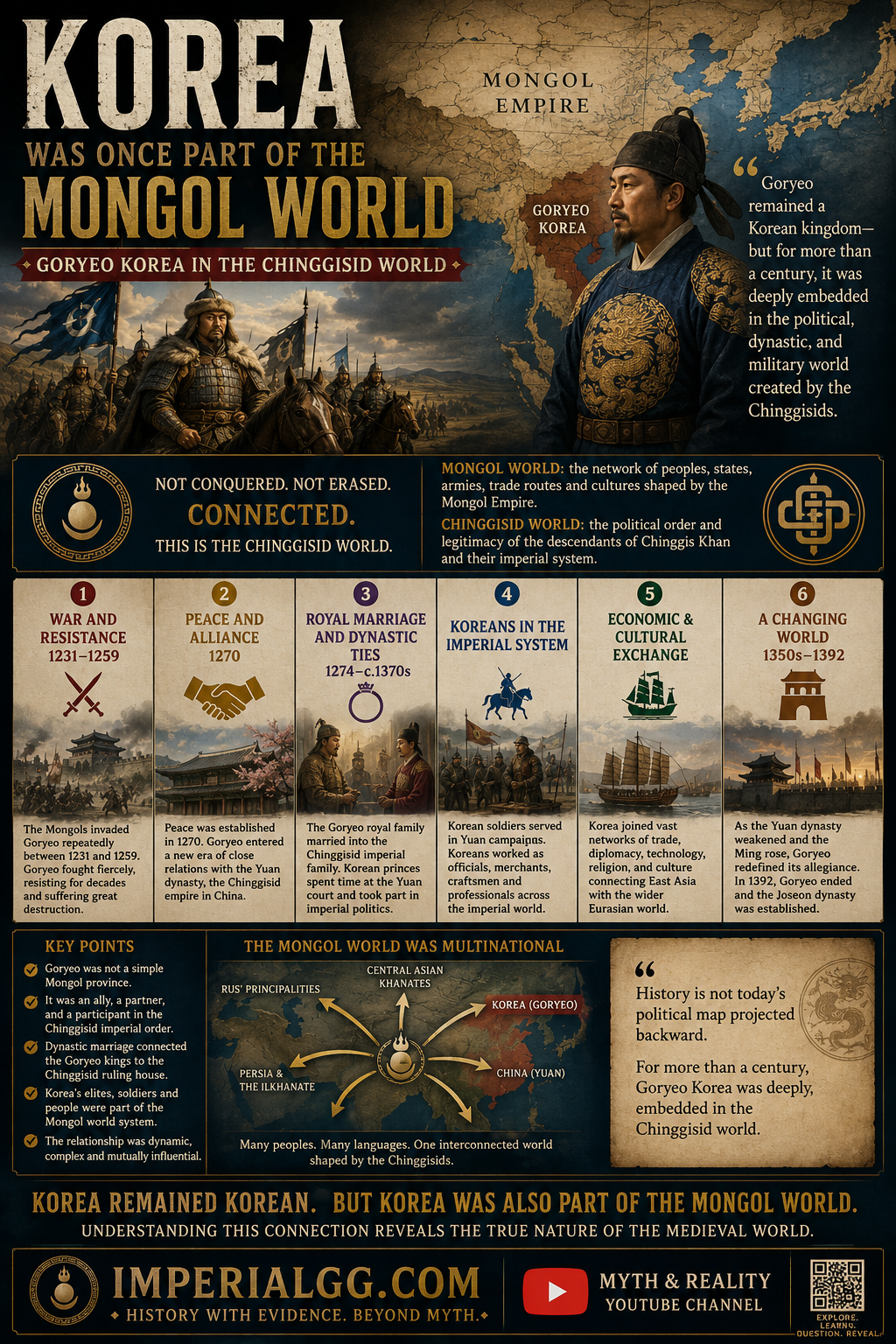
When we think of the Mongol Empire, Korea is rarely the first place that comes to mind. Yet for more than a century, Goryeo Korea was deeply connected to the Mongol imperial world.
The relationship began with conflict. Mongol forces invaded Goryeo repeatedly between 1231 and 1259. The wars caused enormous destruction, but they eventually led to a political relationship far more complex than simple conquest.
From War to Alliance
After peace was established, Goryeo became closely tied to the Yuan dynasty, the Chinggisid imperial dynasty ruling China.
The relationship was strengthened through royal marriage. Beginning in the late 13th century, Goryeo’s royal family became connected by marriage to the Chinggisid imperial family. Korean princes and officials also spent time at the Yuan court and participated in imperial politics. This created a remarkable political situation: Goryeo remained a Korean kingdom, but its royal house became part of the wider Chinggisid political network.
Koreans in the Mongol Imperial System
The connection went beyond diplomacy. Korean soldiers served in Yuan military campaigns, while merchants, craftsmen, officials and other Koreans participated in the wider economic and cultural networks of the Mongol Empire.
By this period, Korea was connected to an enormous Eurasian system extending across China and Central Asia and reaching much farther west. The Mongol world was therefore not simply a world of Mongols. It was a multinational imperial system, incorporating peoples with different languages, religions and political traditions.
Was Korea a Mongol Province?
Yes.
This is where historical precision matters.
Goryeo did not simply disappear and become an ordinary Mongol province. Its royal dynasty continued, and its own institutions remained important. Instead, Goryeo existed in a highly unequal relationship with the Yuan Empire—combining imperial influence, dynastic marriage, military obligations and political intervention. Modern scholarship therefore treats the Goryeo–Yuan relationship as a complex imperial relationship rather than simply “occupation.”
When the Mongol World Changed
After the Yuan dynasty weakened, Goryeo gradually began to redefine its position. The fall of Yuan power and the rise of the Ming dynasty transformed East Asia. Goryeo eventually shifted toward the new Ming order, while the old Chinggisid political relationship declined. In 1392, Goryeo itself ended and the Joseon dynasty was established.
The Bigger Picture
The history of Goryeo Korea shows why the Mongol Empire should not be understood simply as a map of territories conquered by Mongols. The Mongol world was a network of dynasties, armies, marriages, trade routes and political relationships. Korea was one of its most important eastern connections. It resisted the Mongols. It fought them. It later married into their ruling dynasty. Its soldiers served within the Yuan military system. Its elites participated in imperial politics.
And for more than a century, Goryeo Korea was deeply embedded in the Chinggisid world.
Korea remained Korean.
But Korea was also part of the Mongol world.
That distinction is essential. History is not today’s political map projected backward.
ImperialGG.COM
History With Evidence. Beyond Myth.
Key source: David M. Robinson, “Koryŏ in the Mongol Empire,” The Cambridge History of the Mongol Empire, pp. 679–706.b