
BEFORE THE MONGOLS I – MOSCOW SERIES 1.1
MOSCOW BEFORE THE MONGOLS: A SMALL SETTLEMENT ON THE EDGE OF THE RUS’ WORLD
By Altanbagana Baatar
DBA Candidate| Independent Historian
ImperialGG Historical Research Seriers
17 July 2026
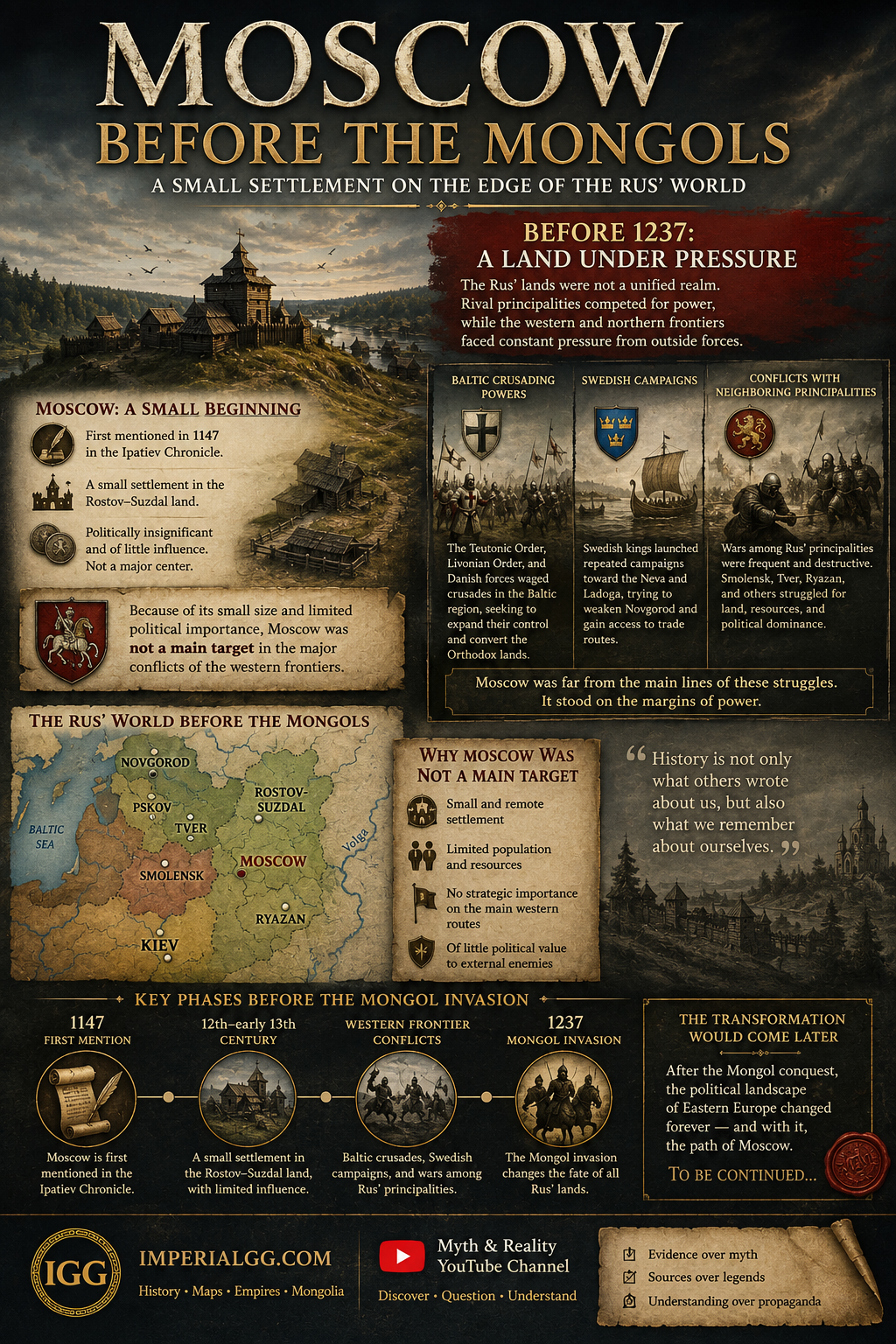
Before the Mongol invasion of the thirteenth century, Moscow was neither the political center of Rus’ nor a major prize in the wider struggles of Eastern Europe. First mentioned in the chronicles in 1147, it remained a relatively small settlement within the Rostov–Suzdal political sphere.
The Rus’ lands themselves were divided among competing principalities. Kiev, Vladimir-Suzdal, Novgorod, Smolensk, Ryazan, and other centers possessed far greater political and strategic importance than early Moscow.
At the same time, the broader Rus’ world faced recurring conflict on several frontiers. Western and northwestern territories were exposed to campaigns involving Baltic crusading powers and Sweden, while rival Rus’ principalities repeatedly fought among themselves for territory, influence, and dynastic power.
Moscow, however, stood away from many of the principal theaters of these struggles. Its limited population, resources, and political importance meant that it was not yet a primary strategic objective for the major powers operating along the western frontiers.
This historical context is essential for understanding Moscow’s later rise.
The city that would eventually become the center of a vast Eurasian state began as a comparatively minor settlement within a much larger and more powerful political world. The transformation came later, amid the profound reorganization of Eastern Europe following the Mongol conquest and the emergence of the Golden Horde.
To understand the rise of Moscow, we must first understand how small Moscow once was.
MOSCOW’S RISE BEGINS: NOT BY STRENGTH, BUT BY POSITION
From a Minor Settlement to a Political Center under the Golden Horde
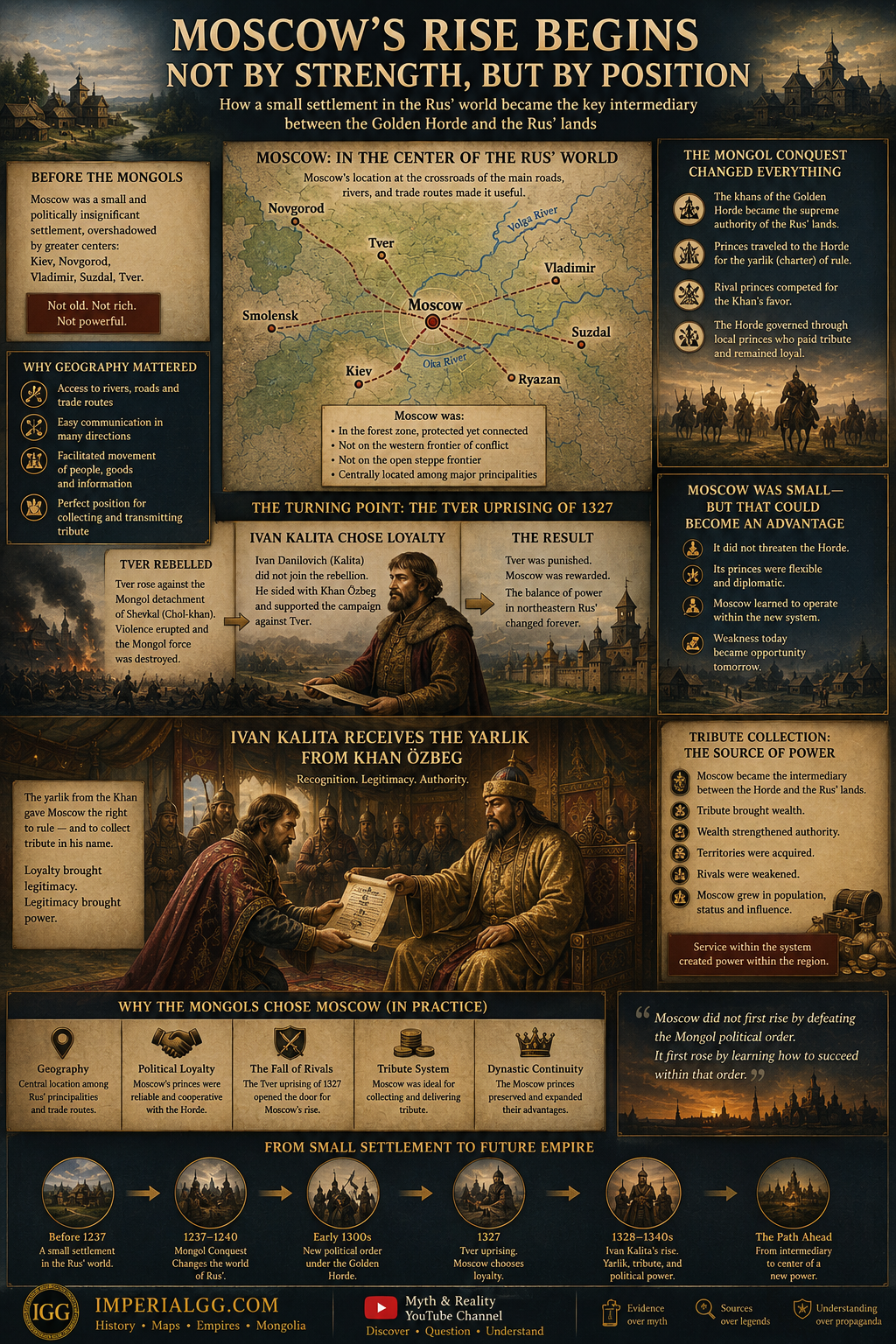
Before the Mongol conquest, Moscow was a relatively minor settlement within the fragmented political world of the Rus’ principalities. It was neither the oldest nor the richest city of Rus’, and it could not rival Kiev in historical prestige, Novgorod in commercial power, or Vladimir and Suzdal in political importance. Yet within little more than a century, Moscow began to emerge as one of the most important political centers of northeastern Rus’.
How did this transformation happen? The conventional national narrative often presents Moscow’s rise as part of the gradual recovery of a Russian state from Mongol domination. The historical process, however, was considerably more complex. Moscow initially rose within the political order created by the Golden Horde, not outside it. Its geography provided opportunities, its princes learned to operate successfully within the political system of the Horde, its rivals made catastrophic political mistakes, and the redistribution of authority that followed the Mongol conquest created conditions in which a previously secondary principality could rise above older and more prestigious centers.
Moscow at the Center of Northeastern Rus’
Moscow occupied a strategically useful position within the network of northeastern Rus’ principalities. It stood between several important political centers and within a broader system of rivers, roads, forests, and commercial routes connecting different parts of the Rus’ lands. Vladimir lay to the east, Tver to the northwest, and Ryazan toward the southeast, while routes leading toward Novgorod and the northern territories extended farther beyond.
Moscow was therefore not located on the distant western frontier, where many conflicts with Baltic and Scandinavian powers occurred, nor was it situated directly on the exposed steppe frontier. Its position within the forest zone provided a degree of geographical protection while still allowing communication in several directions. This did not automatically make Moscow powerful, but it made the settlement potentially useful as political conditions changed.
A relatively central position could facilitate communication, the movement of resources, and eventually the collection and transmission of tribute. Geography alone did not create Moscow’s power, but it provided favorable conditions once political opportunity arrived.
The Mongol Conquest Changed the Political Geography of Rus’
The Mongol invasion of 1237–1240 devastated many Rus’ cities and fundamentally altered the political structure of Eastern Europe. The princes of Rus’ continued to govern their individual principalities, but supreme political authority was now connected to the khans of the Jochid Ulus, the polity later conventionally known as the Golden Horde.
Rus’ princes traveled to the Horde to receive recognition of their political authority, while rival dynasties competed for the khan’s favor and for the prestigious title associated with the grand principality of Vladimir. The Horde did not normally administer every Rus’ town directly. Instead, it governed through a flexible imperial system that preserved local dynasties while demanding political submission, tribute, and, under certain circumstances, military cooperation.
This system created a new form of political competition. The question was no longer simply which Rus’ prince was strongest among the Rus’ principalities. Political success increasingly also depended upon which prince could most successfully negotiate with the Horde and secure recognition from the khan. This transformation would eventually become crucial to Moscow’s rise.
Moscow Was Small, but Weakness Could Become an Advantage
Before its rise, Moscow possessed one characteristic that later historical narratives sometimes overlook: it was relatively weak. Yet weakness could also mean that Moscow initially posed little independent threat to the larger political order. Its princes had to survive through diplomacy, dynastic calculation, territorial acquisition, and carefully managed relations with stronger powers.
Unlike older political centers with deeply established traditions and powerful competing elites, Moscow was building its position within the new political environment that emerged after the conquest. Its princes increasingly demonstrated an ability to operate effectively within the framework established by the Horde. They did not overthrow that system during the period of Moscow’s early ascent. Instead, they learned how to use the opportunities that existed within it.
Ivan Kalita and the Politics of the Horde
The decisive figure in the early rise of Moscow was Ivan I Danilovich, remembered by the epithet Kalita, traditionally interpreted as “Moneybag.” His career must be understood within the political struggle between Moscow and Tver. During the early fourteenth century, Tver was in many respects Moscow’s more powerful rival. It possessed considerable political importance and competed directly for supremacy in northeastern Rus’.
The balance changed dramatically after the uprising in Tver in 1327. The revolt was directed against a Mongol detachment associated with Chol-khan, known in Russian chronicles as Shevkal. Violence erupted, and the detachment was destroyed. Ivan Kalita did not join the rebellion. Instead, he aligned himself with Khan Özbeg and participated in the political and military response against Tver.
For the Horde, this distinction mattered enormously. Tver had become associated with open resistance, while Moscow demonstrated political reliability. The suppression of the Tver uprising therefore became a major turning point in the regional balance of power. Ivan participated in the campaign against Tver alongside forces acting under the authority of the Horde, and in the political settlement that followed, Moscow’s position strengthened substantially.
This was not yet the creation of a centralized Russian state. It was, rather, a redistribution of power within the political world dominated by the Golden Horde, and Moscow proved particularly successful at turning this new balance into a lasting advantage.
Tribute Collection and the Growth of Moscow
Ivan Kalita subsequently acquired an increasingly important position within the tribute system connecting the Rus’ lands with the Horde. This relationship had profound consequences because the collection and transmission of tribute was not merely an administrative function. It could also become a source of political power.
A prince occupying an intermediary position between the Horde and other Rus’ territories could gain access to resources, information, diplomatic networks, and political influence. Moscow was therefore able to benefit from this position in several interconnected ways. The principality accumulated wealth, its rulers strengthened their authority, territories could be purchased or otherwise acquired, political rivals could be weakened, and the city became increasingly attractive to elites, clergy, merchants, and settlers seeking stability and opportunity.
Thus, the tribute system, often described in later national narratives solely as an instrument of foreign oppression, also became one of the institutional environments within which Moscow accumulated power. The relationship remained unequal, and the khan retained superior political authority, but Moscow’s rulers learned how to convert service within that hierarchy into regional advantage.
Why Moscow?
There was no single reason for Moscow’s rise, and its geographical position alone cannot explain its transformation. Several forces operated together. Geography provided connectivity because Moscow occupied a useful position among the northeastern Rus’ principalities and within networks of rivers and overland routes. Political loyalty created opportunities because Moscow’s princes repeatedly demonstrated that cooperation with the Horde could produce greater immediate advantages than premature confrontation.
The weakness of Moscow’s rivals also changed the regional balance. The catastrophe that followed the Tver uprising of 1327 created political space that Moscow was able to exploit. At the same time, Moscow’s increasing intermediary role in relations with the Horde helped concentrate economic and political resources in the hands of its rulers. Dynastic continuity then allowed the Moscow princely house to preserve and expand these accumulated advantages across successive generations.
None of these factors alone explains Moscow’s rise. Together, however, they created a powerful historical mechanism through which a previously secondary principality gradually became the dominant center of northeastern Rus’.
The Paradox of Moscow’s Rise
Here lies one of the central paradoxes of medieval Eurasian history. The Mongol conquest destroyed the old political balance of Rus’, but the new imperial order that followed also created conditions in which a new center of power could emerge. That center eventually became Moscow.
The Mongols did not simply “create Moscow,” nor did they deliberately design the future Russian state or empire. Such a claim would oversimplify several centuries of historical development. Yet it is equally misleading to write Moscow’s early rise as though it occurred entirely in opposition to the Horde.
For a crucial period, Moscow’s political advancement was deeply connected to the institutions, legitimacy, and power structures of the Jochid world. Moscow’s princes obtained political authority through relations with the khans, competed against other Rus’ princes within the Horde’s political system, benefited from the redistribution of power following the defeat of their rivals, and transformed their intermediary position into accumulated political strength.
From Geography to Empire
Moscow began as a relatively minor settlement. Its geographical position gave it possibilities, but geography was not destiny. The decisive transformation occurred when geographical advantages intersected with imperial politics. A centrally situated principality found itself operating within a vast political system extending from the Rus’ forest zone across the Volga and deep into the Eurasian steppe.
Moscow’s rulers learned to negotiate with that system, serve within it, and benefit from the opportunities it provided. Over successive generations, they accumulated enough resources, legitimacy, territory, and political influence to transform Moscow into something entirely different from the minor settlement it had once been.
The historical irony is therefore significant. Moscow did not initially rise by defeating the Mongol political order. During the crucial early stages of its ascent, Moscow rose by learning how to succeed within that order. Only generations later would the balance of power change sufficiently for Moscow to challenge and eventually absorb many of the political territories that had emerged from the Jochid world.
The transformation from a small Rus’ principality operating within the political system of the Golden Horde into an expanding Eurasian power belongs to the next chapter of Moscow’s history.