AFTER THE MONGOL EMPIRE – MOSCOW SERIES 1.3
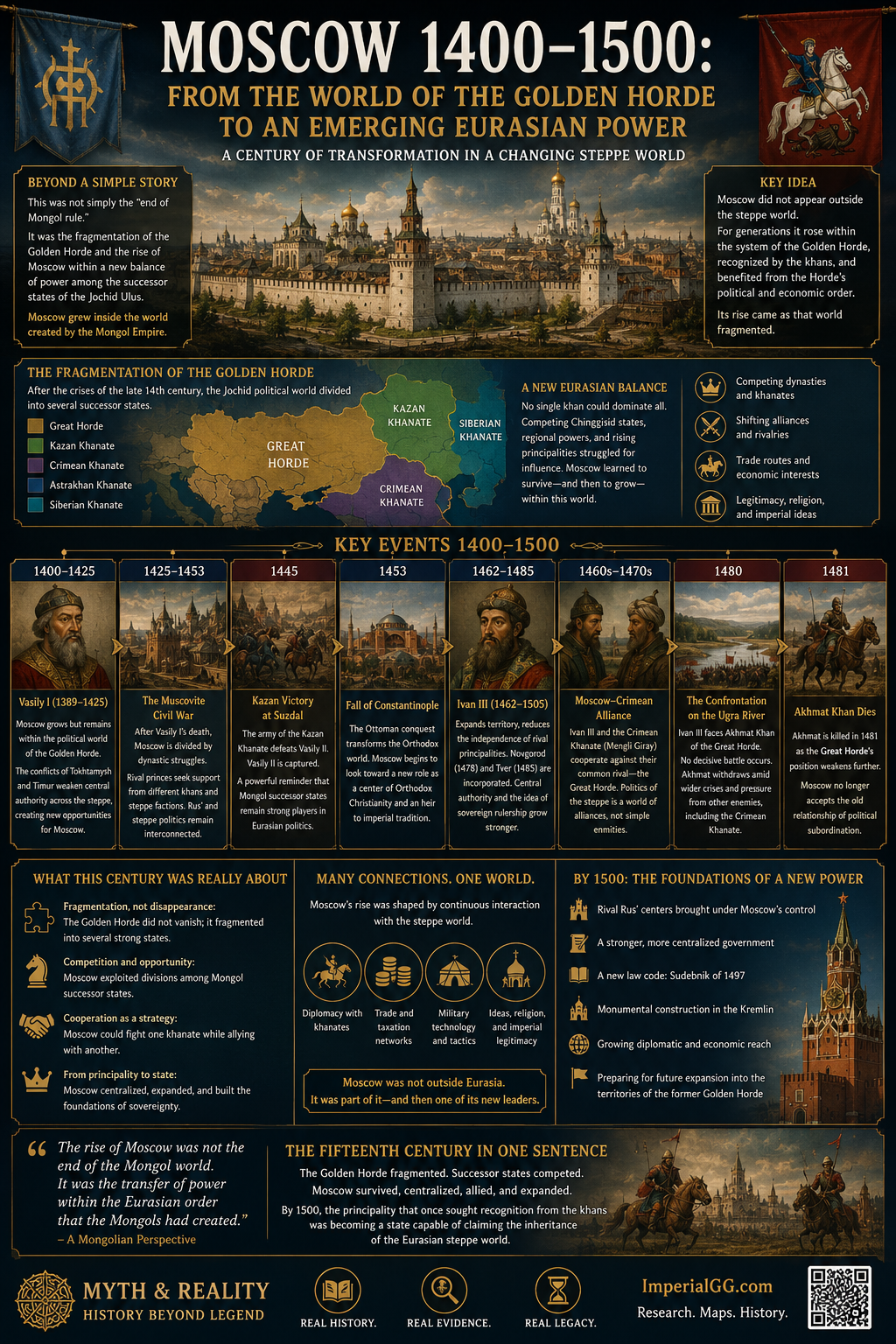
MOSCOW 1400–1500: From a Principality of the Golden Horde to an Emerging Eurasian Power
By Altanbagana Baatar
DBA Candidate| Independent Historian
ImperialGG Historical Research Seriers
16 July 2026
1400–1500: From a Principality of Rus’ to an Emerging Eurasian Power
The fifteenth century is often presented as the age in which Moscow finally “freed Russia from Mongol rule.” In the traditional national narrative, the story appears almost linear: the power of the Golden Horde declined, Moscow grew stronger, and in 1480 the confrontation on the Ugra River brought the so-called “Mongol yoke” to an end. From a Mongolian and broader Eurasian perspective, however, the historical transformation was far more complex.
Moscow did not suddenly emerge outside the political world created by the Mongol Empire. For generations, its rulers had risen within the political order of the Jochid Ulus—the Golden Horde. Their authority had been recognized by the khans, their rivals had competed for the same recognition, and Moscow itself had benefited enormously from its position within the Horde’s political, administrative, and tributary system. What fundamentally changed during the fifteenth century was therefore not simply that Moscow became stronger while “the Mongols” became weaker. The greater transformation was the fragmentation of the Golden Horde itself.
As competing Chinggisid dynasties and regional centers struggled for control of the Jochid political inheritance, Moscow gained increasing room to maneuver. It gradually transformed itself from a subordinate principality operating within the political world of the Horde into an increasingly autonomous state capable of exploiting divisions among the Horde’s successor powers. The fifteenth century was therefore not merely the century in which Mongol authority over Moscow ended; it was the century in which Moscow began to emerge from the political world of the Golden Horde as one of the states competing to inherit the Eurasian order that followed it.
Moscow at the Beginning of the Fifteenth Century
At the opening of the fifteenth century, Moscow was growing, but it was not yet an independent great power. Vasily I, who ruled from 1389 to 1425, inherited a principality whose position had strengthened considerably during the previous century. Yet Moscow remained deeply connected to the politics of the steppe, and the balance of power across northeastern Rus’ could not be separated from developments within the Jochid world.
The decisive background was the conflict between Tokhtamysh Khan and Timur. Tokhtamysh had succeeded in restoring much of the political unity of the Golden Horde after a period of internal instability, but his wars with Timur culminated in devastating campaigns during the 1390s. Important political and commercial centers of the Jochid Ulus were attacked, and the ability of any single khan to maintain continuous authority across the enormous western steppe was severely weakened. For Moscow, this disruption created political space, but the weakening of centralized Jochid authority did not mean that Mongol political power disappeared or that Moscow immediately became independent. Instead, the fifteenth century became an age of competing successor states.
The Fragmentation of the Golden Horde
The political world inherited from Jochi gradually divided into several centers of power. The Great Horde continued important traditions of the central Golden Horde, while the Kazan, Crimean, Astrakhan, and Siberian khanates emerged as major political actors. These states should not be understood merely as declining remnants waiting to be conquered. They possessed armies, dynastic legitimacy, diplomatic networks, commercial interests, and their own political relationships with Moscow, Lithuania, Poland, the Ottoman Empire, and Central Asia.
Moscow’s rise therefore occurred not against a single united Mongol empire, but within a changing balance of power among competing heirs of the Jochid political world. During the fifteenth century, Moscow increasingly learned to maneuver among these competing powers. The political world of the former Golden Horde was fragmenting, but the steppe remained militarily and diplomatically powerful, and Moscow’s eventual success depended in considerable measure on its ability to navigate that fragmentation.
1425–1453: Moscow’s Own Struggle for Survival
The future supremacy of Moscow was by no means inevitable. After the death of Vasily I in 1425, the principality entered a prolonged dynastic conflict known as the Muscovite Civil War, in which Vasily II struggled against rival members of his own dynasty, particularly Yuri of Zvenigorod and Yuri’s sons. The conflict lasted for decades and revealed an important reality often obscured by later national histories: the political structure of northeastern Rus’ remained unstable, Moscow could have lost its leading position, and rival dynastic centers still possessed genuine political possibilities.
During these struggles, relations with Mongol rulers and steppe factions remained politically important. Rus’ princes continued to interact with different khans and sought military or political advantages through the wider networks of the post-Golden Horde world. The boundary between “Russian politics” and “steppe politics” was therefore far less absolute than later narratives often suggest; they remained interconnected parts of the same Eurasian political environment.
1445: The Battle of Suzdal
One of the clearest demonstrations of this reality came in 1445, when forces of the Kazan Khanate defeated the army of Vasily II near Suzdal and captured the grand prince himself. The event directly contradicts the idea of an uninterrupted rise of Moscow against an already powerless steppe. In the middle of the fifteenth century, a Mongol successor state was still capable of defeating the ruler of Moscow in battle and taking him prisoner. Moscow was not yet an uncontested great power but remained one state among several competing political centers in a wider Eurasian system, and its eventual dominance still lay in the future.
1453: Constantinople and a New Political Imagination
The Ottoman conquest of Constantinople in 1453 profoundly altered the political and religious world of Orthodox Christianity. With the disappearance of the Byzantine Empire, Moscow eventually gained the possibility of presenting itself as a major center of Orthodox political authority, a process that became increasingly visible under Ivan III. In 1472, Ivan married Sophia Palaiologina, a niece of the last Byzantine emperor, and Byzantine symbols and concepts would subsequently become increasingly important in Muscovite political culture.
Yet the emerging Muscovite state cannot be understood through Byzantine inheritance alone. Its political institutions had also developed through more than two centuries of interaction with the Mongol imperial world. Moscow therefore emerged at the intersection of several historical traditions: the dynastic inheritance of Rus’, Orthodox Christianity and Byzantine political symbolism, and the political geography and practices of the Eurasian steppe. The Muscovite state was not simply the restoration of a pre-Mongol Rus’, but a new political formation shaped in significant ways by the historical world that had emerged after the Mongol conquest.
1462: Ivan III and the Transformation of Moscow
When Ivan III came to power in 1462, Moscow entered one of the decisive periods of its transformation. Ivan expanded Muscovite territory, weakened the independence of rival principalities, strengthened central authority, and increasingly presented himself as a sovereign ruler. Novgorod was brought under Moscow’s control in 1478 and Tver followed in 1485, as Moscow gradually absorbed competing Rus’ centers through warfare, diplomacy, dynastic claims, and political pressure and established itself as the dominant power of northeastern Rus’.
Yet Ivan’s achievements must also be placed within the larger transformation of the steppe. The Golden Horde was no longer politically unified, and different Chinggisid states and dynastic factions competed against one another, creating divisions that Moscow increasingly learned to exploit. This would become one of the defining characteristics of Muscovite expansion: rather than confronting the entire steppe as a single enemy, Moscow negotiated, allied, competed, and fought with different steppe powers according to changing political circumstances.
Moscow and the Crimean Khanate: The Forgotten Alliance
Perhaps no relationship demonstrates the complexity of this period more clearly than Moscow’s alliance with the Crimean Khanate. Ivan III developed an important political relationship with the Crimean khan Mengli Giray because both rulers shared a major rival: the Great Horde. Thus, at precisely the time when Moscow was challenging the authority of one successor to the Golden Horde, it was cooperating with another Chinggisid state.
This reality fundamentally complicates the traditional narrative of a simple struggle between “Russia” and “the Mongols.” Moscow opposed the Great Horde, Crimea opposed the Great Horde, and Moscow and Crimea cooperated when their strategic interests aligned. The steppe was not a single political bloc, nor were the lands of Rus’. The struggle for power took place within a fragmented Eurasian political system in which religious, ethnic, and civilizational boundaries did not automatically determine alliances; strategic interests often did.
1480: The Great Stand on the Ugra River
The confrontation on the Ugra River in 1480 has traditionally been presented as the final end of the “Mongol yoke.” Its political importance is undeniable, but its historical meaning requires a wider perspective. The forces of Ivan III faced those of Akhmat Khan of the Great Horde, yet there was no decisive battle in which a Muscovite army destroyed the forces of the Horde. The armies confronted one another across the river before Akhmat eventually withdrew.
More importantly, Akhmat was operating within a much larger geopolitical crisis. The Great Horde faced enemies and pressures elsewhere, while Moscow maintained its strategic relationship with Mengli Giray of Crimea. The outcome of 1480 therefore cannot be understood solely as a bilateral confrontation between Moscow and “the Mongols”; it was also a consequence of the fragmentation of the Jochid political world.
Nevertheless, the significance of the event was enormous. Moscow would no longer accept the old relationship of political subordination to the Great Horde, but this was not the moment when Moscow suddenly separated itself from the entire Mongol world. Rather, Moscow had successfully used the fragmentation of that world to establish its own sovereignty. The year 1480 was therefore not simply the moment when “Russia defeated the Mongols,” but a decisive stage in Moscow’s emergence as an increasingly independent actor within the post-Golden Horde political order of Eurasia.
1481 and the Continuing Struggle for the Steppe
The events immediately following the Ugra confrontation further reveal the broader geopolitical reality. Akhmat Khan was killed in 1481 amid continuing conflicts among steppe powers, the position of the Great Horde continued to deteriorate, and the Crimean Khanate grew increasingly powerful. Moscow benefited enormously from this changing balance.
The principality whose rulers had once sought political recognition from the khans was now becoming capable of negotiating with and exploiting rivalries among the successor states of the same imperial world. This transformation did not occur because Moscow had escaped Eurasian politics; it occurred because Moscow had become increasingly skilled at participating in them.
1485–1500: The Foundations of a New State
By the end of the fifteenth century, Moscow had changed fundamentally. Tver had been annexed, Novgorod incorporated, and the authority of the grand prince greatly expanded. The Sudebnik of 1497 contributed to the growing centralization of law and administration, the Kremlin was transformed through monumental construction, diplomatic relations expanded, and increasingly ambitious symbols of sovereignty appeared at the Muscovite court.
Yet Moscow’s larger Eurasian transformation was only beginning. The great expansion into the territories of the former Golden Horde would come in the following century, when Kazan fell in 1552 and Astrakhan in 1556, followed by expansion across Siberia. Over the following centuries, the Muscovite state—and later the Russian Empire—would gradually expand across enormous territories that had once belonged to the political world created by the Mongol Empire and its successor states.
This later history makes the fifteenth century particularly important because it was the transitional century. Moscow had not yet become the great Eurasian empire of later centuries, but the political foundations of that transformation were already visible.
The Deeper Historical Question
The history of 1400–1500 therefore raises a more important question than the traditional story of the “end of Mongol rule”: how did a principality that had risen within the political system of the Golden Horde become one of the principal powers competing for the Eurasian inheritance that emerged after the Horde’s fragmentation?
Moscow inherited a political geography transformed by centuries of Mongol rule, interacted continuously with Chinggisid states, operated within diplomatic practices shaped by the steppe world, formed alliances with Mongol khans against other Mongol khans, and exploited rivalries among the successor states of the Jochid Ulus. Eventually, Moscow itself began expanding into the territories of those successor states.
This does not mean that Moscow was simply a continuation of the Golden Horde, nor does it erase the distinct traditions of Rus’, Orthodox Christianity, or the growing Muscovite state. But neither can Moscow’s rise be fully understood by removing it from the Eurasian political world in which it had developed.
Seen from this broader perspective, the fifteenth century was not simply the end of one historical era but a redistribution of power within Eurasia. The Golden Horde fragmented, its successor states competed, and Moscow survived its own internal crises, centralized its authority, and learned to exploit the new balance of power. By 1500, the principality that had once sought recognition from the khans was becoming a state capable of competing for power across the very Eurasian world in which it had risen.
The story of Moscow was no longer merely the story of one principality of Rus’. It was becoming the story of a new Eurasian power.
MYTH & REALITY — History Beyond Legend
From Moscow to the Soviet Union: A Century-by-Century Historical Series
ImperialGG.com — Research. Maps. History.