
BEGTER’S LAST STAND: TEMÜJIN, QASAR, AND THE MOMENT THAT CHANGED THE BORJIGIN FAMILY
By Altanbagana Baatar
DBA Candidate| Independent Historian
ImperialGG Historical Research Seriers
09 September 2026
AUTHOR’S THESIS
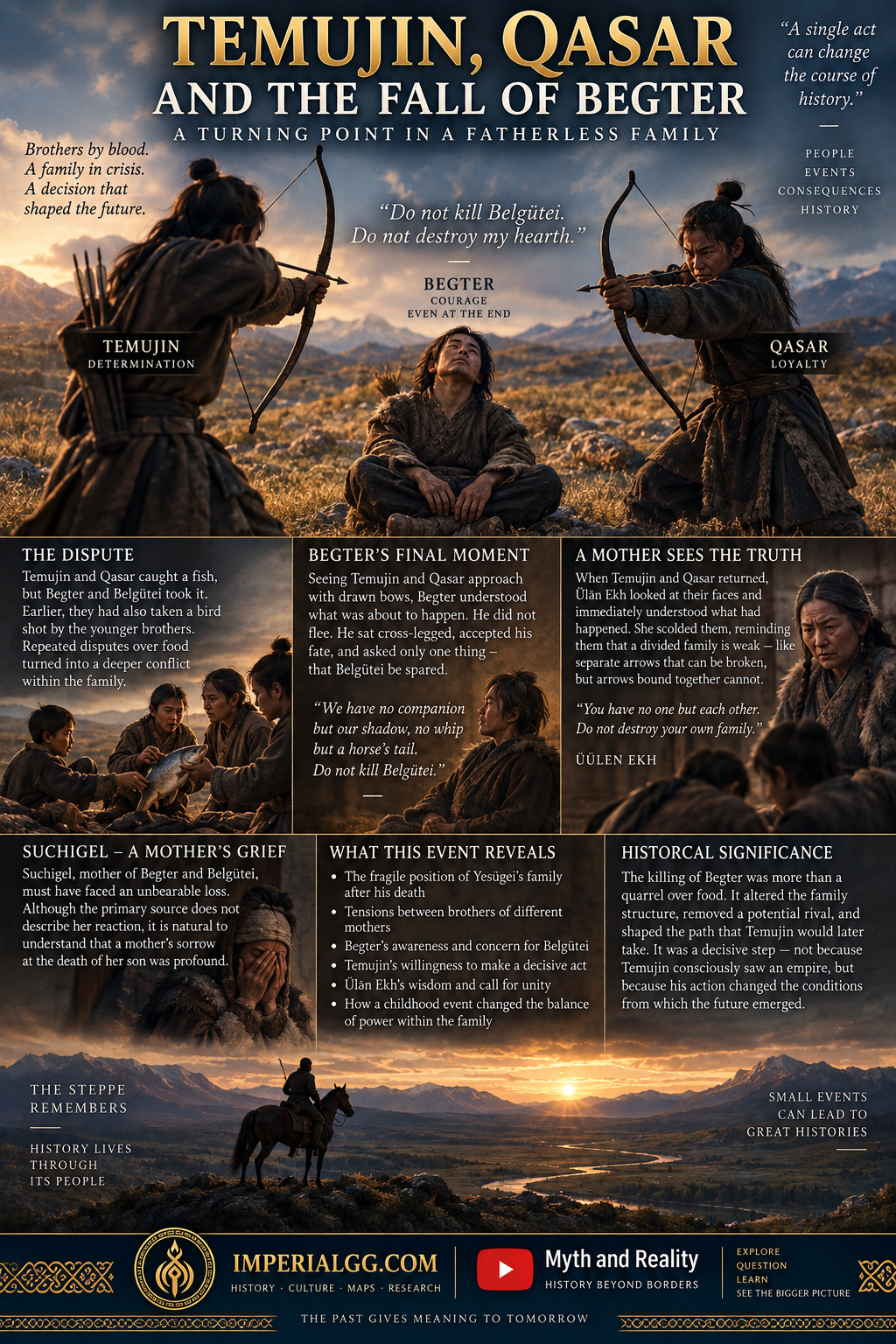
Begter’s killing should not be reduced to a simple quarrel between half-brothers over food. This article argues that Begter occupied a potentially dangerous position within the fractured household of Yisügei Ba’atur: as an older son, he represented a possible alternative center of authority at a time when the family had already been abandoned by the Tayichi’ud. Although the Secret History of the Mongols does not explicitly state that Begter maintained a secret connection with the Tayichi’ud, the possibility of such a political link deserves serious consideration. The subsequent capture of Temüjin by the Tayichi’ud, occurring soon after Begter’s death, does not prove such a connection, but it creates a significant chronological and political question. From this perspective, Temüjin and Qasar’s decision to kill Begter may be understood not merely as an act of personal conflict, but as a decisive attempt to eliminate a potential internal rival at a moment of extreme external vulnerability. The historical importance of the episode therefore lies not in the claim that Temüjin consciously foresaw his imperial future, but in the structural consequences of his decision: the removal of Begter transformed the balance of authority within the family and became part of the chain of events through which Temüjin’s later political trajectory emerged.
BEGTER WAS NOT MERELY A BROTHER TEMÜJIN KILLED; HE MAY HAVE BEEN A POTENTIAL RIVAL WHO STOOD AT THE INTERSECTION OF FAMILY SUCCESSION AND THE POLITICAL DANGER POSED BY THE TAYICHI’UD.
A SOURCE-CRITICAL READING OF THE KILLING OF BEGTER IN THE SECRET HISTORY OF THE MONGOLS
INTRODUCTION
Among the episodes describing the childhood of Temüjin, few are as consequential for understanding the internal structure of the Borjigin family as the killing of his elder half-brother Begter. The Secret History of the Mongols presents the event in the context of repeated disputes over food and hunting spoils following the death of Yesügei Ba’atur, when the family had been abandoned by the Tayichi’ut and was surviving under severe material conditions. The immediate narrative is comparatively brief: Temüjin and Qasar became angry after Begter and Belgütei took a fish that had been caught by the younger brothers; after a further dispute concerning a bird, Temüjin and Qasar armed themselves, approached Begter from opposite directions, and killed him.¹ Yet the episode contains a much more complex configuration of age, maternal status, household authority, political insecurity, and the developing character of Temüjin.
Begter was not simply another brother. He was the son of Yesügei and Suchigel, and therefore the elder half-brother of Temüjin, while Belgütei was his younger full brother.² Temüjin, by contrast, was the eldest son of Hö’elün, Yesügei’s principal wife. The death of Yesügei had removed the adult male authority that had previously organized these relationships, leaving a household in which the relative positions of the sons could become increasingly consequential. Modern scholarship has consequently considered whether Begter’s position involved more than an immediate dispute over food and whether the conflict may have reflected competing claims to authority within the fatherless household.³
The purpose of this article is not to replace the account of the Secret History with a speculative reconstruction, but to examine closely what the source actually says and what may reasonably be inferred from it. Particularly important is Begter’s final response. When Temüjin and Qasar approached him with drawn bows, Begter did not attempt to flee or fight. Instead, he sat cross-legged, recognized the danger, invoked the family’s weakness after the Tayichi’ut abandonment, and specifically asked his brothers not to kill Belgütei. He then accepted his own death.⁴ This final act has often been read simply as resignation, but it can also be examined as an expression of Begter’s awareness of the altered structure of the household and of the future vulnerability of his younger brother.
The episode should therefore be understood not merely as a story of adolescent violence, but as a critical moment in the transformation of Yesügei’s family.
THE FAMILY AFTER YESÜGEI
The Secret History explicitly distinguishes the children of Hö’elün from those of Yesügei’s other wife, Suchigel. Hö’elün bore Temüjin, Qasar, Qachi’un, Temüge, and Temülün, while Suchigel was the mother of Begter and Belgütei. When Temüjin was nine, Qasar was seven, Qachi’un five, Temüge three, and Temülün was still in the cradle.⁵ The exact ages of Begter and Belgütei are not supplied in the same passage, although modern reconstructions generally place Begter somewhat older than Temüjin.⁶
This distinction matters because the household was not organized solely by biological descent from Yesügei. Maternal status also formed part of the social structure. Hö’elün occupied the principal-wife position, while Suchigel belonged to a secondary marital relationship. Later Mongolian scholarship has argued that the different positions of the two women may have affected the status of their sons and that Begter could therefore have occupied an ambiguous position: older than Temüjin but born to a woman whose position within the household was inferior to that of Hö’elün.⁷
This ambiguity becomes especially important after Yesügei’s death. The Secret History describes the abandonment of the family by the Tayichi’ut and the subsequent struggle of Hö’elün and her children to obtain food through hunting, fishing, gathering, and other means.⁸ The family was no longer protected by the political authority that had existed during Yesügei’s lifetime. The children consequently had to negotiate their relationships with one another within a household in which resources were scarce and adult male authority was absent.
It is within this setting that the conflict over food must be interpreted.
THE FISH AND THE BIRD
The Secret History states that Temüjin, Qasar, Begter, and Belgütei were together fishing when a fish was caught. Begter and Belgütei took it from Temüjin and Qasar. When Temüjin and Qasar returned to Hö’elün and complained, she rebuked them rather than supporting their grievance. Her response is significant because she reminded them that the family had no companions beyond their own shadows and no whip beyond a horse’s tail, and she asked why they were acting against one another when the family already lacked allies.⁹
Temüjin and Qasar nevertheless remained resentful. They recalled that Begter and Belgütei had previously taken a lark that the younger brothers had shot with a bone-tipped arrow. Their complaint therefore concerned a repeated pattern of unequal access to the results of hunting rather than one isolated fish. They declared that they could not live together under such circumstances and left the tent.¹⁰
The immediate historical significance of this exchange lies in the fact that Hö’elün recognized the danger of internal division while Temüjin and Qasar rejected her warning. Her position was structurally different from theirs. She understood that the family had become dependent upon internal solidarity for survival, whereas the boys were increasingly experiencing their relationships through competition over resources and status.
This does not prove that Begter was consciously attempting to establish political supremacy. The Secret History does not say so. It does, however, show that Begter’s behavior was perceived by Temüjin and Qasar as an assertion of superiority, whether or not that was Begter’s intention.
BEGTER’S FINAL MOMENT
The narrative becomes remarkably precise when the brothers confront Begter. Begter was sitting on a hill watching the horses. Temüjin approached from behind while Qasar came from the front. They drew their bows and prepared to shoot. At that moment Begter saw what was happening and spoke.¹¹
His words are crucial. He recalled that the family had already suffered from the Tayichi’ut and asked why Temüjin and Qasar were now treating him as an obstacle. He reminded them that they had no companion except their shadow and no whip except a horse’s tail. Most importantly, he told them:
**“Do not destroy my hearth. Do not kill Belgütei.”**¹²
He then sat cross-legged and submitted to the attack.
The physical posture is significant. Begter did not attempt to escape, attack his brothers, or call for help. The Secret History presents him as recognizing the inevitability of the confrontation. His final concern was not his own survival alone but the survival of his younger full brother, Belgütei.
This is one of the reasons the scene deserves greater attention than it usually receives. Begter’s final words can be read as the statement of a young man who understood that his death would leave Belgütei exposed within a household already characterized by division. Whether or not Begter possessed a fully articulated political conception of succession cannot be known, but his concern for Belgütei indicates that he understood the family as a continuing social unit whose survival extended beyond his own life.
The source does not state that Begter foresaw the future political career of Temüjin. Any such claim would be anachronistic. Yet his final behavior demonstrates an awareness that the consequences of the brothers’ actions would extend beyond the immediate quarrel.
“DO NOT KILL BELGÜTEI”
Begter’s final request deserves special emphasis because it distinguishes the two brothers. If the dispute had been solely about the fish, there would have been no obvious reason for Begter to make Belgütei’s survival the central element of his final statement. The Secret History does not provide an explicit explanation, but the request suggests that Begter understood Belgütei to be the remaining vulnerable member of his maternal branch.
This interpretation is strengthened by what happened afterward. Belgütei survived and did not pursue a blood feud against Temüjin. Instead, he eventually became an important member of Temüjin’s political community and later one of his trusted commanders.¹³
Begter’s final concern for Belgütei can therefore be viewed retrospectively as historically significant. He could not have known the precise political future that awaited Temüjin or Belgütei, but his request effectively separated the fate of his younger brother from his own.
The irony of the episode is that Begter’s final act of concern toward Belgütei was eventually fulfilled: Belgütei survived and became integrated into the political order that Temüjin created.
TEMÜJIN’S DECISION
The decision to kill Begter was not a spontaneous act occurring in the absence of warning. Hö’elün had already explicitly told the boys not to quarrel. Temüjin and Qasar nevertheless left the household, armed themselves, and deliberately approached Begter from two directions.¹⁴
The Secret History therefore depicts a coordinated act rather than an accidental confrontation.
This distinction is important when considering Temüjin’s development. The killing cannot simply be described as an uncontrolled childhood outburst. Temüjin and Qasar made a decision, prepared their weapons, positioned themselves strategically, and executed the attack.
At the same time, it would be misleading to treat the act as evidence that Temüjin had already become the fully formed political strategist of his later life. He was still a youth, and the social world in which he acted was radically different from the imperial environment of his adulthood.
The historical significance of the act lies instead in the fact that Temüjin crossed a boundary within his own household. He did so against his mother’s explicit warning and against an older paternal half-brother.
That decision had consequences for the future organization of the family.
DID TEMÜJIN SEE THE FUTURE?
The proposition that Temüjin “saw the future” through the killing of Begter is attractive as an interpretation, but it must be formulated carefully. There is no primary source stating that Temüjin consciously killed Begter because he foresaw the creation of an empire decades later. Such a claim would turn retrospective historical knowledge into an alleged childhood intention.
A more defensible interpretation is that the killing represented an early political act in the structural sense, even if Temüjin did not yet possess a conscious imperial program. By removing an older half-brother who occupied a potentially important position within the fatherless household, Temüjin and Qasar altered the distribution of male authority among Yesügei’s surviving sons.
This interpretation has support in Mongolian scholarship. L. Baasandorj argues that the difference in maternal status between Hö’elün and Suchigel contributed to tensions between their sons and interprets Begter as a potential rival in relation to the position inherited from Yesügei. He further argues that traditions concerning succession among the sons of a principal wife and the status of sons from secondary wives created a background in which Begter could be perceived as a political rival.¹⁵
That argument should not be treated as an established fact. Baasandorj’s reconstruction goes beyond what the Secret History explicitly states. Nevertheless, it offers a historically plausible framework for understanding why the conflict could become lethal.
The killing of Begter may therefore be described as a decisive step in the consolidation of Temüjin’s position within his immediate family, without claiming that Temüjin consciously understood the imperial future that historians now know.
ÖELÜN’S REACTION
The response of Hö’elün is one of the strongest pieces of evidence preserved in the episode. When Temüjin and Qasar returned to the tent, the Secret History states that Hö’elün looked at the faces of her two sons and immediately understood what they had done. She then condemned them.¹⁶
Her speech is unusually severe. She reminded them of the condition in which the family had been left: they had been abandoned by their Tayichi’ut relatives and were living without external protection. She compared their internal destruction to the story of Alan Qo’a’s five sons, emphasizing the difference between isolated arrows that can easily be broken and arrows bound together that cannot easily be broken.¹⁷
The comparison is structurally important. Hö’elün’s argument is not simply that killing a brother is morally wrong. Her argument is that a divided family is vulnerable to destruction. She had already warned them of this before they left to confront Begter. After the killing, her reaction demonstrates that she understood its larger implications.
Her anger therefore provides an important counterpoint to the later political success of Temüjin. From Hö’elün’s perspective, the killing was not an achievement. It was a dangerous weakening of the family at precisely the moment when the family most needed unity.
THE FACE OF TEMÜJIN
The Secret History‘s description that Hö’elün understood what had happened from the faces of her sons is also significant as narrative technique. The source does not describe the psychological interior of Temüjin and Qasar at length. Instead, it allows the mother’s observation of their faces to reveal the consequences of their act. This is consistent with the broader narrative style of the Secret History, which frequently communicates moral and psychological information through speech, physical action, and brief visual details rather than extended interior narration.¹⁸
Hö’elün therefore becomes the first person within the family to confront Temüjin with the consequences of his action. The scene also demonstrates that the family knew one another intimately. Hö’elün did not need a confession. She saw the faces of her sons and understood. For historical reconstruction, however, one should resist turning this literary detail into a precise psychological claim about guilt or remorse. The source establishes recognition and condemnation; it does not provide a detailed account of Temüjin’s internal emotional state.
SUCHIGEL AND THE SILENCE OF THE SOURCE
The position of Suchigel requires particular caution. She was the mother of Begter and Belgütei, and §60 of the Secret History explicitly identifies her as Yesügei’s other wife.¹⁹ Yet in the surviving narrative of the killing of Begter, the mother who speaks is Hö’elün. The Secret History does not provide a scene in which Suchigel is shown weeping over Begter’s death.
It is therefore reasonable to recognize the obvious historical implication: Begter’s death must have affected his mother profoundly, and the death of a son within a household would have carried enormous personal consequences. But the specific scene of Suchigel crying and grieving is not directly preserved in the primary narrative. This distinction matters for an academic article. A historical reconstruction may acknowledge the emotional reality of the event without inventing a primary-source scene.
Later traditions and modern retellings sometimes elaborate Suchigel’s role, but these must be distinguished from the Secret History.²⁰ The source itself is remarkably sparse concerning her response at this particular moment. That silence is itself historically interesting. The Secret History gives extensive attention to Hö’elün because she occupies a central role in the narrative of Temüjin’s childhood. Suchigel, despite being the mother of two of Yesügei’s sons, appears much less prominently.
A MOTHER’S GRIEF AND A FAMILY’S POLITICAL CRISIS
Nevertheless, the historical structure permits us to understand why the death of Begter would have been especially significant for Suchigel. Her household branch had consisted of herself and her two sons, Begter and Belgütei. Once Begter was killed, Belgütei became the sole surviving male representative of that branch.
The request “Do not kill Belgütei” therefore had a direct familial meaning. It also had a political implication. The survival of Belgütei preserved the possibility that Suchigel’s line would remain represented within the family. This eventually became important because Belgütei did not become a permanent rival to Temüjin. Instead, he was incorporated into the emerging political order and became one of Temüjin’s senior companions. From the perspective of family history, therefore, Begter’s death did not eliminate Suchigel’s branch; it reduced it to Belgütei.
BEGTER AS A POTENTIAL RIVAL
The question of Begter’s potential political position remains the most controversial part of the interpretation.
L. Baasandorj argues that Suchigel’s lower position within the household and the different maternal status of her children created a background for conflict between Begter and the sons of Hö’elün. He further suggests that the question of which son might succeed Yesügei contributed to the tension and that some members of the aristocratic lineage may have regarded Begter as a possible successor.²¹
This interpretation is important because it places the killing within a wider political structure rather than treating it as a simple quarrel. However, it should not be presented as though the Secret History itself states that Begter was formally designated heir. It does not. Nor does the source explicitly state that Temüjin killed him to secure succession.
The strongest historical formulation is therefore that Begter may have represented a potential rival source of authority within the fatherless household, particularly because of his age and paternal descent, while Temüjin possessed the different advantage of being Hö’elün’s eldest son. The two positions could overlap without being formally defined as competing claims.
LEVIRATE AND THE POSSIBILITY OF A FUTURE HOUSEHOLD ORDER
The question becomes more complex when the institution of levirate marriage is considered. Steppe societies permitted forms of widow remarriage within the deceased husband’s family, including marriage between a widow and certain male relatives of the deceased. Anne F. Broadbridge has demonstrated that levirate functioned as a mechanism for protecting widows and children and maintaining family property and labor within the husband’s lineage.²²
Timothy May has applied this social context to the Begter episode and noted the possibility that Begter, as the son of another wife, could potentially have married Hö’elün and thereby assumed an important patriarchal position in the household.²³
The Secret History does not state that Begter intended to marry Hö’elün. It does not state that Hö’elün intended to marry Begter. It does not state that Temüjin knew of such a plan. But the existence of such a social possibility makes Begter’s position more historically significant. His age, his status as Yesügei’s son, and the structure of the household meant that his continued existence could have affected the future distribution of authority. This is one reason why the killing may have been more consequential than the immediate dispute over a fish and a bird suggests.
THE GREATNESS OF THE DECISION LIES IN ITS CONSEQUENCES, NOT IN FOREKNOWLEDGE
It is tempting to describe the killing as the moment when Temüjin “saw his future” and consciously removed an obstacle to becoming the leader of the Mongols. The evidence does not support such a psychological reconstruction. What can be established is more historically interesting.
Temüjin made a decision while still young that changed the internal hierarchy of his family. He acted against an older half-brother, did so together with Qasar, and survived the condemnation of his mother. Belgütei was spared and eventually joined Temüjin’s political community. The consequence was that Temüjin emerged from the episode with no older paternal half-brother occupying the same potential position of authority.
Thus the significance of the act lies not in the claim that Temüjin already knew he would become Chinggis Qahan, but in the fact that his action altered the conditions from which his later political career developed. Historical causation does not require conscious foreknowledge. A decision can become historically decisive because of its consequences even when the actor does not know what those consequences will be.
CONCLUSION
The killing of Begter represents one of the earliest documented internal crises of Temüjin’s family and one of the most revealing episodes in the Secret History of the Mongols. The immediate circumstances were material: the family had been abandoned by the Tayichi’ut, resources were scarce, and repeated disputes arose over the distribution of hunting and fishing spoils. Yet the participants occupied different positions within the household. Begter was the son of Suchigel and the older half-brother of Temüjin, while Temüjin was the eldest son of Hö’elün.²⁴ The death of Yesügei had removed the adult authority that had previously mediated these differences.
The final encounter demonstrates that Begter understood the seriousness of what was happening. Seeing Temüjin and Qasar approaching with drawn bows, he did not flee but sat cross-legged and asked them not to destroy his hearth and, above all, not to kill Belgütei.²⁵ His final concern was therefore directed toward the survival of his younger full brother. The Secret History does not allow us to reconstruct every thought behind his words, but it does preserve a striking moment in which Begter recognized that his own death and Belgütei’s survival were now connected.
Temüjin’s action was equally consequential. He and Qasar ignored Hö’elün’s warning, deliberately confronted Begter, and killed him. The act should not be transformed into proof that Temüjin already possessed an imperial vision, but neither should it be reduced to an accidental quarrel between children. It was a deliberate act that changed the internal distribution of male authority within the family.
Hö’elün immediately recognized what had happened from the faces of her sons and condemned them. Her reaction was grounded in the practical reality that the family had already lost its wider support and could not afford to destroy itself from within.²⁶ Her comparison of the brothers to Alan Qo’a’s arrows framed family unity as a condition of survival.
Suchigel’s position requires greater caution. She was unquestionably the mother of Begter and Belgütei, but the Secret History does not record her reaction to Begter’s death. Her grief can reasonably be inferred as a human and familial consequence, but an academic reconstruction should not turn that inference into a primary-source quotation or invented scene.
The historical importance of Begter’s death therefore lies not in an unsupported claim that Temüjin consciously foresaw his imperial destiny, but in the fact that he took a decisive step that altered the family structure from which his later political career emerged. The removal of Begter eliminated an older male member of the household who may have represented a potential alternative source of authority, while the survival of Belgütei allowed Suchigel’s line to remain within the family and eventually within Temüjin’s political order.
In this sense, the killing of Begter was not necessarily the moment when Temüjin “saw the empire.” It was something more historically defensible: the moment when a young Temüjin made a decision whose consequences extended far beyond the immediate quarrel and permanently changed the structure of the family from which the future Mongol Empire would emerge.
FOOTNOTES
1. The Secret History of the Mongols, §§76–79. The relevant narrative records the fishing dispute, the earlier lark dispute, Temüjin and Qasar’s decision to confront Begter, and the killing. The Cleaves translation preserves the sequence in considerable detail.
2. Secret History, §60. The text explicitly identifies Begter and Belgütei as sons of Yesügei’s “other wife,” Suchigel.
3. L. Baasandorj, “Монгол Нууц Товчоо дахь зарим асуудлыг дахин судалж авч үзэх нь,” Acta Mongolica 15 (2014). Baasandorj specifically examines the different household positions of Suchigel and Hö’elün and interprets the Begter–Temüjin conflict in relation to political authority and succession.
4. Secret History, §77. Begter’s speech and his sitting cross-legged before Temüjin and Qasar are preserved in the primary narrative. The passage explicitly includes his request that Belgütei not be killed.
5. Secret History, §60.
6. Modern reconstructions place Begter somewhat before Temüjin, but the Secret History does not give his exact age. The relative-age sequence explicitly supplied in §60 applies to Temüjin, Qasar, Qachi’un, Temüge, and Temülün.
7. Baasandorj argues that Suchigel’s lower position within the household and the different maternal status of her sons contributed to tension between Begter and Hö’elün’s sons. This is a modern scholarly interpretation and should not be presented as a direct statement of the Secret History.
8. Secret History, §§69–75, describing the abandonment of the family and Hö’elün’s efforts to sustain her children.
9. Secret History, §76. Hö’elün’s admonition invokes the family’s lack of companions and emphasizes the necessity of solidarity.
10. Secret History, §77. Temüjin and Qasar explicitly refer to the earlier incident involving the bird and state that they cannot live together under such conditions.
11. Secret History, §77. Begter is described as sitting on a hill watching the horses while Temüjin approached from behind and Qasar from in front.
12. Secret History, §77. The wording concerning Begter’s “hearth” and his request that Belgütei be spared is central to the episode.
13. Secret History, later passages concerning Belgütei’s service to Temüjin, especially §95 and subsequent references. Modern summaries also note his later position as a trusted follower of Temüjin.
14. Secret History, §§77–78. The narrative clearly depicts a coordinated approach by Temüjin and Qasar followed by their return to the tent.
15. Baasandorj argues that the differing status of Hö’elün and Suchigel and the question of succession contributed to the conflict, interpreting Begter as a potential political rival. This interpretation is not identical to the explicit wording of the Secret History and should therefore be treated as secondary analysis.
16. Secret History, §78. The text states that Hö’elün perceived the faces of her two sons and then understood what had happened.
17. Secret History, §78. Hö’elün’s comparison with Alan Qo’a’s five arrows provides the moral and political framework of her rebuke.
18. On the narrative technique and literary structure of the Secret History, see Igor de Rachewiltz, The Secret History of the Mongols: A Mongolian Epic Chronicle of the Thirteenth Century (Leiden: Brill, 2004–2013).
19. Secret History, §60.
20. Later traditions concerning Suchigel should be distinguished from the Secret History. Modern reference materials identify her as the mother of Begter and Belgütei, but the Secret History itself does not narrate her grief at Begter’s death.
21. Baasandorj, “Монгол Нууц Товчоо дахь зарим асуудлыг дахин судалж авч үзэх нь.”
22. Anne F. Broadbridge, Women and the Making of the Mongol Empire (Cambridge: Cambridge University Press, 2018), especially the discussion of marriage, widowhood, levirate, and household organization in the Mongol steppe society.
23. Timothy May, Simply Chinggis: The Story of a Warrior Who Changed the World. May discusses the possibility that levirate practice could have allowed Begter to assume an important patriarchal position within the household. This remains an interpretation rather than a statement found in the Secret History.
24. Secret History, §60.
25. Secret History, §77.
26. Secret History, §78.
SELECT BIBLIOGRAPHY
Baasandorj, L. “Монгол Нууц Товчоо дахь зарим асуудлыг дахин судалж авч үзэх нь.” Acta Mongolica 15 (2014).
Broadbridge, Anne F. Women and the Making of the Mongol Empire. Cambridge: Cambridge University Press, 2018.
de Rachewiltz, Igor. The Secret History of the Mongols: A Mongolian Epic Chronicle of the Thirteenth Century. Leiden: Brill, 2004–2013.
May, Timothy. Simply Chinggis: The Story of a Warrior Who Changed the World.
May, Timothy, ed. The Mongol World. London: Routledge, 2022.
The Secret History of the Mongols, §§60, 76–79, 95.