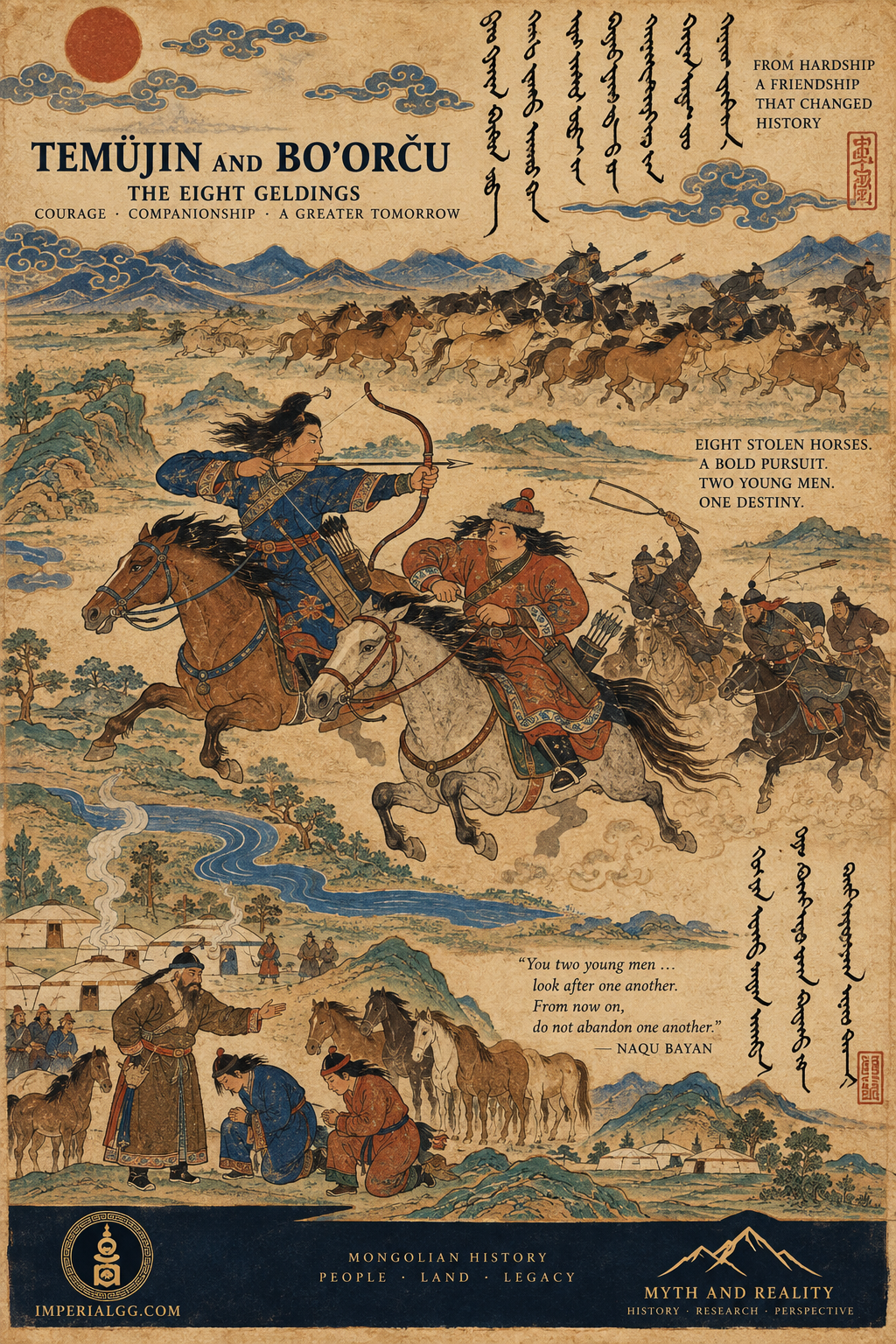
TEMÜJIN AND BO’ORČU: COURAGE, RECIPROCAL LOYALTY, AND THE ETHIC OF COMPANIONSHIP
By Altanbagana Baatar
DBA Candidate| Independent Historian
ImperialGG Historical Research Seriers
09 August 2026
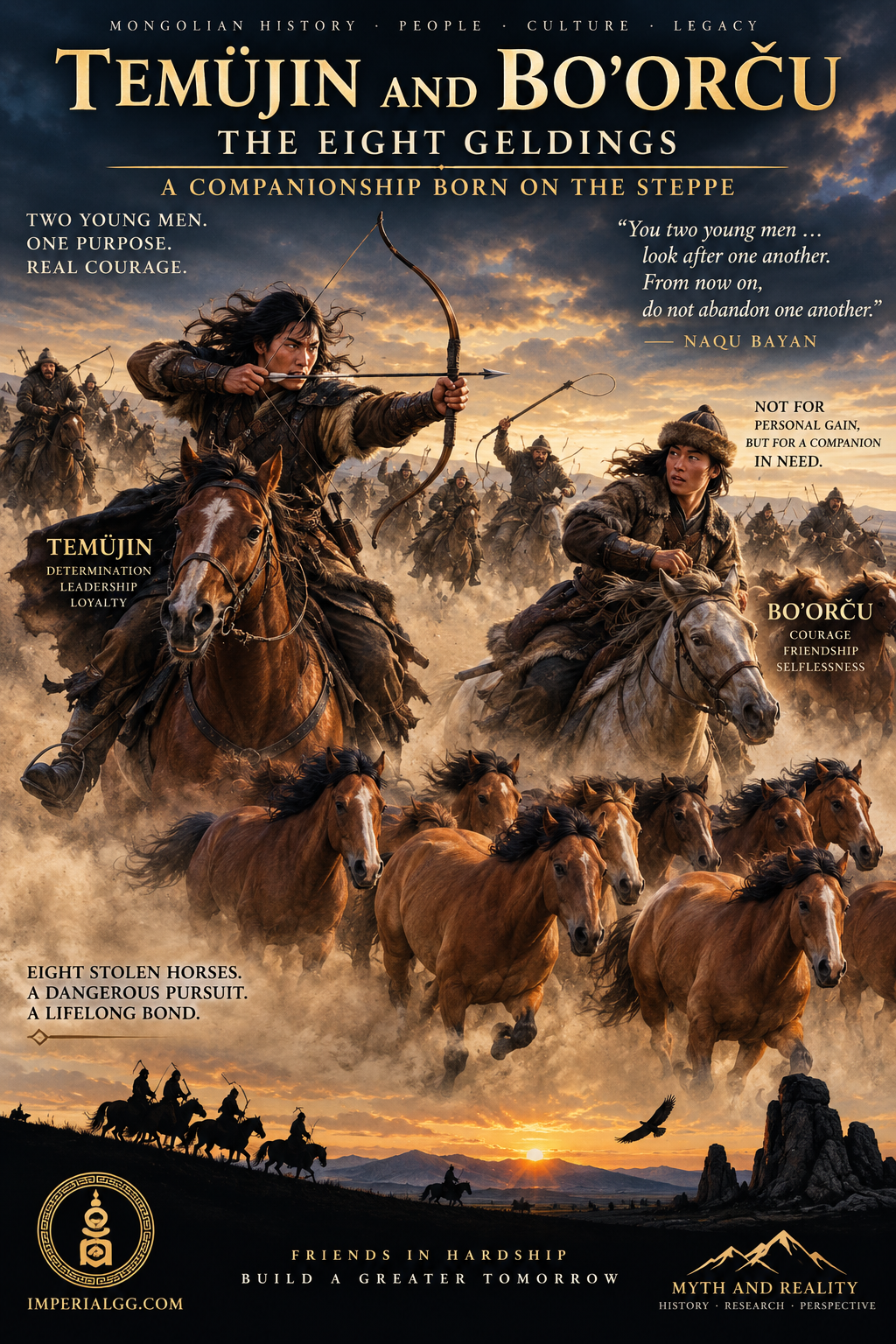
THE EIGHT GELDINGS, SHARED DANGER, AND NAQU BAYAN’S CHARGE NEVER TO ABANDON ONE ANOTHER
AUTHOR’S THESIS
The first recorded meeting between Temüjin and Bo’orču provides more than a biographical anecdote about the recovery of stolen horses. Read closely, the episode offers an important insight into the social and moral world of young Mongol pastoralists before Temüjin’s rise to power. The Secret History of the Mongols presents two young men who, although initially strangers, become companions through a willingness to accept danger for one another and to pursue a common objective without calculating immediate personal gain. Bo’orču abandons his work, leaves his father’s herd without supervision, joins Temüjin in the pursuit of the stolen geldings, enters the thieves’ encampment with him, and refuses to remain behind when Temüjin attempts to protect him from danger. When the pursuers overtake them, Bo’orču is prepared to fight, while Temüjin in turn refuses to allow his new companion to risk his life on his behalf and turns back to face the pursuer himself. Their relationship is therefore constructed through reciprocal courage rather than one-sided loyalty. The episode further demonstrates that companionship involved more than emotional attachment: it required the willingness to share hardship, danger, responsibility, and ultimately the possibility of death. Bo’orču’s refusal to accept any of the recovered horses reinforces this ethical dimension, since he explicitly rejects the transformation of assistance into personal profit. Finally, Naqu Bayan’s instruction that the two young men should look after one another and “never abandon one another” provides an explicit social formulation of the bond that had emerged through their actions. The episode consequently preserves an unusually valuable representation of how courage, mutual protection, common purpose, and personal honor could constitute the foundation of companionship among young men in the Mongolian steppe society of the twelfth century.[1]
THE WORLD OF THE YOUNG NOMADIC HOUSEHOLD
The episode must first be situated within the material conditions of Temüjin’s early life. The family was living in the region around the Senggür Stream, south of Burqan Qaldun, where they survived partly through hunting marmots and other small animals.[2] Their eight light-bay geldings were therefore not merely abstract possessions. Horses were central to mobility, pastoral production, hunting, communication, and warfare in the steppe environment. The loss of eight horses represented a substantial material setback.
The Secret History describes the theft directly: while the horses were standing near the family’s camp, robbers seized them and escaped. Temüjin, Qasar, and Belgütei were initially on foot and could not immediately pursue them. Temüjin nevertheless decided to follow the tracks.[3]
This decision itself is significant. The narrative places the young Temüjin in a situation in which the recovery of the horses required physical endurance and personal initiative. He did not possess the institutional authority of a ruler, nor did he command an organized military force. His response was consequently based upon his own capacity to act.
He pursued the tracks for three days before encountering Bo’orču.
BO’ORČU’S FIRST DECISION: TO SHARE ANOTHER MAN’S DANGER
Bo’orču was engaged in an entirely different activity when Temüjin encountered him. He was milking mares and was the only son of Naqu Bayan. The Secret History emphasizes that Bo’orču immediately recognized Temüjin as a person in difficulty and chose to become his companion.[4]
The significance of this decision is easy to underestimate. Bo’orču had no established obligation to Temüjin. He was not yet his subordinate, political ally, military officer, or relative. Nevertheless, he abandoned his immediate activity, concealed his leather milking bucket and pail, changed horses with Temüjin, and joined the pursuit.[5]
The language used by the source is particularly important. Bo’orču describes the principle underlying his decision in terms of shared human hardship: the distress of one person is not fundamentally different from that of another. He therefore chooses companionship because Temüjin is in difficulty.[6]
This provides a valuable glimpse into the ethical vocabulary of companionship. Friendship here is not initially based upon mutual advantage. It begins with recognizing another person’s hardship as a sufficient reason to act. Bo’orču does not first ask what Temüjin can give him. He asks what he can do.
COURAGE AS ACTION, NOT WORDS
The two young men then spend three days pursuing the stolen horses. On the fourth day they reach a large encampment where the eight geldings are grazing.
Temüjin tells Bo’orču to remain behind while he retrieves the horses himself. Bo’orču refuses. His response is remarkably direct: he has come as Temüjin’s companion, and therefore cannot simply remain behind while his companion enters danger alone.[7]
This is one of the clearest examples in the Secret History of courage being defined through action rather than rhetoric. Bo’orču has already made a commitment by joining the pursuit. Once the danger becomes immediate, he refuses to withdraw from the consequences of that commitment. The two therefore enter the encampment together and drive away the horses.[8]
Their common objective is simple: recover what has been stolen. But the manner in which they pursue it establishes the moral structure of their relationship. Neither man is attempting to achieve the objective at the expense of the other. They act together.
WHEN THE COMMON PURPOSE BECOMES A MATTER OF LIFE AND DEATH
The recovery of the horses immediately creates a second danger. The people from the encampment pursue them. One pursuer on a white horse approaches closely, carrying a pole with a noose.[9]
At this point Bo’orču proposes to take the bow and exchange arrows with the pursuer. The significance is clear: he is prepared to place himself directly between Temüjin and danger. But Temüjin refuses.
The Secret History records Temüjin saying that he fears Bo’orču may be harmed because of him. He therefore turns back and himself exchanges arrows with the pursuer.[10]
This moment is fundamental to understanding the nature of their companionship.
Bo’orču has demonstrated:
“I will risk my life for you.”
Temüjin responds, in action:
“I will not allow you to die because of me.”
The relationship is consequently reciprocal from its earliest stage. This is not simply a story about a young Temüjin acquiring a loyal follower. It is a story about two young men establishing a relationship in which each recognizes an obligation toward the life of the other.
THE COURAGE OF SHARING A COMMON DESTINY
The two men continue their flight, eventually escaping the pursuers as darkness falls. They then ride through the night and continue for three days and three nights before returning.[11]
The narrative’s emphasis upon duration is important. Their companionship is tested not by one brief act of bravery but by prolonged hardship. They ride together. They flee together. They endure exhaustion together. And they return together.
This pattern suggests that courage in the steppe environment was not simply the capacity to fight. It was also the capacity to remain with another person when the consequences of remaining were dangerous. The objective was not individual glory. It was to complete the task they had undertaken together.
BO’ORČU REFUSES THE REWARD
After recovering the horses, Temüjin proposes that they divide them. From an ordinary perspective this would be reasonable. Bo’orču had taken part in the recovery and had personally exposed himself to danger. Yet he refuses.
His reasoning is exceptionally revealing. He had come because Temüjin, a good companion, was in difficulty. He had intended to help him as a companion. How, therefore, could he now regard the horses as spoil? Moreover, Bo’orču explains that he is Naqu Bayan’s only son and that what his father has already accumulated is sufficient for him.[12]
The refusal establishes an important distinction between companionship and economic calculation. Bo’orču does not deny that the horses have material value. He denies that this value should determine the meaning of his action. If he had joined Temüjin only to acquire wealth, then his assistance would have been a transaction. By refusing the horses, he preserves the original meaning of his action: he helped a companion because the companion was in distress. This is one of the strongest moral elements in the entire episode.
NAQU BAYAN’S RESPONSE
The return to Naqu Bayan’s camp adds another dimension to the story. Naqu Bayan had believed that his only son had been lost. When Bo’orču finally returned, his father expressed both grief and anger before learning what had happened.[13]
Bo’orču explained that a good companion had come to him in distress, that he had gone with him as a companion, and that he had now returned. The father then provided food and provisions for Temüjin. A lamb was prepared, and a leather container of mare’s milk was supplied for the journey.[14] But Naqu Bayan’s most important contribution was not material.
He told the two young men: “You two young men … look after one another. From now on, do not abandon one another.”[15]
This statement deserves to be treated as more than a sentimental paternal blessing. Naqu Bayan was articulating a social principle. The two young men had already demonstrated their willingness to protect one another. Naqu Bayan now transformed that experience into an explicit obligation: they were to continue caring for one another and were never to abandon the relationship they had established. The statement therefore gives social recognition to a bond that had originated through shared danger.
NAQU BAYAN’S WORDS AND THE ETHICS OF NOMADIC COMPANIONSHIP
The importance of Naqu Bayan’s statement becomes clearer when placed alongside Bo’orču’s actions. Bo’orču had left his work to help Temüjin. He had entered danger with him. He had refused to remain behind. He had been prepared to fight.
Temüjin had reciprocated by refusing to allow Bo’orču to take the danger upon himself. Bo’orču had then refused material reward.
Naqu Bayan’s instruction therefore summarizes what the two young men had already demonstrated through action.
Companionship required care. Companionship required courage. Companionship required mutual protection. Companionship required endurance. And companionship required fidelity beyond the immediate crisis.
The phrase “never abandon one another” is consequently the conceptual center of the episode. It transforms courage from an isolated heroic quality into a relational virtue. A brave man is not merely someone who faces danger. In this episode, the brave companion is someone who refuses to leave another person alone in danger.
FROM YOUTHFUL COMPANIONSHIP TO POLITICAL LOYALTY
The later importance of Bo’orču makes the episode even more significant. In §205, Chinggis Qahan himself recalls the encounter and explicitly attributes Bo’orču’s decision to his “brave heart.” He remembers that Bo’orču left his herd, joined him in pursuit of the stolen horses, helped recover them, and refused a share of the recovered animals.[16] The retrospective recollection demonstrates that the event remained significant in the political memory of their relationship.
Bo’orču’s later position as one of Chinggis Qahan’s principal commanders therefore cannot be understood simply as the result of a later political appointment. The Secret History deliberately establishes the foundation of that relationship much earlier, at a time when Temüjin possessed neither imperial authority nor the political resources that would later attract followers.
Bo’orču became his companion before Temüjin became powerful. That distinction is historically important. It allows the Secret History to present Bo’orču’s loyalty as grounded in personal character and demonstrated conduct rather than in the benefits of serving an already established ruler.
THE SIGNIFICANCE OF YOUNG MONGOL MEN ACTING TOGETHER
The episode also provides a broader insight into the social world represented by the Secret History. The young men are not passive members of their households waiting for elders to determine every action. They ride, hunt, pursue stolen animals, make decisions under pressure, assess danger, and accept responsibility for their choices.
Their world required mobility and practical competence. A young pastoralist had to know how to ride, manage horses, endure long journeys, hunt, respond to threats, and cooperate with others. The episode involving Temüjin and Bo’orču therefore reveals courage not as an abstract ideal but as a practical necessity of steppe life.
Their courage is expressed through competence, endurance, initiative, and solidarity. Most importantly, however, the story does not portray them as two isolated heroes. Their success depends upon their decision to act together. The stolen horses are recovered not because one young man is individually invincible, but because two young men combine their abilities and refuse to abandon one another when the situation becomes dangerous.
CONCLUSION
The meeting of Temüjin and Bo’orču is one of the earliest surviving narratives in the Secret History of the Mongols concerning the formation of a personal bond that would later become politically consequential. Yet its original significance lies deeper than the later imperial career of either man.
The story portrays a world in which young men were expected to possess courage, initiative, endurance, and the capacity to act decisively under danger. More importantly, it presents these qualities within a framework of mutual obligation. Bo’orču does not leave Temüjin when the danger becomes greater; Temüjin does not permit Bo’orču to risk his life unnecessarily; Bo’orču refuses to turn his assistance into personal profit; and Naqu Bayan converts their demonstrated loyalty into a lasting moral command.
The episode therefore offers an important historical formulation of companionship in the Mongolian steppe world: a true companion was not simply the person who stood beside another in prosperity, but the person who entered danger with him, shared his hardship, protected his life, and remained faithful after the immediate danger had passed.
Naqu Bayan’s words provide the concise ethical conclusion of the entire episode: “Look after one another. From now on, do not abandon one another.” In this sense, the eight stolen horses were only the immediate cause of the encounter. The deeper historical event was the creation of a relationship founded upon shared courage, reciprocal protection, common purpose, and fidelity—a relationship that the later Mongol imperial tradition would remember as one of the earliest foundations of Temüjin’s personal circle.
FOOTNOTES
1. The Secret History of the Mongols, §§90–93. For the episode in translation, see Igor de Rachewiltz, trans., The Secret History of the Mongols: A Mongolian Epic Chronicle of the Thirteenth Century, §§90–93. The text explicitly presents Bo’orču’s decision to become Temüjin’s companion, their joint recovery of the horses, the pursuit, Bo’orču’s refusal of the recovered horses, and Naqu Bayan’s final instruction.
2. Secret History, §89. The family is described as camping at Kökö Na’ur near the Senggür Stream in the Gürelgü Mountains south of Burqan Qaldun and surviving partly by hunting marmots and field mice.
3. Secret History, §90. The eight light-bay geldings were stolen while standing beside the family’s camp. Temüjin and his brothers were initially on foot and were unable to catch the thieves immediately.
4. Secret History, §90. Bo’orču identifies himself as the only son of Naqu Bayan and responds to Temüjin’s distress by becoming his companion.
5. Secret History, §90. Bo’orču hides his leather bucket and pail, changes horses with Temüjin, leaves his herd unattended, and joins the pursuit. Chinggis later recalls these same details in §205.
6. Secret History, §90. Cleaves translates Bo’orču’s statement in terms of the shared nature of human distress; other translations render the idea as “all men suffer in common.”
7. Secret History, §90. When Temüjin tells Bo’orču to remain behind while he retrieves the horses, Bo’orču responds that he came as a companion and cannot simply stand aside.
8. Secret History, §90. The two enter the encampment together and drive out the eight geldings.
9. Secret History, §91. The camp’s inhabitants pursue them, including a man on a white horse carrying a pole with a noose.
10. Secret History, §91. Bo’orču is prepared to exchange arrows with the pursuer, but Temüjin refuses because he fears Bo’orču might be harmed for his sake and instead turns back himself.
11. Secret History, §§91–92. The pursuers are eventually separated from the fugitives by darkness, after which Temüjin and Bo’orču ride through the night and continue for three days and three nights.
12. Secret History, §92. Bo’orču rejects Temüjin’s proposal to divide the recovered horses, explaining that his father’s possessions are sufficient and that he did not come to profit from assisting a companion.
13. Secret History, §93. Naqu Bayan had been grieving over the apparent loss of his only son and reacted with both grief and anger when Bo’orču returned.
14. Secret History, §93. Bo’orču retrieves the equipment he had concealed, while Naqu Bayan’s household provides Temüjin with a lamb and mare’s milk for his journey.
15. Secret History, §93. Naqu Bayan’s instruction is translated by de Rachewiltz as an injunction to the two young men to “look after one another” and “never abandon one another.”
16. Secret History, §205. In his later address to Bo’orču, Chinggis Qahan recalls the eight stolen horses and explicitly attributes Bo’orču’s decision to join him to his “brave heart.” This retrospective testimony is especially important because it demonstrates that the event remained part of Chinggis’s own remembered history of their relationship.
17. On the distinction between the early personal bond and Bo’orču’s later institutional position in the Mongol polity, the Secret History subsequently places Bo’orču among Chinggis Qahan’s principal commanders and repeatedly returns to his loyalty. The retrospective structure of the text thus deliberately connects the youthful episode to Bo’orču’s later political significance.