THE CHILDREN OF YISÜGEI BA’ATUR
By Altanbagana Baatar
DBA Candidate| Independent Historian
ImperialGG Historical Research Seriers
08 September 2026
FAMILY, KINSHIP, SURVIVAL, AND SOCIAL POSITION IN THE PRE-CHINGGISID MONGOL WORLD
INTRODUCTION
The early history of the family of Yisügei Ba’atur has generally been reconstructed through the biography of his most famous son, Temüjin, who later became Chinggis Qahan. This emphasis is understandable, but it can obscure the structure and internal dynamics of the household into which Temüjin was born. The Secret History of the Mongols does not present Yisügei’s children as an undifferentiated group. It distinguishes between the children of Hö’elün and those of Yisügei’s second wife, Sučigil, and its account of the years immediately following Yisügei’s death reveals a household in which differences of maternal status, age, and position among the sons became increasingly consequential.¹ The resulting conflict between Temüjin and his half-brother Bekter has consequently been interpreted in different ways: as a dispute over food and hunting resources, as an expression of rivalry between half-brothers, and, in more recent scholarship, as a conflict that may also have involved the future organization of the fatherless household and the distribution of male authority within it.²
The purpose of this article is to examine Yisügei Ba’atur’s children as a family and social unit rather than treating them merely as the background to Temüjin’s childhood. The surviving evidence allows a reasonably clear reconstruction of the children born to Hö’elün: Temüjin, Qasar, Qachi’un, Temüge, and Temülün, while Bekter and Belgütei were born to Sučigil.³ The sources provide considerably more information about Temüjin and, subsequently, Belgütei than about Qachi’un, Temüge, and Temülün, while Bekter appears primarily in connection with the circumstances surrounding his death. This unevenness is itself important because the historical record reflects the later political significance of particular individuals rather than the relative importance of every child within the original household.
The central argument advanced here is that the conflict following Yisügei’s death should neither be reduced to the immediate dispute over food recorded in the Secret History nor transformed into an unsubstantiated claim that Bekter was formally designated as Yisügei’s successor. The available evidence instead indicates that Yisügei’s death removed the adult male authority around which the household had been organized, leaving a group of children whose relative positions were differentiated by age and maternal status. Temüjin was the eldest son of Hö’elün, while Bekter appears to have been older than Temüjin but belonged to the household through Sučigil. In the context of steppe practices concerning marriage, widowhood, household continuity, and succession, Bekter could therefore have represented a potential source of male authority after Yisügei’s death, although no source establishes that he actually intended to assume such a role.⁴
This distinction between what the sources establish and what can reasonably be inferred is essential. The Secret History is the principal narrative source for the episode, but it is a thirteenth-century work combining historical narrative, genealogy, literary composition, and oral traditions, and it must therefore be read critically rather than treated as an unmediated transcript of events. Igor de Rachewiltz emphasizes both its exceptional value as the earliest substantial native Mongolian account and its composite historical-literary character.⁵ The present analysis therefore combines the Secret History with modern scholarship on Mongol family organization, marriage, levirate, and succession, while keeping conjectural interpretations explicitly separate from primary-source evidence.
YISÜGEI’S CHILDREN AND THE STRUCTURE OF THE FAMILY
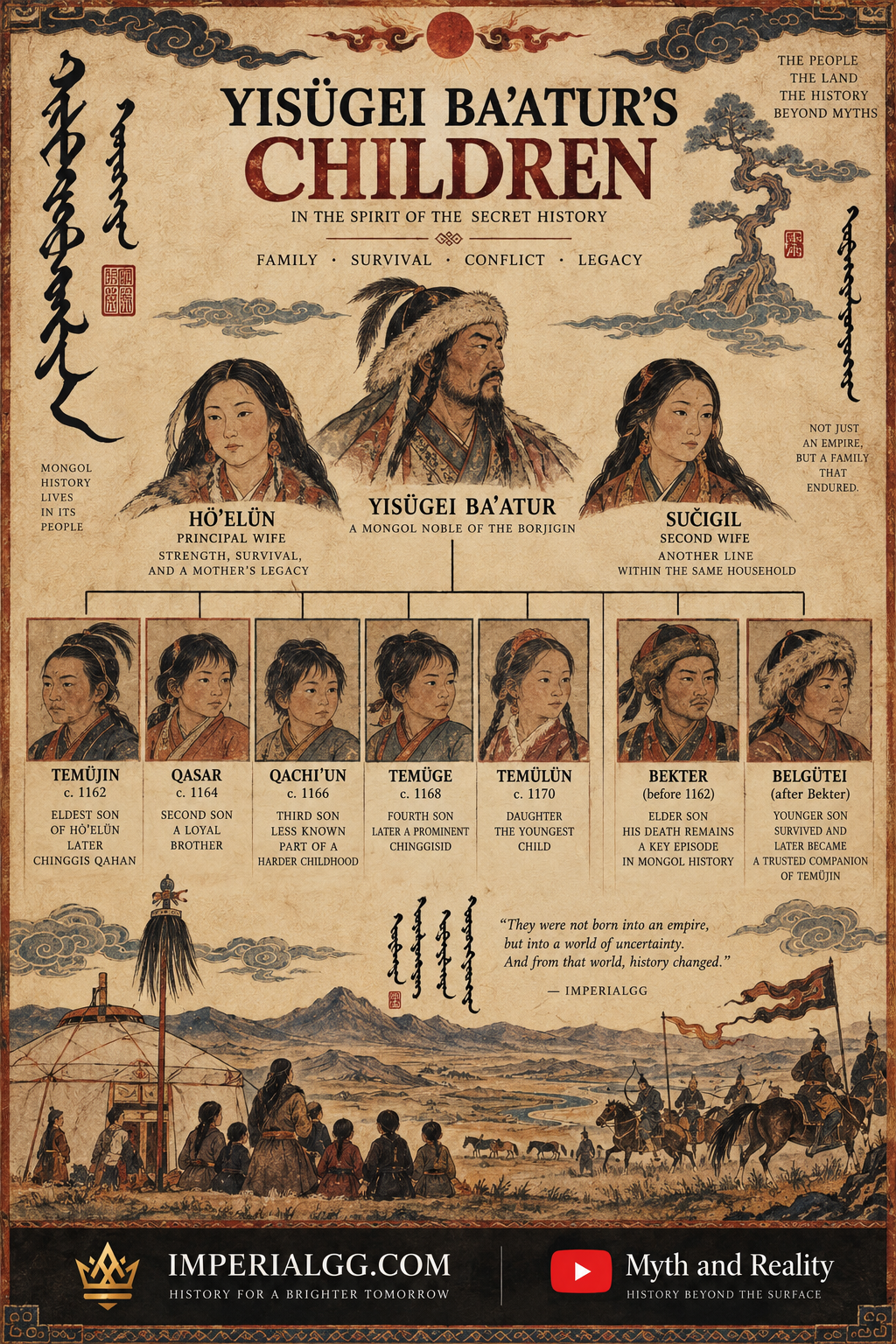
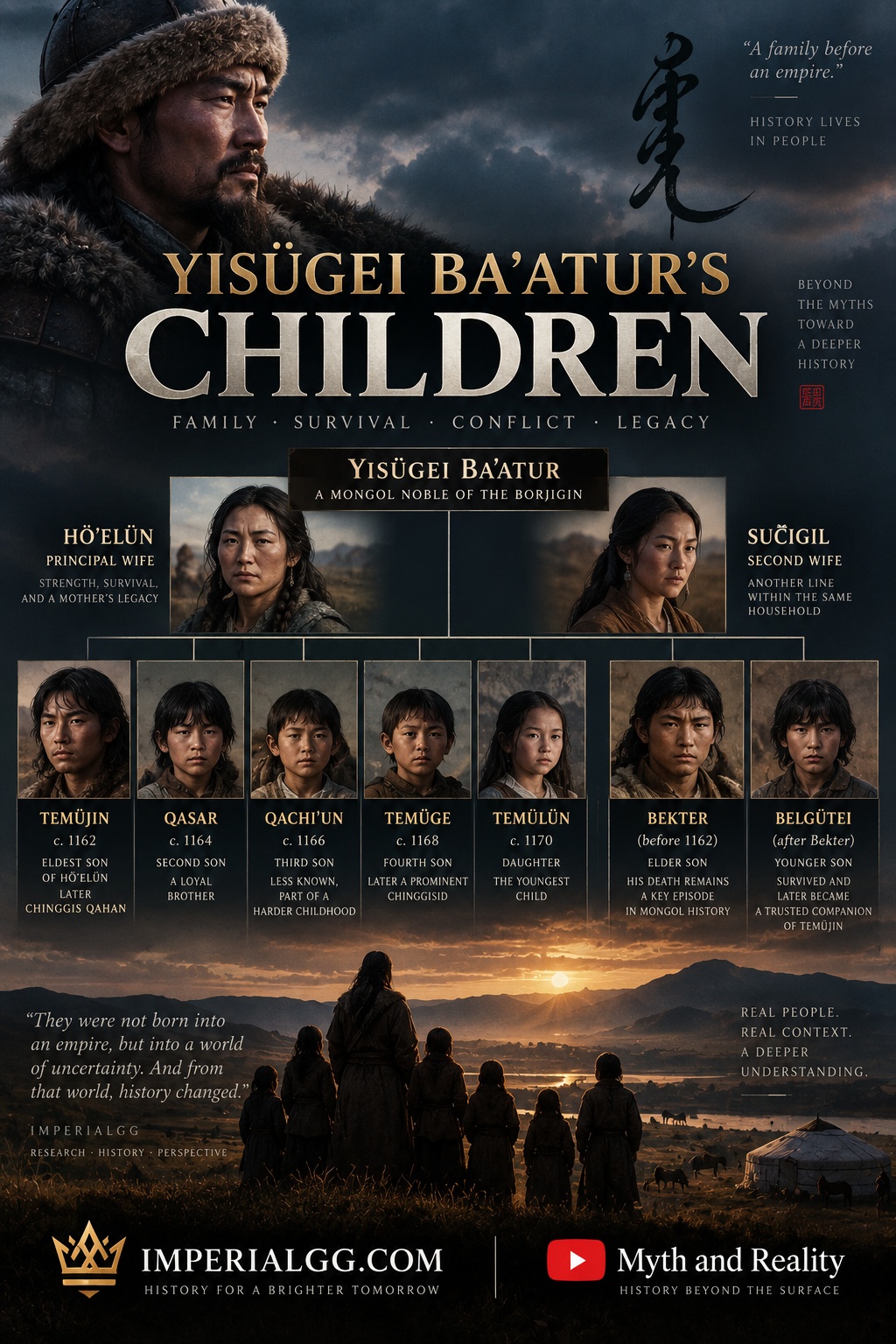
The family structure is stated explicitly in §60 of the Secret History. Yisügei Ba’atur and Hö’elün had four sons—Temüjin, Qasar, Qachi’un, and Temüge—and a daughter, Temülün. The same passage adds that Yisügei’s second wife, Sučigil, bore Bekter and Belgütei. When Temüjin was nine, Qasar was seven, Qachi’un five, Temüge three, and Temülün was still in the cradle.⁶ The passage therefore establishes the relative sequence of the children of Hö’elün, but it does not provide exact calendar years for their births. Modern chronological reconstructions commonly place Temüjin around 1162 and the younger children at approximately two-year intervals, but these dates remain reconstructions from relative ages rather than dates supplied directly by the primary source. Bekter and Belgütei are even less securely dated because the Secret History does not provide their ages in the same manner.⁷
The resulting family should therefore be represented as follows:
By Hö’elün: Temüjin (c.1162) → Qasar (c.1164) → Qachi’un (c.1166) → Temüge (c.1168) → Temülün (c.1170, approximate)
By Sučigil: Bekter (born before Temüjin; exact year uncertain) → Belgütei (younger than Bekter; exact year uncertain)
This distinction is more than genealogical. The children belonged to a polygynous household in which the status of the mother could affect the position of her children. Modern scholarship on Mongol society has emphasized that wives did not occupy identical positions within the household and that seniority among wives, their natal connections, and the status of their sons could have consequences for marriage, inheritance, and political succession.⁸ The Secret History itself does not provide a formal legal code establishing a universal hierarchy by which every son’s position could be determined, and later Mongol history demonstrates that succession could depend upon multiple competing principles rather than a simple rule of biological primogeniture.⁹ Consequently, neither Bekter’s apparent age advantage nor Temüjin’s position as Hö’elün’s eldest son should be treated as an automatic legal entitlement to succession.
This is particularly important because Temüjin is sometimes described imprecisely as Yisügei’s eldest or firstborn son. The primary source does not support that formulation without qualification. Temüjin was the first son of Hö’elün, but Bekter, the son of Sučigil, appears to have been older. Timothy May has consequently treated the relative age of Bekter as significant when examining the conflict that later developed between the half-brothers.¹⁰ The distinction between “eldest son of the principal wife” and “eldest son of the father” is therefore indispensable to any reconstruction of the family.
TEMÜJIN’S BIRTH AND YISÜGEI’S FAMILY BEFORE HIS DEATH
The Secret History introduces Temüjin’s birth in the context of Yisügei’s conflict with the Tatars. Yisügei had captured the Tatar leaders Temüjin Üge and Qori Buqa, and Hö’elün was pregnant when Temüjin was born at Deli’un Boldaq beside the Onon. The child was named Temüjin because he was born at the time when the Tatar Temüjin Üge had been brought captive.¹¹ Whatever literary elements are present in the account of his birth, the narrative establishes that Temüjin entered the world as one son within a politically active warrior household rather than as the predetermined founder of an empire.
The significance of the family becomes clearer when the narrative moves forward to Temüjin’s ninth year. Yisügei took him toward the Olqunu’ut, whom the source describes as the maternal relatives of Hö’elün, with the intention of obtaining a wife for his son. On the journey he encountered Dei Sečen of the Onggirat, and this meeting eventually resulted in Temüjin’s betrothal to Börte.¹² The episode is important for the present study because Yisügei’s choice of destination explicitly invoked Hö’elün’s maternal kin. Anne F. Broadbridge has argued that this choice may have provided an opportunity to reconnect Hö’elün with her natal relatives after the circumstances of her marriage to Yisügei, although the eventual bride, Börte, came from the Qonggirat rather than the Olqunu’ut.¹³
There is no evidence, however, that Yisügei took Temüjin to arrange the marriage because he feared Bekter or intended to establish Temüjin as the future head of the household in preference to his older half-brother. Such a claim goes beyond the evidence. What the source does establish is that Yisügei was actively arranging Temüjin’s future marriage and kinship relationships while his other children remained within the household. The episode consequently belongs to the broader organization of the family and should not be interpreted solely as the beginning of the Temüjin–Börte relationship.
YISÜGEI’S DEATH AND THE TRANSFORMATION OF THE HOUSEHOLD
The decisive transformation came with Yisügei’s death. On his return from leaving Temüjin with Dei Sečen, Yisügei encountered Tatars at Šira Ke’er. The Secret History states that they secretly poisoned him, after which he traveled for three days before reaching his camp in a weakened condition. He summoned Mönglik and instructed him to care for his young sons and his widowed sister-in-law and to bring Temüjin back. He then died.¹⁴
The importance of this episode lies in the fact that Yisügei’s death did not simply remove a father from a family; it removed the adult male around whom the household’s political and economic relations had been organized. The children who remained were not an equal group. Temüjin was nine, Qasar seven, Qachi’un five, Temüge three, and Temülün still an infant at the point when the ages in §60 are given. Bekter and Belgütei were older than at least some of these children, but their exact ages remain uncertain. The household therefore contained several levels of dependency and several possible sources of authority, but no surviving adult male equivalent to Yisügei.
The subsequent abandonment of the family by the Tayichi’ut made this structural problem considerably more severe. The Secret History depicts Hö’elün assuming responsibility for maintaining the children through hunting and gathering after the family was deprived of the support it had previously received. The narrative thereby places Hö’elün at the center of the household’s material survival, while the boys gradually became old enough to participate in obtaining food and defending the family.¹⁵
The importance of Hö’elün should consequently not be reduced to her later identity as the mother of Chinggis Qahan. At this stage she was the senior surviving adult within a household whose male head had disappeared, and the relations among her children and her stepchildren had to be renegotiated in circumstances of material scarcity.
BEKTER AND THE QUESTION OF MALE AUTHORITY
The position of Bekter becomes significant precisely within this transformed household. The Secret History identifies him as the son of Sučigil and the half-brother of Temüjin, but it does not designate him as Yisügei’s successor, nor does it state that he claimed such a position.¹⁶ Any interpretation that presents Bekter as an officially appointed successor must therefore be rejected unless supported by evidence outside the Secret History.
Nevertheless, the question of whether Bekter could have become an important male authority within the household is historically legitimate. His position combined several characteristics that distinguished him from Temüjin: he was older, he was Yisügei’s son, and he belonged to a separate maternal branch of the family. Temüjin, by contrast, was the eldest son of Hö’elün. These overlapping forms of seniority could create competition without requiring either boy to possess a formally defined office.
The question becomes more significant when considered alongside steppe practices of widowhood and levirate marriage. Broadbridge notes that among the Mongols a widow commonly entered a subsequent marriage with a junior male relative of her deceased husband, including a younger brother, nephew, or son of another wife. Such arrangements could provide protection for the widow while keeping children and property within the deceased husband’s family.¹⁷ This evidence does not demonstrate that Hö’elün was expected to marry Bekter, nor does it establish that such a marriage was being contemplated in this particular household. It does, however, demonstrate that the possibility of a deceased man’s widow remaining within his household through marriage to another male member of the family was part of the wider social repertoire of the steppe.
Timothy May has applied this broader social context directly to the Bekter episode. He argues that the possibility of Bekter marrying Hö’elün cannot be entirely excluded and that such a relationship could have allowed Bekter to assume a patriarchal position within the household.¹⁸ This interpretation is important but should remain explicitly hypothetical. The Secret History does not say that Bekter intended to marry Hö’elün, that Hö’elün desired such an arrangement, or that Temüjin killed Bekter specifically to prevent it.
What the evidence permits us to say is more restrained. Bekter occupied a position in which he could potentially have become an important male authority after Yisügei’s death, while Temüjin occupied a different position as the eldest son of the senior wife. The two forms of status did not necessarily produce conflict, but under conditions of deprivation and the absence of Yisügei they could become politically meaningful.
THE CONFLICT OVER FOOD AND THE KILLING OF BEKTER
The Secret History records the immediate cause of the conflict in concrete terms. Temüjin, Qasar, Bekter, and Belgütei were fishing together when a fish was caught. Bekter and Belgütei took it from Temüjin and Qasar. When Temüjin and Qasar complained to Hö’elün, she rebuked them for quarreling with their brothers at precisely the moment when the family had no allies other than itself.¹⁹ The source then records a second dispute involving a lark, after which Temüjin and Qasar attacked Bekter and killed him.²⁰
The importance of the passage lies partly in what it does not say. It does not explicitly mention succession, inheritance, widow remarriage, or a struggle for the position of household head. The source itself therefore does not authorize a reduction of the episode to a succession conflict.
At the same time, the immediate dispute over food need not be regarded as the complete historical explanation. Material scarcity was not incidental to the family’s condition. The household had been abandoned by the Tayichi’ut, and its members depended upon hunting, fishing, gathering, and other means of obtaining food. Control over food obtained by the young men consequently had direct implications for the welfare of the household. Bekter’s taking of food could be interpreted as an assertion of seniority or simply as individual behavior, but the source does not specify which interpretation is correct.
Hö’elün’s response is particularly revealing because she does not treat the incident as an ordinary quarrel between children. Her rebuke invokes the family’s vulnerability and emphasizes the necessity of solidarity among the brothers.²¹ The episode therefore occurred within a household in which internal cooperation was materially necessary, while differences in age and maternal status could nevertheless generate competition.
May’s interpretation takes this structural dimension further by arguing that the killing of Bekter prevented him from potentially occupying the patriarchal position of the family.²² That interpretation is plausible within the broader context of steppe levirate and household organization, but it should be presented as an inference rather than as a statement of fact. The safest historical conclusion is that the killing removed an older male member of the family at a moment when Yisügei’s authority had already disappeared and before Temüjin had reached political maturity.
TEMÜJIN AND QASAR
The role of Qasar in the killing is significant because the event was not undertaken by Temüjin alone. The Secret History presents Temüjin and Qasar as acting together against Bekter.²³ This indicates that the conflict involved more than an individual confrontation between an older and younger brother; it involved a division among the sons of Yisügei.
Qasar was the second son of Hö’elün and was two years younger than Temüjin according to the relative ages given in §60.²⁴ His participation demonstrates that the maternal branch of Hö’elün was not internally uniform in its relationship with Bekter and Belgütei. Belgütei, Bekter’s full brother, belonged to Sučigil’s branch and was on the opposite side of the immediate dispute, although he survived the subsequent killing.
The event therefore produced an asymmetrical division within the family: Temüjin and Qasar acted against Bekter, while Belgütei survived as the remaining male representative of Sučigil’s sons. The significance of this division would become clearer only later, when Belgütei remained within Temüjin’s political community rather than becoming a permanent opponent.
BELGÜTEI AND THE SURVIVAL OF SUČIGIL’S LINE
Belgütei’s later career is essential to understanding the consequences of Bekter’s death. If the killing had been part of an irreconcilable conflict between the two maternal branches, one might expect Belgütei to have become a permanent enemy of Temüjin. The surviving narrative does not show this. Instead, Belgütei became one of Temüjin’s important companions and remained associated with him throughout the later formation of the Mongol polity.²⁵
This development suggests that the conflict should not be understood as a permanent division between the descendants of Hö’elün and Sučigil. The killing of Bekter removed one individual who had occupied a potentially significant position, but Belgütei subsequently became incorporated into the political community formed around Temüjin.
The distinction between the two brothers is therefore historically significant. Bekter became the victim of an internal conflict at a moment of household instability, whereas Belgütei survived and eventually transformed his relationship to Temüjin from that of a half-brother within a divided household into that of a political subordinate and trusted associate. The later prominence of Belgütei also demonstrates that Temüjin’s rise did not require the complete elimination of his paternal half-brothers.
The Secret History later places Belgütei in connection with Bo’orču, one of Temüjin’s most important early companions, illustrating his integration into the emerging political network.²⁶
QACHI’UN, TEMÜGE, AND TEMÜLÜN
The historical record concerning Qachi’un, Temüge, and Temülün during the immediate aftermath of Yisügei’s death is considerably less detailed. This should not be mistaken for evidence that they were unimportant to the household. Their relative ages establish that they were still children when the family lost its father. Qachi’un was five and Temüge three when Temüjin was nine, while Temülün was still in the cradle.²⁷ Their dependence upon Hö’elün and the older children was therefore substantially greater than that of Temüjin, Qasar, or Bekter.
Temüge subsequently acquired significance in the later history of the Chinggisid family, but the evidence concerning his childhood does not justify reconstructing a political role for him that the sources do not record. The same caution is necessary with Temülün. She was the only daughter explicitly identified among Hö’elün’s children and was substantially younger than her brothers. Her limited appearance in the early narrative reflects the source’s concentration on later political actors rather than evidence concerning her actual importance within the household.
The family should therefore not be reconstructed according to the later fame of its members. At the moment of Yisügei’s death, these children formed a single dependent household, and the later political prominence of some of them should not be projected backward as though it had already been established.
MATERNAL STATUS AND THE PROBLEM OF SUCCESSION
The conflict between Bekter and Temüjin becomes more intelligible when age and maternal status are considered together. Bekter’s apparent seniority gave him one form of advantage, while Temüjin’s position as Hö’elün’s eldest son gave him another. The Mongol social system did not operate according to a single universally applicable rule of primogeniture, and later examples demonstrate that succession could be negotiated among sons, brothers, uncles, nephews, and other members of the ruling lineage.²⁸
This flexibility should not be interpreted as the absence of rules. Rather, several principles could operate simultaneously. Seniority mattered, but maternal status mattered as well; paternal designation could matter, but political support was also decisive. In later imperial history, succession disputes repeatedly demonstrate that biological relationship alone did not settle political authority.²⁹ The early family of Yisügei should therefore be examined within the same conceptual framework, while recognizing that the household was far smaller and politically weaker than the later imperial court.
The strongest formulation is consequently not that Bekter “was the heir” or that Temüjin “was the heir,” because neither proposition is directly established. Instead, the evidence indicates that the family contained competing bases of seniority and status that became more consequential after the death of Yisügei. The absence of an adult male authority increased the importance of those distinctions, while material deprivation made conflicts over food and household resources more serious.
THE LIMITS OF THE LEVIRATE HYPOTHESIS
The possibility that Bekter might have married Hö’elün deserves particular attention because it has the potential to explain why his position could have been threatening to Temüjin, but it is also the part of the argument most vulnerable to overinterpretation. Broadbridge establishes that levirate marriage was a widespread practice in Mongol society and that a widow could marry a male relative of her deceased husband, including a son by another wife.³⁰ May applies this evidence to Bekter and argues that the possibility of such a marriage could have enabled him to assume the patriarchal position of the household.³¹
The historical problem is that the Secret History does not connect Bekter’s murder explicitly to such a possibility. Nor does it state that Hö’elün was considering remarriage to Bekter. The source instead presents the conflict through disputes over food and the conduct of the brothers. Hö’elün’s reaction is one of anger at the destruction of family solidarity rather than an explicit statement about widow remarriage.
The levirate hypothesis should therefore be formulated as a structural possibility rather than a demonstrated motive. It helps explain why an older male son of another wife might possess a potential route to household authority, but it cannot establish that such a route was actually being pursued. The hypothesis becomes useful only when it is kept subordinate to the primary evidence.
This distinction also prevents a common analytical error: treating the existence of a social custom as proof that the custom was necessarily applied in a particular case. The existence of levirate does not prove that Bekter intended to marry Hö’elün any more than the existence of primogeniture in some societies proves that every eldest son inherited. Historical customs establish the range of possibilities within which individuals operated; they do not automatically establish individual intentions.
SOURCE CRITICISM AND THE HISTORICAL STATUS OF THE EPISODE
The Secret History of the Mongols is indispensable for reconstructing the family of Yisügei, but its character requires methodological caution. De Rachewiltz describes it as the earliest substantial literary monument of the Mongol-speaking peoples and emphasizes its combination of historical and literary elements.³² The narrative is chronological in broad structure, but its composition incorporates oral traditions, poetic passages, genealogical material, and literary shaping.³³
This is particularly relevant to the early life of Temüjin because the narrative is retrospective. The events surrounding Yisügei’s death and Bekter’s killing occurred decades before the political order associated with Chinggis Qahan was fully established, while the surviving Secret History was composed in a later political environment. The narrative therefore preserves early family traditions but presents them within a larger account of Temüjin’s rise.
The absence of Bekter from the later official histories also matters. The episode is especially prominent in the Secret History because it reveals a morally problematic act committed by the future Chinggis Qahan during his childhood.³⁴ This feature makes the source unusually valuable for reconstructing family tensions, but it also requires attention to the literary function of the episode. The narrative does not merely list events; it preserves episodes that illuminate Temüjin’s development and the values that the text wishes to emphasize.
For this reason, the strongest historical reconstruction does not ask simply, “What exactly happened?” but rather, “What does the earliest surviving Mongolian narrative tell us happened, what social structures make that account plausible, and which elements remain uncertain?”
THE FAMILY AS A UNIT OF SURVIVAL
The history of Yisügei’s children after his death demonstrates that the household was not simply a genealogical unit but a productive and political unit. Its members had to obtain food, maintain their camp, preserve social relationships, and protect one another at a time when the family’s former political support had disappeared.
Hö’elün’s role was therefore central. Her authority was not merely maternal in the modern domestic sense; she became responsible for maintaining a household whose economic survival depended on her labor and that of her children.³⁵ The sons gradually became participants in this economic system, and the distribution of food acquired significance precisely because food was scarce.
Under such circumstances, the behavior of Bekter could have had consequences beyond an isolated disagreement. If an older son exercised preferential access to food, this could be perceived by younger members as an assertion of status. Conversely, the actions of Temüjin and Qasar could be understood as resistance to that assertion. The Secret History does not provide an explicit sociological interpretation of the dispute, but the material conditions of the family make it possible to understand why disputes over hunting and fishing resources became serious.
The family’s vulnerability also explains Hö’elün’s reaction. Her concern was not simply that her children were fighting; it was that they were weakening the very group upon which their survival depended. Her admonition in §76 explicitly invokes the family’s lack of external allies and its need to remain united.³⁶
FROM YISÜGEI’S HOUSEHOLD TO TEMÜJIN’S POLITICAL COMMUNITY
The longer historical significance of the family lies in the transformation that followed. Yisügei’s household did not remain a static group of siblings. It gradually became part of the political community through which Temüjin accumulated followers and ultimately established a new political order.
Belgütei’s survival is especially important in this transition. He did not become an independent rival polity based upon Sučigil’s line. Instead, he became integrated into Temüjin’s political hierarchy. Qasar likewise remained one of Temüjin’s principal brothers. Temüge later became an important member of the Chinggisid ruling house. The family therefore survived the internal crisis, although in a restructured form.
The killing of Bekter can consequently be interpreted as one stage in the transformation from a paternal household into a political community organized increasingly around Temüjin. This does not mean that Temüjin consciously planned such a transformation as a child. It means that the death of Yisügei and the elimination of Bekter altered the distribution of male authority within the family, leaving Temüjin as the senior surviving male of Hö’elün’s branch and eventually allowing his authority to expand beyond the household.
This is where the early family history becomes relevant to the later formation of the Mongol Empire. The political community of Temüjin did not emerge independently of family relations. It developed through them, sometimes by cooperation and sometimes through conflict.
CONCLUSION
The children of Yisügei Ba’atur should be understood as members of a complex pre-imperial household rather than merely as supporting characters in the childhood of Temüjin. Yisügei’s children were divided between two maternal lines: Hö’elün was the mother of Temüjin, Qasar, Qachi’un, Temüge, and Temülün, while Sučigil was the mother of Bekter and Belgütei. The relative ages supplied by the Secret History establish that Temüjin was Hö’elün’s eldest son but do not establish him as Yisügei’s eldest son, since Bekter appears to have been older.³⁷
Yisügei’s death transformed this family structure. The household lost its adult male head while several children were still very young, and the subsequent abandonment by the Tayichi’ut placed the family under severe material pressure. Hö’elün became the central surviving adult, while the older sons increasingly participated in the acquisition and distribution of food. Under these conditions, differences of age and maternal status became more consequential than they had been while Yisügei was alive.
The conflict with Bekter should therefore be understood within this broader structural context. The Secret History directly records disputes over fish and hunting spoils and ultimately the killing of Bekter by Temüjin and Qasar. It does not directly state that Bekter was competing for succession or that Temüjin killed him to prevent him from assuming authority. Such claims exceed the primary evidence. Nevertheless, Bekter’s older position, his status as Yisügei’s son, and the existence of steppe practices permitting levirate marriage make it historically reasonable to consider whether he could have become an important male authority within the fatherless household. The possibility that he might have married Hö’elün and assumed a patriarchal role, discussed explicitly by Timothy May, remains a hypothesis rather than an established fact.³⁸
The more defensible conclusion is that Bekter and Temüjin represented different forms of seniority within a household whose previous organizing authority had disappeared. Bekter’s age and paternal descent gave him one potential source of status, while Temüjin’s position as the eldest son of Hö’elün gave him another. The conflict between them therefore existed within a wider system of family organization in which maternal rank, age, marriage practices, and household authority intersected.
Belgütei’s later career demonstrates that the killing of Bekter did not permanently divide the two maternal branches of Yisügei’s family. Belgütei survived and became an important member of Temüjin’s political community, while Qasar remained a close brother and Temüge eventually became a major member of the Chinggisid lineage. Qachi’un and Temülün appear less frequently in the sources because the surviving narrative is heavily weighted toward later political actors, but their presence is essential for reconstructing the household as it existed before the rise of Temüjin.
The historical significance of Yisügei’s children therefore lies not simply in their genealogical relationship to Chinggis Qahan but in the social transformation of their family after Yisügei’s death. The household passed from a structure organized around a living warrior-father to one in which authority had to be reconstructed among a widowed mother and several sons of different maternal lines. The conflict between Bekter and Temüjin occurred within that transformation. It should neither be romanticized nor reduced to a simple quarrel over food. Its historical importance lies precisely in the intersection between the immediate material circumstances recorded by the Secret History and the broader social structures that made questions of seniority, widowhood, household leadership, and kinship consequential.
The evidence does not permit us to reconstruct every intention of the individuals involved. It does, however, permit a more precise conclusion: before Temüjin became the founder of the Mongol Empire, he was one member of a divided but interdependent household whose internal organization was fundamentally altered by the death of Yisügei Ba’atur. The subsequent fate of Bekter, Belgütei, Qasar, Qachi’un, Temüge, and Temülün belongs to that history in its own right.
FOOTNOTES
1. The Secret History of the Mongols, §§59–60. Igor de Rachewiltz’s translation identifies the work as a thirteenth-century Mongolian historical-literary text and emphasizes its combination of historical narrative and literary composition.
2. Timothy May, Simply Chinggis: The Story of a Warrior Who Changed the World, discussion of Bekter and the early family of Temüjin. May explicitly argues that the episode involved more than ordinary sibling rivalry and connects it with the possible implications of levirate practice.
3. Secret History, §60. The source explicitly distinguishes the five children of Hö’elün from Bekter and Belgütei, whom it attributes to Yisügei’s second wife Sučigil.
4. On Mongol marriage, widowhood, levirate, and the differing status of wives, see Anne F. Broadbridge, Women and the Making of the Mongol Empire (Cambridge: Cambridge University Press, 2018), chap. 1, “Women in Steppe Society,” pp. 9–42. Cambridge identifies this chapter as treating bride price, levirate, and seniority among wives.
5. Igor de Rachewiltz, The Secret History of the Mongols: A Mongolian Epic Chronicle of the Thirteenth Century. The surviving edition describes the Secret History as the earliest major literary monument of the Mongolian-speaking peoples and explicitly discusses its mixture of historical and literary elements.
6. Secret History, §60. The passage gives Temüjin as nine, Qasar seven, Qachi’un five, Temüge three, and Temülün in the cradle, while identifying Bekter and Belgütei as sons of Sučigil.
7. The relative ages of the children are primary-source evidence; the conversion into approximate Gregorian birth years is a modern chronological reconstruction and should not be confused with explicit dates in the Secret History. De Rachewiltz’s discussion places the traditional birth of Temüjin around 1162 while noting the chronological character of the narrative.
8. Broadbridge, Women and the Making of the Mongol Empire, pp. 9–42. Broadbridge discusses polygyny, bride price, seniority among wives, and the implications of levirate for widows, children, and household property.
9. Broadbridge, Women and the Making of the Mongol Empire, chap. 4, “Women and the Guard, the Army, and Succession,” pp. 101–134. The book treats succession as a major institution in which women and household relationships were involved rather than assuming a single mechanical rule of inheritance.
10. May, Simply Chinggis. May treats Bekter as older than Temüjin and discusses the implications of this age difference for the family’s internal hierarchy.
11. Secret History, §59.
12. Secret History, §§61–66. Yisügei explicitly states that he is taking Temüjin toward the Olqunu’ut, the maternal relatives of Hö’elün, to seek a bride for him.
13. Broadbridge, Women and the Making of the Mongol Empire, chap. 2, “Hö’elün and Börte,” pp. 43–72. Broadbridge specifically discusses Yisügei’s intention to approach Hö’elün’s Olqunu’ut relatives and interprets this within wider patterns of maternal kinship and exchange marriage.
14. Secret History, §67–68. The narrative states that the Tatars poisoned Yisügei and that, after three days of travel, he reached his tent, summoned Mönglik, gave instructions concerning his children, and died.
15. Secret History, §§69–75. The post-Yisügei narrative describes the abandonment of the family and Hö’elün’s efforts to maintain the household under materially difficult conditions.
16. Secret History, §60 identifies Bekter and Belgütei as sons of Sučigil but does not call Bekter a qan, successor, or formally designated heir.
17. Broadbridge, Women and the Making of the Mongol Empire, pp. 9–42. Broadbridge states that widows generally entered levirate marriages with a junior male relative of the deceased husband, including a younger brother, nephew, or son of another wife, and explains the protective and economic functions of the institution.
18. May, Simply Chinggis. May specifically connects the Bekter episode with the possibility of levirate marriage and argues that this could have allowed Bekter to assume a patriarchal position within the family. This is May’s interpretation rather than an explicit statement of the Secret History.
19. Secret History, §76. The passage records the fishing dispute and Hö’elün’s rebuke, in which she emphasizes that the family has no allies and should not quarrel among itself.
20. Secret History, §§77–79. The same narrative records the subsequent confrontation and death of Bekter.
21. Secret History, §76. Hö’elün’s response is explicitly framed around the necessity of solidarity among brothers following the family’s abandonment.
22. May, Simply Chinggis. May interprets the killing as having removed the possibility of Bekter becoming the patriarchal head of the family, while acknowledging that Hö’elün’s actual position toward a possible levirate marriage cannot be known.
23. Secret History, §§77–79.
24. Secret History, §60.
25. Secret History, later passages concerning Belgütei’s service under Temüjin.
26. Secret History, §95, where Belgütei is associated with Bo’orču in the developing political community surrounding Temüjin.
27. Secret History, §60.
28. Broadbridge, Women and the Making of the Mongol Empire, chap. 4, pp. 101–134.
29. On the complexity of succession within the Mongol imperial family, see Broadbridge, Women and the Making of the Mongol Empire, especially the discussion of succession in chap. 4.
30. Broadbridge, Women and the Making of the Mongol Empire, pp. 9–42.
31. May, Simply Chinggis.
32. de Rachewiltz, Secret History of the Mongols. The modern scholarly edition explicitly characterizes the work as both historical and literary and discusses its composition and transmission.
33. De Rachewiltz notes that the Secret History is organized as a continuous chronological narrative but contains both historical and literary material; the text’s surviving form is itself the product of transmission and compilation.
34. May notes that the Bekter episode is recorded in the Secret History and not preserved in the same form in the later official historical traditions, making the Secret History especially important for this aspect of Temüjin’s childhood.
35. Broadbridge, Women and the Making of the Mongol Empire, especially chap. 2, “Hö’elün and Börte,” pp. 43–72. The study places Hö’elün within the wider social and economic functions of steppe women and household management.
36. Secret History, §76.
37. Secret History, §60.
38. May, Simply Chinggis. His interpretation should be distinguished from the primary source: the Secret History records the food dispute and killing but does not state that Bekter was killed to prevent a levirate marriage or succession.
BIBLIOGRAPHY
Broadbridge, Anne F. Women and the Making of the Mongol Empire. Cambridge: Cambridge University Press, 2018. DOI: 10.1017/9781108347990.
de Rachewiltz, Igor. The Secret History of the Mongols: A Mongolian Epic Chronicle of the Thirteenth Century. 2 vols. Leiden: Brill, 2004. Supplementary volume, 2013. The scholarly edition contains extensive philological and historical commentary.
May, Timothy. Simply Chinggis: The Story of a Warrior Who Changed the World. [Edition consulted for the discussion of Bekter and the early family.]
May, Timothy, ed. The Mongol World. London: Routledge, 2022.
The Secret History of the Mongols. §§59–60, 61–68, 76–79, 95.
Rashīd al-Dīn. Jāmiʿ al-Tawārīkh (Compendium of Chronicles).
Yuan Shi (元史).
Altan Tobči.