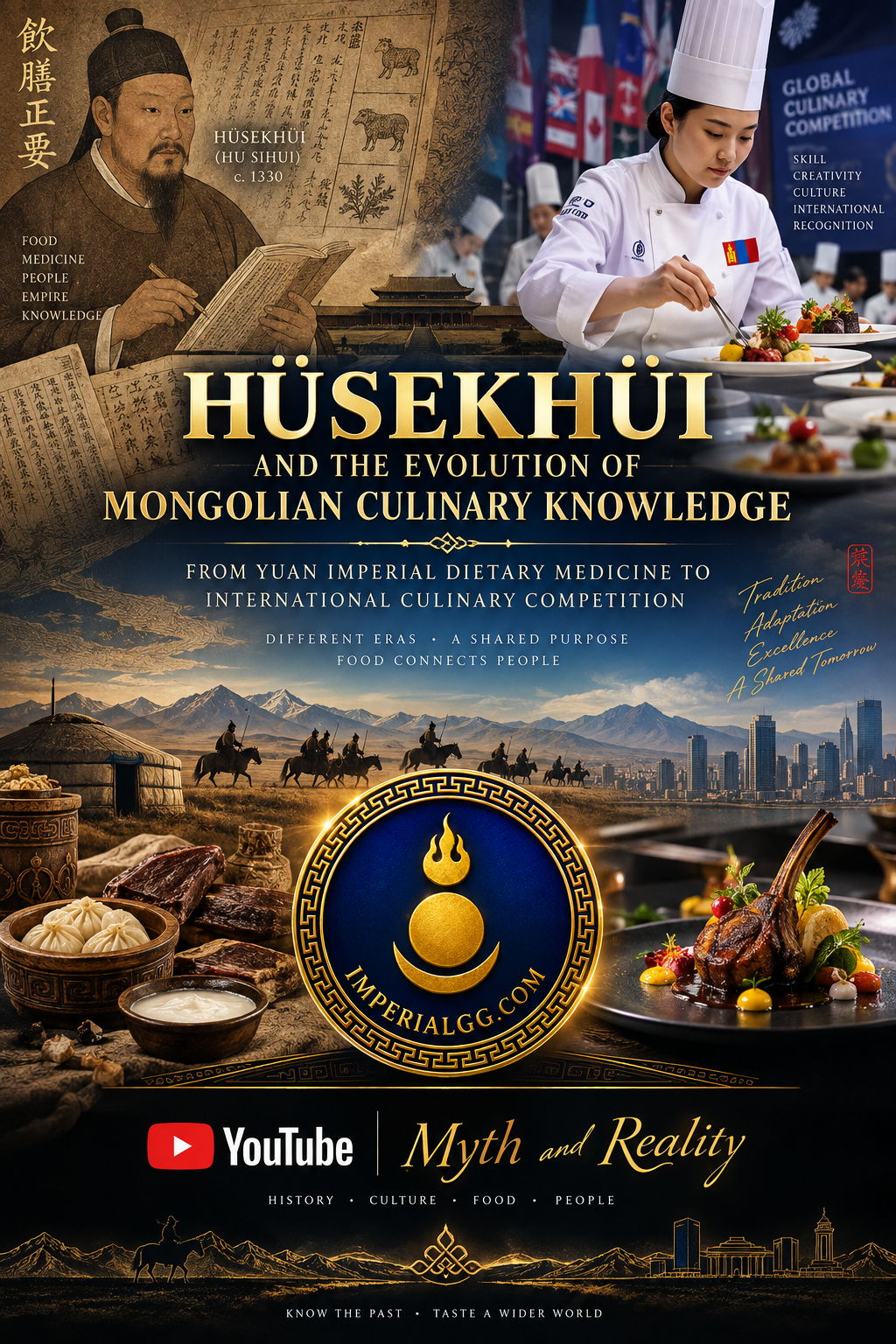
HÜSEKHÜI AND THE DEVELOPMENT OF MONGOLIAN
CULINARY KNOWLEDGE
By Altanbagana Baatar
DBA Candidate| Independent Historian
ImperialGG Historical Research Seriers
05 September 2026
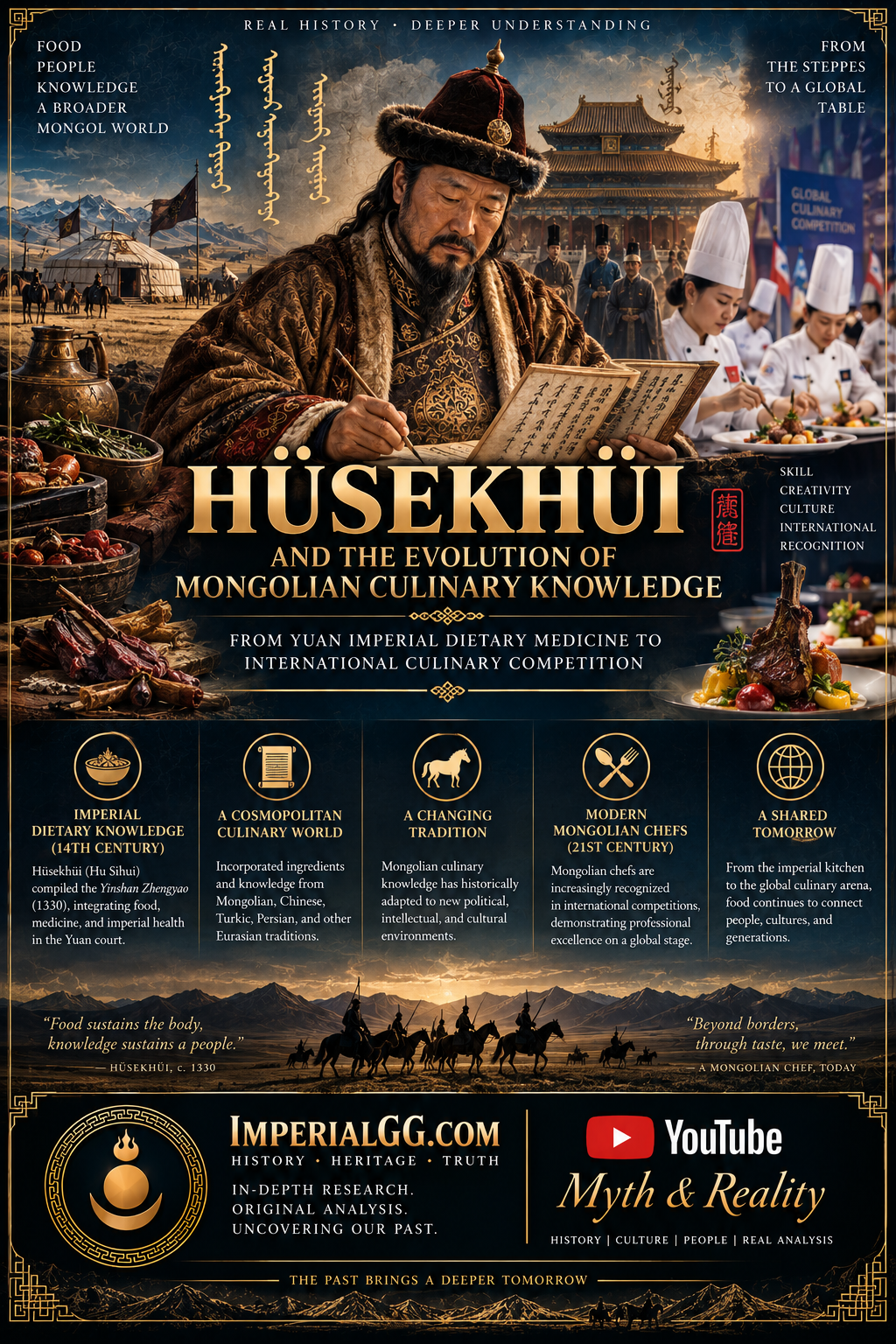
FROM YUAN IMPERIAL DIETARY MEDICINE TO INTERNATIONAL CULINARY COMPETITION
ABSTRACT
The history of Mongolian food has generally been examined through pastoral subsistence, meat and dairy consumption, environmental adaptation, and the culinary practices of nomadic communities. Less attention has been given to culinary knowledge as a specialized intellectual and professional field. This article examines that problem through two historically distant bodies of evidence: the fourteenth-century dietary treatise Yinshan Zhengyao (飲膳正要), compiled by Hüsekhüi (Hu Sihui, 忽思慧) for the Yuan imperial court in 1330, and the participation of Mongolian chefs in international culinary competitions during the twenty-first century.
The article does not propose an uninterrupted institutional lineage between the Yuan imperial dietary service and contemporary Mongolian culinary organizations. Such continuity cannot presently be demonstrated. Instead, it argues that the two periods provide evidence for different historical forms of culinary specialization. Hüsekhüi’s work represents an imperial system in which food preparation, dietary regulation, medicine, and court administration were closely connected. Contemporary Mongolian chefs operate within an international professional system in which culinary competence is standardized, judged, and publicly recognized through competitions and awards. The comparison demonstrates that Mongolian culinary knowledge has repeatedly been reorganized according to changing political, intellectual, and institutional environments.
Keywords: Hüsekhüi; Hu Sihui; Yinshan Zhengyao; Yuan dynasty; Mongol Empire; Mongolian cuisine; dietary medicine; culinary history; Mongolian chefs; culinary competitions.
INTRODUCTION
Food constitutes an important but comparatively underdeveloped field of Mongolian historical research. Histories of the Mongol world have concentrated primarily on political institutions, warfare, pastoralism, trade, religion, and imperial expansion, while food has often been treated as evidence of everyday life rather than as a subject of intellectual and institutional history. This distinction is important because food production and preparation can involve highly developed systems of knowledge concerning ingredients, preservation, health, seasonality, preparation techniques, social hierarchy, and cultural exchange.
The Yuan period provides particularly valuable evidence for such an approach. In 1330, Hüsekhüi, known in Chinese sources as Hu Sihui (忽思慧), presented the Yinshan Zhengyao, generally translated as Proper and Essential Things for the Emperor’s Food and Drink, to the Yuan court. Modern scholarship identifies Hu Sihui as a court dietary physician or dietitian. The work combines recipes and culinary instructions with dietary medicine, food classifications, prohibitions, and discussions of the properties of ingredients. Françoise Sabban’s study of the work emphasizes both its courtly context and its unusually cosmopolitan character, while Paul Buell and Eugene Anderson have treated it as an important source for Chinese dietary medicine under Mongol rule.
The historical importance of the Yinshan Zhengyao extends beyond the question of individual recipes. The work demonstrates that food in the Yuan court could constitute a specialized body of knowledge administered by trained personnel and connected to medical and political institutions. At the same time, the text reflects the multinational environment of the Mongol Empire. Its vocabulary and ingredients contain evidence of interactions among Mongolian, Chinese, Turkic, Persian, and other culinary and medical traditions.
A very different form of culinary specialization can be observed in contemporary Mongolia. Since at least the 2010s, Mongolian chefs have increasingly participated in international culinary competitions, where professional performance is evaluated through standardized categories and judging systems. The 2017 Korea Challenge Cup, for example, recorded substantial Mongolian participation and numerous gold, silver, and bronze medals. Later competitions in South Korea and Malaysia demonstrate the continued integration of Mongolian culinary professionals into international competition networks.
The purpose of this article is not to claim that modern Mongolian chefs are direct institutional successors of Hüsekhüi. There is no evidence for such a continuous institutional chain. Rather, the article asks how the historical status of culinary expertise changed between the Yuan imperial period and the contemporary international culinary environment, and what these changes reveal about the development of Mongolian culinary knowledge.
HÜSEKHÜI AND THE YUAN IMPERIAL DIETARY INSTITUTION
The historical identity of Hüsekhüi requires careful treatment. Chinese sources identify him as Hu Sihui, while Mongolian scholarship commonly renders his name as Hüsekhüi or Хүсэхүй. His precise ethnic background remains uncertain. Sabban notes that scholars have variously considered him Chinese or Mongol and emphasizes that the available evidence does not permit a definitive conclusion. Other scholarship has proposed a Central Asian or Turkic background.
This uncertainty is significant because modern national categories cannot simply be projected onto a fourteenth-century Yuan court official. The Yuan imperial institution was itself multinational, and Hüsekhüi’s work reflects that environment.
What can be established more securely is his professional position. Hüsekhüi served as a dietary physician within the Yuan imperial establishment and compiled the Yinshan Zhengyao for the court. A detailed study of the text observes that its intended audience consisted principally of the emperor, the imperial consorts, and those responsible for preparing food for the imperial household rather than the general population.
This distinction is essential. The Yinshan Zhengyao should not be interpreted as a comprehensive description of what ordinary Mongols ate. It is primarily a record of courtly dietary knowledge, although it incorporates information derived from a broader range of culinary and medical traditions.
The institutional position of its author therefore provides an important starting point for understanding the work. Hüsekhüi was not simply a cook producing meals. He occupied a specialized position in which food preparation was connected with the maintenance of imperial health.
THE YINSHAN ZHENGYAO AS A DIETARY AND MEDICAL TEXT
The structure of the Yinshan Zhengyao confirms that its purpose extended beyond culinary instruction. The work is organized into three major sections. The first addresses dietary prohibitions and practices associated with maintaining health. The second contains recipes and preparations with therapeutic purposes. The third functions as a form of materia dietetica, examining ingredients according to their qualities, flavors, and effects.
This organization reflects the principle commonly described in the scholarship as the relationship between food and medicine. The text treats dietary practice as part of a broader system of maintaining bodily health rather than separating food preparation completely from medical practice.
This is particularly important for the history of culinary knowledge. The modern distinction between “chef,” “nutritionist,” and “physician” cannot simply be transferred to the Yuan court. Hüsekhüi’s professional environment brought these fields into closer institutional proximity.
The historical significance of the Yinshan Zhengyao therefore lies partly in its demonstration that culinary practice could be systematized as expert knowledge.
At the same time, modern scholars have cautioned against describing the work simply as the “first nutrition book.” A study of the text emphasizes that its circulation was initially limited and that its dietary theories were specifically adapted to the imperial context.
Such caution is methodologically important. The historical value of the text does not depend upon assigning it the modern category of “nutrition science.” Its significance lies in what it actually represents within its own historical context: an organized system of dietary knowledge associated with the Yuan imperial court.
THE COSMOPOLITAN CHARACTER OF YUAN CULINARY KNOWLEDGE
One of the most significant features of the Yinshan Zhengyao is its linguistic and culinary diversity. Sabban identified approximately fifty terms in the text borrowed from Mongolian, Turkic, and Arabic. She argues that this linguistic diversity reflects the international environment of the Yuan court.
More recent scholarship similarly emphasizes the cosmopolitan character of the work. A recent study of the chickpea in premodern China describes the Yinshan Zhengyao as representing a “new international cuisine” rooted in a Mongol imperial environment but incorporating ingredients, spices, and techniques from China, Persia, and other parts of Eurasia.
This evidence complicates any attempt to classify the work simply as either “Mongolian” or “Chinese.” The text was written in Chinese and participates substantially in Chinese medical and textual traditions. At the same time, it was produced for a Mongol-ruled imperial court and incorporates foodways associated with the broader Eurasian world.
The most historically useful interpretation is therefore to regard the Yinshan Zhengyao as a Yuan imperial dietary text produced within a Mongol political environment and characterized by substantial intercultural exchange.
This distinction is particularly important when considering Mongolian culinary history. Culinary traditions do not necessarily correspond to the boundaries of modern nation-states. The Mongol Empire created political and commercial networks through which ingredients, terminology, recipes, and technical knowledge could circulate across considerable distances.
HÜSEKHÜI AND THE PROBLEM OF CULINARY “TRADITION”
The case of Hüsekhüi also raises a methodological question concerning the definition of “traditional Mongolian cuisine.” If tradition is understood as an unchanging collection of dishes transmitted unchanged from generation to generation, the Yinshan Zhengyao presents difficulties. Its culinary world was demonstrably interconnected with other traditions. If, however, tradition is understood as a historically changing body of knowledge capable of incorporating new ingredients and techniques while maintaining particular cultural and institutional frameworks, the Yuan evidence becomes considerably more informative.
The Mongol imperial court did not exist outside the cultural world of Eurasia. Its food system reflected the same processes of interaction that characterized other areas of the empire. Thus, the historical importance of Hüsekhüi is not that he preserved an isolated and “pure” Mongolian cuisine. Rather, his work demonstrates the capacity of a Mongol imperial institution to organize, incorporate, and systematize diverse forms of culinary and medical knowledge.
THE TRANSFORMATION OF CULINARY EXPERTISE IN THE MODERN PERIOD
The institutional environment of contemporary Mongolian chefs differs fundamentally from that of the Yuan court. Modern chefs operate within culinary schools, restaurants, professional associations, hospitality businesses, certification systems, and international competitions. Their expertise is assessed through explicit technical criteria and comparative judging. This transformation is significant because culinary knowledge has acquired a new form of public legitimacy.
In the Yuan court, culinary expertise was primarily connected with imperial service and the health of the ruling household. In the contemporary international system, culinary expertise can be demonstrated through competition and measured through awards.
The two systems should not be treated as equivalent. They belong to different historical periods and institutional structures. Nevertheless, both demonstrate the transformation of food preparation from an everyday activity into a specialized field requiring recognized expertise.
MONGOLIAN CHEFS IN INTERNATIONAL COMPETITION AFTER 2017
The contemporary evidence provides several examples of this development. At the Korea Challenge Cup International Culinary Competition in 2017, the Mongolian Master Chefs Association participated with a delegation of twenty people. According to the Mongolian report on the event, 920 chefs from eight countries participated, and the Mongolian delegation received 10 gold, 9 silver, and 13 bronze medals.
This episode is significant not simply because of the number of medals. It demonstrates the emergence of Mongolian culinary professionals as organized competitors within an international judging environment. The distinction between presentation and competition is important. A national cuisine exhibition may primarily aim to introduce a country’s food culture. A culinary competition requires the participant to satisfy formal technical and sensory criteria established by judges.
Consequently, participation in such competitions provides evidence of the professionalization of Mongolian culinary practice. Later competitions reinforce this development.
In 2024, Mongolian chef G. Bat-Uyanga reportedly won a gold medal in the pasta category at an international culinary competition in Jeju, South Korea. The importance of this result lies partly in the category itself. Pasta is not a traditional Mongolian dish, so the achievement demonstrates that Mongolian culinary professionals were being evaluated on transferable technical competence rather than solely on their ability to prepare national cuisine.
This distinction deserves emphasis. International recognition of Mongolian chefs does not depend exclusively upon traditional Mongolian dishes. It can also emerge through mastery of internationally standardized culinary techniques.
THE SIGNIFICANCE OF INTERNATIONAL MEDALS
The growing number of international awards received by Mongolian chefs should nevertheless be interpreted cautiously. A medal does not, by itself, establish the superiority of an entire national cuisine. Nor does the success of an individual chef demonstrate a continuous historical culinary tradition. What medals do establish is more specific: the performance of particular Mongolian culinary professionals was judged successfully within particular international competitions.
This distinction is essential for an academically grounded history. International competition provides a new mechanism for recognition that differs fundamentally from the imperial court. The Yuan court operated through hierarchy and proximity to political authority. Modern competitions operate through standardized categories, judging panels, scores, and awards. The social mechanisms differ, but both systems demonstrate that culinary expertise can acquire institutional recognition.
CONTINUITY WITHOUT CLAIMING INSTITUTIONAL DESCENT
The comparison between Hüsekhüi and contemporary Mongolian chefs should therefore be framed in terms of historical continuity and institutional discontinuity. Institutional continuity cannot presently be demonstrated. There is no documented chain connecting the Yuan imperial dietary office to modern Mongolian culinary associations. There is also no evidence that contemporary professional chefs directly inherited their technical methods from Hüsekhüi’s court. Yet continuity can be considered at a broader cultural and analytical level.
Both historical contexts demonstrate that culinary knowledge can be:
- specialized rather than purely domestic;
- organized institutionally;
- transmitted through texts or professional systems;
- evaluated according to recognized standards; and
- used to represent a larger political or cultural community. The form of expertise changed, but the historical importance of expertise in food did not disappear. This is a more defensible interpretation than presenting Hüsekhüi as the direct predecessor of the modern Mongolian chef.
FROM IMPERIAL DIETARY MEDICINE TO PROFESSIONAL CULINARY CULTURE
The historical contrast becomes clearer when the two systems are placed side by side.
| Yuan imperial context | Contemporary international context |
|---|---|
| Imperial dietary physician | Professional chef |
| Court institution | Culinary association / competition |
| Dietary medicine | Culinary technique |
| Imperial health | Professional performance |
| Court evaluation | International judging |
| Written dietary treatise | Competition rules and professional standards |
| Imperial audience | International professional audience |
| Eurasian culinary exchange | Global culinary exchange |
The comparison does not imply equivalence. Rather, it demonstrates a transformation in the institutional organization of culinary knowledge.
Hüsekhüi’s expertise was embedded in the medical and administrative structure of a medieval empire. Modern Mongolian chefs work within a global professional market characterized by standardized competition, hospitality education, commercial kitchens, and international recognition. The difference between these systems is itself historically meaningful.
MONGOLIAN CULINARY IDENTITY IN A GLOBAL ENVIRONMENT
The development of Mongolian culinary professionalism also raises the question of how national culinary identity functions under globalization. The modern Mongolian chef may compete with traditional meat and dairy dishes, but may also compete in categories such as pasta, pastry, seafood, or international cuisine. This does not necessarily represent the abandonment of Mongolian culinary identity. Instead, it demonstrates that professional competence and national culinary identity are not identical categories.
A chef may represent Mongolia through a traditional dish, while also demonstrating professional mastery through an internationally recognized culinary category. This is comparable, in a broader historical sense, to the cosmopolitan character of the Yuan court. The Yinshan Zhengyao did not preserve a sealed culinary system. It documented a culinary environment in which Mongolian, Chinese, Central Asian, and other traditions interacted. Modern Mongolian culinary culture likewise operates within an international environment. The relevant historical question is therefore not whether Mongolian cuisine remains “pure,” but how Mongolian culinary identity is maintained, adapted, and represented under conditions of cultural exchange.
CONCLUSION
Hüsekhüi occupies an important position in the history of Mongolian-associated culinary knowledge because the Yinshan Zhengyao provides unusually detailed evidence for the organization of food, medicine, and dietary practice within the Yuan imperial court. The work should not be treated simply as a cookbook, nor should Hüsekhüi be reduced to the modern category of chef. His position as a court dietary physician placed him within an institutional environment in which food preparation, health, medical knowledge, and imperial administration intersected. The text’s multilingual terminology and diverse culinary materials further demonstrate the cosmopolitan character of Yuan court culture.
Contemporary Mongolian chefs operate within an entirely different institutional system. Their expertise is demonstrated through professional education, culinary associations, international competitions, formal judging, and awards. The documented successes of Mongolian competitors since the 2010s indicate that Mongolian culinary professionals have become increasingly visible within international culinary networks.
The historical significance of placing these periods in conversation does not depend upon proving a direct institutional lineage. The stronger argument is that culinary expertise has repeatedly been reorganized in Mongolian history according to changing institutional circumstances. In the Yuan period, specialized culinary knowledge served an imperial court and was incorporated into dietary medicine. In the contemporary period, culinary knowledge is increasingly professionalized, standardized, and evaluated through international competition.
The historical distance between Hüsekhüi and today’s Mongolian chefs is therefore not an obstacle to comparison. It is the reason comparison is valuable. The evidence demonstrates neither an unbroken culinary institution nor an unchanged Mongolian cuisine. It demonstrates something more historically significant: the persistence of culinary knowledge as a field of specialization, adaptation, and cultural expression across radically different historical environments.
Hüsekhüi’s Yinshan Zhengyao represents one of the earliest surviving documentary expressions of this process within a Mongol imperial setting. The international medals earned by Mongolian chefs in the contemporary period represent its very different modern institutional form. The history connecting the two is therefore not a simple history of recipes. It is a history of knowledge, institutions, professionalization, and cultural adaptation.
SELECTED SCHOLARLY SOURCES
- Sabban, Françoise. “Cuisine à la cour de l’empereur de Chine au XIVe siècle: Les aspects culinaires du Yinshan Zhengyao de Hu Sihui.” Médiévales 5 (1983): 32–56.
- Sabban, Françoise. “Court Cuisine in Fourteenth-Century Imperial China: Some Culinary Aspects of Hu Sihui’s Yinshan Zhengyao.” Food and Foodways 1 (1985): 161–196.
- Buell, Paul D., Eugene N. Anderson, and Charles Perry. A Soup for the Qan: Chinese Dietary Medicine of the Mongol Era as Seen in Hu Sihui’s Yinshan Zhengyao. Leiden: Brill, 2010.
- Gasperini, Gavin. Heavenly Flavors: Tenggeri, Medicine, and Food in the Yuan Dynasty and the Yinshan Zhengyao. University of Oregon, 2025.
- Yinshan Zhengyao (飲膳正要), 1330.
- “Dietary Treatment, Life-nourishing and Interdictions: A Case Study on the Yinshan Zhengyao (1330).” National Taiwan University repository.