YISÜGEI BA’ATUR: POLITICAL AUTHORITY, WARFARE, AND THE LAST YEARS OF A PRE-CHINGGISID MONGOL LEADER
By Altanbagana Baatar
DBA Candidate| Independent Historian
ImperialGG Historical Research Seriers
06 September 2026
LINEAGE, POLITICAL POSITION, FAMILY, AND DEATH IN THE HISTORICAL SOURCES
Yisügei Ba’atur occupies a central position in the history of the pre-Chinggisid Mongols, yet his historical identity requires careful separation from the later achievements of his son Temüjin. He was not Chinggis Qahan, nor does the Secret History of the Mongols consistently present him as a Qahan. He was Bartan Ba’atur’s third son, a member of the Borjigin ruling lineage, a military leader active during the struggles between the Mongols and Tatars, the husband of Hö’elün, and the father of Temüjin. His career ended abruptly when he was poisoned after leaving Temüjin with the Onggirat family as a prospective son-in-law.
The surviving sources allow a substantially clearer reconstruction of Yisügei than of his father Bartan, although they remain uneven. The Secret History provides several episodes from his adult life, while Rashīd al-Dīn and later Yuan-period traditions preserve additional genealogical and historical material. At the same time, some of the most memorable scenes in the Secret History—particularly the meeting with Dei Sečen—contain literary and epic elements that must be distinguished from the underlying historical event. De Rachewiltz specifically notes that this episode has no direct counterpart in Rashīd al-Dīn’s account and bears marks of later narrative enlargement.
EARLY LIFE AND LINEAGE
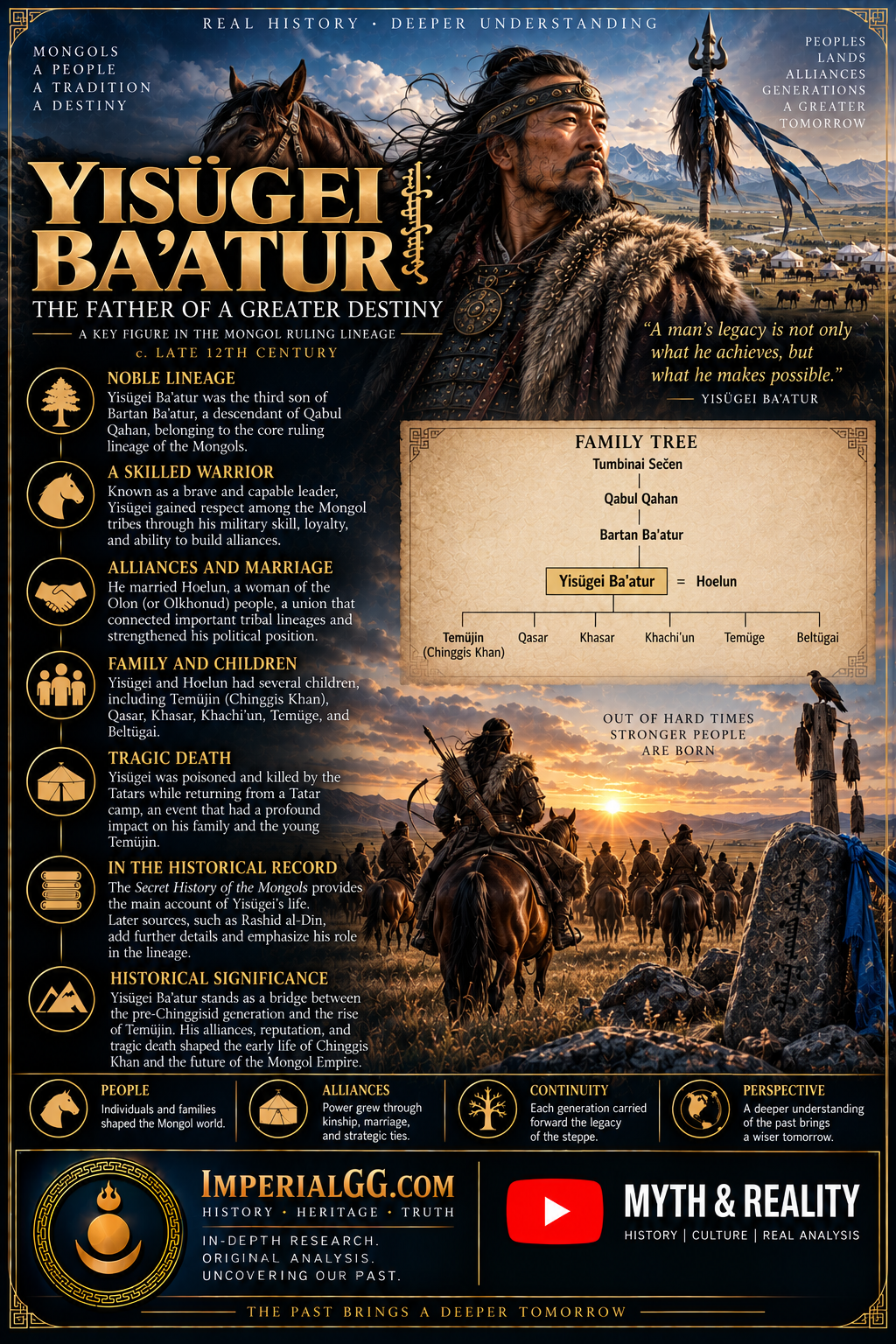
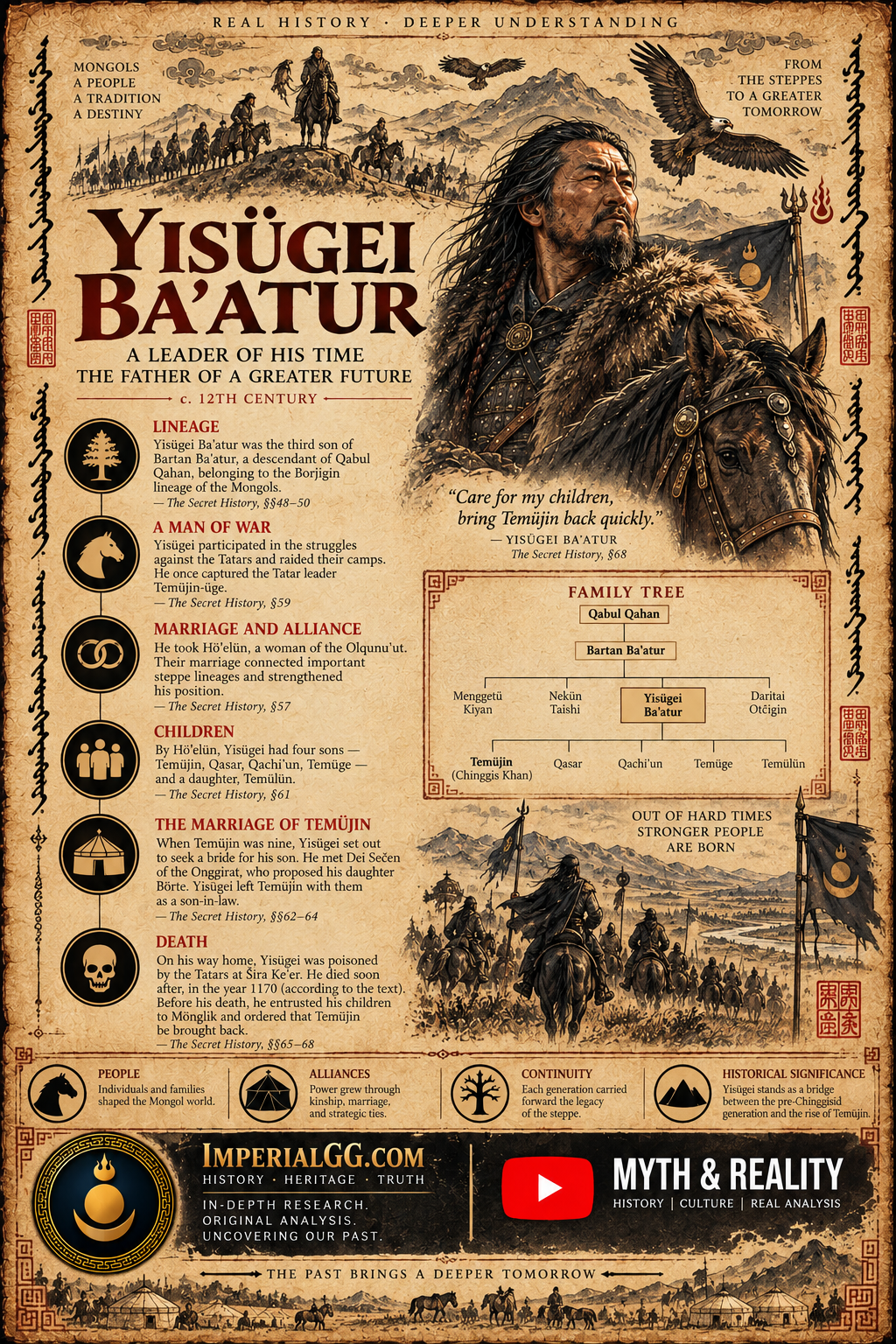
Yisügei was born into the Borjigin lineage descending from Qabul Qahan. The Secret History establishes the genealogy clearly: Qabul Qahan had seven sons, among them Bartan Ba’atur; Bartan in turn had four sons—Menggetü Kiyan, Nekün Taishi, Yisügei Ba’atur, and Daritai Otčigin. Yisügei was therefore the third son of Bartan.
This position is important because Yisügei did not emerge from an obscure branch of the Mongol aristocracy. His father belonged directly to the generation of Qabul Qahan’s sons, while his paternal uncles included Qutula Qahan and Qada’an. Yisügei consequently belonged to the same extended ruling house that had produced the principal pre-Chinggisid Qahans.
Yet genealogy should not be confused with political succession. The fact that Yisügei descended from Qabul did not automatically make him Qahan. The Secret History calls him Ba’atur, not Qahan. This distinction matters because some later traditions and modern histories have attempted to reconstruct a more formal political succession than the surviving evidence securely permits. A study of Mongol royal marriage traditions likewise notes that it is difficult to determine whether Yisügei should be described as the formal tribal chief of the Tayichi’ut, despite the frequency with which modern works give him that designation.
POLITICAL POSITION AND MILITARY ACTIVITY
Yisügei’s political importance is best understood through his military activity.
Following the capture of Ambaqai Qahan, Qutula Qahan and Qada’an led repeated campaigns against the Tatars in an attempt to avenge Ambaqai. The Secret History states that they fought the Tatars thirteen times without achieving their objective. Yisügei appears within this political-military environment as one of the important men of the Mongol side. His own subsequent actions demonstrate that he was not merely a genealogical member of the ruling family but an active participant in the warfare that characterized the Mongolian steppe during this period.
The most direct evidence comes in §59 of the Secret History, where Yisügei is described as having raided the Tatars and captured Temüjin-üge. It was during his return from this expedition that Hö’elün was pregnant with the future Chinggis Qahan. The text therefore links Yisügei’s military activity directly to the circumstances surrounding Temüjin’s birth.
This episode is historically important for another reason. It establishes that Yisügei’s relationship with the Tatars was not merely one of defensive warfare. The sources remember him as an active participant in raids and retaliatory violence. The later poisoning of Yisügei is explicitly connected in the Secret History with the Tatars’ memory of his previous raid against them.
HÖ’ELÜN AND THE FORMATION OF HIS HOUSEHOLD
Yisügei’s family life is closely connected with the political relationships of the eastern steppe. The Secret History records that Yisügei took Hö’elün after encountering her while she was travelling with her newly married husband, Čiledü. The episode belongs to the formative genealogy of the Borjigin family, although its literary presentation has generated considerable scholarly discussion. What can be established securely is that Hö’elün subsequently became Yisügei’s principal wife and the mother of Temüjin and his siblings.
By Hö’elün, Yisügei had four sons—Temüjin, Qasar, Qachi’un, and Temüge—and a daughter, Temülün. The Secret History gives their ages relative to one another when Temüjin was nine.
This household is historically important because Yisügei’s political position cannot be separated entirely from the alliances created through marriage. His marriage to Hö’elün connected his household to the Olqunu’ut, while his later arrangement concerning Temüjin connected his family with the Onggirat through Dei Sečen. Marriage in this context was not simply a private family matter. It could establish political relationships between communities.
THE JOURNEY TO FIND A WIFE FOR TEMÜJIN
One of the best-preserved episodes in Yisügei’s life concerns his decision to arrange a marriage for his nine-year-old son. When Temüjin was nine, Yisügei set out with him toward the Olqunu’ut, the maternal relatives of Hö’elün, intending to seek a bride for his son. On the journey they encountered Dei Sečen of the Onggirat between Chekcher and Chiqurgu. Dei Sečen persuaded Yisügei to consider his daughter Börte instead.
The Secret History presents the encounter in highly literary language, including Dei Sečen’s dream of a white gerfalcon carrying the sun and moon. De Rachewiltz warns that this section bears the marks of epic elaboration and has no direct counterpart in Rashīd al-Dīn’s account. This does not mean the underlying marriage arrangement is necessarily fictitious; rather, the narrative form must be distinguished from the historical core.
The historical core is clear: Yisügei agreed to leave Temüjin with Dei Sečen as a son-in-law, while Börte would later become Temüjin’s wife. Yisügei gave his spare horse as a pledge and departed alone. This decision was one of the final major acts recorded in Yisügei’s life.
THE LAST JOURNEY
The return journey from the Onggirat settlement transformed Yisügei’s life—and consequently the political circumstances of his family. At Šira Ke’er near Mount Čekčer, Yisügei encountered a group of Tatars celebrating a feast. He dismounted and joined them because he was thirsty. The Tatars recognized him as Yisügei Kiyan, remembering his earlier raid against them. According to the Secret History, they secretly mixed poison into his food. Yisügei subsequently became ill while travelling home. After three days he reached his own camp, where his condition deteriorated.
The Secret History then preserves one of the most important personal statements associated with him. Yisügei called Mönglik, son of Charaqa of the Qongqotat, and explained that he had small children and had left Temüjin as a son-in-law. He told Mönglik that the Tatars had secretly harmed him and instructed him to care for his children and his widowed sister-in-law, Hö’elün. Most importantly, he ordered Mönglik to bring Temüjin back quickly. He then died.
This final instruction is significant because it demonstrates what concerned Yisügei at the end of his life: his young children, his wife, and the son he had just left among the Onggirat.
It is therefore misleading to reduce Yisügei’s death simply to the statement that “the Tatars poisoned him.” The episode was simultaneously a military retaliation, a family crisis, and the sudden removal of an adult male leader from a household containing several young children.
THE DATE OF YISÜGEI’S DEATH
The chronology requires caution. The Secret History associates the conversation between Yisügei and Mönglik with the year 1170. De Rachewiltz consequently places Yisügei’s death in 1170 if Temüjin’s birth is dated to 1162, while noting that the chronology has been debated and that the death must in any case fall within a relatively narrow range.
The date should therefore not be presented as absolutely uncontested. For an academic biography, c. 1170 is safer than presenting 1170 as an indisputable modern chronological fact.
YISÜGEI’S STATUS: QAHAN, CHIEF, OR BA’ATUR?
One of the most important questions surrounding Yisügei is his political title. The Secret History of the Mongols calls him Yisügei Ba’atur. It does not call him Qahan. This distinguishes him from Qabul, Ambaqai, and Qutula, whom the text explicitly identifies as Qahans. Modern historical writing has sometimes described Yisügei as the chief or leader of the Tayichi’ut. Such terminology may capture his practical influence, but it should not automatically be converted into the formal title of Qahan.
This distinction is supported by the wider political context. After Ambaqai’s capture, the Mongols and Tayichi’ut assembled and selected Qutula Qahan. Yisügei was active in the subsequent warfare but was not described in the Secret History as replacing Qutula or holding the Qahanate.
The evidence therefore supports describing Yisügei as a prominent Borjigin military and political leader, while avoiding the unsupported assertion that he was formally Qahan.
THE DEATH OF YISÜGEI AND THE CRISIS OF HIS HOUSEHOLD
Yisügei’s death had consequences extending far beyond the individual. At the time of his death, Temüjin was approximately nine years old, while his younger brothers were still children. The Secret History immediately shifts from Yisügei’s death to the crisis surrounding Hö’elün and her children. The Tayichi’ut subsequently separated from the household, leaving Hö’elün and the children in a vulnerable position.
Modern scholarship has debated the precise historical interpretation of this episode. N. Chogt’s 2023 study specifically revisits the traditional account of the Tayichi’ut abandoning Yisügei’s widow and children, comparing the Secret History with Rashīd al-Dīn and other Yuan-period sources. The study argues that this episode deserves renewed source criticism rather than being accepted without examination.
That debate is important because the traditional narrative has often been treated as a straightforward factual report. A more careful approach distinguishes between the narrative preserved by the Secret History and the historical reconstruction possible through comparison with other sources.
YISÜGEI IN THE HISTORICAL MEMORY OF THE MONGOLS
Yisügei’s later historical importance was inevitably shaped by the extraordinary career of his son. This creates a methodological problem. Because Temüjin became Chinggis Qahan, later historians naturally interpreted Yisügei through the genealogy of the imperial founder. But Yisügei must first be reconstructed as a historical actor in his own period.
The surviving evidence shows a man belonging to the Borjigin ruling lineage, participating in warfare against the Tatars, forming marriage alliances, maintaining a household with several children, and attempting to establish a political marriage for his eldest son. His death occurred before Temüjin reached adulthood.
The later importance of Yisügei therefore does not depend upon attributing to him achievements that belong to Temüjin. His historical significance lies partly in the political and familial environment that existed before Temüjin became Chinggis Qahan.
HISTORICAL ASSESSMENT
Yisügei Ba’atur should be understood as a significant pre-Chinggisid Mongol leader whose political authority was substantial but whose exact formal status remains uncertain. The sources firmly establish his place in the Borjigin genealogy, his military activity against the Tatars, his relationship with Hö’elün, his children, his arrangement of Temüjin’s marriage with Börte, and his death after the Tatar poisoning episode.
The sources do not establish that Yisügei was Qahan. Nor do they permit us to reconstruct a complete political biography with precise dates for his campaigns, a clearly defined territorial domain, or a formal state apparatus under his personal command. That distinction is crucial.
Yisügei was important without necessarily being Qahan. He exercised authority without leaving behind the kind of institutional record associated with later imperial rulers. His world was one in which lineage, personal military reputation, marriage alliances, kinship, and shifting political coalitions were central to the exercise of power.
His death around 1170 removed an important adult leader at precisely the moment when his eldest son was still a child. The subsequent history of Temüjin cannot therefore be understood without recognizing the political position Yisügei had occupied before his death.
CONCLUSION
Yisügei Ba’atur was the third son of Bartan Ba’atur and a member of the ruling Borjigin lineage descended from Qabul Qahan. He belonged to the generation that followed Qutula Qahan and preceded the rise of Temüjin. The Secret History of the Mongols remembers him primarily as Ba’atur, a military and political figure rather than as Qahan.
His life was shaped by warfare with the Tatars, alliances among steppe aristocratic communities, and the responsibilities of maintaining a young household. His military activity included a raid against the Tatars and the capture of their leader Temüjin-üge. Later, while returning from arranging his son’s marriage to Börte, he was poisoned by Tatars who remembered his earlier hostility toward them.
His final words reveal the immediate human and political consequences of his death. He knew that his children were still young, that Temüjin had been left far from home, and that Hö’elün would be left without him. His last instruction was therefore not a proclamation of political ambition but a command concerning the survival of his family: bring Temüjin home and care for the children.
Yisügei’s historical importance should consequently be stated precisely. He was not the founder of the Mongol Empire, nor should he be retrospectively transformed into a Qahan. He was the pre-Chinggisid Mongol leader whose death left a young Temüjin in a fractured political world—and whose family line would, within a generation, produce the founder of the Mongol Empire.
That is sufficient to make Yisügei Ba’atur an indispensable figure in the history of how the Mongol political order developed before Chinggis Qahan.
SOURCES
- The Secret History of the Mongols, §§48–50, 59–68. The genealogy identifies Bartan’s four sons and the narrative records Yisügei’s military activity, Temüjin’s birth, marriage arrangement, poisoning, and death.
- Igor de Rachewiltz, The Secret History of the Mongols: A Mongolian Epic Chronicle of the Thirteenth Century, commentary to §§54, 62–68.
- Christopher P. Atwood, “Six Pre-Chinggisid Genealogies in the Mongol Empire,” for the problems surrounding pre-Chinggisid genealogical traditions and the Yisükei/Bartan lineage.
- N. Chogt, “A Question Related to the History of Genghis Khan’s Early Stage—Focused on the Comparison between the Records of The Secret History of the Mongols and Jami’ al-tawarikh,” Mongolian Studies 74 (2023): 123–135, DOI 10.17292/kams.2023.74.123.