ERGÜNE KÜN: A LOST HOMELAND OF THE MONGOLS — OR A DEEP LAYER OF HISTORICAL MEMORY?
By Altanbagana Baatar
DBA Candidate| Independent Historian
ImperialGG Historical Research Seriers
23 June 2026
THE LEGEND OF ESCAPE, ISOLATION, MIGRATION, AND EMERGENCE
INTRODUCTION: THE MONGOL STORY DID NOT BEGIN WITH CHINGGIS KHAN
The history of the Mongols is often presented as beginning with Chinggis Khan and the great assembly of 1206. Yet the political and genealogical traditions recorded by the Mongols themselves reach considerably further back. One of the most intriguing traditions is the story of Ergüne Kün.
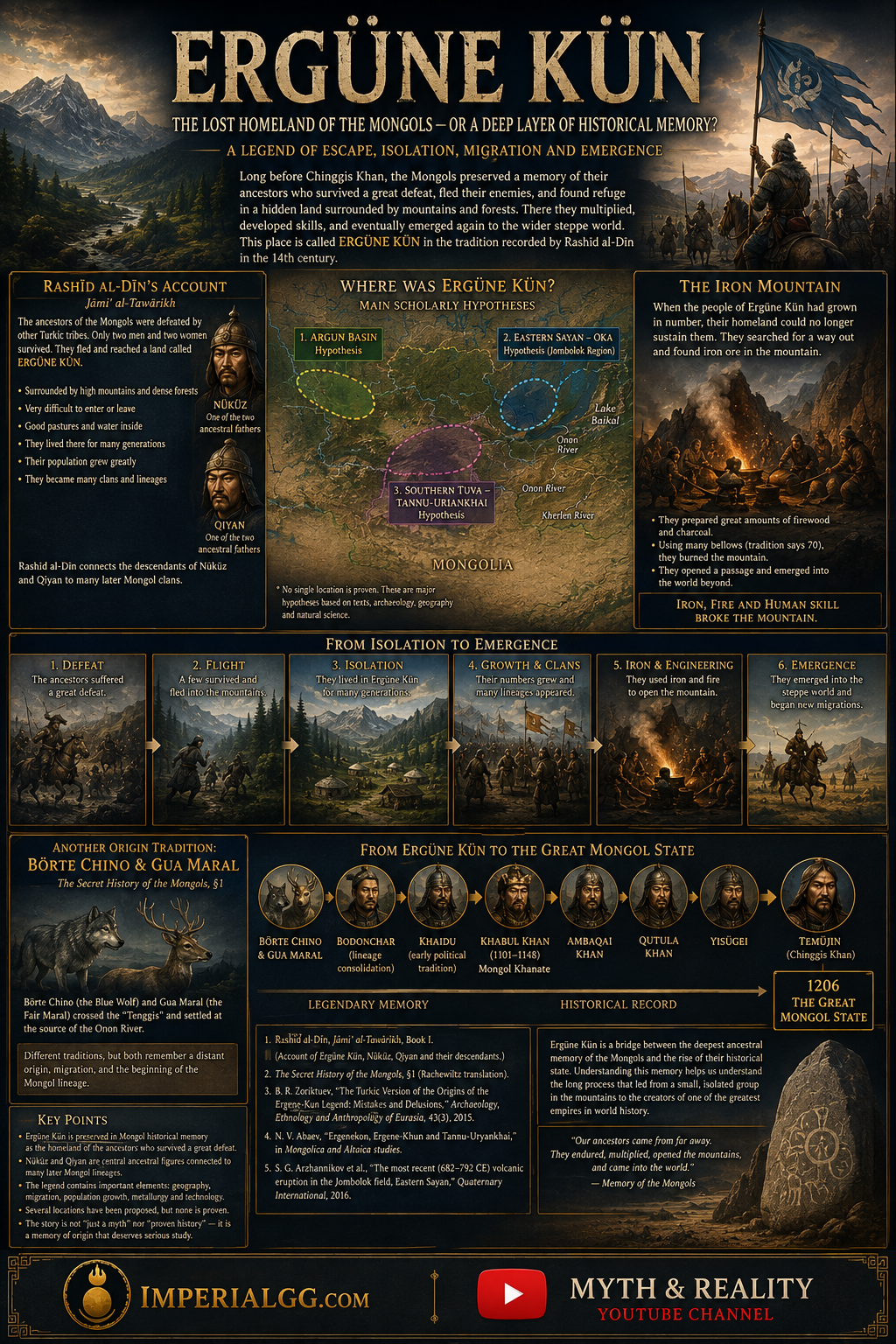
The fullest surviving version is preserved by the Persian historian Rashīd al-Dīn in his Jāmiʿ al-Tawārīkh. According to his account, the ancestors of the Mongols suffered a catastrophic defeat at the hands of other Inner Asian peoples. Only a small number survived. They fled into a remote region surrounded by mountains and forests, accessible through a difficult passage. There they multiplied over many generations until their descendants eventually emerged into the wider world. This story should neither be dismissed simply as a fairy tale nor presented uncritically as literal history.
It should be treated as what it is:
A historical-genealogical memory preserved in legendary form.
Its importance lies precisely in the combination of geography, migration, population growth, clan formation, metallurgy, and collective memory.
RASHĪD AL-DĪN’S ERGÜNE KÜN
In Rashīd al-Dīn’s account, two ancestral figures occupy a central position:
Nüküz
and
Qiyan.
They and their descendants eventually lived within Ergüne Kün, where their population expanded considerably. Over generations, different branches developed, eventually producing numerous groups that later became incorporated into the Mongol genealogical tradition.
The significance of the story is therefore greater than the simple statement that “the Mongols once lived in a hidden valley.”
The narrative describes a complete process:
DEFEAT
↓
FLIGHT
↓
ISOLATION
↓
POPULATION GROWTH
↓
CLAN FORMATION
↓
TECHNOLOGICAL DEVELOPMENT
↓
BREAKING THROUGH THE MOUNTAINS
↓
RETURN TO THE WIDER STEPPE WORLD
This is remarkably close to the structure of an origin tradition.
WHO WERE THE PEOPLE WHO DEFEATED THEM?
This is one of the most difficult questions. Rashīd al-Dīn describes the opponents in terms associated with Turkic peoples. But this terminology must be interpreted historically. It would be a serious anachronism to equate the “Turks” of a medieval Persian chronicle with the modern Turkish nation or the Republic of Türkiye.
The political and ethnic landscape of medieval Inner Asia was vastly different from the modern world. The opponents in the story should therefore be understood within the historical world of early medieval Inner Asia, where numerous Turkic-speaking and Mongolic-speaking populations interacted, competed, migrated, merged, and separated over centuries. This distinction is particularly important when discussing Ergüne Kün.
THE GEOGRAPHY OF ERGÜNE KÜN
Rashīd al-Dīn’s description provides several geographical characteristics.
Ergüne Kün was portrayed as:
- mountainous;
- heavily forested;
- difficult to enter or leave;
- protected by a narrow passage;
- capable of supporting a growing population;
- sufficiently rich in resources for long-term settlement.
This is not the image of an inaccessible desert. It is the image of a mountainous refuge containing a habitable interior landscape. That geographical description has led modern scholars to search for possible locations across the forest-steppe and mountain regions of northern Inner Asia.
WHERE WAS ERGÜNE KÜN?
There is no universally accepted identification. Several geographical hypotheses have been proposed.
THE ARGUN BASIN
One major line of interpretation places Ergüne Kün somewhere in or around the Argun River basin and the eastern Inner Asian frontier. B. R. Zoriktuev, among others, has argued for an interpretation connecting the Ergüne Kün tradition with the Mongolian historical tradition and the Argun region. This remains one of the principal geographical approaches.
THE EASTERN SAYAN–OKA REGION
Another particularly interesting hypothesis concerns the Eastern Sayan and Oka–Jombolok region.
Geological and dendrochronological research has identified major volcanic activity in the Jombolok region dating approximately to 682–792 CE. Researchers have explored whether this chronological window might correspond in some way with traditions concerning the migration of ancestral Mongolian groups. This does not prove that Jombolok was Ergüne Kün.
But it demonstrates how archaeology, geology, environmental history, and textual traditions can be examined together. That is precisely the kind of interdisciplinary approach the question requires.
SOUTHERN TUVA AND THE SAYAN WORLD
Another scholarly tradition places Ergüne Kün within the broader Sayan–Tuvan mountain world, including the historical region associated with Tannu-Uriankhai. N. V. Abaev has specifically examined the relationship between Ergüne Kün, Ergenekon, and Tannu-Uriankhai, demonstrating that the southern-Tuva/Sayan hypothesis is part of a documented scholarly discussion rather than a modern invention. However, the evidence does not justify presenting a precise location in modern Tuva as conclusively established.
The academically defensible formulation is:
The Sayan–southern Tuva region represents one of the geographical hypotheses proposed for Ergüne Kün.
THE IRON MOUNTAIN
Perhaps the most striking element of the legend is the mountain itself. The inhabitants of Ergüne Kün eventually became so numerous that their enclosed homeland could no longer accommodate them. They therefore sought a way out. According to the tradition, they discovered iron-bearing material in the mountain and used fire, charcoal, and bellows to break through the mountain passage. Rashīd al-Dīn’s account contains a remarkable description involving numerous bellows.
This should not be read as a literal geological report. But neither should the metallurgical element be ignored. The story gives ironworking a central role in the liberation of the ancestral population. That is culturally significant. The ancestors do not escape because a supernatural force simply opens the mountain.
They escape through:
FIRE
IRON
TECHNOLOGY
COLLECTIVE LABOR
The mountain is overcome by human skill.
WHY IRON?
The symbolism is striking. The ancestors are trapped by geography. They cannot simply walk out. They therefore use technological knowledge to create an exit. The story can consequently be interpreted as preserving a cultural memory in which metalworking and the ability to manipulate the natural environment were associated with survival and political emergence.
For a civilization whose later military power depended heavily on horses, iron weapons, armor, tools, and mobile pastoral production, the symbolism is especially powerful. Yet this should remain an interpretation, not a claim that the legend is a direct archaeological report.
ERGÜNE KÜN AND THE ORIGIN OF THE MONGOLS
The most important point is that Ergüne Kün is not simply a story about one hidden settlement. It is an ethnogenetic narrative.
It explains how: A SMALL SURVIVING GROUP became A LARGE POPULATION which became MULTIPLE LINEAGES AND CLANS which eventually became part of THE MONGOL POLITICAL WORLD.
Rashīd al-Dīn explicitly incorporates Nüküz and Qiyan into the genealogical traditions of the Mongols. The narrative therefore preserves a memory of ancestral continuity through migration and demographic expansion.
BÖRTE CHINO AND GUA MARAL: ANOTHER BEGINNING
The Secret History of the Mongols opens with a different but remarkably powerful origin tradition.
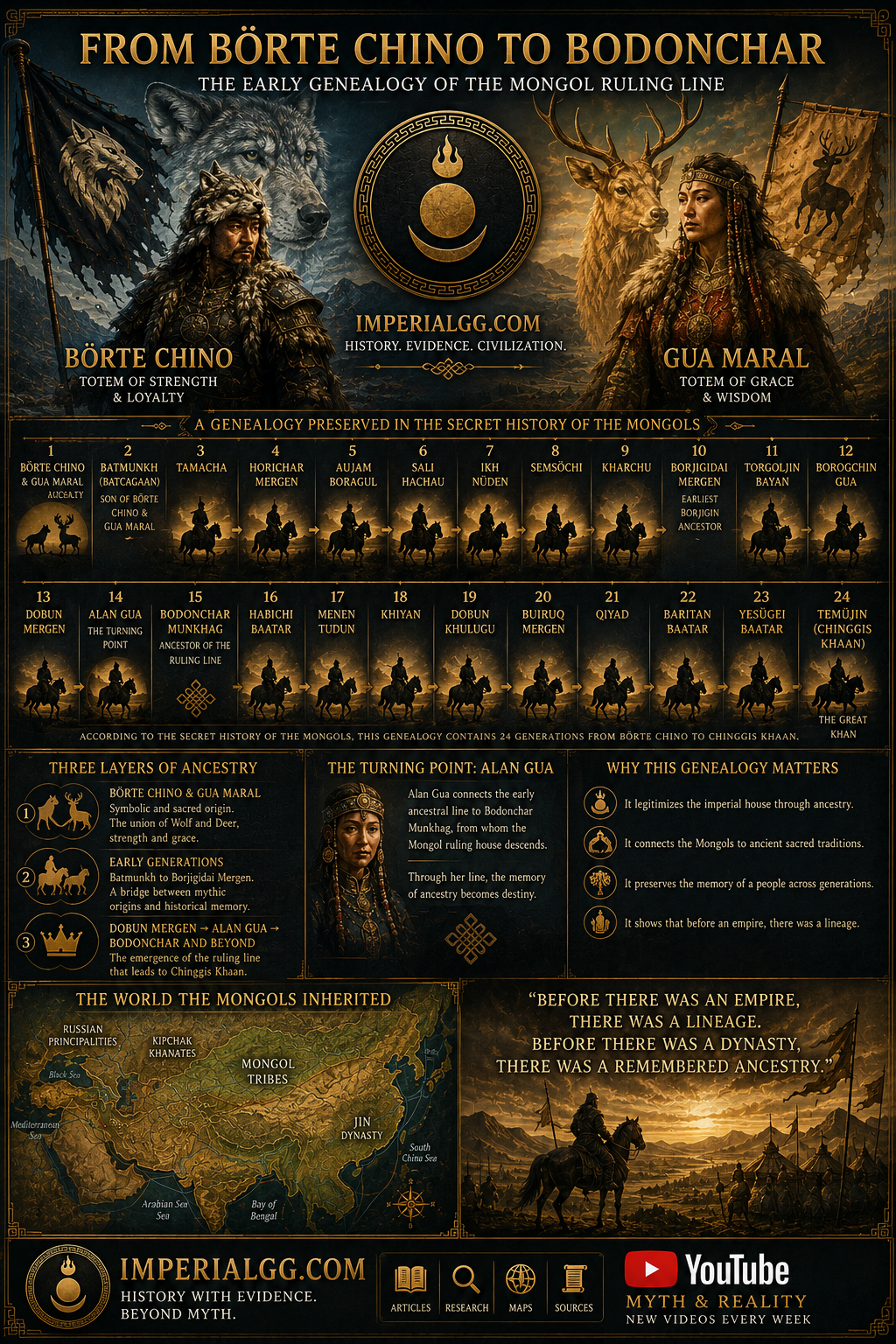
It begins with: Börte Chino and Gua Maral.
They are said to have crossed the “Tenggis” and eventually settled at the source of the Onon River. This is not identical to the Ergüne Kün narrative. The two traditions must not be artificially merged.
But they share an important structural pattern:
A DISTANT ORIGIN
↓
MIGRATION
↓
NEW LANDSCAPE
↓
ANCESTRAL SETTLEMENT
↓
THE FORMATION OF THE MONGOL LINEAGE
The Secret History then moves through generations toward the historical Mongol rulers.
ERGÜNE KÜN AND ONON: MEMORY, NOT PROOF
Could Ergüne Kün and the story of Börte Chino and Gua Maral preserve memories of related migrations? It is possible. But the surviving sources do not allow us to state this as established fact.
The academically responsible position is therefore:
Ergüne Kün and the Börte Chino–Gua Maral narrative should be studied as distinct origin traditions that may preserve overlapping memories of migration and ancestral geography.
This distinction matters. Historical research becomes stronger—not weaker—when it clearly separates: what the source says, what the archaeology suggests, and what remains hypothesis.
THE CHRONOLOGICAL QUESTION
Some interpretations place the Ergüne Kün migration somewhere around the eighth century CE, partly by working backward from genealogical traditions preserved by Rashīd al-Dīn. This is particularly interesting because the eighth century corresponds to a period of major political transformation across Inner Asia.
The period saw:
- the decline and transformation of earlier Turkic political structures;
- movements of populations across Mongolia and the Sayan region;
- changing relationships between forest, mountain, and steppe populations;
- the emergence and reorganization of new political communities.
The chronological correspondence is intriguing. But it remains a hypothesis, not a securely dated event.
THE MOST IMPORTANT DISTINCTION: LEGEND AND HISTORY
There are two equally problematic extremes.
The first says:
“It is a legend, therefore it has no historical value.”
The second says:
“It is a legend, therefore every detail must have happened exactly as described.”
Neither position is satisfactory.
A historical origin legend can preserve:
- memories of migration;
- names of ancestral groups;
- geographical memories;
- social structures;
- technological traditions;
- memories of warfare;
- and concepts of collective identity.
But it can also reshape those memories through generations of oral transmission and later literary recording.
Ergüne Kün should therefore be approached as historical memory requiring historical criticism.
FROM ERGÜNE KÜN TO THE MONGOL KHANATE
This becomes particularly important when we move forward into the documented political history of the Mongols.
The sequence is not:
“Legend → Chinggis Khan → Empire.”
It is much longer.
A more useful historical framework is:
ERGÜNE KÜN — ORIGIN MEMORY
↓
BÖRTE CHINO & GUA MARAL — GENEALOGICAL MEMORY
↓
BODONCHAR — LINEAGE CONSOLIDATION
↓
KHAIDU — EARLY POLITICAL TRADITION
↓
KHABUL KHAN — MONGOL KHANATE
↓
AMBAQAI KHAN
↓
QUTULA KHAN
↓
YISÜGEI
↓
TEMÜJIN
↓
1206 — THE GREAT MONGOL STATE
This does not mean every step can be historically verified with equal certainty. It means that the Mongol historical tradition itself constructed a long chain connecting ancestry, territory, lineage, and political authority.
ERGÜNE KÜN AND KHABUL KHAN
The distinction between the two is essential. Ergüne Kün belongs primarily to the sphere of origin tradition and historical memory. Khabul Khan belongs to the much more securely documented political history of the twelfth century.
We should therefore not say:
“Ergüne Kün was Khabul Khan’s state.”
There is no evidence for that claim.
Instead:
The Mongol tradition preserved an ancestral memory of Ergüne Kün, while several centuries later historical sources record a Mongol political order under Khabul Khan.
This creates a much more interesting historical question:
How did a remembered ancestral world become connected to a historical Mongol polity? That is the question worth investigating.
ERGÜNE KÜN AND THE MONGOL CONCEPT OF HOMELAND
The deeper significance of Ergüne Kün may lie in the concept of homeland itself. The story does not define ancestry solely through blood.
It defines ancestry through: PLACE, MEMORY, MIGRATION, SURVIVAL, DESCENT, RETURN
This is particularly important in understanding the later Mongolian concept of nutag—a homeland not merely as a point on a modern map, but as a lived landscape inhabited by ancestors, animals, rivers, mountains, graves, memories, and descendants. From this perspective, Ergüne Kün is not simply a geographical puzzle. It is a story about where the ancestors lived, where they survived, and where they eventually emerged from.
THE CENTRAL HISTORICAL QUESTION
The question is therefore not simply: “Can we prove where Ergüne Kün was?”
The more important questions are: Why did Mongol historical memory preserve Ergüne Kün?
Why was the ancestral population described as isolated in a mountainous homeland?
Why was metallurgy placed at the center of their escape?
Why did the tradition connect the ancestors to later Mongol lineages?
And finally: What historical experiences may have produced the memory behind the legend? Those questions can be investigated through comparative history.
CONCLUSION: ERGÜNE KÜN AS A DEEP LAYER OF MONGOL HISTORY
Ergüne Kün should neither be abandoned as “mere mythology” nor presented as a geographically proven historical fact. It occupies a more interesting position. It is a Mongol ancestral tradition recorded in a medieval historical work, containing memories of defeat, refuge, population growth, metallurgy, migration, and emergence. Rashīd al-Dīn preserves the names Nüküz and Qiyan and connects their descendants to the genealogical traditions of the Mongols.
The Secret History of the Mongols provides another ancestral tradition through Börte Chino and Gua Maral, connecting the lineage to the Onon River and the landscape that later became central to Mongol history. Modern scholarship has proposed several possible geographical settings for Ergüne Kün, including the Argun region, the eastern Sayan world, and the broader southern-Tuva/Sayan region. None can currently be regarded as conclusively proven.
The geological evidence from the Eastern Sayan is particularly intriguing because its eighth-century chronology overlaps with some proposed interpretations of the migration tradition, although this remains a hypothesis rather than proof. The strongest historical conclusion is therefore not that we have finally located Ergüne Kün.
It is this: ERGÜNE KÜN IS PART OF THE MONGOLS’ OWN MEMORY OF ANCESTRAL ORIGIN, MIGRATION, SURVIVAL, AND EMERGENCE.
And that memory provides a bridge between the deepest layers of Mongol ethnogenesis and the later emergence of the Mongol khanate under Khabul Khan. The story begins in a hidden mountain homeland. It ends, centuries later, with a people capable of creating one of the largest empires in world history.
The mountain was the beginning. The steppe became the homeland. And the Mongol state came later.
PRIMARY AND SCHOLARLY REFERENCES
[1] Rashīd al-Dīn, Jāmiʿ al-Tawārīkh, sections concerning the origins and genealogies of the Mongols. The Ergüne Kün narrative includes Nüküz and Qiyan, the isolated mountain homeland, population expansion, and the eventual emergence of the ancestral groups.
[2] The Secret History of the Mongols, §1. The opening genealogy begins with Börte Chino and Gua Maral and describes their movement toward the Onon region.
[3] B. R. Zoriktuev, research on the Mongolian version of the Ergüne Kün legend and its geographical interpretation, including the Argun-region hypothesis.
[4] N. V. Abaev, studies comparing Ergüne Kün, Ergenekon, and the Tannu-Uriankhai/Sayan region.
[5] Research on the Jombolok volcanic field in the Eastern Sayan, using geological, dendrochronological, and radiocarbon evidence. The latest major volcanic activity is dated approximately to 682–792 CE; its possible relationship to the Ergüne Kün tradition remains hypothetical.
[6] Modern comparative scholarship on the Turkic and Mongolian Ergenekon traditions demonstrates that the relationship between these traditions remains a subject of scholarly debate.
[7] The historical term “Turk/Turkic” in medieval sources must not be retroactively equated with the modern Turkish nation or the Republic of Türkiye.
[8] “Ergüne Kün” should therefore be treated in this article as a historical-geographical hypothesis embedded in a documented Mongol origin tradition, not as a definitively located archaeological site.
IMPERIALGG HISTORICAL RESEARCH SERIES
ERGÜNE KÜN – BÖRTE CHINO & GUA MARAL – ONON — BURKHAN KHALDUN – BODONCHAR – KHAIDU – KHABUL KHAN – AMBAQAI — QUTULA – YISÜGEI – TEMÜJIN – 1206 — THE GREAT MONGOL STATE
From ancestral memory to political statehood.
THE AUTHOR’S THESIS
ERGÜNE KÜN AND THE RETURN OF BÖRTE CHINO
A MONGOLIAN HOMELAND IN THE SAYAN–TUVA WORLD?
This article argues that the Ergüne Kün tradition should be reconsidered not merely as a literary origin legend, but as a geographical and historical memory of an ancestral Mongol population moving through the Sayan–Tuva world before reaching the Onon–Burkhan Khaldun region.
The identification cannot yet be described as archaeologically proven. But the chronological and geographical convergence is striking. The Mongolian historical tradition places Börte Chino in the eighth century; Mongolian scholarship has traditionally dated his birth to approximately 758 CE.
At the same time, the Secret History of the Mongols begins the imperial genealogy with Börte Chino and Gua Maral, who crossed the Tenggis and settled at the source of the Onon River, at Burkhan Khaldun.
If the Ergüne Kün migration is placed within the eighth-century chronological framework preserved in Mongolian historical traditions, an important possibility emerges:
The legendary emergence from Ergüne Kün and the movement of Börte Chino and Gua Maral toward Burkhan Khaldun may preserve different layers of the same broad ancestral migration memory. That proposition deserves serious examination.
AMAR’S ERGÜNE KÜN
A. Amar’s Mongolyn Tovch Tüükh (A Short History of Mongolia), first published in 1934, occupies an important position in modern Mongolian historical writing. Later scholarship describes the work as a major early twentieth-century attempt to systematize Mongolian history using Mongolian and foreign sources. Amar did not simply repeat the Ergüne Kün legend. He attempted to locate it geographically.
According to the account preserved in later Mongolian geographical scholarship, Amar connected Ergüne Kün with a mountainous area associated with the “Okhid, Khüükhed” mountain, in the western continuation of the Khentii range, near the waters of the Onon, Kherlen, Zürek, and Minj rivers. He based his interpretation partly on a local oral tradition describing people who had survived destruction, sheltered children in a mountain refuge, multiplied there, and eventually broke through an iron-bearing mountain using fire. This is remarkably close to the structure of Rashīd al-Dīn’s account. Amar therefore belongs to an important tradition of Mongolian scholars who treated Ergüne Kün as a geographical question, not merely a literary motif.
BUT THE MONGOLIAN SCHOLARLY MAP IS LARGER
The search for Ergüne Kün did not end with Amar.
Mongolian and Inner Asian scholars have proposed several geographical possibilities, including:
- the Argun region;
- the Khentii region;
- northeastern Inner Asia;
- the Akhа region;
- and the broader Sayan–Tuva world.
A modern survey of the debate explicitly records several competing geographical hypotheses rather than a single universally accepted location. This is important. The argument of this article is therefore not that one modern map coordinate has already been proven. The stronger proposition is that the Sayan–Tuva hypothesis deserves particular attention because of its geographical and chronological relationship to the early Mongol ancestral traditions.
ERGÜNE KÜN IN THE SAYAN–TUVA WORLD
The Sayan–Tuva hypothesis becomes particularly interesting when the geographical description of Ergüne Kün is compared with the physical landscape.
Rashīd al-Dīn describes a place surrounded by: mountains, forests, difficult approaches, a narrow entrance, and an interior capable of supporting a growing population. That description is compatible with the mountain-and-forest environment of the Sayan region, including areas extending toward present-day Tuva. Modern Mongolian and Inner Asian scholarship has indeed examined Ergüne Kün in relation to the Tannu-Uriankhai/Sayan region. This does not establish a precise archaeological location.
But it means that the proposition: “Ergüne Kün may belong to the Sayan–Tuva geographical world” is a scholarly hypothesis, not an invented modern claim.
THE 758 CE PROBLEM
The chronological question is even more intriguing. Mongolian historical scholarship has traditionally placed Börte Chino’s birth around 758 CE. The Mongolian historical reference work Mongol Toli identifies Börte Chino as a historical figure of the eighth century and gives approximately 758 as his birth date, while explaining that this chronology derives from later Mongolian chronological traditions and the work of Kh. Perlee.
A recent 2026 article by Academician Narangerel Sodov likewise states that Börte Chino is traditionally regarded as having been born in 758, and places the movement of the ancestral Mongols toward Burkhan Khaldun in the second half of the eighth to the beginning of the ninth century. This is precisely where the Ergüne Kün question becomes historically interesting. Because the proposed chronology for the emergence of the ancestral population from Ergüne Kün falls into approximately the same broad historical window.
THE SECRET HISTORY OF THE MONGOLS
The opening of the Secret History of the Mongols is extraordinarily concise: Börte Chino and Gua Maral came across the Tenggis and settled at the source of the Onon River, at Burkhan Khaldun. Their son was Batatchikhan.
The text itself does not say: “They returned from Ergüne Kün.” That connection must therefore remain an interpretation, not a direct quotation from §1. But the chronological relationship is difficult to ignore. If Börte Chino belongs to the eighth-century historical horizon, and if the Ergüne Kün migration is likewise placed within that broad period, then the possibility arises that the two traditions preserve overlapping memories of ancestral movement.
FROM THE SAYAN–TUVA WORLD TO BURKHAN KHALDUN
This is the central proposition of the article. Imagine the geographical sequence: SAYAN– TUVA MOUNTAINS
ERGÜNE KÜN – EMERGENCE FROM THE MOUNTAIN REFUGE – MIGRATION THROUGH THE FOREST–STEPPE ZONE – MOVEMENT TOWARD THE EASTERN MONGOLIAN PLATEAU – ONON RIVER – BURKHAN KHALDUN
This sequence is not directly documented as a single continuous historical journey. But it is a historically plausible reconstruction worth testing. The distance, ecological transition, and direction of movement are consistent with the broader migration patterns known from Inner Asian history.
BÖRTE CHINO: MYTHICAL ANIMAL OR HISTORICAL ANCESTOR?
This question has also been debated. The Secret History presents Börte Chino symbolically as the Blue-Grey Wolf, while Gua Maral is the Fallow Doe. But later Mongolian scholarship has attempted to interpret Börte Chino as a historical person rather than merely a mythological animal. The Mongolian historical reference work summarizes Kh. Perlee’s argument that Börte Chino was an eighth-century historical figure associated with the Mongol-Darlegin groups.
A 2015 scholarly discussion by G. Aким likewise treats the possibility seriously, citing Rashīd al-Dīn’s statement that one of the men who emerged from Ergüne Kün was a prominent military leader named Börte Chino, whose son Batatchi later attained khanly rank.
This is an important convergence. The sources do not merely say: “people emerged.” They preserve a named leader.
RASHĪD AL-DĪN’S CRUCIAL TESTIMONY
Rashīd al-Dīn’s account is especially important because it preserves a tradition in which the Mongol tribes originated from the people who entered Ergüne Kün. His account names Nüküz and Qiyan and describes the population multiplying inside the enclosed region. Eventually the inhabitants became too numerous and sought a way out. They used ironworking and fire to break through the mountain. But the later tradition cited by G. Аким contains an even more important detail: Börte Chino appears among those who emerged from Ergüne Kün.
According to the passage he cites from Rashīd al-Dīn, Börte Chino became a prominent military leader and had a son named Batatchi Qiyan, who later attained the rank of khan. If this passage is read together with the Secret History, the relationship becomes striking:
ERGÜNE KÜN – BÖRTE CHINO – BATATCHIKHAN – THE MONGOL GENEALOGICAL TRADITION The traditions are not identical. But they overlap.
THE 758 DATE AND THE RETURN TO BURKHAN KHALDUN
Here lies the strongest chronological argument. Mongolian historical scholarship gives Börte Chino a traditional birth date of approximately 758 CE. The 2026 study by Narangerel Sodov places the return/movement of the ancestral Mongol population toward Burkhan Khaldun in the second half of the eighth century and beginning of the ninth century. And the Secret History places Börte Chino and Gua Maral at the source of the Onon, Burkhan Khaldun.
Therefore:
The traditional 758 CE chronology of Börte Chino and the proposed eighth-century chronology of the Ergüne Kün emergence fall within the same broad historical window as the ancestral movement toward Burkhan Khaldun. That does not prove the entire Ergüne Kün story as literal history. But it creates a chronological convergence that deserves investigation.
AMAR AND THE LATER SCHOLARLY DEBATE
There is another important point. Amar’s own geographical identification should not be incorrectly transformed into a Tuva identification. His interpretation, as preserved in later geographical scholarship, points toward the northern end of the Khentii range. Later scholarship widened the discussion.
The proposed locations include the Argun basin and other northeastern regions, while scholars working on the Sayan–Tuva world have considered the possibility that Ergüne Kün belongs farther west, within the mountain landscape extending toward Tannu-Uriankhai.
Thus the intellectual history itself is significant: AMAR : KHENTII HYPOTHESIS – ARGUN / NORTHEASTERN HYPOTHESES – SAYAN–TUVA HYPOTHESIS – MODERN INTERDISCIPLINARY INVESTIGATION This is much stronger than pretending that Mongolian scholarship has always agreed on one location.
THE CASE FOR THE TUVA–SAYAN HYPOTHESIS
The case becomes compelling when several independent observations are placed together:
1. THE LANDSCAPE
The Sayan–Tuva region contains precisely the type of mountainous and forested environment described in the Ergüne Kün tradition.
2. THE MIGRATION LOGIC
A population emerging from a protected mountain refuge could move gradually toward the eastern steppe and eventually toward the Onon–Kherlen world.
3. THE CHRONOLOGY
The eighth-century horizon proposed for Ergüne Kün overlaps with the traditional chronology associated with Börte Chino.
4. THE GENEALOGICAL MEMORY
Rashīd al-Dīn connects the Ergüne Kün population with Börte Chino and later Mongol lineages in traditions transmitted to him.
5. THE SECRET HISTORY
The Secret History places Börte Chino and Gua Maral at Burkhan Khaldun and the source of the Onon.
6. THE LATER MONGOL TRADITION
Mongolian historians repeatedly preserved the memory of movement from an earlier ancestral homeland toward the Burkhan Khaldun–Onon region. None of these points alone proves the hypothesis. Together, however, they form a research problem that cannot simply be dismissed as mythology.
THE STRONGEST FORMULATION
The strongest academic claim is therefore not: “We have proven that Ergüne Kün is in modern Tuva.” That goes beyond the evidence.
The stronger claim is: “The Sayan–Tuva region provides one of the most compelling geographical frameworks in which to investigate the Ergüne Kün tradition, particularly when its eighth-century chronological horizon is compared with the traditional dating of Börte Chino and the ancestral movement toward Burkhan Khaldun recorded in the Secret History of the Mongols.” This formulation is bold. But it remains academically defensible.
FROM ERGÜNE KÜN TO THE MONGOL STATE
The significance of this question extends far beyond the location of one legendary valley. If the tradition preserves a memory of an ancestral population moving from the Sayan–Tuva mountain world toward the Onon–Burkhan Khaldun region, then the early history of the Mongols should be understood as a long process of migration, concentration, ethnogenesis, and political formation.
The sequence becomes: ERGÜNE KÜN – BÖRTE CHINO – GUA MARAL – BURKHAN KHALDUN – ONON – BODONCHAR – KHAIDU – KHABUL KHAN – AMBAQAI – QUTULA – YISÜGEI – TEMÜJIN – 1206 — THE GREAT MONGOL STATE
This is not the story of a people suddenly appearing in 1206. It is the story of a political community whose own historical memory reaches backward through generations of migration, genealogy, territory and leadership.
AUTHOR’S CONCLUSION
My conclusion is deliberately stronger than a conventional textbook treatment, but narrower than a claim of absolute proof. The Ergüne Kün tradition should be treated as a serious historical-geographical problem. The evidence does not yet allow us to place the site on a modern map with certainty. However, the Sayan–Tuva hypothesis deserves particular attention because the geography corresponds to the mountain-and-forest environment described in the tradition, while the proposed eighth-century chronology intersects remarkably with the traditional dating of Börte Chino to approximately 758 CE.
The Secret History of the Mongols then places Börte Chino and Gua Maral at the source of the Onon, at Burkhan Khaldun. The most intriguing possibility is therefore that two apparently separate traditions may preserve different layers of an ancestral movement: FROM A MOUNTAIN REFUGE IN THE SAYAN–TUVA WORLD – TO THE ONON–BURKHAN KHALDUN HOMELAND.
We cannot yet say that this reconstruction has been proven. But neither should we dismiss it. The chronology is compatible. The geography is plausible. The genealogical traditions overlap. And the Mongol sources themselves preserve the memory of movement. That is enough to make Ergüne Kün a serious historical question.
FOOTNOTES
[1] A. Amar, Mongolyn Tovch Tüükh (A Short History of Mongolia), first published in Ulaanbaatar in 1934. Amar’s work was an important early twentieth-century attempt to systematize Mongolian history from domestic and foreign sources. The 1989 edition is catalogued by the National Institute of Informatics in Japan.
[2] Amar’s geographical interpretation of Ergüne Kün is preserved in later Mongolian geographical scholarship: he associated it with the “Okhid, Khüükhed” mountain and the northern/western continuation of the Khentii range, rather than with modern Tuva.
[3] Rashīd al-Dīn, Jāmiʿ al-Tawārīkh, preserves the Ergüne Kün tradition in which Mongol ancestors were defeated, a small number escaped, lived in an enclosed mountain region, multiplied, and eventually broke through the mountain using ironworking technology.
[4] The Mongolian historical reference Mongol Toli identifies Börte Chino as an eighth-century historical figure and gives approximately 758 CE as his traditional birth date, citing Kh. Perlee’s chronological interpretation.
[5] Narangerel Sodov, “Fundamental Views of the Mongolian People,” Mongolian Journal of Strategic Studies 36(100), 2026, pp. 107–114. The article explicitly gives the traditional date of Börte Chino as 758 and places the movement toward Burkhan Khaldun in the second half of the eighth to early ninth century.
[6] The Secret History of the Mongols, §1, begins with Börte Chino and Gua Maral, states that they crossed the Tenggis, and places their settlement at the source of the Onon at Burkhan Khaldun.
[7] The claim that Börte Chino was among those who emerged from Ergüne Kün appears in later discussions citing Rashīd al-Dīn and other historical traditions. G. Аким reproduces the relevant passage and connects Börte Chino with Batatchi Qiyan.
[8] The identification of Ergüne Kün with modern Tuva should be treated as a scholarly hypothesis, not an established archaeological fact. The broader literature contains several competing geographical proposals.
[9] The relationship between Ergüne Kün and the Börte Chino–Gua Maral narrative is an interpretive hypothesis. The Secret History does not explicitly state that Börte Chino and Gua Maral came from Ergüne Kün.
[10] Consequently, the proposed chronological convergence between Ergüne Kün, Börte Chino’s traditional eighth-century dating, and the movement toward Burkhan Khaldun should be understood as a research hypothesis requiring further archaeological, geographic, linguistic and chronological testing, rather than as a conclusively demonstrated historical sequence.