FROM THE EASTERN STEPPE TO THE FIRST KHAGANATE
By Altanbagana Baatar
DBA Candidate| Independent Historian
ImperialGG Historical Research Seriers
25 August 2026
Introduction
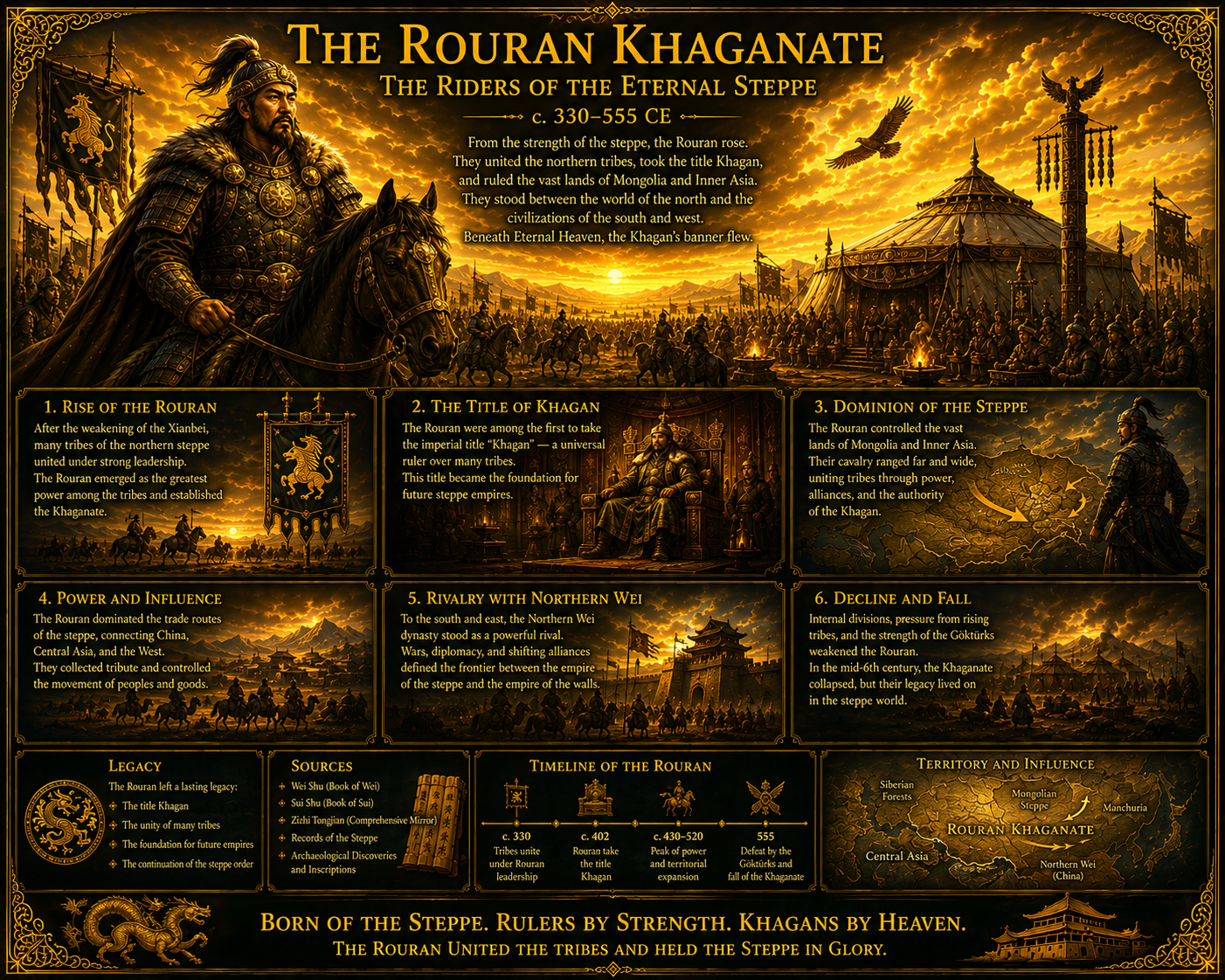
The emergence of the Rouran (柔然) in the fourth and fifth centuries CE marks one of the most important transformations in the political history of the Mongolian Plateau. Following the fragmentation of the Xianbei political world and the consolidation of the Tuoba-led Northern Wei in northern China, a new steppe confederation emerged across the regions north and south of the Gobi Desert. By the early fifth century, the Rouran had developed into a major Inner Asian imperial power whose political center lay on the Mongolian Plateau.
The Rouran are particularly important for the history of Inner Asia because their political system introduced or institutionalized a title that would subsequently become one of the most important sovereign titles across Eurasia: qaγan / khagan (可汗). The origin and linguistic history of the title remain debated, but the Rouran are among its earliest securely documented users in the historical record. Modern research has also identified a substantial number of Rouran titles whose vocabulary appears compatible with Mongolic and Old Turkic linguistic forms, although the linguistic identity of the Rouran as a whole cannot be established with certainty from the surviving evidence.
The central argument of this article is therefore not that the Rouran should simply be equated with a modern ethnic category. Rather, the Rouran should be understood as a major political transformation within the long history of the Eastern Steppe, emerging from a world already shaped by Xiongnu, Xianbei and other Inner Asian populations.
1. THE WORLD AFTER THE XIANBEI
The political landscape of Inner Asia changed profoundly between the third and fourth centuries CE. The Xianbei had produced several powerful confederations and dynasties, most importantly the Tuoba polity that eventually became Northern Wei. By the late fourth century, Northern Wei had established itself as a major power in northern China, while the northern regions of the Mongolian Plateau remained outside direct Northern Wei control.
It was in this broader environment that the Rouran emerged. Modern scholarship places their rise on both sides of the Gobi Desert during the late fourth century. This geographical setting is significant. The Rouran were not a state created on the Chinese frontier and then projected northward.
Their political center developed within the Inner Asian steppe zone itself.
Nikolay Kradin has consequently interpreted the Rouran Khaganate as part of a regional political system involving three major powers: the Southern dynasties in China, Northern Wei in northern China, and the Rouran imperial confederation in the territory of present-day Mongolia. The Rouran therefore occupied the strategic middle ground between the agricultural empires of East Asia and the pastoral world of the northern steppe.
2. THE YUJIULÜ HOUSE
The ruling dynasty of the Rouran is conventionally identified as the Yujiulü (郁久閭) clan. The early history of the dynasty is difficult to reconstruct because the surviving written evidence was recorded primarily by neighboring states, particularly Northern Wei and the southern Chinese dynasties. A recent study of Rouran sources emphasizes that the Wei Shu provides the principal Northern Wei account, while the Song Shu, Nan Qi Shu, and Liang Shu preserve additional information concerning relations between the Rouran and the southern Chinese states.
This source situation presents an important historiographical problem. The Rouran did not leave behind a surviving native chronicle comparable to the later written histories of the Mongol Empire. Consequently, much of what we know about them comes through the political perspectives of their neighbors. This makes it particularly important to distinguish between:
what the Rouran actually were,
and
how their Chinese neighbors described them.
3. SHELUN AND THE FOUNDATION OF THE KHAGANATE
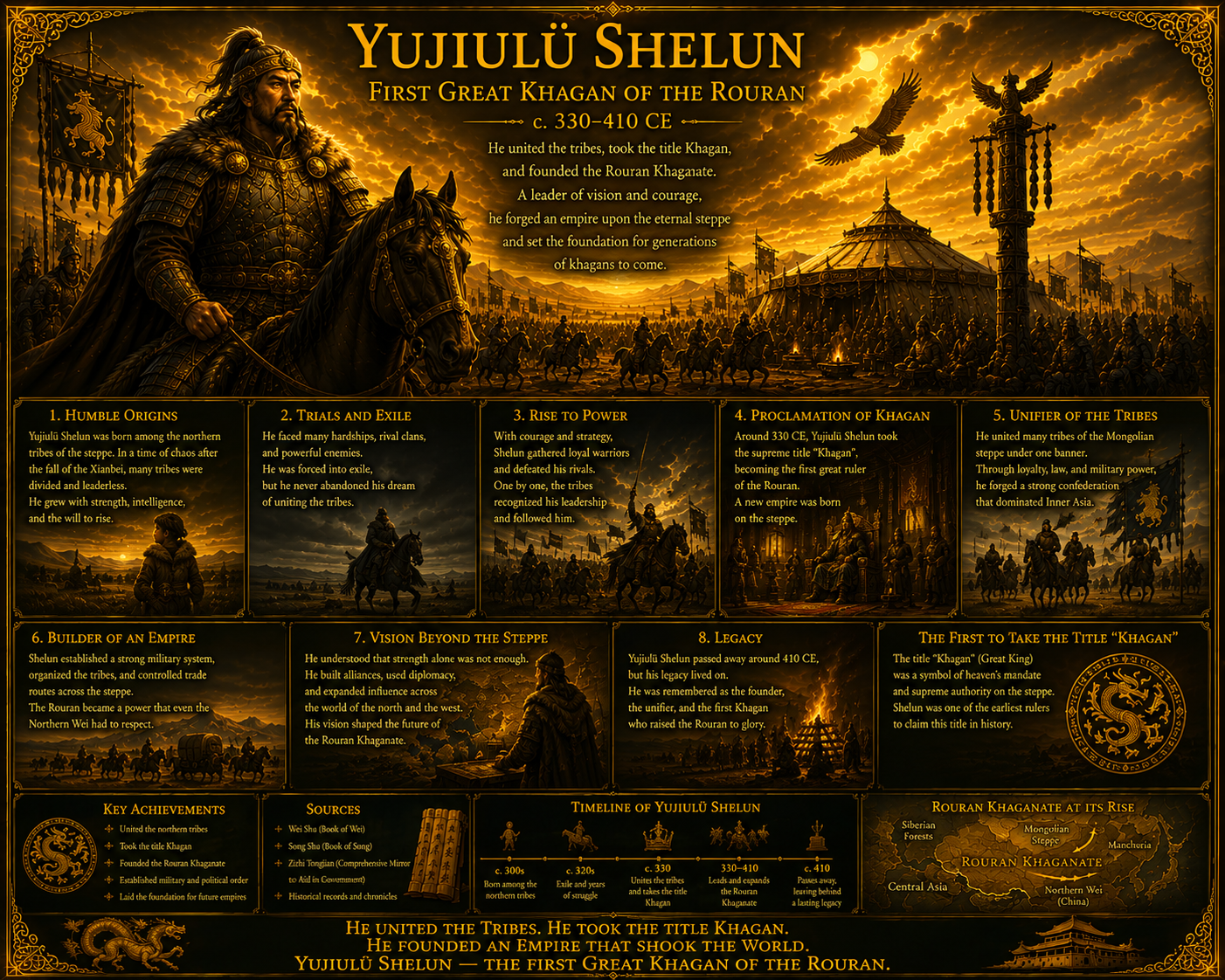
The decisive transformation occurred under Yujiulü Shelun (社崙). Shelun is generally regarded as the founder of the Rouran Khaganate as a centralized imperial confederation. The importance of Shelun lies not simply in his military victories but in the political reorganization associated with his rule.
Kradin’s reconstruction emphasizes that the Rouran developed an administrative and military system characteristic of the major nomadic empires of Eurasia, including a core-periphery structure, a two-wing organization and a military hierarchy based on the decimal system. This is a critical point. The Rouran were not merely a collection of tribes periodically united by a charismatic leader. They developed a political architecture capable of sustaining an empire.
4. THE DECIMAL MILITARY SYSTEM
The organization of the Rouran military reflects a broader Inner Asian political tradition. Kradin identifies a military hierarchy based on the decimal principle: units organized around tens, hundreds, thousands and larger formations. Such an organization allowed the ruler to transform a collection of pastoral communities into a coordinated military system. The significance of the system lies in its administrative function. The decimal organization was not merely a battlefield arrangement.
It provided a mechanism through which:
- military manpower could be counted;
- commanders could be appointed;
- subordinate groups could be incorporated;
- obligations could be organized;
- and the central ruler could exercise authority over a geographically dispersed population.
This became one of the recurring institutional features of Inner Asian empires.
5. THE EMERGENCE OF THE KHAGAN
The most historically consequential feature of Rouran political development was the emergence of the Khagan (可汗) as the supreme title of the ruler. The title is first securely documented in the Rouran political environment, although its ultimate linguistic origin remains disputed.
A Cambridge study notes that the terms xan, xayan / qaγan, and xatun are among titles associated with the Rouran and that these titles later became widespread among different steppe peoples, including the European Avars. At the same time, the study stresses that the ultimate etymology of these words remains controversial. This distinction is essential.
We can confidently say:
THE ROURAN USED THE TITLE KHAGAN.
We cannot confidently say:
THE ROURAN INVENTED THE WORD.
The first is historical evidence. The second remains an etymological hypothesis.
6. ROURAN KHAN TITLES AND LANGUAGE
The linguistic evidence is nevertheless unusually interesting. A detailed study of twelve Rouran khan titles concluded that several elements—such as tengryin, čori, böke, törü, and dobu—can be compared with vocabulary found in Mongolic and Old Turkic, while the authors argue that a substantial proportion of the identifiable vocabulary is closer to Mongolian forms. This is potentially significant for the historical relationship between the Rouran and later Mongolic-speaking populations. But the evidence must be handled cautiously. The Rouran language is not preserved in a large indigenous corpus. The titles survive primarily through Chinese transcription.
Consequently, linguistic reconstruction remains provisional. The safest conclusion is that the Rouran political vocabulary contains important Inner Asian linguistic elements, including forms that have strong Mongolic parallels, but the exact linguistic classification of the Rouran remains debated.
7. THE MONGOLIAN PLATEAU AS THE IMPERIAL CORE
The geographical position of the Rouran is fundamental to understanding their historical significance. Kradin describes the Rouran imperial confederation as being centered in Outer Mongolia, within the broader three-power system of fifth-century Inner Asia. This means that the Mongolian Plateau once again functioned as the political center of a major steppe empire.
The sequence is striking:
XIONGNU — MONGOLIAN PLATEAU
XIANBEI — EASTERN STEPPE / MONGOLIA AND NORTHERN CHINA
ROURAN — MONGOLIAN PLATEAU
The political names changed. The ruling houses changed. The imperial structures changed. But the Mongolian Plateau remained a central arena of state formation. This continuity should not be confused with the claim that the population was ethnically unchanged. The steppe was never static. It was a zone of migration, alliance, incorporation and intermarriage. But political geography demonstrates a striking persistence.
8. ROURAN AND NORTHERN WEI
The relationship between Rouran and Northern Wei was one of the most important geopolitical relationships in fifth-century Inner Asia. Northern Wei controlled northern China. Rouran controlled the northern steppe. Neither state could ignore the other. The Rouran could raid the northern Chinese frontier. Northern Wei could launch campaigns against the steppe. At other times, diplomacy and marriage created temporary stability.
Kradin characterizes the regional structure as involving Northern Wei as a semi-nomadic buffer empire between the agricultural south and the Rouran imperial confederation farther north. This relationship resembles the earlier Han–Xiongnu system in one important respect:
the agricultural empire and the steppe empire were strategically interdependent.
But the political institutions had evolved. The Rouran were now organized under a Khagan, rather than merely a Chanyu.
9. THE ROURAN ECONOMY AND “GIFTS”
Rouran foreign policy toward the agricultural states followed patterns characteristic of earlier Inner Asian empires. Kradin identifies several possible strategies—raiding, distant exploitation, tribute, migration and assimilation—and argues that the Rouran frequently used distant pressure, alternating military raids with periods in which agricultural states provided valuable gifts.
This is significant when compared with the earlier Xiongnu–Han relationship. The political economy of the steppe had not fundamentally disappeared. The Rouran could use mobility and military pressure to obtain access to agricultural wealth without attempting to conquer and administer every agricultural region directly. This was a form of imperial extraction adapted to steppe conditions.
10. THE WESTERN REGIONS
The Rouran were not confined to the immediate northern frontier of China. Their political and military interests extended westward into the regions of the northern Silk Road. Research on Rouran activity in the Western Regions indicates that successive khagans expanded their influence toward the northern Tianshan grasslands and the oasis regions around Hami and Turfan, including control or effective influence over Yiwu and Gaochang at various stages. This demonstrates the geographic scale of the Khaganate.
The Rouran political system connected:
MONGOLIAN STEPPE
with
NORTHERN CHINA
and
CENTRAL ASIAN OASIS NETWORKS.
The empire therefore participated in both pastoral and trans-Eurasian economic systems.
11. THE ROURAN AS AN IMPERIAL CONFEDERATION
The term “tribal confederation” can be misleading if it implies a loose alliance without institutions.
Kradin explicitly describes the development as a transformation:
From tribal confederation to empire.
The distinction is important.
The Rouran political system possessed:
- a supreme Khagan;
- a ruling dynasty;
- military hierarchy;
- two-wing organization;
- core and peripheral zones;
- subordinate populations;
- diplomatic relations;
- economic extraction;
- and territorial expansion.
These are characteristics of an imperial system. The Rouran should therefore be studied alongside the Xiongnu and later Turkic Khaganates as part of a recurring Inner Asian imperial tradition.
12. THE QUESTION OF MONGOLIC IDENTITY
The linguistic question naturally raises the issue of whether the Rouran were Mongolic. The evidence is suggestive but not conclusive. The Rouran had close historical connections with Xianbei groups, and some scholars have proposed that at least portions of the Rouran population spoke a Mongolic language. A Cambridge review specifically notes that this possibility cannot be excluded, while emphasizing the limitations of the evidence. This is an important methodological distinction.
The statement:
“Some Rouran groups may have spoken a Mongolic language.”
is compatible with the current evidence.
The statement:
“All Rouran were Mongols in the modern ethnic sense.”
goes beyond the evidence. For a serious historical study, the first formulation is defensible; the second is not.
13. ROURAN AND THE LATER KHAGANATES
The historical importance of Rouran extends beyond their own empire. The title Khagan became one of the defining political titles of later steppe empires. The title appears among the later Turkic Khaganates and subsequently in numerous Inner Asian political traditions. The Cambridge review notes its later use among Hunnic groups and European Avars as well as other peoples of different linguistic backgrounds. This does not prove that every later Khaganate was directly descended from the Rouran. Political titles travel.
They can be adopted by conquerors. They can become prestigious symbols. But the Rouran represent one of the earliest historically documented political environments in which the title Khagan became central to imperial sovereignty. This is one of their greatest contributions to Eurasian political history.
14. THE FALL OF THE ROURAN
The Rouran Khaganate eventually faced a new political challenge from the Türrg groups. By the sixth century, the balance of power on the Eastern Steppe had changed. The Tureg developed their own imperial organization and ultimately defeated the Rouran.
In 552 CE, the Rouran Khaganate collapsed under the pressure of the emerging Türk polity.
The collapse should not, however, be interpreted as the disappearance of every person who had belonged to the Rouran political system. Empires collapse. Populations survive. Political identities change. Some groups are incorporated into new empires. Others migrate. Others become indistinguishable within new political communities. This is one of the central methodological lessons of Inner Asian history.
15. THE PROBLEM OF “DISAPPEARING PEOPLES”
The Rouran provide an excellent example of why the disappearance of a name from political history should not automatically be interpreted as demographic disappearance. After the destruction of the Rouran Khaganate, the name Rouran gradually disappears from the political record. But the populations formerly incorporated within the Khaganate did not simply cease to exist. Some were absorbed by the Turks. Some entered other steppe communities. Some moved toward Central Asia.
Others may have remained in the regions where they had previously lived. This makes it dangerous to construct historical narratives in which:
XIONGNU DISAPPEARED → XIANBEI ARRIVED
or
XIANBEI DISAPPEARED → ROURAN ARRIVED
or
ROURAN DISAPPEARED → TURKS ARRIVED.
The actual historical process was considerably more complicated. Political systems replaced one another. Populations overlapped. Languages changed. Elite identities changed. And new political names were imposed upon older populations.
CONCLUSION
The Rouran Khaganate occupies a pivotal position in the history of Inner Asia. It emerged after the transformation of the Xianbei political world and established itself across the Mongolian Plateau and neighboring regions. Under Shelun and his successors, the Rouran developed a sophisticated imperial confederation characterized by military hierarchy, two-wing organization, a core-periphery structure and long-distance economic extraction. Their most enduring political legacy may have been the prominence of the Khagan title.
Although the ultimate etymology remains disputed, the Rouran provide some of the earliest secure evidence for its use as a supreme steppe title. Their language remains uncertain, but linguistic analysis of surviving Rouran titles has identified substantial vocabulary that can be compared with Mongolic and Old Turkic forms, with some scholars finding particularly strong Mongolic parallels.
The fall of the Rouran in the sixth century did not mean that their entire population vanished. The political name disappeared. The people were incorporated into new political systems. And the title Khagan continued its extraordinary journey across Eurasia. The historical importance of the Rouran therefore lies not only in their empire but in what they reveal about the nature of Inner Asian history itself:
EMPIRES DID NOT REPLACE PEOPLES AS CLEANLY AS HISTORICAL CHRONICLES SUGGEST.
Political names changed. Ruling houses changed. Languages interacted. Populations mixed. But the Mongolian Plateau remained one of the great laboratories of Eurasian state formation. The Rouran were one of its most important imperial experiments.
FOOTNOTES
1. Nikolay N. Kradin, “From Tribal Confederation to Empire: The Evolution of the Rouran Society,” Acta Orientalia Academiae Scientiarum Hungaricae 58, no. 2 (2005): 149–169. Kradin places the Rouran Khaganate within a regional Inner Asian system involving Northern Wei, the southern Chinese states, and the Rouran confederation centered in Outer Mongolia.
2. 袁刚 (Yuan Gang), “柔然基本史料辨析” [Study on the Basic Document Materials of Rouran], Mongolian Studies 78 (2024): 127–146. The article identifies Wei Shu as the principal Northern Wei source for Rouran history and discusses the Song Shu, Nan Qi Shu, and Liang Shu as important sources for southern relations.
3. Scott Pearce, Northern Wei (386–534): A New Form of Empire in East Asia (Oxford: Oxford University Press, 2023). Pearce’s study emphasizes the Inner Asian origins and changing political identities of the Tuoba and the broader frontier world from which later steppe powers emerged.
4. Kradin, “From Tribal Confederation to Empire,” 149–169. Kradin describes the Rouran political system as having a core-periphery structure, two wings and a decimal military hierarchy.
5. Kang Junyoung and Lee Seonggyu, “Rouran Khan Titles Research,” The Oriental Studies 77 (2019): 131–159. The study examines twelve Rouran khan titles preserved in historical sources and discusses their linguistic interpretation.
6. Alexander Savelyev and Choongwon Jeong, “Early nomads of the Eastern Steppe and their tentative connections in the West,” Evolutionary Human Sciences 2 (2020). The authors note that some Rouran groups may have spoken a Mongolic language but emphasize the uncertainty of the evidence.
7. Savelyev and Jeong also discuss the proposed Rouran connection of xan, xayan/qaγan, and xatun, while stressing that the ultimate etymology remains disputed.
8. Kradin, “From Tribal Confederation to Empire,” especially the discussion of Rouran foreign policy toward agrarian states.
9. On Rouran activity in the Western Regions, see Yuan Gang, “The Historical Events of Rouran’s Administration of the Western Regions,” The Oriental Studies 76 (2019): 45–57. The study discusses Rouran expansion toward the northern Tianshan, Hami and Turfan regions.
10. Kradin, “From Tribal Confederation to Empire,” argues that the Rouran system possessed political characteristics typical of Eurasian nomadic empires rather than representing a loose tribal alliance.
11. Savelyev and Jeong caution against using later sixth- and seventh-century Brāhmī inscriptions as straightforward evidence for the ethnic composition of the earlier Rouran elite because of chronological problems.
12. Kang and Lee’s analysis of Rouran titles identifies several terms with parallels in both Mongolic and Old Turkic and argues that a substantial portion of the identifiable vocabulary has Mongolic parallels.
13. Pearce, Northern Wei, demonstrates the importance of treating Inner Asian political communities as historical actors in their own right rather than merely as objects of Chinese historiography.
14. The surviving evidence therefore supports describing Rouran as a major Inner Asian imperial confederation while leaving its precise ethnic and linguistic classification open to continued research.
Author's Thesis
ROURAN AS A CONTINUATION AND TRANSFORMATION OF THE EASTERN STEPPE IMPERIAL TRADITION
The Rouran Khaganate should be understood not as an isolated political episode situated between the Xianbei and the Türk Khaganates, but as a major continuation and transformation of the imperial tradition of the Eastern Steppe. Its emergence demonstrates that the Mongolian Plateau remained an important center of political organization, military mobilization, and imperial state formation long after the political dissolution of earlier steppe confederations.¹
The significance of the Rouran therefore lies not simply in the fact that they controlled a large territory during the fourth to sixth centuries CE. More fundamentally, the Rouran transformed an existing steppe political tradition into a new institutional configuration. Under Yujiulü Shelun, the Rouran established a centralized imperial confederation, reorganized military manpower according to hierarchical and decimal principles, divided political authority into wings, and adopted the title Khagan (可汗) as the supreme designation of sovereignty.²
This development is particularly important because the Rouran emerged within an already highly structured Inner Asian political environment. Their rise was closely connected with the triangular geopolitical system formed by the Rouran in the northern steppe, the Tuoba/Northern Wei polity in northern China, and the Southern dynasties farther south. The Rouran were therefore not simply a peripheral population reacting to Chinese political developments; they constituted one of the principal powers of the regional international system.³
1. THE MONGOLIAN PLATEAU AS A CENTER OF POLITICAL CONTINUITY
The political history of the Mongolian Plateau cannot adequately be described as a succession of unrelated peoples entering and leaving an otherwise empty geographical space.
The archaeological and historical record instead reveals a region repeatedly capable of producing large-scale political formations. The Xiongnu established an imperial confederation in the late third century BCE; Xianbei political formations subsequently became dominant across much of the Eastern Steppe and northern China; the Rouran then established their own imperial confederation centered on the Mongolian Plateau; and the Türk Khaganate emerged in the sixth century as the next major steppe empire.⁴
This sequence does not mean that the populations of these political formations were identical. Nor does it demonstrate an uninterrupted ethnic lineage. The more defensible historical interpretation is that successive political formations inherited, transformed, and competed over institutions, territories, military practices, elite traditions, and populations that had already developed within the Eastern Steppe.
The Rouran are particularly important within this process because their political system demonstrates that the Eastern Steppe continued to function as an autonomous center of imperial formation rather than merely as a frontier of Chinese civilization. Kradin’s analysis explicitly places the Rouran imperial confederation in Outer Mongolia within the wider political structure of fifth-century Inner Asia.⁵
2. FROM XIANBEI POLITICAL FRAGMENTATION TO ROURAN IMPERIAL FORMATION
The emergence of the Rouran occurred after major transformations within the Xianbei political world. The Tuoba established Northern Wei in northern China, while political competition continued across the northern steppe. Within this environment, Yujiulü Shelun consolidated a number of groups and in 402 CE established the Rouran imperial confederation.⁶ According to the reconstruction of Nikolay Kradin, Shelun’s political achievement involved more than military conquest. He reorganized the population and military forces of the Rouran, established hierarchical units, required registration of warriors, and introduced rules governing military conduct.⁷
This is precisely the point at which the Rouran should be understood as an imperial formation rather than simply a tribal coalition. The political authority of the Khagan became capable of organizing manpower beyond the immediate kinship structures of individual groups. The state consequently acquired an institutional capacity that could survive the death of individual leaders and incorporate populations of different origins.
3. THE KHAGAN AS A NEW FORM OF STEPPE SOVEREIGNTY
One of the most important elements of the Rouran political transformation was the prominent use of the title Khagan (可汗). The historical evidence connects the Rouran political system with the title qaγan / khagan, which subsequently became one of the defining titles of Eurasian steppe sovereignty.⁸
The ultimate etymology of khagan, however, remains disputed. This distinction is essential. The evidence allows us to state with confidence that the title was associated with the Rouran political world and subsequently became widespread among other steppe powers. It does not allow us to establish with certainty that the Rouran “invented” the word or that its linguistic origin belongs exclusively to one later language.⁹
Research on Rouran royal titles has nevertheless identified several terms whose forms have been compared with Mongolic and Old Turkic vocabulary. Kang Junyoung and Lee Seonggyu analyzed twelve Rouran khan titles and argued that terms such as tengryin, čori, böke, törü, and dobu show parallels with Mongolic and Old Turkic, while they identify a particularly substantial Mongolic component in the material they examine.¹⁰
The linguistic evidence therefore strengthens the importance of the Rouran for the history of the Mongolic-speaking world, but it should not be converted into an absolute ethnic equation.
4. POLITICAL CONTINUITY DOES NOT MEAN ETHNIC IDENTITY
The central thesis of this article requires an important methodological distinction.
Political continuity is not the same thing as ethnic continuity.
The formula
XIONGNU → XIANBEI → ROURAN → TÜRK
should therefore not be interpreted as:
“the same people changed their names four times.”
Such an interpretation would exceed the evidence. The sequence is better understood as a succession of political formations operating within an interconnected Eastern Steppe world. Populations moved. Groups were incorporated. Political elites were replaced. Languages interacted. Marriage connected ruling houses. Military confederations incorporated previously independent communities. And defeated populations could be absorbed into the victorious political system. This model explains why political continuity can coexist with substantial demographic change. The Eastern Steppe therefore functioned less like a series of isolated civilizations and more like a continually transforming political ecosystem.
5. THE ROURAN AS AN IMPERIAL SYSTEM
The Rouran political system displays several characteristics associated with the wider tradition of Inner Asian nomadic empire. Kradin identifies a core-periphery structure, a two-wing political organization, a military hierarchy based on the decimal principle, and a system of extracting resources from neighboring agricultural societies.¹¹ These institutions allowed the Rouran Khaganate to maintain political control across an enormous geographical area without requiring the permanent settlement of its population in agricultural cities.
The empire was therefore adapted to the ecological and economic conditions of the steppe. Mobility itself became a political resource. Military organization allowed the Khagan to mobilize dispersed populations. And the geographical separation between the steppe political center and agricultural frontier did not prevent imperial control; instead, it became part of the political system.
6. THE ROURAN AND THE AGRICULTURAL WORLD
Rouran relations with Northern Wei and the Chinese states demonstrate another important aspect of steppe imperial continuity. The Rouran did not have to conquer and directly administer every agricultural territory in order to obtain economic benefits from it. Instead, their political strategy could combine military pressure, raids, diplomacy, and the extraction of valuable gifts from neighboring states.¹²
Kradin describes this as a form of distant exploitation, in which periods of military pressure alternated with periods of diplomatic accommodation and the receipt of substantial gifts.¹³
Such a system was not simply an economic necessity. It was also a form of political diplomacy. The ability of the Khagan to force a powerful agricultural state to negotiate from a position of weakness was itself evidence of imperial sovereignty.
7. THE ROURAN AND THE NORTHERN WEI
The relationship between Rouran and Northern Wei provides perhaps the clearest evidence that the Rouran were a major international power. Northern Wei was not simply confronting an undefined “barbarian frontier.” It was interacting with another organized imperial polity. The Rouran occupied the northern steppe, while Northern Wei controlled extensive territories in northern China. Their relationship consequently involved warfare, diplomacy, strategic competition, and periods of accommodation.¹⁴
This geopolitical structure is significant because it challenges older interpretations in which Chinese dynasties appear as the primary actors while steppe societies appear merely as external threats. The Rouran were themselves participants in the international politics of Inner Asia.
8. THE ROURAN AND THE MONGOLIC QUESTION
The linguistic identity of the Rouran remains one of the most difficult questions in the field. Some modern scholars have argued that at least some Rouran groups may have spoken a Mongolic language, partly because of their historical connections with Mongolic-speaking Xianbei groups. Savelyev and Jeong, however, emphasize that the evidence remains insufficient to establish a definitive linguistic identity for the entire Rouran population.¹⁵
This uncertainty should not be treated as a weakness of Rouran studies. Rather, it demonstrates the necessity of distinguishing between:
language,
political identity,
ethnicity,
and
dynastic identity.
A political confederation could contain communities speaking different languages. A ruling house could adopt titles from another linguistic tradition. And a population could change its political identity without disappearing demographically. The Rouran therefore provide an excellent case study for understanding how Inner Asian identities were historically constructed.
9. THE ROURAN AS A TRANSFORMATION OF THE XIONGNU MODEL
The Rouran political system also demonstrates important structural parallels with the earlier Xiongnu imperial formation.
Both systems were based upon:
- mobile pastoral populations;
- centralized supreme rulers;
- hierarchical military organization;
- incorporation of subordinate groups;
- relations with agricultural empires;
- and the extraction of resources from sedentary regions.
Yet the Rouran were not simply “the Xiongnu under another name.” Their institutions developed under different historical circumstances. The political environment of the fifth century included powerful Chinese dynasties, Central Asian networks, and increasingly complex interactions between steppe and agricultural societies. Thus, the Rouran inherited an imperial tradition while simultaneously transforming it. This precisely why the word continuation must always be accompanied by transformation.
10. THE ROURAN AS A NEW IMPERIAL ORDER
The Rouran were therefore not merely the “people who came after the Xianbei.” They created a new political order.
Their importance lies in the combination of:
STEPPE MOBILITY
MILITARY ORGANIZATION
IMPERIAL HIERARCHY
KHAGAN SOVEREIGNTY
DIPLOMATIC POWER
and
CONTROL OF A TRANSREGIONAL POLITICAL SYSTEM.
Their empire demonstrated that the Mongolian Plateau could once again become the center from which an imperial political system projected power across Inner Asia.¹⁶
The Rouran should consequently be placed within the same broad historical problem as the Xiongnu, Xianbei, Türk, Uyghur, and later Mongol empires:
How did political systems repeatedly emerge from the Eastern Steppe and transform the political order of Eurasia?
The answer cannot be reduced to ethnicity. It requires the study of ecology, military organization, political institutions, economic exchange, elite networks, and cultural transmission.
11. THE TRANSITION TO THE TÜRK KHAGANATE
The collapse of the Rouran Khaganate in the sixth century provides the final stage of this transformation. The rise of the Türk polity altered the political balance of the Eastern Steppe, and in 552 CE the Rouran political order was defeated by the Turks.¹⁷
Yet political defeat did not necessarily mean demographic disappearance. The fall of an empire removes a political structure. It does not erase every individual who belonged to it. Former Rouran populations could be incorporated into new political formations, while elites, military traditions, titles, and institutions could survive in transformed forms. The title Khagan provides one of the clearest examples.
The title became central to the subsequent Türk imperial tradition and later spread across a much wider Eurasian world. Encyclopaedia Iranica notes that the title was used among various Xianbei-derived groups, including the Rouran, and later became prominent among the Turks and other steppe peoples.¹⁸
Thus, one of the most visible elements of Rouran political sovereignty survived the collapse of the Rouran state itself.
12. AUTHOR’S THESIS
The evidence therefore supports the following interpretation:
The Rouran Khaganate was a continuation and transformation of the Eastern Steppe imperial tradition, not an isolated political episode between the Xianbei and the Türk.
Its political center was located within the Mongolian Plateau and its wider steppe environment.¹⁹
Its rulers developed an imperial system based upon hierarchical military organization, core-periphery relations, two-wing political organization, and the extraction of resources from neighboring agricultural societies.²⁰
Its rulers employed the title Khagan, a designation that subsequently became one of the most important symbols of steppe sovereignty across Eurasia.²¹
Its political relations extended beyond the steppe itself, encompassing Northern Wei, the Southern Dynasties, and Central Asian regions.²²
Most importantly, the Rouran demonstrate that the Eastern Steppe repeatedly generated large-scale political systems from within its own historical environment.
The historical sequence should therefore be represented as:
XIONGNU → XIANBEI → ROURAN → TÜRK
but with an essential qualification:
This is a sequence of political transformations, not a claim of uninterrupted ethnic identity.
The populations of these empires were neither completely identical nor completely unrelated. They existed within overlapping networks of migration, incorporation, alliance, warfare, marriage, linguistic interaction, and political succession. The Rouran stand precisely at the center of this process. They inherited elements of an older Eastern Steppe political tradition. They transformed those elements into a new imperial structure. And their political innovations, above all the institutional prominence of the Khagan, became part of the vocabulary of later Eurasian empire. The Rouran were therefore not simply the people who came after the Xianbei.
They were the creators of a new imperial order on the Mongolian Plateau.
FOOTNOTES
1. Nikolay N. Kradin, “From Tribal Confederation to Empire: The Evolution of the Rouran Society,” Acta Orientalia Academiae Scientiarum Hungaricae 58, no. 2 (2005): 149–169. Kradin explicitly interprets the Rouran formation as an imperial confederation centered in Outer Mongolia and analyzes it within the broader political structure of Inner Asia.
2. Kradin, “From Tribal Confederation to Empire,” 149–169. His analysis identifies the Rouran core-periphery structure, two-wing organization, decimal military hierarchy, and the political significance of the Khagan title.
3. Kradin describes the fifth-century regional structure as involving the Southern Song, Northern Wei/Toba Wei, and the Rouran imperial confederation in Outer Mongolia.
4. For the broader Eastern Steppe sequence and the relationship between Xianbei-derived formations and the Rouran, see Alexander Savelyev and Choongwon Jeong, “Early Nomads of the Eastern Steppe and Their Tentative Connections in the West,” Evolutionary Human Sciences 2 (2020).
5. Kradin, “From Tribal Confederation to Empire.”
6. Kradin reconstructs Shelun’s consolidation of Rouran groups and the establishment of the imperial confederation in 402 CE.
7. Ibid. Kradin discusses Shelun’s reorganization of the military-administrative structure, registration of warriors, hierarchical organization, and regulations governing military conduct.
8. Alexander Savelyev and Choongwon Jeong note that χan, χaγan, and xatun are titles that have been proposed as having an early Rouran connection and that these titles subsequently appeared among diverse steppe populations.
9. Encyclopaedia Iranica, “Khagan.” The etymology of khagan remains unclear, and the title cannot securely be assigned as exclusively Mongolic, Turkic, or Iranian in origin.
10. Kang Junyoung and Lee Seonggyu, “Rouran Khan Titles Research,” The Oriental Studies 77 (2019): 131–159. Their study analyzes twelve Rouran titles and identifies vocabulary with Mongolic and Old Turkic parallels, while arguing that much of the analyzable vocabulary has Mongolic parallels.
11. Kradin, “From Tribal Confederation to Empire.”
12. Ibid. Kradin identifies distant exploitation, plunder, tribute, migration and assimilation among the major strategies available to Inner Asian nomadic states and emphasizes the Rouran use of distant pressure.
13. Ibid.
14. On the broader Northern Wei political environment and the establishment of state institutions under the Tuoba, see Scott Pearce, Northern Wei (386–534): A New Form of Empire in East Asia (Oxford University Press, 2023), especially chapter 6.
15. Savelyev and Jeong caution that the linguistic identity of the Rouran cannot be established conclusively, although they consider it possible that some Rouran groups spoke a Mongolic language, particularly given their historical connection with Mongolic-speaking Xianbei.
16. Kradin’s analysis supports treating the Rouran as an imperial confederation rather than merely a temporary tribal alliance.
17. The Rouran defeat by the Türk polity and the subsequent transformation of the Eastern Steppe political order are discussed in the wider literature on the Rouran and early Turks. The surviving evidence supports the date 552 CE for the collapse of Rouran supremacy.
18. Encyclopaedia Iranica, “Khagan,” notes the use of the title among Xianbei-derived groups including the Rouran and its subsequent transmission into Turkic and other steppe political traditions.
19. Kradin explicitly locates the Rouran imperial confederation in Outer Mongolia within the fifth-century Inner Asian political system.
20. Ibid.
21. Kang and Lee, “Rouran Khan Titles Research”; Savelyev and Jeong, “Early Nomads of the Eastern Steppe.”
22. Kradin, “From Tribal Confederation to Empire,” and the broader discussion of Rouran relations with Northern Wei and the Western Regions.
Core thesis for the ImperialGG series
XIONGNU → XIANBEI → ROURAN → TÜRK