
WHO IS “WE”?
By Altanbagana Baatar
DBA Candidate| Independent Historian
ImperialGG Historical Research Seriers
10 October 2026
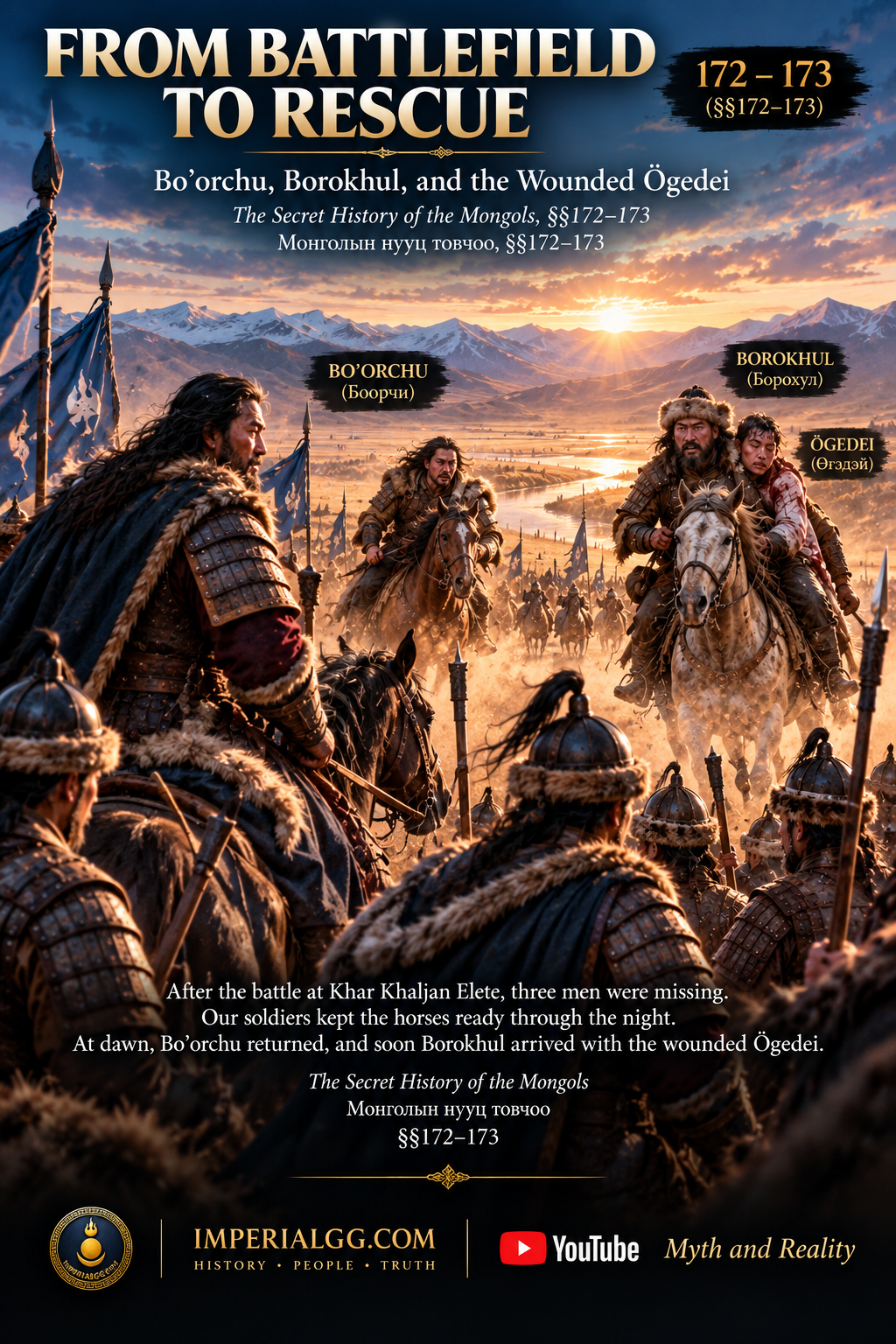
The Missing Companions, the Ready Horses, and the Narrative Voice of the Secret History of the Mongols
The Secret History of the Mongols (Монголын нууц товчоо), §§172–173
ABSTRACT
Sections 172–173 of The Secret History of the Mongols (Монголын нууц товчоо) recount the events following the battle at Khar Khaljan Elete (Хархалзан элээт), when Ögedei (Өгэдэй), Bo’orchu (Боорчи), and Borokhul (Борохул) are found to be missing from Temüjin’s forces. The narrative describes the morning roll call, the preparation of horses during the night, the expectation of a possible enemy pursuit, and the eventual return of Bo’orchu and Borokhul with the wounded Ögedei. Beyond its military and biographical significance, this episode raises an important narratological question: who is included when the text refers to “our soldiers” and speaks of “us” as a collective? The first-person plural expressions may preserve the perspective of a community closely connected to Temüjin’s forces, but determining whether they indicate personal eyewitness participation, collective memory, or a literary narrative voice requires comparison with other passages of the chronicle.
Keywords: The Secret History of the Mongols; Монголын нууц товчоо; narrative voice; first-person plural; “we”; “our soldiers”; Temüjin; Ögedei; Bo’orchu; Borokhul; military history.
1. THE HISTORICAL SEQUENCE: THREE MEN ARE MISSING
Following the fighting at Khar Khaljan Elete (Хархалзан элээт), Temüjin (Тэмүжин) and his followers move away from the battlefield and spend the night elsewhere. Section 172 begins with the men remaining prepared for possible renewed fighting. At daybreak, when the roll is called, three important figures are discovered to be missing: Ögedei, Bo’orchu, and Borokhul. Temüjin expresses confidence that Bo’orchu and Borokhul have remained with Ögedei and will not abandon one another, whether alive or dead.
This moment is significant because the narrative does not immediately explain the missing men’s whereabouts. Instead, it records the uncertainty experienced by the group, Temüjin’s assessment of the relationships among the three men, and the military preparations maintained during the night. The missing companions are not merely names absent from a list; their disappearance creates a practical problem for a force that has just fought a battle and may be pursued again.
The subsequent events resolve that uncertainty in stages. Bo’orchu returns first and explains how the loss or injury of his horse forced him to continue on foot before finding another mount and following the tracks of his companions. Borokhul arrives later, carrying the wounded Ögedei behind him. Ögedei has been struck in the neck by an arrow, and Borokhul has undertaken the difficult task of bringing him back alive. The episode thus moves from a collective discovery of absence to the return of two companions and the rescue of a wounded member of Temüjin’s family.
2. “OUR SOLDIERS”: THE NARRATIVE’S COLLECTIVE POSITION
The passage contains a detail that deserves attention beyond its immediate military context. During the night, the text states that “our soldiers” prepared their horses, while Temüjin declared that if the enemy pursued them, they would fight. The Mongolian wording that you have identified—“манай цэргүүд морийг бэлэн барьж хононо”—places the preparation of the horses within the group’s shared experience. The narrative does not describe the preparation merely as something that Temüjin’s soldiers did; it presents the soldiers through a collective possessive expression, “манай,” corresponding to “our” in English translation.
The distinction is important. In the immediate narrative situation, “our soldiers” refers to the force associated with Temüjin and the people who have withdrawn from the battlefield. The phrase therefore establishes a collective viewpoint within the account. The text presents the group’s readiness, its uncertainty about the missing men, and its expectation of possible enemy pursuit as connected elements of the same situation.
The historical question is whether this collective expression reflects only a conventional narrative style or whether it preserves a more specific relationship between the narrator and the military community being described. A narrator who repeatedly speaks of the forces as “our soldiers” may be employing the language of a group whose identity is central to the narrative. If the same first-person perspective recurs in passages containing detailed knowledge of camp routines, military movements, and collective decisions, the pattern becomes worth examining as evidence of the narrator’s relationship to the world represented in the chronicle.
However, the possessive expression alone cannot establish that the writer personally spent that night with Temüjin’s army. A text may preserve the language of a historical group through oral transmission, later composition, or a literary convention that places the narrator inside the community being described. The appropriate conclusion at this stage is therefore that the passage provides evidence of an internally positioned collective narrative voice, while the historical identity of that voice remains an open question.
3. FROM “OUR SOLDIERS” TO “WE SHALL DEMAND THEM”
The significance of the passage becomes clearer when the collective language is read alongside the response to the three missing men. As you point out, the Mongolian account does not stop at recording their absence and the preparation of horses; it also introduces the possibility that the enemy may have taken them and the intention to demand them back. The collective perspective therefore extends from the group’s military readiness to its understanding of the missing men as members of its own community.
The underlying logic is straightforward but historically meaningful: the men are missing after a battle, the opposing force remains a potential threat, and Temüjin’s followers must be prepared both to fight and to recover their companions. The language of “we” expresses a shared position in relation to the enemy. The missing men are not treated simply as individuals whose fate is unknown; their absence creates an issue for the group as a whole.
For the narratological inquiry, the important point is the relationship between the collective possessive “манай” and the first-person plural “бид.” The first identifies the soldiers as belonging to the group from whose perspective the events are being narrated; the second identifies a collective subject capable of acting, demanding, or fighting. If both forms occur in the Mongolian text in the manner described, they should be recorded separately and then examined together. Their grammatical difference matters, but their shared reference to a collective may reveal a consistent pattern in the narrative’s representation of group identity.
The precise wording of the relevant sentence must remain anchored to the Mongolian edition. English translations differ in their treatment of implied subjects, possessive expressions, and direct speech, and a translated “our” or “we” may sometimes reflect a translator’s decision to make the original construction explicit. For this reason, the Mongolian text should be the primary evidence, with the English translations used for comparison rather than as substitutes for the original wording.
4. THE RETURN OF BO’ORCHU AND BOROKHUL
The return of Bo’orchu and Borokhul resolves the uncertainty that has shaped the preceding passage. Bo’orchu’s explanation describes the practical consequences of combat: his horse has been lost or rendered unusable, he has had to continue on foot, and he has eventually obtained another mount and followed the tracks of his companions. His return is therefore not represented as instantaneous or effortless; it involves recovering his ability to travel and finding the route taken by the force.
Borokhul’s arrival provides a different but complementary account of loyalty. He returns carrying the wounded Ögedei, whose neck has been pierced by an arrow. The narrative describes Borokhul’s efforts to preserve Ögedei’s life during the journey, including the removal of blood from the wound. Temüjin responds immediately to his son’s condition, ordering treatment and drink to be brought.
The episode therefore links the collective concern expressed during the night to the physical return of the missing men. Bo’orchu’s account explains his separation and return; Borokhul’s actions demonstrate the risks undertaken to protect a wounded companion. Together, their stories show how the chronicle represents loyalty through concrete conduct rather than through declarations alone.
This sequence also helps explain why the earlier use of “our soldiers” deserves close reading. The collective subject is not an abstract political label detached from individual experience. It is the group whose members are counted, whose horses are prepared, whose possible pursuit by the enemy is anticipated, and whose missing companions are expected to return or be recovered.
5. THE QUESTION OF THE NARRATOR: WAS THE AUTHOR PRESENT?
The strongest version of the hypothesis would be that the narrator personally belonged to Temüjin’s military circle and witnessed the events described. The passage offers reasons to investigate that possibility: it contains a collective first-person perspective, details about the readiness of horses, a morning roll call, concern about missing companions, and the group’s response to a potential enemy pursuit. These are elements of camp life presented from within the collective experience of the army.
Nevertheless, three different claims must be distinguished.
First, the text adopts an internal collective viewpoint. This is the most directly supported interpretation of the language “our soldiers” and the collective response to the missing men.
Second, the narrative may preserve knowledge originating in the historical military community. The concrete sequence of events and the practical details of the camp make this a reasonable research hypothesis, although the passage alone cannot determine whether the information was transmitted by an eyewitness or through later accounts.
Third, the author personally witnessed the events. This is a stronger historical claim, and it cannot be established solely from first-person plural expressions. Establishing it would require a broader pattern of evidence, including consistent shifts between narration and direct speech, recurring expressions of collective identity, the narrator’s knowledge of events inaccessible to an external observer, and comparison with the chronicle’s other sections.
The distinction is essential because the identity of the historical author of The Secret History of the Mongols remains uncertain. The aim of this inquiry is not to assign authorship prematurely but to identify and test the textual evidence that may illuminate the relationship between the narrator and Temüjin’s community.
6. “WHO IS ‘WE’?”: COMPARISON WITH §§165 AND 168
This passage should be read alongside the earlier instances that prompted the research question. In §165, the narrative uses a first-person plural expression in connection with the treatment of Temüjin’s side by the Kereit ruling household. In §168, Mönglik (Мөнглик), speaking directly, refers to the earlier rejection of their request for Cha’ur Beki (Чаур бэхи) and says that those people had despised “us.”
The three passages do not necessarily use “we” in the same way. In §168, the pronoun belongs to Mönglik’s direct speech; in §172, “our soldiers” appears within the narrative account of the military community. The first task is therefore to identify the grammatical speaker and the people included in each expression, rather than assuming that every first-person plural form has the same referent.
The comparison becomes particularly interesting if the narrator’s collective wording in §165 and §172 consistently aligns with the group represented in Mönglik’s speech in §168. Such a pattern could indicate that the chronicle’s narrative voice is closely associated with the political and social community surrounding Temüjin. It might also reveal a literary practice in which the narrator’s collective language echoes the speech and self-understanding of the characters.
A further possibility is that the text preserves layers of collective memory, with the narrator and particular characters drawing upon a shared political identity without necessarily being the same speaker. These explanations are not interchangeable, and they should be evaluated through the complete wording of each passage and its surrounding context.
The working question is therefore not simply whether the word “we” recurs, but who speaks, who is included, and whether the narrative voice repeatedly places itself inside the same historical community. That is the central question of the “WHO IS ‘WE’?” series.
7. AUTHOR’S THESIS
Sections 172–173 present the aftermath of the Battle at Khar Khaljan Elete (Хархалзан элээт) through a sequence of collective uncertainty, military preparedness, and personal return. The discovery that Ögedei, Bo’orchu, and Borokhul are missing leads to concern for their fate; the preparation of horses and the expectation of enemy pursuit reveal the continuing readiness of Temüjin’s force; and the eventual return of Bo’orchu and Borokhul resolves the immediate crisis.
At the same time, the expression “манай цэргүүд” and the collective language associated with recovering missing companions provide a valuable clue for studying the narrative voice. They present the events from a viewpoint closely aligned with the group whose experiences are being recounted. When compared with the first-person plural expressions in §§165 and 168, this passage contributes to a larger inquiry into whether the chronicle preserves a consistent collective perspective rooted in Temüjin’s political and military community.
The evidence does not yet prove that the author personally witnessed the events. It does, however, justify a systematic examination of the text’s first-person plural expressions, the distribution of narrative and direct speech, and the relationship between the narrator’s collective identity and the characters’ own use of “we.” The historical identity of the narrator should emerge, if it can, from this cumulative textual analysis rather than from a single phrase.
SOURCE AND METHOD NOTE
The principal source is the Mongolian text of Монголын нууц товчоо, §§172–173, using the edition supplied for this series. English comparisons include Urgunge Onon’s translation, which renders the relevant passage with “our [soldiers],” and Christopher P. Atwood’s modern translation. These translations are useful for comparison, but the Mongolian wording remains decisive when examining the narrator’s grammatical person and collective point of view. <Cite refs={[“turn193383search12″,”turn193383search2”]}/>
For the continuing “WHO IS ‘WE’?” project, every relevant occurrence should be recorded with its section number, exact Mongolian wording, speaker, referent of “we/us/our,” narrative or direct-speech status, and possible connection with earlier or later passages. The aim is to build a cumulative textual record before proposing a conclusion about the narrator’s identity.
ImperialGG — HISTORY • PEOPLE • TRUTH