
Ulugh Beg’s Tārīkh-i arbaʿ ulūs (“History of the Four Uluses”)
By Altanbagana Baatar
DBA Candidate| Independent Historian
ImperialGG Historical Research Seriers
11 August 2026
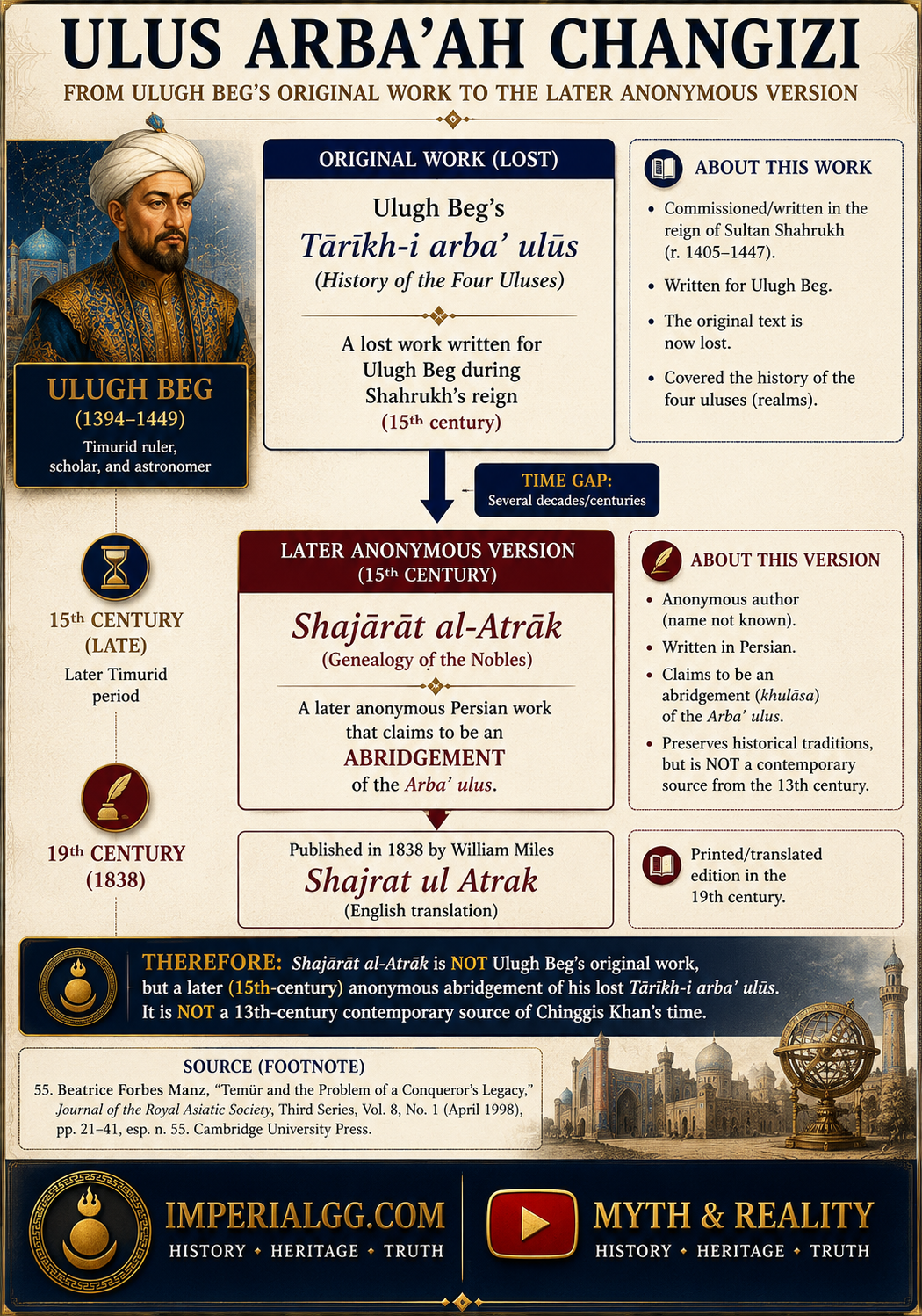
Ulugh Beg’s Tārīkh-i arbaʿ ulūs (“History of the Four Uluses”) was itself a lost work written for Ulugh Beg during the reign of Shahrukh. Beatrice Forbes Manz identifies it precisely in footnote 55 of her study in the Journal of the Royal Asiatic Society as “a lost work written for Ulugh Beg during Shahrukh’s reign.”
By contrast, Shajārat al-atrāk is described in the same footnote as “the later anonymous Persian work” that claims to be an abridgement of the Arbaʿ ulus. Thus, Shajārat al-atrāk should not be treated as Ulugh Beg’s own work, nor as a contemporary source from the time of Chinggis Khan. It is a later, anonymous Persian text claiming to preserve an abridged version of an earlier work that is itself now lost.
The source relationship can therefore be represented as:
Ulugh Beg’s Tārīkh-i arbaʿ ulūs
→ lost work written for Ulugh Beg during Shahrukh’s reign
→ later anonymous Persian work, Shajārat al-atrāk
→ claims to be an abridgement of the Arbaʿ ulus.
This distinction is important when evaluating passages attributed to Chinggis Khan in Shajārat al-atrāk. Such passages may preserve an earlier historical tradition, but the surviving text itself is not a contemporary thirteenth-century source, and its authorship and textual transmission must be treated with caution.
Footnote
- Beatrice Forbes Manz, “Temür and the Problem of a Conqueror’s Legacy,” Journal of the Royal Asiatic Society, Third Series, Vol. 8, No. 1 (April 1998), pp. 21–41, esp. n. 55.
Shajarat al-Atrak is not a clearly identified, contemporary source from the Mongol period. The surviving text is an anonymous later Persian work associated with the Ulus-i Arbaʿah tradition of Ulugh Beg and described in the British Museum catalogue as an abridged work based on Ulugh Beg’s history. Even the title “Shajarat al-Atrak” is problematic: the catalogue notes that the title was written on the manuscript flyleaf by William Erskine and does not appear in the text itself.