The Rong: Frontier Peoples of the Western Borderlands
By Altanbagana Baatar
DBA Candidate| Independent Historian
ImperialGG Historical Research Seriers
05 July 2026
Reconsidering the Western Frontier Between the Zhou World and Inner Asia
Introduction
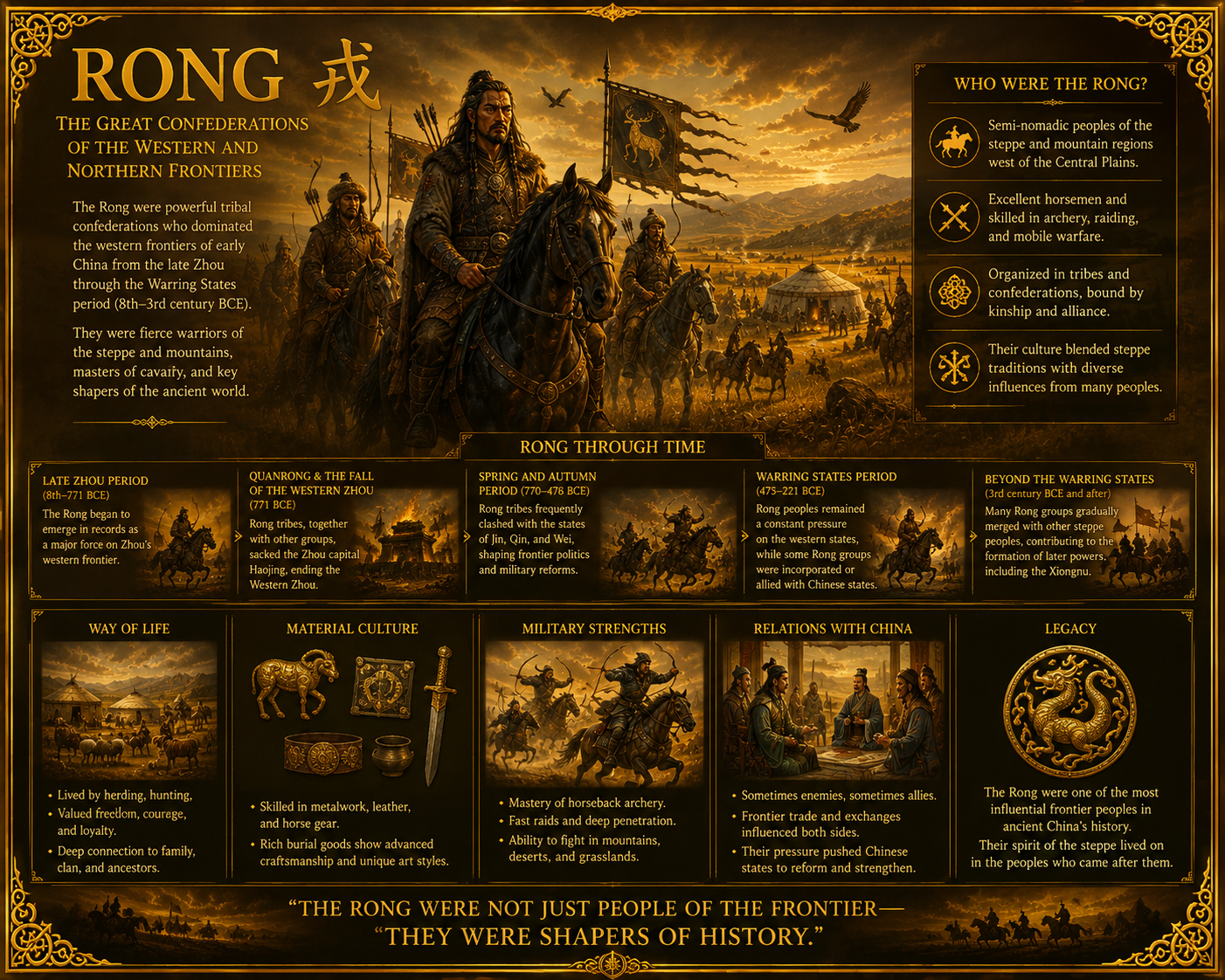
The Rong were among the most important frontier peoples recorded in the historical sources of ancient China. Appearing frequently in the sources of the Western Zhou, Spring and Autumn, and Warring States periods, the Rong were not a single tribe or unified nation but a broad designation applied to numerous populations inhabiting the western and north-western borderlands beyond the political core of the Zhou states.
The lands associated with the Rong extended across regions corresponding broadly to present-day Shaanxi, Gansu, Ningxia, and parts of Qinghai. Far from constituting a uniformly agrarian or fully integrated part of the Zhou world, these territories formed a vast frontier zone characterized by cultural diversity, mixed economies, seasonal mobility, and continual interaction between sedentary and mobile populations. Their position along the western corridors of northern China also connected them to the wider networks of Inner Asia and, ultimately, to the routes leading toward the Tarim Basin and the western steppe.
For centuries the Rong interacted with the Zhou states through warfare, diplomacy, trade, migration, and alliance. At times they threatened the political order of early China; at other times they served as intermediaries linking the Central Plains with the societies of the Inner Asian frontier. The most dramatic example of their historical importance came in 771 BCE, when the Quanrong participated in the sack of Haojing and the collapse of the Western Zhou dynasty, an event that transformed the political history of East Asia.
Traditional Chinese historiography often portrayed the Rong as “barbarians” beyond civilization. Modern scholarship, however, increasingly recognizes that the Rong represented a diverse and dynamic frontier world inhabited by numerous communities possessing their own political traditions, economic systems, and regional identities. Their history demonstrates that the western frontier of early China was neither empty nor peripheral, but rather a politically significant region whose peoples played a decisive role in shaping the development of both the Zhou states and the broader history of Inner Asia.
The study of the Rong therefore offers valuable insight into the formation of the western frontier, the limits of early Chinese political authority, and the long historical processes that connected the civilizations of the Central Plains with the wider world of Eurasia.
Footnotes
- Nicola Di Cosmo, Ancient China and Its Enemies: The Rise of Nomadic Power in East Asian History (Cambridge: Cambridge University Press, 2002). (page verification required).
- Gideon Shelach-Lavi, The Archaeology of Early China: From Prehistory to the Han Dynasty (Cambridge: Cambridge University Press, 2015); and Jessica Rawson, “The Northern Frontier of Late Bronze Age China,” in The Cambridge History of Ancient China: From the Origins of Civilization to 221 B.C., ed. Michael Loewe and Edward L. Shaughnessy (Cambridge: Cambridge University Press, 1999). (page verification required).
- Records of the Grand Historian, “Basic Annals of Zhou”; and Zuo Zhuan. (page verification required).
Historical Sources and Terminology
The term Rong (戎) occupies a prominent place in early Chinese historical literature, yet it did not refer to a single tribe, nation, or ethnic community. Rather, Rong functioned as a broad frontier designation applied to numerous populations inhabiting the western and north-western borderlands beyond the political core of the Zhou states.Its meaning evolved over time and often reflected the perspectives and classifications of Chinese authors rather than the self-identification of the peoples to whom the name was applied.
Early Chinese texts mention numerous Rong groups, including the Quanrong (犬戎), Xirong (西戎), Shanrong (山戎), and other regional communities occupying the mountains, river valleys, and frontier corridors of north-western China. These groups did not constitute a unified political entity. Instead, they represented a diverse frontier world composed of multiple societies that differed in political organization, economic practices, and regional traditions.
The territories associated with the Rong extended across much of present-day Shaanxi, Gansu, Ningxia, and parts of Qinghai. Archaeological and textual evidence indicates that these regions should not be viewed as uniformly agricultural or fully integrated into the Zhou world during the first millennium BCE. Rather, they formed a complex frontier zone inhabited by mixed populations practicing combinations of agriculture, pastoralism, hunting, and seasonal mobility.The later incorporation of these lands into successive Chinese empires should not obscure their earlier history as regions inhabited by numerous non-Zhou communities.
The geographical position of the Rong also gave them considerable historical importance. Their territories occupied the natural corridors linking the Central Plains with Inner Asia and the regions farther west, including the Hexi Corridor and the routes that ultimately connected northern China with the Tarim Basin. Through these corridors flowed people, animals, technologies, and cultural practices, making the western frontier one of the principal zones of interaction between the agrarian societies of China and the wider world of Eurasia.
The earliest references to the Rong appear in Western Zhou texts and bronze inscriptions, but they become increasingly prominent during the Spring and Autumn period, when frontier peoples played an active role in the political affairs of northern China. Sources such as the Book of Documents, the Book of Songs, the Zuo Zhuan, and later the Records of the Grand Historian preserve valuable information concerning their military activities and relations with the Zhou states.Nevertheless, these sources must be approached critically, for they were written entirely from the perspective of the settled states and frequently portrayed frontier peoples through cultural and political stereotypes.
Modern scholarship increasingly emphasizes the complexity of the term Rong. Rather than representing a single ethnic identity, the name appears to have encompassed numerous communities occupying a vast frontier zone between the Central Plains and Inner Asia. Understanding this terminology is therefore essential not only for reconstructing the history of the Rong themselves but also for understanding the broader processes of interaction, migration, and political transformation that shaped the western frontier of early China.
Footnotes
- Nicola Di Cosmo, Ancient China and Its Enemies: The Rise of Nomadic Power in East Asian History (Cambridge: Cambridge University Press, 2002). (page verification required).
- Zuo Zhuan; and Records of the Grand Historian. (page verification required).
- Gideon Shelach-Lavi, The Archaeology of Early China: From Prehistory to the Han Dynasty (Cambridge: Cambridge University Press, 2015); and Jessica Rawson, “The Northern Frontier of Late Bronze Age China,” in The Cambridge History of Ancient China: From the Origins of Civilization to 221 B.C., ed. Michael Loewe and Edward L. Shaughnessy (Cambridge: Cambridge University Press, 1999). (page verification required).
- Nicola Di Cosmo, Ancient China and Its Enemies; and Christopher I. Beckwith, Empires of the Silk Road: A History of Central Eurasia from the Bronze Age to the Present (Princeton: Princeton University Press, 2009). (page verification required).
- Book of Documents; Book of Songs; Zuo Zhuan; and Records of the Grand Historian.
Political and Military History
The Rong occupied a central place in the political and military history of early China. Throughout the Western Zhou and Spring and Autumn periods, numerous Rong groups interacted with the states of the Central Plains through warfare, diplomacy, trade, and migration. Far from being isolated tribes on the periphery of civilization, they were important political actors whose actions repeatedly influenced the balance of power in northern China.
The most dramatic example of Rong influence came in 771 BCE, when the Quanrong (犬戎), in alliance with the Marquis of Shen and other disaffected regional forces, attacked and sacked Haojing, the capital of the Western Zhou dynasty. During the assault, King You of Zhou was killed, and the political order that had dominated northern China for nearly three centuries collapsed. The destruction of Haojing marked the end of the Western Zhou and the beginning of the Eastern Zhou period, during which political authority shifted eastward and the regional states gradually emerged as the principal actors in Chinese politics.
Traditional historical accounts often explained this catastrophe through the personal failures of King You and the intrigues surrounding Bao Si and the royal succession. Yet the fall of the Western Zhou also reflected deeper structural transformations, including the weakening of royal authority and the growing military capabilities of frontier peoples. The participation of the Quanrong demonstrated that the western frontier was inhabited by societies capable of conducting large-scale military operations and decisively shaping the political destiny of early China.
Following the collapse of the Western Zhou, the Rong remained an influential force along the western frontier. Numerous Rong groups occupied strategically important regions extending from present-day Shaanxi to Gansu and Qinghai, controlling mountain valleys and frontier corridors linking the Central Plains with Inner Asia. Their geographical position enabled them to participate in long-distance networks of exchange while also posing a persistent military challenge to neighboring states.
The history of the state of Qin is particularly significant in this regard. Situated on the western frontier, Qin spent centuries interacting with neighboring Rong communities through conflict, alliance, migration, and cultural exchange. Some scholars have argued that Qin’s military traditions, frontier institutions, and territorial ambitions were shaped in part by these prolonged interactions with the Rong world. The rise of Qin therefore cannot be understood solely through developments within the Central Plains but must also be viewed within the broader context of the western frontier.
Over time, many Rong groups were conquered, incorporated into expanding states, or absorbed into new political formations. Others migrated westward or disappeared from the historical record altogether.Yet the disappearance of particular ethnonyms should not be mistaken for the disappearance of the peoples themselves. The frontier societies associated with the Rong continued to influence the historical development of north-western China and Inner Asia long after the name itself became less prominent in Chinese sources.
The military and political history of the Rong thus reveals a frontier world characterized by remarkable resilience, adaptability, and historical significance. Their interactions with the Zhou states transformed the political geography of early China and contributed to the emergence of new patterns of frontier organization that would shape the history of East Asia for centuries to come.
Footnotes
- Nicola Di Cosmo, Ancient China and Its Enemies: The Rise of Nomadic Power in East Asian History (Cambridge: Cambridge University Press, 2002). (page verification required).
- Records of the Grand Historian, “Basic Annals of Zhou”; and Zuo Zhuan. (page verification required).
- The Cambridge History of Ancient China. (page verification required).
- Gideon Shelach-Lavi, The Archaeology of Early China: From Prehistory to the Han Dynasty (Cambridge: Cambridge University Press, 2015). (page verification required).
- Yuri Pines, studies on Qin and frontier interaction. (specific page verification required).
- Thomas J. Barfield, The Perilous Frontier: Nomadic Empires and China (Cambridge, MA: Blackwell, 1989). (page verification required).
Society, Identity, and Scholarly Debates
Among the frontier peoples of early China, the Rong present one of the most difficult problems of historical interpretation. The term Rong (戎) did not denote a single tribe, language, or ethnic community. Rather, it encompassed numerous populations inhabiting the western and north-western borderlands of the Zhou world, many of whom likely possessed distinct political traditions, economic systems, and cultural identities.
Traditional Chinese historiography often portrayed the Rong as uncivilized peoples living beyond the boundaries of the Central Plains. Modern scholarship, however, increasingly rejects such characterizations and instead views the Rong as diverse frontier societies occupying a vast transitional zone between the agrarian states of northern China and the wider world of Inner Asia. Their geographical position made them important intermediaries in the movement of people, technologies, animals, and cultural practices across Eurasia.
The question of Rong ethnicity and language remains unresolved. Some scholars have suggested that certain Rong groups may have spoken early Tibeto-Burman languages, while others have proposed possible connections with Indo-European-speaking populations of the western frontier. Still others emphasize the likelihood that the term Rong encompassed communities of varied linguistic backgrounds whose only common feature was their location beyond the political boundaries of the Zhou states.
Archaeological evidence strongly supports this interpretation. Excavations throughout Shaanxi, Gansu, Ningxia, and Qinghai reveal a complex frontier world characterized by mixed economies and diverse cultural traditions. Many communities practiced combinations of agriculture, pastoralism, hunting, and seasonal mobility rather than the fully sedentary agricultural lifeways associated with the Central Plains. These regions therefore constituted a distinct frontier zone whose societies developed along trajectories different from those of the Zhou core.
The geographical position of the Rong also raises important questions concerning their connections with the wider world of Inner Asia. The western frontier corridors occupied by many Rong groups eventually linked northern China with the Hexi Corridor, the Tarim Basin, and the western steppe. Although direct historical connections between the Rong and the later peoples of Central Asia cannot presently be demonstrated, the archaeological record increasingly suggests that these regions participated in broader networks of exchange extending across Eurasia.
Another important issue concerns the political organization of the Rong. The surviving sources mention numerous Rong groups but provide little evidence for a unified Rong confederation. Instead, the available evidence suggests a mosaic of regional societies capable of forming temporary alliances and military coalitions when circumstances required. The participation of the Quanrong in the destruction of the Western Zhou capital demonstrates that at least some Rong communities possessed considerable political and military capabilities.
Modern scholarship therefore increasingly treats the Rong not as a single people but as a frontier category encompassing a wide range of populations inhabiting the western borderlands of early China. Their significance lies precisely in their diversity. They occupied one of the principal zones of interaction between the Central Plains and Inner Asia and played an essential role in the long historical processes that shaped the political and cultural landscape of ancient Eurasia.
Footnotes
- Nicola Di Cosmo, Ancient China and Its Enemies: The Rise of Nomadic Power in East Asian History (Cambridge: Cambridge University Press, 2002). (page verification required).
- Edwin G. Pulleyblank, “The Chinese and Their Neighbors in Prehistoric and Early Historic Times,” in The Origins of Chinese Civilization, ed. David N. Keightley (Berkeley: University of California Press, 1983). (page verification required).
- Christopher I. Beckwith, Empires of the Silk Road: A History of Central Eurasia from the Bronze Age to the Present (Princeton: Princeton University Press, 2009). (page verification required).
- Gideon Shelach-Lavi, The Archaeology of Early China: From Prehistory to the Han Dynasty (Cambridge: Cambridge University Press, 2015); and Jessica Rawson, “The Northern Frontier of Late Bronze Age China,” in The Cambridge History of Ancient China: From the Origins of Civilization to 221 B.C., ed. Michael Loewe and Edward L. Shaughnessy (Cambridge: Cambridge University Press, 1999). (page verification required).
- Nicola Di Cosmo, Ancient China and Its Enemies; and Christopher I. Beckwith, Empires of the Silk Road. (page verification required).
- Records of the Grand Historian, “Basic Annals of Zhou”; and Zuo Zhuan. (page verification required).
Legacy and Historical Significance
Although the name Rong gradually became less prominent in later historical sources, the historical significance of the Rong peoples endured long after the disappearance of particular tribal designations. For several centuries, the Rong remained among the most important inhabitants of the western frontier and played a decisive role in shaping the political, military, and cultural development of early China.
The destruction of the Western Zhou capital in 771 BCE demonstrated that frontier peoples could become decisive actors in the fate of dynasties and empires. The participation of the Quanrong in the sack of Haojing transformed the political geography of East Asia by ending the Western Zhou and inaugurating the Eastern Zhou period. Few frontier peoples of early China exercised such direct influence upon the course of Chinese history.
The Rong also played a significant role in the historical development of the western frontier itself. Their occupation of regions corresponding to present-day Shaanxi, Gansu, Ningxia, and parts of Qinghai illustrates that these territories were for centuries complex frontier zones inhabited by diverse non-Zhou populations rather than uniformly integrated components of the agrarian states of the Central Plains. The later expansion of imperial China into these regions should not obscure their earlier history as lands characterized by cultural diversity and frontier interaction.
Equally important was the role of the Rong as intermediaries between two worlds. Their territories occupied the principal corridors linking northern China with Inner Asia and the regions farther west. Through these frontier routes moved people, technologies, animals, and cultural practices that contributed to the long-term integration of Eurasia. Although direct connections between particular Rong groups and later Central Asian peoples cannot be demonstrated with certainty, the western frontier occupied by the Rong formed part of a broader zone of interaction extending far beyond the boundaries of the Zhou states.
The history of the state of Qin further illustrates the enduring legacy of the Rong. Centuries of interaction with neighboring frontier populations influenced Qin’s military traditions, frontier institutions, and methods of territorial expansion. In this sense, the emergence of the first imperial dynasty of China cannot be understood solely as a product of developments within the Central Plains but must also be viewed within the context of prolonged engagement with the western frontier.
The Rong therefore occupy an important place in the long history of the eastern Eurasian frontier. They were not merely peoples beyond the borders of early China but active participants in the historical processes that shaped both the civilizations of the Central Plains and the societies of Inner Asia. Their history reminds us that the frontiers of ancient Eurasia were dynamic regions of interaction, adaptation, and political creativity whose influence extended far beyond their immediate geographical boundaries.
Conclusion
The Rong remain among the most significant yet most misunderstood frontier peoples of early East Asian history. Rather than constituting a single ethnic nation, they represented a diverse collection of communities inhabiting the western and north-western borderlands between the Zhou states and Inner Asia.
Their participation in the fall of the Western Zhou, their long interaction with the state of Qin, and their occupation of the western frontier corridors demonstrate that they were major historical actors whose influence reached far beyond the limits of the Central Plains. The study of the Rong therefore provides valuable insight into the historical geography of early China, the complexity of frontier societies, and the long processes of interaction that connected East Asia with the wider world of Eurasia.
The Rong should consequently be understood not merely as “barbarians” beyond civilization but as essential participants in the making of early East Asian history and in the development of the frontier world that would later give rise to new political formations across Inner Asia.
Footnotes
- Nicola Di Cosmo, Ancient China and Its Enemies: The Rise of Nomadic Power in East Asian History (Cambridge: Cambridge University Press, 2002). (page verification required).
- Records of the Grand Historian, “Basic Annals of Zhou”; and Zuo Zhuan. (page verification required).
- Gideon Shelach-Lavi, The Archaeology of Early China: From Prehistory to the Han Dynasty (Cambridge: Cambridge University Press, 2015); and Jessica Rawson, “The Northern Frontier of Late Bronze Age China,” in The Cambridge History of Ancient China: From the Origins of Civilization to 221 B.C., ed. Michael Loewe and Edward L. Shaughnessy (Cambridge: Cambridge University Press, 1999). (page verification required).
- Christopher I. Beckwith, Empires of the Silk Road: A History of Central Eurasia from the Bronze Age to the Present (Princeton: Princeton University Press, 2009). (page verification required).
- Yuri Pines, studies on Qin and frontier interaction. (specific page verification required).
Author’s Thesis
This essay argues that the Rong were not a single ethnic people but a diverse collection of frontier societies inhabiting the western and north-western borderlands between the Zhou states and Inner Asia. Their territories, extending across regions corresponding to present-day Shaanxi, Gansu, Ningxia, and parts of Qinghai, demonstrate that these lands remained for centuries complex frontier zones inhabited by numerous non-Zhou populations rather than uniformly integrated components of the agrarian world of the Central Plains.
Furthermore, this study contends that the historical significance of the Rong extends beyond their role as adversaries of the Zhou. By occupying the principal western corridors of northern China, the Rong participated in the long processes of interaction that linked the Central Plains with Inner Asia and the wider Eurasian world. Their frontier environment also profoundly influenced the development of the state of Qin, whose prolonged interaction with Rong populations helped shape its military traditions and frontier institutions.
The later rise of Qin and the establishment of the first Chinese empire serve as an important reminder that the political unification of China emerged in part from a frontier state whose historical development was deeply intertwined with the peoples of the western borderlands. The history of the Rong therefore illuminates not only the limits of early Chinese political authority but also the central role of frontier societies in the making of imperial China.