
THE RENEWAL OF THE JIN WAR AND THE FALL OF JUNGDU
By Altanbagana Baatar
DBA Candidate| Independent Historian
ImperialGG Historical Research Seriers
13 November 2026
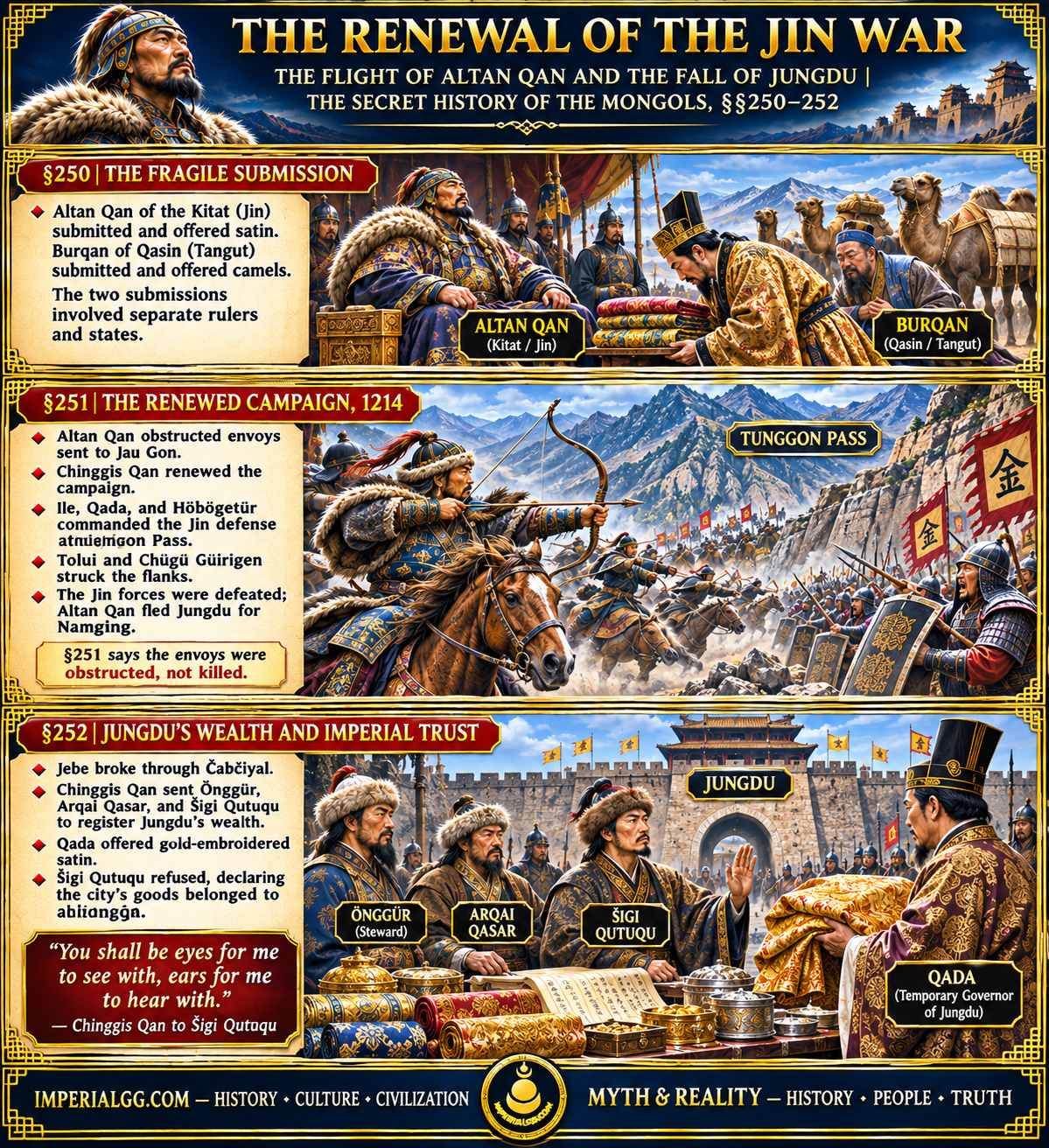
MONGOL MILITARY VICTORY, THE FLIGHT OF ALTAN QAN, AND THE PRINCIPLE OF IMPERIAL PROPERTY
An academic study of The Secret History of the Mongols, §§250–252
ABSTRACT
Sections 250–252 of The Secret History of the Mongols recount the renewal of the Mongol war against the Jin dynasty after the submission of its ruler, Altan Qan, in 1211. The narrative connects the breakdown of the earlier settlement, the obstruction of Mongol diplomatic envoys, the renewed campaign of 1214, the battle at Tunggon Pass, the defeat of the Jin commanders, and the flight of Altan Qan from Jungdu to Namging. It then shifts from the battlefield to the administration of conquered territory, describing Jebe’s capture of the strategic passage at Čabčiyal and the inventory of Jungdu’s wealth by Önggür, Arqai Qasar, and Šigi Qutuqu. The refusal of Šigi Qutuqu to accept gifts from Qada, the temporary governor appointed by Altan Qan, provides a revealing account of the relationship between imperial authority, property, official accountability, and loyalty to the ruler. This article argues that the three sections present military conquest and political administration as interconnected dimensions of Mongol imperial power.
Keywords: Chinggis Qan; Jin dynasty; Altan Qan; Aqutai; Jebe; Tunggon Pass; Jungdu; Namging; Tolui; Chügü Güirigen; Šigi Qutuqu; Mongol imperial administration.
INTRODUCTION
The relationship between the Mongol Empire and the Jin dynasty (1115–1234), known in Mongolian historical terminology as the Kitat people and their ruler as the Altan Qan, was not resolved by the first Mongol campaign of 1211. Although Chinggis Qan obtained the submission of the Jin ruler and received substantial quantities of satin, the political settlement did not eliminate the underlying military conflict. The Secret History of the Mongols records that the ruler of the Kitat, named Aqutai, subsequently obstructed Mongol envoys sent to Jau Gon. In response, Chinggis Qan renewed the campaign against the Kitat in the Year of the Dog, identified as 1214 in the chronicle. The ensuing narrative describes a major engagement at Tunggon Pass, the defeat of the Jin commanders, the flight of Altan Qan from Jungdu, and the subsequent occupation and administration of the city.
Angkor Database+1
These events are significant not only for the military history of the Mongol conquest of northern China but also for the study of Mongol political authority. The account moves from the conduct of diplomatic relations to the deployment of armies, from the destruction of an opposing military force to the appropriation and registration of urban wealth. Its final episode, involving Šigi Qutuqu’s refusal to accept gifts from Qada, reveals an important principle of the emerging imperial administration: property belonging to the conquered city had become the property of Chinggis Qan and could not legitimately be distributed by an official without authorization.
Angkor Database+1
The article follows the sequence of §§250–252 and distinguishes the chronicle’s own statements from modern historical interpretation. It also retains the names and titles as represented in Igor de Rachewiltz’s English translation, while noting where a place-name or personal identification requires caution.
1. THE SUBMISSION OF ALTAN QAN AND THE UNRESOLVED JIN QUESTION — §250
Section 250 summarizes the outcome of the campaign of 1211. Chinggis Qan had obtained the submission of Altan Qan of the Kitat people and received a large quantity of satin. In the same campaign, he obtained the submission of Burqan of the Qasin people and received a great number of camels. The section identifies the Kitat ruler by the name Aqutai and the Tangut ruler as Iluq Burqan. Following these submissions, Chinggis Qan returned and established his camp on the Sa’ari Steppe.
Angkor Database+1
Figure 1. The Jin dynasty and the Mongol–Jin frontier in the early thirteenth century. The historical map provides geographical context for the campaign; it should not be treated as a precise reconstruction of every movement recorded in the Secret History.
The distinction between the two submissions in §250 is essential. Altan Qan was the ruler of the Kitat, that is, the Jin dynasty; Burqan was the ruler of the Qasin, or Tangut, polity. The chronicle presents their submissions in the same section, but they were separate political events involving different rulers, territories, and forms of tribute. The satin received from Altan Qan and the camels supplied by Burqan are not interchangeable details: they represent the different obligations and resources offered by the two submitted rulers.
Angkor Database+1
The submission of Altan Qan should not be interpreted as the definitive end of the Jin–Mongol conflict. The preceding account in §248 describes how the Jin official Ongging Čingsang advised the ruler to seek a temporary settlement. He warned that another military defeat could cause the Jin forces to disperse to their respective cities and potentially turn against the government if forcibly remobilized. He therefore proposed sending a princess to Chinggis Qan and distributing gold, silver, satin, and other goods among the Mongol army in return for a withdrawal. The chronicle records that Altan Qan accepted this advice and that Chinggis Qan agreed to the settlement.
Angkor Database+1
The terms of this earlier agreement help explain the significance of the renewed conflict in §251. The Mongol withdrawal had not destroyed the Jin state, nor had it established a durable political settlement. The Jin ruler retained his court and political authority, while the Mongols retained the military capacity to return. The renewed campaign therefore reveals the fragility of the earlier submission and the continuing contest over the political relationship between the two powers.
2. THE RENEWAL OF THE CAMPAIGN IN 1214: DIPLOMATIC OBSTRUCTION AND THE MARCH TOWARD TUNGGON PASS — §251
Section 251 begins by stating that Jübqan and many other Mongol envoys had been sent to Jau Gon to seek allegiance. Their mission was obstructed by Altan Qan, identified as Aqutai, ruler of the Kitat. In response, Chinggis Qan again set out against the Kitat in the Year of the Dog, 1214. The chronicle records his reaction in a direct statement: “After they had already submitted themselves, how could they hinder the envoys sent to Jau Gon?”
Angkor Database
The obstruction of the envoys was politically important because the earlier submission had established an expectation of compliance with Chinggis Qan’s authority. The mission to Jau Gon was not simply a private diplomatic journey; it was part of a wider effort to extend political allegiance and secure recognition of Mongol supremacy. By obstructing the envoys, Altan Qan challenged the practical consequences of his earlier submission. The chronicle thus presents the renewed campaign as a response to the violation of an established political relationship.
A source-critical distinction is necessary here. In de Rachewiltz’s translation, §251 states that the envoys were “hindered” or obstructed. It does not state that Jübqan and the other envoys were killed. The killing of a Mongol diplomatic mission is recorded separately in §254, where one hundred envoys headed by Uquna were held up and slain by the Sarta’ul people. These are different incidents, involving different envoys, different political opponents, and different sections of the chronicle. It would therefore be inaccurate to describe the envoys in §251 as having been killed.
Angkor Database
Figure 2. A modern historical reconstruction of Mongol diplomatic travel. The illustration is contextual rather than a contemporary image of Jübqan’s mission.
Following the decision to renew the campaign, Chinggis Qan moved in the direction of Tunggon Pass and ordered Jebe to proceed by way of Čabčiyal. This deployment divided the Mongol advance into separate operational directions. Chinggis Qan himself approached Tunggon Pass, while Jebe was assigned the route through Čabčiyal. The chronicle does not provide a modern military map or exact coordinates for every stage of this operation, but its account makes clear that the two routes formed part of a coordinated campaign.
Angkor Database
When Altan Qan learned that Chinggis Qan was approaching by way of Tunggon Pass, he entrusted command of his troops to three commanders: Ile, Qada, and Höbögetür. He ordered them to block the passage, place the Red Coats in the vanguard, and prevent the Mongol army from crossing the defile. The chronicle records the instruction as a defensive order to hold the pass and deny the Mongols access through the narrow route.
Angkor Database
Figure 3. Mountain passes and fortified routes in northern China. The landscape of narrow defiles helps explain the defensive logic behind Altan Qan’s deployment at Tunggon Pass. The images are illustrative and do not independently establish the precise location of the battle.
The Jin commanders hurried toward the pass with their troops. When Chinggis Qan arrived, the Kitat soldiers came out to intercept him, declaring, “Our soil!” The phrase is important because it presents the Jin resistance as a defense of territorial possession. The Mongol advance was no longer merely a dispute over tribute or diplomatic recognition; it had become a direct military confrontation over control of the territory.
Angkor Database
Chinggis Qan personally engaged the forces commanded by Ile, Qada, and Höbögetür and drove Ile and Qada into retreat. At this point, Tolui and Chügü Güirigen arrived and attacked the Jin forces from their flanks. Their intervention forced back the Red Coats and completed the defeat of Ile and Qada. The chronicle describes the Kitat dead as lying “like heaps of rotten logs,” a vivid literary image conveying the scale of the destruction rather than a numerical casualty report.
Angkor Database
The battle narrative identifies several distinct elements of the Mongol victory. Chinggis Qan led the central engagement; Tolui and Chügü Güirigen delivered the flank attack; and the Jin defensive formation, including the Red Coats, was broken. The chronicle does not provide the exact size of either army or a precise casualty count. Consequently, the episode should be analyzed through the described deployment and sequence of action rather than through unsupported numerical estimates.
3. THE FLIGHT OF ALTAN QAN FROM JUNGDU AND THE RECOGNITION OF TOLUI AND CHÜGÜ GÜIRIGEN
After learning that his Kitat troops had been destroyed, Altan Qan fled from Jungdu and entered the city of Namging. The remaining Jin soldiers were reduced to such severe conditions that, according to the chronicle, they began to die of starvation and eat human flesh among themselves. This description marks the collapse of the Jin military position in the immediate theater of operations.
Angkor Database
Figure 4. Jungdu and Namging in the historical geography of northern China. Jungdu is identified with the Jin capital in the Beijing region. Namging in de Rachewiltz’s translation is identified in the accompanying historical notes with Nanjing, present-day Kaifeng in Henan. The naming and historical identification should be read in the context of the translator’s notes, rather than assumed to correspond directly to modern place-name usage.
Angkor Database+1
The flight of Altan Qan from Jungdu is a major political consequence of the battle. The ruler’s departure did not, by itself, mean that every Jin institution or city had been conquered. It did, however, demonstrate that the Mongol army had broken the immediate defensive system protecting the capital and forced the ruler to abandon his principal political center. The chronicle’s account of starvation among the remaining troops further emphasizes the breakdown of military supply and command.
Chinggis Qan then praised Tolui and Chügü Güirigen for their performance in the battle and bestowed special favor upon both. The wording of the chronicle is concise, but its placement is significant: the recognition follows directly after the defeat of the Jin forces and the flight of Altan Qan. Tolui’s contribution as Chinggis Qan’s son and Chügü Güirigen’s contribution as a son-in-law and military leader were publicly acknowledged as important to the victory.
Angkor Database
The episode also illustrates the importance of coordinated command within the Mongol army. The success described in §251 was not attributed exclusively to the Great Qan’s personal action. The chronicle explicitly names the commanders who participated in the decisive engagement and records the special recognition granted to Tolui and Chügü Güirigen. In this respect, the narrative presents military achievement as both a collective operation and a basis for the distribution of political favor.
4. JEBE’S CAPTURE OF ČABČIYAL AND THE OCCUPATION OF THE JUNGDU REGION — §252
Section 252 shifts the narrative from the battle at Tunggon Pass to the occupation and administration of the Jungdu region. Chinggis Qan first established camp at Qosivu and then at Sira Ke’er, in the territory of Jungdu. Meanwhile, Jebe broke down the gate at Čabčiyal, routed the enemy troops guarding the passage, and joined Chinggis Qan.
Angkor Database
Jebe’s action is significant because Čabčiyal had already appeared in the earlier campaign narrative as a strategically defended passage. In §247, Jebe had used a feigned retreat to draw the Kitat troops away from their defensive positions. After the enemy pursued him, he turned and attacked, eventually taking the gate of Čabčiyal. In §252, the chronicle records the subsequent breaking of the gate and the routing of the remaining defenders. These references should be read as connected stages in the wider campaign, rather than as unrelated descriptions of separate places.
Angkor Database
Figure 5. The fortified mountain passage conventionally associated with the Čabčiyal route. The modern image provides geographical context for the strategic significance of a defended pass; it is not a photograph of the medieval battle.
Before leaving Jungdu, Altan Qan appointed Qada as liušiu, a temporary governor or vice-regent, to remain in the city. This appointment indicates that the Jin ruler had not simply abandoned the city without an administrative representative. Qada was left to exercise authority in Jungdu after the ruler’s departure. The precise Chinese administrative title is rendered in de Rachewiltz’s translation as liušiu, with the explanatory meaning of temporary vice-regent or governor.
Angkor Database
Chinggis Qan then ordered an inventory of the gold, silver, goods, satin, and other valuable property gathered in Jungdu. For this task, he sent three officials: Önggür, described as the steward; Arqai Qasar; and Šigi Qutuqu. Their assignment was to inspect and register the property of the city. The chronicle thus moves beyond the description of military victory to the practical administration of conquered wealth.
Angkor Database
The presence of these three officials is important. The inventory was not described as an informal distribution of spoils among soldiers. Chinggis Qan appointed named representatives to examine the goods and report back. The act of recording the city’s wealth implies that conquest involved the establishment of a new authority over property and resources. The city’s assets were now subject to the ruler’s administration.
5. QADA’S GIFTS AND ŠIGI QUTUQU’S REFUSAL: IMPERIAL PROPERTY AND OFFICIAL ACCOUNTABILITY
As Önggür, Arqai Qasar, and Šigi Qutuqu approached Jungdu, Qada went out to welcome them. He brought with him satins embroidered with gold thread and decorated with patterns. He offered these valuable textiles to the three officials. The offer appears within the social conventions of reception and gift-giving, but it also raised a question of political authority: who had the right to distribute the property of a city that had passed into the possession of a new ruler?
Angkor Database
Figure 6. Examples of historical Chinese silk brocade and gold-thread embroidery. These objects illustrate the type of valuable textile described in the chronicle; they are not identified as the actual gifts presented by Qada.
Šigi Qutuqu refused to accept the textiles. He explained to Qada that Jungdu and its goods had formerly belonged to Altan Qan, but now the city belonged to Chinggis Qan. He therefore asked how Qada could take the property of Chinggis Qan and secretly give it to the officials. Šigi Qutuqu explicitly refused the gift. Önggür and Arqai, however, accepted the goods offered to them.
Angkor Database
The distinction between the three officials is central to the episode. All three had been sent on the same official mission, but they did not respond to Qada’s offer in the same way. Šigi Qutuqu regarded the goods as imperial property and refused to treat them as personal gifts. Önggür and Arqai accepted them. The chronicle does not describe the precise value or quantity of the textiles, and it does not provide a legal code governing this particular transaction. Its emphasis is instead on the moral and political principle articulated by Šigi Qutuqu.
After completing the inventory, the three officials returned to Chinggis Qan. The ruler asked Önggür, Arqai, and Qutuqu what Qada had given them. Šigi Qutuqu answered openly, explaining that Qada had brought gold-embroidered and patterned satins, that he himself had refused them, and that Önggür and Arqai had accepted the gifts. Chinggis Qan then strongly rebuked Önggür and Arqai.
Angkor Database
By contrast, Chinggis Qan praised Šigi Qutuqu for remembering the great principle concerning one’s obligations to the qan. He then declared: “You shall be
Eyes for me to see with,
Ears for me to hear with!”
Angkor Database
The statement is more than an expression of personal approval. It defines a relationship between the ruler and a trusted official. The metaphor of the ruler’s eyes and ears suggests a role involving observation, information, reporting, and the transmission of reliable knowledge to the sovereign. In the context of the episode, Šigi Qutuqu’s refusal to accept the gifts demonstrated that he could distinguish between the personal benefit offered by a local authority and the property that belonged to the ruler.
The episode therefore provides evidence of an important aspect of Mongol imperial administration: the political meaning of conquered property. Once Jungdu had passed into Chinggis Qan’s possession, Qada could no longer legitimately treat its goods as his own to distribute. The former Jin official’s attempt to give the textiles to the Mongol representatives did not override the new sovereign’s authority. Šigi Qutuqu’s response affirmed that the transfer of political control also entailed a transfer of the right to administer and dispose of the city’s wealth.
This passage should not be treated as proof that a fully codified bureaucratic system operated in every conquered city in precisely the same way. It is, however, direct evidence that the Secret History regarded the registration of property, the accountability of officials, and loyalty to the ruler as important elements of imperial governance. The contrast between Šigi Qutuqu and the two officials who accepted the gifts gives the episode its particular force.
6. HISTORICAL INTERPRETATION: FROM MILITARY SUBMISSION TO IMPERIAL ADMINISTRATION
Sections 250–252 form a coherent narrative of the transformation of military victory into political control. Section 250 recalls the submission of Altan Qan and the acquisition of valuable goods in 1211. Section 251 describes the breakdown of that settlement, the obstruction of Mongol envoys, and the renewed campaign of 1214. The battle at Tunggon Pass then demonstrates the defeat of the Jin defensive forces and the flight of Altan Qan from Jungdu. Section 252 moves from the battlefield to the occupation of the city, the appointment of a temporary governor by the departing Jin ruler, the inventory of property, and the enforcement of the new sovereign’s authority over that property.
Angkor Database+1
The military narrative emphasizes coordination. Chinggis Qan advanced toward Tunggon Pass, Jebe was directed through Čabčiyal, and the Jin defense was entrusted to Ile, Qada, and Höbögetür. Tolui and Chügü Güirigen attacked the enemy’s flanks and received special recognition for their performance. The defeat of the Jin army and Altan Qan’s flight were therefore presented as the outcome of a coordinated campaign rather than as a single isolated act of personal heroism.
The administrative narrative is equally important. The appointment of Qada as liušiu shows that the Jin ruler attempted to maintain an administrative presence in Jungdu even as he withdrew. Chinggis Qan’s order to register the city’s wealth shows that the Mongol leadership sought to establish control over the conquered city’s resources. The encounter between Qada and the three Mongol officials reveals how that new authority was expected to operate in practice.
Šigi Qutuqu’s conduct provides the clearest expression of the principle underlying this transition. He did not regard the textiles as a harmless gift or as a reward for performing an official task. He identified them as property belonging to Chinggis Qan and refused to accept them without authorization. His conduct was rewarded because it upheld the ruler’s authority over the conquered city and its resources. The ruler’s declaration that Šigi Qutuqu would be his “eyes” and “ears” further connected personal loyalty with the functions of imperial oversight.
The three sections thus reveal an important dimension of Mongol state formation. Military conquest created the conditions for political authority, but conquest alone did not complete the process. The administration of cities, the registration of resources, the appointment and supervision of officials, and the control of property were also necessary. In this sense, the narrative of Jungdu is not merely an account of a defeated capital; it is an account of how the Mongol ruler’s authority was asserted over the material and administrative structures of a conquered state.
CONCLUSION
The events recorded in §§250–252 demonstrate the fragility of the Jin ruler’s earlier submission and the consequences of challenging Mongol political authority. Altan Qan’s obstruction of the envoys sent to Jau Gon was followed by the renewed Mongol campaign in 1214. At Tunggon Pass, Chinggis Qan confronted the Jin forces commanded by Ile, Qada, and Höbögetür, while Tolui and Chügü Güirigen delivered the flank attack that helped defeat the Red Coats and the remaining Kitat forces. Altan Qan consequently fled from Jungdu to Namging, while Chinggis Qan’s forces established control over the region.
The subsequent inventory of Jungdu’s wealth reveals a second dimension of this victory. The appointment of Qada as temporary governor, the mission entrusted to Önggür, Arqai Qasar, and Šigi Qutuqu, and the dispute over the gold-embroidered satins all demonstrate the importance of controlling the property of conquered territories. Šigi Qutuqu’s refusal to accept Qada’s gifts became an exemplary act of loyalty to the sovereign and respect for imperial property.
Ultimately, these sections present the Mongol conquest as both a military and administrative process. The defeat of an opposing army and the flight of its ruler were followed by the registration of property and the assertion of a new political order. The chronicle’s account of Šigi Qutuqu’s conduct makes this transition especially clear: the authority of Chinggis Qan was expressed not only through victory on the battlefield but also through the expectation that his officials would protect and administer the resources of the empire.
PRIMARY SOURCES AND BIBLIOGRAPHY
1. The Secret History of the Mongols. §§250–252. The principal primary source for the events discussed in this article. English translation by Igor de Rachewiltz.
2. de Rachewiltz, Igor. The Secret History of the Mongols: A Mongolian Epic Chronicle of the Thirteenth Century. 3 vols. Leiden and Boston: Brill, 2004 and 2013. The full scholarly edition contains the English translation, extensive commentary, textual notes, and indexes.
3. Onon, Urgunge, trans. The Secret History of the Mongols: The Life and Times of Chinggis Khan. London and New York: RoutledgeCurzon, 2001.
– The Secret History of the Mongols — Urgunge Onon translation.
4. Historical background. The Jin dynasty, its political geography, and the Mongol campaigns of the early thirteenth century should be examined alongside Chinese historical records, especially the Jin shi 金史 (History of Jin), rather than relying exclusively on the Mongol chronicle.
SOURCE-CRITICAL NOTES
1. The envoys in §251: Jübqan and the other envoys sent to Jau Gon were obstructed by Altan Qan. De Rachewiltz translates the relevant expression as “hindered.” The passage does not state that they were killed.
2. The envoys killed in §254: The chronicle separately records the killing of one hundred Mongol envoys headed by Uquna by the Sarta’ul people. This later event must not be confused with §251.
3. The name Gungju: In §248, Gungju is not the personal name of the woman sent to Chinggis Qan. It represents the Chinese title gongzhu 公主, meaning “princess.”
Angkor Database
4. Namging: The place-name is retained in the translation. Its identification with the historical city of Kaifeng is explained in the translator’s notes; modern place-name equivalences should be used cautiously.
Yumpu+1
5. The Red Coats: The chronicle names them as a military formation deployed in the Jin vanguard. Their exact institutional composition should not be assumed without further evidence.
6. Qada’s appointment: De Rachewiltz explains liušiu as a temporary vice-regent or governor. The article therefore uses “temporary governor” as an explanatory rendering, not as a claim that the title was identical to a modern provincial office.
Angkor Database
IMPERIALGG.COM — HISTORY • CULTURE • CIVILIZATION
MYTH & REALITY — HISTORY • PEOPLE • TRUTH