
THE QORI-TUMAT REBELLION, THE DEATH OF BOROQUL, AND THE DIVISION OF THE MONGOL IMPERIAL PEOPLE
By Altanbagana Baatar
DBA Candidate| Independent Historian
ImperialGG Historical Research Seriers
08 November 2026
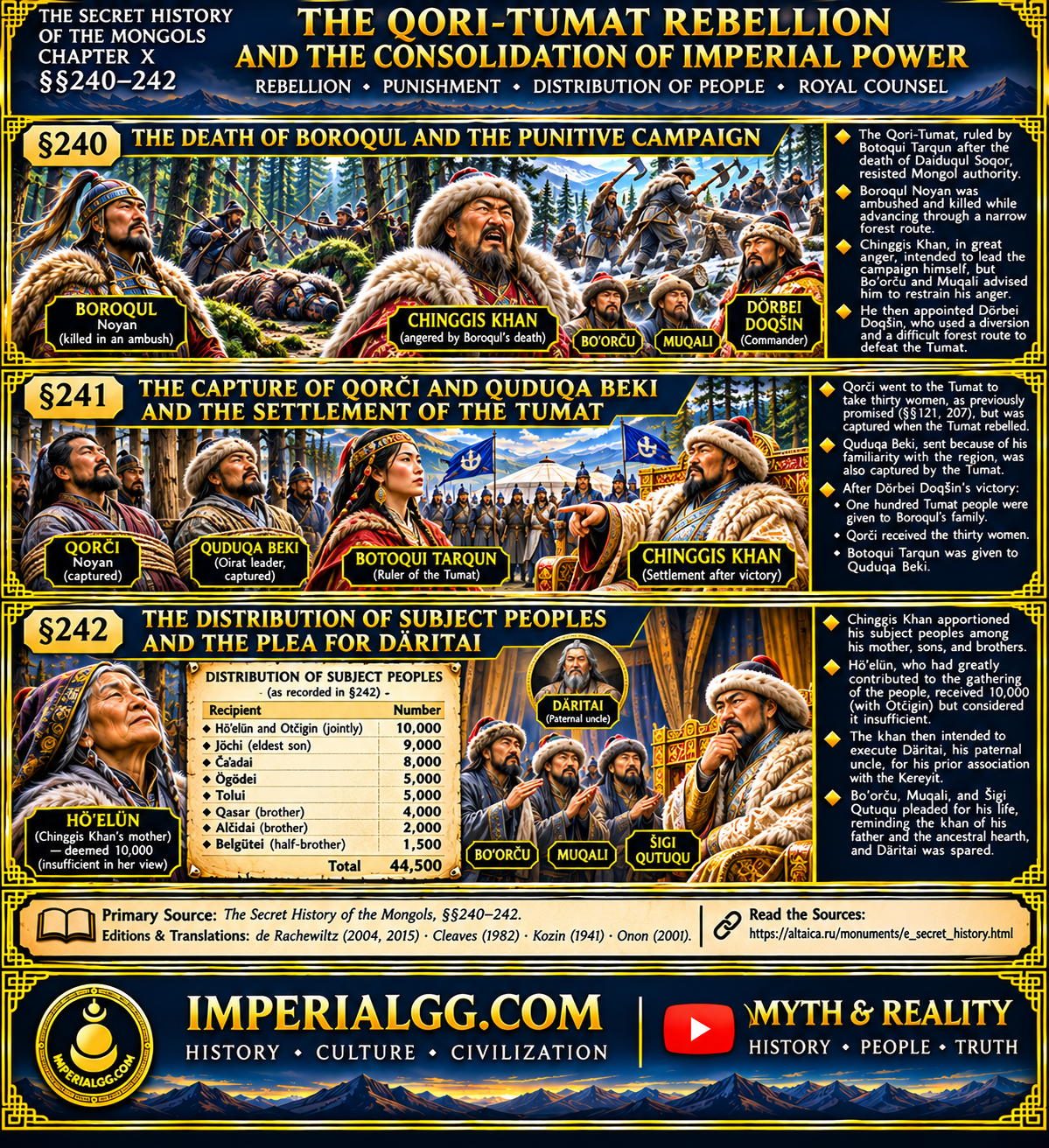
Military Retaliation, Political Authority, Dynastic Allocation, and the Limits of Sovereign Power in The Secret History of the Mongols, §§240–242
IMPERIALGG.COM | ACADEMIC HISTORICAL RESEARCH
ABSTRACT
Sections 240–242 of The Secret History of the Mongols preserve three interconnected episodes concerning the consolidation of Chinggis Khan’s authority: the killing of Boroqul Noyan during the Qori-Tumat rebellion and the subsequent punitive campaign led by Dörbei Doqšin; the capture of Qorči Noyan and Quduqa Beki and the settlement imposed upon the defeated Tumat; and the allocation of subject populations among Chinggis Khan’s mother, sons, and brothers, followed by a dispute over the proposed execution of his paternal uncle Däritai.
These passages illuminate fundamental questions about the formation of the Mongol imperial state. They show how military resistance could challenge imperial authority, how the death of a trusted commander could provoke a personal response from the sovereign, how local political leadership was confronted and reorganized, and how populations were assigned within the ruling family. They also reveal the importance of counsel in restraining the sovereign’s anger.
Particular attention is given to the named individuals, the numerical allocations recorded in §242, the dissatisfaction of Hö’elün, and the intervention of Bo’orču, Muqali, and Šigi Qutuqu on behalf of Däritai. By distinguishing the original narrative from later scholarly interpretation, this article examines both the administrative ambitions and the personal tensions of early Mongol imperial government.
Keywords: Chinggis Khan; Boroqul; Qori-Tumat; Dörbei Doqšin; Botoqui Tarqun; Qorči; Quduqa Beki; Hö’elün; Bo’orču; Muqali; Šigi Qutuqu; Däritai; Mongol Empire; dynastic appanages; Secret History of the Mongols.
Principal primary-source editions: The Secret History — original text and transliterations · de Rachewiltz and Street, 2015, pp. 155–159 (PDF) · de Rachewiltz, 2004, translation and detailed commentary (PDF).
altaica.c4.starlingdb.org+2
INTRODUCTION — THE INTERNAL CHALLENGES OF IMPERIAL CONSOLIDATION
The establishment of the Mongol Empire was not completed by the defeat of rival steppe rulers or the submission of neighboring communities. Even after Chinggis Khan had secured recognition as the supreme ruler of the Mongols, the extension of his authority created new problems of governance, military control, political loyalty, and the distribution of people among members of the ruling dynasty. These problems were especially acute in regions where local communities possessed established leaders and where geographical conditions complicated the movement of Mongol forces.
The narrative of The Secret History of the Mongols, §§240–242, offers a concentrated illustration of these difficulties. The first two sections recount the resistance of the Qori-Tumat, the death of Boroqul, the seizure of imperial representatives, and the campaign undertaken to restore Mongol authority. The third section shifts from the battlefield to the ruling household, describing the distribution of subject populations and the political disagreement surrounding the fate of Däritai, Chinggis Khan’s paternal uncle.
At first glance, the punitive campaign and the distribution of people may appear to be unrelated events. Yet they address the same underlying question: how was the authority acquired through conquest and submission to be maintained, exercised, and transmitted? The Qori-Tumat episode concerns the enforcement of imperial power over a resisting community; the distribution of subjects concerns the allocation of authority within the imperial family. Both demonstrate that the early empire was shaped by personal relationships as well as by military institutions.
The source itself requires critical examination. The Secret History combines historical recollection, political legitimation, dramatic dialogue, and literary narrative. Its detailed speeches cannot always be treated as verbatim transcripts, and its sequence of events does not invariably follow a strict chronology. Nevertheless, its accounts remain indispensable evidence for understanding how the Mongol ruling tradition represented the actions, decisions, and conflicts of Chinggis Khan’s reign. [1]
I. §240 — THE QORI-TUMAT REBELLION AND THE DEATH OF BOROQUL NOYAN
THE POLITICAL BACKGROUND: DAIDUQUL SOQOR AND BOTOQUI TARQUN
The Qori-Tumat episode begins with a significant change in local leadership. According to §240, the former Tumat leader Daiduqul Soqor had died, and his wife, Botoqui Tarqun, was governing the people. This detail deserves attention because it identifies a woman exercising political authority within a community resisting Mongol domination. Botoqui Tarqun is not merely mentioned as the widow of a deceased ruler; the narrative explicitly places her in a position of leadership.
The passage does not provide a detailed explanation of her accession or the internal political institutions of the Qori-Tumat. It would therefore be inappropriate to infer a comprehensive system of female succession from this single episode. Nevertheless, the source establishes that the Mongol expedition confronted a community whose leadership was associated with a named woman. This is particularly important because Botoqui Tarqun reappears in §241, where her fate becomes part of the settlement imposed after the Tumat defeat.
The broader context is the incorporation of the Forest Peoples described in §239. Although a number of northern communities had submitted during Jöchi’s expedition, the subsequent resistance of the Qori-Tumat demonstrates that submission was not necessarily permanent or uncontested. Imperial recognition did not eliminate the possibility of renewed opposition, especially where local political interests conflicted with the demands of Mongol authority. [2]
BOROQUL’S EXPEDITION AND THE FATAL AMBUSH
Chinggis Khan sent Boroqul Noyan against the Qori-Tumat. Boroqul was one of the trusted men associated with the ruler’s household and military establishment, making his death an event of exceptional personal and political importance in the narrative.
According to §240, Boroqul advanced with only two companions, forming a party of three men, as he attempted to reach the Tumat through difficult forest terrain. The source describes the route as exceptionally narrow and challenging. While proceeding along the forest path, Boroqul was ambushed by Tumat guards, captured, and killed.
This episode illustrates a fundamental operational problem for armies accustomed to the open steppe. In mountainous and densely forested environments, mobility could be restricted to narrow passages where small defending forces possessed considerable tactical advantages. The killing of Boroqul was therefore not presented as the result of a conventional battle between large armies. It occurred during an attempted approach through terrain controlled by the defenders.
The account should also be interpreted with caution. The narrative does not establish why Boroqul personally advanced with such a small party, nor does it explain every detail of his tactical intentions. Claims that he was conducting reconnaissance, negotiating surrender, or deliberately sacrificing himself would require additional evidence. What the text does record is his movement through difficult terrain, the ambush, and his death. [3]
CHINGGIS KHAN’S ANGER AND THE INTERVENTION OF BO’ORČU AND MUQALI
When Chinggis Khan learned of Boroqul’s death, he became intensely angry and began preparing to lead an expedition against the Tumat himself. The response reveals the importance of Boroqul’s position within the ruler’s circle. His killing was not treated as an ordinary military casualty; it provoked a reaction that threatened to draw the sovereign personally into a punitive campaign.
At this point, Bo’orču and Muqali intervened. Both were among Chinggis Khan’s most prominent and trusted commanders. They urged him to abandon his intention of personally leading the expedition, and the narrative states that he eventually accepted their counsel.
This intervention is significant because it illustrates the political function of senior advisers within the imperial court. Bo’orču and Muqali did not challenge Chinggis Khan’s authority or deny his right to respond to the rebellion. Rather, they sought to influence the manner in which that authority would be exercised. Their counsel separated the sovereign’s personal anger from the practical decision of who should command the operation.
The episode also anticipates §242, where the same two men, joined by Šigi Qutuqu, intervene to prevent the proposed execution of Däritai. The recurrence of their names is not incidental. Within the literary structure of The Secret History, these advisers repeatedly appear as figures capable of moderating decisions made under the influence of anger. [4]
DÖRBEI DOQŠIN AND THE SECOND EXPEDITION
Having abandoned the plan to command the expedition himself, Chinggis Khan appointed Dörbei Doqšin, a commander associated with the Dörbet, to lead the campaign against the Qori-Tumat. The ruler instructed him to maintain strict discipline among his troops and to undertake the operation under the protection of Eternal Heaven.
The account of Dörbei Doqšin’s campaign is particularly valuable for its description of military adaptation to forested terrain. Rather than repeating Boroqul’s unsuccessful approach, Dörbei used a diversion. He directed part of his force toward the guarded route associated with Boroqul’s death, drawing the defenders’ attention to the expected line of advance. Meanwhile, his principal force moved along another difficult route associated with the tracks of wild cattle.
The men were equipped with axes, adzes, saws, chisels, and other implements suitable for cutting through the forest. The source emphasizes the difficulty of the passage and the harsh measures employed to prevent soldiers from abandoning the effort. The force eventually reached the heights above the Tumat position and descended unexpectedly upon the people while they were feasting.
The narrative attributes the success of the campaign to the combination of deception, discipline, engineering labor, and surprise. Its dramatic description of the sudden descent should not necessarily be interpreted as a precise tactical map, but the underlying military principle is clear: Dörbei avoided the defended approach and exploited an unexpected route to overcome a geographical disadvantage.
The account concludes with the defeat and capture of the Tumat. The source does not provide independently verifiable figures for casualties or the number of prisoners, and these should not be invented in modern retellings. [5]
Direct sources for §240: S. A. Kozin — Russian translation, §240 · Urgunge Onon, The Secret History of the Mongols, Chapter Ten, pp. 223–224 · de Rachewiltz, 2004, §240 and commentary.
Monumenta Altaica+2
II. §241 — THE CAPTURE OF QORČI AND QUDUQA BEKI, AND THE SETTLEMENT OF THE TUMAT
QORČI NOYAN AND THE THIRTY TUMAT WOMEN
Section 241 returns to events associated with the rebellion and explains that two important figures, Qorči Noyan and Quduqa Beki, had been captured by the Tumat and were held in the sphere of Botoqui Tarqun’s authority.
Qorči’s presence among the Tumat was connected to an earlier promise made by Chinggis Khan. In §121, Qorči had requested a reward associated with his prediction of Temüjin’s future supremacy. The matter was subsequently addressed in §207, where he was permitted to take thirty women from among the subject populations. Section 241 explains that Qorči went to the Tumat intending to claim thirty women whom the narrative describes as beautiful.
This detail should not be omitted or softened into a vague reference to a diplomatic visit. The source explicitly connects Qorči’s journey to the proposed acquisition of women as wives. It also states that the Tumat, who had previously submitted, rebelled and seized him. The narrative does not establish that the marriage demand was the sole cause of the uprising, but its placement immediately before the account of Qorči’s capture makes the issue historically relevant.
The incident reveals a tension within the political order established by conquest. Rewards granted to imperial followers could impose obligations upon subject communities. What appeared to the ruler as the legitimate fulfillment of a promise could be experienced by those communities as an unwanted demand. In the case of the Tumat, the narrative records resistance rather than compliance. Whether this particular demand directly triggered the rebellion remains uncertain, but the episode demonstrates that the extraction of people, including women, formed part of the political relationships created by imperial domination. [6]
THE CAPTURE OF QUDUQA BEKI
When Chinggis Khan learned of Qorči’s capture, he decided to send Quduqa Beki, the Oirat leader whose cooperation had been important during Jöchi’s expedition among the Forest Peoples. The reason given in §241 was Quduqa Beki’s familiarity with the customs and circumstances of those communities.
This decision reveals the continuing importance of local intermediaries in Mongol imperial administration. Quduqa Beki had previously assisted the Mongols in extending their authority into the northern regions; he was now expected to use his knowledge and regional relationships in a situation of renewed resistance. Yet his earlier success did not guarantee his safety. The Tumat also captured Quduqa Beki.
The capture of both Qorči and Quduqa Beki demonstrates that the rebellion directly challenged the authority of imperial representatives. The two men occupied different positions in the expanding political order: Qorči was a rewarded supporter of Chinggis Khan, while Quduqa Beki was a regional leader incorporated through submission and dynastic alliance. Their simultaneous captivity illustrates the limits of both military patronage and negotiated incorporation when local resistance persisted. [7]
THE DEFEAT OF THE TUMAT AND THE DISTRIBUTION OF CAPTIVES
Following Dörbei Doqšin’s successful campaign, the narrative records several decisions concerning the defeated Tumat. First, Chinggis Khan assigned one hundred Tumat people to the family of Boroqul in recognition of his death. This was a form of compensation expressed through the transfer of human dependents rather than a monetary payment. The distinction is essential: the individuals transferred were themselves subject to the political decisions of the conquerors.
Second, Qorči obtained the thirty women previously promised to him. The source does not provide their individual names or describe their subsequent experiences. Their absence from the narrative should not obscure the fact that they were central to the settlement imposed after the rebellion.
Third, Botoqui Tarqun, who had governed the Tumat following Daiduqul Soqor’s death, was given to Quduqa Beki. The woman who had exercised local political authority thus became part of the settlement made by the victorious Mongol ruler. The narrative does not record her consent, and it would be inappropriate to interpret the arrangement as an ordinary voluntary marriage without further evidence.
These decisions reveal the close relationship between military victory, personal reward, and the redistribution of people in the early empire. The defeat of a resisting community could produce compensation for the household of a fallen commander, fulfillment of earlier promises, and the reassignment of local political figures. In this respect, the settlement of the Tumat was not merely the restoration of military control; it involved the reorganization of human relationships under imperial authority. [8]
Direct sources for §241: de Rachewiltz and Street (2015), §241, p. 157 · de Rachewiltz (2004), commentary on §241, pp. 861–862 · Kozin — parallel Russian translation, §241.
Angkor Database+2
III. §242 — THE DISTRIBUTION OF SUBJECT PEOPLES AMONG THE IMPERIAL FAMILY
CHINGGIS KHAN’S DECREE AND THE PRINCIPLE OF DYNASTIC ALLOCATION
Section 242 moves from the suppression of rebellion to the internal organization of the ruling family. Chinggis Khan decreed that the subject populations of the expanding empire would be apportioned among his mother, sons, and younger brothers. The passage is important because it records both the names of the recipients and the numerical shares assigned to them.
The distribution was not presented as an equal division among family members. Instead, the narrative identifies particular considerations influencing the allocation: the contribution of Chinggis Khan’s mother to the gathering of the people, Jöchi’s position as the eldest son, and Otčigin’s position as the youngest brother. These considerations reflect the intersection of political service, seniority, and kinship in the early Mongol ruling order.
The term subject people requires careful interpretation. The figures recorded in the narrative should not automatically be understood as a modern census of individual inhabitants. Nor should the allocations be equated without qualification with the later territorial appanages of the Mongol imperial princes. They represent assignments of people and associated authority within a political system in which military organization, household dependence, and dynastic entitlement were closely connected.
THE RECORDED ALLOCATIONS
The following figures reproduce the allocations stated in §242 of de Rachewiltz’s translation. They are source-reported numbers, not independently verified demographic totals.
Recipient | Relationship to Chinggis Khan | Recorded allocation |
|---|---|---|
Hö’elün and Otčigin | Mother and youngest brother, jointly | 10,000 |
Jöchi | Eldest son | 9,000 |
Ča’adai | Son | 8,000 |
Ögödei | Son | 5,000 |
Tolui | Youngest son | 5,000 |
Qasar | Brother | 4,000 |
Alčidai | Brother | 2,000 |
Belgütei | Half-brother | 1,500 |
Source: The Secret History of the Mongols, §242; de Rachewiltz and Street (2015), p. 157.
Angkor Database+1
The total of the recorded allocations is 44,500. This arithmetic sum is useful for understanding the scale of the distribution described by the text, but it should not be presented as the total population of the Mongol Empire or even as the total number of all people under Chinggis Khan’s authority. The passage concerns specified dynastic assignments, and the historical meaning of its numerical units requires further examination.
HÖ’ELÜN’S CONTRIBUTION AND HER SILENT DISSATISFACTION
Among the most revealing details of §242 is the position of Hö’elün, the mother of Chinggis Khan. The ruler explicitly acknowledged that she had contributed more than anyone to the gathering of the people. This recognition recalled the difficult years following the death of Yisügei, when Hö’elün had struggled to preserve and sustain her family amid political abandonment and material hardship.
Despite this acknowledgment, Hö’elün received a joint allocation of ten thousand with Otčigin. The narrative states that she considered the share insufficient but did not voice her dissatisfaction. Her silence is significant because it creates a tension between public recognition of her historical contribution and the practical distribution of political resources.
It would be too simplistic to interpret her reaction merely as disappointment over a numerical share. The issue involved the relationship between past service and present authority. Hö’elün had played an essential role in the survival of the family from which the imperial ruling house emerged, yet the distribution was now being determined by her son as sovereign. Her dissatisfaction therefore reflects the changing relationship between maternal authority, family memory, and imperial government.
De Rachewiltz notes that the expression concerning the gathering of the people may refer both to the recovery of followers who had abandoned the family after Yisügei’s death and to Hö’elün’s broader support during Chinggis Khan’s rise to power. This interpretation helps explain why the passage explicitly associates her with the foundational work of political consolidation. [9]
The source, however, does not record a speech in which Hö’elün formally protests the allocation. Any modern reconstruction of such a speech would be fictional. The historically significant fact is precisely that the narrative attributes dissatisfaction to her while emphasizing that she remained silent.
DÄRITAI, THE KEREYIT CONNECTION, AND THE THREAT OF EXECUTION
After recording the distribution, §242 introduces another conflict within the ruling family. Chinggis Khan turned his attention to Däritai, his paternal uncle, who had previously associated himself with the Kereyit. The ruler declared his intention to remove him, a statement understood by the translators as a threat to his life.
The historical significance of this episode lies in the tension between political loyalty and family obligation. Däritai’s earlier association with the Kereyit represented, from Chinggis Khan’s perspective, a serious breach of allegiance. Yet Däritai was also the brother of Yisügei, Chinggis Khan’s deceased father, and therefore occupied a position within the senior generation of the Borjigin family.
The passage does not present Däritai’s proposed punishment as a routine judicial proceeding. No formal trial, evidentiary hearing, or written judgment is described. Instead, the narrative portrays a sovereign decision arising from remembered political disloyalty. This distinction matters because the episode is best understood as an example of personal rulership confronted by competing obligations, rather than as evidence for a fully codified legal procedure. [10]
BO’ORČU, MUQALI, AND ŠIGI QUTUQU INTERVENE
Three men intervened on Däritai’s behalf: Bo’orču, Muqali, and Šigi Qutuqu. Their argument appealed not to Däritai’s innocence but to the consequences of killing a close paternal relative. They invoked the image of extinguishing the ancestral hearth and destroying the family dwelling, presenting the proposed execution as an act that would damage the continuity of Chinggis Khan’s own lineage.
The metaphor of the hearth was especially powerful in the cultural context of the narrative. The domestic fire represented the continuity of a household and the memory of its ancestors. By reminding Chinggis Khan that Däritai was a surviving brother of his father, the advisers reframed the issue. The question was no longer simply whether Däritai had been disloyal, but whether the punishment would dishonor the memory of Yisügei and damage the ruler’s ancestral household.
The narrative emphasizes the intensity of the advisers’ efforts. They continued to plead until Chinggis Khan recalled his father and accepted their counsel. Däritai was spared.
The presence of Šigi Qutuqu alongside Bo’orču and Muqali is particularly noteworthy. The three advisers are identified by name, and their intervention is presented as a collective act of persuasion. The passage does not describe a formal council vote or a constitutional limitation upon the ruler’s authority. Nevertheless, it provides evidence that senior members of the ruling establishment could influence consequential decisions by appealing to established values and personal obligations. [11]
THE REPEATED ROLE OF BO’ORČU AND MUQALI
The recurrence of Bo’orču and Muqali in §§240 and 242 creates an important connection between the two episodes. In §240, they prevented Chinggis Khan from personally undertaking a campaign while angry over Boroqul’s death. In §242, they helped prevent the execution of his uncle. In both cases, their influence operated through counsel rather than coercion.
These episodes suggest that political authority in the early Mongol Empire was not exercised in complete isolation. Although Chinggis Khan possessed extraordinary power, trusted commanders and household advisers could affect how that power was used. Their capacity to intervene depended upon their personal standing, established service, and access to the ruler.
This was not an impersonal system of checks and balances in the modern constitutional sense. It was a political culture in which personal relationships, loyalty, reputation, and the ability to speak persuasively could constrain individual decisions. The distinction is essential: the source demonstrates successful intervention in particular circumstances, not a universal rule that imperial commands could always be reversed. [12]
Direct sources for §242: de Rachewiltz and Street (2015), §§242, pp. 157–158 · Kozin — §242, including the advisers’ appeal · de Rachewiltz (2004), commentary on §242.
Angkor Database+2
IV. HISTORICAL AND SOURCE-CRITICAL ANALYSIS
THE CHRONOLOGY OF THE TUMAT REBELLION
The chronological relationship between the events in §§239–241 requires careful treatment. Section 239 describes Jöchi’s expedition among the Forest Peoples in 1207, whereas the subsequent narrative moves to the rebellion of the Qori-Tumat and the campaigns associated with Boroqul and Dörbei Doqšin. The sequence of the text does not necessarily establish that all these events occurred immediately after one another.
De Rachewiltz’s commentary explicitly cautions that the Tumat material has a fragmented narrative arrangement. He also notes the strongly epic character of the account of Dörbei Doqšin’s campaign, a reminder that its dramatic presentation may have been shaped by literary conventions as well as historical recollection.
For this reason, the descriptions of the ambush, the difficult mountain passage, the diversionary maneuver, and the surprise attack should be analyzed as evidence preserved by the narrative rather than treated as an independently verified operational report. The distinction does not make the passage historically worthless. Instead, it identifies the limits within which its details can responsibly be used. [13]
THE POLITICAL STATUS OF BOTOQUI TARQUN
Botoqui Tarqun’s appearance in both §§240 and 241 raises important questions about women and political authority in the northern regions. The source presents her first as a ruler exercising authority after her husband’s death and subsequently as a woman transferred to Quduqa Beki following the defeat of her people.
These two positions should be considered together. Her political authority before the conquest demonstrates that the Tumat leadership structure could accommodate a woman in a governing role. Her treatment after the conquest demonstrates how military defeat could transform the position of a local ruler and subordinate her to decisions made by the victorious imperial power.
The narrative does not preserve her own testimony, and it would be misleading to attribute specific political intentions or personal emotions to her. Nevertheless, the contrast between her initial authority and her later disposition is a central historical feature of the episode. [14]
HUMAN ALLOCATION AS A FORM OF POLITICAL POWER
The transfer of one hundred Tumat people to Boroqul’s family in §241 and the much larger distribution among Chinggis Khan’s relatives in §242 belong to different circumstances, but they reveal a shared political principle: authority over people could be assigned as a reward, compensation, or dynastic entitlement.
This does not mean that every assigned person occupied the same legal or social status. The Tumat captives transferred after a punitive campaign cannot automatically be equated with all the populations allocated to members of the imperial family. Nevertheless, both passages demonstrate that people were central to the distribution of political and economic power.
The figures in §242 also require comparison with other medieval sources. De Rachewiltz observes that the numbers attributed to dynastic allocations in The Secret History differ from those preserved by Rashid al-Din and that the figures in the Mongol narrative may be inflated. The numerical list should therefore be treated as a historically important statement of dynastic distribution, not as an independently confirmed population census. [15]
V. AUTHOR’S THESIS — THE CONSOLIDATION OF IMPERIAL POWER THROUGH MILITARY AUTHORITY, DYNASTIC ALLOCATION, AND RESTRAINED SOVEREIGNTY
The central thesis of this article is that §§240–242 represent a critical stage in the transition from military unification to imperial governance. The episodes demonstrate that Chinggis Khan’s authority was exercised through several overlapping mechanisms: military coercion against rebellious communities, rewards to loyal followers, the redistribution of subject populations, the recognition of dynastic claims, and consultation with trusted advisers.
The death of Boroqul and the subsequent campaign against the Qori-Tumat reveal the military dimension of imperial consolidation. A rebellion against Mongol authority resulted in a punitive expedition whose success depended upon tactical adaptation to unfamiliar terrain. The narrative also reveals the personal nature of sovereign authority: the death of a trusted commander could provoke the ruler’s anger, while the intervention of senior advisers could redirect the response.
The capture of Qorči and Quduqa Beki illustrates the difficulties of incorporating previously independent communities. Submission did not guarantee permanent obedience, and the obligations imposed by the expanding empire could generate resistance. The settlement following the Tumat defeat shows that imperial victory could entail the redistribution of captives and the transformation of local political relationships.
The allocation of subject peoples in §242 demonstrates a further stage of consolidation. Political authority was distributed among members of the ruling dynasty, but the distribution was neither equal nor free from dissatisfaction. Hö’elün’s silent resentment reveals the tension between recognition of past service and the practical allocation of power. The threatened execution of Däritai reveals another tension, between political loyalty and ancestral obligation.
The intervention of Bo’orču, Muqali, and Šigi Qutuqu is particularly significant. Their successful counsel suggests that the early Mongol political order included a practical tradition of advising and restraining the sovereign, grounded not in modern constitutional institutions but in personal authority, shared memory, and the moral obligations of kinship.
Taken together, these passages support an interpretation of early Mongol state formation as a process in which conquest and political integration were inseparable from the management of human relationships. The empire was not simply an army expanding across territory; it was an emerging system of authority in which loyalty, punishment, compensation, family entitlement, and counsel shaped the distribution and exercise of power.
This is the author’s analytical interpretation of the evidence, rather than a direct thesis stated by the compiler of The Secret History. Further comparison with Persian and Chinese records is necessary to determine the degree to which the narrative reflects actual administrative practice, literary representation, or both.
CONCLUSION
Sections 240–242 of The Secret History of the Mongols preserve a complex picture of the early Mongol Empire. The rebellion of the Qori-Tumat, the death of Boroqul, the punitive campaign of Dörbei Doqšin, the captivity of Qorči and Quduqa Beki, the political fate of Botoqui Tarqun, the distribution of subject peoples among the ruling family, and the intervention that spared Däritai are not isolated anecdotes. Together, they reveal the difficulties of transforming military supremacy into a durable political order.
The named individuals are essential to understanding the events. Boroqul’s death explains the ruler’s anger; Bo’orču and Muqali demonstrate the influence of trusted advisers; Dörbei Doqšin illustrates military adaptation; Botoqui Tarqun represents local political leadership confronted by conquest; Qorči and Quduqa Beki reveal the vulnerabilities of imperial representatives; Hö’elün embodies the unresolved relationship between maternal contribution and dynastic allocation; and Šigi Qutuqu’s intervention on behalf of Däritai demonstrates the role of collective counsel in moderating sovereign decisions.
The historical importance of these passages lies in the coexistence of military violence, political reward, administrative distribution, family obligation, and negotiated restraint. Their careful interpretation provides a more complex understanding of the formation of the Mongol Empire than any account focused exclusively on battlefield victories.
FOOTNOTES AND PRIMARY-SOURCE REFERENCES
The following notes correspond to the numbered references in the article. Page numbers refer to the printed pagination of the cited editions, which may differ from PDF viewer page numbers.
[1] Igor de Rachewiltz, The Secret History of the Mongols: A Mongolian Epic Chronicle of the Thirteenth Century, 2 vols. (Leiden–Boston: Brill, 2004), introduction and Chapter X, §§240–242. Full scholarly edition (PDF).
[2] Secret History, §§239–240; de Rachewiltz, shorter version, edited by John C. Street (2015), pp. 155–156. Open translation (PDF).
[3] Secret History, §240; Urgunge Onon, The Secret History of the Mongols: The Life and Times of Chinggis Khan (London: RoutledgeCurzon, 2001), Chapter Ten, pp. 223–224. Onon translation (PDF).
[4] Secret History, §§240, 242; compare Bo’orču and Muqali’s interventions in Kozin’s translation.
[5] Secret History, §240; de Rachewiltz (2004), commentary on §240. Commentary and military interpretation.
[6] Secret History, §§121, 207, 241; de Rachewiltz (2004), commentary on §241, pp. 861–862. This commentary discusses the wording concerning Qorči’s thirty women and the variations among translators. Philological discussion.
[7] Secret History, §§239, 241; de Rachewiltz and Street (2015), pp. 155–157. Primary narrative.
[8] Secret History, §241; de Rachewiltz (2004), commentary on §241, p. 862. Compare the compensation granted to Quyildar’s family in §185. Comparative commentary.
[9] Secret History, §242; de Rachewiltz (2004), commentary on §242, pp. 862 onward, discussing ulus quriya’an and Hö’elün’s role. Scholarly commentary.
[10] Secret History, §242; de Rachewiltz and Street (2015), pp. 157–158. Däritai episode.
[11] Secret History, §242; S. A. Kozin, Russian translation, paragraph 242. Advisers’ intervention and Chinggis Khan’s response.
[12] Secret History, §§240, 242; compare the two interventions of Bo’orču and Muqali in Onon’s translation.
[13] de Rachewiltz (2004), commentary on §§240–241, especially the observation that the campaign narrative has an epic character and that the arrangement of events is not strictly chronological. Historical and philological commentary.
[14] Secret History, §§240–241; de Rachewiltz and Street (2015), pp. 155–157.
[15] de Rachewiltz (2004), commentary on §242, comparing the distribution figures in The Secret History with those reported by Rashid al-Din and Chinese sources. Source comparison.
Monumenta Altaica+1
HISTORICAL IMAGES AND DOCUMENTARY MATERIAL
FIGURE 1 — THE CHINESE-CHARACTER TEXTUAL TRADITION
Documentary evidence for checking the transmitted text of The Secret History, including names and original terminology.
FIGURE 2 — MONGOLIA AROUND AD 1200
Geographical background for the Mongol heartland and northern forest regions. De Rachewiltz’s shorter edition contains a historical map on printed page 270.
FIGURE 3 — CHINGGIS KHAN IN LATER HISTORICAL PORTRAITURE
Contextual portraiture, not a contemporary image of the events in §§240–242.
The images above are visual references for editorial selection. Their exact file provenance, attribution, and reproduction permissions have not been individually verified; the accompanying links lead to relevant source collections or documents, not necessarily to the exact displayed image. The article should not be published with these illustrations as authenticated source images until that verification is complete.
BIBLIOGRAPHY
Cleaves, Francis Woodman, trans. The Secret History of the Mongols. Cambridge, MA: Harvard University Press, 1982. Bibliography and textual repository.
de Rachewiltz, Igor. The Secret History of the Mongols: A Mongolian Epic Chronicle of the Thirteenth Century. 2 vols. Leiden–Boston: Brill, 2004. Full text and commentary.
de Rachewiltz, Igor, trans.; John C. Street, ed. The Secret History of the Mongols, shorter version. Western Washington University, 2015. University repository.
Kozin, Sergei A. Sokrovennoe skazanie: Mongol’skaia khronika 1240 g. Moscow–Leningrad, 1941. Digital translation.
Onon, Urgunge, trans. The Secret History of the Mongols: The Life and Times of Chinggis Khan. London: RoutledgeCurzon, 2001. Digitized edition.
IMPERIALGG.COM — HISTORY • CULTURE • CIVILIZATION | HEAVENLEWIND750.com — HISTORY • PEOPLE • TRUTH