The Hu (胡): Reconsidering Historical Continuity on the Mongolian Plateau
By Altanbagana Baatar
DBA Candidate| Independent Historian
ImperialGG Historical Research Seriers
07 July 2026
Introduction
Among the numerous ethnonyms preserved in the historical records of ancient China, few have generated greater scholarly debate than the term Hu (胡). Unlike the Xiongnu, Donghu, Xianbei, or Wuhuan, whose names are generally associated with identifiable political confederations or historical communities, the designation Hu appears throughout Chinese historical literature as a broad and often ambiguous term applied to various peoples living beyond the northern and northwestern frontiers of the Central Plains. Its meaning changed over time, reflecting not only geographical distinctions but also evolving Chinese perceptions of the frontier world. Consequently, the historical identity of the peoples described as Hu has remained one of the most challenging problems in the historiography of Inner Asia.
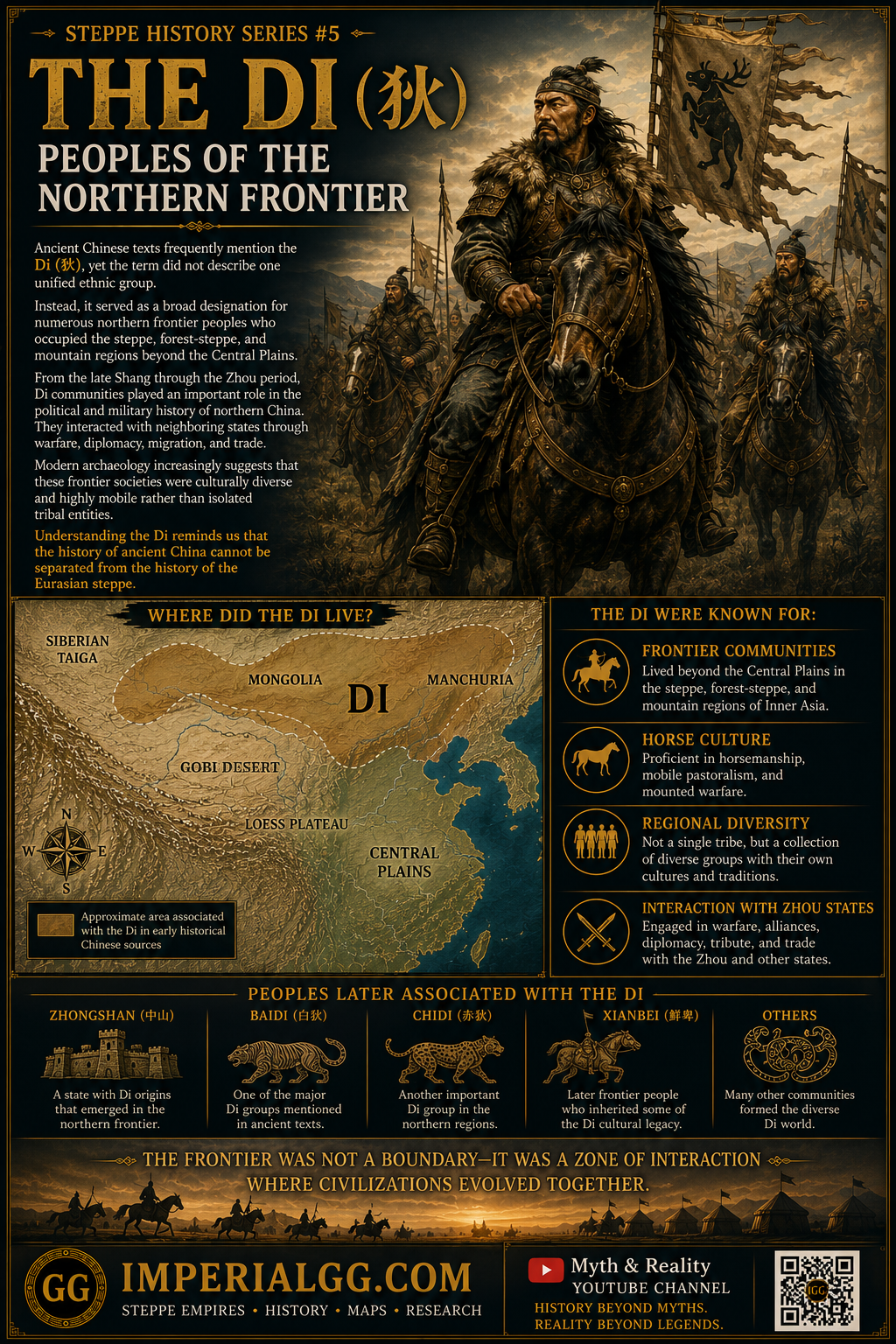
Traditional Chinese historiography frequently employed ethnonyms not as precise indicators of ethnicity or language but as political and geographical designations for populations existing outside the sphere of direct imperial administration. Similar terms—including Rong (戎), Di (狄), and later Hu (胡)—often encompassed multiple communities that differed in language, political organization, economy, and regional identity. Modern historical scholarship increasingly recognizes that these names should not automatically be interpreted as representing homogeneous ethnic groups. Instead, they reflected the changing knowledge, political interests, and administrative perspectives of Chinese states confronting a highly dynamic frontier.
The interpretation of Hu is therefore inseparable from a broader methodological question concerning the reconstruction of early Inner Asian history. Throughout the historical literature of ancient China, the names assigned to northern peoples changed repeatedly. Guifang, Xianyun, Rong, Di, Hu, Donghu, Xiongnu, Xianbei, Rouran, and numerous other ethnonyms appear successively over more than a millennium of recorded history. These changes have often been understood as evidence that one people disappeared and another entirely unrelated population emerged in its place. Such an interpretation, however, assumes that every change in nomenclature necessarily reflected complete demographic replacement rather than political transformation, regional variation, or the evolution of Chinese historical terminology itself.
Comparable assumptions are rarely applied to the histories of other ancient civilizations. Despite repeated dynastic change, migration, warfare, and political fragmentation, the historical continuity of China is generally regarded as self-evident. Likewise, the early history of Korea is reconstructed through the combined use of archaeology, indigenous traditions, and Chinese historical records, even though the earliest surviving comprehensive Korean chronicles were compiled centuries after many of the events they describe. In neither case is the absence of continuous indigenous written documentation interpreted as proof that an entirely new people appeared whenever historical terminology changed. Whether the peoples of the Mongolian Plateau should be examined according to fundamentally different historiographical standards remains an important question deserving renewed scholarly attention.
Chinese historical sources remain indispensable for reconstructing the ancient history of the eastern Eurasian steppe. Nevertheless, these records were written from the perspective of sedentary states located south of the frontier. Their knowledge naturally focused upon neighboring peoples who directly influenced Chinese political and military affairs. Beyond the immediate frontier, however, information became increasingly fragmentary and was often filtered through diplomacy, trade, warfare, or second-hand reports. Consequently, the disappearance of a particular ethnonym from Chinese historical texts should not automatically be interpreted as the disappearance of the population itself, nor should the appearance of a new designation necessarily imply the arrival of an entirely unrelated people.
Recent developments in archaeology, archaeogenetics, historical linguistics, and the comparative study of nomadic societies have significantly transformed our understanding of the ancient Mongolian Plateau. These disciplines increasingly reveal long-term patterns of cultural continuity, regional interaction, and demographic persistence extending far beyond the limits of surviving written sources. Archaeological cultures, burial traditions, settlement systems, and genetic evidence frequently demonstrate historical developments that cannot be adequately explained solely through the changing terminology preserved in Chinese texts. Such interdisciplinary evidence encourages a more comprehensive reconstruction of the northern frontier and suggests that political transformation often occurred within populations that maintained substantial cultural continuity.
The study of the Hu therefore extends far beyond the interpretation of a single historical name. It offers an opportunity to reconsider how the northern peoples of the Mongolian Plateau should be studied and how Chinese historical terminology ought to be interpreted within its broader historical context. Rather than representing a single ethnic community, the term Hu appears to reflect an evolving Chinese conception of the frontier world during different historical periods. Understanding that evolution contributes not only to the interpretation of Chinese historical sources but also to the reconstruction of the long processes of political development that eventually culminated in the emergence of the great steppe confederations, most notably the Xiongnu Empire.
2. Historical Sources and Terminology
The historical interpretation of the term Hu (胡) begins with the recognition that it was not originally employed as the name of a single tribe, kingdom, or ethnic community. Rather, throughout much of early Chinese history, Hu functioned as a broad historical designation applied to various peoples inhabiting the northern and northwestern frontier beyond the political boundaries of the Central Plains. Like the earlier terms Rong (戎) and Di (狄), the meaning of Hu evolved according to changing political circumstances, geographical knowledge, and the perspectives of the Chinese states that recorded these frontier populations.
The earliest surviving references to Hu appear during the late Zhou period and become increasingly frequent throughout the Warring States, Qin, and Han dynasties. Unlike the ethnonyms Donghu (東胡) or Xiongnu (匈奴), which generally referred to identifiable political confederations, the simple designation Hu often served as a collective term embracing numerous northern peoples whose individual political identities were either unknown to Chinese historians or considered secondary to their position beyond the frontier. Consequently, Chinese historical texts frequently distinguished between specific political entities and the broader category of Hu, illustrating that the latter possessed a wider geographical and conceptual meaning.
The principal historical sources concerning the Hu include the Shiji (Records of the Grand Historian), the Hanshu (Book of Han), the Hou Hanshu (Book of the Later Han), the Zuo Zhuan, the Zhanguoce (Strategies of the Warring States), and other classical works preserving information concerning the northern frontier. These texts record military campaigns, diplomatic exchanges, trade relations, migrations, and political alliances involving numerous groups designated collectively or individually as Hu. Yet none of these works provides a precise ethnographic definition of the term itself. Instead, its meaning varies according to historical context, reinforcing the conclusion that it functioned primarily as a flexible frontier designation rather than a narrowly defined ethnic label.
Chinese sources also reveal that the term Hu was employed alongside more specific names. Expressions such as Donghu (Eastern Hu), Linhu (Forest Hu), and other regional designations demonstrate that Chinese historians recognized considerable diversity among the peoples included within the broader category. Such terminology suggests that Hu served as a general classificatory concept, while geographical modifiers identified particular political communities or regional populations. Similar patterns can be observed in the earlier use of the terms Rong and Di, both of which likewise encompassed numerous independent groups rather than unified nations.
The geographical distribution associated with the Hu extended across a vast frontier stretching from the eastern Mongolian Plateau and southern Manchuria through Inner Mongolia and portions of the Ordos region toward the northwestern borderlands of early China. These territories formed one of the principal zones of interaction between sedentary agricultural societies and increasingly mobile pastoral populations. Military conflict, seasonal migration, trade, diplomatic negotiation, and cultural exchange all contributed to the complex historical environment within which the various peoples designated as Hu developed.
The terminology itself therefore requires careful interpretation. Because Hu originated as an exonym employed by Chinese authors, it reflected Chinese perceptions rather than indigenous self-identification. Communities described as Hu in one historical context might later appear under different political names, become incorporated into expanding frontier confederations, or disappear from the documentary record altogether without necessarily implying demographic replacement. Such patterns are characteristic of frontier historiography, where political transformations frequently altered the names by which neighboring societies were known.
Modern scholarship increasingly emphasizes this complexity. Rather than identifying the Hu as a single ethnic nation, many historians now regard the term as a broad historical category encompassing diverse frontier populations that occupied different ecological zones and participated in different political systems over several centuries. This interpretation better reflects both the textual evidence and the dynamic historical character of the northern frontier, where political identities evolved continuously in response to changing regional circumstances.
Accordingly, the study of the Hu should begin not with assumptions concerning ethnic uniformity but with an examination of how Chinese historical terminology functioned within the broader context of frontier administration, diplomacy, and historical writing. Only by distinguishing between historical nomenclature and historical populations can the complex development of the peoples inhabiting the Mongolian Plateau be properly understood.
3. The Evolution of the Term Hu in Chinese Historical Sources
The historical development of the term Hu (胡) reflects the changing manner in which Chinese states perceived and categorized the peoples inhabiting the vast northern frontier. Rather than referring consistently to a single political entity or ethnic community, the meaning of Hu evolved over several centuries alongside the expansion of Chinese geographical knowledge and the transformation of frontier politics. Understanding this evolution is essential for interpreting both the historical sources themselves and the broader history of the Mongolian Plateau.
During the Western Zhou period, Chinese historical literature most frequently employed the ethnonyms Rong (戎) and Di (狄) to describe the populations living beyond the northern and western frontiers. These names appear throughout the Book of Documents, the Book of Songs, and the Zuo Zhuan, where they encompass numerous independent communities that maintained varying political and military relationships with the Zhou states. Although later historiography often treated Rong and Di as distinct peoples, the historical evidence suggests that both terms functioned primarily as broad frontier designations rather than precise ethnic classifications.
By the late Spring and Autumn and Warring States periods, however, Chinese knowledge of the northern frontier expanded considerably. The increasing military activity of the northern states—particularly Zhao, Yan, and Qin—brought Chinese officials into closer contact with populations inhabiting the eastern Mongolian Plateau, the Ordos region, and southern Manchuria. As a result, historical sources gradually began employing the broader designation Hu with increasing frequency. Rather than replacing earlier terminology completely, Hu appears alongside Rong and Di, indicating that Chinese authors were adapting their vocabulary to describe a frontier world whose political geography had become progressively more complex.
The emergence of more specific names further illustrates this process. Chinese historical texts distinguish Donghu (Eastern Hu), Linhu (Forest Hu), and other regional communities while simultaneously continuing to employ the broader designation Hu. This pattern demonstrates that Hu functioned as an overarching historical category within which multiple political organizations could exist simultaneously. Such usage closely resembles other historical classifications employed by Chinese historians, in which broad geographical terms coexisted with more specific political designations.
The rise of the Xiongnu Empire at the end of the third century BCE represents another important stage in the evolution of Chinese frontier terminology. Following the political unification of numerous northern peoples under Modu Chanyu, Chinese sources increasingly referred to this powerful confederation by its own political name, Xiongnu, while the more general term Hu continued to appear in broader geographical or cultural contexts. This development illustrates that the adoption of a new political ethnonym did not eliminate the wider historical vocabulary previously employed for the frontier as a whole.
Such changes caution against interpreting successive ethnonyms as evidence for repeated demographic replacement. Throughout Chinese historical literature, political consolidation frequently resulted in the emergence of new names corresponding to newly organized confederations or states. The appearance of the term Xiongnu therefore reflects the formation of a powerful imperial polity rather than necessarily indicating the arrival of an entirely new population unrelated to earlier frontier communities. Similar patterns may be observed in later centuries with the emergence of the Xianbei, Rouran, Turks, and other steppe confederations, each of which acquired distinctive political names while occupying many of the same frontier regions described in earlier sources.
Modern historians increasingly recognize that ethnonyms preserved in Chinese historical texts often represent changing political realities rather than fixed biological or linguistic identities. The evolution from Rong and Di to Hu, and subsequently to more specific political names such as Donghu and Xiongnu, reflects the gradual refinement of Chinese historical knowledge and the growing complexity of frontier relations. Consequently, the study of Hu should focus not only on identifying the peoples designated by the term but also on understanding how Chinese historiography itself evolved in response to changing political circumstances along the northern frontier.
The changing terminology preserved in early Chinese sources therefore provides valuable evidence for the development of Chinese perceptions of Inner Asia. At the same time, it reminds historians that historical names are not always equivalent to historical populations. Careful distinction between nomenclature and demographic continuity remains essential for reconstructing the early history of the Mongolian Plateau.
4. Political and Military Development of the Hu
The peoples collectively designated as Hu (胡) occupied one of the most strategically significant frontiers of ancient East Asia. Extending across the eastern Mongolian Plateau, Inner Mongolia, the Ordos region, and parts of southern Manchuria, these communities inhabited territories that formed the principal interface between the sedentary agricultural states of northern China and the increasingly mobile societies of the Eurasian steppe. Their geographical position profoundly influenced both their political development and their military organization.
Unlike the image preserved in much of traditional historiography, the Hu were not isolated tribes living beyond the frontier with little internal organization. Chinese historical sources repeatedly describe military campaigns, diplomatic negotiations, tribute exchanges, frontier trade, and shifting alliances involving communities designated as Hu. Such activities imply political leadership capable of mobilizing substantial military forces, maintaining authority over extensive territories, and conducting relations with neighboring states. Although the surviving evidence does not permit the reconstruction of a unified Hu polity, it strongly suggests the existence of numerous organized regional powers whose influence extended well beyond local tribal structures.
During the Warring States period, the northern frontier underwent profound political transformation. The states of Zhao, Yan, and Qin increasingly expanded toward the steppe, constructing frontier defenses, establishing cavalry forces, and adopting military practices developed through prolonged interaction with northern peoples. At the same time, the communities identified as Hu likewise adapted to changing military conditions. Greater mobility, increasing reliance upon horses, and expanding regional alliances gradually altered the balance of power across the frontier, creating a political environment markedly different from that of the early Zhou period.
Chinese sources preserve important evidence of this transformation. The distinction between Donghu (Eastern Hu) and Linhu (Forest Hu) demonstrates that separate political organizations had already emerged within the broader historical category of Hu. These communities controlled different ecological zones, maintained independent leadership, and pursued their own military and diplomatic strategies. Their appearance illustrates a frontier characterized not by political fragmentation alone but by the coexistence of multiple organized societies occupying different regions of the Mongolian Plateau and its surrounding borderlands.
The growing military importance of cavalry further transformed frontier relations. Historical accounts describing the military reforms of King Wuling of Zhao, including the adoption of mounted archery and northern dress, reveal that Chinese states increasingly recognized the military effectiveness of the northern frontier peoples. These developments should not be understood simply as isolated military innovations but as evidence of sustained interaction between agricultural kingdoms and societies possessing extensive experience in mounted warfare. The emergence of cavalry-based military systems on both sides of the frontier fundamentally reshaped the strategic landscape of northern East Asia.
The political development of the Hu should therefore be considered within the broader context of long-term state formation across the Mongolian Plateau. Large imperial confederations do not emerge spontaneously. The appearance of the Xiongnu Empire at the end of the third century BCE presupposes centuries of preceding political evolution among the northern populations. The organized regional communities identified in earlier Chinese sources as Hu, together with contemporaneous groups such as the Donghu and other frontier societies, represent important stages in this historical process. Although direct institutional continuity cannot always be demonstrated, the progressive development of increasingly complex political structures across the northern frontier is clearly reflected in both historical and archaeological evidence.
The history of the Hu also illustrates one of the enduring characteristics of Inner Asian political development: the continual transformation of political identities while maintaining geographical continuity. Throughout the history of the Eurasian steppe, confederations expanded, fragmented, reorganized, and re-emerged under new political leadership. Consequently, the disappearance of the designation Hu from later historical sources should not automatically be interpreted as the disappearance of the populations themselves. More often, changing political circumstances produced new confederations that acquired new historical names while occupying many of the same regions and incorporating many of the same frontier communities.
The political and military history of the Hu therefore represents an essential chapter in the long historical development of the Mongolian Plateau. Rather than existing on the margins of civilization, these frontier societies participated actively in the military transformations, political consolidation, and regional interactions that ultimately gave rise to the great imperial confederations of Inner Asia. Their historical significance lies not only in their relations with the Chinese states but also in their contribution to the centuries-long processes through which increasingly complex political organizations emerged across the eastern Eurasian steppe.
5. Society, Identity, and Historiographical Debates
Among all the ethnonyms employed in early Chinese historical literature, Hu (胡) presents one of the greatest challenges for historical interpretation. Unlike political names such as the Xiongnu or Donghu, which usually referred to identifiable confederations, Hu functioned as a broad designation applied to numerous frontier populations inhabiting different ecological regions and political environments. Consequently, attempts to identify the Hu with a single ethnicity, language, or political community have produced widely differing conclusions among modern scholars.
Traditional Chinese historiography generally viewed the Hu as peoples living beyond the sphere of Chinese civilization. Such descriptions reflected the perspective of sedentary states rather than objective ethnographic observation. The term itself functioned primarily as an exonym and therefore cannot automatically be interpreted as the self-designation of any particular population. Similar historiographical problems may be observed in the earlier use of the terms Rong and Di, both of which likewise encompassed numerous independent frontier communities rather than unified ethnic nations.
Modern scholarship increasingly recognizes this complexity. Many historians now interpret the Hu as representing a broad frontier world extending across the northern regions of Inner Asia rather than a single homogeneous people. Within this frontier existed numerous political communities whose relationships changed continually through alliance, warfare, migration, and political consolidation. Such diversity helps explain why Chinese historical sources frequently employed both the general designation Hu and more specific names, including Donghu, Linhu, and eventually Xiongnu.
The question of the ethnolinguistic identity of the Hu remains equally complex. Various scholars have proposed associations with early Para-Mongolic, Proto-Mongolic, Turkic, Tungusic, Yeniseian, or other linguistic communities. At present, however, neither the written evidence nor archaeology permits the identification of all populations designated as Hu with any single linguistic family. The northern frontier of early East Asia was characterized by remarkable cultural diversity, and different communities may well have spoken different languages while participating in similar political and economic systems.
At the same time, methodological caution should not lead to the opposite conclusion—that every change in Chinese terminology necessarily represents the appearance of an entirely new population. Throughout the history of Eurasia, political identities frequently changed while populations, territories, and cultural traditions displayed substantial continuity. Dynastic succession in China has never been interpreted as evidence that the Chinese people themselves disappeared whenever a new dynasty emerged. Likewise, the reconstruction of early Korean history combines archaeology, later indigenous chronicles, and Chinese historical records without assuming complete demographic replacement whenever political institutions changed. Comparable historiographical principles deserve consideration in the study of the Mongolian Plateau.
This observation is particularly relevant to the interpretation of frontier ethnonyms. The succession of names preserved in Chinese historical literature—Guifang, Xianyun, Rong, Di, Hu, Donghu, Xiongnu, Xianbei, and others—may reflect changing political organizations, regional distinctions, and the evolution of Chinese historical knowledge as much as fundamental demographic transformation. Consequently, the disappearance of one historical designation and the emergence of another should not automatically be interpreted as evidence that one people vanished and an entirely unrelated population appeared in its place.
Recent archaeological investigations conducted across the Mongolian Plateau increasingly reinforce this methodological perspective. Bronze Age and Early Iron Age cultures demonstrate considerable regional continuity in settlement patterns, pastoral adaptation, mortuary traditions, and material culture despite changing political circumstances. Similarly, advances in archaeogenetics have revealed long-term biological continuity within many regions of Inner Asia, suggesting that political transformation often occurred among populations maintaining substantial demographic persistence. Although such evidence cannot by itself determine linguistic identity, it provides an essential framework for interpreting the historical record beyond the limitations of textual nomenclature.
Accordingly, the significance of the Hu lies not in the possibility of identifying a single ethnic origin but in recognizing the historical processes reflected by the term. The Hu represent an important stage in the political and cultural development of the northern frontier, illustrating how Chinese historical terminology evolved in response to increasingly complex interactions with the peoples of the Mongolian Plateau. Their history demonstrates that frontier identities were dynamic, political, and historically contingent rather than fixed ethnic categories.
The study of the Hu therefore contributes to a broader understanding of early Inner Asia. It encourages historians to distinguish carefully between historical names and historical populations, between political transformation and demographic continuity, and between the perspective of Chinese chroniclers and the historical realities of the northern frontier itself.
6. Legacy and Historical Significance
Although the historical designation Hu (胡) gradually became less prominent as more specific political names appeared in Chinese historical records, the historical importance of the peoples encompassed by the term extended far beyond the disappearance of the ethnonym itself. The changing terminology preserved in Chinese sources reflects the continual political transformation of the northern frontier rather than the repeated disappearance of its inhabitants. In this respect, the study of the Hu provides valuable insight into the long-term historical development of the Mongolian Plateau.
The history of the Hu demonstrates that the northern frontier was neither a static boundary nor a peripheral region inhabited by isolated tribal communities. Instead, it constituted a dynamic political landscape in which numerous societies interacted through warfare, diplomacy, migration, trade, and cultural exchange. Over many centuries, these interactions encouraged the gradual emergence of increasingly complex political organizations capable of controlling extensive territories and mobilizing considerable military forces. The appearance of large steppe confederations in later centuries should therefore be understood within this broader historical context rather than as isolated or sudden events.
The geographical distribution associated with the Hu further strengthens this interpretation. Chinese historical sources consistently place many of the communities designated as Hu across regions corresponding broadly to the Mongolian Plateau, Inner Mongolia, the eastern steppe, and southern Manchuria. These same regions subsequently became the historical homeland of major political confederations, including the Donghu and, later, the Xiongnu. Although the available evidence does not permit the reconstruction of direct institutional continuity between every political entity recorded in the historical sources, the persistence of these frontier regions as centers of political development suggests long-term geographical and cultural continuity.
Throughout the history of Inner Asia, political confederations repeatedly expanded, fragmented, reorganized, and re-emerged under new leadership. Such cycles are evident not only in the history of the Xiongnu but also in the later histories of the Xianbei, Rouran, Turks, Khitan, Mongols, and numerous other steppe polities. Political fragmentation, therefore, should not automatically be interpreted as evidence for demographic replacement or civilizational discontinuity. Rather, it represents one of the defining structural characteristics of political development on the Eurasian steppe. The disappearance of the designation Hu from historical sources should be understood within this broader pattern of political transformation.
The interpretation of the Hu also raises important historiographical questions. Chinese historical records remain indispensable for reconstructing the ancient history of Inner Asia, yet they necessarily reflect the geographical horizon and political concerns of the states that produced them. Chinese historians possessed their most detailed knowledge of neighboring frontier societies with whom direct diplomatic and military contact existed. Beyond these immediate frontier zones, however, information became increasingly limited. Consequently, historical silence should not automatically be interpreted as evidence that populations ceased to exist or that long-established political traditions disappeared. Instead, the changing vocabulary of Chinese historical writing often reflects the limits of contemporary knowledge as much as the realities of the frontier itself.
Recent archaeological, archaeogenetic, and historical-linguistic research increasingly encourages a more integrated interpretation of these historical processes. Material culture, burial traditions, and biological continuity frequently extend across periods in which Chinese historical terminology changed substantially. Such evidence demonstrates that historical development on the Mongolian Plateau cannot be reconstructed solely through the succession of ethnonyms preserved in written sources. Rather, the history of the northern frontier emerges most clearly when documentary evidence is examined alongside the archaeological record and other independent categories of historical evidence.
The historical significance of the Hu therefore lies not simply in identifying a particular people but in illuminating the long-term processes through which the societies of the Mongolian Plateau evolved before the emergence of the great imperial confederations of Inner Asia. Their history illustrates that the political development of the steppe was cumulative, adaptive, and deeply rooted in earlier frontier societies whose contributions have often been underestimated. Understanding the Hu within this broader historical framework contributes not only to the study of ancient China but also to the reconstruction of the deep history of the Mongolian Plateau itself.
Conclusion
The historical interpretation of the Hu (胡) remains one of the most complex questions in the study of early Inner Asia. The surviving Chinese historical sources demonstrate that the term did not denote a single tribe, kingdom, or ethnic community. Rather, it functioned as a broad historical designation encompassing numerous frontier populations inhabiting the northern and northwestern regions beyond the political core of ancient China. Its meaning evolved alongside the expansion of Chinese geographical knowledge, the transformation of frontier politics, and the emergence of increasingly complex political organizations across the Mongolian Plateau.
The historical evidence further demonstrates that the societies designated as Hu participated actively in the political, military, and economic development of the northern frontier. Their interactions with the states of Zhao, Yan, Qin, and later Han reveal frontier communities possessing considerable organizational capacity and occupying strategically important territories linking the Central Plains with the eastern Eurasian steppe. The appearance of more specific political names, including Donghu and Xiongnu, reflects the growing political complexity of the frontier rather than the sudden creation of entirely new historical populations.
The study of the Hu also illustrates the methodological limitations of relying exclusively upon changing ethnonyms preserved in historical texts. Chinese historical records remain indispensable sources for reconstructing the history of Inner Asia, yet they necessarily reflect the perspectives and geographical horizons of the states that produced them. The disappearance of a particular historical designation should therefore not automatically be interpreted as evidence for demographic replacement or the complete disappearance of earlier populations. Archaeological evidence, historical linguistics, and recent archaeogenetic research increasingly demonstrate patterns of long-term regional continuity that extend beyond the changing vocabulary of written sources.
The history of the Hu consequently occupies an important position in the broader historical development of the Mongolian Plateau. Although many questions concerning their ethnolinguistic identity remain unresolved, their political significance and geographical position place them within the long historical processes through which increasingly organized frontier societies emerged across Inner Asia. Understanding these processes contributes not only to the study of ancient Chinese frontier policy but also to a more balanced reconstruction of the early history of the Mongolian Plateau itself.
Ultimately, the significance of the Hu lies not in identifying a single ethnic ancestry but in recognizing the dynamic historical environment from which later steppe confederations emerged. Their history reminds us that the political evolution of the Eurasian steppe was gradual, cumulative, and shaped by centuries of interaction among diverse frontier societies. Reconsidering the Hu within this broader historical framework therefore contributes to a more comprehensive understanding of the origins of the great political traditions that later transformed the history of Inner Asia.
Author’s Thesis
This study argues that the historical designation Hu (胡) should not be understood as the name of a single ethnic community but as a broad Chinese historiographical category applied to numerous frontier populations inhabiting the northern regions beyond the Central Plains. The changing application of the term reflects the evolution of Chinese geographical knowledge, political experience, and frontier administration rather than repeated episodes of complete population replacement.
Furthermore, this article contends that the succession of ethnonyms preserved in early Chinese historical literature—including Guifang, Xianyun, Rong, Di, Hu, Donghu, and Xiongnu—should not automatically be interpreted as representing the disappearance of one people and the emergence of another unrelated population. Instead, these changing historical designations may reflect successive stages in the political development of the northern frontier, where regional societies continually reorganized, expanded, fragmented, and formed new political confederations while occupying many of the same geographical landscapes of the Mongolian Plateau.
This study further proposes that the historical development of the peoples inhabiting the Mongolian Plateau deserves to be examined according to historiographical standards comparable to those commonly applied to other ancient civilizations of East Asia. The long-term historical continuity accepted in the reconstruction of Chinese and Korean history should likewise encourage renewed consideration of continuity among the early populations of the Mongolian Plateau. The absence of indigenous written records or the changing terminology employed by neighboring civilizations should not, by themselves, be regarded as sufficient evidence for demographic discontinuity or the disappearance of established historical traditions.
Finally, this article argues that the history of the Hu should be reconstructed through an interdisciplinary methodology integrating Chinese historical sources with archaeology, historical linguistics, archaeogenetics, historical geography, and the material culture of the Mongolian Plateau. Only through such a comprehensive approach can the complex historical development of the northern frontier be understood. Reconsidering the Hu within this broader framework contributes not only to a more balanced interpretation of early Chinese frontier history but also to a deeper understanding of the long processes of political evolution that ultimately preceded the emergence of the Xiongnu Empire and the later imperial traditions of Inner Asia.