
TATAR, DISCIPLINE, AND THE REORGANIZATION OF POWER
By Altanbagana Baatar
DBA Candidate| Independent Historian
ImperialGG Historical Research Seriers
30 September 2026
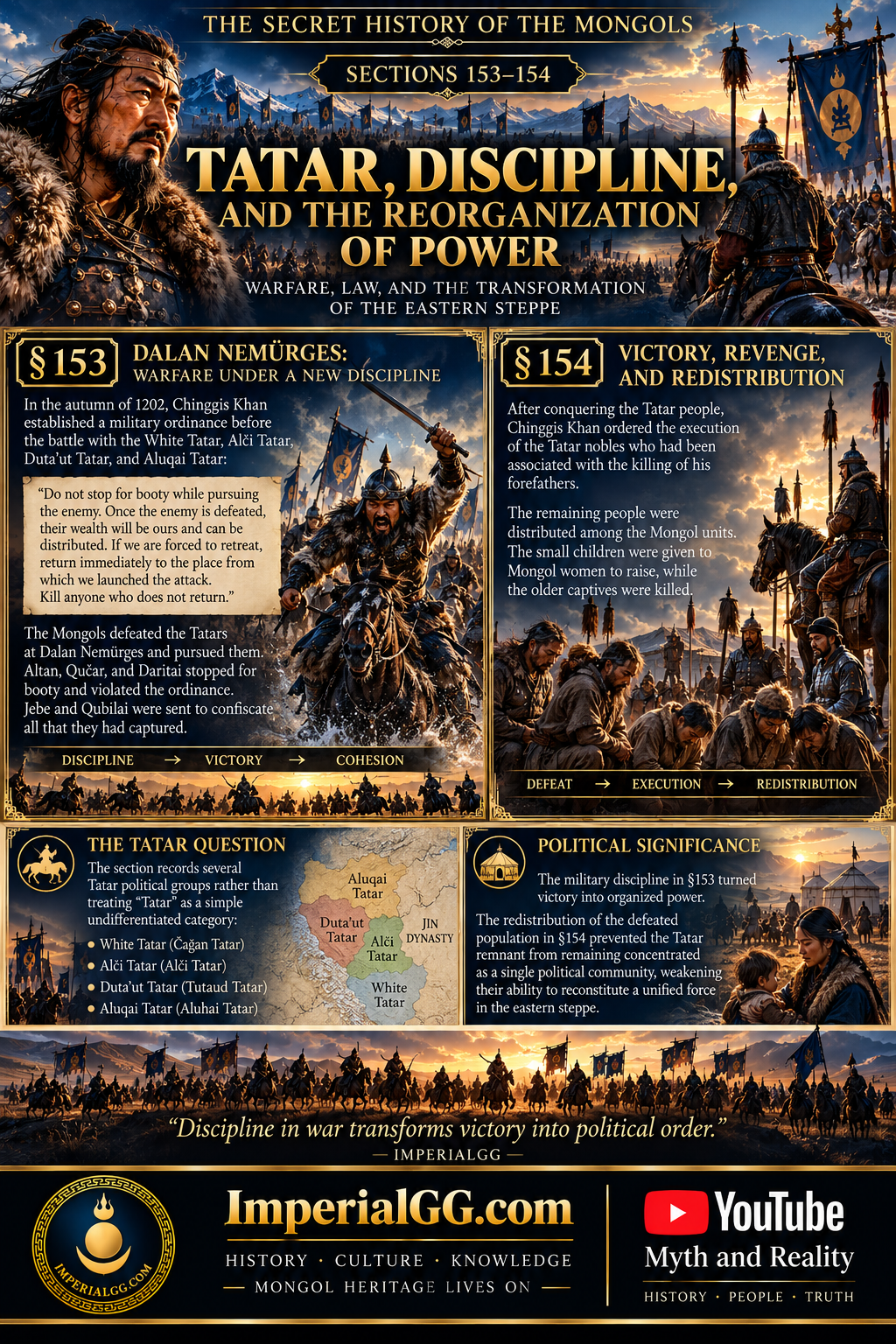
Reading Sections 153–154 of The Secret History of the Mongols
AUTHOR’S THESIS
Sections 153–154 of The Secret History of the Mongols record more than a Mongol victory over the Tatars. They reveal a broader transformation in the political and military order of the eastern steppe. The Tatars encountered by Chinggis Khan were not an isolated population suddenly appearing in the twelfth century; they belonged to a wider historical landscape in which large steppe confederations had repeatedly united and fragmented, while local communities continued to occupy their established territories. The association of the term Tatar (татар) with groups near the frontier of the Jurchen Jin state also demonstrates how political geography shaped the terminology through which steppe populations were identified.
At Dalan Nemürges, Chinggis Khan simultaneously imposed a new military discipline: warriors were forbidden to stop for booty during the decisive phase of battle and were required, if forced to retreat, to return to the point from which they had launched their attack. The order placed the cohesion of the army above the immediate interests of individual warriors. After defeating the Tatars, the subsequent destruction and redistribution of their surviving population further altered the political structure of the steppe. Although the Secret History does not explicitly state that this redistribution was designed to prevent the Tatars from reconstituting themselves as a unified political force, its effect was to break the concentration of the defeated population and incorporate its survivors into other units of Chinggis Khan’s emerging political order.
I. THE TATAR QUESTION: A NAME AND A POLITICAL GEOGRAPHY
Section 153 identifies four Tatar groups: the Čaγa’an Tatar, Alči Tatar, Duta’ut Tatar, and Aluqai Tatar. Rachewiltz preserves these names in his scholarly transcription and places the battle at Dalan Nemürges in the autumn of 1202. Monumenta Altaica
The designation Tatar (татар) requires careful historical treatment. It should not automatically be understood as an ethnic label with the same fixed meaning across all periods. Christopher Atwood notes that before the rise of Chinggis Khan, Tatar could function as a broad external designation for Mongolic-speaking pastoralists of the plateau; with the rise of Chinggis Khan and the emergence of Mongol as the wider political designation, the term became more specifically associated in the Secret History with groups near the Jurchen Jin frontier. Penguin Random House
This geographical dimension is important for understanding §153. The Tatars defeated by Chinggis Khan were located within the political world of eastern Mongolia, but their position was also connected to the frontier of the Jin state. Contemporary and later Chinese sources likewise demonstrate that the terminology applied to steppe peoples could change according to political context, and modern scholarship cautions against treating Tatar as a single, unchanging ethnic category. ResearchGate
Thus, the Tatars of §153 should be understood simultaneously as historical communities, political groups, and inhabitants of a particular frontier zone.
II. FROM IMPERIAL UNITY TO POLITICAL FRAGMENTATION
This geographical observation also connects §153 with the longer history of the eastern Eurasian steppe. The history of the steppe repeatedly demonstrates the coexistence of two processes: political unification and political fragmentation. Large confederations could unite diverse communities under a single political authority, while the weakening of that authority could leave those communities occupying their established territories under more localized leadership.
This broader historical pattern is important when reading the Tatar groups of §153. Their existence does not necessarily imply that they were newly formed communities. Rather, they can be situated within a much older landscape of populations whose political affiliations changed over time.
This perspective is consistent with the broader problem addressed in our earlier Jüilü and Nine Tribes study: the emergence of powerful steppe states did not necessarily erase the underlying communities from which those political formations were constructed. When central authority weakened, previously integrated groups could again appear as distinct political units.
The Tatar case therefore illustrates a recurring phenomenon of steppe history: Political unity could disappear without the disappearance of the populations that had once been incorporated into it.
This distinction between political integration and population continuity is essential to interpreting the world encountered by Chinggis Khan.
III. DALAN NEMÜRGES: WARFARE UNDER A NEW DISCIPLINE
The most important feature of §153, however, is not the list of Tatar groups but the military ordinance (цааз) issued before the battle.
Chinggis Khan orders his soldiers not to stop for booty during the battle. Once the enemy has been defeated, the booty will remain available for distribution. If the army is forced to retreat, the soldiers must return to the place from which they began their attack; those who fail to return are to be executed. Rachewiltz translates this as a jointly established military ordinance and emphasizes the requirement to return to the original point of attack. Monumenta Altaica
The importance of this command is considerable. The individual warrior’s immediate interest is booty. The commander’s interest is victory and the preservation of the fighting force. Chinggis Khan’s ordinance places the second above the first. The battle therefore becomes a test not only of courage but of collective discipline.
The subsequent behavior of Altan, Qučar, and Daritai demonstrates precisely why such a rule was necessary. They stop for booty rather than maintaining the agreed military order, and Chinggis Khan sends Jebe and Qubilai to confiscate everything they had acquired. Monumenta Altaica
The fact that these offenders were important figures is especially significant. The rule was not restricted to ordinary soldiers. Kinship and status did not exempt a commander from the military ordinance.
IV. RETURNING TO THE POINT OF ATTACK
The second part of the ordinance deserves particular attention. Chinggis Khan requires a retreating force to return to the point from which it originally launched its attack. This should not be reduced to a modern concept of battlefield maneuver. In a highly mobile mounted army operating across an open steppe environment, cohesion was itself a strategic resource. A force that dispersed while pursuing booty or retreating could lose its capacity to regroup, communicate, or counterattack.
Modern scholarship on early Mongol warfare has emphasized this connection between discipline and mobility. One study of Mongol military organization specifically identifies the 1202 Tatar campaign as an early example in which Chinggis Khan sought to prevent victory from dissolving into individual plunder and required troops to regroup at a designated location. ResearchGate
The ordinance can therefore be understood as institutionalizing an important principle of mobile warfare: Movement without cohesion produces dispersion; movement under discipline produces military power.
The command to return to the original point of attack is particularly suited to a mobile cavalry force. It establishes a fixed reference point within an otherwise highly fluid battlefield. Rather than allowing every warrior to determine his own direction after the engagement, Chinggis Khan creates a common spatial order.
V. THE DEFEAT OF THE TATARS AND THE END OF THEIR CORPORATE POWER
The battle at Dalan Nemürges results in the defeat of the Tatars, who are driven toward the Ulqui Šilügeljit River and then subjected to further attack and plunder. The Secret History names the principal Tatar groups and states that their important people were destroyed. Monumenta Altaica
Section 154 then moves beyond battlefield victory to a question of political reorganization: what should be done with the defeated Tatar population?
This is a critical transition. A military victory destroys an army. A political reorganization can destroy the possibility of that army being reconstructed. The text records Chinggis Khan’s council with his kinsmen, in which the historical grievances between Tatars and Mongols are recalled and revenge is invoked. Rachewiltz’s translation records the decision to kill the adult men while enslaving and distributing the survivors. PeachV
The Mongolian narrative therefore moves from:
defeat → destruction → deliberation → redistribution.
VI. THE DISTRIBUTION OF THE SURVIVORS
This is where the political significance of §154 becomes particularly important. The surviving Tatar population was not left as a single, autonomous political community. The text states that the survivors would be enslaved and divided among the Mongol groups. Aziz Yardımlı
We should distinguish here between what the source explicitly states and what can be inferred from its political consequences.
The Secret History explicitly gives revenge for the killing of Mongol ancestors as the stated justification for the decision. It does not explicitly say: “We shall divide the Tatars so that they can never reunite politically.”
Nevertheless, the redistribution had precisely the structural effect of preventing the defeated Tatar population from continuing as a concentrated corporate political body. This is significant because steppe power depended not only on territory but on the ability of a population to maintain leadership, military manpower, kinship networks, and collective political identity. Dispersing survivors among other groups weakened that capacity.
Thus, the redistribution can be interpreted as part of a broader process of political incorporation and fragmentation of former enemy power, without attributing an explicit motive to Chinggis Khan that the text itself does not state.
VII. FROM TRIBAL POWER TO IMPERIAL INCORPORATION
This point becomes even more important when viewed against the earlier history of the steppe. A powerful confederation could emerge when related or allied groups were politically united under strong leadership. Conversely, when political unity broke down, those same populations could reappear as separate groups.
Chinggis Khan’s political project increasingly moved in the opposite direction. Rather than permitting defeated groups to remain autonomous, he incorporated their surviving populations into the expanding Mongol political and military structure. The Tatar case therefore represents an early example of a larger imperial process:
defeat the political leadership → break the concentration of the population → redistribute survivors → incorporate them into the new order.
The significance of §154 lies not only in its violence but in this transformation of political organization.
VIII. THE MILITARY AND POLITICAL LOGIC ARE CONNECTED
Sections 153 and 154 should therefore be read together.
Section 153 establishes discipline within the Mongol army.
Section 154 establishes reorganization of the defeated population.
The same political principle appears at two different levels.
WITHIN THE MONGOL ARMY
Individual warriors are prevented from acting independently for immediate booty.
Individual interest → collective military discipline
WITHIN THE DEFEATED TATAR POPULATION
The defeated population is prevented from remaining as an autonomous political body.
Former collective power → dispersed incorporation
The result is a political order in which both the conqueror’s army and the conquered population are organized according to the requirements of the emerging central authority.
IX. THE DEEPER SIGNIFICANCE OF THE 1202 CAMPAIGN
The importance of the Tatar campaign therefore extends beyond the destruction of a traditional enemy.
At Dalan Nemürges, Chinggis Khan demonstrates that victory requires discipline. The warrior must postpone private acquisition until the collective objective has been achieved; if forced to retreat, he must return to the established point of assembly. The punishment of Altan, Qučar, and Daritai demonstrates that the rule applied even to prominent members of the ruling elite. Monumenta Altaica
After victory, the same logic of political consolidation is applied to the defeated population. The Tatar survivors are not preserved as an autonomous political bloc but redistributed among the victorious groups.
The campaign thus illustrates two complementary transformations: The Mongol army is disciplined internally, while the conquered population is reorganized externally.
This is an important step in the movement from a coalition of steppe groups toward a centralized imperial polity.
X. AUTHOR’S THESIS II
THE MILITARY ORDER AS A FOUNDATION OF STATE FORMATION
Section 153 can therefore be read as an early statement of a principle that would become central to Mongol imperial expansion: the army must belong to the political order rather than to the immediate interests of individual warriors.
The prohibition against premature plunder is not merely a battlefield instruction. It establishes a hierarchy of priorities:
victory → survival of the army → collective distribution of booty → individual reward.
The punishment of those who violate this sequence demonstrates that Chinggis Khan was attempting to replace fragmented warrior interests with centralized military discipline. Scholarship on Mongol warfare likewise emphasizes the importance of discipline in preventing successful campaigns from degenerating into uncontrolled plunder and dispersion. ResearchGate
This transformation is fundamental to understanding the later Mongol Empire. An army capable of maintaining cohesion over great distances could operate beyond the immediate territory of its own tribe or clan. Military discipline therefore became one of the mechanisms through which a localized steppe coalition could develop into a transregional imperial force.
XI. CONCLUSION
Sections 153–154 mark an important stage in the transformation of Chinggis Khan’s political order.
The Tatar (татар) groups appear within a historical landscape shaped by the interaction of steppe communities and the Jurchen Jin frontier. Their existence also reflects the longer pattern of steppe history in which large political formations could unite diverse communities and later fragment, leaving local populations and territorial identities intact.
At Dalan Nemürges, however, Chinggis Khan introduces a different principle. The army is ordered to subordinate individual pursuit of booty to collective military objectives. The requirement to return to the point of attack if forced to retreat creates a mechanism for maintaining cohesion within a highly mobile mounted force. The violation of this rule by Altan, Qučar, and Daritai—and the confiscation of their booty—demonstrates that the ordinance applied across social rank. Monumenta Altaica
After the Tatar defeat, §154 extends this process from the battlefield to political society. The surviving Tatars are divided and incorporated rather than preserved as a single autonomous community. The text explicitly presents revenge for earlier attacks on Mongol ancestors as the justification; the broader interpretation that redistribution also prevented the reconstitution of a unified Tatar political force is an inference from its structural effect rather than a stated motive.
The larger historical significance is therefore found in the combination of these two processes: Chinggis Khan disciplined his own army while reorganizing the political structure of the conquered.
The 1202 Tatar campaign consequently represents more than a military victory. It illustrates an early stage in the construction of a political order in which military cohesion, centralized authority, redistribution of populations, and the weakening of autonomous corporate power operated together. The Tatars were defeated on the battlefield; but more importantly for the emerging Mongol polity, their ability to reconstitute themselves as an independent political force was fundamentally altered.
SELECTED SCHOLARLY SOURCES
- Igor de Rachewiltz, The Secret History of the Mongols: A Mongolian Epic Chronicle of the Thirteenth Century. Brill, 2004–2013. Rachewiltz’s edition is identified by the ANU Mongolia Institute as the standard English scholarly version. Mongolia Institute
- Christopher P. Atwood, The Secret History of the Mongols / related scholarship on the historical geography and usage of Tatar and Mongol. Atwood’s discussion distinguishes the broad pre-Chinggisid external use of Tatar from its more specific association with frontier Tatars in the Secret History. Penguin Random House
- Bair Nanzatov and Vladimir Tishin, “Toward the History of Tatars of Inner Asia: An Attempt to Identify Tribal Names,” Golden Horde Review 9.1 (2021): 8–27. ResearchGate
- Christopher P. Atwood, The Rise of the Mongols: Five Chinese Sources, discussed by Peter Jackson in The Medieval Review, for the Chinese-source perspective on Mongol/Tatar terminology and the Jin frontier.