1. TAJIK PEOPLE BEFORE THE MONGOL EMPIRE
By Altanbagana Baatar
DBA Candidate| Independent Historian
ImperialGG Historical Research Seriers
23 July 2026
FROM ANCIENT IRANIAN PEOPLES TO THE TAJIKS
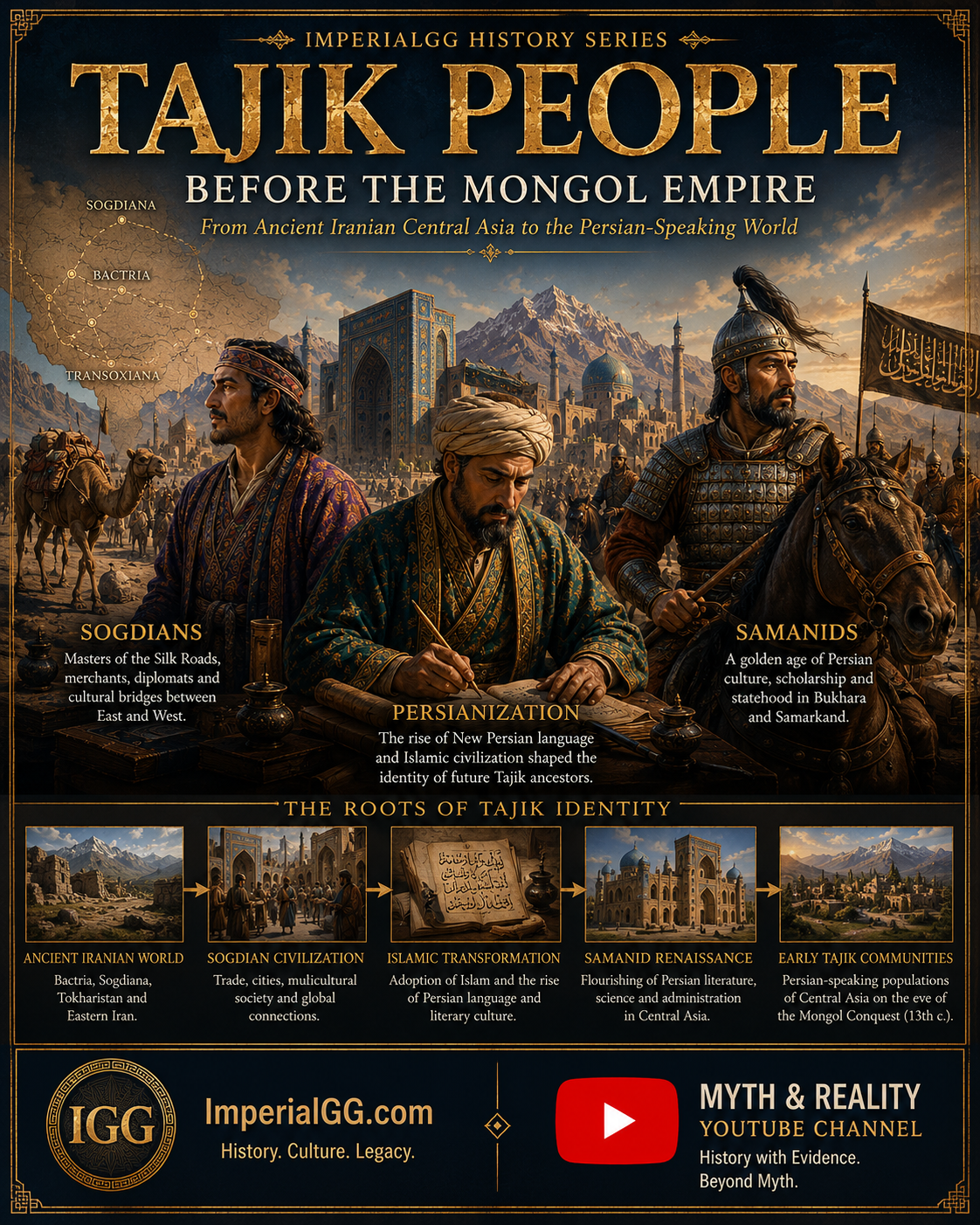
The historical formation of the Tajik people was not the result of the survival of a single ancient tribe under an unchanged ethnic name. It emerged from a long process in which the diverse Iranian-speaking populations of Central Asia were gradually integrated into a new Persian-speaking cultural world. Among these populations, the inhabitants of Sogdiana, Bactria, Tokharistan, and neighboring regions formed an important part of the demographic and cultural foundations from which the later Tajik population developed.
This process involved considerable linguistic transformation. The ancient peoples of Central Asia spoke several Iranian languages, including Sogdian and Bactrian, which were distinct from Persian. Following the expansion of Islam into Central Asia and the subsequent rise of New Persian as a major language of literature, administration, and urban culture, many of these older Iranian languages gradually declined. Their speakers did not simply disappear; substantial sections of the population were absorbed into the expanding Persian-speaking cultural environment of Transoxiana and Khorasan.
The Samanid period of the ninth and tenth centuries represented a particularly important stage in this transformation. From their centers in Bukhara and Samarkand, the Samanids presided over a major flourishing of Persian language and culture in Central Asia. New Persian developed into a prestigious literary and administrative language, while the region produced scholars, poets, and intellectual traditions that became influential throughout the wider Persianate world. Although the Samanid state cannot accurately be described as a modern Tajik nation-state, its cultural environment played a fundamental role in the historical formation of the Persian-speaking communities later identified as Tajiks.
The ethnonym “Tajik” itself acquired its later meaning gradually. In medieval Central Asia, particularly as Turkic-speaking populations and dynasties became increasingly prominent, the term came to distinguish Persian-speaking sedentary communities from their Turkic-speaking neighbors. The development of Tajik identity was therefore closely connected to the broader transformation of Central Asia into a Turko-Persian cultural world, in which different linguistic communities lived within shared political, economic, and religious systems.
By the beginning of the thirteenth century, Persian-speaking communities were firmly established throughout Transoxiana, including Samarkand, Bukhara, Khujand, the Zeravshan Valley, and regions extending southward toward Badakhshan and Afghanistan. They did not inhabit a political entity called Tajikistan, nor did they constitute an independent Tajik state. Most of the major territories associated with these populations had become incorporated into the expanding Khwarazmian Empire.
Thus, immediately before the Mongol conquest, the ancestors of the modern Tajiks belonged politically to the wider Khwarazmian world while retaining the Persian language and cultural traditions that had developed over centuries in Central Asia. Their pre-Mongol history therefore ends not with the emergence of a Tajik state, but with their incorporation into one of the last great Central Asian empires to stand before the expansion of Chinggis Khan.
THE SOGDIAN AND BACTRIAN FOUNDATIONS
Among the ancient populations that contributed to the historical foundations of the Tajik people, the Sogdians and Bactrians occupy a particularly important place. Their civilizations developed long before the emergence of the Tajik ethnonym and belonged to the broader Iranian-speaking world of ancient Central Asia. Although neither people can simply be identified as “Tajik” in the modern sense, the territories they inhabited, the populations they represented, and the cultural traditions they transmitted formed part of the historical environment from which the later Persian-speaking communities of Central Asia emerged.
Sogdiana was centered primarily in the Zeravshan and Kashkadarya valleys, with Samarkand as its most celebrated urban center. Its geographic position between the agricultural civilizations of the south and the pastoral societies of the Eurasian steppe enabled the Sogdians to become important intermediaries in long-distance trade. By Late Antiquity and the early medieval period, Sogdian merchants had established commercial communities across Central Asia and along routes extending through the Tarim Basin into China. Their activities connected distant political and cultural worlds, making Sogdiana one of the principal crossroads of pre-Mongol Eurasia.
The importance of the Sogdians extended far beyond commerce. Their networks facilitated the movement of religious beliefs, artistic traditions, technologies, and information across the continent. Sogdian communities participated in the transmission of Buddhism, Manichaeism, Zoroastrian traditions, and Christianity, reflecting the remarkable religious diversity of Central Asia before the consolidation of Islam. Their cities developed sophisticated forms of urban culture, while Sogdian merchants and diplomats maintained relations with both the sedentary civilizations of Asia and the powerful nomadic confederations of the steppe.
South of Sogdiana lay Bactria, an equally ancient center of Iranian-speaking civilization located around the upper and middle Amu Darya and extending across territories that today belong primarily to Afghanistan, Tajikistan, and Uzbekistan. Bactria had been incorporated into the Achaemenid Empire and later became one of the principal centers of the Hellenistic world in Central Asia following the campaigns of Alexander the Great. The subsequent Greco-Bactrian and Kushan periods transformed the region into another major zone of interaction between Iranian, Hellenistic, Indian, and Central Asian cultural traditions.
The populations of Sogdiana and Bactria did not remain culturally or linguistically unchanged. Political conquest, migration, trade, religious transformation, and interaction with neighboring peoples continually reshaped these societies. The arrival of Islam and the gradual expansion of New Persian eventually altered the linguistic structure of much of the region. Sogdian and Bactrian declined as widely spoken languages, while Persian became increasingly prominent in the cities and settled communities of Transoxiana and Khorasan.
This linguistic transition should not be interpreted as the disappearance of the earlier populations. Languages can change without the complete replacement of the people who speak them. Over generations, communities descended from older Iranian-speaking populations could adopt Persian while retaining elements of regional ancestry, local culture, and historical continuity. The emergence of the Persian-speaking population later associated with the Tajik identity was therefore not the creation of an entirely new people, but part of a long transformation of Central Asia’s older Iranian cultural landscape.
The relationship between the ancient Sogdians, Bactrians, and modern Tajiks must consequently be described with historical precision. The Tajiks are not simply Sogdians or Bactrians under a new name, but neither are these ancient civilizations unrelated to Tajik history. They represent important ancestral and cultural layers within the complex historical formation of the Persian-speaking peoples of Central Asia.
FROM THE ISLAMIC TRANSFORMATION TO THE EMERGENCE OF THE TAJIK PEOPLE
The Arab expansion into Central Asia during the seventh and eighth centuries initiated one of the most important transformations in the history of the region. The conquest did not immediately erase the older Iranian-speaking societies of Sogdiana, Bactria, and Tokharistan, but it gradually introduced a new political, religious, and cultural framework. Islam became increasingly established among the local population, while Central Asia was incorporated into the wider intellectual and commercial networks of the Islamic world. Over the following centuries, this transformation contributed to the emergence of the Persian-speaking cultural environment from which the historical Tajik population developed.
The linguistic transformation of Central Asia was particularly significant. Before the Islamic period, the region contained several Iranian languages, including Sogdian, Bactrian, and other regional languages. Arabic became important as the language of religion, theology, and scholarship following the conquest, but it did not replace the Iranian languages of the population as a whole. Instead, New Persian gradually emerged as the dominant literary and cultural language across much of eastern Iran, Khorasan, and Transoxiana. Written primarily in the Arabic script and influenced extensively by Arabic vocabulary, it nevertheless represented the continuation of the Persian linguistic tradition.
As New Persian expanded, many communities descended from older Iranian-speaking populations gradually adopted it. This process occurred over generations and differed considerably between regions. Sogdian, for example, survived for centuries after the Arab conquest before gradually declining, while other Eastern Iranian languages continued in more isolated areas. The spread of Persian therefore represented a long process of linguistic integration rather than the sudden replacement of one population by another. Through this transformation, communities of different regional backgrounds increasingly became part of a shared Persian-speaking cultural world.
The rise of the Samanid state in the ninth and tenth centuries marked a decisive stage in this development. Centered principally on Bukhara and exercising authority across much of Transoxiana and Khorasan, the Samanids presided over a major flourishing of Persian language and culture. Their period witnessed the consolidation of New Persian as a prestigious language of literature, court culture, and intellectual life, alongside Arabic, which retained its central importance in religion and scholarship.
Bukhara and Samarkand became major centers of the Persian-Islamic world, while figures such as Rudaki contributed to the emergence of classical Persian literary culture. The significance of the Samanid period to later Tajik history lies primarily in this cultural transformation. Although the Samanid realm was a medieval Islamic state rather than a modern Tajik nation-state, it provided one of the most important political and cultural environments in which the Persian-speaking civilization of Central Asia became firmly established.
The decline of the Samanids at the end of the tenth century did not bring an end to this Persian cultural world. Turkic-speaking peoples had already played important roles in Central Asian history, but their political influence increased significantly with the rise of dynasties such as the Karakhanids and later other Turkic and Turko-Persian powers. The political landscape of Central Asia consequently became increasingly dominated by Turkic-speaking military elites and dynasties, while Persian continued to occupy a central position in administration, literature, scholarship, and urban culture.
This interaction produced the distinctive Turko-Persian civilization that would characterize much of medieval Central Asia. Turkic and Persian-speaking populations were not separated into isolated cultural worlds. They lived within the same states, participated in common economic and religious institutions, and influenced one another linguistically and culturally. Turkic rulers frequently patronized Persian literature and employed Persian-speaking administrators, while Persian-speaking communities lived under dynasties of diverse ethnic and political origins.
It was within this changing environment that the term “Tajik” gradually acquired a more recognizable Central Asian meaning. The precise origin and early history of the ethnonym remain subjects of scholarly discussion, and its meaning was not constant across all periods. Earlier forms of the term could refer to Arabs or Muslims in particular contexts, but among Turkic-speaking populations it increasingly came to designate Persian-speaking sedentary communities. Over time, the distinction between “Turk” and “Tajik” became an important social and linguistic category in parts of Central Asia, although medieval identities remained considerably more complex than modern ethnic classifications suggest.
The emergence of the Tajik identity should therefore not be understood as the sudden appearance of a new people. It represented the gradual formation of a Persian-speaking Central Asian population whose deeper historical roots included the older Iranian-speaking societies of the region. The adoption of Persian, the spread of Islam, the cultural achievements of the Samanid period, and centuries of interaction with Turkic-speaking populations all contributed to this development.
By the twelfth and early thirteenth centuries, Persian-speaking sedentary communities were established across a broad geographical area that extended far beyond the borders of modern Tajikistan. They inhabited important cities and agricultural regions in Transoxiana, including Samarkand, Bukhara, Khujand, and the Zeravshan Valley, as well as mountainous regions extending toward Badakhshan and the territories south of the Amu Darya. The political geography of this population therefore cannot be projected onto the boundaries of the modern Tajik state.
Immediately before the Mongol expansion into Central Asia, much of this Persian-speaking world had been incorporated into the Khwarazmian Empire. The ancestors of the modern Tajiks did not possess a separate Tajik kingdom on the eve of the Mongol conquest; they formed part of the diverse urban, agricultural, and mountain populations living within the larger political order of Khwarazm.
The pre-Mongol formation of the Tajik people can therefore be understood as the outcome of several interconnected historical processes. The ancient Iranian-speaking foundations of Central Asia provided the deeper demographic and cultural background; Islam transformed the religious and intellectual environment; New Persian created an increasingly shared linguistic sphere; the Samanid period strengthened Persian literary and urban culture; and prolonged interaction with the Turkic world contributed to the gradual emergence of “Tajik” as a distinctive designation for Persian-speaking populations.
By the time the armies of Chinggis Khan entered the Khwarazmian Empire in 1219, this long process had already produced a recognizable Persian-speaking Central Asian cultural community. The Mongols were not encountering a newly formed people, but populations whose historical roots reached back through the Islamic and Samanid periods to the much older Iranian civilizations of Central Asia.
4. TAJIKS UNDER PAX MONGOLICA
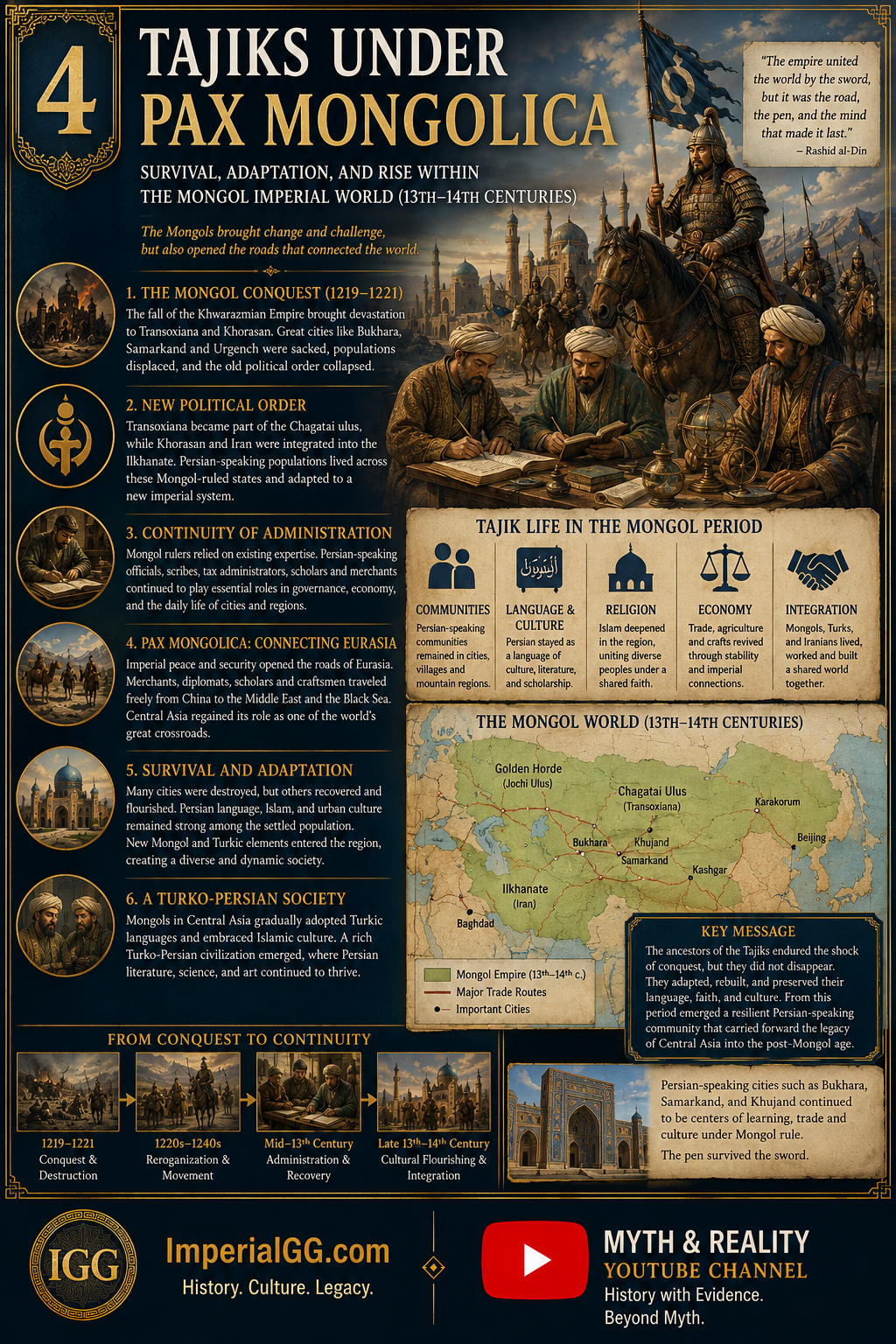
The Mongol conquest of Central Asia beginning in 1219 marked a profound political rupture for the Persian-speaking populations from whom the later Tajik people developed. The Khwarazmian Empire collapsed under the campaigns of Chinggis Khan, and major centers of Transoxiana and Khorasan were subjected to warfare, population displacement, and political reorganization. Yet the conquest did not bring an end to the Persian-speaking communities of Central Asia. After the initial destruction, these populations became part of a much larger imperial system that connected Central Asia with China, Iran, the Eurasian steppe, and the western regions of the Mongol world.
Following the division of the Mongol Empire, much of Transoxiana came under the authority of the Chagatai ulus, while neighboring Khorasan and Iran eventually formed part of the Ilkhanate. The historical Tajik population consequently lived across political boundaries within the wider Mongol imperial world. Persian-speaking urban communities remained particularly important in cities, agricultural districts, and mountain regions, while Mongol and Turkic military elites dominated much of the political structure.
The relationship between the conquerors and the settled population gradually changed as Mongol rule became institutionalized. The Mongols possessed highly effective traditions of military and imperial organization, but governing the complex agricultural and urban societies of Central Asia required cooperation with existing administrative communities. Persian-speaking officials, secretaries, tax administrators, merchants, scholars, and other specialists therefore continued to play important roles in the functioning of the post-conquest states.
The broader imperial order commonly described as the Pax Mongolica also created new opportunities for communication across Eurasia. Once the major regions of the continent had been incorporated into interconnected Mongol-ruled states, merchants, diplomats, religious figures, craftsmen, and intellectuals could move across distances that had previously been divided among competing political powers. Central Asia regained its historic position as one of the principal crossroads between eastern and western Eurasia.
For the Persian-speaking population of Central Asia, this period was characterized by both disruption and adaptation. Some cities devastated during the conquest recovered, while others never regained their former importance. Agricultural systems and patterns of settlement were altered in several regions, and movements of populations introduced new Mongol and Turkic elements into the demographic landscape. At the same time, Persian language and culture remained deeply rooted among the settled population.
The Mongol period also accelerated the interaction between Persian-speaking and Turkic-speaking communities. Over time, many Mongol groups in Central Asia adopted Turkic languages and became increasingly integrated into the region’s Islamic cultural environment. The result was not the simple replacement of one population by another, but the further development of the Turko-Persian society that had already begun to emerge before the conquest.
For the ancestors of the Tajiks, continuity was particularly visible in the survival of Persian as a language of urban culture, administration, literature, and scholarship. Political dynasties changed repeatedly, but Persian-speaking communities continued to inhabit important centers such as Bukhara, Samarkand, Khujand, and the mountain regions extending toward Badakhshan. Their identity remained connected primarily to language, locality, religion, and patterns of settled life rather than to a territorial nation-state.
By the later Mongol period, the conquerors themselves had become increasingly integrated into the societies they ruled. Islamization, Turkicization, and interaction with Persianate culture gradually transformed the Chagatai world. The distinction between the original Mongol conquerors and the wider Central Asian population became increasingly complex, producing new political and cultural identities that would shape the region for centuries.
The Tajik historical experience under the Mongols should therefore not be presented solely as a story of conquest and destruction. The initial invasion was unquestionably catastrophic for many communities, but the subsequent period also witnessed reconstruction, imperial integration, population movement, and intensified cultural exchange across Eurasia. Persian-speaking communities survived the collapse of the Khwarazmian order and adapted to the political world created by the Mongol conquests.
When Mongol political unity gradually fragmented and new regional powers emerged, the Persian-speaking population of Central Asia remained one of the enduring elements of the region. The political order had been transformed, but the linguistic and cultural foundations that had developed before the conquest survived into the post-Mongol age.
The next major transformation would take place within the world that emerged from the Chagatai ulus itself, eventually giving rise to the political and cultural environment of the Timurid period.
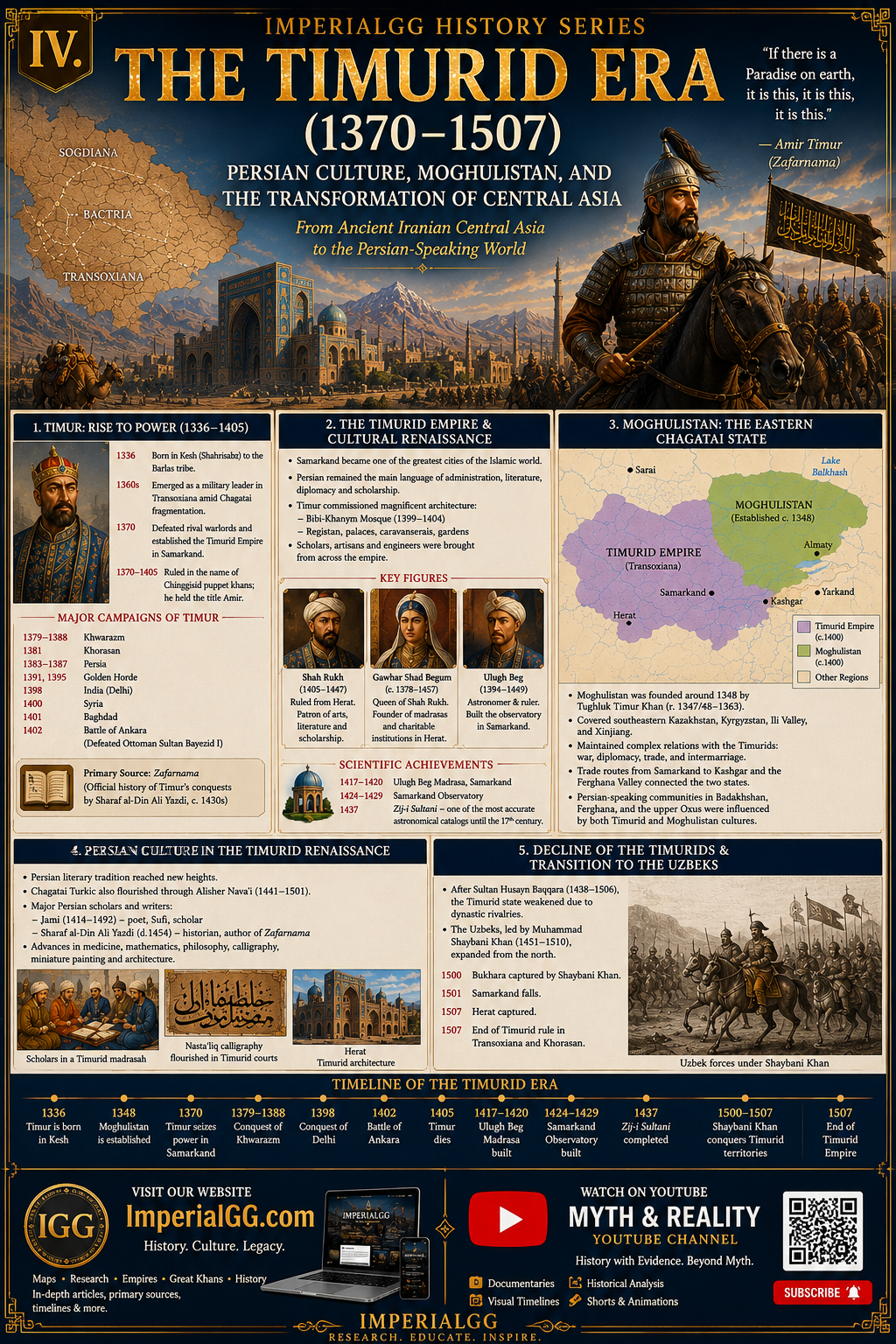
IV. THE TIMURID ERA (1370–1507)
Persian Culture, Moghulistan, and the Transformation of Central Asia
The collapse of the unified Chagatai Khanate during the mid-fourteenth century created a prolonged struggle for political authority across Central Asia. By the 1350s and 1360s, Transoxiana (Mawarannahr) was fragmented among competing tribal leaders, while the eastern territories formed the independent state of Moghulistan. This political fragmentation created the conditions for the rise of Timur (1336–1405), one of the most influential rulers in Eurasian history.
In 1370, Timur defeated his principal rivals and established himself as the supreme ruler of Transoxiana. Although he was a member of the Barlas tribe rather than a direct descendant of Chinggis Khan (c.1162–1227), Timur carefully legitimized his authority by governing in the name of Chinggisid puppet khans while assuming the title Amir. He selected Samarkand as the capital of the Timurid Empire (1370–1507), transforming it into the political and cultural center of Central Asia.
Between 1370 and 1405, Timur launched nearly continuous military campaigns across Eurasia. His armies conquered Khwarazm (1379–1388), Khorasan (1381), Persia (1383–1387), the Golden Horde (1391, 1395), Delhi (1398), Syria (1400), Baghdad (1401), and defeated the Ottoman Sultan Bayezid I at the Battle of Ankara (1402). These victories established one of the largest empires of the late medieval world. Although many of these campaigns caused immense destruction, they also redirected wealth, skilled artisans, engineers, and scholars toward Samarkand.
For the Persian-speaking populations that later became identified as the Tajik people, the Timurid period represented both political continuity and cultural renewal. Unlike many nomadic dynasties that adopted multiple administrative languages, the Timurids continued the long-established tradition of governing through Persian. Court administration, historical writing, literature, diplomacy, philosophy, medicine, and much of the bureaucracy operated primarily in Persian, preserving the intellectual foundations established during the Samanid Empire (819–999).
Samarkand rapidly emerged as one of the greatest cities of the Islamic world. Timur commissioned monumental architecture, including the Bibi-Khanym Mosque (1399–1404), the reconstruction of the Registan, and numerous caravanserais, gardens, and public buildings. Craftsmen from Isfahan, Shiraz, Damascus, Tabriz, Delhi, and other conquered cities contributed to the city’s transformation into an international center of architecture and commerce.
After Timur’s death in 1405, power eventually passed to his son Shah Rukh (r. 1405–1447), who ruled primarily from Herat. Under Shah Rukh and his wife Gawhar Shad Begum (c.1378–1457), Herat became one of the foremost cultural capitals of the Persianate world. Persian literature, miniature painting, calligraphy, architecture, and Islamic scholarship flourished under extensive royal patronage.
One of the greatest scientific achievements of the Timurid period occurred under Ulugh Beg (1394–1449), Timur’s grandson and ruler of Transoxiana. He founded the Ulugh Beg Madrasa in Samarkand (1417–1420) and constructed the famous Samarkand Observatory (c.1424–1429). His astronomical catalogue, the Zij-i Sultani (1437), contained observations of remarkable precision and remained one of the world’s most accurate astronomical works until the seventeenth century.
Moghulistan and the Eastern Chagatai World
While the Timurids dominated Transoxiana and much of western Central Asia, the eastern territories of the former Chagatai Khanate evolved into Moghulistan, established around 1348 under Tughlugh Timur Khan (r.1347/48–1363). Moghulistan occupied much of present-day southeastern Kazakhstan, Kyrgyzstan, the Ili Valley, and Xinjiang, extending at times into eastern Ferghana and the Tarim Basin.
Despite frequent warfare, the Timurid Empire and Moghulistan remained deeply interconnected. Diplomatic marriages, military alliances, commercial exchanges, and religious networks linked the two states. The frontier between them was not a fixed border but a dynamic zone where sedentary Persian-speaking communities interacted continuously with Turkic and Mongol nomadic populations.
The Tajik-speaking populations of Badakhshan, the upper Oxus (Amu Darya) basin, and eastern Transoxiana occupied a strategic position between these rival powers. Trade caravans traveling along branches of the Silk Road connected Samarkand, Kashgar, Yarkand, and the Ferghana Valley, facilitating the movement of merchants, scholars, Sufi missionaries, and artisans. These exchanges reinforced the cultural resilience of Persian-speaking urban communities while integrating them into the wider political landscape of Central Asia.
Persian Culture During the Timurid Renaissance
The fifteenth century is widely regarded as the Timurid Renaissance, one of the high points of Persianate civilization. Persian remained the dominant language of administration and elite literary culture, while Chagatai Turkic gained increasing prestige as a literary language through figures such as Mir Ali Shir Nava’i (1441–1501). Rather than replacing Persian, Chagatai developed alongside it, producing a bilingual intellectual environment that profoundly influenced both Tajik and Uzbek cultural history.
Major Persian literary figures associated with the Timurid court included Nur al-Din Abd al-Rahman Jami (1414–1492), whose poetry and Sufi writings became classics throughout the Persian-speaking world. Court historian Sharaf al-Din Ali Yazdi (d.1454) composed the celebrated Zafarnama, the official history of Timur’s reign, while numerous scholars expanded the fields of theology, philosophy, medicine, mathematics, and historiography.
The End of the Timurid Era
Following the death of Sultan Husayn Bayqara (1438–1506), the Timurid state fragmented under dynastic rivalries. This internal instability coincided with the rise of the Uzbeks under Muhammad Shaybani Khan (1451–1510). Between 1500 and 1507, Shaybani captured Bukhara, Samarkand, and Herat, bringing an end to Timurid political dominance in Transoxiana and Khorasan.
Although Timurid rule disappeared, its cultural achievements endured. Persian remained the principal language of many urban communities, including the ancestors of the modern Tajiks. The architectural monuments of Samarkand and Herat, the scientific legacy of Ulugh Beg, and the literary works of Jami and other Persian scholars continued to shape Central Asian civilization long after the Timurid dynasty itself had vanished.
Key Dates
| Year | Event |
|---|---|
| 1348 | Foundation of Moghulistan under Tughlugh Timur Khan |
| 1370 | Timur establishes the Timurid Empire |
| 1398 | Conquest of Delhi |
| 1402 | Victory at the Battle of Ankara |
| 1405 | Death of Timur |
| 1417–1420 | Ulugh Beg Madrasa constructed |
| 1424–1429 | Samarkand Observatory built |
| 1437 | Zij-i Sultani completed |
| 1447 | Death of Shah Rukh |
| 1500–1507 | Shaybani Khan conquers Timurid territories |
| 1507 | End of the Timurid Empire in Central Asia |