
STAN COUNTRIES IN THE 13TH CENTURY
By Altanbagana Baatar
DBA Candidate| Independent Historian
ImperialGG Historical Research Series
27 June 2026
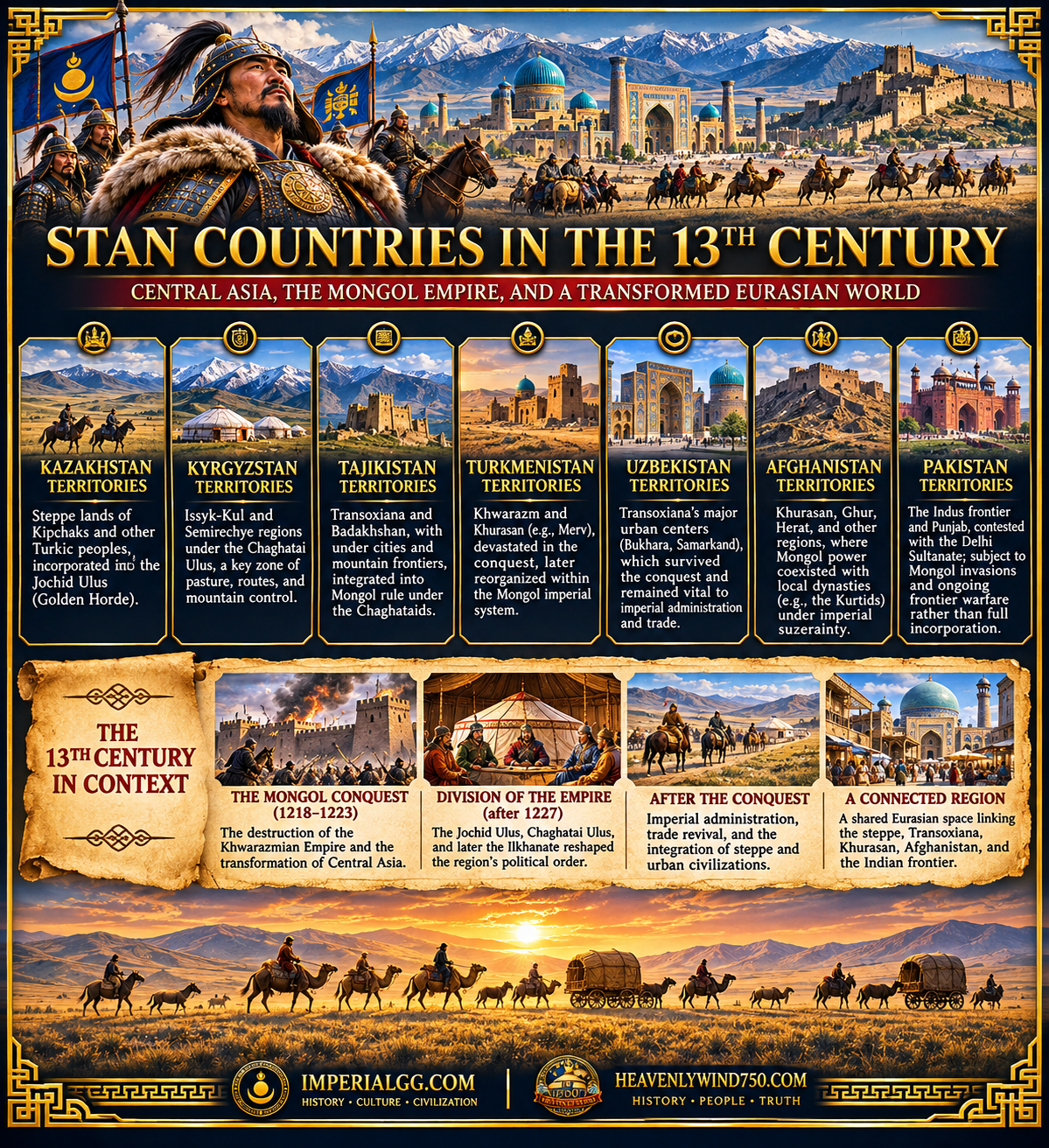
The Mongol Empire, Central Asian Political Transformations, and the Historical Foundations of Modern Central Asia
An Academic Historical Study of the Territories of Kazakhstan, Kyrgyzstan, Tajikistan, Turkmenistan, Uzbekistan, Afghanistan, and Pakistan
ABSTRACT
The thirteenth century was one of the most consequential periods in the political and cultural history of the territories that today constitute the seven countries commonly identified by the suffix -stan. During this period, the political geography of Central and South-Central Asia underwent a fundamental transformation as the Mongol Empire expanded westward, dismantled the Khwarazmian Empire, reorganized the territories of the former Qara-Khitai and other regional powers, and established new systems of imperial administration, military control, taxation, communication, and diplomacy.
The historical significance of this transformation cannot be understood by treating the modern countries of Kazakhstan, Kyrgyzstan, Tajikistan, Turkmenistan, Uzbekistan, Afghanistan, and Pakistan as if they had existed as unified political entities in the thirteenth century. Their present territories were divided among different dynasties, tribal confederations, urban principalities, pastoral communities, and imperial jurisdictions. The Mongol conquest did not simply replace one political authority with another; it connected the Eurasian steppe, Transoxiana, Khwarazm, Khurasan, Afghanistan, and the northwestern Indian frontier within a wider imperial framework.
This article examines the region through historical geography rather than modern national boundaries. It investigates the political landscape before the Mongol invasion, the campaigns of 1218–1223, the division of the empire among Chinggis Khan’s descendants, the emergence of the Jochid and Chaghadaid uluses, the development of the Ilkhanate, and the continuing military and diplomatic encounters with the Delhi Sultanate. Particular attention is given to the interaction between nomadic political institutions and settled urban civilizations, as well as the long-term consequences of Mongol rule for regional identity, trade, administration, and cultural exchange.
Keywords: Mongol Empire; Central Asia; Chinggis Khan; Khwarazmian Empire; Jochi Ulus; Chaghatai Ulus; Ilkhanate; Transoxiana; Khurasan; Silk Road; Delhi Sultanate; Eurasian history.
1. INTRODUCTION: WHAT DID “STAN” MEAN IN THE THIRTEENTH CENTURY?
The word -stan, derived from an Iranian linguistic root meaning a place, land, or country, appears in the names of several modern states across Central and South Asia. However, the political geography of the thirteenth century was fundamentally different from the map of the modern world. Kazakhstan, Kyrgyzstan, Tajikistan, Turkmenistan, Uzbekistan, Afghanistan, and Pakistan did not exist as seven independent nation-states with their present borders. Their territories belonged to a much wider historical environment in which political authority was exercised through dynastic sovereignty, tribal alliances, urban administrations, military governors, and imperial jurisdictions.
Consequently, the expression Stan Countries in the 13th Century should be understood as a modern geographical framework for examining the historical territories of these seven states, rather than as a description of seven medieval countries. This distinction is essential because the modern borders of Central Asia emerged through much later political processes, particularly during the Russian imperial and Soviet periods and the twentieth-century formation of South Asian states.
UNESCO’s History of Civilizations of Central Asia provides a useful methodological foundation for this approach. Its geographical framework deliberately extends beyond the narrow definition of Central Asia to include Afghanistan, northeastern Iran, Pakistan, northern India, western China, Mongolia, and the former Soviet Central Asian republics. This reflects the historical reality that the region developed through continuous interactions between nomadic and settled societies, rather than within isolated national territories.¹
unesdoc.unesco.org
The thirteenth century is particularly important because the Mongol expansion brought many of these territories into a common political and military system. Yet the resulting imperial order was not uniform. The northern steppe, the agricultural cities of Transoxiana, the oasis settlements of Khwarazm, the mountainous regions of Afghanistan, and the frontier zones of the Indian subcontinent experienced Mongol power in different ways.
The central argument of this article is that the thirteenth-century history of the -stan territories should be understood as the history of an interconnected Eurasian political system. The Mongol Empire was a decisive force in restructuring that system, but it did not erase the older regional societies, languages, religious traditions, and political institutions upon which its authority depended.
2. THE POLITICAL LANDSCAPE BEFORE THE MONGOL CONQUEST
Before the beginning of the Mongol western campaigns, the territories of modern Central Asia and Afghanistan were governed by a complex collection of political powers. Among the most significant were the Khwarazmian Empire, the Qara-Khitai state, the remnants of the Karakhanid dynasties, the Ghurid political tradition, and numerous Turkic and Iranian regional rulers.
The Khwarazmian Empire, under Sultan ʿAlāʾ al-Dīn Muhammad II (r. 1200–1220), had become the dominant power across much of Transoxiana, Khwarazm, and Khurasan. Its influence extended into territories corresponding to modern Uzbekistan, Turkmenistan, Tajikistan, and parts of Afghanistan and Iran. Its political and military strength rested on a combination of Turkic military elites, Persian-speaking administrative personnel, urban taxation, and control over important commercial routes.
Nevertheless, the Khwarazmian state contained serious internal weaknesses. Its expansion had brought it into conflict with neighboring dynasties, while the relationship between Sultan Muhammad and his mother, Terken Khatun, created competing centres of political authority within the ruling family. The empire’s administrative and military structure was therefore not as unified as its territorial extent might suggest.²
To the northeast, the Qara-Khitai, or Western Liao, had exercised authority over large parts of eastern and southeastern Central Asia. Their political influence extended into the Semirechye region and the territories surrounding the Chu and Ili river systems. The defeat of the Qara-Khitai political order created opportunities for the expansion of other powers, including the Khwarazmians and the Mongols.
In the south, the Ghurid political sphere had previously connected Afghanistan with northern India. Although the Ghurid Empire had fragmented by the beginning of the thirteenth century, its political legacy remained visible through local dynasties and regional rulers. Meanwhile, the Delhi Sultanate, established in 1206 under Qutb al-Din Aibak, was consolidating its authority in northern India.³
The northern and northeastern territories were shaped by a different political environment. The steppe regions corresponding to modern Kazakhstan and parts of Kyrgyzstan were inhabited by Turkic and Mongolic groups, including Kipchaks, Naimans, Kereyids, and other political communities. These were not merely peripheral populations. Their military capabilities, pastoral economies, and control over strategic routes made them central actors in the wider political history of Eurasia.
Thus, before the Mongol conquest, the territories of the modern -stan countries already formed a connected world of steppe confederations, agricultural cities, caravan routes, and competing dynastic powers.
3. THE MONGOL CAMPAIGNS OF 1218–1223: THE COLLAPSE OF THE KHWARAZMIAN EMPIRE
The Mongol campaigns into Central Asia began in the context of an already established diplomatic and commercial relationship between the Mongol Empire and the Khwarazmian state. Chinggis Khan sought to develop commercial relations and diplomatic communication with Sultan Muhammad. The destruction of the Mongol commercial mission at Otrar in 1218, together with the killing of its members and the subsequent diplomatic crisis, became the immediate catalyst for war.
In 1219, Mongol forces entered the territories of the Khwarazmian Empire. The campaign was strategically organized across several operational directions. Chinggis Khan, together with Tolui, advanced toward the major urban centres of Transoxiana, while Jochi, Chagadai, and Ögedei were involved in operations against the Khwarazmian centres farther west and north. The Mongol commanders also employed separate forces to pursue the Khwarazmian ruler and disrupt his ability to reorganize resistance.
The cities of Otrar, Bukhara, Samarkand, and Gurganj became central points in the campaign. Their capture represented not only military victories but also the destruction or subordination of important administrative and commercial centres. The Khwarazmian ruler Muhammad II fled before the Mongol advance and died in 1220–1221. His son Jalal al-Din Mingburnu continued resistance, but the defeat of his forces at the Indus River in November 1221 forced him to retreat toward the Indian subcontinent.⁴
The campaign also affected the regions of Khurasan and present-day Afghanistan. Tolui led operations in Khurasan, where major cities including Merv, Nishapur, and Herat suffered severe destruction. In the mountainous and frontier territories, local rulers sometimes resisted, while others submitted or negotiated with the Mongol commanders. The political consequences were therefore not identical throughout the region.
The conquest of the Khwarazmian Empire must be examined with particular care. The Mongol campaigns caused extensive destruction, population displacement, and the collapse of established political structures. At the same time, the subsequent history of the region cannot be reduced to destruction alone. The Mongols inherited and adapted existing administrative institutions, relied on local officials, and gradually reorganized the conquered territories within their imperial system.
Peter Jackson’s study of the Mongols and the Islamic world demonstrates the importance of distinguishing the initial military conquest from the later processes of imperial government, mediated sovereignty, and economic recovery.⁵
paxmongolica.org+2
4. THE TERRITORIES OF MODERN KAZAKHSTAN: THE STEPPE AND THE JOCHID ULUS
The territory of modern Kazakhstan occupied a central position in the political geography of the Mongol Empire. Its extensive grasslands connected Mongolia with the western steppe, the Volga region, the Aral Sea, and the commercial and agricultural centres of Central Asia.
During the early thirteenth century, this region was inhabited by multiple Turkic and Mongolic communities, including Kipchaks, Naimans, Kereyids, and other groups whose political affiliations changed through military alliances, conquest, and dynastic competition. It is important not to project the later Kazakh national identity directly onto all these medieval communities. The Kazakh Khanate emerged much later, in the fifteenth century.
After the death of Chinggis Khan in 1227, the western territories associated with Jochi, his eldest son, developed into the Jochid Ulus. This political formation eventually became known in modern historiography as the Golden Horde. Its territory included parts of the western steppe, the Volga region, and the lands extending toward the Black Sea and eastern Europe.
The Jochid political system was not simply a military occupation. It developed into a major imperial centre with its own dynastic authority, diplomatic networks, commercial interests, and relations with neighbouring states. The Golden Horde became particularly important during the second half of the thirteenth century, when it emerged as a powerful political entity linking the Eurasian steppe with eastern Europe and the Islamic world.⁶
cambridge.org+1
The significance of the steppe territories lay in their ability to sustain mobile armies, pastoral production, and long-distance communication. The Mongol Empire’s military and political system depended heavily on these resources. The steppe was therefore not an empty space between urban civilizations; it was one of the essential foundations of imperial power.
5. THE TERRITORIES OF MODERN KYRGYZSTAN: ISSYK-KUL, SEMIRECHYE, AND THE CHAGHATAI ULUS
The territory of modern Kyrgyzstan was situated at the intersection of major mountain routes and the pastoral zones of the Tian Shan. Its political and economic history was connected with Semirechye, the Chu River valley, the Issyk-Kul basin, and the wider eastern Central Asian region.
During the thirteenth century, these areas became closely connected with the Chaghatai Ulus, the political domain associated with Chinggis Khan’s second son, Chagadai. Following the division of the empire, Chagadai received extensive territories in Transoxiana and eastern Central Asia. His political domain included the region around Issyk-Kul and parts of Semirechye, although its boundaries were not fixed in the modern territorial sense.⁷
The Chaghatai Ulus was shaped by a complex relationship between nomadic political authority and settled urban society. The ruling elite retained important Mongol political traditions, while the cities and agricultural settlements depended on local administrative personnel and established systems of taxation.
The mountainous geography of the region also influenced political organization. Control over passes, valleys, seasonal pastures, and caravan routes was strategically important. The region connected the steppe with the oasis cities of Transoxiana and the eastern routes leading toward Kashgar and the Tarim Basin.
The later history of the Kyrgyz people cannot be reduced to the history of the Chaghatai dynasty. Nevertheless, the thirteenth century was an important period in the wider political and demographic transformations of the Tian Shan and surrounding territories.
6. THE TERRITORIES OF MODERN TAJIKISTAN: TRANSOXIANA, BADAKHSHAN, AND THE MOUNTAIN FRONTIERS
The territory of modern Tajikistan was historically connected with Transoxiana, the Oxus River basin, the Pamir region, and the mountainous corridors linking Central Asia with Afghanistan and the Indian subcontinent.
Transoxiana, known in Arabic and Persian geographical terminology as Māwarāʾ al-Nahr, referred to the lands beyond the Oxus River from the perspective of the Islamic world. It included major urban centres such as Bukhara and Samarkand, as well as agricultural settlements and commercial routes connecting the region with Khurasan, Khwarazm, and the eastern Islamic world.
The Mongol conquest fundamentally changed the political administration of this region. After the collapse of Khwarazmian authority, Transoxiana was incorporated into the Mongol imperial system. Following the division of the empire, much of the region came under the political authority of the Chaghatai dynasty.
However, the Mongols did not govern every settlement through direct military administration. They relied on local officials and administrators, including members of the established Persian-speaking administrative elite. One particularly important figure was Mahmud Yalavach, who was associated with the administration of urban settlements in Transoxiana under Ögedei. His son Masʿud Beg later continued this administrative role.⁸
Encyclopaedia Iranica+1
The mountainous regions of Badakhshan and the Pamirs formed a different political environment from the agricultural centres of Transoxiana. Their difficult geography, local ruling families, and strategic routes made them important frontier zones. Their history illustrates why the Mongol Empire should not be imagined as a uniform administrative structure imposed identically across every conquered territory.
The later historical development of Tajik identity was also shaped by the survival of Persian language and literary culture, which continued to play a major role in regional administration, scholarship, and urban life under Mongol rule.
7. THE TERRITORIES OF MODERN TURKMENISTAN: KHWARAZM AND KHURASAN
The territory of modern Turkmenistan was divided among several historical regions, particularly Khwarazm, the Karakum desert zone, and parts of Khurasan. These regions were connected through the Amu Darya basin, the Merv oasis, and the caravan routes linking Iran with Central Asia.
Khwarazm was one of the most important agricultural and commercial regions of the medieval Islamic world. Its economy depended on irrigation, river systems, agriculture, animal husbandry, and trade. Before the Mongol invasion, it was the political centre of the Khwarazmian dynasty.
The Mongol conquest brought a major disruption to this political and economic order. The capture of Gurganj and the destruction associated with the campaign had profound consequences for the region’s urban population and agricultural infrastructure. Yet Khwarazm did not disappear as a historical or economic region. It continued to function within the political and commercial networks of the Mongol successor states.
The southern parts of modern Turkmenistan were connected with Khurasan, where Merv was one of the most important urban centres. During the early 1220s, Tolui’s campaign caused extensive destruction in Khurasan. In the following decades, the region became part of the broader Mongol political order and later fell within the sphere of the Ilkhanate.
The history of modern Turkmenistan therefore cannot be described through a single thirteenth-century state. It was shaped by the interaction of Khwarazmian political traditions, Turkic and Oghuz communities, Mongol imperial administration, and the economic geography of the Amu Darya and Khurasan.⁹
8. THE TERRITORIES OF MODERN UZBEKISTAN: THE URBAN CIVILIZATION OF TRANSOXIANA
The territory of modern Uzbekistan contained some of the most important urban centres of medieval Central Asia. Bukhara, Samarkand, and Khiva were not merely political capitals; they were centres of commerce, religious scholarship, craft production, architecture, and intellectual exchange.
Before the Mongol conquest, Bukhara and Samarkand belonged to the Khwarazmian political sphere. Their economic significance was connected with irrigation agriculture and their position along the transcontinental routes linking China, India, Iran, and the western Islamic world.
The Mongol capture of these cities in 1220 represented a major turning point. Their populations experienced the effects of military occupation, forced labour, displacement, and changes in political administration. Nevertheless, the subsequent history of these cities reveals the continuing importance of urban institutions and commercial expertise.
Under Mongol rule, the administration of Transoxiana depended significantly on local officials. The Mongol ruling elite controlled political and military authority, but the practical management of taxation, urban revenue, and agricultural production required administrative knowledge that already existed within the conquered society.
This arrangement illustrates a broader feature of Mongol imperial government: the ability to combine a mobile military-political elite with the administrative experience of settled populations.
By the later thirteenth century, Transoxiana had become an important component of the Chaghatai political domain. Its urban economy, however, remained connected to wider imperial networks, including the routes leading toward China, the Iranian world, and the Jochid territories.
The region’s history demonstrates that the Mongol conquest did not eliminate the urban civilization of Central Asia. Rather, it altered the political framework within which that civilization operated.¹⁰
9. THE TERRITORIES OF MODERN AFGHANISTAN: KHURASAN, GHUR, AND THE MONGOL FRONTIER
The territory of modern Afghanistan occupied one of the most strategically important positions in the thirteenth-century Eurasian world. It connected Central Asia with Iran, the Indian subcontinent, and the mountainous regions of the Hindu Kush.
However, Afghanistan did not exist as a unified state in the modern sense. Its territory was divided among historical regions such as Khurasan, Ghur, Herat, Balkh, Badakhshan, and parts of the former Ghurid political sphere.
The Mongol campaigns affected these regions in different ways. The capture of Balkh and the campaigns across Khurasan were followed by military operations against local rulers and remaining Khwarazmian forces. Some political elites submitted to Mongol authority, while others attempted to preserve their independence through resistance or negotiated arrangements.
Jalal al-Din Mingburnu became one of the most important figures in this period. After the collapse of his father’s empire, he continued the struggle against the Mongols. His defeat at the Indus River in 1221 marked a decisive moment in the history of the Khwarazmian dynasty and the Mongol expansion toward South Asia.
The region subsequently developed under a variety of local dynasties and Mongol-appointed authorities. The Kurtid dynasty of Herat, for example, became an important regional political power under Mongol overlordship. Its emergence illustrates the system of mediated sovereignty through which local Muslim rulers could retain authority while acknowledging Mongol imperial supremacy.¹¹
paxmongolica.org+2
The history of Afghanistan in the thirteenth century was therefore not simply a story of conquest. It was a history of frontier politics, local dynastic survival, military resistance, and the gradual integration of regional powers into the Mongol imperial system.
10. THE TERRITORIES OF MODERN PAKISTAN: THE INDUS FRONTIER AND THE DELHI SULTANATE
The territory of modern Pakistan occupies a special position in this study because its thirteenth-century history belongs simultaneously to the worlds of Central Asia and South Asia. The Indus River basin and the Punjab region formed a strategic frontier between the Islamic political powers of northern India and the expanding Mongol Empire. The most important military event connecting the Mongols with this region was the defeat of Jalal al-Din Mingburnu near the Indus River in November 1221.
After his defeat, Jalal al-Din crossed the river and entered the Indian subcontinent. His presence created a new political and military situation for the Delhi Sultanate, whose ruler at the time was Shams al-Din Iltutmish (r. 1211–1236).
The Delhi Sultanate did not become a permanent Mongol possession during the thirteenth century. Although Mongol forces repeatedly threatened the northwestern frontier and conducted military incursions into the Punjab, much of the Indian subcontinent remained outside direct Mongol rule.
The distinction between military pressure and territorial conquest is essential. The Mongols exercised influence through frontier warfare, diplomacy, political alliances, and commercial connections, but their military expansion did not result in the permanent incorporation of the entire territory of modern Pakistan or northern India into a Mongol khanate.
The Cambridge History of the Mongol Empire emphasizes that the relationship between the Mongol world and South Asia involved far more than military confrontation. It included diplomatic exchanges, trade, migration, and the circulation of knowledge and technology.¹²
cambridge.org+2
The territory of modern Pakistan should therefore be understood as a frontier zone between the Mongol imperial world and the political systems of South Asia, rather than as a fully incorporated Mongol province.
11. THE DIVISION OF THE MONGOL EMPIRE AND THE EMERGENCE OF NEW POLITICAL CENTRES
The death of Chinggis Khan in 1227 did not immediately produce four fully independent states. The empire continued under the authority of the Great Qa’an, while the dynastic branches of Jochi, Chagadai, Ögedei, and Tolui exercised authority over their respective territories and populations.
The distinction between an imperial ulus and a later independent khanate is important. During the thirteenth century, the dynastic territories were connected through common political traditions, imperial legitimacy, military obligations, and the authority of the Great Qa’an.
The Jochid territories developed into the Golden Horde, which became a major power across the western steppe and the Volga region. The Chaghatai Ulus controlled important parts of Central Asia, including Transoxiana and territories extending toward the Tian Shan and eastern Central Asia.
The territories of Khurasan, Iran, Afghanistan, and neighbouring regions later became central to the formation of the Ilkhanate under Hülegü, Chinggis Khan’s grandson, following the campaigns of 1253–1260.
The Mongol political order therefore connected the modern -stan territories with a much larger imperial system. The boundaries between the successor dynasties were not always fixed, and political authority was frequently contested. Nevertheless, the dynastic structure established during this period shaped the political history of Central Asia for generations.
Michal Biran’s study of Mongol Central Asia describes the Chaghatai polity as a particularly enduring successor state whose political culture influenced the region well beyond the thirteenth century.¹³
cambridge.org+2
12. THE MONGOL ADMINISTRATIVE SYSTEM: GOVERNANCE, COMMUNICATION, AND ECONOMIC INTEGRATION
One of the most important consequences of the Mongol expansion was the development of a transcontinental administrative and communication system. The empire did not depend exclusively on military occupation. It required mechanisms for collecting revenue, transmitting orders, regulating movement, maintaining military forces, and connecting distant political centres.
The Mongol postal and relay system, known as yam, was particularly important. It connected imperial centres through a network of stations that supported official communications and the movement of authorized personnel. The system helped link Central Asian cities with the Great Khan’s court and other imperial centres.
In the conquered territories, the Mongols also relied on administrative officials, including darughachis, who supervised conquered cities and regions. Their responsibilities could include oversight of taxation, political control, and the implementation of imperial orders. The exact functions of these offices varied according to time and locality, and should not be treated as a single unchanging administrative model.¹⁴
paxmongolica.org+1
The economic consequences of Mongol rule were equally complex. The destruction of the early conquest period was followed in some regions by the reconstruction of commercial networks and the expansion of long-distance trade. The imperial system created opportunities for merchants, envoys, craftsmen, and religious travellers to move across political boundaries that had previously been difficult to cross.
However, this development was neither immediate nor uniform. Some cities recovered more quickly than others, and the effects of warfare, taxation, demographic displacement, and political instability continued to shape regional economies.
The thirteenth-century -stan territories therefore experienced both the destructive consequences of conquest and the transformative effects of imperial integration.
13. NOMADIC AND SETTLED CIVILIZATIONS: A SHARED HISTORICAL SYSTEM
A persistent problem in the historiography of Central Asia is the tendency to describe nomadic and settled societies as separate or opposing civilizations. The thirteenth-century Mongol Empire demonstrates the limitations of this distinction.
The steppe supplied mobile military forces, horses, livestock, and the political traditions of nomadic leadership. The urban centres supplied agricultural production, taxation, craft industries, written administration, and long-distance commercial expertise. Neither system could function independently of the other across the enormous territories of the Mongol Empire.
The Mongol ruling elite retained important nomadic political traditions while employing Persian-speaking administrators, Turkic military groups, and local urban officials. Over time, the Mongol successor states also underwent substantial cultural and religious transformations.
The historical territories of the modern -stan countries were central to this process because they contained both major steppe populations and some of the most important urban centres of the medieval Islamic world.
This interaction was not a simple process of one civilization replacing another. It was a long historical exchange in which political institutions, languages, military practices, religious traditions, and economic systems influenced one another.
14. AUTHOR’S THESIS: THE “STAN COUNTRIES” AS AN INTERCONNECTED EURASIAN HISTORICAL SPACE
The thirteenth-century history of the territories now known as Kazakhstan, Kyrgyzstan, Tajikistan, Turkmenistan, Uzbekistan, Afghanistan, and Pakistan should not be interpreted as seven separate national histories. Such an approach risks imposing modern political boundaries upon a medieval world whose political, economic, and cultural structures operated across much wider geographical spaces.
The Mongol Empire provides a framework through which these territories can be examined as parts of a connected historical system. The Jochid steppe, the Chaghatai domains, the agricultural centres of Transoxiana, the oases of Khwarazm, the mountainous frontiers of Afghanistan, and the Indus frontier were not isolated regions. They were linked by military campaigns, dynastic relations, commercial routes, diplomatic exchanges, and population movements.
The historical importance of the Mongol period lies not only in the scale of conquest but also in the restructuring of Eurasian political geography. It brought together territories with different languages, religions, economic systems, and political traditions under a common imperial framework. Yet this framework did not eliminate local identities or regional institutions. Instead, it created new conditions in which those institutions continued to operate, adapt, and transform.
From this perspective, the modern -stan countries represent different geographical and political inheritances of a much wider medieval world. Their thirteenth-century histories are therefore best understood through the interaction of steppe power, urban civilization, imperial administration, and transregional exchange.
15. CONCLUSION
The thirteenth century was a decisive period in the history of Central and South-Central Asia. The Mongol campaigns of 1218–1223 destroyed the Khwarazmian Empire and transformed the political order of Transoxiana, Khwarazm, Khurasan, and the surrounding territories. The subsequent division of the Mongol Empire established dynastic political centres that shaped the histories of the Jochid and Chaghatai territories, while the expansion of the Ilkhanate later connected Afghanistan and neighbouring regions to a wider Mongol political system.
The territories of modern Kazakhstan and Kyrgyzstan were closely connected with the steppe and Chaghatai-Jochid political worlds. The territories of modern Uzbekistan, Tajikistan, and Turkmenistan were shaped by the interaction of urban civilization, agricultural production, and Mongol imperial administration. Afghanistan became a major frontier between Central Asia, Iran, and South Asia, while the territory of modern Pakistan experienced Mongol power primarily through frontier warfare and its political relationship with the Delhi Sultanate.
The historical record demonstrates that the Mongol Empire was neither merely a destructive force nor simply a mechanism for political unification. Its impact was regionally differentiated and historically complex. It destroyed some established political structures, preserved and employed others, and created new dynastic and administrative systems.
Ultimately, the history of the -stan territories in the thirteenth century is a history of Eurasian interconnection. It reveals how the steppe and the city, the nomadic and the sedentary, the Turkic and the Iranian, and the Central Asian and South Asian worlds were linked through a shared historical process.
FOOTNOTES
UNESCO, History of Civilizations of Central Asia, Vol. IV, The Age of Achievement: A.D. 750 to the End of the Fifteenth Century, Part One: The Historical, Social and Economic Setting (Paris: UNESCO Publishing, 1998), Preface and Description of the Project. UNESCO’s geographical framework includes Afghanistan, Pakistan, northern India, Mongolia, western China, and the former Soviet Central Asian republics.
C. E. Bosworth, “The Khwarazm Shahs,” in UNESCO, History of Civilizations of Central Asia, Vol. IV; see also Peter Jackson, The Mongols and the Islamic World: From Conquest to Conversion (New Haven: Yale University Press, 2017), chapters 2–3.
Peter Jackson, The Delhi Sultanate: A Political and Military History (Cambridge: Cambridge University Press, 1999).
Jackson, The Mongols and the Islamic World, chapter 3; see also Juvaini, The History of the World-Conqueror, trans. J. A. Boyle, 2 vols. (Manchester: Manchester University Press, 1958).
Jackson, The Mongols and the Islamic World, chapters 3–4 and 6.
Marie Favereau and Roman Yu. Pochekaev, “The Golden Horde, c. 1260–1502,” in The Cambridge History of the Mongol Empire, Vol. I, Part 1, ed. Michal Biran and Hodong Kim (Cambridge: Cambridge University Press, 2024).
Bertold Spuler, “Central Asia v. In the Mongol and Timurid Periods,” Encyclopaedia Iranica, Vol. V, Fasc. 2 (1990), pp. 172–176.
Spuler, “Central Asia v.”; Jackson, The Mongols and the Islamic World, chapter 4.
UNESCO, History of Civilizations of Central Asia, Vol. IV; Jackson, The Mongols and the Islamic World, chapters 3 and 6.
UNESCO, History of Civilizations of Central Asia, Vol. IV; Spuler, “Central Asia v.”
Jackson, The Mongols and the Islamic World, chapters 3 and 9.
“South Asia and the Mongol Empire,” in The Cambridge History of the Mongol Empire, Vol. I, ed. Michal Biran and Hodong Kim (Cambridge: Cambridge University Press, 2024).
Michal Biran, “Mongol Central Asia: The Chaghadaids and the Ögödeids, 1260–1370,” in The Cambridge History of the Mongol Empire, Vol. I, Part 1 (Cambridge: Cambridge University Press, 2024).
Jackson, The Mongols and the Islamic World, chapter 4; see also the discussion of darughachis and imperial administration.
SELECTED BIBLIOGRAPHY
Biran, Michal. “Mongol Central Asia: The Chaghadaids and the Ögödeids, 1260–1370.” In The Cambridge History of the Mongol Empire. Cambridge University Press, 2024.
Favereau, Marie, and Roman Yu. Pochekaev. “The Golden Horde, c. 1260–1502.” In The Cambridge History of the Mongol Empire. Cambridge University Press, 2024.
Jackson, Peter. The Delhi Sultanate: A Political and Military History. Cambridge University Press, 1999.
Jackson, Peter. The Mongols and the Islamic World: From Conquest to Conversion. Yale University Press, 2017.
Juvaini, ʿAla al-Din Ata-Malik. The History of the World-Conqueror. Translated by J. A. Boyle. 2 vols. Manchester University Press, 1958.
Spuler, Bertold. “Central Asia v. In the Mongol and Timurid Periods.” Encyclopaedia Iranica, Vol. V, Fasc. 2, 1990, pp. 172–176.
UNESCO. History of Civilizations of Central Asia. Vol. IV: The Age of Achievement: A.D. 750 to the End of the Fifteenth Century. Part One: The Historical, Social and Economic Setting. UNESCO Publishing, 1998.
Editorial note: This is a first scholarly draft organized by the seven modern territorial areas. Before publication, the next research pass should strengthen the individual regional sections with more primary-source material from Juvaini, Nasawi, Rashid al-Din, Juzjani, and Chinese and Mongolian records. In particular, the chronology of Mongol administration, the status of local dynasties, and the distinction between direct rule, tributary submission, and military frontier pressure deserve further source-by-source verification.
IMPERIALGG.COM — HISTORY • CULTURE • CIVILIZATION
MYTH & REALITY — HISTORY • PEOPLE • TRUTH