
QOJIN: THE FIRST DAUGHTER OF TEMÜJIN AND BÖRTE
By Altanbagana Baatar
DBA Candidate| Independent Historian
ImperialGG Historical Research Seriers
12 September 2026
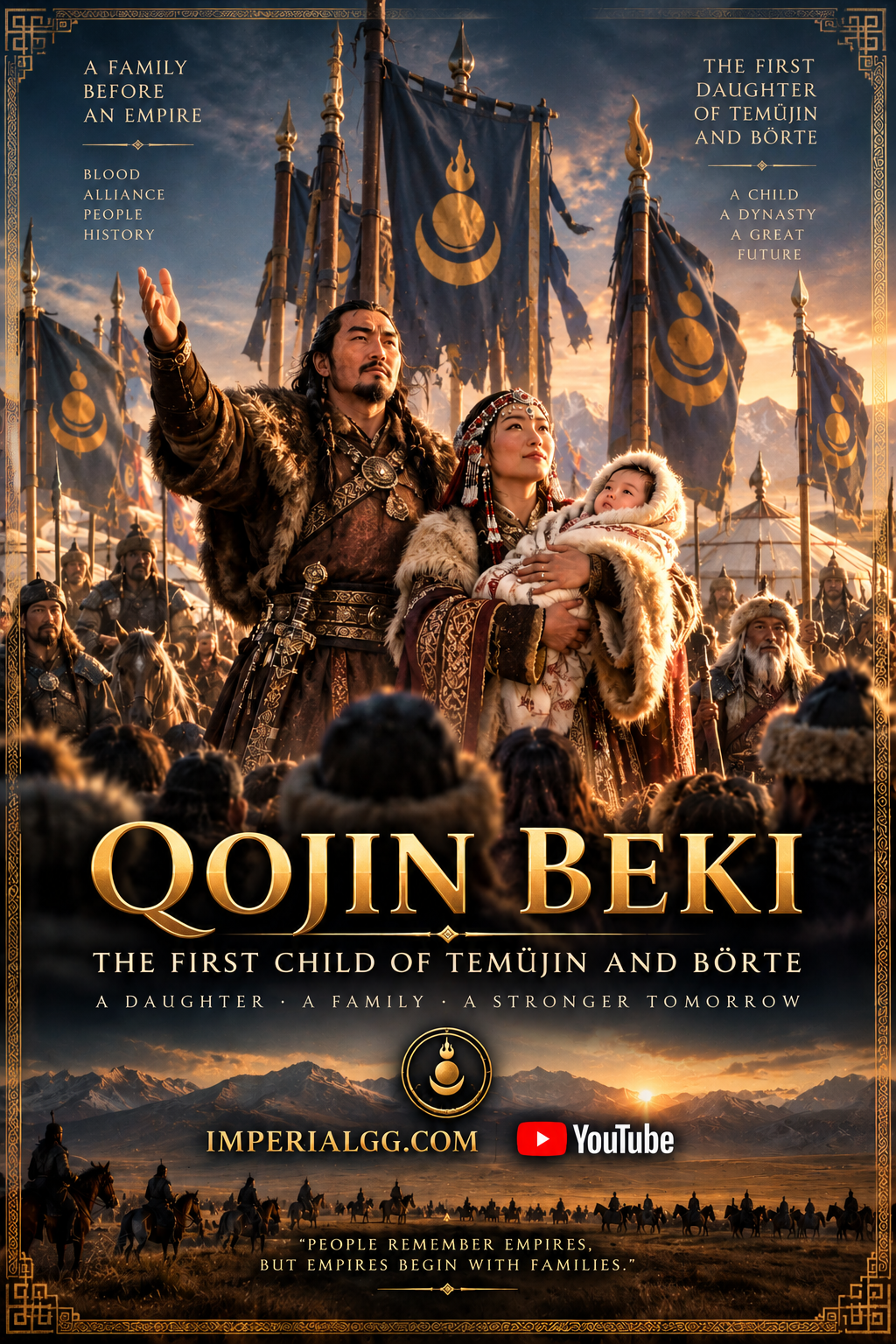
THE CHILD WHO CAME BEFORE THE EMPIRE
The early life of Temüjin is usually narrated through battles, alliances, betrayals, captivity, and the gradual accumulation of political power. Yet one of the most important facts about his family life is easily overlooked. Before Börte was abducted by the Merkit, before Jochi was born, and long before Temüjin became Chinggis Qa’an, Temüjin and Börte already had a daughter.
Her name was Qojin Beki.
She was the first child of Temüjin and Börte, and therefore the first child born from the marriage that would become the central dynastic union of the Mongol imperial house. Modern scholarship generally places her birth around 1179–1180, although the medieval sources do not provide a precise birth year. Anne F. Broadbridge reconstructs this chronology by comparing the available genealogical and chronological evidence, while Igor de Rachewiltz identifies Qojin as Chinggis Khan’s eldest daughter in his commentary on the Secret History.
Her story matters for a reason larger than genealogy.
Qojin’s life allows us to see the Mongol imperial family before it became an empire.
BÖRTE’S FIRST CHILD
The Secret History of the Mongols does not narrate Qojin’s birth as a separate episode.
This silence is important.
The Secret History is not a modern biography in which every birth, marriage, and family event is recorded chronologically. Its narrative concentrates on events that its compiler considered politically, morally, or genealogically significant. As a result, Qojin enters the historical record much later, when her marriage becomes politically relevant. This means that her existence has to be reconstructed from the wider Mongol genealogical tradition.
Later sources and modern scholarship identify Börte as the mother of four sons and five daughters: Qojin, Jochi, Chagatai, Ögedei, Checheyigen, Alaqa, Tümelün, Tolui, and Al Altan. Qojin stands at the beginning of this sequence. Broadbridge specifically identifies her as Börte’s oldest daughter and reconstructs her birth to approximately 1179 or 1180.
This chronology also changes how we understand the events surrounding Börte’s abduction. When the Merkits attacked Temüjin’s camp, Börte was not a newly married woman without children. She was already the mother of a daughter. The subsequent birth of Jochi therefore occurred after Qojin, not before her. That distinction is historically important.
THE MERKIT RAID DID NOT BEGIN THE FAMILY
The story of Börte is often remembered primarily through her abduction by the Merkits and her subsequent rescue. But Qojin reminds us that the family existed before that catastrophe. Temüjin and Börte had already established a household.
The young Temüjin had married Börte after returning to the Onggirat territory and meeting her father, Dei Sečen. The marriage created a connection between Temüjin and the Onggirat world, while Börte became the senior wife who would eventually stand at the center of the Chinggisid family.
Qojin was the first child of that union. Only afterward did the Merkit attack fundamentally alter the course of their lives. This sequence is important because it prevents a common distortion in the narrative of Temüjin’s early life: Börte’s importance does not begin with her captivity. nShe was already Temüjin’s wife and the mother of his first child. The Merkit episode transformed their circumstances, but it did not create their family.
QOJIN AND THE PROBLEM OF CHRONOLOGY
Dating Qojin’s birth is more complicated than a simple family tree might suggest.
Igor de Rachewiltz has traditionally placed Temüjin’s marriage to Börte around 1180 and the Merkit raid around 1181, with Jochi’s birth following the rescue. Anne F. Broadbridge argues that this chronology needs adjustment if Qojin is to be accommodated as the first child. She therefore proposes moving the marriage somewhat earlier, to approximately 1178, allowing Qojin’s birth around 1179–1180. This is precisely the kind of problem that historians must distinguish from established fact.
We can say with considerable confidence that:
- Qojin was Temüjin and Börte’s eldest child.
- She was older than Jochi.
- She was Börte’s eldest daughter.
- She was already born before the later generation of Börte’s children.
- Her exact birth year remains a reconstruction rather than a directly recorded date.
Therefore, 1179–1180 should be treated as a scholarly estimate, not as a documented birth date. That distinction matters in serious historical writing.
FROM DAUGHTER TO POLITICAL FIGURE
Qojin becomes visible in the historical record much more clearly once Temüjin had become Chinggis Qa’an. The Secret History eventually identifies her as Qojin Beki.
In §165, Chinggis seeks to strengthen his relationship with Ong Qan and Nilqa Senggüm through marriage. He proposes a marriage exchange: his son Jochi would marry Ča’ur Beki, Senggüm’s younger sister, while Chinggis would give his daughter Qojin Beki to Senggüm’s son Tusaqa. The proposal fails.
Senggüm rejects the arrangement in insulting terms, comparing the relative status that the women would occupy in each household. Chinggis becomes offended and loses affection for Ong Qan and Senggüm. This short passage is extraordinarily important. It demonstrates that Qojin was not simply a daughter whose marriage was a private family matter.
Her marriage could be proposed as part of a major political relationship involving:
- Chinggis Qa’an,
- his son Jochi,
- Ong Qan,
- Nilqa Senggüm,
- the Kerait ruling house,
- and the future political alignment of the Mongol and Kerait worlds.
A daughter stood at the center of this diplomatic structure.
THE MARRIAGE THAT ACTUALLY TOOK PLACE
The failed Kerait marriage was not the end of Qojin’s political importance. She later married Butu of the Ikires, one of Temüjin’s early supporters. The chronology is significant.
Anne F. Broadbridge argues that Butu had first married Temüjin’s sister Temülün. After Temülün’s death, Butu subsequently married Qojin, probably after the failed 1203 marriage proposal involving Senggüm’s family. By 1206, Butu was recognized as a son-in-law within Chinggis’s political order.
Rachewiltz likewise identifies Butu/Botu of the Ikires as the husband of Chinggis’s eldest daughter Qojin Beki.
This marriage connected three layers of the emerging Mongol political order:
TEMÜJIN’S ROYAL FAMILY
↓
QOJIN BEKI
↓
BUTU OF THE IK IRES
The marriage therefore joined the Chinggisid household to an established military and tribal constituency.
MARRIAGE AS POLITICAL INFRASTRUCTURE
This is where Qojin becomes much more than a genealogical footnote. Modern scholarship increasingly emphasizes that Mongol marriage alliances were not merely domestic arrangements. They could create durable political relationships between ruling families, military groups, and subject or allied communities.
Broadbridge’s work is particularly important here. Her Women and the Making of the Mongol Empire places daughters, wives, and sons-in-law within the political and military architecture of the Mongol Empire rather than treating them as secondary characters in a male-centered narrative. Cambridge University Press describes the book as examining the systematic participation of women in Mongol empire, politics, and war, including the role of daughters and their husbands in the imperial military system.
Qojin provides an early example of this phenomenon.
Her marriage to Butu connected the Chinggisid family with the Ikires. Broadbridge further notes that Butu commanded Ikires forces and that his sons by Qojin inherited this position. Thus the significance of Qojin cannot be measured simply by asking what battles she personally fought. Her importance lies partly in the political relationships created through her position within the dynasty.
THE DAUGHTER WHO CAME BEFORE THE EMPIRE
There is another reason Qojin deserves attention. She was born before the Mongol Empire existed.
When she was born, there was:
- no Mongol Empire,
- no Chinggis Qa’an,
- no imperial capital,
- no continental conquest,
- and no unified Mongol imperial aristocracy.
There was only Temüjin, the son of Yesügei, and Börte, the daughter of Dei Sečen. Their first child was Qojin. That makes her a witness, in genealogical terms, to the transformation of a family into a dynasty. She belonged to the generation that preceded the imperial foundation. By the time she appears in the Secret History as Qojin Beki, her father was no longer the young Temüjin struggling for survival. He was Chinggis Qa’an, the ruler whose political system was being transformed into an imperial order. Her life therefore spans a fundamental historical transition:
HOUSEHOLD → ALLIANCE → DYNASTY → EMPIRE
THE FIVE DAUGHTERS OF BÖRTE
Qojin was not an isolated case. Börte eventually had five daughters:
Qojin
Checheyigen
Alaqa
Tümelün
Al Altan
Their later marriages connected the Chinggisid family with several important political communities, including the Ikires, Oirats, Onggüts, and Qonggirats. Broadbridge’s scholarship argues that these marriage connections were part of a larger system through which the Chinggisid dynasty built political relationships and incorporated manpower and authority into its expanding imperial structure.
Qojin was the first. Her later marriage to Butu therefore belongs to the earliest generation of this developing system.
A DAUGHTER, NOT A FOOTNOTE
The traditional narrative of Chinggis Khan naturally emphasizes his sons.
Jochi.
Chagatai.
Ögedei.
Tolui.
Their appanages and later political struggles shaped the history of Eurasia. But the imperial family cannot be understood through the sons alone. The daughters formed another network of political relationships.
Qojin demonstrates this particularly well. She was the first child of Temüjin and Börte, the eldest daughter of Börte, a participant in an attempted Kerait marriage alliance, and later the wife of Butu of the Ikires. The historical record surrounding her is incomplete, but what survives shows that her position mattered within the political architecture of the Chinggisid dynasty.
Her story therefore forces us to look again at the meaning of dynasty. A dynasty is not built only by sons who inherit territories. It is also built through daughters who connect households, clans, military communities, and ruling houses.
AUTHOR’S THESIS
Qojin is easy to overlook because the Secret History of the Mongols does not give her a dramatic biography. There is no great battle named after her. There is no famous speech. There is no conquest attributed to her. Yet that silence should not be mistaken for insignificance.
Qojin was born before the empire and became part of the family network through which the empire was later constructed.
Her position reveals something fundamental about the transformation of Temüjin’s household. The first generation of Temüjin’s family did not begin as an imperial institution. It began with a marriage between two young people—Temüjin and Börte—and their first child, Qojin. Only later did that household become a dynasty.
And only later still did that dynasty become the ruling house of the largest contiguous land empire in history. Therefore, Qojin’s historical importance lies not in what later generations made of her name, but in where she stands in the chronology of that transformation. She was there before the empire had a name.
CONCLUSION
Qojin Beki occupies a small place in the surviving narrative sources, but a much larger place in the reconstruction of the early Chinggisid family. She was the first child of Temüjin and Börte, probably born around 1179–1180 according to a modern chronological reconstruction. She was older than Jochi and the eldest of Börte’s five daughters. Her later marriage to Butu of the Ikires connected her directly to one of the military constituencies that became part of Chinggis Khan’s imperial order.
Her story reminds us that the Mongol Empire did not suddenly appear in 1206. Its foundations were laid earlier—in marriages, children, households, alliances, loyalties, and kinship.
Before there was Chinggis Qa’an, there was Temüjin.
Before there was an empire, there was a household.
And before that household became an imperial dynasty, its first child was born: Qojin.
FOOTNOTES
1. Igor de Rachewiltz, The Secret History of the Mongols: A Mongolian Epic Chronicle of the Thirteenth Century, §165 and commentary; Rachewiltz identifies Butu/Botu of the Ikires as the husband of Chinggis Khan’s eldest daughter Qojin Beki.
2. Anne F. Broadbridge, Women and the Making of the Mongol Empire (Cambridge: Cambridge University Press, 2018), especially chs. 2 and 5. Broadbridge reconstructs Qojin’s birth as approximately 1179 or 1180 and places her within the broader political history of Chinggisid women and marriage alliances.
3. Igor de Rachewiltz, The Secret History of the Mongols, §165: Chinggis proposes an exchange marriage involving his son Jochi, Qojin Beki, and the family of Nilqa Senggüm.
4. Anne F. Broadbridge, “Marriage, Family and Politics: The Ilkhanid-Oirat Connection,” Journal of the Royal Asiatic Society 26, nos. 1–2 (2016): 121–135. Broadbridge notes Qojin’s marriage to Butu and situates such marriages within the broader Chinggisid policy of cultivating in-law relationships.
5. Broadbridge, Women and the Making of the Mongol Empire, argues for understanding Chinggisid women and their husbands as participants in the political and military structures of the Mongol Empire, rather than treating royal women as peripheral to imperial history.
6. The precise birth year of Qojin remains a reconstruction. Broadbridge explicitly contrasts her proposed chronology with de Rachewiltz’s dating of Temüjin’s marriage and the Merkit episode. Therefore, 1179–1180 should not be presented as a directly recorded medieval date.
BIBLIOGRAPHY
Broadbridge, Anne F. Women and the Making of the Mongol Empire. Cambridge: Cambridge University Press, 2018.
Broadbridge, Anne F. “Marriage, Family and Politics: The Ilkhanid-Oirat Connection.” Journal of the Royal Asiatic Society 26, nos. 1–2 (2016): 121–135.
de Rachewiltz, Igor. The Secret History of the Mongols: A Mongolian Epic Chronicle of the Thirteenth Century. Leiden and Boston: Brill, 2004–2013.
Rashīd al-Dīn Faḍl Allāh. Jāmiʿ al-Tawārīkh. English translations and editions consulted through modern scholarship.