
ÖGEDEI QA’AN’S ADMINISTRATIVE REFORMS
By Altanbagana Baatar
DBA Candidate| Independent Historian
ImperialGG Historical Research Seriers
23 November 2026
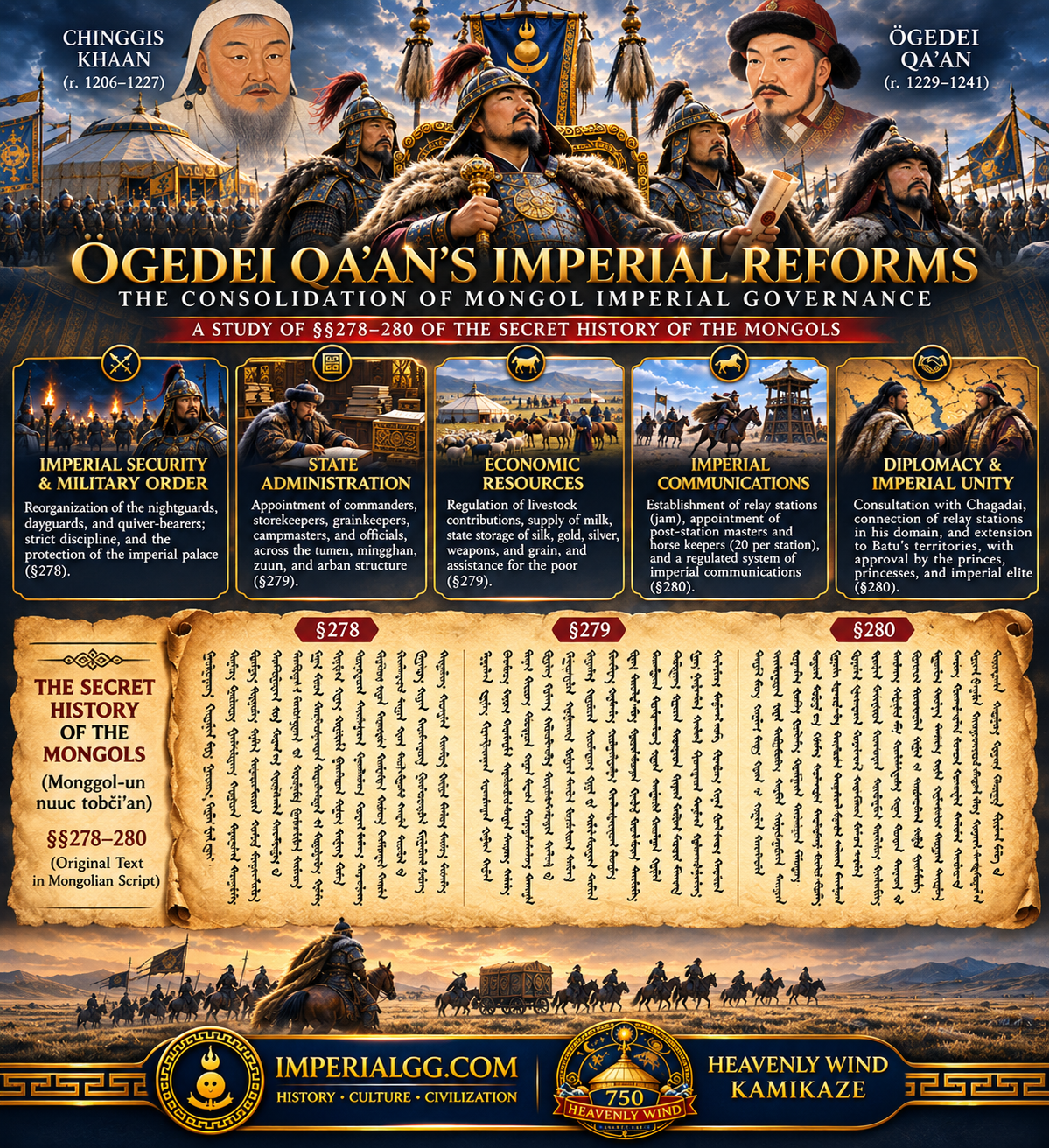
Military Power, Central Administration, Imperial Security, and Diplomacy under Ögedei Qa’an
An Academic Study of §§278–280 of The Secret History of the Mongols
IMPERIALGG.COM — HISTORY • CULTURE • CIVILIZATION
ABSTRACT
Sections 278–280 of The Secret History of the Mongols constitute one of the most revealing accounts of the institutional development of the Mongol Empire under Ögedei Qa’an. These passages describe a complex system of imperial governance in which military organization, palace security, administrative hierarchy, resource management, public obligations, inter-princely cooperation, and long-distance communication were brought into an increasingly coordinated framework. Read together, they demonstrate that the Mongol Empire was not maintained by military conquest alone. Its political authority depended upon the capacity to organize people, regulate service, protect the imperial centre, mobilize economic resources, coordinate the territories of the Chinggisid princes, and transmit official information across vast distances.
Section 278 is particularly important for understanding the military and security foundations of the imperial government. Ögedei reaffirmed and reorganized the service of the nightguards, dayguards, and quiver-bearers inherited from Chinggis Khan. The regulations governing access to the imperial palace, guard rotations, command responsibilities, military discipline, and rank reveal an institutionalized system of protection surrounding the sovereign. These provisions also demonstrate the close relationship between the imperial guard and the broader military hierarchy.
Section 279 expands the discussion from palace security to the economic and administrative foundations of imperial rule. It records the regulation of livestock contributions, the provision of resources for the poor, the organization of milk supplies, the storage of military equipment and grain, the management of grazing grounds and water resources, and the appointment of officials responsible for these functions. These measures reveal the relationship between the imperial government and the productive population upon which its military and administrative institutions depended.
Section 280 provides evidence of the political and diplomatic coordination required to administer an extensive empire. Ögedei consulted Chagadai concerning the proposed relay-station system, while Chagadai proposed connections between his territory, Ögedei’s administrative centre, and Batu’s western domain. The subsequent approval of the measures by princes, princesses, sons-in-law, and military-administrative officials demonstrates that imperial policy involved a wider political structure than the immediate household of the Great Qa’an.
The central argument of this article is that §§278–280 describe the consolidation of an integrated imperial state. They reveal the relationship between military command, internal security, administrative discipline, economic organization, diplomatic cooperation, and communication infrastructure as mutually dependent components of Mongol imperial governance.
Keywords: Mongol Empire; Ögedei Qa’an; Chinggis Khan; imperial state; military organization; imperial guard; palace security; administration; taxation; relay stations; diplomacy; Chagadai; Batu; The Secret History of the Mongols.
1. INTRODUCTION: THE TRANSFORMATION OF IMPERIAL CONQUEST INTO IMPERIAL GOVERNANCE
The expansion of the Mongol Empire during the reign of Chinggis Khan created a political domain that extended far beyond the traditional territories of the Mongolian steppe. Military campaigns brought numerous peoples, cities, agricultural regions, pastoral territories, and established political centres under Mongol authority. However, the conquest of territory and the administration of territory were fundamentally different historical processes. The former required military mobilization and strategic command; the latter required institutions capable of maintaining order, collecting resources, protecting political authority, and coordinating communication across extensive distances.
The reign of Ögedei Qa’an occupies a particularly important position in this transformation. As the successor of Chinggis Khan, Ögedei inherited not simply a political title but an imperial system whose continued existence depended upon the preservation and development of institutions established during his father’s lifetime. The Secret History of the Mongols presents this process through a sequence of administrative decisions, military arrangements, and political consultations.
Sections 275–277, discussed in the preceding article, describe the conflict among Batu, Güyük, Büri, and other members of the ruling family during the western expedition. That episode demonstrates the political difficulties inherent in governing a vast empire through several branches of the Chinggisid dynasty. Section 278 then turns to the internal organization of the imperial centre, while §§279–280 describe the regulation of resources and the establishment of a communication network.
This narrative sequence is historically meaningful. The chronicle moves from the question of authority among princes to the organization of the imperial government itself. It shows how the authority of the Great Qa’an had to be supported by an organized military establishment, an administrative hierarchy, a system for maintaining the imperial household, and cooperation with rulers governing distant territories.
The sections should therefore be interpreted as a connected account of imperial governance rather than as three unrelated lists of regulations. Their subject is the organization of political power: how the ruler protects his person and court, how the government obtains and manages resources, how officials are appointed and supervised, and how decisions are communicated and implemented throughout the empire.
2. SECTION 278: THE IMPERIAL GUARD AS THE MILITARY FOUNDATION OF CENTRAL AUTHORITY
2.1. Institutional continuity from Chinggis Khan to Ögedei
Section 278 begins with Ögedei’s proclamation concerning the duties of the guards who had served under his father, Chinggis Khan. He declares that the nightguards, quiver-bearers, and dayguards are to continue performing their duties according to the arrangements previously established by the former Qa’an.
The significance of this declaration extends beyond the preservation of a palace custom. It demonstrates that the new ruler legitimized his own administrative commands through the institutional authority of Chinggis Khan. Ögedei did not present the imperial guard as a new organization created independently of his father’s government. Instead, he reaffirmed the existing structure while issuing further regulations concerning its personnel, command, discipline, and deployment.
This is an important indication of political continuity. The authority of the Great Qa’an was connected to the preservation of the institutions through which Chinggis Khan had exercised power. At the same time, the detailed provisions in §278 show that institutional continuity did not mean the absence of administrative development.
The passage identifies three major components of the guard establishment:
Kebte’ül — the nightguards responsible for protection during the night;
Turqa’ut — the dayguards responsible for daytime security;
Qorčin — the quiver-bearers who carried and managed the quivers associated with the guard service.
These groups performed differentiated duties within the imperial security establishment. Their responsibilities were organized according to time, location, and function. The dayguards and quiver-bearers performed their assigned service during daylight, after which the nightguards assumed responsibility for protecting the imperial residence.
The regulations therefore reveal a structured military institution with scheduled rotations and designated areas of responsibility. The imperial guard was not simply an informal body of warriors surrounding the ruler. It operated through an established service system in which personnel, commanders, and subordinate units were assigned specific duties.
2.2. Protection of the imperial palace and the security of the sovereign
The nightguards were ordered to remain beside the Qa’an and protect the imperial palace tent. Their responsibilities included guarding the entrance, patrolling the front and rear of the palace, controlling movement after sunset, and preventing unauthorized access to the protected area.
The importance of these regulations becomes clearer when the imperial palace is understood as the operational centre of the government. The Qa’an’s residence was also the place where military commanders, princes, senior officials, messengers, and diplomatic representatives could approach the ruler and conduct official business. Security at the palace therefore protected not only the personal safety of the sovereign but also the continuity of the imperial administration.
The chronicle records a particularly strict regulation concerning the movement of people around the nightguards. Individuals were not permitted to pass beyond or between their positions without authorization. People who entered restricted areas could be arrested, and those who attempted to discover the number of nightguards were subject to confiscation of their horse, saddle, bridle, and clothing.
This provision is especially revealing. The government was protecting information about the guard establishment as well as the physical space surrounding the ruler. Knowledge of the number and positioning of guards could have military and security implications. The regulation thus reflects an awareness that the protection of the imperial centre required control over both access and information.
The incident involving Eljigidei further illustrates this principle. Although he was considered a trustworthy person, the nightguards had detained him when he approached beyond their assigned positions. Ögedei explicitly uses this incident to affirm that the guards should be trusted because they had followed their orders.
The underlying principle is significant: personal reputation did not automatically exempt an individual from security regulations. The guards were expected to enforce the rules even when the person involved was an established figure within the imperial establishment.
This reveals an important characteristic of the Mongol system of government: loyalty to the ruler was accompanied by a defined obligation to execute assigned duties. Security depended upon the authority of regulations rather than solely upon personal familiarity or informal relationships.
2.3. The guard hierarchy and the military chain of command
Section 278 also provides detailed information about the organization of guard companies and their commanders. Qada’an was appointed to supervise the nightguards, while other named commanders were assigned to specific companies and positions around the imperial palace. The companies were arranged on the eastern and western sides of the palace, and their commanders were instructed to coordinate their activities.
The chronicle also names the commanders of the dayguards and the quiver-bearers. Eljigidei was appointed commander of the Guard, and the leaders of the companies were instructed to act according to his orders.
This arrangement demonstrates the existence of a hierarchical military structure. The Qa’an stood at the apex of the command system, while the commander of the Guard exercised authority over subordinate company leaders. Individual units were assigned their own commanders, and their responsibilities were coordinated through a system of rotation and supervision.
The regulation of disciplinary penalties is equally important. A guard who failed to appear for duty could receive three strokes for the first offence, seven for the second, and thirty-seven for the third. A repeated offender could also be removed from the imperial centre and sent to a distant place. Commanders who failed to assemble their units or communicate the regulations to their subordinates could themselves be punished.
This establishes accountability at more than one level. The individual guard was responsible for performing his duty, while the commander was responsible for ensuring that the unit functioned properly. The system therefore did not place the entire burden of discipline upon ordinary soldiers.
Ögedei also declared that the imperial guards ranked above commanders of thousands outside the guard establishment, while the attendants of the guards ranked above outside commanders of hundreds and tens.
This distinction is historically significant because it demonstrates that rank within the imperial court was not determined solely by the numerical size of a military command. Direct service to the Qa’an carried a special institutional status. The imperial guard occupied a privileged position within the broader military and political hierarchy because of its immediate relationship to the sovereign.
2.4. Military security and the protection of imperial authority
The provisions of §278 should be understood as part of the wider military organization of the Mongol Empire. The imperial guard was responsible for protecting the ruler, but its function was also connected to the preservation of the central command structure. The presence of guards around the palace, the control of movement, the protection of banners and drums, the supervision of weapons and provisions, and the regulation of guard rotations all formed part of the security system surrounding the imperial government.
The guard establishment also had an operational relationship with the military organization of the empire. Its commanders held high status, its personnel were organized into companies, and its members were subject to regulations that applied to a military institution rather than an ordinary household service.
De Rachewiltz’s commentary is particularly useful here. He compares the regulations in §278 with the earlier arrangements in §§224–229 and explains that the passage represents a further development of the guard institutions established under Chinggis Khan. He also notes that the quiver-bearers were organized into four companies and attached to the dayguards to strengthen their capacity.
altaica.ru
Thus, §278 provides evidence of the institutionalization of imperial security: a system in which military personnel, palace protection, command hierarchy, and administrative discipline were integrated around the person and authority of the Great Qa’an.
3. SECTION 279: ECONOMIC ADMINISTRATION, RESOURCE MOBILIZATION, AND THE OBLIGATIONS OF THE POPULATION
3.1. The ruler’s responsibility and the material foundations of government
Section 279 begins with Ögedei’s declaration that he does not wish to cause suffering to the people whom his father Chinggis Khan had established as a political community through great effort. This statement is not merely a moral introduction to the following regulations. It provides the political framework within which the measures concerning livestock, provisions, storage, and public obligations are presented.
The imperial government required substantial material resources. The imperial household, the military establishment, official gatherings, administrative personnel, and communication infrastructure all depended upon the organized supply of food, animals, equipment, and transportation.
The challenge was to obtain these resources without allowing the obligations imposed upon the population to become uncontrolled or unnecessarily burdensome. The chronicle therefore presents Ögedei as seeking a more predictable system of contributions and provisioning.
One regulation required each flock to provide one two-year-old sheep annually for the Qa’an’s soup. A separate contribution of one sheep from every hundred was intended for the poor and needy within the same unit.
These provisions must be distinguished. The first was a contribution supporting the imperial ruler and household. The second was explicitly designated for assistance to the poor. The chronicle thus records two different purposes for the collection of livestock resources.
The second provision is particularly significant because it connects the regulation of public obligations with a responsibility toward vulnerable members of the population. It should not be described as a modern welfare programme, since the text does not provide evidence for such a comprehensive institutional system. Nevertheless, it records an explicit provision for distributing part of the collected resources to people in need.
3.2. The supply system for the imperial household and military establishment
The chronicle next addresses the provision of drink during gatherings of imperial princes, troops, and guards. Ögedei asks why the population should be required to supply drink every time the imperial family and its officials assemble. The proposed solution was to obtain mares from different units of a thousand and appoint people responsible for milking and tending them. Campmasters were required to provide replacement mares and organize the herding of the animals.
This measure reveals the importance of specialized provisioning within the imperial government. The supply of milk and other provisions was to be managed through assigned personnel and designated animals rather than through repeated, ad hoc demands upon local households.
The regulation also records that gifts and rewards would be distributed when the imperial brothers assembled. This is relevant to the political economy of the ruling family. Gatherings among the princes were not simply private social events; they formed part of the political culture of the ruling dynasty, where relationships, loyalty, status, and reciprocal obligations were maintained. The provision of gifts and rewards therefore had a political dimension. It helped sustain relationships within the imperial family and its military-administrative elite.
3.3. State storage, military equipment, and the management of grain
Section 279 then describes the collection and storage of valuable and strategically important materials. The list includes silk fabrics, gold and silver ingots, quivers, bows, breastplates, weapons, and grain collected as land tax.
These goods represent several different categories of imperial resources. Silk and precious metals were valuable commodities. Bows, quivers, armour, and weapons were military equipment. Grain was an essential food resource that could support the imperial household, administrative personnel, and military forces.
The chronicle specifies that storekeepers and grainkeepers should be selected from different areas and appointed to protect the storehouses.This is an important administrative detail. The government did not simply collect goods and leave them without supervision. It appointed personnel whose responsibilities were connected to the preservation and management of the resources.
The inclusion of land-tax grain is particularly important because it indicates the relationship between the pastoral and agricultural dimensions of the empire. The Mongol state governed territories with different economic structures. Pastoral livestock contributions were important, but agricultural production and grain collection were also essential to the maintenance of imperial power. The administrative system therefore had to accommodate different forms of production and different types of resources.
3.4. Territorial organization, grazing grounds, and water management
The same section records the division of camps and waters among the people and the appointment of campmasters from different units of a thousand. This provision should be considered in the context of the pastoral economy. Access to grazing land and water was fundamental to the maintenance of livestock herds and the livelihoods of pastoral communities. The organization of camps and water resources therefore had direct consequences for the economic stability of the population.
The appointment of campmasters suggests that the government sought to regulate the use of these resources through designated officials. These officials were responsible for organizing the camps and supervising the arrangements within their assigned areas. The chronicle then mentions the Chöl region, generally understood here as the Gobi. Because water sources were limited and people were dispersed across extensive areas, Ögedei ordered the digging of wells. Chanai and U’l’urtai were assigned responsibility for the campmasters, who were to arrange the digging of wells and construct protective brick walls around them to keep wild animals away.
This measure demonstrates that imperial administration extended beyond the collection of taxes and the organization of military personnel. It also involved the management of essential environmental resources. Water infrastructure was directly connected to settlement, livestock production, and the ability of people to inhabit and use difficult geographical regions. The construction and protection of wells therefore had both economic and administrative significance.
The chronicle does not provide a complete geographical survey of the wells or the precise location of every site. It nevertheless records a deliberate programme of water provision in areas where natural resources were insufficient for the needs of dispersed communities.
4. SECTION 280: DIPLOMATIC COORDINATION AND THE POLITICAL GEOGRAPHY OF THE EMPIRE
4.1. The problem of communication across imperial territory
The development of the relay system in §280 is one of the most significant administrative measures recorded in these sections. The chronicle explains that couriers had previously travelled freely among the population. Although this allowed them to obtain assistance while carrying official messages, their journeys were slow and their movements imposed burdens upon ordinary people.
Ögedei proposed to resolve this problem by establishing designated relay stations and appointing personnel responsible for maintaining the horses and managing the stations. This was not merely a transportation improvement. It was a response to a structural problem faced by a government whose political authority extended across enormous distances.
The imperial centre needed to communicate with regional authorities, military commanders, members of the ruling family, and distant territories. A messenger system dependent upon informal arrangements with local households could not always provide the speed, reliability, or predictability required by imperial administration. The proposed relay network was intended to provide an organized alternative.
4.2. The relay station as an institution of imperial government
The chronicle identifies two categories of personnel: jamuchin, the post-station masters, and ula’achin, the post-horse keepers. The government proposed establishing a jam at each stage of the route. Couriers were to travel through these stations rather than move freely among the population, except when urgent circumstances required otherwise.
The arrangement involved several institutional components:
designated relay stations along official routes;
personnel responsible for managing the stations;
horse keepers responsible for maintaining the animals;
the allocation of horses and other supplies;
regulation of official messengers’ movement;
coordination of the network across different territories.
The system was therefore a state communication infrastructure supported by personnel, animals, provisions, and administrative supervision. Its importance extended beyond the transmission of ordinary letters. It provided the means through which the imperial government could transmit commands, receive reports, coordinate military operations, maintain diplomatic contact, and communicate with regional authorities. The relay system should consequently be understood as part of the institutional foundation of Mongol imperial power.
4.3. Ögedei and Chagadai: consultation as an instrument of imperial diplomacy
One of the most important aspects of §280 is the consultation between Ögedei and his elder brother Chagadai. When Chanai and Bolqadar proposed the new arrangements, Ögedei did not simply declare that the system should be extended into every territory without consultation. Instead, he stated that Chagadai should decide whether the proposed measures were appropriate and whether he approved them.
Chagadai’s reply was affirmative. He agreed to the measures and proposed that relay stations in his own territory should be connected with those of Ögedei. He also proposed establishing a connection with Batu’s territory through the relay network.
This is a major political detail. The passage shows that the organization of imperial communication required cooperation among the territories governed by different branches of the Chinggisid dynasty.
Chagadai was not merely an official subordinate to Ögedei. He was a senior member of the imperial family with authority and responsibilities in his own territorial domain. His approval was therefore politically important for the implementation of a network extending across different spheres of Chinggisid rule.
The exchange also demonstrates the diplomatic character of imperial administration. The Great Qa’an’s policy required consultation, agreement, and coordination with other members of the ruling family.
The passage does not describe this relationship in the language of a modern treaty or a formal constitutional agreement. Nevertheless, it clearly records a process in which a central imperial measure was discussed with a senior dynastic ruler, approved by him, and extended through inter-territorial cooperation.
4.4. The connection between the eastern, central, and western territories
Chagadai’s proposal to connect his relay stations with those of Ögedei and Batu is particularly revealing. The chronicle distinguishes among the western princes, the eastern princes, and the princes of the centre. This terminology reflects the political geography of the Chinggisid imperial family.
The ruling house was not organized solely around the physical location of the Great Qa’an. Different branches of the family possessed political and territorial responsibilities in different regions. The ability to communicate between these territories was therefore essential to maintaining imperial cohesion. The relay network provided an institutional mechanism through which these regions could remain connected.
The proposed connection between Chagadai and Batu is especially important because Batu’s authority was associated with the western territories reached through the great campaign. The relay system could facilitate communication between the central imperial court and the western branch of the dynasty.
Thus, §280 provides evidence that the Mongol Empire’s communication infrastructure was conceived on an imperial scale. It was not limited to the immediate administrative needs of Ögedei’s court.
5. SECTION 280: THE IMPERIAL ASSEMBLY AND THE COLLECTIVE APPROVAL OF STATE POLICY
Following the consultation with Chagadai, §280 records a broader approval of the proposed measures. The chronicle names Chagadai and Batu, the other princes of the right hand or West, Otchigin-noyan and Yegü, the princes of the left hand or East, the other members of the ruling family, the princesses, sons-in-law, and the commanders of units of ten thousand, one thousand, one hundred, and ten. The inclusion of these groups is one of the most important aspects of the passage.
It demonstrates that the approval of imperial policy was not presented as a purely private decision made by the Qa’an and a small group of palace officials. The chronicle describes a broader political and administrative consensus involving members of the ruling dynasty and military leaders across several levels of the imperial hierarchy.
The distinction between the right and left hands is also important. It reflects the organization of the imperial order through eastern and western political-military divisions. The central ruling family, its princes, and its subordinate commanders were connected through a structure that could be mobilized for both military and administrative purposes.
The presence of princesses and sons-in-law should not be overlooked. The ruling family’s political relationships extended through marriage alliances as well as male dynastic descent. The inclusion of these groups suggests that the imperial political community was broader than the direct male line of the Chinggisid princes.
The approval recorded in §280 concerned three principal measures:
First, the annual contribution of one two-year-old sheep from each flock for the support of the Great Qa’an.
Second, the contribution of one one-year-old sheep from every hundred sheep for the poor and needy.
Third, the establishment of relay stations, with designated station masters and horse keepers, to improve communications and reduce the burdens imposed upon the population.
The text states that these measures were unanimously approved. It then records that they were implemented among the various administrative units. This is significant because it connects political consultation with administrative implementation. The agreement was not left as an abstract declaration. The chronicle records the appointment of personnel, the allocation of resources, and the establishment of the stations.
The number of horse keepers assigned to each stage is also specified: twenty at each relay station. Arachan and Toquchar were appointed to supervise the system. The passage therefore offers evidence of a process involving proposal, consultation, approval, appointment, resource allocation, and implementation. This is a valuable example of how the Mongol imperial government organized a major administrative measure through the cooperation of the ruling family and military-administrative hierarchy.
6. THE INTEGRATED STRUCTURE OF IMPERIAL POWER
The three sections can now be considered together. Their significance becomes clearer when the institutions they describe are understood as parts of a single system.
6.1. Military power and internal security
Section 278 describes the military organization responsible for protecting the imperial centre. The guard system maintained the security of the sovereign, regulated access to the palace, protected official property, and enforced discipline through a hierarchical command structure. The guard was therefore a military institution serving the political centre of the empire.
6.2. Administrative hierarchy and public obligations
Section 279 describes the organization of resources and the responsibilities of officials. The appointment of storekeepers, grainkeepers, campmasters, herders, and other personnel demonstrates that the imperial government relied upon differentiated administrative functions. The population was required to provide resources, but the text also records measures intended to regulate these obligations and direct part of the contributions toward the poor.
6.3. Economic and logistical capacity
The storage of grain, military equipment, precious metals, silk, and other materials reveals the importance of maintaining reserves. The provision of horses, mares, carts, and provisions for official services further demonstrates that the empire required a substantial logistical system. The construction of wells and the organization of grazing grounds connected imperial administration with the environmental and economic conditions of different regions.
6.4. Diplomacy and dynastic cooperation
Section 280 reveals that the implementation of imperial policy depended upon the cooperation of several branches of the ruling family. The consultation with Chagadai and the proposed connection with Batu demonstrate that the Great Qa’an’s administrative measures required agreement across territorial divisions. The broader approval recorded in §280 further illustrates the political participation of princes, princesses, sons-in-law, and military commanders.
6.5. Information and communication
The relay network connected the imperial centre with distant territories. It allowed official communications to travel through a regulated system of stations, horses, and personnel. This was essential to the coordination of military, diplomatic, and administrative affairs. Taken together, these measures demonstrate that military power, administration, security, economic resources, diplomacy, and communication were not separate domains. They were interdependent components of the Mongol imperial system.
7. HISTORICAL SIGNIFICANCE AND SOURCE CRITICISM
Although §§278–280 provide unusually detailed information, their interpretation requires several distinctions.
First, the chronicle records regulations and administrative decisions. It does not necessarily demonstrate that every provision was implemented uniformly in all territories or maintained without interruption. A decree reveals the government’s intention and its proposed institutional structure; it does not by itself establish the precise degree of implementation.
Second, the text reflects the political perspective of the imperial court. Its description of collective approval and administrative order should be understood as the chronicle’s presentation of imperial legitimacy. It provides evidence of the political language through which the government represented its authority, but further comparison with Chinese and Persian sources is necessary to reconstruct the practical operation of each institution.
Third, the relay system should not be described as an institution that suddenly appeared in its entirety under Ögedei. The passage records a particular stage in its organization and expansion. The Mongol Empire already possessed systems of military communication, messengers, and official travel. The significance of §280 is that it documents a more systematic arrangement of relay stations and assigned personnel.
Fourth, the relationship between the Great Qa’an and the other Chinggisid princes should not be simplified into a modern centralized administrative hierarchy. The princes possessed their own political authority and territorial responsibilities. The consultation with Chagadai demonstrates that imperial integration required negotiation and cooperation within the ruling dynasty.
These qualifications do not diminish the historical importance of the passage. Rather, they help distinguish the institutional arrangements explicitly recorded by the chronicle from broader interpretations of the Mongol Empire’s political development.
8. AUTHOR’S THESIS
Sections 278–280 demonstrate that the Mongol Empire under Ögedei Qa’an operated through an increasingly integrated system of military, administrative, economic, diplomatic, and communication institutions.
The imperial guard was the military foundation of central authority. It protected the sovereign, secured the imperial residence, regulated access, and maintained discipline through a defined command hierarchy. The regulations governing the nightguards, dayguards, and quiver-bearers reveal an institution that was both militarily organized and politically privileged.
The measures in §279 demonstrate that imperial authority also depended upon the systematic management of economic resources. Livestock contributions, grain, stored military equipment, provisions, water, and grazing grounds were brought within a framework of designated responsibilities. The government sought to regulate the obligations of the population while maintaining the resources required for imperial administration and military activity.
Section 280 reveals a further dimension: the political and diplomatic coordination of the empire. Ögedei’s consultation with Chagadai, Chagadai’s proposal to connect the relay system with Batu’s territory, and the subsequent approval by princes and commanders demonstrate that imperial integration depended upon cooperation among several branches of the Chinggisid dynasty.
The relay system was therefore not merely a means of transporting messages. It was an institutional network connecting the imperial centre with the political, military, and administrative structures of distant territories.
The central thesis of this article is that §§278–280 reveal the Mongol Empire as an integrated imperial state whose power rested upon the coordination of armed force, internal security, administrative hierarchy, economic resources, dynastic diplomacy, and long-distance communication. The empire’s strength was not simply the ability to conquer territory; it was also the ability to organize, protect, supply, communicate with, and govern that territory.
9. CONCLUSION
Sections 278–280 of The Secret History of the Mongols provide a detailed account of the institutional foundations of Mongol imperial governance during Ögedei Qa’an’s reign.
The first section describes the organization of the imperial guard and the protection of the sovereign. It reveals the continuity of Chinggis Khan’s military institutions, the establishment of a clear hierarchy of command, the regulation of palace security, and the enforcement of discipline among guard personnel.
The second section describes the management of resources, public obligations, and essential infrastructure. It records the regulation of livestock contributions, the provision of assistance to the poor, the supply of provisions, the storage of grain and military equipment, and the organization of camps, grazing grounds, and water resources.
The third section demonstrates the importance of diplomacy and inter-territorial cooperation. The consultation with Chagadai, the proposed connection with Batu, and the approval of the relay system by the wider imperial ruling and military hierarchy reveal the political framework through which the Mongol Empire maintained communication across its territories.
These measures show that the administration of the Mongol Empire required a complex relationship between military organization, economic resources, political authority, and communication infrastructure. The imperial guard protected the centre; administrative officials managed resources and obligations; diplomatic consultation coordinated the ruling dynasty; and the relay system connected distant regions with the imperial government.
The historical significance of these passages therefore extends far beyond the organization of a palace or the establishment of a messenger service. They provide evidence of how the Mongol Empire developed the institutions necessary to sustain political authority across a vast and geographically diverse imperial domain.
The reign of Ögedei Qa’an should consequently be examined not only through military campaigns and territorial expansion but also through the development of the administrative and institutional structures that enabled the empire to function as a connected political system.
FOOTNOTES
1. Igor de Rachewiltz, The Secret History of the Mongols: A Mongolian Epic Chronicle of the Thirteenth Century, vol. 1 (Leiden: Brill, 2004), §§278–280. For the English translation of the relevant passages, see the chapter XII translation reproduced in Papers on Far Eastern History.
altaica.ru+1
2. Ibid., §278. The passage explicitly identifies the nightguards, dayguards, and quiver-bearers as institutions inherited from Chinggis Khan.
3. Ibid., §278. The regulations concerning the guard commanders, the four companies of nightguards, the quiver-bearers, and the appointment of Eljigidei as commander of the Guard are recorded in this section.
4. de Rachewiltz, commentary on §§225–226 and §278. The commentary compares the guard regulations under Ögedei with the earlier institutional arrangements established under Chinggis Khan.
altaica.ru
5. The Secret History of the Mongols, §279. The provisions concerning livestock contributions, assistance to the poor, the supply of mares, storage, and the appointment of campmasters are recorded in this section.
altaica.ru
6. Ibid., §279. The chronicle records the proposal to establish relay stations, appoint jamuchin and ula’achin, and regulate the movement of official couriers.
7. Ibid., §280. The consultation with Chagadai and his proposal to connect his relay stations with those of Ögedei and Batu are explicitly recorded in this section.
8. Ibid., §280. The approval of the proposed measures by the princes, princesses, sons-in-law, and military commanders is recorded in the same section.
9. For the publication history, textual editions, translations, and scholarly resources relating to the chronicle, see Monumenta Altaica, Secret History of the Mongols: Texts and Translations.
Monumenta Altaica+1
BIBLIOGRAPHY
PRIMARY SOURCES
de Rachewiltz, Igor, trans. The Secret History of the Mongols: A Mongolian Epic Chronicle of the Thirteenth Century. Vol. 1. Leiden: Brill, 2004.
Cleaves, Francis Woodman, trans. The Secret History of the Mongols. Cambridge, MA: Harvard University Press, 1982.
Yuan shi 元史 [History of the Yuan Dynasty]. Beijing: Zhonghua Shuju edition. To be consulted for comparison with the institutional and administrative history of the Yuan period.
SECONDARY AND REFERENCE WORKS
de Rachewiltz, Igor. The Secret History of the Mongols: A Mongolian Epic Chronicle of the Thirteenth Century. Leiden: Brill, 2004.
de Rachewiltz, Igor. “The Secret History of the Mongols.” Papers on Far Eastern History, relevant chapter translations and commentaries.
Monumenta Altaica. “Secret History of the Mongols: Texts, Translations, and Bibliography.” Texts and editions.
IMPERIALGG.COM — HISTORY • CULTURE • CIVILIZATION
MYTH & REALITY — HISTORY • PEOPLE • TRUTH
Source note: The primary analysis is based on §§278–280 in de Rachewiltz’s translation. The interpretation of these passages as evidence of an integrated imperial state is the author’s analytical argument. The article does not claim that the chronicle alone proves uniform implementation of every regulation throughout all Mongol territories