
NICOLA DI COSMO: THE MONGOL EMPIRE, INNER ASIA, AND THE HISTORICAL RELATIONSHIP BETWEEN CHINA AND THE EURASIAN STEPPE
By Altanbagana Baatar
DBA Candidate| Independent Historian
ImperialGG Historical Research Seriers
16 October 2026
Nicola Di Cosmo is a leading historian of Inner Asia whose research has significantly influenced the study of the political, military, environmental, and cultural relationships between China and the peoples of the Eurasian steppe. His scholarship examines how nomadic societies developed political power, how steppe empires interacted with sedentary states, and how warfare, trade, diplomacy, geography, and climate shaped the history of Eurasia.
As the Luce Foundation Professor in East Asian Studies at the Institute for Advanced Study in Princeton, New Jersey, Di Cosmo has contributed to the study of early nomadic empires, Mongol history, Manchu state formation, and the historical relationships connecting China with Central and Inner Asia. His work is particularly important for understanding the Mongol Empire within a longer history of steppe political traditions rather than treating the Mongols as an isolated phenomenon that appeared suddenly in the thirteenth century.
Di Cosmo received his PhD in 1991 from Indiana University’s Department of Uralic and Altaic Studies, now known as Central Eurasian Studies. Before joining the Institute for Advanced Study in 2003, he held academic positions at the University of Cambridge, Harvard University, and the University of Canterbury in New Zealand. His research has also expanded into the use of climatological and other palaeoscientific evidence to investigate the relationship between environmental change and historical developments in Eurasia. His institutional biography and publication record document this broad scholarly trajectory.
Rethinking the History of the Eurasian Steppe
One of Di Cosmo’s most influential contributions is his challenge to the conventional separation between the histories of China and the nomadic peoples living along its northern and western frontiers.
For centuries, historical narratives have often treated the Chinese state and the steppe populations as fundamentally different worlds. In simplified versions of this interpretation, China represents settled agriculture, bureaucracy, and urban civilization, while the steppe represents mobility, pastoralism, and warfare. Di Cosmo’s research demonstrates why such a rigid division is insufficient.
The relationship between China and Inner Asia involved much more than military confrontation. It included trade, diplomatic negotiations, the exchange of goods and technologies, political alliances, tribute, migration, and the formation of states whose institutions and identities developed through interaction across the frontier.
The steppe was not an empty geographical space separating established civilizations. It was a dynamic historical region inhabited by societies with their own economic systems, political traditions, military organizations, and connections to distant territories.
Pastoral mobility was central to these societies. Herding animals across extensive grasslands required knowledge of seasonal conditions, water availability, grazing resources, and movement between ecological zones. Political authority developed within this environment through relationships among ruling families, military followers, pastoral communities, and external trading partners.
At the same time, the nomadic world was never completely isolated from agricultural civilizations. Steppe societies exchanged livestock, horses, animal products, and other commodities for grain, textiles, metal goods, and manufactured products. Political leaders could obtain resources through commerce, diplomacy, tribute, or military campaigns.
Di Cosmo’s approach therefore places nomadic societies within the wider history of Eurasia. Rather than interpreting their political development solely as a reaction to China, it examines how internal social structures and external relationships interacted to produce different forms of political organization.
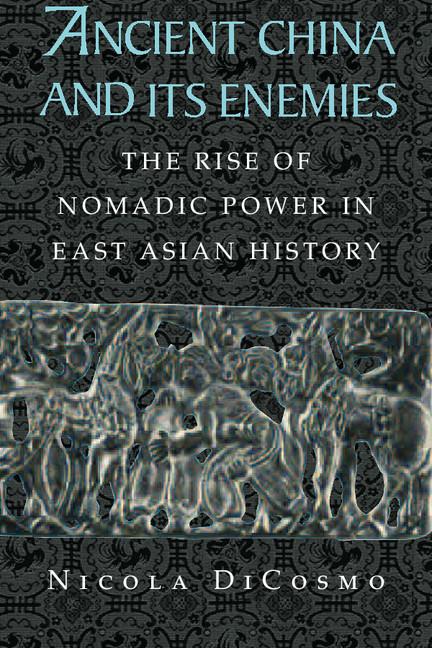
Ancient China and Its Enemies: The Rise of Nomadic Power in East Asian History (2002)
Published by Cambridge University Press in 2002, Ancient China and Its Enemies: The Rise of Nomadic Power in East Asian History is one of Di Cosmo’s most important monographs. The book investigates the emergence and development of powerful nomadic societies in relation to early Chinese states. It examines the political and military relationships between the agricultural societies of northern China and the peoples of the surrounding steppe, placing these interactions within a long historical framework.
Its central concern is not simply why Chinese rulers fought their northern neighbors. It is how relations between sedentary states and nomadic societies contributed to the development of both sides.
Chinese frontier policies could include military campaigns, defensive construction, diplomacy, trade arrangements, and efforts to influence political relationships among steppe groups. Nomadic leaders, in turn, could use warfare, alliances, control of trade routes, and their own military organization to negotiate with or challenge Chinese states.
These interactions changed over time. Neither China nor the steppe can be treated as a single, unchanging political entity across the centuries. Different dynasties faced different circumstances, while steppe confederations and empires developed their own institutions and strategies.
The book is especially significant for its treatment of the relationship between nomadic political power and the wider structure of East Asian history. It encourages historians to examine the development of steppe states on their own terms while also recognizing the importance of their relationships with China.
For Mongolian history, this perspective is essential. The Mongol Empire emerged from a world in which steppe political organization, military competition, economic exchange, and relations with neighboring states had developed over many centuries.
Chinggis Khaan did not create steppe political history from nothing. His achievement must be understood against a longer background of earlier confederations, political traditions, and changing relationships across Inner Asia. Di Cosmo’s work supplies an important framework for investigating that background without assuming that earlier societies were identical to the Mongols of the thirteenth century.
The book’s historical scope also requires careful distinctions. The Xiongnu, Xianbei, Turks, and later Mongol groups belonged to different historical contexts. Similarities in political organization or frontier relations do not establish that they all shared the same ethnic identity, language, or uninterrupted political lineage. Such questions require evidence specific to each period.
From Earlier Steppe Empires to the Mongol Empire
The Mongol Empire is best understood as a major development in the history of Inner Asia, not as an isolated event disconnected from earlier centuries.
Di Cosmo’s scholarship on ancient nomadic powers provides a comparative perspective for examining the institutions and circumstances that made large-scale steppe empires possible. These include the organization of mobile pastoral economies, the concentration of military power, relationships between ruling elites and followers, access to external resources, and the ability to coordinate groups across extensive territories.
The Mongol Empire under Chinggis Khaan and his successors developed its own distinctive political and military system. Its expansion cannot be explained by geography or pastoralism alone. Leadership, political alliances, military discipline, strategic decisions, and the incorporation of conquered populations were also fundamental.
Comparative history is useful because it allows scholars to identify recurring problems faced by steppe rulers: how to maintain political unity, secure resources, manage succession, organize armies, and govern territories with different economic and cultural traditions.
However, comparison must not become a substitute for historical explanation. The political structures of earlier steppe confederations cannot simply be projected onto the Mongol Empire. Each case must be reconstructed from its own written records, archaeological evidence, and historical circumstances.
Di Cosmo’s broader work on Inner Asia provides a framework for making these comparisons without assuming that every nomadic empire followed the same path.
Warfare, Political Organization, and Military Culture
Military history is another central dimension of Di Cosmo’s research. His scholarship examines warfare not merely as a sequence of battles but as a system connected to economic resources, political authority, technology, and social organization.
Steppe military power depended on the ability to mobilize people and animals across large distances. Horses provided mobility, while knowledge of terrain and seasonal conditions influenced the planning and conduct of campaigns. Leadership and coordination were equally important, particularly when rulers sought to unite different groups under a common command.
Military success, however, did not automatically produce stable political control. Conquest created new administrative challenges, including the distribution of resources, the maintenance of communications, the management of local elites, and the establishment of political legitimacy.
These issues are particularly relevant to the Mongol Empire. Its expansion across Eurasia required more than mounted warfare. Mongol rulers and commanders also made use of intelligence, siege capabilities, diplomatic negotiations, logistical planning, and personnel drawn from different conquered societies.
Di Cosmo’s edited volume Warfare in Inner Asian History (500–1800), published by Brill in 2002, brings together research on military developments across a broad historical period. His introduction, “Inner Asian Ways of Warfare in Historical Perspective,” situates military practices within the changing societies and political systems of Inner Asia.
His work on Military Culture in Imperial China, published by Harvard University Press in 2009, approaches military institutions from another direction, examining the historical development of military culture within imperial China.
Taken together, these publications encourage a comparative understanding of military history. Chinese and Inner Asian military systems developed through their own traditions, but they also influenced one another through warfare, political competition, and technological exchange.
This approach is useful for studying the Mongol invasions of Japan in 1274 and 1281, the Mongol campaigns in China and Central Asia, and the military institutions of the Yuan dynasty. It directs attention toward the practical conditions of warfare rather than relying on explanations based entirely on heroic narratives or later national traditions.
The Mongols and Europe: Beyond the Image of Conquest
Di Cosmo has also contributed directly to the study of Mongol relations with Europe. His chapter “The Mongols and Europe,” published in volume one of The Cambridge History of the Mongol Empire, examines the Mongols within the wider historical context of Eurasian interaction.
The Mongol expansion into western Eurasia brought the empire into contact with Rus’ principalities, European political powers, and commercial networks connecting the Black Sea and the Mediterranean. These relationships included military conflict, diplomatic missions, political negotiations, and trade.
European responses to the Mongols were not uniform. Different rulers and communities interpreted the Mongol presence according to their own strategic interests, religious expectations, and political circumstances. Some considered the Mongols a formidable enemy; others explored the possibility of alliances or diplomatic cooperation.
The history of Mongol–European relations therefore cannot be reduced to a single confrontation between two civilizations. It involved multiple political actors and changing relationships across a large geographical area.
Di Cosmo’s research on the Black Sea provides a particularly important perspective. In his article “Black Sea Emporia and the Mongol Empire: A Reassessment of the Pax Mongolica,” published in the Journal of the Economic and Social History of the Orient in 2010, he reconsidered the commercial significance of the Black Sea trading centers within the Mongol imperial system.
The term Pax Mongolica is often used to describe the conditions that facilitated long-distance travel and commerce across parts of Eurasia during Mongol rule. Yet the term should not imply universal peace, uniform security, or the disappearance of political conflict. The empire contained different regions, competing authorities, and changing economic conditions.
By focusing on commercial centers and the relationships that connected them, Di Cosmo’s work encourages a more precise examination of how trade operated under Mongol political authority and where the limits of imperial integration lay.
The Mongol Empire, Climate, and Environmental History
One of the most significant developments in Di Cosmo’s more recent scholarship is the integration of environmental evidence into the study of Eurasian history.
Historical research has traditionally relied heavily on written records. These sources remain indispensable, but they can be incomplete, politically motivated, or unevenly distributed across time and geography. Environmental research can provide additional evidence about the conditions in which societies lived and political decisions were made.
Di Cosmo has investigated the use of climatic and other palaeoscientific data to understand the history of China, Inner Asia, the Mongol Empire, and the Qing dynasty. This work brings history into dialogue with disciplines that reconstruct past environmental conditions through evidence such as sediment records, tree rings, and other natural archives.
Climate can influence the availability of pasture, water, and agricultural production. Changes in these resources may affect pastoral mobility, settlement patterns, food supplies, and political relationships. In societies dependent on livestock, variations in environmental conditions can have important economic and social consequences.
Yet climate is not a complete explanation for the rise or fall of an empire. Environmental pressures do not determine a single political outcome. The same conditions may produce different responses depending on institutions, technology, leadership, economic flexibility, and the choices available to a society.
This distinction is especially important in discussions of the Mongol Empire. The empire’s rise cannot be explained simply by claiming that favorable weather created ideal conditions for expansion. Nor can its later political fragmentation be attributed automatically to environmental change.
A sound historical explanation must examine the relationship between environmental conditions and human decisions, using different kinds of evidence to test specific arguments.
Di Cosmo’s article “Why Qara Qorum? Climate and Geography in the Early Mongol Empire,” published in Archivum Eurasiae Medii Aevi in 2014–2015, addresses the geographical and environmental context of the early Mongol imperial center. His later work, “Climate Variability and Medieval Nomadic Empires: Notes from Case Studies,” published in Medieval Worlds in 2024, further reflects his interest in integrating climate research with the history of nomadic empires.
His chapter “The Climate and Environment of the Mongol Conquest,” published in The Cambridge History of the Mongol Empire, also places environmental questions within the broader historical study of Mongol expansion.
This interdisciplinary direction is valuable because it allows historians to ask more precise questions. Rather than treating climate as a general background condition, researchers can investigate when environmental changes occurred, which regions were affected, what the available evidence shows, and how those changes interacted with political and economic developments.
Manchu–Mongol Relations and the Formation of the Qing Empire
Di Cosmo’s work extends well beyond the ancient steppe and the thirteenth-century Mongol Empire. A substantial part of his research concerns Manchu history and the relationships between the Manchus and Mongol political groups during the period preceding the Qing conquest of China.
His book Manchu-Mongol Relations on the Eve of the Qing Conquest, published in 2003, examines these relationships during a crucial period of political transformation in East Asia. His related documentary work, produced with Dalizhabu Bao, is titled A Documentary History of Manchu-Mongol Relations (1616–1626).
These studies are important because they investigate the political processes through which the early Manchu state developed relationships with Mongol leaders and communities. Such relationships could involve alliances, diplomatic exchanges, warfare, marriage politics, and competition over political legitimacy.
The Manchus and Mongols were not merely passive participants in the transition from Ming to Qing rule. Their leaders pursued political strategies within a changing regional environment, and their relationships helped shape the structure of the emerging Qing state.
Marriage was particularly important in the political culture of Inner Asia. Dynastic unions could establish alliances, create obligations, and strengthen relationships between ruling families. However, marriage alone did not guarantee loyalty or political stability; its significance depended on the wider balance of power and the circumstances in which alliances were formed.
Di Cosmo’s article “From Alliance to Tutelage: A Historical Analysis of Manchu-Mongol Relations before the Qing Conquest,” published in Frontiers of History in China in 2012, explores the changing nature of these relationships.
His research also addresses the extension of Qing rule over Mongolia, Xinjiang, and Tibet. In his contribution to The Cambridge History of China, he examines the expansion of Qing authority across Inner Asia between 1630 and 1800.
These studies place Mongolian history within the broader political history of East Asia while preserving the importance of Mongol actors, political institutions, and regional circumstances. They also demonstrate why the Mongol Empire and the later Qing imperial system must be studied as distinct historical formations rather than as interchangeable examples of steppe power.
The Cambridge History of Inner Asia: The Chinggisid Age (2009)
Di Cosmo co-edited The Cambridge History of Inner Asia: The Chinggisid Age with Peter B. Golden and Allen J. Frank. Published by Cambridge University Press in 2009, the volume examines the historical period shaped by Chinggis Khaan and the political developments associated with his descendants.
An edited scholarly volume differs from a single-author monograph. Rather than presenting one continuous interpretation by one historian, it brings together contributions from specialists working on different regions, periods, and historical questions.
The Chinggisid age extended far beyond the lifetime of Chinggis Khaan. His descendants established or ruled political formations across a wide geographical area, including the Yuan dynasty in China, the Ilkhanate in Iran, the Golden Horde in the western Eurasian steppe, and the Chagatai realm in Central Asia.
These political formations shared dynastic connections, but they developed under different geographical, economic, religious, and political conditions. Their histories cannot be understood solely as chapters in a single unified empire.
The importance of The Cambridge History of Inner Asia: The Chinggisid Age lies in its regional and comparative scope. It places the Mongol imperial tradition within the broader history of Inner Asia and allows readers to consider the different trajectories of the successor states.
For scholars of Mongolian history, such a collection provides an important framework for understanding the legacy of Chinggis Khaan beyond the initial conquests of the early thirteenth century.
The Silk Road, Commerce, and the Mongol World
Trade and long-distance exchange form another important part of Di Cosmo’s research. The Silk Road was not one road or a single commercial institution. It consisted of changing networks of routes, markets, cities, ports, and political relationships connecting East Asia with Central Asia, the Middle East, Europe, and other regions.
Mongol expansion affected these networks by bringing large territories under related political authorities and by changing the conditions under which merchants, envoys, travelers, and religious communities moved across Eurasia. Nevertheless, the degree of integration varied across regions and periods.
Di Cosmo’s research on the Black Sea and Mongol commercial relations investigates how trade operated at the intersection of imperial power and regional interests. His work emphasizes the importance of examining specific commercial centers and the political circumstances that shaped their development.
His book, co-authored with Lorenzo Pubblici, Venezia e i Mongoli: commercio e diplomazia sulle vie della seta nel medioevo, published by Viella in 2022, examines Venice and the Mongols through the history of medieval commerce and diplomacy along the Silk Roads.
The subject is significant because it connects Mongol history with the history of European commercial expansion and diplomatic engagement in Asia. It also highlights the role of intermediaries, trading communities, and political authorities in maintaining connections across great distances.
The book’s Italian publication should be distinguished from any subsequent English translation. Di Cosmo’s official publication list has identified an English translation under the title Venice and the Mongols: The Eurasian Exchange That Transformed the Medieval World, prepared with Lorenzo Pubblici. The precise publication status of that translation should be checked against the publisher’s current catalogue before citing an English edition as already published.
Publications and Scholarly Contributions
Di Cosmo’s published work spans monographs, documentary editions, edited collections, journal articles, and chapters in major academic reference works. The following titles represent important parts of his scholarship; they are selected works rather than an exhaustive list of every publication.
His principal monographs and documentary studies include Reports from the Northwest: A Selection of Manchu Memorials from Kashgar (1806–1807) (1993); Ancient China and Its Enemies: The Rise of Nomadic Power in East Asian History (2002); Manchu-Mongol Relations on the Eve of the Qing Conquest (2003); A Documentary History of Manchu-Mongol Relations (1616–1626), co-authored with Dalizhabu Bao (2003); and The Diary of a Manchu Soldier in Seventeenth-Century China (2006).
His major edited and co-edited volumes include Warfare in Inner Asian History (500–1800) (2002); Political Frontiers, Ethnic Boundaries and Human Geographies in Chinese History, co-edited with Don J. Wyatt (2003); Military Culture in Imperial China (2009); The Cambridge History of Inner Asia: The Chinggisid Age, co-edited with Peter B. Golden and Allen J. Frank (2009); and Empires and Exchanges in Eurasian Late Antiquity: Rome, China, Iran, and the Steppe, ca. 250–750, co-edited with Michael Maas (2018).
His more recent work includes Rebel Economies: Warlords, Insurgents, Humanitarians, edited with Didier Fassin and Clémence Pinaud (2021), and Venezia e i Mongoli, co-authored with Lorenzo Pubblici (2022).
Among his significant journal articles are “Ancient Inner Asian Nomads: Their Economic Basis and Its Significance in Chinese History” (1994); “State Formation and Periodization in Inner Asian History” (1999); “Black Sea Emporia and the Mongol Empire: A Reassessment of the Pax Mongolica” (2010); “From Alliance to Tutelage: A Historical Analysis of Manchu-Mongol Relations before the Qing Conquest” (2012); “Why Qara Qorum? Climate and Geography in the Early Mongol Empire” (2014–2015); and “Climate Variability and Medieval Nomadic Empires: Notes from Case Studies” (2024).
His chapters in collaborative volumes include “The Mongols and Europe” and “The Climate and Environment of the Mongol Conquest” in The Cambridge History of the Mongol Empire, as well as “Violence in Inner Asian History” in The Cambridge World History of Violence. These contributions illustrate the range of his interests, from the military and political history of nomadic societies to the environmental context of imperial expansion.
The Institute for Advanced Study maintains an extensive bibliography of his books, articles, and book chapters. For formal academic citation, readers should consult that bibliography and verify individual publication details against the original publisher or journal record.
Historical Method and the Significance of Di Cosmo’s Work
The principal strength of Di Cosmo’s scholarship is its integration of political history with economic, military, environmental, and regional analysis. It brings the history of the steppe into the center of East Asian and Eurasian history and demonstrates the limitations of treating nomadic peoples merely as external opponents of settled states.
His work also illustrates the importance of historical comparison. The rise of the Mongol Empire can be examined alongside earlier steppe confederations, later Inner Asian states, and the changing political relationships between China and its northern neighbors. Such comparisons help historians identify both recurring patterns and significant differences.
At the same time, historical explanations must remain grounded in evidence. Written sources often reflect the priorities of the states and elites that produced them. Chinese dynastic histories, Mongolian chronicles, Persian accounts, European travel narratives, and archaeological findings each provide different kinds of information and have different limitations.
Environmental evidence can broaden the historical record, but it must also be interpreted carefully. A climatic reconstruction does not automatically explain a political event, and a correlation between environmental change and imperial expansion does not by itself establish causation.
Di Cosmo’s interdisciplinary approach is valuable precisely because it encourages scholars to combine evidence while distinguishing what each source can establish. His work provides tools for asking more precise questions about how political power emerged, how empires operated, and how societies responded to changing conditions.
Conclusion
Nicola Di Cosmo has made a substantial contribution to the study of Inner Asia by examining the historical relationships between China, the Eurasian steppe, and the wider world. His research on ancient nomadic powers, the Mongol Empire, Manchu–Mongol relations, military culture, long-distance commerce, and climate has helped broaden the scope of historical inquiry beyond conventional divisions between sedentary civilizations and nomadic societies.
For the study of Mongolia, his scholarship offers a particularly useful perspective on the longer history of steppe political organization and the international relationships within which the Mongol Empire developed. It also helps connect the age of Chinggis Khaan with the histories of the Yuan dynasty, the Mongol successor states, and the later political transformations of Inner Asia.
Di Cosmo’s work does not eliminate the need for primary sources or specialized research on particular Mongolian historical questions. Instead, it provides a framework for placing those questions within a wider Eurasian context.
His lasting contribution is the demonstration that the history of Mongolia cannot be understood in isolation. The steppe, China, Central Asia, the Middle East, and Europe were connected through changing networks of power, commerce, warfare, diplomacy, and environmental interaction. Understanding those connections is essential to reconstructing the history of the Mongol Empire and its place in world history.
Authoritative source: Nicola Di Cosmo, official biography and publication list, Institute for Advanced Study: https://www.ias.edu/hs/nicola-di-cosmo and https://www.ias.edu/hs/di_cosmo/publications

SELECTED BIBLIOGRAPHY — NICOLA DI COSMO
Books and Monographs
Di Cosmo, Nicola. Reports from the Northwest: A Selection of Manchu Memorials from Kashgar (1806–1807). Bloomington: Indiana University Research Institute for Inner Asian Studies, 1993.
Stary, Giovanni, Nicola Di Cosmo, Tatiana A. Pang, and Alessandra Pozzi. On the Tracks of Manchu Culture 1644–1994: 350 Years after the Conquest of Peking. Wiesbaden: Harrassowitz, 1995.
Di Cosmo, Nicola. Ancient China and Its Enemies: The Rise of Nomadic Power in East Asian History. Cambridge: Cambridge University Press, 2002.
Di Cosmo, Nicola. Manchu-Mongol Relations on the Eve of the Qing Conquest. 2003.
Di Cosmo, Nicola, and Dalizhabu Bao. A Documentary History of Manchu-Mongol Relations (1616–1626). Leiden: Brill, 2003.
Di Cosmo, Nicola. The Diary of a Manchu Soldier in Seventeenth-Century China. London: RoutledgeCurzon, 2006.
Di Cosmo, Nicola, and Lorenzo Pubblici. Venezia e i Mongoli: commercio e diplomazia sulle vie della seta nel medioevo. Rome: Viella, 2022.
Edited and Co-Edited Books
Di Cosmo, Nicola, ed. Warfare in Inner Asian History (500–1800). Leiden: Brill, 2002.
Di Cosmo, Nicola, and Don J. Wyatt, eds. Political Frontiers, Ethnic Boundaries and Human Geographies in Chinese History. London: RoutledgeCurzon, 2003.
Di Cosmo, Nicola, Peter B. Golden, and Allen J. Frank, eds. The Cambridge History of Inner Asia: The Chinggisid Age. Cambridge: Cambridge University Press, 2009.
Di Cosmo, Nicola, ed. Military Culture in Imperial China. Cambridge, MA: Harvard University Press, 2009.
Di Cosmo, Nicola, and Michael Maas, eds. Empires and Exchanges in Eurasian Late Antiquity: Rome, China, Iran, and the Steppe, ca. 250–750. Cambridge: Cambridge University Press, 2018.
Di Cosmo, Nicola, Didier Fassin, and Clémence Pinaud, eds. Rebel Economies: Warlords, Insurgents, Humanitarians. Lexington Books, 2021.
Selected Academic Journal Articles
Di Cosmo, Nicola. “Ancient Inner Asian Nomads: Their Economic Basis and Its Significance in Chinese History.” The Journal of Asian Studies 53, no. 4 (1994): 1092–1126.
Di Cosmo, Nicola. “State Formation and Periodization in Inner Asian History.” Journal of World History 10, no. 1 (1999): 1–40.
Di Cosmo, Nicola. “Black Sea Emporia and the Mongol Empire: A Reassessment of the Pax Mongolica.” Journal of the Economic and Social History of the Orient 53, nos. 1–2 (2010): 83–108.
Di Cosmo, Nicola. “From Alliance to Tutelage: A Historical Analysis of Manchu-Mongol Relations before the Qing Conquest.” Frontiers of History in China 7, no. 2 (2012): 175–197.
Di Cosmo, Nicola. “Why Qara Qorum? Climate and Geography in the Early Mongol Empire.” Archivum Eurasiae Medii Aevi 21 (2014–2015): 67–78.
Büntgen, Ulf, and Nicola Di Cosmo. “Climatic and Environmental Aspects of the Mongol Withdrawal from Hungary in 1242 CE.” Scientific Reports 6 (2016): article 25606.
Pederson, Neil, Amy E. Hessl, Nachin Baatarbileg, Kevin J. Anchukaitis, and Nicola Di Cosmo. “Pluvials, Droughts, the Mongol Empire, and Modern Mongolia.” Proceedings of the National Academy of Sciences 111, no. 12 (2014): 4375–4379.
Di Cosmo, Nicola, Stefan Wagner, and Ulf Büntgen. “Climate and Environmental Context of the Mongol Invasion of Syria and Defeat at ‘Ayn Jālūt (1258–1260 CE).” Erdkunde 75, no. 2 (2021): 87–104.
Di Cosmo, Nicola. “Climate Variability and Medieval Nomadic Empires: Notes from Case Studies.” Medieval Worlds 21 (2024): 32–50.
Selected Chapters in Edited Volumes
Di Cosmo, Nicola. “The Northern Frontier in Pre-Imperial China.” In The Cambridge History of Ancient China, edited by Michael Loewe and Edward L. Shaughnessy, 885–966. Cambridge: Cambridge University Press, 1999.
Di Cosmo, Nicola. “The Qing and Inner Asia: 1636–1800.” In The Cambridge History of Inner Asia: The Chinggisid Age, edited by Nicola Di Cosmo, Peter B. Golden, and Allen J. Frank, 333–362. Cambridge: Cambridge University Press, 2009.
Di Cosmo, Nicola. “The Extension of Ch’ing Rule over Mongolia, Sinkiang, and Tibet, 1630–1800.” In The Cambridge History of China, vol. 9, part 2, 111–145. Cambridge: Cambridge University Press, 2016.
Di Cosmo, Nicola. “The Relations between China and the Steppe from the Xiongnu to the Turk Empire.” In Empires and Exchanges in Eurasian Late Antiquity, 35–53. Cambridge: Cambridge University Press, 2018.
Di Cosmo, Nicola. “The War Economy of Nomadic Empires.” In Rebel Economies: Warlords, Insurgents, Humanitarians. Lexington Books, 2021.
Di Cosmo, Nicola. “The Climate and Environment of the Mongol Conquest.” In The Cambridge History of the Mongol Empire, vol. 1, 603–627. Cambridge: Cambridge University Press.
Di Cosmo, Nicola. “The Mongols and Europe.” In The Cambridge History of the Mongol Empire, vol. 1, 779–797. Cambridge: Cambridge University Press.
Di Cosmo, Nicola. “Beyond Boom and Bust: Climate in the History of Medieval Steppe Empires (c. 550–1350 CE).” In Perspectives on Public Policy in Societal-Environmental Crises: What the Future Needs from History, 177–189. Springer, 2022.
Selected Translated Editions
Di Cosmo, Nicola. Gudai Zhongguo yu qi qiang lin 古代中国与其强邻. Chinese translation of Ancient China and Its Enemies. Beijing, 2010.
Di Cosmo, Nicola, ed. Gudai Zhongguo de junshi wenhua 古代中国的军事文化. Chinese translation of Military Culture in Imperial China. Beijing: Social Sciences Academic Press, 2024.
Di Cosmo, Nicola, and Michael Maas, eds. Impérios e trocas na Antiguidade Tardia Eurasiática. Portuguese translation of Empires and Exchanges in Eurasian Late Antiquity. Editora Unicamp, 2024.
Further Bibliographic Resources
Institute for Advanced Study. “Nicola Di Cosmo: List of Publications.”
https://www.ias.edu/hs/di_cosmo/publications
Institute for Advanced Study. “Nicola Di Cosmo: Biography and Research.”
https://www.ias.edu/hs/nicola-di-cosmo