
The Emergence of the Kazakh Khanate
1465-1466
By Altanbagana Baatar
DBA Candidate| Independent Historian
ImperialGG Historical Research Seriers
25 June 2026
c. 1458–1465
Conflict within the Uzbek Khanate
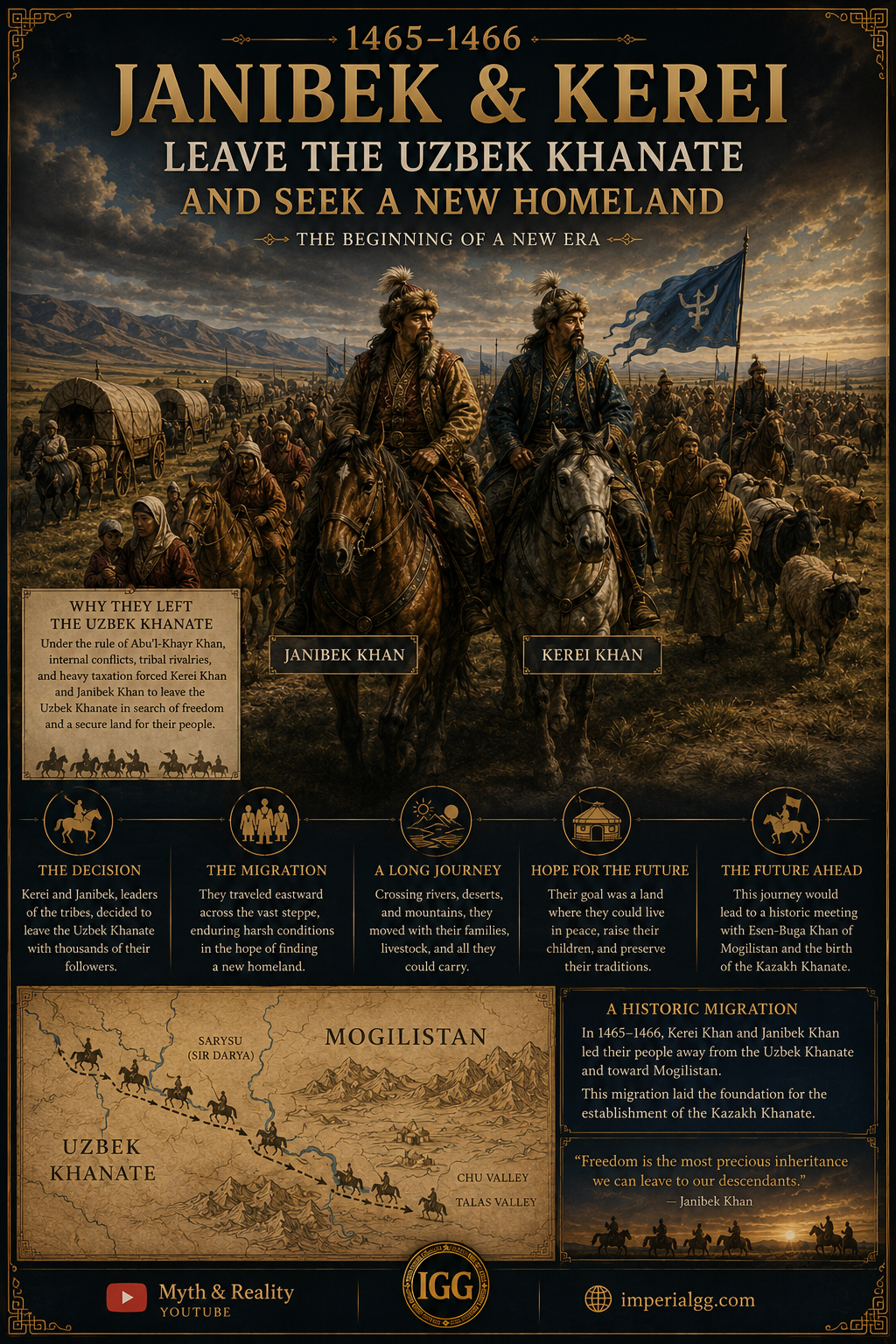
Under the rule of Abu’l-Khayr Khan, growing political tensions and tribal rivalries divided the steppe. Seeking greater autonomy, Kerei Khan and Janibek Khan led many tribes away from the Uzbek Khanate.
1465–1466
Migration to Moghulistan
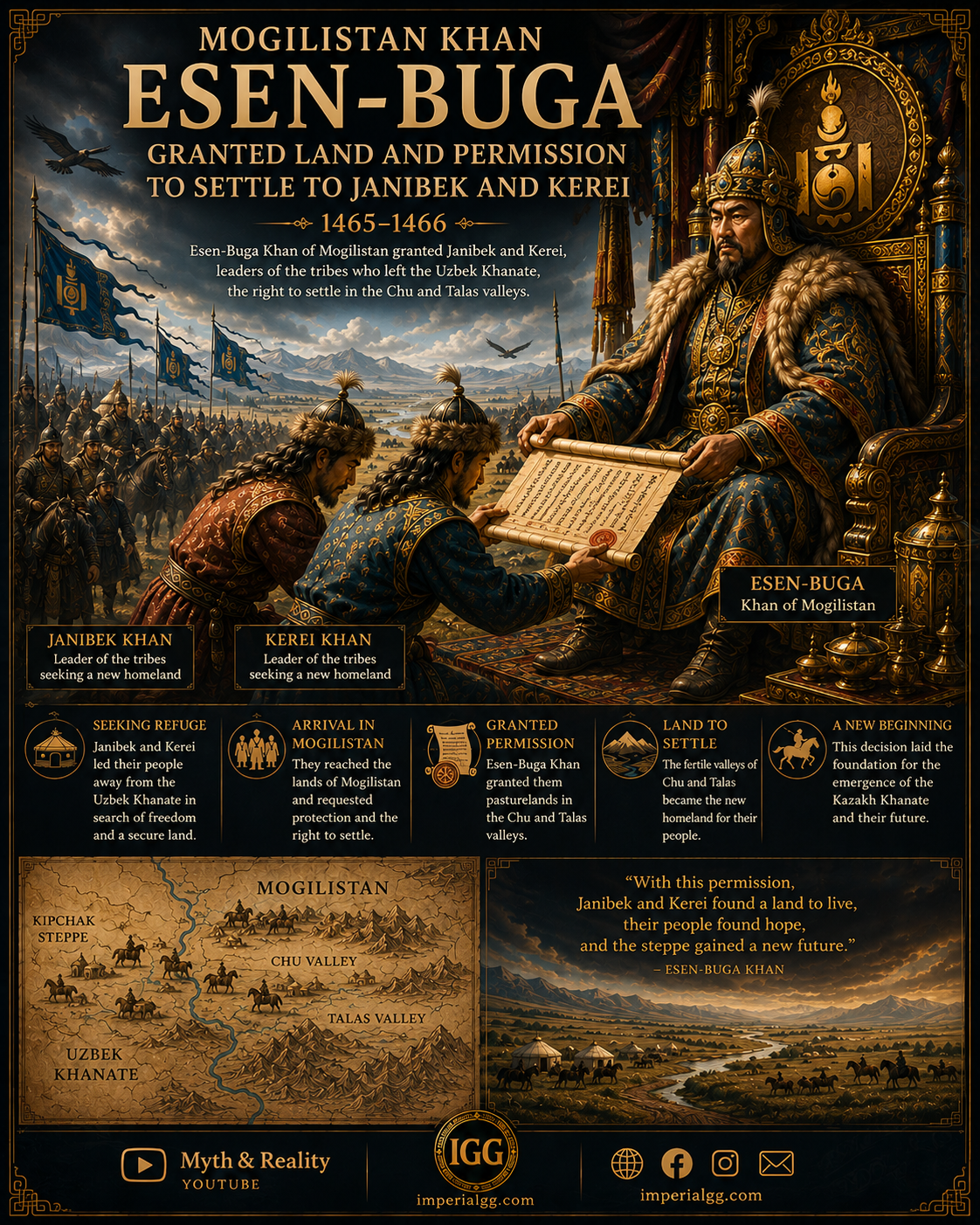
Kerei Khan and Janibek Khan migrated eastward with thousands of followers. Esen Buqa II, Khan of Moghulistan, granted them pasturelands in the Chu and Talas valleys, providing the foundation for a new political community.
1465–1466
Foundation of the Kazakh Khanate
With the support of Moghulistan, Kerei Khan and Janibek Khan established the Kazakh Khanate, marking the beginning of an independent Kazakh state and the emergence of a distinct political identity.
Late 15th Century
Growth of the Khanate
The Kazakh Khanate expanded rapidly as many nomadic tribes joined the new confederation. Its authority spread across the eastern Dasht-i Qipchaq through diplomacy, alliances, and military strength.
Early 16th Century
The Reign of Qasym Khan
Under Qasym Khan (r. c.1511–1523), the Kazakh Khanate reached the height of its influence. His legal code, Qasym Khan’s Bright Road (Qasym Khannyn Qasqa Zholy), strengthened governance and unified the khanate.
16th–17th Centuries
The Three Zhuzes
The Kazakh people became organized into the Senior (Uly), Middle (Orta), and Junior (Kishi) Zhuzes, regional tribal unions that strengthened political cooperation while preserving local leadership.
17th Century
Defending the Steppe
The Kazakh Khanate defended its homeland against the expansion of neighboring powers, preserving its nomadic traditions and political independence.
18th Century
The Dzungar Wars
The Kazakh people faced repeated invasions from the Dzungar Khanate. Despite heavy losses, they preserved their identity through resistance, alliances, and resilience.
JANIBEK AND KEREI FLEE THE UZBEK KHANATE
Seeking Refuge in Moghulistan (1465–1466)
Seeking Refuge in Moghulistan
Historical Background
Amid growing political tensions under Abu’l-Khayr Khan, Janibek Khan and Kerei Khan led thousands of followers away from the Uzbek Khanate in search of security and political autonomy.
Their migration marked one of the most significant movements in the history of the Great Steppe.
The Decision
The two Chinggisid princes rejected the authority of Abu’l-Khayr Khan and chose to establish a new future for their people.
JANIBEK AND KEREI FLEE THE UZBEK KHANATE
The Great Migration
Accompanied by their families, warriors, and livestock, the migrating tribes crossed the steppe toward Moghulistan, enduring a long and difficult journey.
Seeking Refuge
Their destination was the court of Esen Buqa II, Khan of Moghulistan, where they hoped to obtain protection and the right to settle.
Toward a New Beginning
This migration laid the foundation for the events that would soon lead to the establishment of the Kazakh Khanate.
Migration Route (1465–1466)
From the Uzbek Khanate to the Chu and Talas Valleys of Moghulistan
Historical Significance
The migration of Janibek and Kerei was more than a political separation. It marked the emergence of a new steppe polity whose legacy would shape the history and identity of the Kazakh people for centuries.
“Every great nation begins with a journey, a choice, and the courage to seek a new future.”
MYTH & REALITY | YouTube
IMPERIALGG.COM