
FROM CONSPIRACY TO DISCOVERY
By Altanbagana Baatar
DBA Candidate| Independent Historian
ImperialGG Historical Research Seriers
08 October 2026
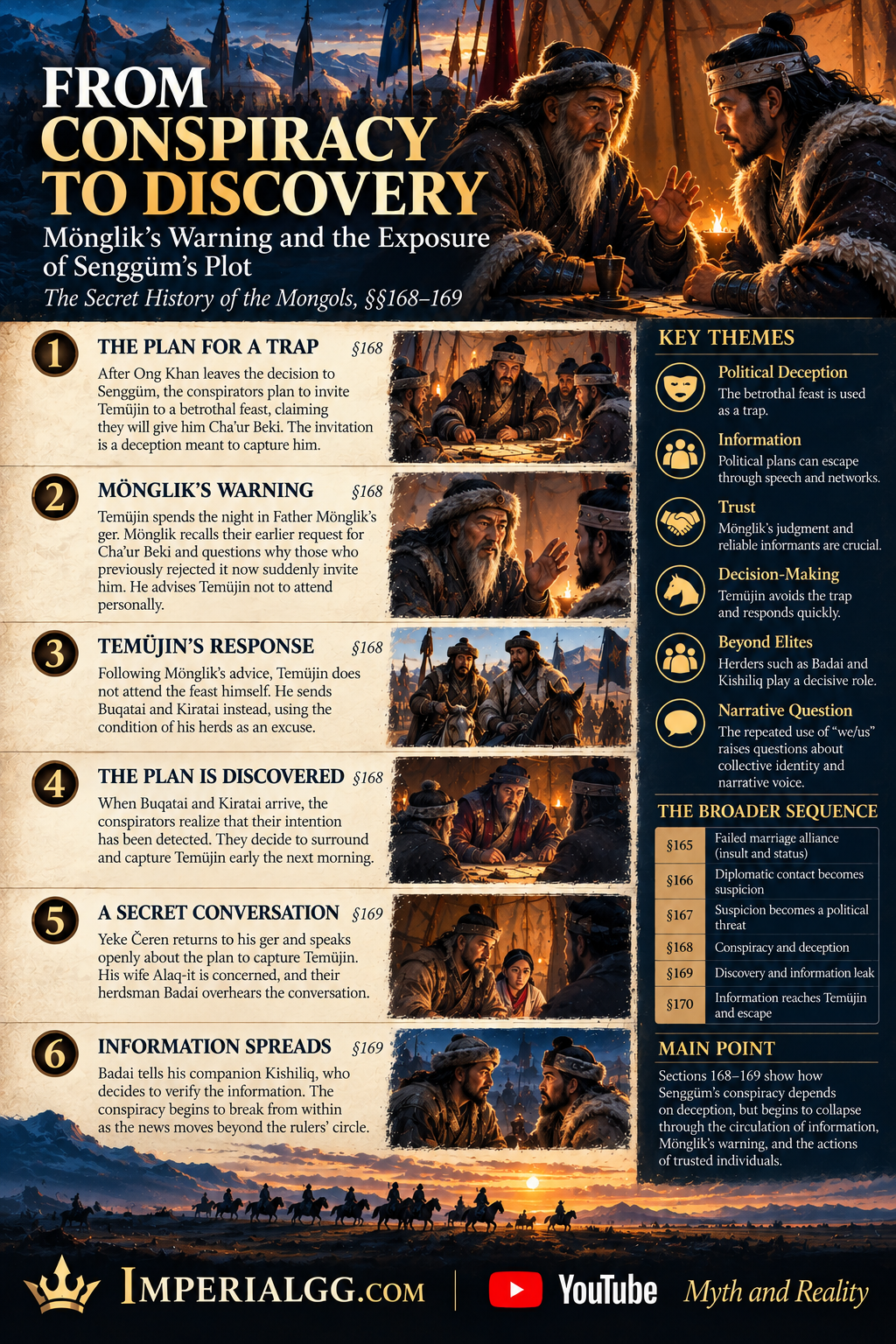
Mönglik’s Warning and the Exposure of Senggüm’s Plot
The Secret History of the Mongols, §§168–169
ABSTRACT
Sections 168–169 mark the transition from an authorized political conspiracy to an attempted deception against Temüjin. After Ong Khan ultimately leaves Senggüm to determine how the matter should be handled, Senggüm and his associates decide to use the betrothal feast for Cha’ur Beki as a means of capturing Temüjin. The plan depends upon Temüjin accepting an invitation that appears to reverse Senggüm’s earlier rejection of the marriage proposal. Mönglik recognizes this contradiction and advises Temüjin to proceed cautiously. Temüjin therefore sends Buqatai and Kiratai in his place, prompting the conspirators to realize that their intentions have been detected. Section 169 then shows how the conspiracy begins to collapse from within when Yeke Čeren openly discusses the planned capture and his herdsman Badai overhears the conversation. These sections consequently connect political deception with the circulation of information while continuing the narrative pattern of collective first-person language through Mönglik’s repeated use of “we/us.” Peachv
Keywords: The Secret History of the Mongols; Temüjin; Mönglik; Senggüm; Ong Khan; Cha’ur Beki; conspiracy; political deception; information; narrative voice
I. FROM POLITICAL PERMISSION TO POLITICAL ACTION
Section 168 follows directly from Ong Khan’s final response to Senggüm in §167. After initially resisting the proposal to act against Temüjin, Ong Khan recalls his angry son and tells him, in effect, to do what he can and decide the matter himself. The narrative then immediately shifts from the question of whether Temüjin should be opposed to the practical question of how he should be captured. Senggüm proposes that Temüjin be invited to a betrothal feast and seized there, and the others agree to the plan. Rachewiltz similarly treats §168 as the beginning of the concrete implementation of the conspiracy. Peachv
This transition is important for reconstructing responsibility. Ong Khan’s earlier refusal and his later withdrawal of opposition should not be collapsed into an explicit command to kill or capture Temüjin. The initiative in §168 comes from Senggüm and his associates, who formulate the method of entrapment after Ong Khan ceases to prevent them from acting.
The political process can therefore be represented as:
accusation → persuasion → withdrawal of opposition → conspiracy → deception.
II. THE BETROTHAL FEAST AS A MEANS OF DECEPTION
Senggüm’s proposal depends upon the earlier marriage dispute. He and his associates announce that they will now give Cha’ur Beki and invite Temüjin to the betrothal feast. The apparent reconciliation is precisely what makes the invitation politically useful: a proposal previously rejected is suddenly presented as acceptable, providing a plausible reason for Temüjin to approach the Kereit camp. Aziz Yardımlı
The feast is therefore not merely a social event. Within the narrative it becomes an instrument of political deception. The conspirators intend to transform a ritual of alliance into an opportunity for capture.
This reversal is particularly significant because the same marriage proposal had already become a source of political resentment in §§164–165. The marriage alliance that might have strengthened the relationship between Temüjin and the Kereit ruling house is now used as the mechanism through which Senggüm attempts to remove Temüjin.
III. MÖNGLIK RECOGNIZES THE CONTRADICTION
Temüjin travels toward the Kereit camp with ten men and spends the night in Father Mönglik’s ger. At this point Mönglik recalls the earlier request for Cha’ur Beki and observes that the same people who had previously rejected the proposal are now inviting Temüjin to the betrothal feast. He therefore questions the credibility of their sudden change of position and advises Temüjin to proceed cautiously. Peachv
Mönglik’s reasoning is significant because it is based on political continuity. He does not possess direct evidence of the planned ambush at this moment. Instead, he recognizes that the present invitation is inconsistent with the recent behavior of Senggüm and his faction.
Atwood’s translation makes the same point through Mönglik’s questions about why those who previously scorned them would suddenly reverse their position and offer Cha’ur Beki. The warning therefore rests upon an assessment of motive rather than upon confirmed intelligence. Studylib
IV. THE “WE” OF MÖNGLIK’S SPEECH
This section is particularly important for the separate “WHO IS ‘WE’?” research series.
Mönglik recalls: when “we” requested Cha’ur Beki, those people despised “us.”
Both Rachewiltz and Atwood preserve the collective first-person perspective in their translations. Cleaves likewise translates the relevant passage with “us.” Peachv
The significance is not simply that Mönglik uses a plural pronoun. The important point is its relationship to §165, where the narrative itself uses “us” in describing Senggüm’s rejection of the marriage proposal. We therefore have a close textual sequence in which the same collective perspective appears in the narrative and then in Mönglik’s direct speech.
This should not yet be interpreted as proof that the narrator and Mönglik are the same voice. Nevertheless, it creates a legitimate narratological problem: Who is included in “we” and “us” in these passages?
The answer may change according to context, and the question should therefore be followed systematically throughout the Secret History rather than resolved from one occurrence.
V. TEMÜJIN’S RESPONSE
Mönglik advises Temüjin to send an excuse based on the seasonal condition of his herds: spring has arrived, the horses are lean, and the herds must first be strengthened. Temüjin accepts the advice and does not attend the feast himself. Instead, he sends Buqatai and Kiratai to attend and eat at the feast in his place. Peachv
This decision is politically significant because Temüjin does not openly accuse Senggüm of treachery. He also does not simply accept the invitation. He adopts an intermediate strategy that preserves the appearance of communication while avoiding personal exposure.
The decision demonstrates that Mönglik’s warning has produced a practical change in Temüjin’s behavior without immediately producing an open rupture.
VI. “WE HAVE BEEN DISCOVERED”
When Buqatai and Kiratai arrive, Senggüm and his associates immediately understand that Temüjin has not accepted the invitation in the expected manner. Their response, preserved by Cleaves as “We have been felt” and explained in his note as meaning “We have been suspected by him,” indicates that they recognize the failure of their deception. Monumenta Altaica
Atwood renders the same moment more directly as: “We’ve been discovered.”
The difference between these translations is worth noting. Cleaves preserves the unusual literal expression, whereas Atwood conveys its practical meaning. The underlying narrative function is the same: the conspirators realize that Temüjin has detected something suspicious.
They consequently decide to surround and capture him early the following morning. Aziz Yardımlı
The failed deception therefore does not end the conspiracy. Instead, it changes its character from a concealed trap into an impending armed action.
VII. §169 — THE CONSPIRACY BEGINS TO BREAK FROM WITHIN
Section 169 begins with the conspirators confirming their decision to surround and capture Temüjin. Yeke Čeren, the younger brother of Altan, returns to his ger and speaks openly about their plan. He says that they have decided to capture Temüjin early the next morning and even asks what reward someone might receive for carrying this information to Temüjin. His wife Alaq-it warns him about the danger of speaking so openly. Aziz Yardımlı
While they are speaking, Yeke Čeren’s herdsman Badai arrives to deliver milk and overhears the conversation. Badai then approaches his companion Kishiliq and reports what he has heard. Kishiliq responds that he will personally go and determine whether the information is true. Aziz Yardımlı
The political significance of this passage lies in the movement of information from the ruling circle into the wider social environment.
Senggüm’s faction → Yeke Čeren → household conversation → Badai → Kishiliq → Temüjin
The conspiracy therefore begins to fail because the conspirators cannot completely control the information generated by their own decisions.
VIII. SPEECH AS POLITICAL INFORMATION
The contrast between §§168 and 169 is particularly revealing. In §168, Senggüm attempts to control information through deception: Temüjin is given a false reason to approach the Kereit camp. In §169, however, the conspiracy is weakened because one of its participants speaks openly enough for the information to reach someone outside the immediate political circle. The Secret History therefore presents speech in two opposing forms:
speech as deception
and
speech as disclosure.
Mönglik’s speech protects Temüjin because it interprets suspicious behavior. Yeke Čeren’s speech endangers the conspiracy because it reveals its intention. Badai and Kishiliq then transform overheard speech into actionable intelligence.
The political importance of the episode consequently lies not only in what the characters do, but also in who knows what, when they know it, and how information moves between social groups.
IX. THE ROLE OF ORDINARY ACTORS
The emergence of Badai and Kishiliq is also significant from the perspective of social hierarchy. The central political conflict involves khans, princes, aristocrats, and commanders, yet the information that ultimately reaches Temüjin passes through herdsmen.
This does not mean that the Secret History presents the political order as socially egalitarian. Rather, it demonstrates that information can move across hierarchical boundaries and that individuals without formal political authority can nevertheless become significant participants in political events.
The later narrative explicitly remembers Badai and Kishiliq for this service. In §204, Chinggis Khan recalls that the warning associated with Mönglik’s intervention saved him from entering what he metaphorically describes as dangerous waters and red fire, while Badai and Kishiliq are also remembered for their role in the crisis. AnyFlip
Their importance therefore extends beyond the immediate episode.
X. §§168–169 AS A NARRATIVE TRANSITION
These two sections form a coherent sequence:
§168 — Senggüm creates the trap.
§168 — Mönglik recognizes the contradiction.
§168 — Temüjin avoids the trap.
§168 — the conspirators realize they are suspected.
§169 — the conspirators prepare an open capture.
§169 — Yeke Čeren reveals the plan.
§169 — Badai overhears it.
§169 — Kishiliq carries the information forward.
The narrative therefore moves from concealment toward disclosure. The conspiracy has not yet failed completely, but its secrecy has already been compromised. The following section will determine whether the information reaches Temüjin in time and whether the conspirators can still convert their plan into effective action.
AUTHOR’S THESIS
Sections 168–169 mark the transformation of Senggüm’s political conspiracy into a practical attempt to capture Temüjin, while simultaneously demonstrating the vulnerability of political plots that depend upon deception and secrecy. Senggüm uses the betrothal feast as a means of converting a previously rejected marriage proposal into an apparent gesture of reconciliation, but Mönglik recognizes the contradiction between past and present behavior and persuades Temüjin to proceed cautiously. Temüjin’s decision to send Buqatai and Kiratai exposes the deception, after which the conspirators themselves begin to reveal their intentions through uncontrolled speech. Yeke Čeren’s conversation is overheard by Badai and transmitted to Kishiliq, establishing the information chain that will soon reach Temüjin. At the same time, Mönglik’s repeated use of “we/us” connects §168 to the earlier narrative formulation in §165 and provides another important piece of evidence for our continuing investigation into collective identity and narrative voice in the Secret History of the Mongols.
IMPERIALGG RESEARCH NOTE
§168–169 should therefore be preserved as a single analytical unit: CONSPIRACY → DECEPTION → SUSPICION → DISCOVERY → INFORMATION LEAK
And within it, the separate narratological question remains: WHO IS “WE”?