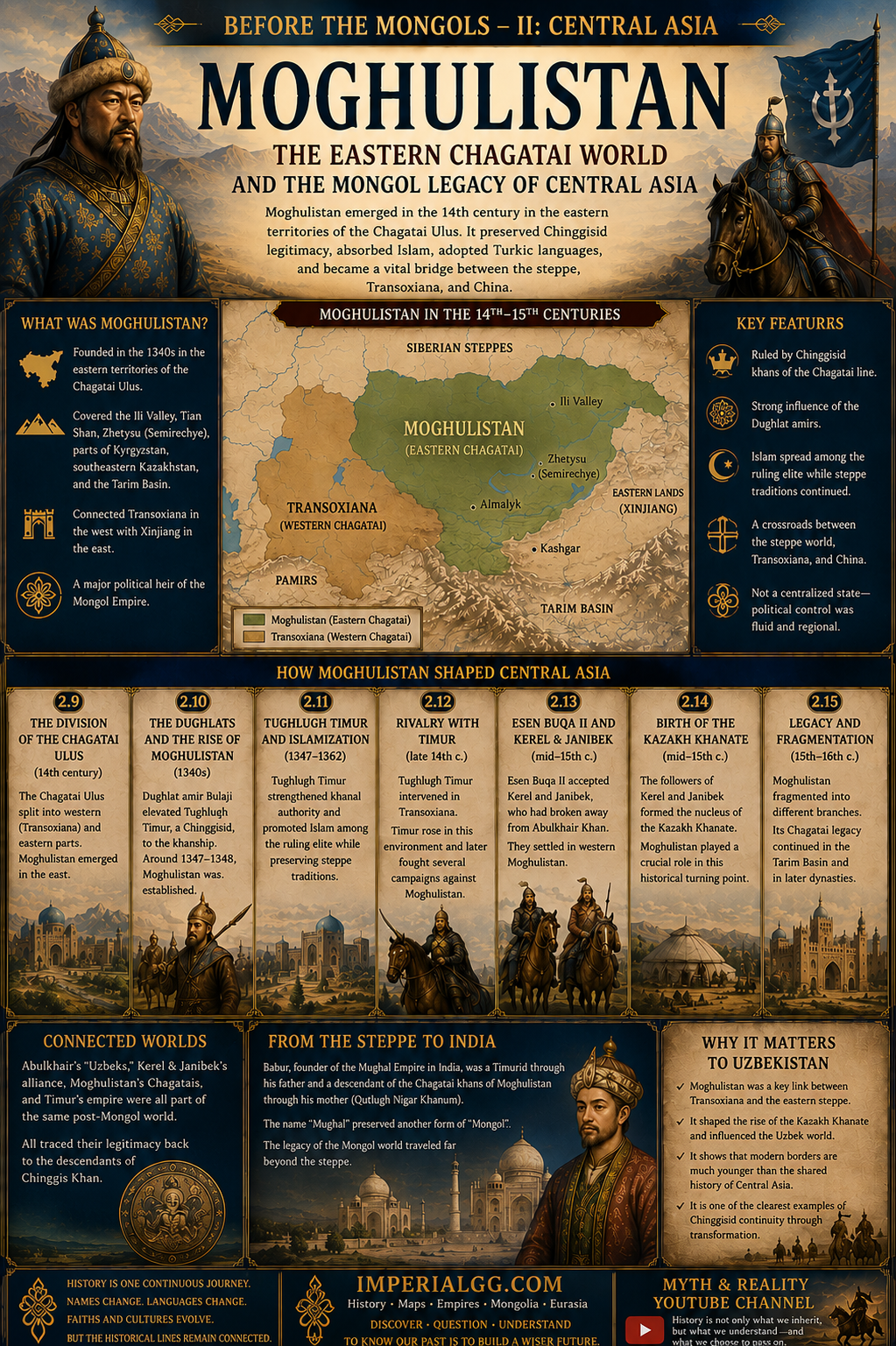
2.9 — MOGHULISTAN: THE EASTERN CHAGATAI WORLD AND THE MONGOL LEGACY OF CENTRAL ASIA
By Altanbagana Baatar
DBA Candidate| Independent Historian
ImperialGG Historical Research Seriers
16 July 2026
The history of Central Asia after the Mongol conquests cannot be understood simply as the disappearance of the Mongol Empire and the emergence of entirely new peoples and states. Across the region, the political structures created by the descendants of Chinggis Khan survived, fragmented, adapted, and developed into new forms. One of the most important examples of this transformation was Moghulistan, a state that emerged in the eastern territories of the former Chagatai Ulus during the fourteenth century.
Moghulistan occupied a vast and shifting geographical world extending across much of the eastern Chagatai realm. At different times, its political sphere included areas of the Ili Valley, the Tian Shan, Semirechye or Zhetysu, parts of present-day Kyrgyzstan, southeastern Kazakhstan, and the regions surrounding the Tarim Basin. Its western frontier connected it directly with Transoxiana, while its eastern territories reached toward the lands that today form part of Xinjiang.
For the history of modern Uzbekistan, Moghulistan may at first appear to belong to a different geographical story. In reality, the histories of Moghulistan and Transoxiana were inseparable. The political division between the western and eastern parts of the Chagatai Ulus shaped the world from which the Timurid Empire, the later Uzbek political formations, the Kazakh Khanate, and several other Central Asian powers eventually emerged. Moghulistan was therefore not a marginal state beyond the borders of Central Asian civilization. It was one of the principal political heirs of the Mongol imperial order.
The Chagatai Ulus Divides
After the death of Chinggis Khan in 1227, the territories assigned to his sons and their descendants gradually developed into major dynastic realms. Central Asia became primarily associated with the descendants of Chagatai, the second son of Chinggis Khan. The Chagatai Ulus encompassed both the great cities and agricultural regions of Transoxiana and the enormous pastoral territories stretching eastward toward the Tian Shan and beyond.
These two geographical worlds were deeply connected, but they were not identical. Transoxiana contained ancient urban centers such as Samarkand and Bukhara. Its economy depended heavily upon agriculture, crafts, taxation, long-distance commerce, and established administrative traditions. Persian literary and bureaucratic culture remained influential, while Turkic languages increasingly expanded across the region.
The eastern territories, by contrast, remained more strongly connected to the pastoral and military traditions of the steppe and mountain zones. Tribal confederations, mobile aristocracies, seasonal migration, and the political authority of military lineages continued to shape political life.
During the fourteenth century, the unity of the Chagatai Ulus weakened. Political authority fragmented, rival amirs competed for influence, and the western and eastern parts of the ulus increasingly followed different political paths. By the middle of the fourteenth century, this division had produced a new political reality. In the west, Transoxiana entered a period of intense political competition that eventually created the conditions for the rise of Timur. In the east, the Chagatai political tradition survived through the state that became known as Moghulistan.
Why Was It Called “Moghulistan”?
The name itself is historically significant. “Moghulistan” can be understood broadly as the “land of the Moghuls,” with “Moghul” representing a regional form of the name Mongol. Medieval Persian and Central Asian sources used the term in ways shaped by the political and linguistic transformations that followed the Mongol conquests.
By the fourteenth century, the descendants of the Mongol imperial armies in Central Asia had already undergone substantial cultural transformation. Many had adopted Turkic languages. Islam was spreading among the ruling and military elites. Intermarriage with local populations had continued for generations. Yet contemporary political terminology still preserved the memory of their Mongol origin.
This distinction is particularly important. The people described as “Moghuls” in later Central Asian sources were not necessarily Mongolian-speaking populations in the modern sense. Many had become linguistically Turkicized. Their society had changed through generations of life in Central Asia. Nevertheless, the political name “Moghul” continued to carry a connection to the Mongol imperial world from which their ruling institutions and aristocratic traditions had emerged.
This illustrates one of the central themes of post-Mongol Eurasian history: cultural transformation did not automatically erase political ancestry. The Mongol Empire could disappear as a unified imperial structure while its descendants continued to rule through institutions, genealogies, and political traditions inherited from the age of Chinggis Khan.
The Dughlat Amirs and the Creation of Moghulistan
The emergence of Moghulistan was closely connected with the powerful Dughlat, or Dughlat, tribal aristocracy. As central Chagatai authority weakened, leading military families gained increasing control over regional politics. Among the most influential were the Dughlat amirs, whose power was particularly strong in the eastern regions of the former Chagatai Ulus.
However, political power and legitimate khanly authority were not considered the same thing. An amir could command armies, control territory, and dominate political affairs. But within the political tradition inherited from the Mongol Empire, the title and legitimacy of khan remained closely connected to descent from Chinggis Khan.
This principle had enormous consequences across Central Asia. Even powerful rulers who were not themselves Chinggisids often found it necessary to rule through, beside, or in the name of descendants of Chinggis Khan. Timur would later provide perhaps the most famous example. Although he became the dominant ruler of Central Asia, he was not a direct male-line descendant of Chinggis Khan and therefore did not normally claim the title of khan for himself. Instead, Chinggisid princes remained important to the formal structure of legitimacy.
The founders of Moghulistan followed the same political logic. In the 1340s, the Dughlat amir Bulaji elevated Tughlugh Timur, a descendant of Chagatai, to the khanship. Through this act, the eastern Chagatai realm regained a recognized Chinggisid ruler. Around 1347–1348, Tughlugh Timur emerged as khan of the eastern Chagatai territories, marking the conventional beginning of Moghulistan as a distinct political state. The state was new in its political configuration. But its legitimacy was explicitly rooted in the dynasty of Chinggis Khan.
Tughlugh Timur and the Restoration of Chinggisid Authority
Tughlugh Timur became one of the most important early rulers of Moghulistan. His reign represented an attempt to restore political unity and strengthen khanly authority in a world dominated by powerful tribal aristocracies. He also became closely associated with the expansion of Islam among the ruling elites of Moghulistan.
Islam had, of course, been present in Central Asia for centuries before the Mongol conquests. Muslim cities, merchants, scholars, and communities existed throughout the region. The Mongol imperial world itself had included large Muslim populations from its earliest decades. What changed during the post-conquest period was the gradual adoption of Islam by major Chinggisid dynasties and Mongol-descended political elites.
In the Jochid Ulus, this process was strongly associated with rulers such as Berke and later Özbeg Khan. In Moghulistan, Tughlugh Timur became an important figure in the Islamization of the eastern Chagatai ruling world. This did not mean that older steppe traditions immediately disappeared. Political culture remained deeply shaped by Chinggisid legitimacy, tribal organization, military aristocracy, and inherited Mongol institutions. Islam became incorporated into this existing political world rather than simply replacing it overnight.
This combination of Chinggisid political legitimacy and Islamic religious identity would become one of the defining features of many later Central Asian states.
Moghulistan and the Rise of Timur
The relationship between Moghulistan and Transoxiana became increasingly important during the rise of Timur in the second half of the fourteenth century. Before Timur established his empire, Transoxiana was politically fragmented. Rival amirs competed for control, and the region became vulnerable to intervention from Moghulistan.
Tughlugh Timur launched campaigns into Transoxiana and temporarily extended his authority westward. During this period, the young Timur entered the rapidly changing political environment that would eventually lead to his own rise.
The relationship between Timur and the Chinggisid political order was complicated. Timur was not an outsider to the Mongol imperial political world. His Barlas tribe had emerged from the military and political structures created during the Mongol conquest of Central Asia. By Timur’s lifetime, the Barlas were largely Turkic-speaking and culturally integrated into the Islamic society of Transoxiana. Yet the political world in which Timur operated remained fundamentally shaped by the legacy of Chinggis Khan.
Timur married into the Chinggisid dynasty and used the prestigious title Gürgän, or royal son-in-law. He ruled through an imperial ideology that combined Islamic sovereignty, Turco-Mongol military traditions, and Chinggisid political legitimacy. Moghulistan, meanwhile, remained one of his major regional rivals.
Timur repeatedly campaigned against the eastern Chagatai territories. These wars were not simply conflicts between completely separate civilizations. They were struggles within the broader political world that had emerged from the fragmentation of the Mongol Empire. On both sides stood societies deeply transformed since the thirteenth century, but both still operated within political traditions created by the Mongol imperial age.
Moghulistan Was Never a Simple Unified State
It is important not to imagine Moghulistan as a centralized territorial state with fixed borders comparable to a modern country. Its political geography was fluid. The authority of the khan depended upon relationships with powerful tribal leaders. Different regions could move in and out of effective central control. The Dughlat amirs remained particularly influential, especially in the southern and southeastern territories.
The state also contained different ecological and cultural zones. The northern and western regions were closely connected with the pastoral world of Zhetysu and the Tian Shan. The southern regions interacted with the oasis cities of the Tarim Basin. Trade routes connected Moghulistan with Transoxiana, China, the steppe, and the wider Islamic world.
This diversity was one of its strengths, but also one of its political difficulties. The khans had to balance tribal aristocracies, regional interests, religious change, and external pressure from powerful neighboring states. Yet Moghulistan survived for generations because it occupied one of the most strategically important crossroads of Inner Eurasia.
The Dughlats and the Memory of Mongol Central Asia
Our understanding of Moghulistan is closely connected with one particularly important historical work: the Tarikh-i Rashidi, written in the sixteenth century by Mirza Muhammad Haidar Dughlat.
Muhammad Haidar was himself a descendant of the powerful Dughlat aristocratic family. His work provides one of the most important narratives of the political history of Moghulistan, the eastern Chagatai khans, the Dughlats, and the wider Central Asian world. The Tarikh-i Rashidi is especially valuable because it preserves a historical memory from within the political society that had emerged from the eastern Chagatai world.
At the same time, like every historical source, it must be read critically. Muhammad Haidar wrote generations after some of the events he described, and his narrative reflected the political memory and interests of his own time and family. Nevertheless, without his work, our knowledge of Moghulistan would be considerably poorer.
The existence of such a source also reminds us that the history of post-Mongol Central Asia was not preserved only in Chinese, Russian, or modern national historiographies. The descendants of the political world created by the Mongol Empire produced their own historical traditions.
Esen Buqa II and the Arrival of Kerei and Janibek
One of the most historically consequential episodes in the later history of Moghulistan occurred during the reign of Esen Buqa II in the fifteenth century. At this time, the eastern Dasht-i Qipchaq was dominated by Abulkhair Khan, a descendant of Shiban, the son of Jochi. His confederation brought together numerous tribes and became associated in historical sources with the “Uzbeks” or “nomadic Uzbeks.”
But Abulkhair’s political authority was not universally accepted. Two Chinggisid princes, Kerei and Janibek, broke away from his political sphere with groups of followers. They moved toward western Moghulistan. Esen Buqa II accepted them and allowed them to settle in the region of western Zhetysu, traditionally associated with the Chu and Talas valleys.
This decision would have consequences far beyond Moghulistan itself. The followers of Kerei and Janibek gradually became the political nucleus of what developed into the Kazakh Khanate. Thus, Moghulistan played a direct role in one of the most important political transformations of the fifteenth-century steppe.
The emerging division between the followers of Abulkhair and those who joined Kerei and Janibek contributed to the later differentiation between Uzbek and Kazakh political identities. These identities did not appear suddenly as modern nations. They emerged gradually through political allegiance, migration, dynastic competition, tribal association, and territorial development. But the geography of Moghulistan provided the political space in which one of these new formations could take shape.
The Uzbek–Kazakh Division Was Part of a Larger Mongol Imperial Legacy
Viewed from a modern national perspective, the histories of Uzbekistan and Kazakhstan are often presented as separate stories. From the perspective of the fifteenth century, however, such a division would be artificial.
The political ancestors of the later Uzbek and Kazakh formations belonged to overlapping Jochid, Chagatai, Turkic, Mongol, and Islamic worlds. Abulkhair was a Chinggisid. Kerei and Janibek were Chinggisids. The khans of Moghulistan were Chinggisids. The political legitimacy of all these competing rulers ultimately traced back to the sons and descendants of Chinggis Khan.
The struggle was therefore not simply between “Mongols” and later Central Asian peoples. It was largely a struggle among different branches and political heirs of the world created by the Mongol Empire. This distinction is fundamental.
By the fifteenth century, many of these populations no longer spoke Mongolian. Their cultures had changed. Islam had become central to their identities. New tribal and political names had emerged. But the architecture of political legitimacy remained remarkably persistent. To rule as khan still required Chinggisid blood.
From Moghulistan to the Later Central Asian World
Over time, Moghulistan itself fragmented. Different branches of the eastern Chagatai dynasty established authority in different regions. Political centers shifted toward the Tarim Basin and the oasis cities of eastern Central Asia. The western territories of Moghulistan became increasingly connected with the rise of the Kazakh Khanate and other regional powers. In the south and east, the descendants of the Chagatai line continued to play important roles in the political history of the Tarim Basin.
One of the most famous descendants of this eastern Chagatai world was Babur. Babur was a Timurid through his father, but through his mother, Qutlugh Nigar Khanum, he descended from the Chagatai khans of Moghulistan. This made Babur a remarkable product of the interconnected post-Mongol political world. His paternal ancestry connected him with Timur. His maternal ancestry connected him directly with the Chinggisid house of Chagatai.
When Babur later founded the Mughal Empire in India, the very name “Mughal” preserved another linguistic form of “Mongol.” The political history that began on the Mongolian Plateau had therefore undergone an extraordinary transformation. Mongol imperial institutions moved into Central Asia. There they interacted with Turkic languages and Islamic civilization. The Chagatai world divided. Moghulistan emerged. Timur built a new empire.
The Uzbek confederations rose from the Jochid steppe. The Kazakh Khanate developed partly within territories connected to Moghulistan. Babur carried the Timurid and Chagatai inheritance into India. The names changed. The languages changed. The religions and cultures evolved. But the historical lines remained connected.
Why Moghulistan Matters to the History of Uzbekistan
Moghulistan was not the direct predecessor of modern Uzbekistan, but it is impossible to understand the formation of the later Central Asian political world without it. Moghulistan stood between Transoxiana and the eastern steppe. It preserved the Chagatai branch of Chinggisid political authority. It interacted continuously with the Timurid world. It provided refuge and territory to Kerei and Janibek, contributing to the formation of the Kazakh Khanate. Its political fragmentation helped reshape the balance of power across Central Asia.
Its history also demonstrates that the borders separating modern Uzbekistan, Kazakhstan, Kyrgyzstan, and Xinjiang did not exist in their present form during the medieval period. The peoples and dynasties of this region belonged to overlapping worlds.
For a Mongolian observer, this history also carries a deeper significance. The Mongol Empire did not simply conquer Central Asia and then disappear. Its descendants became part of Central Asia. They adopted new languages without immediately abandoning their political ancestry. They accepted Islam while preserving Chinggisid legitimacy. They intermarried with local populations and participated in the creation of new societies.
From this long process emerged political communities that eventually contributed to the histories of modern Uzbeks, Kazakhs, Kyrgyz, and other peoples of the region. This does not mean that these modern nations are simply “Mongols under different names.” History is more complex than that. But neither can their medieval history be fully understood if the Mongol and Chinggisid foundations of the political world from which they emerged are removed.
Moghulistan is one of the clearest examples of this historical continuity through transformation. It was Mongol in political ancestry. It became increasingly Turkic in language. It became deeply Islamic in religion. It remained Chinggisid in dynastic legitimacy. And from within its political world emerged developments that helped shape the map of Central Asia for centuries to come.
Moghulistan therefore should not be remembered merely as a forgotten state between greater empires. It was one of the central bridges between the Mongol imperial age and the later history of Central Asia.