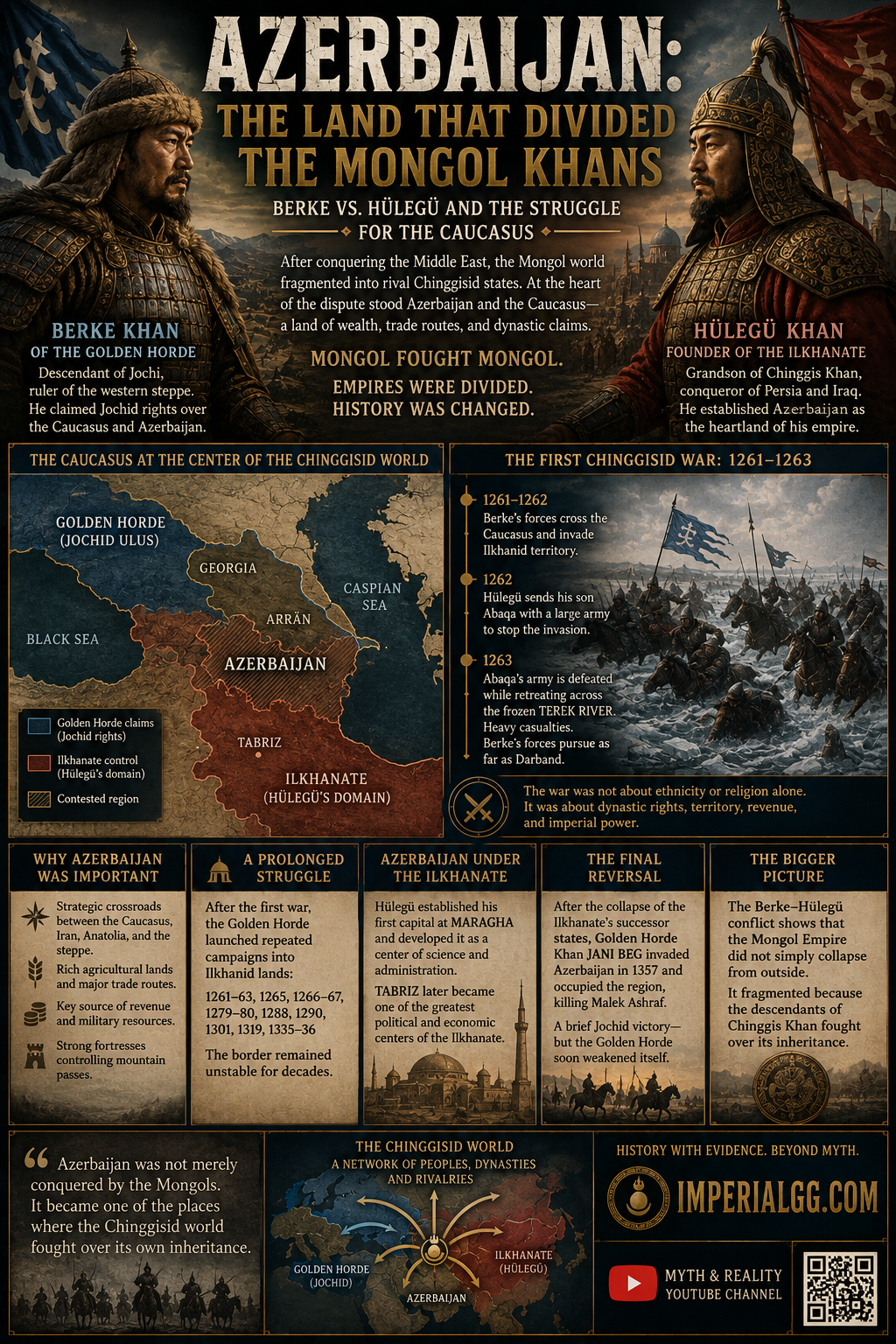
AZERBAIJAN AND THE CHINGGISID STRUGGLE
By Altanbagana Baatar
DBA Candidate| Independent Historian
ImperialGG Historical Research Seriers
10 August 2026
Berke, Hülegü, and the Contest for the Caucasus
The Mongol conquest of western Asia did not end with the establishment of Hülegü’s power.
It created a new problem:
Who had the right to control Azerbaijan and the Caucasus?
By the early 1260s, two branches of the Chinggisid dynasty were prepared to fight over the answer. On one side stood Berke Khan, ruler of the Jochid ulus, later known as the Golden Horde. On the other stood Hülegü, grandson of Chinggis Khan and founder of the Ilkhanid state in western Asia. The resulting conflict was one of the first major wars between successor branches of the Mongol imperial family.
1. WHY AZERBAIJAN MATTERED
By the time Hülegü established his authority in western Asia, Azerbaijan had become a central region of his political base. Hülegü established his first capital at Maragha, while Tabriz subsequently became one of the principal centers of Ilkhanid power. Azerbaijan was therefore not a peripheral frontier. It was strategically positioned between the Caucasus, Iran, Anatolia, and the routes leading toward the northern steppe. For the Jochid dynasty, however, the region represented something different.
The descendants of Jochi regarded territories south of the Caucasus—including Arrān and Azerbaijan—as belonging to the sphere of Jochid claims deriving from the distribution of Chinggis Khan’s imperial domains. This created a fundamental contradiction.
Hülegü governed Azerbaijan.
Berke claimed rights there.
2. THE Jochid CLAIM
The conflict was not simply a struggle between two men. It reflected competing understandings of Chinggisid dynastic rights. Jochid forces had already operated in regions that later came under Hülegü’s control. When Hülegü established his authority in Persia and the Caucasus, he appropriated territories that the Jochid branch regarded as part of its inherited sphere.
The issue therefore involved:
- territorial claims;
- access to revenues;
- control of strategic routes;
- authority over the Caucasus;
- and the political rights of the Jochid branch of the Chinggisid family.
This was not merely a dispute over a modern national territory called “Azerbaijan.” The political geography of the thirteenth century was different.
3. THE BREAK BETWEEN BERKE AND HÜLEGÜ
Tensions between Berke and Hülegü had been developing for several years. According to Encyclopaedia Iranica, the immediate causes included the perceived violation of Jochid rights in the Caucasus and Azerbaijan, together with disputes over revenues that Berke believed should reach the Golden Horde. The crisis became even more serious after Hülegü executed several Jochid princes who had accompanied his western expedition and attacked their contingents.
Some survivors escaped to Mamluk territory. The relationship between the two branches had crossed the point of reconciliation.
The Chinggisid family was now at war with itself.
4. BERKE MOVES SOUTH
In the winter of 1261–1262, open warfare broke out in the Caucasus. Berke’s forces moved southward against Hülegü’s territories. Hülegü responded by sending forces under his son Abaqa. The fighting moved across the Caucasus and toward the northern frontier of the Ilkhanid state.
The conflict reached a dramatic moment in 1263, when Abaqa’s forces were defeated while retreating across the frozen Terek River. The ice broke beneath the retreating troops, causing substantial losses. Berke’s forces pursued the Ilkhanid army as far as Darband before withdrawing northward. The battle demonstrated something that would become increasingly important in the history of the Mongol Empire:
The empire could no longer be treated as a single political command.
5. MONGOL AGAINST MONGOL
The Berke–Hülegü conflict is one of the clearest examples of the fragmentation of Chinggisid political authority. Both rulers belonged to the dynasty descended from Chinggis Khan.
Both claimed legitimate authority.
Both commanded Mongol armies.
Yet they fought each other over territory, revenue and dynastic rights. This is why describing the conflict simply as “Mongols versus non-Mongols” misses the essential historical reality. It was a struggle within the Chinggisid political world itself.
6. RELIGION WAS IMPORTANT — BUT NOT THE WHOLE STORY
Berke had converted to Islam, while Hülegü’s political environment remained religiously diverse. Berke’s anger over Hülegü’s destruction of Baghdad and execution of the Abbasid caliph became an additional source of hostility.
The Mamluk Sultanate also became an important partner of the Golden Horde. But religion should not be used as the sole explanation for the war. The underlying dispute included dynastic rights, territory, revenue and imperial authority. Religion intensified the conflict, but it did not create the entire conflict by itself.
7. THE WAR DID NOT END WITH BERKE AND HÜLEGÜ
The first confrontation was only the beginning. Golden Horde rulers launched repeated campaigns south of the Caucasus during the following decades. Encyclopaedia Iranica records invasions in 1261–63, 1265, 1266–67, 1279–80, 1288, 1290, 1301, 1319 and 1335–36.
The Golden Horde never permanently conquered the Ilkhanid territories. But the repeated conflict had major consequences. It forced the Ilkhans to keep substantial military resources in the Caucasus and contributed to the strategic pressure surrounding the Ilkhanate. The once-unified Mongol imperial world was becoming a system of competing Chinggisid states.
8. AZERBAIJAN AS AN ILKHANID CENTER
Despite the conflict, Azerbaijan became one of the most important centers of the Ilkhanate. Maragha became Hülegü’s first capital and developed into an important scientific center, most famously associated with the observatory established under Hülegü.
Tabriz subsequently became a major Ilkhanid political and economic center. Under the Ilkhans, Azerbaijan therefore became more than a contested frontier. It became one of the principal centers from which Mongol rule in western Asia was organized.
9. THE FINAL REVERSAL
The long struggle eventually produced a remarkable reversal. After the Ilkhanate began to disintegrate following the death of Abu Saʿid in 1335, the Golden Horde once again moved south. In 1357, Khan Jani Beg invaded Azerbaijan and occupied the region, killing the Chobanid ruler Malek Ashraf. For a brief moment, the Jochid branch achieved what Berke had sought almost a century earlier: control of Azerbaijan.
But the victory was short-lived. Jani Beg withdrew, and the Golden Horde itself soon entered a period of severe political fragmentation.
CONCLUSION
The history of Azerbaijan in the Mongol period cannot be reduced to a simple story of conquest. It became a fault line within the Chinggisid world. Hülegü needed Azerbaijan as the strategic heart of his western empire. Berke regarded the region as part of the Jochid sphere of dynastic rights. Their disagreement helped trigger the first major war between the Golden Horde and the Ilkhanate.
The conflict demonstrates a fundamental reality of Mongol imperial history:
The fragmentation of the Mongol Empire was not simply the collapse of an empire from outside. It was also a struggle among the descendants of Chinggis Khan over who possessed the right to inherit and command the imperial world.
And at the center of one of those struggles stood Azerbaijan.
Azerbaijan was not merely conquered by the Mongols.
It became one of the places where the Chinggisid world fought over its own inheritance.
ImperialGG.COM
History With Evidence. Beyond Myth.
Notes & References
1. Peter Jackson, “Golden Horde,” Encyclopaedia Iranica, Vol. XI, Fasc. 1, pp. 75–76. The article discusses Jochid claims to Arrān and Azerbaijan, the wars with the Ilkhans, and the later occupation of Azerbaijan by Jani Beg in 1357.
2. Peter Jackson, “Hulāgu Khan,” Encyclopaedia Iranica. The discussion of the 1261–63 conflict identifies Jochid claims in the Caucasus and Azerbaijan, revenue disputes, the Terek River campaign, and the continuation of the war.
3. The Cambridge History of the Mongol Empire, “The Ilkhanate, 1260–1335.” The chapter examines the formation and development of Hülegü’s Mongol-ruled state in western Asia.
4. The Cambridge History of the Mongol Empire, “Georgia and the Caucasus.” The chapter places the Mongol conquest and subsequent Ilkhanid political transformation within the broader history of the Caucasus.
5. On Maragha and Tabriz as Ilkhanid centers, see the archaeological and historical literature summarized in recent scholarship on the Ilkhanate.
6. For the broader political context of Chinggisid succession and competing dynastic claims, see The Cambridge History of the Mongol Empire, especially its discussion of the united empire and the competing claims of Chinggisid kin.
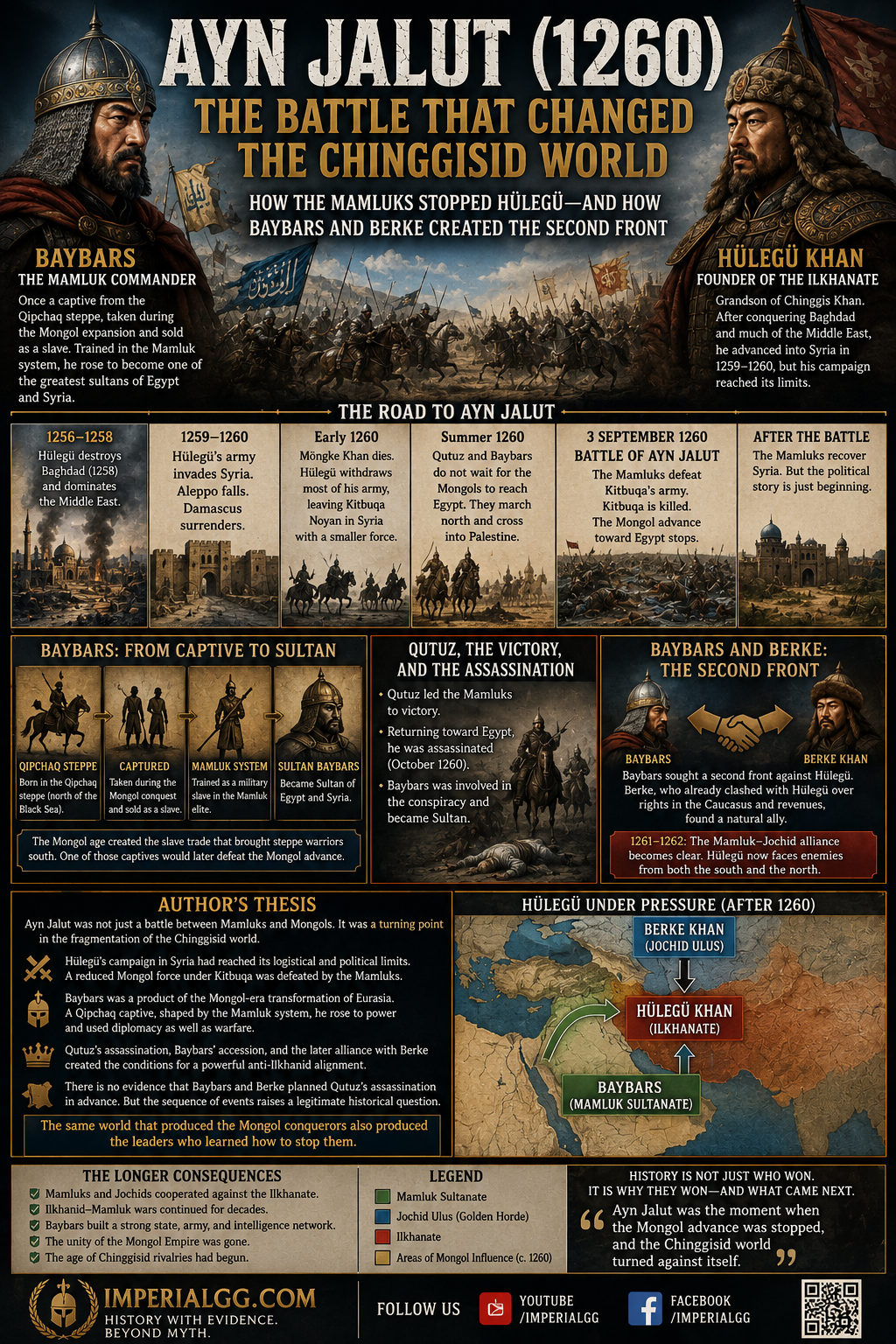
AUTHOR'S THESIS
By Altanbagana Baatar
DBA Candidate| Independent Historian
ImperialGG Historical Research Seriers
10 August 2026
Baybars: The Captive of the Steppe Who Defeated the Mongol Advance
Baybars, Qutuz, Berke, and the Politics Behind the Mamluk Victory
The Battle of ʿAyn Jālūt, fought in September 1260, is conventionally remembered as the battle in which the Mamluks stopped the Mongol advance into Egypt. Yet the significance of the battle extends far beyond the battlefield itself. It occurred at a moment when Hülegü’s western campaign had been interrupted, the Mongol imperial family was beginning to divide politically, and the Mamluk military elite was preparing to confront a reduced Mongol force in Syria. The events that followed the battle—including the assassination of Sultan Qutuz and the rise of Baybars—would contribute to the formation of a new strategic relationship between the Mamluk Sultanate and Berke Khan of the Jochid ulus.
Hülegü’s Advance and the Withdrawal from Syria
By 1260, Hülegü had destroyed major centers of resistance in the Middle East. Baghdad had fallen in 1258, and in 1259–1260 his army advanced through northern Syria. Aleppo fell, Damascus surrendered, and Mongol forces reached the southern Levant. The campaign appeared to be opening a route toward Egypt.
The strategic situation changed, however, following the death of Möngke Khan in 1259. Hülegü withdrew with the greater part of his army, leaving Kitbuqa Noyan in Syria with a much smaller force. The reasons for this withdrawal remain debated, but logistical considerations were significant. The Mongol army had operated for a long time in regions where pasture and fodder were limited, and the maintenance of a large mounted army deep in Syria presented serious logistical difficulties. This withdrawal created an opportunity for the Mamluks. Qutuz, the Mamluk sultan of Egypt, chose not to wait for the Mongols to consolidate their position in Syria. Baybars, one of the most capable commanders of the Mamluk military elite, played a leading role in the advance northward.
At ʿAyn Jālūt, the Mamluks confronted Kitbuqa’s army. The battle involved careful use of reconnaissance, mobility and deception, while the Mongol force itself was considerably smaller than the army that had originally entered Syria. The Mamluks won, and Kitbuqa was killed. The immediate consequence was the recovery of much of Syria and the preservation of the Mamluk state in Egypt. But the political consequences were even greater.
Baybars: A Man Produced by the Mongol Age
The biography of Baybars makes the battle particularly remarkable.
Baybars was not born in Egypt. He originated in the Qipchaq steppe north of the Black Sea and entered the slave markets of the Islamic world during the upheavals associated with the Mongol expansion into the western steppe. A source-based reconstruction of his early life states that he was captured during the Mongol invasion of Russia and eastern Europe and subsequently sold into slavery before entering the Mamluk military system. His birth name is not securely preserved.
This does not establish that Baybars was ethnically Mongol. The stronger identification in the sources is Qipchaq Turkic. His name, Baybars, is also associated with the Turkic linguistic environment of the Qipchaq steppe; one scholarly study of the name explains it through bay and bars, with bars meaning a large feline such as a tiger or leopard in Turkic usage. The historical significance lies elsewhere.
The Mongol conquest of the Eurasian steppe contributed to the displacement and enslavement of large numbers of Qipchaq and other steppe peoples. Many of these captives entered the military-slave markets of Anatolia, Syria and Egypt. The Mamluk military system consequently became heavily dependent on steppe military manpower, particularly from the Qipchaq regions. Modern scholarship emphasizes that early Mamluk recruits were imported principally from the Qipchaq steppe before later recruitment expanded to other regions. Baybars was one of the most extraordinary products of this system.
The Mongol transformation of the steppe helped create the circumstances through which a Qipchaq captive could enter the Mamluk military elite and eventually become Sultan of Egypt and Syria. In 1260, that former steppe captive stood on the opposite side of the battlefield from Hülegü’s army.
Qutuz and the Politics of Victory
The victory at ʿAyn Jālūt did not produce a stable partnership between Qutuz and Baybars. Soon after the battle, Qutuz was assassinated while returning toward Egypt, and Baybars became sultan.
The precise circumstances remain disputed. Medieval accounts differ concerning the identity of the men who physically killed Qutuz and the exact role played by Baybars. Nevertheless, modern scholarship generally regards Baybars as having been involved in the conspiracy, with Amitai-Preiss describing it as a conspiracy of amirs that included Baybars and was probably under his leadership. This distinction is important.
Baybars’ involvement is a strong historical conclusion; the precise mechanics and motivations of the assassination remain less certain.
One commonly proposed explanation is that Baybars expected a major reward—particularly the governorship of Aleppo—for his role in the victory, but Qutuz did not grant his expectations. Other explanations appear in the medieval sources. Whatever the precise motivation, the political result was clear:
Baybars became Sultan. And his accession fundamentally changed Mamluk policy toward Hülegü.
Baybars and Berke: The Search for a Second Front
Hülegü now faced a problem that was larger than the Mamluk frontier. His relationship with Berke Khan, ruler of the Jochid ulus, was deteriorating rapidly.
The dispute involved Jochid claims in the Caucasus and territories south of the Caucasus, together with questions concerning sovereignty and revenues. Hülegü’s establishment of his own political authority in Iran and the Caucasus challenged interests that the Jochid branch regarded as part of its inherited sphere. Baybars recognized the strategic opportunity. If the Mamluks could encourage Berke to pressure Hülegü from the north, the Ilkhanid state would face a second front.
This is precisely the context in which the Baybars–Berke relationship developed. Reuven Amitai-Preiss describes the emergence of the Mamluk–Golden Horde entente as a consequence of their shared opposition to Hülegü and explicitly treats the relationship as part of the Mamluk search for a second front. The consequences were profound. Hülegü no longer faced only the Mamluks in the south. He increasingly faced Berke’s Jochid forces from the north.
The unified Mongol Empire was becoming a system of competing Chinggisid powers.
Was Baybars Already Coordinating with Berke Before Qutuz’s Assassination?
This is where the evidence becomes particularly interesting. The documented Baybars–Berke relationship belongs primarily to the period after ʿAyn Jālūt and after Qutuz’s death, rather than providing clear evidence of a prior agreement. There is currently no surviving source that proves Baybars and Berke had arranged Qutuz’s assassination in advance.
Nor is there evidence demonstrating that Berke ordered the assassination. However, the chronology raises a legitimate historical question. Qutuz was assassinated. Baybars succeeded him. Baybars then developed relations with Berke. Berke was already in conflict with Hülegü. And the resulting Mamluk–Jochid alignment placed increasing pressure on Hülegü from two directions. This sequence does not prove a prior conspiracy.
But it does demonstrate that the political consequences of Qutuz’s assassination were closely connected to the larger transformation of the Chinggisid world.
Baybars should not simply be presented as the man who “defeated the Mongols.” His life represents something much more complex: the unintended consequences of the Mongol transformation of Eurasia.
A Qipchaq youth from the northern steppe was caught within the upheavals produced by Mongol expansion, transferred through the slave markets of the Islamic world, trained within the Mamluk military system, and eventually elevated to the sultanate. The Mamluk military system itself drew heavily upon steppe manpower, particularly from the Qipchaq regions.
Baybars therefore emerged from a world profoundly transformed by the Mongols. Yet he became one of the principal architects of the military and diplomatic resistance against Hülegü. This creates an important historical paradox: the same Eurasian transformations that expanded Mongol power also helped create the military elites capable of resisting that power.
The second part of the thesis concerns the political transition after ʿAyn Jālūt. There is no evidence sufficient to establish that Baybars and Berke had arranged Qutuz’s assassination beforehand. Such a claim would go beyond the surviving evidence. But Qutuz’s death, Baybars’ accession, and the subsequent development of the Baybars–Berke alliance occurred within an unusually compressed period of geopolitical change.
The documented alliance demonstrates that both rulers recognized a common strategic problem: Hülegü’s growing power. Berke’s dispute with Hülegü concerned Jochid rights and revenues in the Caucasus, while Baybars sought to prevent the Ilkhanids from recovering their position in Syria. Their interests therefore converged naturally.
The most defensible hypothesis is consequently not that Baybars and Berke necessarily planned Qutuz’s assassination together, but that the political realignment following Qutuz’s death created the conditions in which a powerful Mamluk–Jochid alignment could emerge against Hülegü.
That distinction separates historical hypothesis from historical fact.
Beyond the Battle
The importance of ʿAyn Jālūt therefore lies not only in the defeat of Kitbuqa. The battle occurred at the intersection of several transformations: Hülegü’s western campaign had reached its logistical limits. The main Mongol army had withdrawn from Syria. The Mamluks seized the opportunity. Kitbuqa’s reduced force was defeated. Qutuz was assassinated. Baybars became sultan. Baybars sought a second front. Berke found common cause with him.
And the Chinggisid political world moved from imperial unity toward dynastic rivalry. The subsequent Mamluk–Ilkhanid conflict lasted for decades. Baybars himself continued to build a military system capable of confronting the Ilkhanids, while diplomatic and covert operations extended the conflict beyond conventional battlefield warfare. Ayn Jālūt was therefore not the end of Mongol power.It was the beginning of a new strategic balance.
Conclusion
The conventional narrative says that the Mamluks stopped the Mongols at ʿAyn Jālūt. The deeper history is more complicated.
A Mongol army that had advanced deep into Syria was reduced by strategic and logistical circumstances. The Mamluks exploited the opportunity and defeated Kitbuqa. Qutuz was subsequently assassinated, Baybars became sultan, and the Mamluk state began developing a diplomatic relationship with Berke Khan.
The result was a new geopolitical structure in which Hülegü faced enemies from both the south and the north. And Baybars himself embodied the complexity of this world. He was a Qipchaq man of the steppe, brought into the Mamluk system through the upheavals of the Mongol age. He was not demonstrably Mongol by ethnicity. Yet his life was inseparable from the transformations produced by the Mongol conquest. The man who emerged from that transformed steppe world eventually became one of the principal opponents of the Ilkhanids.
Ayn Jālūt was therefore not simply a battle between Mongols and Mamluks.
It was a moment in which the consequences of Mongol expansion, Mamluk military organization, Qipchaq migration, dynastic rivalry, and Chinggisid fragmentation converged on one battlefield.
The Mongol world had changed Eurasia.
But the new Eurasian world also changed the Mongols.
ImperialGG.COM
History With Evidence. Beyond Myth.
Footnotes
1. Reuven Amitai-Preiss, Mongols and Mamluks: The Mamluk-Īlkhānid War, 1260–1281 (Cambridge: Cambridge University Press, 1995), especially chapters 2–4, on ʿAyn Jālūt, the formulation of anti-Īlkhānid policy, and the Mamluk search for a second front.
2. Peter Jackson, “Mongol Raids into Palestine (A.D. 1260 and 1300),” Journal of the Royal Asiatic Society 21 (2011). Jackson examines the composition of Kitbuqa’s force, the movements of the Mongol army, and the role of local allies during the campaign.
3. Carl F. Petry, The Mamluk Sultanate, chapter 2, “Ethos of the ‘Slave-Soldiers’ Regime.” Petry notes that early Mamluk recruitment drew heavily from the Qipjaq Steppe and that the Mamluk military culture developed in conscious interaction with the military traditions associated with the Mongol imperium.
4. “The Early Life of Baybars,” Teaching Medieval Slavery and Captivity. The source-based reconstruction places Baybars’ origins in the Kipchak steppe and connects his enslavement to the Mongol invasion of Russia and eastern Europe. His birth name is not preserved.
5. Thierry Buquet, “Nommer les animaux exotiques de Baybars, d’Orient en Occident,” in Les non-dits du nom. Onomastique et documents en terres d’Islam, Presses de l’Ifpo. Buquet discusses Baybars’ Qipchaq origin and the Turkic linguistic interpretation of his name.
6. Amitai-Preiss, Mongols and Mamluks, discussion of Qutuz’s assassination and the political transition to Baybars. The surviving medieval accounts differ concerning the exact circumstances, while modern scholarship generally places Baybars within the conspiracy.
7. Amitai-Preiss, “The Search for a Second Front,” in Mongols and Mamluks, pp. 78–105. The chapter specifically examines the origins of the Baybars–Berke entente and identifies their shared opposition to Hülegü as the central strategic factor.
8. Amitai-Preiss, “The Secret War,” in Mongols and Mamluks, pp. 139–156. The chapter examines the intelligence, espionage and covert dimensions of the prolonged Mamluk–Ilkhanid conflict.
9. Amitai-Preiss, “Baybars’s Posthumous Victory,” in Mongols and Mamluks, pp. 179–201. The study places Baybars’ military system within the longer Mamluk–Ilkhanid confrontation and shows the durability of the military structure he created.
10. The surviving evidence does not establish a prior Baybars–Berke agreement to assassinate Qutuz. The proposed connection should therefore remain an author’s hypothesis, not a historical fact. The documented Baybars–Berke alignment belongs to the subsequent period and is best explained through their converging strategic interests against Hülegü.