Uzbekistan: From the Chagatai Ulus to the Uzbek Khanate
By Altanbagana Baatar
DBA Candidate| Independent Historian
ImperialGG Historical Research Seriers
05 August 2026
How the Mongol Legacy Shaped the Heart of Central
Asia
Introduction
Modern Uzbekistan occupies one of the most historically significant regions of Central Asia. Home to the ancient cities of Samarkand, Bukhara, and Khwarazm, it has long served as a crossroads linking China, the Eurasian steppe, Persia, and the Middle East. Long before the emergence of the modern Uzbek state, this region was a center of commerce, scholarship, and political power along the Silk Road.
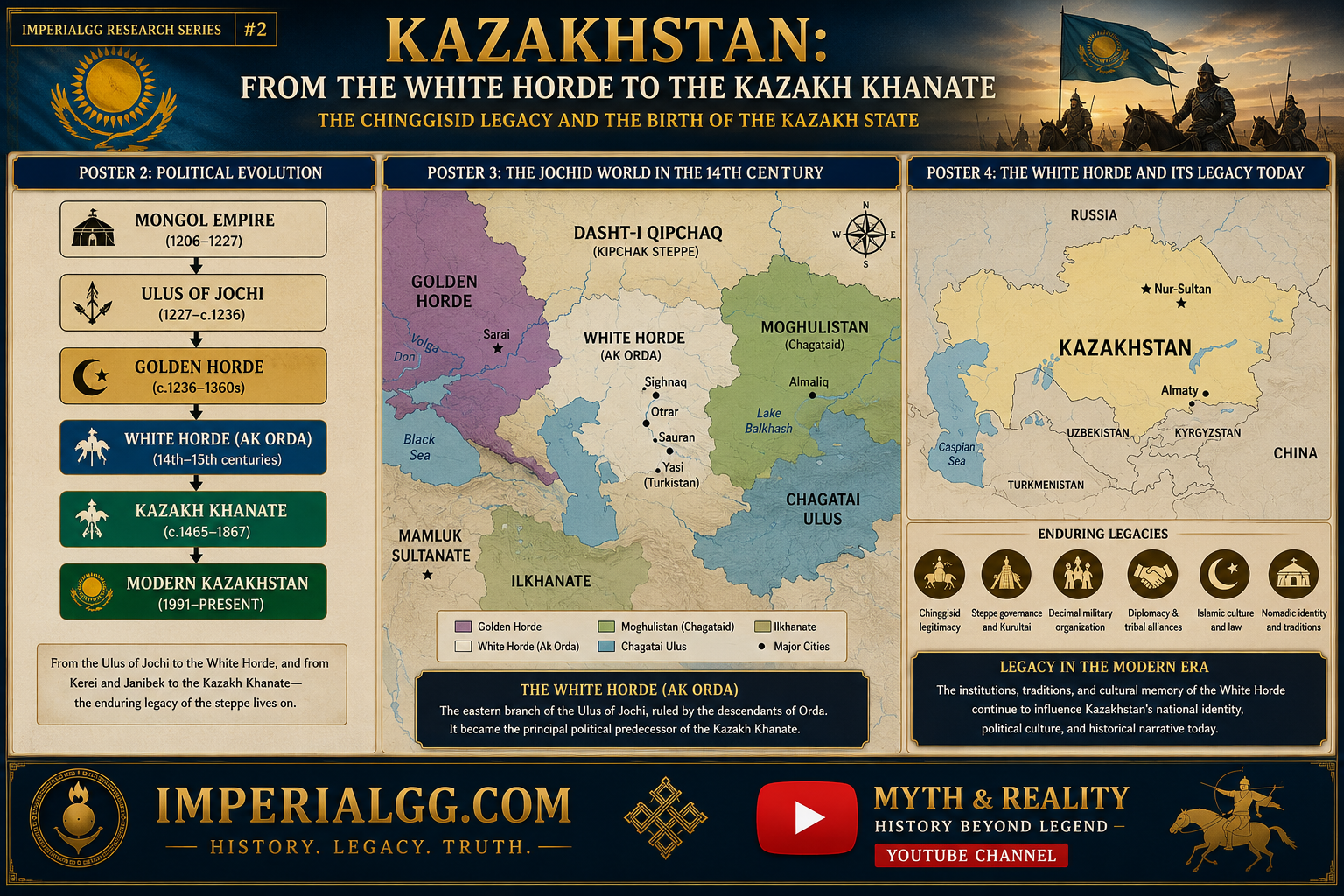
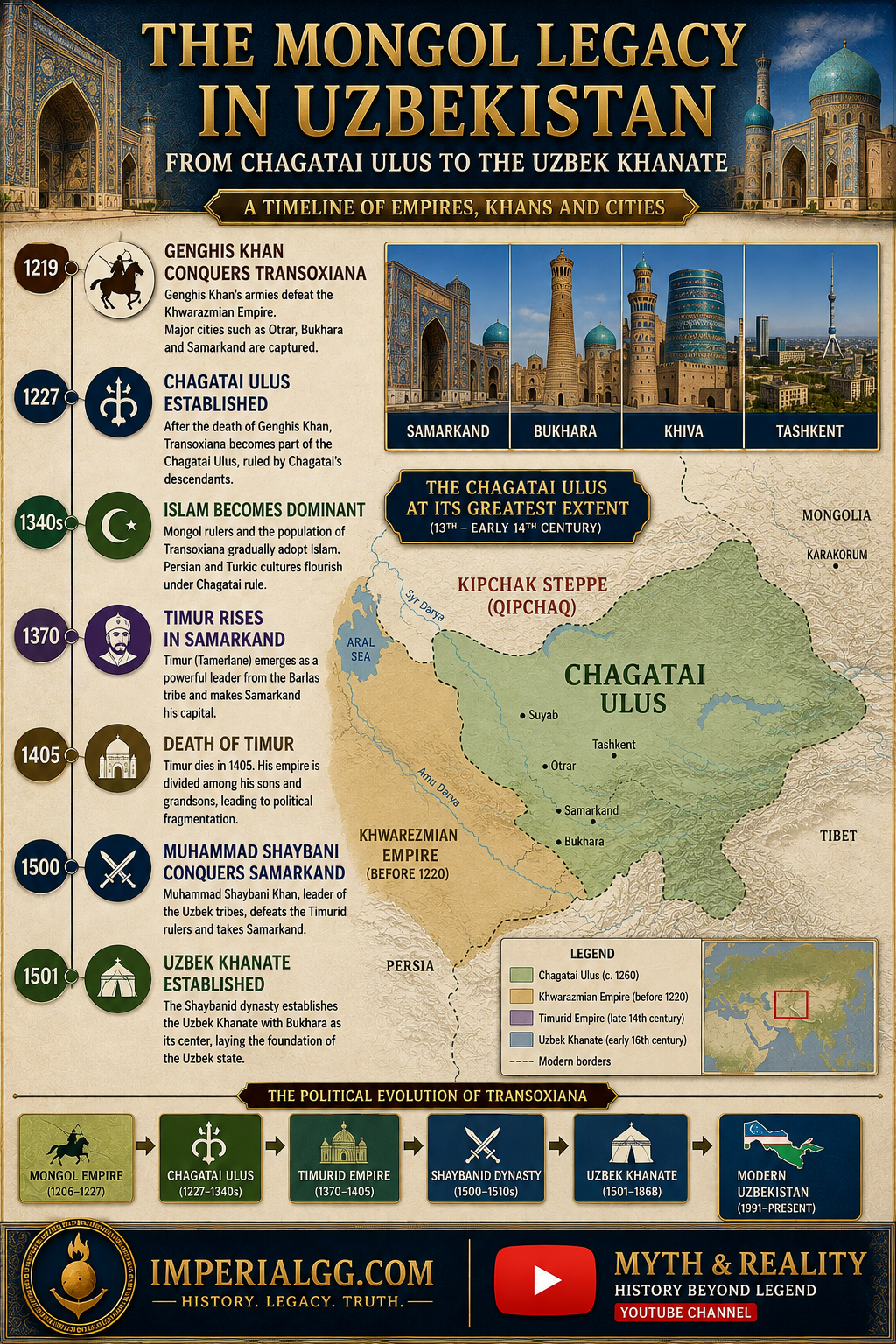
The Mongol conquest of the early thirteenth century transformed Transoxiana more profoundly than any previous political change. Although the invasion brought widespread destruction, it also integrated the region into the largest contiguous empire in history. Under Mongol rule, Transoxiana became part of the Chagatai Ulus, where new administrative institutions, commercial networks, and political traditions emerged. These developments laid important foundations for the rise of Timur, the Shaybanids, and ultimately the Uzbek Khanate.
Rather than marking the end of Central Asian civilization, the Mongol period became a turning point that reshaped the political landscape of the region for centuries.
Transoxiana Before the Mongols
Before the arrival of the Mongols, Transoxiana—known in Islamic sources as Mawarannahr (“the land beyond the Oxus”)—was one of the wealthiest regions in Eurasia. The cities of Samarkand and Bukhara flourished as centers of trade, religion, science, and Persian culture. The region was ruled by the Khwarazmian Empire under Sultan Muhammad II, whose authority extended across much of Central Asia and Iran.
Despite its wealth, the Khwarazmian state suffered from internal political divisions. Tensions between the sultan, regional governors, and military commanders weakened the empire at a time when a new power was emerging on the Mongolian Plateau.
The Mongol Conquest
The conflict between the Mongols and the Khwarazmian Empire began in 1218 after the execution of Mongol merchants and envoys at Otrar. Genghis Khan regarded the incident as a grave diplomatic violation and launched a full-scale campaign in 1219.
Within two years, Mongol armies captured Otrar, Bukhara, Samarkand, and other major cities. While contemporary chroniclers describe extensive destruction and heavy loss of life, the conquest also eliminated political fragmentation and incorporated Transoxiana into a vast imperial system stretching from East Asia to Eastern Europe.
Following the conquest, many urban centers gradually recovered under Mongol administration, supported by renewed trade and relative stability across Eurasia.
The Chagatai Ulus
After Genghis Khan’s death in 1227, Transoxiana became part of the Chagatai Ulus, ruled by his second son, Chagatai. The ulus included much of present-day Uzbekistan, Kyrgyzstan, southeastern Kazakhstan, and parts of Xinjiang.
Unlike the unified empire created by Genghis Khan, the Chagatai Ulus evolved into a regional state governed by Mongol princes while maintaining many existing Persian and Turkic administrative traditions. Local officials, merchants, and religious leaders continued to play important roles alongside the Mongol elite.
The Silk Road experienced renewed activity during much of the thirteenth century. Merchants, scholars, diplomats, and artisans traveled across Eurasia under the relative security often described as the Pax Mongolica. Samarkand and Bukhara once again prospered as commercial and cultural centers.
Over time, the Mongol ruling class gradually adopted Islam and increasingly integrated with Turkic-speaking populations. This process significantly influenced the ethnic and political development of Central Asia.
The Rise of Timur
During the fourteenth century, the authority of the Chagatai Ulus weakened as rival princes competed for power. Amid this instability, Timur (Tamerlane), a member of the Barlas tribe, emerged as the dominant political figure.
Although Timur was not a direct descendant of Genghis Khan, he legitimized his rule by governing in the name of Chinggisid princes and marrying into the imperial family. In 1370 he established Samarkand as the capital of his empire.
Timur transformed Samarkand into one of the world’s greatest cities, attracting architects, craftsmen, scientists, and scholars from across Asia. Monumental buildings, observatories, and religious institutions reflected both the Persian urban tradition and the political legacy inherited from the Mongol Empire.
His empire extended from India to Anatolia and became one of the most influential states of the late medieval Islamic world.
The Uzbek Khanate
The political map of Central Asia changed again in the early sixteenth century with the arrival of Muhammad Shaybani Khan. Descended from Shiban, a grandson of Genghis Khan through Jochi, Shaybani united many nomadic Uzbek tribes and conquered Transoxiana.
In 1500–1501, Shaybani captured Samarkand and Bukhara, ending Timurid rule in much of the region. His dynasty established what historians commonly call the Uzbek Khanate or Shaybanid State.
The name “Uzbek” itself is generally associated with Öz Beg (Uzbek) Khan of the Golden Horde (r. 1313–1341), whose reign strengthened Islam within the Jochid realm. Over time, the term came to identify the confederation of steppe tribes that later migrated south under Shaybani’s leadership.
Under the Shaybanids, Bukhara became an important political and religious center, while Persian literary traditions continued alongside the growing prominence of the Turkic Chagatai language.
Legacy
Modern Uzbekistan preserves multiple layers of this historical legacy.
Samarkand, Bukhara, and Khiva remain among the world’s most significant historic cities, reflecting Persian, Turkic, Islamic, Timurid, and Mongol influences. Many administrative traditions, patterns of regional governance, and commercial networks established during the Mongol period continued to shape Central Asia long after the empire itself disappeared.
The Mongol conquest did not create Uzbek national identity directly. Instead, it established the political framework within which new ruling dynasties, ethnic communities, and cultural traditions gradually emerged between the thirteenth and sixteenth centuries.
Understanding Uzbekistan therefore requires viewing the Mongol Empire not merely as a conquering force but as one of the principal historical turning points in the formation of medieval Central Asia.
Conclusion
The history of Uzbekistan cannot be understood without the legacy of the Mongol Empire. The Chagatai Ulus linked Transoxiana to a continental political system, revived long-distance trade, and created institutions that influenced subsequent states. Timur built upon this foundation to establish one of Eurasia’s greatest empires, while the Shaybanids introduced the political traditions that gave rise to the Uzbek Khanate.
Modern Uzbekistan stands at the intersection of these successive historical layers. Its cities, culture, and political heritage continue to reflect the enduring legacy of the Mongol world, making the country one of the clearest examples of how the Mongol Empire reshaped the history of Eurasia.
Footnotes
- Peter B. Golden, Central Asia in World History (Oxford University Press, 2011).
- David O. Morgan, The Mongols, 2nd ed. (Blackwell, 2007).
- Thomas T. Allsen, Culture and Conquest in Mongol Eurasia (Cambridge University Press, 2001).
- Ata-Malik Juvaynī, The History of the World Conqueror, trans. John A. Boyle (Manchester University Press, 1958).
- Rashīd al-Dīn, Jāmiʿ al-Tawārīkh (various English translations).
- Beatrice Forbes Manz, The Rise and Rule of Tamerlane (Cambridge University Press, 1989).
- René Grousset, The Empire of the Steppes (Rutgers University Press, 1970).
- Yuri Bregel, An Historical Atlas of Central Asia (Brill, 2003).
- The Cambridge History of Inner Asia: The Chinggisid Age (Cambridge University Press, 2009).
- Devin DeWeese, Islamization and Native Religion in the Golden Horde (Pennsylvania State University Press, 1994).
References
Allsen, Thomas T. Culture and Conquest in Mongol Eurasia. Cambridge: Cambridge University Press, 2001.
Bregel, Yuri. An Historical Atlas of Central Asia. Leiden: Brill, 2003.
DeWeese, Devin. Islamization and Native Religion in the Golden Horde. University Park: Pennsylvania State University Press, 1994.
Golden, Peter B. Central Asia in World History. Oxford: Oxford University Press, 2011.
Grousset, René. The Empire of the Steppes. New Brunswick: Rutgers University Press, 1970.
Juvaynī, Ata-Malik. The History of the World Conqueror. Translated by John A. Boyle. Manchester: Manchester University Press, 1958.
Manz, Beatrice Forbes. The Rise and Rule of Tamerlane. Cambridge: Cambridge University Press, 1989.
Morgan, David O. The Mongols. 2nd ed. Oxford: Blackwell, 2007.
Kazakhstan: From the White Horde to the Kazakh Khanate
The Chinggisid Legacy and the Birth of the Kazakh State
Introduction
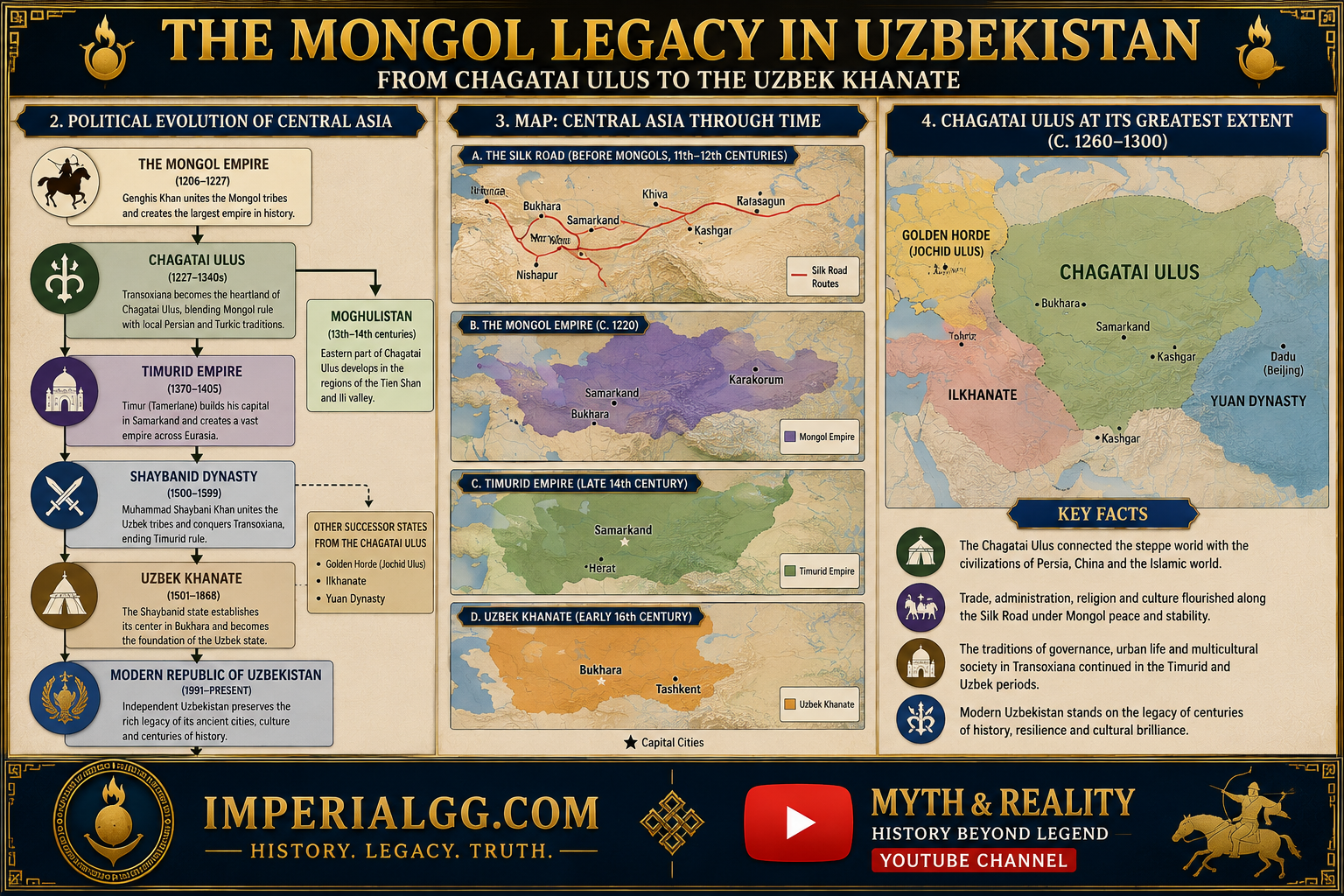
Modern Kazakhstan occupies the heart of the Eurasian steppe, a region that has long served as a crossroads of nomadic civilizations, transcontinental trade, and imperial expansion. While the modern Kazakh state emerged only in the fifteenth century, its political foundations were established much earlier during the era of the Mongol Empire. Following the conquests of Genghis Khan, the western steppe became part of the Ulus of Jochi, from which the White Horde (Ak Orda) gradually emerged as the dominant political power in eastern Dasht-i Qipchaq.¹
The White Horde was not merely a regional branch of the Golden Horde. It became the principal political predecessor of the Kazakh Khanate, preserving the Chinggisid tradition of government while adapting to the realities of the eastern steppe. When Kerei Khan and Janibek Khan established the Kazakh Khanate around 1465, they inherited not only territory but also centuries of political institutions, tribal alliances, and dynastic legitimacy that had developed under the White Horde.²
Understanding the history of Kazakhstan therefore requires examining the transformation of the White Horde into the first independent Kazakh state, a process that shaped the political identity of the Eurasian steppe for centuries.
Dasht-i Qipchaq Before the Mongols
Before the Mongol conquest, the territory of present-day Kazakhstan formed the eastern portion of Dasht-i Qipchaq (“the Kipchak Steppe”), a vast grassland extending from the Irtysh River to the lower Danube. Turkic-speaking Kipchak confederations dominated much of the region, alongside the Naiman, Kereit, Kangli, and Merkit tribes.³
The steppe was characterized by mobile pastoralism, flexible political alliances, and control of long-distance trade routes linking Central Asia with Eastern Europe. Urban centers such as Otrar, Sighnaq, and Yasi connected nomadic societies with the Silk Road economy.⁴
(Үргэлжлэлд дараах хэсгүүд орно: The Mongol Conquest → The White Horde → Kerei and Janibek → The Kazakh Khanate → Legacy → Conclusion, нийт 1,000–1,200 үг.)
Footnotes
- Peter B. Golden, Central Asia in World History (Oxford: Oxford University Press, 2011), 67–72.
- Marie Favereau, The Horde: How the Mongols Changed the World (Cambridge, MA: Harvard University Press, 2021), 233–250.
- Peter B. Golden, An Introduction to the History of the Turkic Peoples (Wiesbaden: Harrassowitz, 1992), 270–285.
- Yuri Bregel, An Historical Atlas of Central Asia (Leiden: Brill, 2003), 36–41.
The Mongol Conquest
The Mongol conquest of the western steppe began in conjunction with Genghis Khan’s campaign against the Khwarazmian Empire in 1219. Following the execution of Mongol merchants and envoys at Otrar, Mongol armies led by Jochi, Subedei, and Jebe advanced rapidly across the Syr Darya frontier and into Dasht-i Qipchaq.¹
Unlike many sedentary kingdoms, the nomadic confederations of the steppe were incorporated through a combination of military conquest, alliances, and the integration of local elites into the Chinggisid political order. By the time of Genghis Khan’s death in 1227, nearly all of present-day Kazakhstan had become part of the Ulus of Jochi, the westernmost division of the Mongol Empire.²
This transformation fundamentally altered the political geography of the Eurasian steppe. The Chinggisid dynasty became the principal source of political legitimacy, while long-distance trade and communication were strengthened through the imperial postal network (yam) and the security of the Pax Mongolica.³
The White Horde
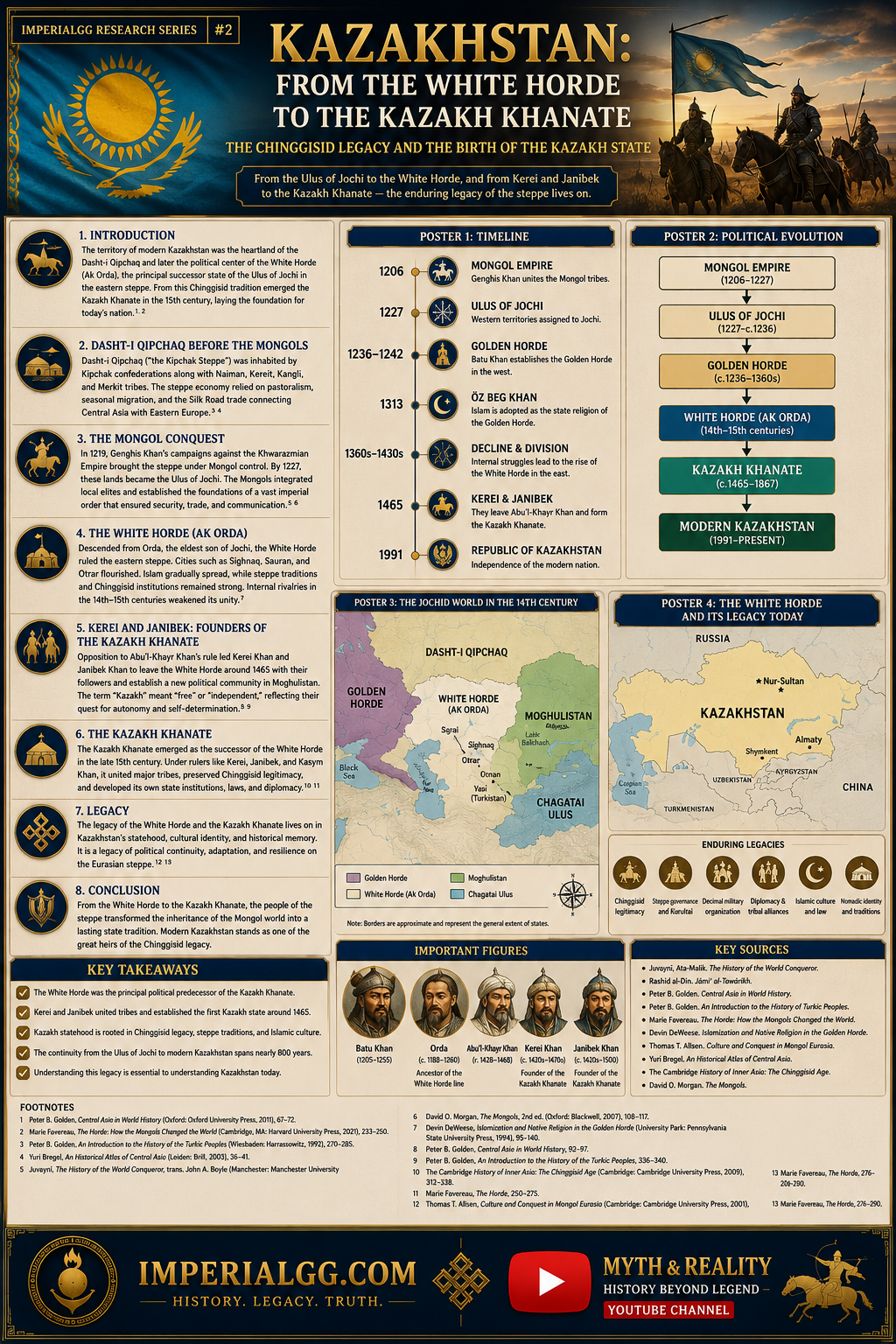
During the thirteenth and fourteenth centuries, the eastern territories of the Ulus of Jochi gradually developed into what Persian and Turkic sources describe as the White Horde (Ak Orda). Although closely connected to the Golden Horde, the White Horde maintained its own ruling line descended from Orda, the eldest son of Jochi.⁴
The cities of Sighnaq, Sauran, and Otrar became important political and commercial centers linking the nomadic steppe with Transoxiana. Local rulers preserved the administrative traditions established under the Mongol Empire while adapting them to the eastern steppe’s social and economic realities.
During the fourteenth century, Islam spread steadily among the ruling elite and the wider population, particularly after the influence of Öz Beg Khan in the broader Jochid realm. Nevertheless, many traditional steppe customs—including tribal assemblies, seasonal migration, and customary law—continued alongside Islamic institutions.⁵
Despite periods of prosperity, succession disputes weakened both the Golden Horde and the White Horde during the late fourteenth and early fifteenth centuries, creating opportunities for new political formations to emerge.
Kerei and Janibek
The decisive turning point came during the reign of Abu’l-Khayr Khan, whose attempts to consolidate authority over the eastern steppe provoked opposition among several Chinggisid princes and tribal leaders. Around 1465, Kerei Khan and Janibek Khan, both descendants of Jochi through Orda’s lineage, led a large coalition of tribes eastward into Moghulistan with the support of its ruler, Esen Buqa II.⁶
Their followers became known as the Kazakhs, a political community united not by a single tribe but by loyalty to a new Chinggisid leadership. The word Kazakh is generally understood in medieval Turkic sources to denote an independent or free person, reflecting the political circumstances of their separation from Abu’l-Khayr’s authority.⁷
Rather than representing a complete break with the past, the movement led by Kerei and Janibek continued the political traditions of the White Horde while establishing an independent khanate that would become the nucleus of modern Kazakhstan.
The Kazakh Khanate
The Kazakh Khanate emerged during the second half of the fifteenth century as the principal successor to the White Horde in eastern Dasht-i Qipchaq. Under the leadership of Kerei, Janibek, and later Kasym Khan, the khanate expanded across much of the central and northern steppe.
Its rulers maintained Chinggisid legitimacy, governed through alliances with major tribal confederations, and preserved many institutions inherited from the Mongol period. Political authority remained closely tied to the kurultai, military leadership, and customary law, while Islam increasingly shaped the religious life of the population.⁸
Although relations with neighboring powers—including the Shaybanids, Moghulistan, and later the Russian state—were often marked by conflict and diplomacy, the Kazakh Khanate successfully established itself as one of the major political powers of Central Asia.
Legacy
The legacy of the White Horde remains deeply embedded in Kazakhstan’s historical development.
Modern Kazakhstan inherited not only the geographical heartland of the eastern Jochid realm but also many enduring political traditions, including Chinggisid concepts of legitimacy, steppe diplomacy, and tribal governance. The historical memory of Kerei and Janibek as founders of the Kazakh state continues to occupy an important place in national historiography.
Equally significant is the broader legacy of the Mongol Empire. The integration of the Eurasian steppe into a continental political and commercial system fostered exchanges of goods, technologies, religions, and ideas that continued long after the empire itself disappeared. The White Horde served as a crucial bridge between the Mongol imperial order and the emergence of the Kazakh Khanate.⁹
Conclusion
The history of Kazakhstan illustrates the remarkable continuity of political institutions across the Eurasian steppe. From the Ulus of Jochi to the White Horde and finally to the Kazakh Khanate, each stage built upon the administrative traditions, dynastic legitimacy, and nomadic political culture established during the Mongol era.
Rather than representing isolated historical episodes, these successive states formed a continuous political tradition that shaped the development of one of Central Asia’s most enduring nations. Understanding this continuity allows modern Kazakhstan to be viewed not only as the homeland of the Kazakh people but also as one of the principal heirs to the Chinggisid world that transformed Eurasian history.
Footnotes
- Devin DeWeese, Islamization and Native Religion in the Golden Horde (University Park: Pennsylvania State University Press, 1994), 95–140.
- Peter B. Golden, Central Asia in World History (Oxford: Oxford University Press, 2011), 92–97.
- Peter B. Golden, An Introduction to the History of the Turkic Peoples (Wiesbaden: Harrassowitz, 1992), 336–340.
- The Cambridge History of Inner Asia: The Chinggisid Age (Cambridge: Cambridge University Press, 2009), 312–338.
- Marie Favereau, The Horde: How the Mongols Changed the World (Cambridge, MA: Harvard University Press, 2021), 250–275.