
Financing Total War: The Economic Transformation of Han China under Emperor Wu and the Campaigns against the Xiongnu
By Altanbagana Baatar
DBA Candidate| Independent Historian
ImperialGG Historical Research Seriers
01 August 2026
Financing an Empire at War: How Emperor Wu Reshaped the Han Economy to Defeat the Xiongnu
Introduction
The prolonged conflict between the Han dynasty (206 BCE–220 CE) and the Xiongnu Confederation stands as one of the defining geopolitical struggles of ancient Eurasia. By the middle of the second century BCE, Emperor Wu of Han (Han Wudi, r. 141–87 BCE) abandoned the conciliatory heqin (“peace through marriage”) policy pursued by many of his predecessors and adopted an ambitious strategy of sustained military expansion.
This decision fundamentally transformed the Han state. Large-scale cavalry campaigns across the northern frontier demanded unprecedented financial resources. Traditional land taxes, agricultural levies, and customary tribute proved incapable of sustaining armies that numbered in the hundreds of thousands and required immense quantities of horses, weapons, grain, and logistical support.
Rather than merely increasing taxation, Emperor Wu implemented one of the most comprehensive economic restructurings in ancient Chinese history. His government expanded direct state control over strategic industries, centralized monetary authority, confiscated private wealth, intervened aggressively in commodity markets, and even commercialized political privilege. These reforms permanently altered the relationship between the imperial state and the economy while providing the financial foundation for Han military offensives against the Xiongnu.
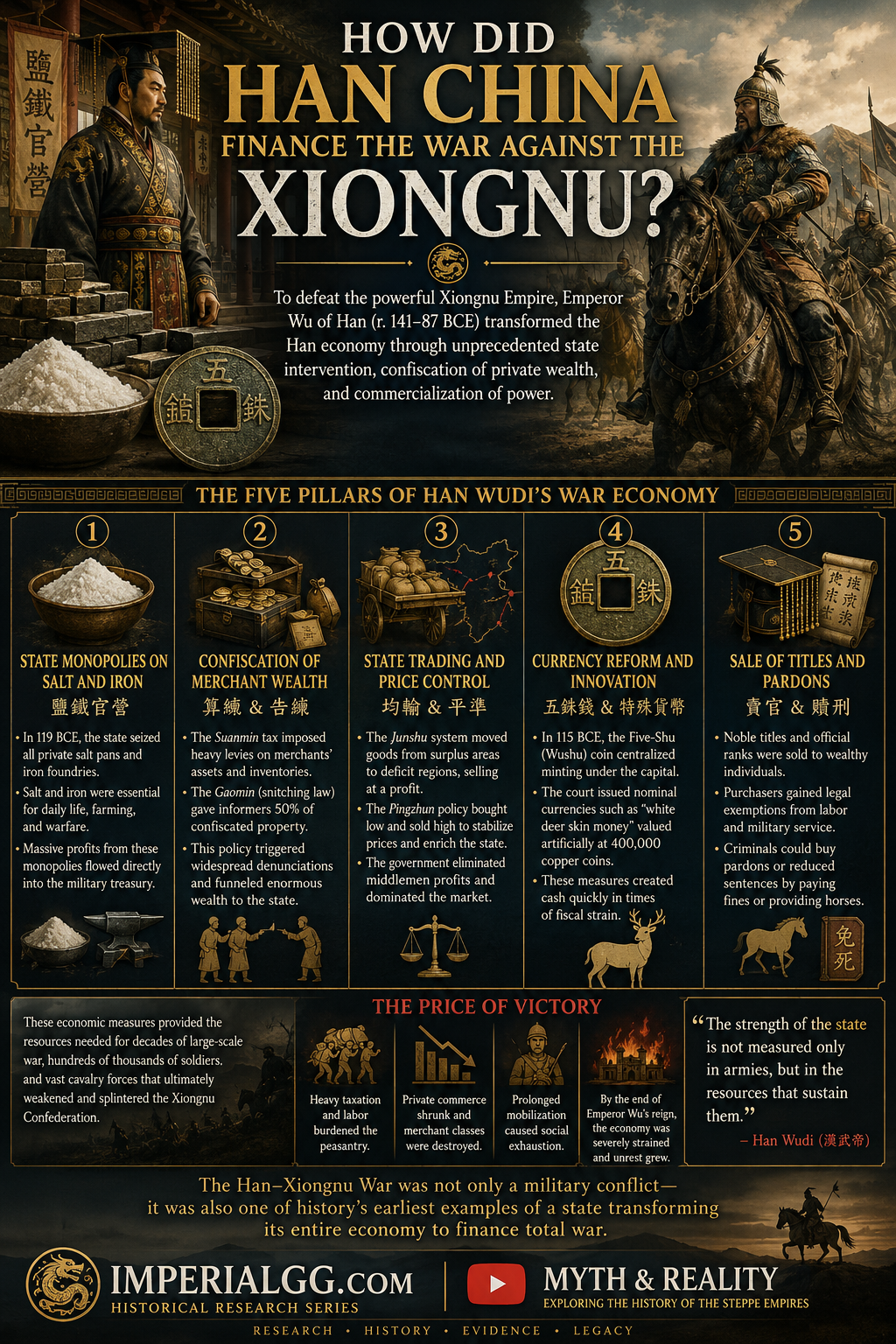
1. State Monopolies on Salt and Iron (鹽鐵官營)
Among Emperor Wu’s most significant reforms was the establishment of state monopolies over salt and iron in 119 BCE.
Salt occupied a unique position within the ancient economy. As an indispensable commodity for food preservation and daily consumption, demand remained constant regardless of political or economic conditions. Recognizing its fiscal potential, the Han government nationalized private salt production and assumed exclusive authority over its manufacture and distribution.
Iron possessed equal strategic importance. Agricultural productivity depended upon iron tools, while military expansion required vast quantities of iron weapons and equipment. The government therefore seized private iron foundries and placed production under direct imperial administration.
These monopolies generated enormous and reliable state revenues. Profits that had previously accumulated in the hands of wealthy entrepreneurs were redirected into the imperial treasury, providing a stable financial base for continuous military operations against the Xiongnu.
2. Confiscation of Merchant Wealth: Suanmin (算緡) and Gaomin (告緡)
Emperor Wu viewed wealthy merchants with profound suspicion. Unlike farmers, whose labor produced food and tax revenue, merchants were often portrayed in official ideology as individuals who accumulated wealth without contributing directly to national defense.
To reduce their influence while increasing state revenue, the government introduced the Suanmin tax, an assessment imposed on merchants’ commercial assets, inventories, carts, and other capital. Merchants frequently faced substantially higher effective tax burdens than ordinary agricultural households.
Even more consequential was the implementation of the Gaomin reporting system. Citizens who exposed tax evasion or concealed merchant wealth received approximately half of the confiscated property as a reward.
This policy encouraged widespread denunciations throughout the empire. Large fortunes were confiscated, many commercial families were financially ruined, and enormous quantities of private wealth flowed directly into state coffers. The measure represented one of the earliest examples of systematic fiscal confiscation employed to finance prolonged warfare.
3. State Commercial Intervention: Junshu (均輸) and Pingzhun (平準)
Emperor Wu did not limit economic intervention to taxation and confiscation. The Han government also entered the marketplace as an active commercial participant.
The Junshu (“Equable Transportation”) system reorganized the collection and distribution of regional tax goods. Instead of transporting products indiscriminately to the capital, the government redirected local specialties to regions where demand was highest, selling them at advantageous prices.
Complementing this system was Pingzhun (“Price Standardization”). State officials purchased grain and essential commodities during periods of abundance when prices were low and sold them during shortages when prices increased.
Although these policies stabilized markets and reduced price volatility, they also allowed the government to capture commercial profits that previously belonged to private merchants. The Han state increasingly functioned not only as a tax collector but also as one of the empire’s largest commercial enterprises.
4. Currency Centralization and Monetary Innovation
A stable monetary system was essential for sustaining military expenditures.
Prior to Emperor Wu’s reforms, numerous local authorities possessed the ability to mint coins, resulting in inconsistent standards and monetary fragmentation. In 115 BCE, the imperial government centralized minting authority and introduced the standardized Five-Shu (Wushu) coin as the empire’s official currency.
During periods of fiscal strain, however, the court also experimented with unconventional monetary instruments. Among the most notable examples was the issuance of White Deer Skin Currency, ceremonial certificates manufactured from the skins of deer raised within the imperial park and assigned extraordinarily high official values despite possessing little intrinsic worth.
The government similarly issued alloy-based currencies whose official valuations exceeded their material value, effectively allowing the state to generate purchasing power through monetary authority.
Although these measures temporarily relieved fiscal pressures, they also reflected the extraordinary financial demands imposed by continuous warfare.
5. Commercialization of Rank, Office, and Judicial Leniency
When military expenditures exceeded ordinary revenue, the Han government increasingly converted social privilege into a source of state income.
Official ranks and noble titles could be purchased by wealthy individuals. These honors frequently carried legal privileges, including exemption from certain labor obligations or military service.
Judicial penalties likewise became monetized. Individuals convicted of crimes—including some facing severe punishments—could reduce or commute their sentences by paying substantial fines or contributing horses to the imperial cavalry.
These measures demonstrated the extent to which fiscal necessity reshaped administrative practice during Emperor Wu’s reign.
Economic Consequences
Collectively, these reforms represented one of the earliest examples of a highly centralized wartime economy in world history.
| Policy | Primary Target | Strategic Purpose |
|---|---|---|
| State Salt and Iron Monopolies | Entire population | Stable long-term fiscal revenue |
| Suanmin and Gaomin | Wealthy merchants | Immediate confiscation of private wealth |
| Junshu and Pingzhun | Regional markets | State commercial profit and market control |
| Currency Centralization | Monetary system | Fiscal stability and enhanced state authority |
| Sale of Titles and Pardons | Elites and convicted individuals | Rapid acquisition of cash and military resources |
These policies successfully financed the sustained military campaigns that weakened and ultimately fragmented the Xiongnu Confederation during the first century BCE. Han armies penetrated deep into the steppe, established new frontier commanderies, and fundamentally altered the balance of power across Inner Asia.
Yet victory came at a considerable domestic cost. Heavy taxation, compulsory labor, repeated military mobilization, extensive state intervention, and the concentration of economic power within the imperial government generated mounting social tensions. Agricultural households bore increasing burdens, private commerce declined in many regions, and widespread economic exhaustion emerged during the final decades of Emperor Wu’s reign.
Consequently, while Emperor Wu achieved remarkable military success against the Xiongnu, the fiscal and administrative mechanisms that enabled these victories also imposed significant long-term costs upon Han society. His reign therefore illustrates one of history’s enduring paradoxes: the economic institutions capable of financing imperial expansion may simultaneously undermine the prosperity and stability of the empire they are designed to preserve.
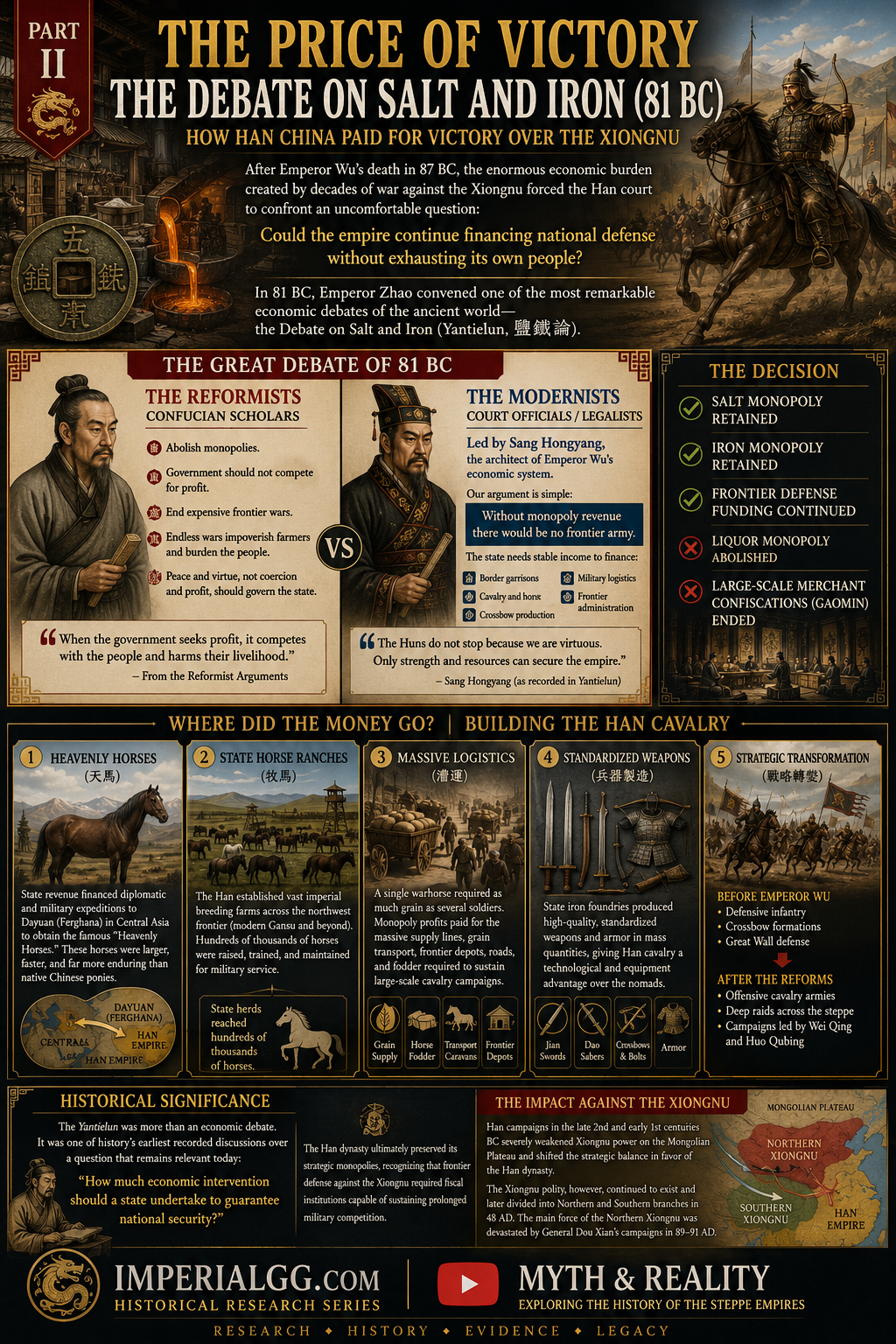
THE PRICE OF VICTORY
The Debate on Salt and Iron (81 BC)
THE GREAT DEBATE OF 81 BC
| The Reformists | The Modernists |
|---|---|
| Confucian Scholars | Court Officials |
| Abolish Monopolies | Preserve Monopolies |
| Government should not compete for profit | National security requires state revenue |
| End expensive frontier wars | Xiongnu remain a military threat |
| Reduce burdens on peasants | Finance frontier defense |
Confucian Criticism
• Salt and Iron monopolies should be abolished.
• Government had become “a merchant competing with the people for profit.”
• Endless wars impoverished farmers.
• Moral government should rule through virtue rather than economic coercion.
• Peace should replace expansion.
THE MODERNISTS
Led by Sang Hongyang
The architect of Emperor Wu’s economic system defended the monopolies.
His argument was simple:
Without monopoly revenue there would be no frontier army.
The government needed stable income to finance:
• Border garrisons
• Cavalry
• Crossbow production
• Military logistics
• Horse breeding
Without these resources, the Xiongnu could once again dominate the northern frontier.
THE DECISION
✔ Salt Monopoly — Retained
✔ Iron Monopoly — Retained
✔ Frontier defense funding — Continued
✘ Liquor Monopoly — Abolished
✘ Large-scale merchant confiscations (Gaomin) — Ended
WHERE DID THE MONEY GO?
Building the Han Cavalry
1. Heavenly Horses
State revenue financed expeditions to Dayuan (Ferghana) to obtain the famous “Heavenly Horses” (天馬) whose endurance far exceeded local breeds.
2. State Horse Ranches
The Han established vast imperial breeding farms across today’s Gansu and the northwestern frontier.
Hundreds of thousands of horses were raised for military service.
3. Logistics
The war economy funded
• Grain supplies
• Horse fodder
• Frontier depots
• Roads
• Transport caravans
Without these systems, large cavalry campaigns were impossible.
4. Standardized Weapons
State iron foundries produced
• Jian swords
• Dao sabers
• Crossbows
• Armor
• Spears
Standardization improved both quality and mass production.
5. Strategic Transformation
Before Emperor Wu
➡ Defensive infantry
➡ Great Wall defense
After the reforms
➡ Offensive cavalry armies
➡ Deep raids across the steppe
➡ Campaigns led by Wei Qing and Huo Qubing
HISTORICAL SIGNIFICANCE
The Yantielun was more than an economic debate.
It represented one of history’s earliest recorded discussions over a question that remains relevant today:
How much economic intervention should a state undertake to guarantee national security?
The Han dynasty ultimately preserved its strategic monopolies, recognizing that frontier defense against the Xiongnu required fiscal institutions capable of sustaining prolonged military competition
IMPERIALGG.COM
Historical Research Series
MYTH & REALITY
Exploring the History of the Steppe.
“Their campaigns severely weakened Xiongnu power on the Mongolian Plateau and shifted the strategic balance in favor of the Han dynasty, although the Xiongnu polity continued to exist and later divided into northern and southern branches.”
Huo Qubing: The Lightning General Who Changed the Han–Xiongnu War
Introduction
Among the military commanders of ancient China, few achieved as much in as short a lifetime as Huo Qubing (140–117 BC). Entering military service at only seventeen years of age and dying at twenty-three, Huo commanded Han cavalry for barely six years. Yet during this remarkably brief career, he transformed the conduct of frontier warfare and became one of the principal architects of Han China’s strategic offensive against the Xiongnu Confederation.
His campaigns occurred during the reign of Emperor Wu of Han (r. 141–87 BC), whose extensive fiscal reforms—including state monopolies on salt and iron, centralized taxation, and expanded state control of strategic industries—provided the economic foundation for sustained military operations. While these reforms financed unprecedented cavalry armies, it was commanders such as Wei Qing and Huo Qubing who converted economic strength into battlefield success.
The Strategic Context
Before Emperor Wu abandoned the heqin policy, Han frontier strategy was largely defensive. Garrisons protected agricultural settlements while infantry formations and crossbow units guarded the northern frontier. Although effective in fixed defensive positions, these forces struggled against the highly mobile horse archers of the Xiongnu, whose speed and operational flexibility allowed them to avoid decisive engagements and strike vulnerable frontier districts.
Recognizing these limitations, Emperor Wu adopted a fundamentally different strategy. Rather than waiting behind defensive fortifications, Han armies would pursue the Xiongnu deep into the steppe, attacking their political leadership, logistical networks, and seasonal encampments. This strategic transformation required not only new military doctrine but also an enormous investment in cavalry, horses, weapons, and frontier logistics.
A Revolution in Cavalry Warfare
Huo Qubing became the most dynamic practitioner of this new strategy. Unlike earlier commanders who depended heavily on extended supply trains, Huo emphasized operational speed. His cavalry traveled with relatively light logistical support, enabling rapid movement across the steppe. Contemporary historical accounts describe his forces sustaining themselves in part through captured livestock and resources obtained during their campaigns, allowing them to penetrate deep into Xiongnu territory without the delays imposed by conventional supply columns.
Equally important was his emphasis on striking strategic rather than merely tactical objectives. Instead of concentrating on frontier skirmishes, Huo targeted noble camps, military headquarters, and leadership groups, seeking to disrupt the political and military cohesion of the Xiongnu Confederation. This approach represented one of the earliest examples of deep-penetration cavalry operations recorded in East Asian military history.
The Campaign of 123 BC: A Remarkable Debut
Huo first distinguished himself during the campaign of 123 BC, serving under his uncle, the Grand General Wei Qing.
Entrusted with approximately 8,000 elite cavalry, the seventeen-year-old commander departed from the main force and advanced hundreds of li into the desert. The operation achieved complete surprise. Han sources record the death of a senior Xiongnu noble related to the Chanyu and the capture of several important officials.
In recognition of this extraordinary success, Emperor Wu awarded Huo the noble title Champion Marquis (Guanjun Hou, 冠軍侯)—an honor reflecting exceptional military merit at an unusually young age.
The Hexi Corridor Campaign (121 BC)
The campaigns of 121 BC established Huo Qubing’s military reputation. The Hexi Corridor, located in present-day Gansu Province, formed the strategic gateway between the Chinese heartland and Central Asia. Control of this corridor not only secured the northwestern frontier but also facilitated later exchanges that became associated with the Silk Road.
Leading approximately 10,000 cavalry, Huo executed rapid advances through multiple Xiongnu-controlled territories within a matter of days. Later that year he conducted another offensive by maneuvering across desert terrain to strike from an unexpected direction.
Han historical sources report decisive victories and the capture of ritual objects associated with Xiongnu elites, symbolizing both military success and political prestige. Although later traditions often describe these victories in dramatic terms, modern historians generally emphasize that the campaign significantly weakened Xiongnu influence in the Hexi region rather than ending their power altogether.
The Mobei Campaign (119 BC)
The Battle of Mobei represented the largest offensive of the Han–Xiongnu War. Emperor Wu committed approximately 100,000 cavalry in a coordinated two-pronged advance led by Wei Qing and Huo Qubing, crossing the Gobi Desert to engage the principal Xiongnu forces. Commanding the eastern army, Huo advanced deep into the steppe in pursuit of the Wise King of the Left, one of the highest-ranking Xiongnu leaders. Han chronicles describe severe Xiongnu losses and an extensive pursuit into northern territories.
Traditional accounts claim that Huo reached the vicinity of the Northern Sea, commonly identified with Lake Baikal, and performed the Feng sacrifice at Mount Langjuxu to commemorate the campaign. Modern scholarship generally accepts the symbolic significance of these accounts while recognizing that the precise geography and details remain subjects of historical discussion.
Regardless of these debates, the Mobei campaign fundamentally altered the strategic balance between the Han dynasty and the Xiongnu Confederation.
Economic Power Behind Military Success
Huo Qubing’s achievements cannot be understood solely through battlefield tactics.
His campaigns depended upon the extensive fiscal system constructed under Emperor Wu:
- State monopolies on salt and iron generated stable military revenue.
- Government horse-breeding programs expanded cavalry resources.
- Centralized weapon production standardized arms and armor.
- Frontier supply networks sustained long-distance operations across arid environments.
- Administrative reforms ensured continuous recruitment, transport, and logistical coordination.
The effectiveness of Han cavalry therefore reflected not only tactical innovation but also the integration of economic administration with military planning.
Legacy
Huo Qubing became one of the most celebrated commanders in Chinese historical memory.
According to the Records of the Grand Historian (Shiji), when Emperor Wu proposed building him an elaborate residence in recognition of his victories, Huo reportedly declined, declaring:
“The Xiongnu have not yet been destroyed; how can I think of a home?”
Although the precise wording may reflect later literary tradition, the statement came to symbolize complete devotion to military service.
Huo died unexpectedly in 117 BC at only twenty-three years of age. Emperor Wu honored him with a magnificent tomb near the imperial mausoleum, traditionally described as being shaped to resemble the Qilian Mountains, commemorating the region in which many of his greatest victories had been won.
Conclusion
Huo Qubing’s career demonstrates that military success depends upon far more than exceptional leadership on the battlefield. His victories were made possible by the convergence of strategic planning, fiscal reform, logistical organization, and technological standardization undertaken during the reign of Emperor Wu.
While Han victories under Huo Qubing and Wei Qing significantly weakened Xiongnu power and secured Han influence across the Hexi Corridor, they did not immediately destroy the Xiongnu Confederation. Instead, these campaigns marked a decisive turning point in a prolonged struggle that continued for decades, reshaping the political geography of Inner Asia and laying important foundations for later Han expansion toward Central Asia.
For this reason, Huo Qubing remains not merely a legendary cavalry commander, but one of the central figures in the military transformation of early imperial China.