The Ancient Chinese Worldview
By Altanbagana Baatar
DBA Candidate| Independent Historian
ImperialGG Historical Research Seriers
27 July 2026
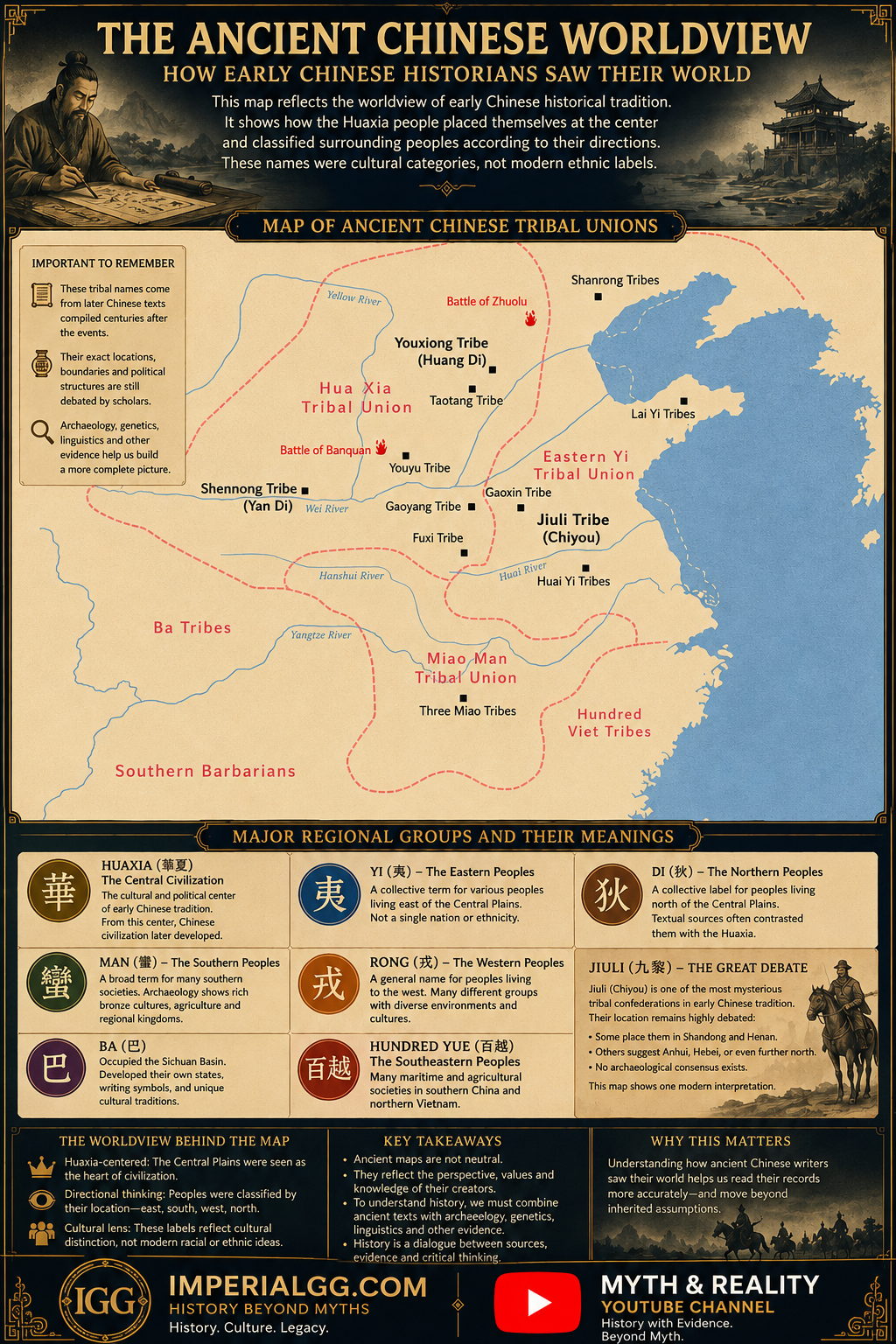
Reading Early Tribal Maps Critically
Historical maps do more than illustrate geography—they reveal how civilizations understood the world around them.
This reconstruction of ancient tribal unions is based primarily on traditional Chinese historical narratives. While it serves as a useful visual guide, it should not be interpreted as a definitive map of prehistoric East Asia. Instead, it reflects how early Chinese scholars and chroniclers perceived neighboring peoples and organized the world according to their own cultural and political framework.
The Huaxia at the Center
Early Chinese civilization developed around the Yellow River basin, where the Huaxia (華夏) regarded themselves as the cultural and political center of the known world.
Rather than describing surrounding peoples as independent civilizations, early texts often classified them according to their geographic relationship with the Huaxia states.
Yi (夷) – The Eastern Peoples
The term Yi referred collectively to various peoples living east of the Central Plains. It was a broad cultural designation rather than the name of a single ethnic group.
Man (蠻) – The Southern Peoples
The Man represented numerous societies living south of the Huaxia world. Although many classical texts portrayed them as culturally different, archaeological discoveries reveal sophisticated agricultural communities, bronze-working traditions, and regional political organizations.
Rong (戎) – The Western Peoples
The Rong inhabited regions west of the Huaxia states. They consisted of many independent communities occupying diverse ecological zones, from river valleys to mountain frontiers.
Di (狄) – The Northern Peoples
The Di were a collective designation for peoples living north of the Central Plains. Ancient texts frequently contrasted them with the Huaxia, yet archaeological evidence suggests considerable political and cultural diversity among these northern societies.
Ba
The Ba occupied much of present-day Sichuan. Far from being isolated tribes, they developed organized regional states with distinctive military traditions and material culture before their incorporation into the expanding Qin state.
The Hundred Yue (百越)
The Hundred Yue referred to numerous societies inhabiting southern China and northern Vietnam. These communities possessed rich maritime traditions, wet-rice agriculture, advanced bronze craftsmanship, and extensive regional trade networks.
Were They Really “Barbarians”?
Many English translations render these neighboring peoples simply as “barbarians.” This translation reflects terminology found in many classical Chinese sources but can be misleading when understood in its modern sense.
In early Chinese literature, these labels primarily expressed a distinction between the Huaxia cultural sphere and the peoples living beyond it. They were part of a worldview that placed the Huaxia at the center while describing surrounding societies through broad cultural and geographical categories.
Modern archaeology increasingly demonstrates that many of these neighboring peoples possessed complex political systems, advanced technologies, organized warfare, long-distance trade, and vibrant religious traditions. They were not culturally uniform, nor were they necessarily less developed than the societies that described them.
The Jiuli (九黎) and the Problem of Historical Geography
The placement of the Jiuli, traditionally associated with Chiyou (蚩尤), illustrates one of the greatest challenges in reconstructing early East Asian history.
Many modern maps place the Jiuli in eastern China, often around present-day Shandong, Henan, or Anhui, following later Chinese literary traditions. However, no scholarly consensus exists regarding their original homeland.
Several factors contribute to this uncertainty:
- The earliest written accounts were compiled centuries after the events they describe.
- Different historical texts preserve different traditions.
- Archaeological cultures cannot be directly equated with legendary tribal confederations.
- Political narratives often reshaped earlier traditions to support later historical identities.
Consequently, the location of the Jiuli shown on modern maps should be understood as one scholarly reconstruction rather than an established historical fact.
Reading Ancient Maps Critically
Ancient maps are never entirely objective.
They combine historical memory, political ideology, literary tradition, and modern scholarly interpretation. Some features are well supported by archaeological and textual evidence, while others remain hypothetical.
For historians, the most important questions are not simply whether a map is “correct” or “incorrect,” but:
- Who created this reconstruction?
- Which historical sources were used?
- What assumptions shaped the map?
- Which conclusions are supported by evidence?
- Which remain open to debate?
Understanding the worldview behind a map is often just as important as understanding the geography it depicts.
History Beyond Myths
Every historical map tells two stories. One is the story of the past. The other is the story of the civilization that chose to record and interpret that past. To understand ancient East Asia, we must study both.
ImperialGG.com | History Beyond Myths