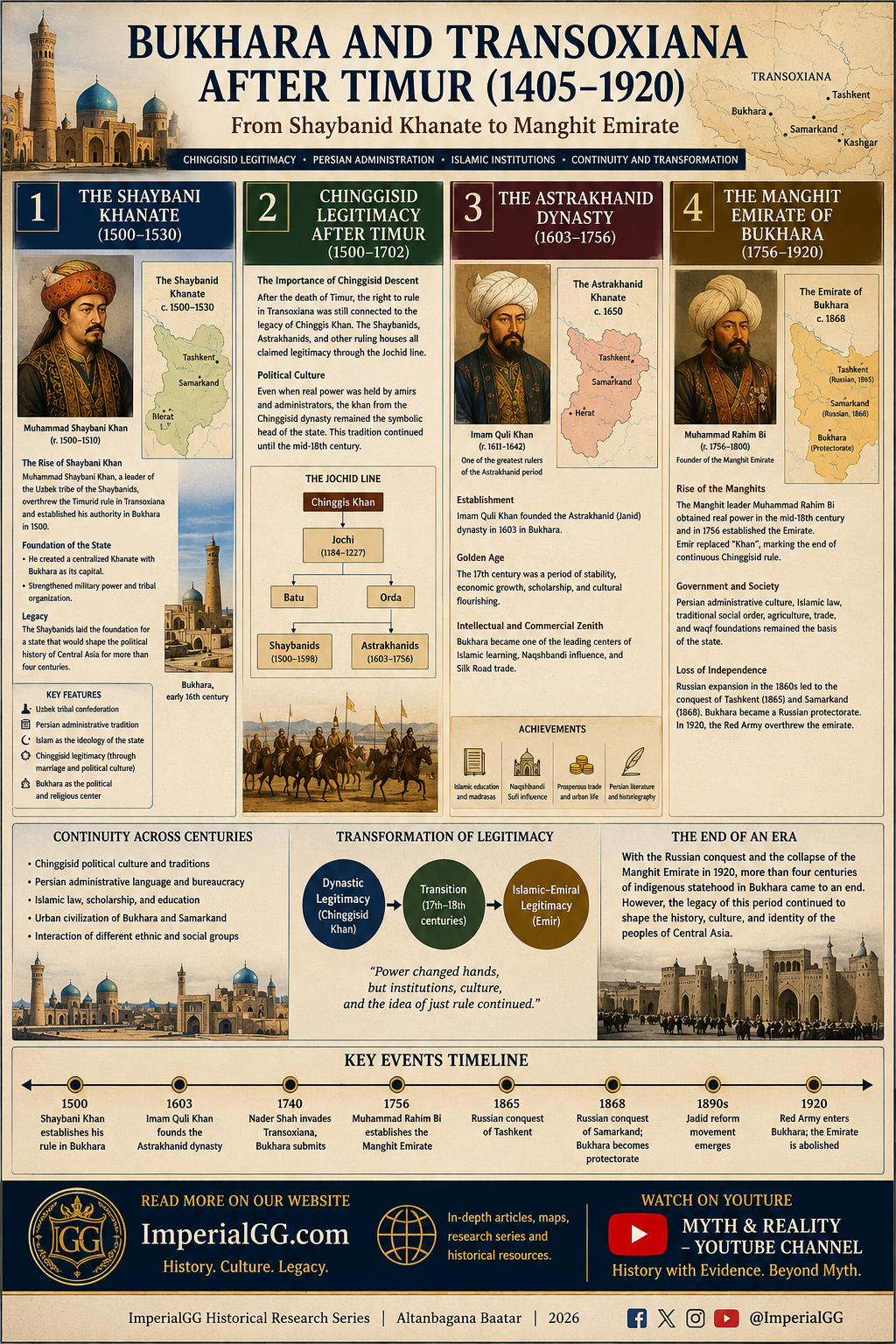
V. THE MONGOL LEGACY AFTER TIMUR (1507–1868)
By Altanbagana Baatar
DBA Candidate| Independent Historian
ImperialGG Historical Research Seriers
24 July 2026
Chinggisid Legitimacy, the Uzbek Khanates, and the Persian-Speaking Tajiks
Introduction
The conquest of Herat in 1507 by Muhammad Shaybani Khan (1451–1510) has traditionally been regarded as the symbolic end of the Timurid period in Central Asia. In many modern surveys, this event serves as the dividing line between the Timurid Empire and the rise of the Uzbek Khanates. Such a periodization is politically convenient, yet it risks obscuring the deeper historical continuities that linked the Mongol Empire, the Timurid state, the Shaybanid and Janid dynasties, and the Emirate of Bukhara. From the perspective of political institutions, dynastic legitimacy, administrative practice, and the social history of the Persian-speaking populations of Transoxiana, the year 1507 represented less a rupture than the beginning of another phase in the evolution of the Chinggisid world.
Since the nineteenth century, national historiographies have generally interpreted the history of Central Asia through the framework of modern nation-states. Uzbek history, Tajik history, Kazakh history, and other regional narratives are commonly presented as separate historical traditions. While this approach has contributed significantly to the study of individual societies, it has also tended to fragment a region whose political, cultural, and economic institutions remained deeply interconnected for centuries. During the early modern period, Samarkand, Bukhara, Balkh, Hisar, Kulob, Badakhshan, and the Ferghana Valley formed part of a shared political landscape in which dynastic change rarely altered the fundamental structures of governance, scholarship, commerce, or urban life.^1
The Persian-speaking communities that constitute the historical ancestors of the modern Tajik people experienced this period not as a succession of isolated dynasties but as a continuous process of adaptation within changing political frameworks. Whether governed by the Timurids, the Shaybanids, the Janids, or the Manghit emirs, Persian remained one of the principal languages of administration, religious scholarship, literature, diplomacy, and urban society. Although Turkic-speaking military elites often dominated political power, the administrative and intellectual life of the cities continued to depend heavily upon Persian-speaking scholars, jurists, merchants, secretaries, and religious institutions.^2
Equally important was the persistence of Chinggisid legitimacy, one of the defining constitutional principles of Central Asian politics. Throughout much of the post-Mongol period, descent from Chinggis Khan (c. 1162–1227) remained the strongest claim to supreme sovereignty. Timur (1336–1405), despite creating one of the largest empires of the late medieval world, never assumed the title of Khan because he lacked Chinggisid ancestry. Instead, he governed as Amir while maintaining Chinggisid princes as nominal rulers to reinforce the legitimacy of his regime.^3 The Shaybanids, in contrast, traced their lineage to Shiban, a son of Jochi and grandson of Chinggis Khan, thereby grounding their authority within an established political tradition rather than creating an entirely new order.^4
The continuation of Chinggisid political culture did not end with the Shaybanids. Their successors, the Astrakhanid (Janid) dynasty (1599–1756), likewise claimed Chinggisid descent, while the Manghit emirs (1756–1920)—although not Chinggisids themselves—preserved many institutions, ceremonial practices, and administrative conventions inherited from earlier Mongol and post-Mongol states. During these centuries, the concept of legitimate rulership remained inseparable from traditions that had emerged under the Mongol Empire, even as new political realities transformed Central Asia’s social and economic landscape.
Beyond Transoxiana, the eastern successor of the Chagatai Khanate—Moghulistan, and later the Yarkand Khanate—continued to preserve Chinggisid dynasties into the seventeenth century. Relations among these states, together with the Kazakh Khanate, Safavid Iran, Qing China, and Afghanistan, shaped the political environment within which Persian-speaking communities lived. Trade routes linking Samarkand, Bukhara, Kashgar, Balkh, and Herat ensured the continued circulation of merchants, scholars, manuscripts, and religious ideas across political frontiers, reinforcing a broader Persianate and Islamic cultural sphere despite recurring warfare.
Only during the nineteenth century did this centuries-old political order encounter a fundamentally different imperial power. Between 1865 and 1868, the Russian Empire captured Tashkent, defeated the Emirate of Bukhara at the Battle of Zirabulak, and occupied Samarkand, permanently altering the political structure of Central Asia. Russian colonial administration introduced new systems of law, taxation, military organization, and territorial governance that differed substantially from the Chinggisid political traditions that had shaped the region since the thirteenth century. Although the Emirate of Bukhara formally survived as a protectorate until 1920, the Russian conquest marked the decisive end of an era in which Chinggisid legitimacy had remained a central principle of political authority.^5
This chapter argues that the period between 1507 and 1868 should be understood not simply as the history of successive Uzbek dynasties, but as the final stage of the post-Mongol political order in Central Asia. By examining the Shaybanids, the Janids, the Manghits, Moghulistan, and the position of the Persian-speaking Tajik population within these states, this study seeks to demonstrate that the Mongol legacy endured far beyond the dissolution of the Mongol Empire itself. Rather than representing a sharp break with the past, the political evolution of Central Asia after Timur illustrates the remarkable adaptability of institutions, concepts of legitimacy, and cultural traditions that originated during the age of Chinggis Khan and continued to shape the region until the arrival of Russian imperial rule.
- Peter B. Golden, Central Asia in World History (New York: Oxford University Press, 2011); Svat Soucek, A History of Inner Asia (Cambridge: Cambridge University Press, 2000).
- C. Edmund Bosworth, The New Islamic Dynasties (Edinburgh: Edinburgh University Press, 1996); R. D. McChesney, Central Asia: Foundations of Change (Princeton: Darwin Press, relevant chapters).
- Beatrice Forbes Manz, The Rise and Rule of Tamerlane (Cambridge: Cambridge University Press, 1989).
- John E. Woods, The Timurid Dynasty; Maria Eva Subtelny, Timurids in Transition; Muʿizz al-Ansāb (primary source).
- Seymour Becker, Russia’s Protectorates in Central Asia (Cambridge, MA: Harvard University Press, 1968); Adeeb Khalid, Making Uzbekistan (Cornell University Press, 2015).
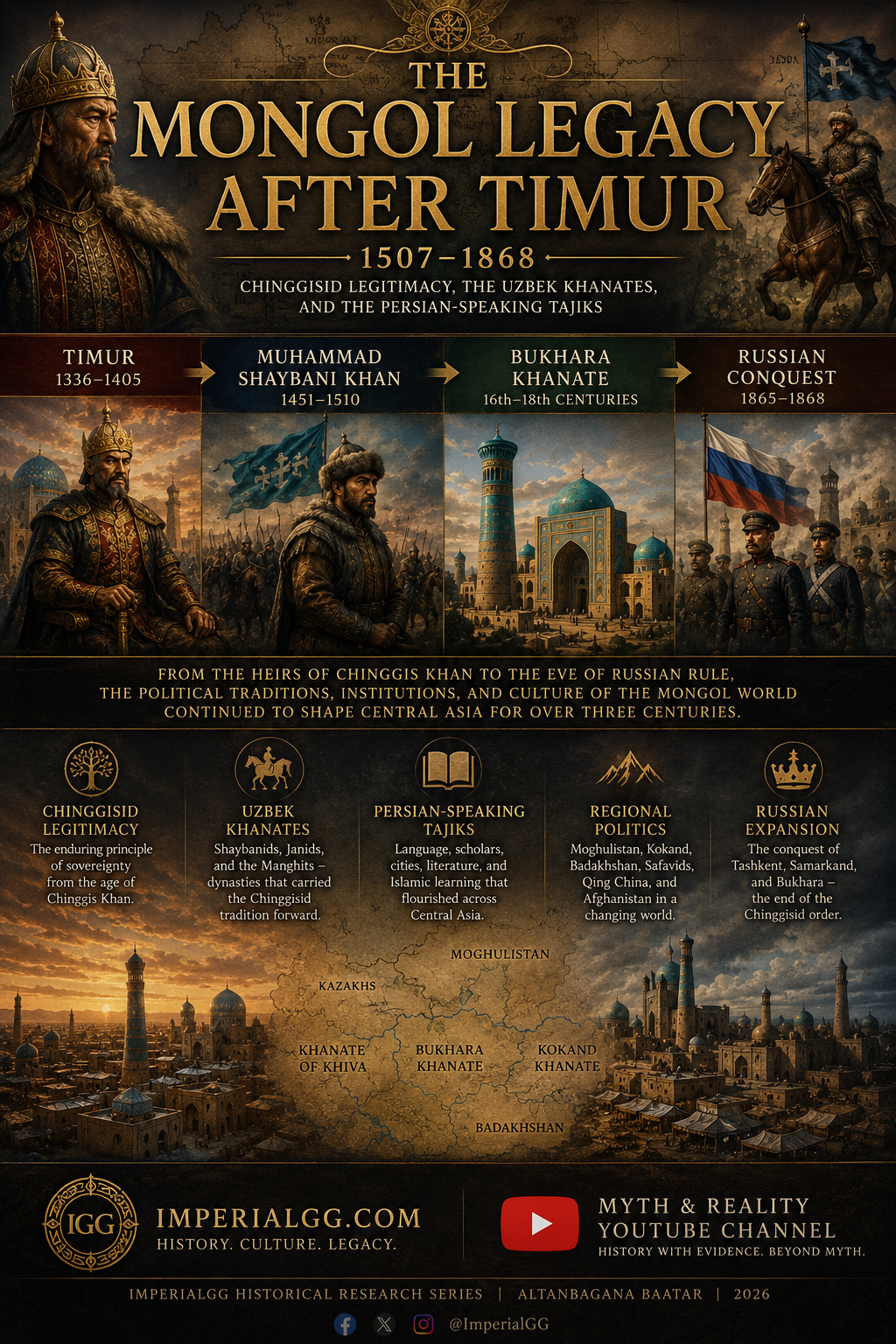
The Rise of Muhammad Shaybani Khan and the Transformation of Central Asia (1451–1510)
From the Collapse of Timurid Unity to the Emergence of the Uzbek Khanates
The political transformation that reshaped Central Asia at the beginning of the sixteenth century has frequently been described as the fall of the Timurids and the rise of the Uzbeks. Such a characterization, however, oversimplifies one of the most significant transitions in the post-Mongol history of Inner Asia. The replacement of the Timurid dynasty by the Shaybanids did not represent the disappearance of the Mongol political tradition. Rather, it marked the restoration of a Chinggisid ruling house whose legitimacy was firmly rooted in the lineage of Jochi, the eldest son of Chinggis Khan. From this perspective, the conquest of Transoxiana by Muhammad Shaybani Khan constituted less a revolutionary break than the adaptation of the Mongol imperial legacy to a changing political landscape.¹
Following Timur’s death in 1405, his empire rapidly fragmented into competing principalities ruled by his descendants. Although Timur had assembled one of the largest empires of the late medieval world through military conquest, he had never established a stable mechanism of succession capable of preventing dynastic conflict. His successors inherited vast territories stretching from Anatolia to Central Asia, yet they also inherited persistent rivalry among members of the Timurid family. Throughout the fifteenth century, Samarkand, Herat, Bukhara, Balkh, and Ferghana repeatedly changed hands as Timurid princes struggled for supremacy, exhausting both military resources and political authority.²
The weakening of Timurid unity coincided with profound changes across the Eurasian steppe. The once-powerful Golden Horde had entered a prolonged period of fragmentation after the late fourteenth century. Regional khanates emerged across the former Jochid domains, while rival descendants of Chinggis Khan competed for control over the steppe. Despite political division, however, Chinggisid legitimacy remained the universally accepted foundation of sovereignty among the nomadic elites. No ruler lacking descent from Chinggis Khan could legitimately claim the title of khan without relying upon a Chinggisid figurehead.³
Among the branches of the Jochid dynasty, the descendants of Shiban—one of Jochi’s sons—gradually established themselves within the eastern steppe. Their political fortunes expanded considerably during the reign of Abu’l-Khayr Khan (r. 1428–1468), who succeeded in uniting numerous nomadic tribes under his authority. Persian chronicles and later Central Asian histories describe Abu’l-Khayr not merely as a tribal leader but as the architect of a new political confederation that extended across much of present-day Kazakhstan and western Siberia. His realm incorporated Qipchaqs, Naymans, Manghits, Qarluqs, Uysuns, Kongrats, and many other Turkic and Mongol tribes whose military cooperation formed the foundation of later Shaybanid expansion.⁴
The designation “Uzbek,” often misunderstood as a purely ethnic label, originally possessed a predominantly political meaning. The term had gained prominence during the reign of Öz Beg Khan (r. 1313–1341) of the Golden Horde and gradually came to identify the confederation of tribes owing allegiance to Jochid rulers in the eastern steppe. Consequently, the “Uzbeks” encountered in fifteenth-century Persian sources should be understood primarily as participants in a political community rather than members of a homogeneous ethnic nation in the modern sense. Their identity remained fluid, encompassing numerous tribes of diverse origins united through loyalty to a Chinggisid dynasty and shared participation in the nomadic military order.⁵
Abu’l-Khayr’s death in 1468 threatened to dissolve this fragile political union. Rival Chinggisid princes challenged one another for authority, while several tribal groups migrated eastward under the leadership of Janibek and Kerei, eventually laying the foundations of the Kazakh Khanate. Although this fragmentation weakened the Uzbek confederation temporarily, it did not eliminate the political institutions or dynastic traditions that Abu’l-Khayr had created. Instead, they remained available for reconstruction by a capable successor possessing both military skill and legitimate Chinggisid ancestry.⁶
That successor emerged in the person of Muhammad Shaybani Khan (1451–1510), Abu’l-Khayr’s grandson. Unlike many princes raised in stable courts, Shaybani spent much of his youth amidst political uncertainty, exile, and continuous warfare. Forced to navigate shifting tribal alliances, he developed exceptional military and diplomatic abilities that later enabled him to reunify much of his grandfather’s former confederation. His early campaigns demonstrated a keen understanding of steppe politics: authority could not be maintained solely through conquest but required the continual negotiation of loyalty among tribal leaders whose support remained indispensable for military success.⁷
While Shaybani consolidated power across the northern steppe, the Timurid princes continued to undermine one another through incessant civil wars. The most prominent among them was Zahir al-Din Muhammad Babur, ruler of Ferghana and later founder of the Mughal Empire in India. Babur’s memoirs vividly illustrate the instability that characterized Central Asia during the late fifteenth century. Samarkand changed hands repeatedly, alliances shifted with remarkable speed, and local rulers devoted increasing attention to dynastic rivalries rather than regional defense. Such conditions provided Shaybani with unprecedented opportunities to advance southward toward the wealthy urban centers of Transoxiana.⁸
The contrast between the two political systems became increasingly evident. The Timurids governed sophisticated urban states supported by Persian bureaucracies, commercial networks, and Islamic institutions, yet they suffered from chronic dynastic fragmentation. The Shaybanids, by contrast, emerged from the military traditions of the Eurasian steppe, where personal leadership, tribal cohesion, and Chinggisid legitimacy combined to produce a remarkably mobile and resilient political structure. Rather than representing mutually exclusive civilizations, these two systems would ultimately merge under Shaybani’s rule, creating a state in which Mongol political traditions coexisted with Persian administrative institutions.
By the final years of the fifteenth century, the balance of power had begun to shift decisively. Shaybani no longer appeared merely as the leader of a nomadic confederation but as the representative of a restored Jochid dynasty prepared to challenge Timurid supremacy in Transoxiana. His campaigns against Bukhara and Samarkand would transform not only the political geography of Central Asia but also the historical trajectory of its Persian-speaking urban populations. The year 1500 therefore marked the beginning of a new political era—one in which Chinggisid sovereignty reasserted itself at the heart of Central Asia without dismantling the sophisticated administrative traditions inherited from earlier Persianate states.
Footnotes
- David Morgan, The Mongols, 2nd ed. (Malden, MA: Blackwell, 2007); Peter B. Golden, Central Asia in World History (New York: Oxford University Press, 2011).
- Beatrice Forbes Manz, The Rise and Rule of Tamerlane (Cambridge: Cambridge University Press, 1989); Maria Eva Subtelny, Timurids in Transition (Leiden: Brill, 2007).
- Thomas T. Allsen, Culture and Conquest in Mongol Eurasia (Cambridge: Cambridge University Press, 2001); David Morgan, The Mongols.
- Tarikh-i Abulkhair Khani; Peter B. Golden, Central Asia in World History.
- Peter B. Golden, “Uzbek,” in Encyclopaedia of Islam, 2nd ed.; Devin DeWeese, Islamization and Native Religion in the Golden Horde (University Park: Pennsylvania State University Press, 1994).
- Svat Soucek, A History of Inner Asia (Cambridge: Cambridge University Press, 2000); Peter B. Golden, Central Asia in World History.
- Maria Eva Subtelny, Timurids in Transition; John E. Woods, studies on the Timurid dynasty.
- The Baburnama: Memoirs of Babur, trans. Wheeler M. Thackston (New York: Modern Library, 2002).
The Conquest of Transoxiana and the Consolidation of Shaybanid Rule
The decisive phase of Muhammad Shaybani Khan’s career began in 1500 when his armies crossed permanently into Transoxiana. Unlike earlier steppe raids aimed primarily at acquiring tribute or livestock, these campaigns pursued permanent political control over the principal cities of Central Asia. Shaybani recognized that lasting sovereignty required not only military victory but also possession of the region’s commercial centers, agricultural wealth, and administrative institutions. Consequently, Bukhara and Samarkand became the principal objectives of his expansion.⁹
The capture of Bukhara represented far more than a tactical success. As one of the oldest Islamic cities of Central Asia, Bukhara possessed immense religious prestige, prosperous commercial markets, and an experienced Persian-speaking administrative class. Control of the city provided Shaybani with revenue, legitimacy among the urban elite, and access to bureaucratic expertise that no nomadic government could easily replace. Rather than dismantling the existing administration, he preserved many local officials whose knowledge of taxation, finance, and municipal governance ensured continuity in public administration.¹⁰
Soon afterward, Samarkand also fell under Shaybanid control. For more than a century the city had served as the political and symbolic capital of the Timurid dynasty. Timur had transformed Samarkand into one of the greatest urban centers of the Islamic world, attracting architects, scholars, artisans, and merchants from across Eurasia. Its conquest therefore carried significance extending beyond military strategy. It demonstrated that political authority in Central Asia had passed from the descendants of Timur to a dynasty whose legitimacy rested upon direct descent from Jochi and, ultimately, Chinggis Khan.¹¹
One of Shaybani’s principal rivals was the young Timurid prince Zahir al-Din Muhammad Babur. Babur’s memoirs describe repeated attempts to recover Samarkand, illustrating both the determination of the Timurids and their inability to overcome internal divisions. Although Babur briefly reoccupied the city, his fragile coalition quickly collapsed under the pressure of Shaybanid military organization and tribal unity. These defeats eventually compelled Babur to abandon Central Asia and redirect his ambitions toward Afghanistan and northern India, where he later founded the Mughal Empire in 1526.¹²
The military success of the Shaybanids has often been attributed solely to superior cavalry tactics. Such an explanation, however, is incomplete. Shaybani’s victories resulted equally from political organization. His authority rested upon carefully negotiated relationships with tribal leaders who expected rewards, recognition, and participation in governance. This flexible coalition allowed the Shaybanid army to mobilize rapidly while maintaining remarkable cohesion during prolonged campaigns. At the same time, the Timurid princes exhausted their resources through dynastic rivalries, making coordinated resistance increasingly difficult.¹³
Administrative Continuity and the Persian Bureaucratic Tradition
Despite their origins in the nomadic world of the Eurasian steppe, the Shaybanids did not attempt to replace the sophisticated institutions that governed the cities of Transoxiana. Instead, they adopted an approach characteristic of several earlier Mongol dynasties: military leadership remained in the hands of the ruling elite, while civil administration relied heavily upon experienced local officials. Persian continued to function as the principal language of administration, diplomacy, taxation, historical writing, and literary culture throughout the sixteenth century.¹⁴
This administrative continuity was particularly significant for the Persian-speaking urban populations commonly identified today as Tajiks. Merchants, scholars, judges, secretaries, and religious leaders continued to occupy influential positions within city life despite the change in dynasty. Mosques, madrasas, charitable foundations, and commercial institutions remained largely intact, enabling the economic and intellectual life of Central Asia to continue without major disruption. Dynastic change therefore did not produce a wholesale transformation of urban society. Instead, it created a political partnership in which Chinggisid rulers governed through institutions that had evolved over centuries of Persianate statecraft.¹⁵
The preservation of Persian administrative culture also reflected practical necessity. The prosperity of Transoxiana depended upon irrigation systems, agricultural taxation, long-distance trade, and urban markets that required experienced bureaucratic management. A purely nomadic administrative model would have proven incapable of governing such a complex economic environment. Consequently, Shaybanid rulers combined steppe traditions of military leadership with the institutional experience of Persian-speaking officials, producing a hybrid political system that became one of the defining characteristics of Central Asian government for the next three centuries.¹⁶
The Battle of Merv and the Survival of the Shaybanid State
The expansion of the Shaybanids inevitably brought them into conflict with the newly established Safavid Empire of Iran. Shah Ismail I sought to extend Safavid influence into Khurasan, while Shaybani viewed the region as an essential component of his expanding state. Their rivalry culminated in the Battle of Merv in December 1510.
During the campaign, Shah Ismail successfully drew Shaybani into open battle through a carefully executed strategic deception. The Shaybanid army suffered a decisive defeat, and Muhammad Shaybani Khan was killed on the battlefield. Contemporary chronicles describe his death as a dramatic turning point, while later Persian and Ottoman historians often portrayed the battle as a symbolic triumph over one of the most formidable rulers of Central Asia.¹⁷
Yet Shaybani’s death did not destroy the political order he had created. Unlike Timur’s empire after 1405, the Shaybanid state survived the loss of its founder. Other members of the dynasty quickly assumed leadership, preserving control over much of Transoxiana and ensuring the continuation of Chinggisid rule. Throughout the sixteenth century, the Shaybanids consolidated their authority in Bukhara and Samarkand, laying the institutional foundations for the later Uzbek Khanates that dominated Central Asia until the nineteenth century.
Historical Assessment
The conquest of Transoxiana by Muhammad Shaybani Khan should therefore be understood as a political transformation rather than a civilizational rupture. The Timurid dynasty disappeared from Central Asia, but the Mongol political tradition did not. Instead, power returned to a Chinggisid house whose legitimacy was universally recognized across the Eurasian steppe. At the same time, Persian administrative institutions, Islamic scholarship, urban commerce, and the cultural life of the region continued with remarkable continuity.
For the Persian-speaking populations of Central Asia, including the communities retrospectively identified as Tajiks, the transition from Timurid to Shaybanid rule represented a change in political leadership rather than the destruction of established urban civilization. Persian remained the language of government and scholarship, while local elites continued to participate actively in administration and economic life.
This continuity forms the central argument of the present study. The year 1507 did not mark the end of the Mongol legacy in Central Asia. Rather, it inaugurated a new phase in which Chinggisid political legitimacy, steppe military traditions, and Persian urban culture were integrated into a durable political system that endured until the Russian conquest of the nineteenth century. Understanding this continuity provides the essential foundation for examining the subsequent history of the Shaybanid, Astrakhanid, and Manghit dynasties that shaped the historical experience of Central Asia for more than three hundred years.
Footnotes
- Svat Soucek, A History of Inner Asia (Cambridge: Cambridge University Press, 2000).
- R. D. McChesney, Central Asia: Foundations of Change; C. E. Bosworth, The New Islamic Dynasties (Edinburgh: Edinburgh University Press, 1996).
- Beatrice Forbes Manz, The Rise and Rule of Tamerlane (Cambridge: Cambridge University Press, 1989).
- The Baburnama: Memoirs of Babur, trans. Wheeler M. Thackston (New York: Modern Library, 2002).
- Peter B. Golden, Central Asia in World History (New York: Oxford University Press, 2011); David Morgan, The Mongols, 2nd ed. (Malden, MA: Blackwell, 2007).
- Maria Eva Subtelny, Timurids in Transition (Leiden: Brill, 2007); R. D. McChesney, Central Asia: Foundations of Change.
- C. E. Bosworth, The New Islamic Dynasties; Richard Foltz, Religions of the Silk Road, 2nd ed. (New York: Palgrave Macmillan, 2010).
- Scott C. Levi, The Rise and Fall of Khoqand (Pittsburgh: University of Pittsburgh Press, 2017); Svat Soucek, A History of Inner Asia.
- Roger Savory, Iran under the Safavids (Cambridge: Cambridge University Press, 1980); The Baburnama, trans. Thackston.
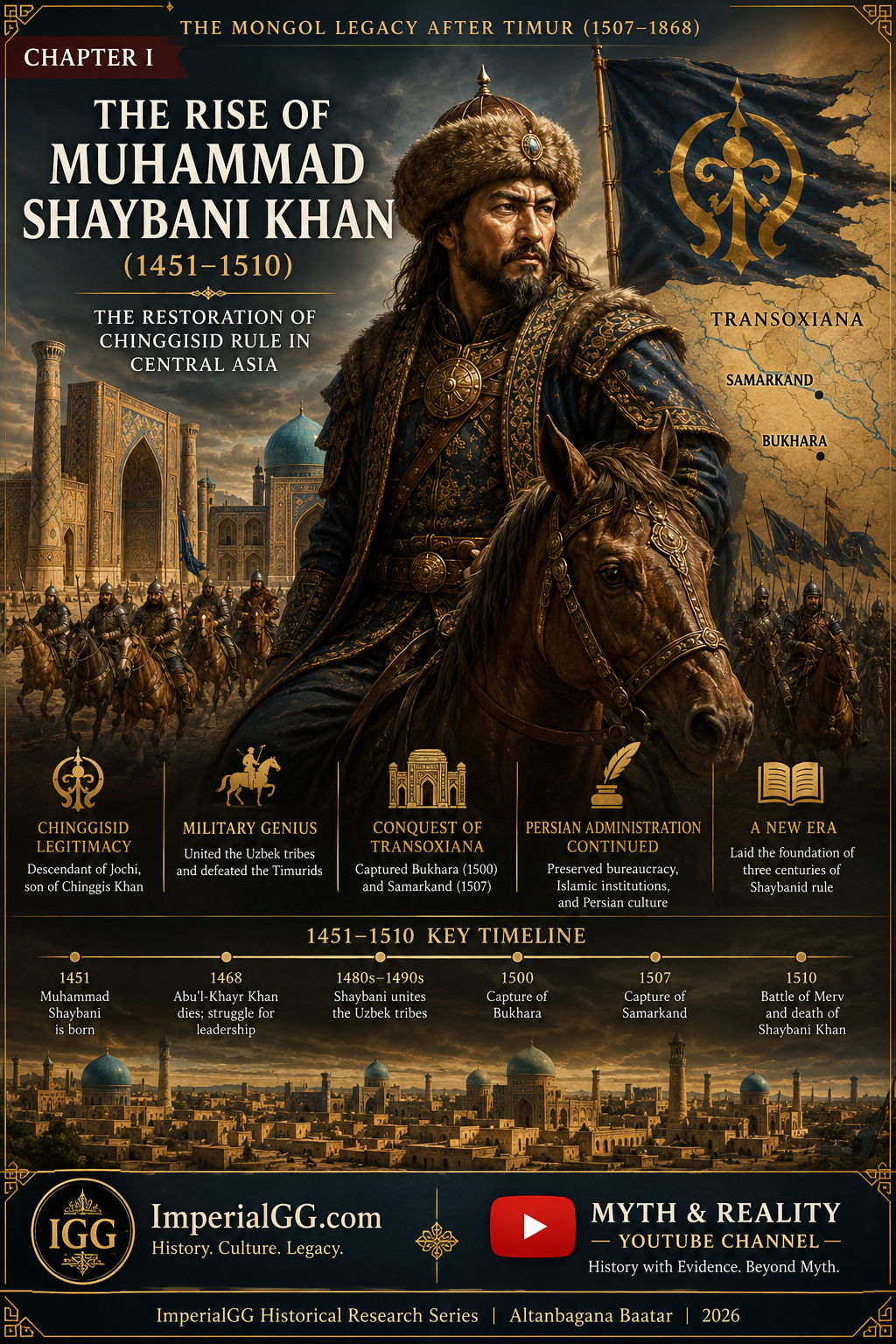
CHAPTER II Chinggisid Legitimacy after the Mongol Empire
Sovereignty Beyond the Fall of the Empire
The dissolution of the unified Mongol Empire in the fourteenth century did not bring an end to the political principles established by Chinggis Khan. Although the empire fragmented into several independent khanates, the concept of Chinggisid legitimacy continued to shape political authority across much of Inner Asia for centuries. From the Crimean Khanate in the west to Moghulistan in the east, rulers continued to derive their right to govern from their descent from Chinggis Khan or through association with his lineage. This enduring political culture profoundly influenced the successor states that emerged after the Mongol Empire, including the Shaybanid, Astrakhanid, and later Manghit regimes of Central Asia.¹
Unlike many medieval empires whose collapse resulted in the disappearance of their political traditions, the Mongol Empire left behind a durable ideology of sovereignty. Chinggis Khan’s descendants were regarded not simply as members of a royal family but as possessors of a unique dynastic legitimacy that could not easily be replicated by outsiders. Throughout the fifteenth and sixteenth centuries, rival princes competed for territory and influence, yet few questioned the principle that supreme authority properly belonged to a descendant of Chinggis Khan.²
Timur himself illustrates this paradox. Although he established one of the largest empires of the late medieval world and became one of history’s most successful conquerors, he never claimed the title of Khan. Lacking Chinggisid ancestry, Timur instead ruled as Amir, carefully preserving a Chinggisid prince as the nominal sovereign while exercising real political power himself. His marriage into the Chinggisid family earned him the title Güregen (“son-in-law”), further demonstrating the extraordinary prestige attached to the imperial lineage.³
This distinction between de facto military authority and de jure dynastic legitimacy survived long after Timur’s death. His successors continued to emphasize their connection with the Chinggisid house even while exercising independent political authority. The persistence of this practice reveals that the Mongol conception of sovereignty remained deeply embedded within the political culture of Central Asia. Even rulers capable of conquering vast territories recognized the symbolic necessity of Chinggisid legitimacy.
For the descendants of Shiban, however, such legitimacy required no symbolic adoption. As members of the Jochid branch of the Chinggisid dynasty, the Shaybanids possessed direct genealogical descent from Chinggis Khan through Jochi and Shiban. When Muhammad Shaybani Khan conquered Transoxiana, he therefore combined military success with an inherited dynastic legitimacy already recognized throughout the steppe. His authority rested simultaneously upon conquest, tribal support, and an accepted legal tradition of sovereignty that had developed under the Mongol Empire.⁴
This distinction helps explain why the rise of the Shaybanids represented more than the replacement of one dynasty by another. Whereas the Timurids derived their prestige largely from Timur’s military achievements, the Shaybanids united military conquest with Chinggisid ancestry. Their accession to power therefore restored a ruling house whose claims to kingship conformed to long-established political norms across Inner Asia.
Footnotes
- David Morgan, The Mongols, 2nd ed. (Malden, MA: Blackwell, 2007); Peter B. Golden, Central Asia in World History (New York: Oxford University Press, 2011).
- Thomas T. Allsen, Culture and Conquest in Mongol Eurasia (Cambridge: Cambridge University Press, 2001); Christopher P. Atwood, Encyclopedia of Mongolia and the Mongol Empire (New York: Facts On File, 2004).
- Beatrice Forbes Manz, The Rise and Rule of Tamerlane (Cambridge: Cambridge University Press, 1989); John E. Woods, studies on the Timurid dynasty.
- Peter B. Golden, Central Asia in World History; Svat Soucek, A History of Inner Asia (Cambridge: Cambridge University Press, 2000).
The Concept of Chinggisid Sovereignty
The persistence of Chinggisid legitimacy rested upon more than genealogy alone. Throughout the post-imperial period, sovereignty was understood as the product of both dynastic descent and the political traditions established during the Mongol Empire. The authority of the khan was reinforced through customary law, military leadership, consultation with tribal elites, and recognition by other Chinggisid rulers. Although these practices evolved over time and varied among different successor states, they continued to distinguish legitimate sovereignty from mere military domination.⁵
This distinction is particularly important when examining Central Asia after the collapse of Timurid rule. A successful conqueror could seize cities and defeat rival armies, yet military victory alone did not automatically establish universally recognized kingship. The extraordinary prestige attached to the descendants of Chinggis Khan remained deeply embedded within the political culture of the Eurasian steppe. Consequently, dynasties possessing direct Chinggisid ancestry enjoyed an advantage that extended beyond military power; they possessed an accepted legal and historical claim to supreme authority.
The symbolic value of this legitimacy also shaped diplomatic relations. Neighboring rulers frequently addressed Chinggisid khans with honors reflecting their dynastic status, while rival claimants sought to demonstrate genealogical superiority in order to strengthen their own political position. Genealogy therefore functioned not merely as family history but as an essential component of international politics across Inner Asia.
Chinggisid Rule under the Shaybanids
The accession of Muhammad Shaybani Khan represented the restoration of a Chinggisid dynasty to the political center of Transoxiana. Unlike Timur, whose legitimacy depended primarily upon conquest and marriage into the imperial family, Shaybani combined military success with direct descent from Jochi through Shiban. His victories therefore satisfied both the practical and symbolic requirements of sovereignty recognized throughout the region.⁶
Following the conquest of Bukhara and Samarkand, the Shaybanids did not attempt to erase the institutions inherited from previous Persianate states. Instead, they integrated Chinggisid political traditions with established systems of administration. Persian remained the principal language of government, Islamic scholars continued to enjoy royal patronage, and urban commercial networks operated with relatively little interruption. This combination of dynastic continuity and administrative pragmatism became one of the defining characteristics of the Uzbek Khanates.
The result was not the replacement of one civilization by another but the emergence of a political synthesis. Steppe military traditions provided the ruling elite, while Persian bureaucratic experience supplied the administrative expertise necessary to govern densely populated urban societies. The durability of this arrangement explains why the Shaybanid state survived well beyond the lifetime of its founder.
The Astrakhanids and Dynastic Continuity
When the main Shaybanid line gradually weakened during the late sixteenth century, political authority passed to another branch of the Jochid family: the Astrakhanids, also known as the Janids. Although the dynasty changed, the underlying principle of Chinggisid legitimacy remained intact. The Astrakhanids likewise traced their ancestry to Jochi and therefore inherited the same dynastic prestige that had legitimized the Shaybanids.⁷
Under Astrakhanid rule, Bukhara continued as one of the leading intellectual and religious centers of the Islamic world. Persian-speaking scholars, jurists, poets, and administrators remained central to the functioning of the state, while Turkic languages increasingly expanded within the military and courtly environment. Rather than replacing earlier traditions, the Astrakhanids preserved the political framework established during the sixteenth century, demonstrating that dynastic succession did not fundamentally alter the institutional character of the khanate.
The Manghits and the Endurance of Chinggisid Legitimacy
An even more revealing example of the endurance of Chinggisid political culture emerged during the rise of the Manghit dynasty in the eighteenth century. The Manghits themselves were not descendants of Chinggis Khan. Nevertheless, they initially governed through Chinggisid puppet khans before eventually assuming the title of Emir rather than Khan. This distinction was neither accidental nor ceremonial. It reflected the continued recognition that the title of Khan traditionally belonged to members of the Chinggisid lineage.⁸
The Manghit experience demonstrates that the ideology established during the Mongol Empire continued to influence political practice centuries after the empire itself had disappeared. Even rulers exercising effective control over the state hesitated to appropriate a title associated with a dynastic lineage they did not possess. Their decision illustrates the remarkable durability of Chinggisid concepts of sovereignty within Central Asian political culture.
Historical Assessment
The history of Central Asia after the fall of the Mongol Empire cannot be understood solely through the succession of dynasties. Beneath these political transitions existed a remarkably stable conception of legitimate rule grounded in Chinggisid ancestry and reinforced by centuries of historical tradition. The Shaybanids, Astrakhanids, and even the Manghits all governed within this ideological framework, whether by possessing Chinggisid descent or by acknowledging its continuing authority.
For this reason, the political history of Central Asia between the sixteenth and nineteenth centuries should be interpreted as an era of continuity rather than repeated rupture. Dynasties changed, territories expanded or contracted, and regional rivalries intensified, yet the Mongol conception of sovereignty endured. This continuity explains why the Mongol legacy remained a defining element of Central Asian political culture until the Russian conquest transformed the region during the nineteenth century.
Footnotes
- Thomas T. Allsen, Culture and Conquest in Mongol Eurasia (Cambridge: Cambridge University Press, 2001); David Morgan, The Mongols, 2nd ed. (Malden, MA: Blackwell, 2007).
- Peter B. Golden, Central Asia in World History (New York: Oxford University Press, 2011); The Baburnama: Memoirs of Babur, trans. Wheeler M. Thackston (New York: Modern Library, 2002).
- Svat Soucek, A History of Inner Asia (Cambridge: Cambridge University Press, 2000); C. E. Bosworth, The New Islamic Dynasties (Edinburgh: Edinburgh University Press, 1996).
- R. D. McChesney, studies on the Emirate of Bukhara; Scott C. Levi, The Rise and Fall of Khoqand (Pittsburgh: University of Pittsburgh Press, 2017).
CHAPTER III The Shaybanid Dynasty (1500–1599)
Building a Chinggisid State in Transoxiana
The conquest of Transoxiana by Muhammad Shaybani Khan marked only the beginning of Shaybanid rule. His death at the Battle of Merv in 1510 might have ended the ambitions of a less stable political system, yet the institutions established during the first decade of Shaybanid expansion proved remarkably resilient. Rather than collapsing with the death of its founder, the dynasty reorganized under other members of the Jochid house and gradually transformed itself from a conquering tribal confederation into one of the most durable states in post-Mongol Central Asia.¹
The survival of the Shaybanid state distinguished it from many contemporary empires that depended heavily upon the personal authority of a single ruler. While Muhammad Shaybani Khan undoubtedly served as the architect of the dynasty’s expansion, political legitimacy remained vested not in one individual but in the broader Chinggisid lineage descending from Shiban, a son of Jochi. This dynastic foundation enabled succession to continue despite military setbacks and internal rivalries, preserving both the authority of the ruling house and the stability of state institutions.²
During the sixteenth century the Shaybanids governed a territory extending across much of Transoxiana, including Bukhara, Samarkand, Balkh, Tashkent, and numerous smaller urban centers linked by the commercial networks of the Silk Roads. These cities represented far more than military strongholds. They functioned as centers of Islamic scholarship, long-distance trade, handicraft production, and agricultural administration. Consequently, the success of the dynasty depended not merely upon military conquest but upon effective governance of prosperous urban societies whose administrative traditions had developed over many centuries.³
Unlike the early Mongol conquests of the thirteenth century, the Shaybanid state did not seek to replace the existing bureaucratic order. Persian remained the principal language of government administration, taxation, diplomacy, historiography, and literary culture. Experienced secretaries, judges, scholars, and financial officials continued to serve under the new dynasty, ensuring institutional continuity despite the transfer of political authority. This pragmatic approach reflected a broader pattern observable throughout Mongol history, whereby conquering elites frequently preserved effective administrative systems rather than dismantling them.⁴
The relationship between the ruling dynasty and the Persian-speaking urban population formed one of the defining characteristics of Shaybanid government. Merchants continued to operate across commercial routes connecting Central Asia with Iran, India, Russia, and China. Religious institutions retained royal patronage, while scholars associated with Bukhara and Samarkand contributed to the continued prestige of both cities within the wider Islamic world. Rather than experiencing cultural displacement, Persian urban society remained an indispensable component of state administration and intellectual life.⁵
At the same time, the dynasty preserved many political traditions inherited from the Eurasian steppe. Tribal military organization remained central to the army, while alliances among Uzbek clans continued to influence appointments, campaigns, and regional administration. This balance between nomadic political culture and settled bureaucratic governance enabled the Shaybanids to maintain authority across territories characterized by considerable ethnic, linguistic, and economic diversity.
The reign of Abdullah Khan II (r. 1557–1598) represented the political high point of the Shaybanid dynasty. Through military campaigns and administrative reforms, he reunified territories that had previously been divided among competing branches of the ruling family. Under his leadership Bukhara emerged as the effective political capital of the khanate, while trade, architecture, and Islamic scholarship flourished. Many historians regard his reign as the period during which the Shaybanid state achieved its greatest political cohesion and international influence.⁶
Nevertheless, the very dynastic principles that had sustained the state also generated recurring succession disputes. Like many Chinggisid dynasties, the Shaybanids lacked a rigid system of primogeniture. Multiple princes possessed legitimate claims to power, creating periodic rivalries that weakened central authority after the death of particularly capable rulers. By the closing years of the sixteenth century these internal divisions contributed to the gradual decline of the ruling house.
The collapse of the Shaybanid dynasty in 1599, however, did not signify the end of Chinggisid government in Central Asia. Instead, political authority passed to another branch of the Jochid family—the Astrakhanids (Janids)—whose own Chinggisid ancestry ensured the continuation of dynastic legitimacy. The transition therefore represented a change within the broader Chinggisid political order rather than the replacement of that order itself.
Footnotes
- Svat Soucek, A History of Inner Asia (Cambridge: Cambridge University Press, 2000).
- Peter B. Golden, Central Asia in World History (New York: Oxford University Press, 2011).
- Scott C. Levi, The Rise and Fall of Khoqand (Pittsburgh: University of Pittsburgh Press, 2017).
- Maria Eva Subtelny, Timurids in Transition (Leiden: Brill, 2007); R. D. McChesney, studies on Bukhara.
- Richard Foltz, Religions of the Silk Road, 2nd ed. (New York: Palgrave Macmillan, 2010).
- C. E. Bosworth, The New Islamic Dynasties (Edinburgh: Edinburgh University Press, 1996); Peter B. Golden, Central Asia in World History.
III-A. State Formation (1500–1533)
From Conquest to Government
Although Muhammad Shaybani Khan is remembered primarily as a conqueror, his most enduring achievement lay not in the capture of cities but in the establishment of a durable political order capable of governing them. The transition from a mobile steppe confederation to a territorial state required profound institutional adaptation. Military victory could secure Transoxiana, yet only effective administration could preserve it. Following the conquest of Bukhara and Samarkand, the Shaybanids therefore faced the challenge common to many post-nomadic empires: transforming conquest into stable government.¹
The early Shaybanid administration reflected both continuity and innovation. Rather than dismantling the sophisticated institutions inherited from the Timurids, the new rulers preserved much of the existing Persian bureaucratic apparatus. Local administrators continued to collect taxes, maintain irrigation systems, supervise urban markets, and administer justice according to established Islamic legal traditions. Persian remained the principal language of chancery correspondence, financial administration, and historiography, while Chagatai Turkic expanded within the military elite and courtly culture.²
This pragmatic approach reflected political necessity rather than ideological compromise. The prosperity of Transoxiana depended upon agricultural production sustained by extensive irrigation networks, caravan trade linking East and West, and densely populated urban centers whose administration required specialized expertise. Experienced Persian-speaking officials therefore remained indispensable to the functioning of the state. Rather than replacing them with tribal leaders unfamiliar with urban administration, the Shaybanids integrated existing bureaucratic institutions into their own political system.
Military organization nevertheless retained its steppe foundations. Uzbek tribal contingents continued to provide the core of the army, while leading clans exercised considerable influence within provincial administration. The khan depended upon negotiated relationships with tribal elites whose loyalty was rewarded through appointments, land revenues, and participation in military campaigns. This balance between centralized dynastic authority and tribal cooperation became one of the defining features of Shaybanid government.³
The first decades after Muhammad Shaybani Khan’s death demonstrated the resilience of these institutions. Although succession disputes emerged among members of the ruling family, the state itself survived. Competing princes generally accepted the legitimacy of the Chinggisid dynasty, and political conflict remained largely confined within the ruling house rather than resulting in complete institutional collapse. Such continuity distinguished the Shaybanids from many contemporary dynasties whose governments disintegrated following the death of a powerful founder.
Economically, the sixteenth century witnessed renewed commercial activity throughout Transoxiana. Bukhara and Samarkand resumed their traditional roles as major commercial centers linking China, India, Iran, and the Volga region. Merchants transported textiles, horses, precious metals, spices, paper, and manufactured goods across caravan routes that connected Central Asia with the broader Eurasian economy. The stability provided by Shaybanid rule encouraged commercial recovery after decades of political fragmentation during the late Timurid period.⁴
Religious institutions likewise benefited from dynastic patronage. Madrasas, mosques, Sufi lodges, and charitable foundations continued to receive endowments from rulers and local elites. Islamic scholarship flourished, while Persian literary culture remained deeply rooted in the intellectual life of urban society. Rather than attempting cultural transformation, the Shaybanids presented themselves as legitimate Muslim sovereigns responsible for protecting both religion and political order.
By the middle decades of the sixteenth century, the foundations of the Shaybanid state had become firmly established. The dynasty had successfully combined Chinggisid political legitimacy, steppe military organization, Persian administrative expertise, and Islamic institutions into a remarkably durable system of government. This political synthesis would reach its greatest maturity under the reign of Abdullah Khan II.
Footnotes
- Peter B. Golden, Central Asia in World History (New York: Oxford University Press, 2011).
- Maria Eva Subtelny, Timurids in Transition (Leiden: Brill, 2007); R. D. McChesney, studies on Bukhara.
- David Morgan, The Mongols, 2nd ed. (Malden, MA: Blackwell, 2007); Svat Soucek, A History of Inner Asia (Cambridge: Cambridge University Press, 2000).
- Scott C. Levi, The Rise and Fall of Khoqand (Pittsburgh: University of Pittsburgh Press, 2017); Richard Foltz, Religions of the Silk Road, 2nd ed. (New York: Palgrave Macmillan, 2010).
CHAPTER III-B Abdullah Khan II and the Consolidation of the Shaybanid State (1557–1598)
The Political Zenith of the Shaybanid Dynasty
If Muhammad Shaybani Khan established the foundations of the Shaybanid state, it was Abdullah Khan II (r. 1557–1598) who transformed those foundations into a stable and centralized kingdom. His reign is widely regarded as the political and administrative high point of the Shaybanid dynasty. During more than four decades of rule, Abdullah Khan II reunited territories divided by dynastic rivalries, strengthened royal authority, expanded commercial networks, and reinforced Bukhara’s position as the leading political and religious center of Central Asia. Rather than pursuing conquest alone, he devoted considerable attention to consolidating institutions capable of sustaining long-term stability.¹
When Abdullah Khan II emerged as the dominant ruler, the Shaybanid state faced challenges that threatened its cohesion. Rival branches of the ruling family controlled different regions of Transoxiana, provincial governors exercised considerable autonomy, and neighboring powers sought to exploit internal divisions. The Safavid Empire remained an important competitor to the south, while the Kazakh khans and other steppe confederations influenced the northern frontier. Abdullah’s principal achievement was not simply defeating these rivals but restoring effective central authority without abandoning the Chinggisid political traditions upon which the dynasty’s legitimacy rested.²
One of his earliest priorities was the reunification of Transoxiana under a single administration. Through a combination of military campaigns, diplomatic negotiation, and strategic appointments, Abdullah gradually reduced the independence of competing princes and provincial governors. Cities such as Bukhara, Samarkand, Tashkent, Balkh, and Hisar increasingly recognized the authority of the central government. This process strengthened political stability and reduced the recurring succession conflicts that had weakened the dynasty after the death of Muhammad Shaybani Khan.³
Unlike many contemporary rulers who concentrated primarily upon military expansion, Abdullah devoted significant attention to administration. Provincial officials remained responsible for taxation, irrigation, judicial affairs, and urban management, yet they operated within a more coordinated governmental framework. Experienced Persian-speaking bureaucrats continued to occupy essential administrative positions, while members of the Uzbek military elite supervised provincial security and frontier defense. The resulting partnership between Chinggisid political leadership and Persian administrative expertise represented one of the defining characteristics of Shaybanid government.⁴
Bukhara emerged as the principal beneficiary of these reforms. Although Samarkand retained enormous historical prestige as Timur’s former capital, Bukhara increasingly became the effective political center of the khanate. Royal patronage encouraged the construction and restoration of mosques, madrasas, caravanserais, markets, bridges, and public infrastructure. The city developed into one of the foremost centers of Islamic scholarship in Central Asia, attracting jurists, theologians, historians, poets, and merchants from across the Persianate world. Contemporary travelers described Bukhara as a prosperous city whose commercial vitality reflected the broader stability achieved under Abdullah’s government.⁵
Economic expansion formed another important feature of his reign. The sixteenth century witnessed renewed commercial activity along the transcontinental caravan routes linking China, India, Iran, the Volga basin, and the Ottoman world. Merchants transported silk, cotton textiles, horses, leather goods, paper, spices, precious metals, and luxury products through markets administered by Shaybanid officials. State protection of trade routes encouraged both domestic commerce and long-distance exchange, reinforcing Bukhara’s position as one of Central Asia’s principal commercial hubs.⁶
Abdullah Khan II also understood that political stability depended upon cooperation between nomadic and settled communities. Uzbek tribal leaders remained indispensable components of the military establishment, while Persian-speaking urban populations supplied much of the administrative expertise, commercial capital, and intellectual leadership necessary for effective government. Rather than favoring one community at the expense of another, the Shaybanid administration generally relied upon both. This political accommodation contributed significantly to the longevity of the dynasty and reduced tensions between the steppe aristocracy and the urban elite.
The flourishing of scholarship during Abdullah’s reign further enhanced the prestige of the khanate. Madrasas expanded their educational activities, historians produced important chronicles, and religious scholars maintained close relationships with the court. Persian continued as the principal language of learned literature and official administration, while Chagatai Turkic flourished in poetry and courtly culture. The coexistence of these literary traditions reflected the multicultural character of the Shaybanid state rather than the dominance of a single linguistic or ethnic identity.⁷
Footnotes
- Peter B. Golden, Central Asia in World History (New York: Oxford University Press, 2011); Svat Soucek, A History of Inner Asia (Cambridge: Cambridge University Press, 2000).
- C. E. Bosworth, The New Islamic Dynasties (Edinburgh: Edinburgh University Press, 1996); David Morgan, The Mongols, 2nd ed. (Malden, MA: Blackwell, 2007).
- R. D. McChesney, studies on the Khanate of Bukhara and Central Asian administration.
- Maria Eva Subtelny, Timurids in Transition (Leiden: Brill, 2007); Scott C. Levi, The Rise and Fall of Khoqand (Pittsburgh: University of Pittsburgh Press, 2017).
- R. D. McChesney, studies on Bukhara; Richard Foltz, Religions of the Silk Road, 2nd ed. (New York: Palgrave Macmillan, 2010).
- Scott C. Levi, The Rise and Fall of Khoqand; Svat Soucek, A History of Inner Asia.
- Maria Eva Subtelny, Timurids in Transition; Richard Foltz, Religions of the Silk Road.
CHAPTER III-C Decline of the Shaybanids and the Transition to the Astrakhanids (1598–1599)
The remarkable achievements of Abdullah Khan II could not entirely eliminate the structural challenges inherent within the Shaybanid political system. Like many Chinggisid dynasties, the succession to the throne remained dependent upon the competing claims of multiple princes rather than a fixed principle of primogeniture. While Abdullah’s personal authority had preserved political unity throughout most of his reign, the stability of the state increasingly depended upon the continued presence of an exceptionally capable ruler.¹
The death of Abdullah Khan II in 1598 exposed these underlying weaknesses. His designated successor, Abd al-Mu’min Khan, inherited a politically fragile kingdom already burdened by factional rivalries among members of the ruling elite. His reign proved exceptionally brief, lasting only a few months before his assassination. The rapid collapse of central authority revived longstanding disputes among competing branches of the Chinggisid family and encouraged regional leaders to pursue their own political ambitions.²
Despite this dynastic crisis, the institutional foundations of the Shaybanid state remained largely intact. Provincial administrations continued to function, commercial activity persisted within the principal cities, and Islamic educational institutions maintained their traditional roles. The bureaucratic machinery developed over the preceding century did not disappear with the extinction of a single ruling line. Instead, the political system demonstrated a degree of institutional resilience that distinguished it from many contemporary states whose administrative structures collapsed alongside their dynasties.
The resolution of the succession crisis came not through the abandonment of Chinggisid legitimacy but through its continuation in another branch of the Jochid family. In 1599 political authority passed to the Astrakhanids, also known as the Janids, whose ancestry likewise traced back to Jochi, the eldest son of Chinggis Khan. Consequently, the transfer of power represented dynastic succession within the broader Chinggisid political tradition rather than the replacement of that tradition by an entirely new system of government.³
This transition illustrates one of the defining characteristics of post-Mongol Central Asian history. Dynasties changed, yet the underlying principles of legitimate sovereignty remained remarkably consistent. The Astrakhanids inherited not only the territory and institutions of the Shaybanids but also the political expectations associated with Chinggisid rule. Persian administrative practices continued to shape government, Bukhara remained the principal political and religious center of the khanate, and commercial life proceeded with relatively limited disruption.
From the perspective of the Persian-speaking urban population, including the communities retrospectively identified as Tajiks, the transition from Shaybanid to Astrakhanid rule involved considerably more continuity than change. Administrators, scholars, merchants, judges, and religious leaders continued to serve successive governments, while Persian retained its position as an essential language of administration, scholarship, and literature. The endurance of these institutions demonstrates that dynastic succession did not fundamentally transform the social and administrative fabric of Transoxiana.⁴
Historical Assessment
The Shaybanid dynasty occupies a pivotal position in the history of Central Asia. It restored Chinggisid rule to Transoxiana after the decline of the Timurids, reunited much of the region under a single government, strengthened Bukhara as a political and intellectual center, and established institutions that endured well beyond the lifetime of its founding rulers. Rather than representing a temporary military conquest, the Shaybanids created a durable political order that shaped the development of Central Asia throughout the sixteenth century.
Equally significant was the dynasty’s ability to reconcile different political traditions. Chinggisid dynastic legitimacy provided the ideological foundation of sovereignty, while Persian administrative experience supplied the institutional expertise necessary to govern prosperous urban societies. Islamic religious institutions reinforced political legitimacy, and long-distance commerce connected the khanate to the wider economy of Eurasia. The resulting synthesis represented one of the most successful examples of political adaptation in the post-Mongol world.
The end of the Shaybanid ruling line in 1599 therefore should not be interpreted as the collapse of the political order established by Muhammad Shaybani Khan. Instead, it marked the transfer of authority to another Chinggisid dynasty that inherited the same administrative institutions, territorial ambitions, and concepts of legitimate sovereignty. The Astrakhanids would continue this political tradition for more than a century and a half, demonstrating that the Mongol legacy in Central Asia remained a living political reality long after the dissolution of the unified Mongol Empire.
For the purposes of this study, the Shaybanid period represents the first major stage in the post-Timurid evolution of Central Asia. It established the institutional framework through which later dynasties—including the Astrakhanids and, eventually, the Manghit emirs—would govern the region until the Russian conquest fundamentally transformed the political landscape during the nineteenth century.
Footnotes
- C. E. Bosworth, The New Islamic Dynasties (Edinburgh: Edinburgh University Press, 1996); Peter B. Golden, Central Asia in World History (New York: Oxford University Press, 2011).
- Svat Soucek, A History of Inner Asia (Cambridge: Cambridge University Press, 2000).
- R. D. McChesney, studies on the Khanate of Bukhara; David Morgan, The Mongols, 2nd ed. (Malden, MA: Blackwell, 2007).
- Maria Eva Subtelny, Timurids in Transition (Leiden: Brill, 2007); Richard Foltz, Religions of the Silk Road, 2nd ed. (New York: Palgrave Macmillan, 2010).
CHAPTER IV
The Astrakhanid Dynasty (1599–1756) Preserving Chinggisid Rule and the Persianate State
Part I – The Succession of the Janids
The extinction of the principal Shaybanid line in 1599 did not bring an end to Chinggisid rule in Central Asia. Instead, political authority passed to another branch of the Jochid dynasty known to historians as the Astrakhanids or Janids. Their accession represented a dynastic transition rather than a political revolution. The institutions of government, the administrative traditions of Transoxiana, and the ideological foundations of sovereignty remained largely intact. Consequently, the emergence of the Astrakhanid dynasty illustrates one of the most remarkable features of post-Mongol Central Asian history: continuity through dynastic succession rather than institutional collapse.¹
The Janids traced their ancestry to the rulers of the Khanate of Astrakhan, one of the successor states that had emerged following the fragmentation of the Golden Horde. After the Russian conquest of Astrakhan in 1556, members of the dynasty migrated southward, eventually establishing themselves within the political world of Transoxiana. Their Chinggisid descent through Jochi made them acceptable candidates for the throne following the extinction of the ruling Shaybanid branch. Unlike non-Chinggisid military leaders, the Janids possessed the dynastic legitimacy required by the political traditions of Inner Asia.²
The accession of Baqi Muhammad Khan in 1599 therefore represented both continuity and adaptation. While a new branch of the Chinggisid family assumed power, the governmental institutions inherited from the Shaybanids remained operational. Provincial governors retained their administrative responsibilities, Persian-speaking secretaries continued to manage taxation and state correspondence, and Bukhara remained the principal political and religious center of the khanate. For the urban population, particularly merchants, scholars, judges, and administrators, everyday government changed relatively little despite the dynastic transition.³
One of the greatest strengths of the Astrakhanid state lay in its ability to preserve administrative continuity while accommodating changing regional circumstances. During the seventeenth century Central Asia confronted shifting commercial patterns, increased competition among neighboring states, and the gradual expansion of Russian influence across the Eurasian steppe. Nevertheless, the khanate continued to function through the institutional framework established during the preceding century. Persian remained the dominant language of administration and historical writing, while Chagatai Turkic continued to flourish within elite literary culture and courtly society.⁴
Unlike the early decades of Shaybanid expansion, the Astrakhanid rulers inherited a mature political system rather than creating one from conquest. Their principal task was therefore not territorial unification but political preservation. They sought to maintain stability among provincial governors, manage relations with neighboring powers, and sustain the prosperity of the commercial cities upon which the state’s finances depended. Bukhara, Samarkand, Balkh, and other urban centers continued to serve as focal points of trade connecting India, Iran, the Kazakh steppe, and western China through the surviving caravan routes of Inner Asia.⁵
The relationship between the Chinggisid dynasty and the Persian-speaking urban elite remained one of mutual dependence. The khans required experienced administrators, judges, religious scholars, and merchants capable of maintaining the economic and institutional life of the state. Urban society, in turn, benefited from the political stability and military protection provided by the ruling dynasty. This reciprocal relationship contributed significantly to the durability of the khanate during the seventeenth century.
Religious institutions likewise retained considerable influence. The rulers of Bukhara actively supported Islamic scholarship, endowed mosques and madrasas, and maintained close relations with influential religious families. Bukhara’s reputation as one of the leading centers of Sunni learning expanded during this period, attracting students and scholars from across Central Asia, Afghanistan, and northern India. The continued patronage of Islamic education reinforced both political legitimacy and the cultural prestige of the dynasty.⁶
The Astrakhanids therefore should not be viewed merely as successors to the Shaybanids. Rather, they represented the continuation of a broader political tradition in which Chinggisid legitimacy, Persian administrative culture, Islamic scholarship, and commercial urban life remained closely interconnected. Their reign demonstrates that the Mongol political legacy endured not through imperial expansion but through institutional continuity, dynastic legitimacy, and the successful adaptation of inherited political structures to changing historical conditions.
Footnotes
- Peter B. Golden, Central Asia in World History (New York: Oxford University Press, 2011); Svat Soucek, A History of Inner Asia (Cambridge: Cambridge University Press, 2000).
- David Morgan, The Mongols, 2nd ed. (Malden, MA: Blackwell, 2007); C. E. Bosworth, The New Islamic Dynasties (Edinburgh: Edinburgh University Press, 1996).
- R. D. McChesney, studies on the Khanate of Bukhara and its administration.
- Maria Eva Subtelny, Timurids in Transition (Leiden: Brill, 2007); Scott C. Levi, The Rise and Fall of Khoqand (Pittsburgh: University of Pittsburgh Press, 2017).
- Svat Soucek, A History of Inner Asia; Richard Foltz, Religions of the Silk Road, 2nd ed. (New York: Palgrave Macmillan, 2010).
- Jo-Ann Gross, Muslims in Central Asia: Expressions of Identity and Change; R. D. McChesney, works on Bukhara and Naqshbandi institutions.
CHAPTER IV-A The Establishment of Astrakhanid Rule (1599–1642)
The accession of the Astrakhanids in 1599 marked the beginning of a new dynastic era in Central Asia, yet it did not represent a fundamental break with the political traditions established by their Shaybanid predecessors. Rather than dismantling the institutions of government, the new rulers inherited and preserved a political system that had evolved over the course of the sixteenth century. The transition demonstrated that legitimacy in Transoxiana remained closely tied to Chinggisid ancestry, while effective governance depended upon the continued cooperation between the ruling dynasty, Persian-speaking administrators, Islamic scholars, and the urban merchant communities.¹
The first ruler of the new dynasty, Baqi Muhammad Khan (r. 1599–1605), faced the immediate challenge of consolidating authority after the turbulent succession that followed the death of Abdullah Khan II. Although rival claimants remained active in several regions, Baqi Muhammad succeeded in securing recognition among the principal political elites of Bukhara and the surrounding provinces. His authority rested not only upon military success but also upon his acknowledged descent from Jochi through the Astrakhanid branch of the Chinggisid family. In the political culture of Inner Asia, this hereditary legitimacy remained indispensable for the office of khan.²
Baqi Muhammad’s reign was relatively brief, yet it provided the stability necessary for the peaceful establishment of the new dynasty. Rather than introducing sweeping administrative reforms, he largely retained the governmental structures inherited from the Shaybanids. Provincial governors continued to administer taxation, irrigation, judicial affairs, and urban administration, while experienced Persian secretaries managed the chancery and fiscal bureaucracy. Such institutional continuity reassured both the urban population and the religious establishment that dynastic succession would not disrupt the ordinary functioning of the state.³
Following Baqi Muhammad’s death, Vali Muhammad Khan (r. 1605–1611) encountered increasing opposition from rival factions within the ruling elite. Political competition among members of the Chinggisid family, combined with conflicts among influential tribal leaders, weakened the central government and created opportunities for external intervention. Nevertheless, these struggles remained contests over legitimate succession rather than attempts to abolish the existing political order. Even competing factions accepted that sovereignty properly belonged to a Chinggisid ruler.
The political situation stabilized significantly under Imam Quli Khan (r. 1611–1642), whose long reign restored confidence in the dynasty and strengthened the authority of the central government. Historians generally regard Imam Quli Khan as one of the most capable rulers of the Astrakhanid period. Through careful diplomacy, administrative continuity, and the maintenance of internal peace, he enabled Bukhara to experience several decades of relative prosperity despite the changing geopolitical environment surrounding Central Asia.⁴
One of Imam Quli Khan’s greatest achievements was the preservation of political stability without extensive military expansion. Unlike the founders of earlier dynasties, he concentrated upon strengthening existing institutions rather than pursuing large-scale territorial conquest. This strategy reflected the realities of the seventeenth century, when the commercial prosperity of Transoxiana depended increasingly upon secure internal administration rather than continuous warfare. Stability encouraged merchants to resume long-distance trade and allowed agricultural production to recover in many irrigated regions surrounding the principal cities.
The administrative partnership between the ruling house and the Persian-speaking bureaucratic elite continued to define the operation of government. Persian remained the language of official correspondence, financial records, historiography, and judicial administration, while Islamic jurists and religious scholars exercised considerable influence over legal and educational institutions. At the same time, Uzbek military leaders retained responsibility for frontier defense and provincial security. The coexistence of these complementary institutions reflected a political synthesis that had developed gradually since the late Timurid and Shaybanid periods rather than an entirely new governmental model.
Religious legitimacy likewise remained central to Astrakhanid rule. The khans actively supported Sunni Islamic institutions, particularly the influential Naqshbandi order, whose scholars enjoyed considerable prestige throughout Central Asia. Royal patronage financed the maintenance of mosques, madrasas, charitable endowments (waqf), and religious education. These policies strengthened the moral authority of the dynasty while reinforcing Bukhara’s reputation as one of the leading intellectual centers of the Islamic world.⁵
The continuation of commercial life further illustrates the remarkable stability achieved during the first half of the seventeenth century. Caravan routes linking India, Safavid Iran, Siberia, the Kazakh steppe, and western China remained active despite changing regional political conditions. Bukhara continued to function as a major center for the exchange of textiles, horses, paper, precious metals, dyes, leather, and luxury goods. Merchants from diverse ethnic and linguistic backgrounds operated within an environment protected by the institutions inherited from earlier Chinggisid governments.
Thus, the first four decades of Astrakhanid rule demonstrated that dynastic succession need not produce institutional disruption. Instead, the Janid rulers successfully preserved the administrative foundations established by the Shaybanids while adapting them to the political realities of the seventeenth century. This continuity would allow Bukhara to emerge as one of the most important centers of Islamic scholarship, commerce, and political authority in Inner Asia during the following generations.
Footnotes
- Peter B. Golden, Central Asia in World History (New York: Oxford University Press, 2011); Svat Soucek, A History of Inner Asia (Cambridge: Cambridge University Press, 2000).
- C. E. Bosworth, The New Islamic Dynasties (Edinburgh: Edinburgh University Press, 1996); David Morgan, The Mongols, 2nd ed. (Malden, MA: Blackwell, 2007).
- R. D. McChesney, studies on the Khanate of Bukhara and its administration.
- Audrey Burton, The Bukharans: A Dynastic, Diplomatic and Commercial History, 1550–1702 (Richmond: Curzon Press, 1997).
- Jo-Ann Gross, Muslims in Central Asia: Expressions of Identity and Change; R. D. McChesney, studies on Bukhara and the Naqshbandi order.
CHAPTER IV-B Bukhara at its Intellectual and Commercial Zenith
The political stability achieved during the reign of Imam Quli Khan created conditions in which Bukhara experienced one of the most significant periods of intellectual and commercial development in its history. Although the Astrakhanids did not construct an empire comparable in territorial scale to that of Chinggis Khan or Timur, they governed a state whose influence rested increasingly upon scholarship, religion, commerce, and urban culture rather than military expansion alone. During the seventeenth century, Bukhara emerged as one of the foremost centers of Sunni Islamic learning, attracting scholars, merchants, pilgrims, and diplomats from across Central Asia, Iran, the Ottoman Empire, and Mughal India.¹
The city’s prestige was built upon institutions whose origins stretched back many centuries but which flourished under sustained Astrakhanid patronage. Madrasas expanded their educational activities, libraries accumulated works from across the Persianate world, and religious endowments (waqf) provided financial support for teachers, students, and charitable institutions. Islamic jurisprudence, Qur’anic studies, theology, philosophy, mathematics, astronomy, and Persian literature were taught within an educational environment that linked Bukhara to a much wider network of intellectual exchange throughout the Islamic world.²
Among the most influential religious movements of the period was the Naqshbandi Sufi order, whose spiritual authority extended far beyond Central Asia. Successive Astrakhanid rulers cultivated close relationships with prominent Naqshbandi scholars, recognizing that religious legitimacy strengthened political authority. The influence of leading Sufi families reached not only the royal court but also provincial administration, judicial institutions, and local communities. This partnership between political and religious leadership became one of the defining characteristics of seventeenth-century Bukhara.³
Persian remained the dominant language of administration, historiography, theology, and literary scholarship. Court historians composed chronicles documenting the reigns of successive khans, while poets and scholars continued the rich literary traditions inherited from both the Timurid and Shaybanid periods. Chagatai Turkic also retained an important position within elite literary culture, particularly among members of the military aristocracy and the ruling family. The coexistence of these languages reflected the multicultural character of the khanate rather than competition between distinct national identities.
Commercial prosperity reinforced Bukhara’s intellectual importance. Although maritime trade increasingly redirected portions of Eurasian commerce toward the Indian Ocean during the seventeenth century, the overland caravan routes crossing Central Asia remained economically significant. Merchants from India, Safavid Iran, Russia, the Kazakh steppe, Tibet, and western China continued to exchange textiles, cotton, silk, horses, leather goods, spices, dyes, paper, precious metals, and manufactured products within Bukharan markets. The city’s commercial vitality supported artisans, scholars, religious institutions, and urban development alike.⁴
The Astrakhanid government actively encouraged this economic activity by maintaining caravan routes, protecting merchants, and preserving the legal institutions necessary for commercial transactions. Urban markets operated under established Islamic legal principles administered by judges and commercial officials familiar with both local practice and broader Islamic jurisprudence. This institutional stability enabled Bukhara to remain an attractive destination for long-distance merchants despite increasing competition from maritime trade networks.
Architecture likewise reflected the prosperity of the period. Although many of Bukhara’s most famous monuments had originated during earlier centuries, the Astrakhanids invested heavily in restoration, expansion, and new construction. Mosques, madrasas, caravanserais, bridges, reservoirs, and marketplaces received royal patronage, reinforcing both the practical needs of urban society and the symbolic prestige of the dynasty. Architectural patronage served not merely religious purposes but also demonstrated the ruler’s responsibility for maintaining public welfare and Islamic civilization.⁵
Diplomatic relations further enhanced Bukhara’s international standing. The Astrakhanid court maintained contact with the Mughal Empire, the Safavid state, Russian authorities, and neighboring Central Asian polities. Ambassadors carried gifts, commercial agreements, diplomatic correspondence, and religious texts across Eurasia, illustrating that Bukhara remained fully integrated into the political networks of the early modern world. These exchanges also facilitated the movement of scholars, craftsmen, physicians, and merchants whose activities enriched the cultural life of the khanate.
Despite this prosperity, important structural challenges gradually became apparent. The expansion of Russian influence along the Volga basin and into Siberia altered established trade patterns. Maritime commerce increasingly diverted valuable international trade away from traditional caravan routes, while regional rivalries among neighboring states continued to require diplomatic attention. These developments did not immediately undermine the Astrakhanid state, but they foreshadowed the economic and geopolitical transformations that would become increasingly significant during the eighteenth century.
Historical Assessment
The seventeenth century represents the cultural zenith of the Astrakhanid dynasty. Rather than seeking legitimacy primarily through conquest, the rulers of Bukhara reinforced their authority by supporting Islamic scholarship, protecting commercial activity, preserving Persian administrative traditions, and maintaining political stability across Transoxiana. Their achievements demonstrate that the enduring legacy of the Mongol political order was expressed not only through military power but also through the successful governance of prosperous urban societies.
The flourishing of Bukhara during this period also illustrates the adaptability of the Chinggisid political tradition. Although the unified Mongol Empire had long since disappeared, the institutional framework inherited from earlier centuries continued to evolve. Chinggisid dynastic legitimacy, Persian bureaucratic expertise, Islamic religious authority, and long-distance commerce remained mutually reinforcing pillars of government. This synthesis enabled the Astrakhanids to preserve one of Central Asia’s most important states well into the eighteenth century, even as the wider balance of power across Eurasia began to change.
Footnotes
- Audrey Burton, The Bukharans: A Dynastic, Diplomatic and Commercial History, 1550–1702 (Richmond: Curzon Press, 1997).
- Jo-Ann Gross, Muslims in Central Asia: Expressions of Identity and Change (Durham: Duke University Press, 1992).
- R. D. McChesney, Central Asia: Foundations of Change and related studies on Bukhara’s institutions.
- Scott C. Levi, The Rise and Fall of Khoqand (Pittsburgh: University of Pittsburgh Press, 2017); Richard Foltz, Religions of the Silk Road, 2nd ed. (New York: Palgrave Macmillan, 2010).
- Svat Soucek, A History of Inner Asia (Cambridge: Cambridge University Press, 2000); Audrey Burton, The Bukharans.
CHAPTER IV-C The Decline of the Astrakhanids and the Rise of the Manghits (1702–1756)
By the beginning of the eighteenth century, the Astrakhanid dynasty confronted challenges that differed fundamentally from those faced by its seventeenth-century predecessors. The political institutions established by the Shaybanids and preserved by the Astrakhanids remained in place, yet the regional environment had changed considerably. Long-distance commercial patterns shifted, neighboring powers became increasingly assertive, and internal competition among provincial elites gradually weakened the authority of the khan. Rather than experiencing a sudden collapse, the Khanate of Bukhara entered a prolonged period of political decentralization that unfolded over several decades.¹
One of the principal causes of decline was the growing imbalance between the formal authority of the Chinggisid khan and the practical influence exercised by powerful military commanders, tribal leaders, and provincial governors. Although the khans continued to possess unquestioned dynastic legitimacy, their ability to enforce decisions across the entire khanate diminished as local elites accumulated military and economic resources of their own. Administrative offices increasingly became arenas of factional competition, while regional governors exercised greater autonomy in taxation, military recruitment, and local administration.²
Economic circumstances also contributed to political instability. Since the sixteenth century, Bukhara had benefited from its position along the overland caravan routes connecting East Asia, South Asia, Iran, and Russia. By the eighteenth century, however, maritime commerce across the Indian Ocean and expanding Russian trade networks increasingly diverted commercial activity away from traditional Silk Road corridors. Although Bukhara remained an important regional market, reduced transit trade limited state revenues and weakened the financial resources available to the central government.³
The changing geopolitical balance of Eurasia further complicated the situation. Russian expansion across the Volga basin and into the Kazakh steppe brought a major imperial power ever closer to Central Asia. To the south, the Safavid Empire entered its own period of decline before being replaced by the expanding military state created by Nader Shah Afshar. These developments altered the diplomatic environment in which the Astrakhanids had previously maintained relative stability.
The most dramatic external challenge occurred in 1740, when Nader Shah invaded Transoxiana during his wider campaigns across Central Asia. The Bukharan government, already weakened by internal divisions, proved unable to organize effective resistance. Rather than destroying the khanate, Nader Shah compelled its submission and incorporated it into his broader sphere of influence. Although Astrakhanid rulers remained in place, their political independence was significantly reduced, and the prestige of the dynasty suffered a severe blow.⁴
The weakening of central authority created opportunities for new political actors. Among the most influential were the Manghits, an Uzbek tribal confederation whose leaders had long occupied important military and administrative positions within the Bukharan state. Unlike the Astrakhanids, the Manghits did not possess Chinggisid ancestry. Their rise therefore illustrates an important transformation in Central Asian political culture. Whereas previous dynastic transitions had occurred between different branches of the Chinggisid family, political authority now increasingly depended upon military effectiveness and administrative control rather than genealogy alone.
The decisive figure in this transition was Muhammad Rahim Bi, who gradually consolidated power during the middle decades of the eighteenth century. Acting initially as the principal military commander and chief minister, he became the effective ruler of Bukhara while the Astrakhanid khans retained largely ceremonial authority. Following the extinction of effective Astrakhanid power, Muhammad Rahim formally assumed control in 1756, establishing the Manghit Emirate of Bukhara.⁵
The emergence of the Manghit state represented a significant constitutional transformation. For more than four centuries, political legitimacy in most of Central Asia had rested upon descent from Chinggis Khan through the Jochid line. Because the Manghits lacked this ancestry, their rulers did not adopt the title Khan. Instead, they ruled as Emirs, deriving legitimacy primarily from Islamic political authority, military leadership, and practical control of the state rather than from Chinggisid genealogy. This marked one of the most important political changes in post-Mongol Central Asian history.⁶
Nevertheless, the transition from Astrakhanid to Manghit rule did not involve the destruction of existing governmental institutions. Persian administrative traditions continued to shape state bureaucracy, Islamic judges and scholars retained their influence, and Bukhara remained the principal political, commercial, and religious center of the region. Many officials who had served the Astrakhanids continued to serve the new regime, illustrating the remarkable continuity of Central Asian administrative culture despite dynastic change.
Historical Assessment
The decline of the Astrakhanid dynasty should not be interpreted simply as evidence of political failure. For more than one and a half centuries, the Janid rulers preserved the institutional framework inherited from the Shaybanids while maintaining Bukhara as one of the leading centers of Islamic scholarship and commerce in Inner Asia. Their gradual weakening resulted not from a single catastrophic event but from the combined effects of internal decentralization, changing commercial geography, and the emergence of increasingly powerful neighboring empires.
The rise of the Manghits marked the end of continuous Chinggisid rule in Bukhara, yet it did not erase the political traditions established during the Mongol period. Instead, the new dynasty inherited and adapted administrative institutions that had evolved over centuries of Chinggisid, Timurid, Shaybanid, and Astrakhanid governance. This continuity demonstrates that the Mongol legacy in Central Asia extended far beyond dynastic genealogy, shaping the structures of government well into the modern era.
The establishment of the Manghit Emirate in 1756 therefore represents both an ending and a beginning. It concluded the long era in which Chinggisid descent remained the principal foundation of sovereignty in Transoxiana, while opening a new phase in which Islamic legitimacy, military authority, and administrative competence became the primary pillars of political rule. The evolution of this new political order forms the subject of the following chapter.
Footnotes
- Svat Soucek, A History of Inner Asia (Cambridge: Cambridge University Press, 2000).
- Audrey Burton, The Bukharans: A Dynastic, Diplomatic and Commercial History, 1550–1702 (Richmond: Curzon Press, 1997); R. D. McChesney, studies on Bukhara.
- Scott C. Levi, The Rise and Fall of Khoqand (Pittsburgh: University of Pittsburgh Press, 2017).
- Michael Axworthy, The Sword of Persia: Nader Shah, from Tribal Warrior to Conquering Tyrant (London: I.B. Tauris, 2006).
- C. E. Bosworth, The New Islamic Dynasties (Edinburgh: Edinburgh University Press, 1996); Peter B. Golden, Central Asia in World History (New York: Oxford University Press, 2011).
- David Morgan, The Mongols, 2nd ed. (Malden, MA: Blackwell, 2007); Christopher P. Atwood, Encyclopedia of Mongolia and the Mongol Empire (New York: Facts On File, 2004).
CHAPTER V The Manghit Emirate of Bukhara (1756–1920)
From Chinggisid Khans to Islamic Emirs
Part I – A New Foundation of Political Authority
The establishment of the Manghit Emirate in 1756 marked one of the most consequential constitutional transformations in the history of Central Asia. For nearly five centuries, political legitimacy in Transoxiana had rested upon descent from Chinggis Khan through the Jochid line. Although dynasties had changed—from the Shaybanids to the Astrakhanids—the fundamental principle remained constant: the supreme ruler was expected to belong to the Chinggisid family. With the accession of the Manghits, this tradition entered a new phase. Political authority was no longer derived primarily from dynastic genealogy but increasingly from effective military leadership, administrative control, and Islamic legitimacy.¹
The rise of the Manghits did not occur through sudden revolution. During the final decades of Astrakhanid rule, the khans had become progressively dependent upon influential military commanders and tribal leaders who exercised real authority over the affairs of government. Among these figures, the Manghit amirs emerged as the most powerful. By controlling the army, supervising provincial administration, and managing relations with the religious establishment, they gradually accumulated authority while the Chinggisid khans retained largely ceremonial status.²
The decisive transition occurred under Muhammad Rahim Bi, who consolidated political power following the weakening of Astrakhanid authority after the campaigns of Nader Shah. In 1756, Muhammad Rahim assumed direct control of the state and established the Manghit Emirate. Significantly, he did not proclaim himself Khan. Instead, he adopted the title Amir, reflecting the political reality that he lacked Chinggisid ancestry. This choice illustrates the continuing symbolic importance of Chinggisid legitimacy even as the practical foundations of government evolved.³
Rather than rejecting the institutions inherited from previous dynasties, the Manghits preserved much of the existing administrative framework. Persian remained the principal language of government records, taxation, diplomacy, and historical writing, while Islamic judges (qadis), scholars (ulama), and administrators continued to perform many of the same functions they had exercised under the Shaybanids and Astrakhanids. The continuity of these institutions demonstrates that dynastic succession did not necessarily require institutional rupture.⁴
The Manghit rulers also recognized the growing political influence of Islamic religious authorities. Unlike the Chinggisid khans, whose legitimacy rested primarily upon hereditary descent, the emirs relied heavily upon the support of respected scholars, jurists, and Sufi leaders. Public patronage of mosques, madrasas, charitable endowments (waqf), and religious education strengthened the moral authority of the regime while reinforcing Bukhara’s longstanding reputation as one of the foremost centers of Sunni Islamic learning.⁵
Nevertheless, Chinggisid political culture did not disappear overnight. The memory of Chinggisid sovereignty remained deeply embedded in Central Asian political thought, court ceremony, and historical writing. Even under Manghit rule, chroniclers frequently referred to earlier Chinggisid dynasties as the historical foundation of legitimate government. The Manghits therefore governed within a political tradition they had inherited rather than replacing it entirely. Their legitimacy rested upon a combination of military success, administrative competence, Islamic authority, and the careful appropriation of established political customs.
The eighteenth century also witnessed significant changes in the international environment surrounding Central Asia. Russian expansion accelerated across the Kazakh steppe, Qing authority extended firmly into Xinjiang following the destruction of the Dzungar Khanate, and Afghanistan emerged under the Durrani Empire as an important regional power. These developments altered the geopolitical balance inherited from earlier centuries and required the Manghit rulers to pursue increasingly pragmatic diplomatic policies in order to preserve their independence.⁶
Although the Manghit Emirate represented a new constitutional order, it remained unmistakably rooted in the political traditions of post-Mongol Central Asia. Administrative institutions, commercial networks, Islamic scholarship, and urban culture continued to display remarkable continuity with the Shaybanid and Astrakhanid periods. The principal innovation lay not in the machinery of government but in the changing basis upon which political legitimacy itself was justified.
Footnotes
- Peter B. Golden, Central Asia in World History (New York: Oxford University Press, 2011); David Morgan, The Mongols, 2nd ed. (Malden, MA: Blackwell, 2007).
- R. D. McChesney, studies on the Emirate of Bukhara and the late Astrakhanid period.
- C. E. Bosworth, The New Islamic Dynasties (Edinburgh: Edinburgh University Press, 1996); Christopher P. Atwood, Encyclopedia of Mongolia and the Mongol Empire (New York: Facts On File, 2004).
- Audrey Burton, The Bukharans: A Dynastic, Diplomatic and Commercial History, 1550–1702 (Richmond: Curzon Press, 1997); Scott C. Levi, The Rise and Fall of Khoqand (Pittsburgh: University of Pittsburgh Press, 2017).
- Jo-Ann Gross, Muslims in Central Asia: Expressions of Identity and Change (Durham: Duke University Press, 1992); R. D. McChesney, works on Bukhara and Islamic institutions.
- Peter C. Perdue, China Marches West: The Qing Conquest of Central Eurasia (Cambridge, MA: Harvard University Press, 2005); Michael Axworthy, The Sword of Persia (London: I.B. Tauris, 2006).
CHAPTER V-B Government, Society, and Economy under the Manghit Emirs (1756–1868)
Following the establishment of the Manghit Emirate, the rulers of Bukhara inherited a political system that had evolved over several centuries of Chinggisid, Timurid, Shaybanid, and Astrakhanid governance. Rather than creating an entirely new administrative order, the Manghit emirs refined and adapted existing institutions to meet the political realities of the late eighteenth and early nineteenth centuries. This continuity explains why the Emirate of Bukhara remained one of the most stable states in Central Asia despite profound changes occurring elsewhere across Eurasia.¹
Although supreme authority rested with the emir, effective government depended upon cooperation among military commanders, provincial governors, Islamic jurists, and experienced bureaucrats. Provincial administration continued to collect taxes, supervise irrigation systems, regulate markets, and maintain public order. Many administrative practices retained strong Persianate characteristics, reflecting centuries of bureaucratic development in Transoxiana. Government correspondence, fiscal records, legal documentation, and historical chronicles continued to be produced primarily in Persian, while Chagatai Turkic remained important within the court and among sections of the military elite.²
One of the defining features of Manghit administration was its close relationship with the religious establishment. The ulama exercised considerable authority within judicial and educational institutions, while judges (qadis) administered Islamic law in matters of inheritance, commerce, family affairs, and charitable endowments. The Naqshbandi order remained especially influential, and prominent Sufi families frequently acted as intermediaries between the government and local communities. Unlike many contemporary states where religious institutions competed with political authority, the Bukharan emirate generally sought cooperation between the two.³
Agriculture remained the foundation of the economy. Irrigated cultivation along the Zarafshan and Amu Darya river systems supported the production of wheat, barley, cotton, fruits, and vegetables. Maintenance of canals and irrigation networks required continuous state supervision, making water management one of the most important administrative responsibilities of provincial officials. Control over irrigation directly influenced agricultural productivity, tax revenues, and political stability throughout the emirate.⁴
Urban centers continued to serve as the commercial heart of the state. Bukhara, Samarkand, Karshi, and other cities hosted vibrant markets where merchants from Russia, Persia, Afghanistan, Kashgar, and northern India exchanged textiles, cotton, silk, carpets, leather goods, horses, dyes, paper, and precious metals. Although maritime trade had reduced the international importance of portions of the Silk Road, overland commerce remained economically significant for Central Asia throughout much of the eighteenth and nineteenth centuries.⁵
The population of the emirate reflected the diversity that had characterized Transoxiana for centuries. Persian-speaking urban communities constituted an important element of commercial, literary, and administrative life, while Uzbek tribal groups provided much of the military and political leadership. Tajik-speaking agricultural populations occupied numerous towns and villages throughout the river valleys, and additional communities—including Turkmens, Kazakhs, Arabs, Jews, Indians, and others—participated in regional trade and local economic activity. Rather than forming rigidly separated societies, these groups interacted through markets, religious institutions, administrative service, and everyday economic exchange.⁶
Education remained centered upon the madrasa system. Students received instruction in Qur’anic studies, Islamic jurisprudence, Arabic grammar, logic, philosophy, mathematics, astronomy, and Persian literature. Bukhara retained its reputation as one of the leading centers of Sunni scholarship, attracting students from across Central Asia, Afghanistan, and the Volga region. The prestige of its educational institutions reinforced both the cultural authority of the emirate and its wider influence within the Islamic world.
Despite this apparent stability, important structural weaknesses gradually became more visible during the nineteenth century. Administrative authority often depended upon personal relationships rather than permanent institutions. Provincial governors exercised considerable autonomy, tax collection varied between regions, and modernization proceeded slowly compared with neighboring empires. While Russia introduced new military organization, industrial production, and administrative reforms, the Bukharan government largely preserved traditional structures that had served earlier generations effectively but proved increasingly difficult to adapt to the rapidly changing geopolitical environment.⁷
These developments did not immediately threaten the survival of the emirate. Nevertheless, they created conditions under which external powers possessing modern armies, expanding industrial economies, and increasingly centralized governments would acquire decisive strategic advantages. During the middle decades of the nineteenth century, Russian expansion toward Central Asia transformed these long-term structural challenges into immediate political realities.
Historical Assessment
The Manghit Emirate represented both continuity and adaptation within the long history of post-Mongol Central Asia. Although Chinggisid dynastic rule had ended, many of the administrative institutions, commercial networks, and cultural traditions established under earlier dynasties continued to function with remarkable resilience. Persian bureaucratic culture, Islamic legal institutions, and urban commercial life remained fundamental components of government, while the emirs developed new sources of legitimacy rooted in religious authority and practical administration.
The stability achieved by the Manghits should not obscure the broader transformation taking place across Eurasia during the eighteenth and nineteenth centuries. Industrialization, expanding imperial competition, and technological innovation increasingly favored centralized states capable of rapid military and administrative modernization. The Emirate of Bukhara entered this new international environment with institutions designed for an earlier age. Their historical durability was undeniable, yet their capacity to respond to modern geopolitical pressures became progressively limited.
These developments set the stage for the Russian conquest of Central Asia, which would fundamentally alter the political landscape of Transoxiana while introducing new forms of imperial administration that challenged centuries of indigenous statecraft.
Footnotes
- Scott C. Levi, The Rise and Fall of Khoqand (Pittsburgh: University of Pittsburgh Press, 2017).
- R. D. McChesney, studies on the administration of Bukhara.
- Jo-Ann Gross, Muslims in Central Asia: Expressions of Identity and Change (Durham: Duke University Press, 1992).
- Audrey Burton, The Bukharans: A Dynastic, Diplomatic and Commercial History, 1550–1702 (Richmond: Curzon Press, 1997).
- Richard Foltz, Religions of the Silk Road, 2nd ed. (New York: Palgrave Macmillan, 2010).
- Adeeb Khalid, The Politics of Muslim Cultural Reform: Jadidism in Central Asia (Berkeley: University of California Press, 1998).
CHAPTER V-C Russian Expansion, the Great Game, and the End of Bukharan Independence (1865–1920)
The Final Transformation of Post-Mongol Central Asia
During the nineteenth century, the political balance that had shaped Central Asia for centuries changed with unprecedented speed. The gradual expansion of the Russian Empire across the Eurasian steppe brought an industrializing imperial state into direct contact with the traditional khanates of Central Asia. At the same time, the British Empire consolidated its control over the Indian subcontinent, creating a strategic rivalry that later became known as the Great Game. The Emirate of Bukhara, together with the Khanates of Khiva and Kokand, found itself positioned between two expanding empires whose geopolitical ambitions extended far beyond the region itself.¹
Unlike the conflicts that had characterized earlier centuries, this new confrontation was not primarily a struggle between rival Central Asian dynasties. Instead, it reflected profound differences in military technology, administrative organization, transportation, and industrial capacity. The Russian Empire possessed railways, modern artillery, standardized firearms, centralized logistics, and a rapidly expanding industrial economy. By contrast, the Bukharan Emirate relied upon institutions that had evolved during the early modern period and had undergone only limited military or administrative modernization.²
Russian military expansion accelerated during the 1860s. In 1865, Russian forces captured Tashkent, one of the largest commercial and political centers in Central Asia. The loss of Tashkent fundamentally altered the regional balance of power, providing Russia with a strategic base from which further campaigns could be launched into Transoxiana. The conquest also weakened the neighboring Khanate of Kokand and increased Russian influence over regional trade networks.³
The decisive confrontation between Russia and the Emirate of Bukhara occurred in 1868. Following military defeats near Samarkand and Zirabulak, Emir Muzaffar was compelled to negotiate with the Russian authorities. The resulting agreements preserved the formal existence of the Emirate but substantially reduced its sovereignty. Samarkand and surrounding territories were incorporated directly into the Russian Empire, while Bukhara became a Russian protectorate. Although the emir retained authority over internal administration, foreign policy and many strategic decisions increasingly fell under Russian influence.⁴
The establishment of the protectorate represented a constitutional compromise rather than outright annexation. Russian officials recognized that indirect rule through the existing Bukharan government would be less costly and politically disruptive than immediate incorporation. Consequently, the Manghit emirs continued to govern according to Islamic law and established administrative practice, while Russian advisers exercised growing influence over diplomacy, military affairs, and economic development. This arrangement enabled the emirate to preserve many traditional institutions even as its international independence disappeared.
Economic relations likewise underwent significant transformation. Russian manufactured goods entered Central Asian markets in increasing quantities, while cotton cultivation expanded dramatically to supply the textile industries of the Russian Empire. New commercial routes redirected trade toward Russian markets, reducing the relative importance of older caravan networks connecting Central Asia with Iran and India. These economic changes integrated the Bukharan economy more closely into the imperial system while simultaneously altering traditional patterns of production and exchange.⁵
The late nineteenth and early twentieth centuries also witnessed important intellectual developments within the emirate. A new generation of Muslim reformers, known collectively as the Jadids, argued that the preservation of Islamic civilization required educational, social, and administrative modernization. Inspired by developments in the Ottoman Empire, the Russian Empire, and other parts of the Islamic world, Jadid intellectuals advocated modern schools, scientific education, printing, journalism, and administrative reform while remaining committed to Islamic cultural identity.⁶
The relationship between the Jadids and the conservative religious establishment proved increasingly contentious. Many traditional scholars viewed rapid reform with suspicion, fearing that foreign influence might undermine established religious institutions. Reformers, by contrast, argued that educational renewal and administrative modernization were essential if Central Asian society was to remain politically independent and economically competitive in the modern world. These debates reflected broader tensions experienced throughout the Islamic world during the late nineteenth century.
The final collapse of the emirate occurred amid the revolutionary upheavals that followed the Russian Revolution of 1917. After several years of political instability, the Red Army launched a major campaign against Bukhara in 1920. Emir Mohammed Alim Khan fled the capital, and the centuries-old emirate was abolished. In its place, the Bukharan People’s Soviet Republic was proclaimed, marking the end of independent dynastic rule in Bukhara after more than four hundred years of political continuity extending from the Shaybanids through the Astrakhanids and the Manghits.⁷
Historical Assessment
The Russian conquest did not merely replace one ruling dynasty with another. It fundamentally transformed the political structure of Central Asia by integrating the region into the institutions of a modern industrial empire. Administrative reforms, new transportation networks, changing economic relationships, and the introduction of imperial legal structures reshaped the region in ways that differed profoundly from earlier dynastic transitions.
Nevertheless, the centuries preceding Russian expansion left a lasting institutional and cultural legacy. From the establishment of Shaybanid rule in 1500 through the fall of the Manghit Emirate in 1920, successive governments preserved many elements of the Persianate administrative tradition while adapting inherited Mongol concepts of sovereignty to changing political realities. Although the basis of legitimacy evolved—from Chinggisid genealogy to Islamic-emiral authority—the continuity of bureaucratic practice, urban commercial life, and religious scholarship remained one of the defining characteristics of Central Asian history.
For the Persian-speaking urban populations of Transoxiana, retrospectively identified in large part as Tajiks, these four centuries were marked less by repeated cultural rupture than by administrative continuity under successive ruling houses. At the same time, Uzbek tribal elites, Islamic scholars, merchants, and other communities all contributed to the political and social fabric of the region. This shared history helps explain why the modern identities of Central Asia emerged from centuries of interaction rather than from the uninterrupted dominance of any single ethnic or linguistic group.
The history of post-Timurid Central Asia is therefore best understood not as a succession of isolated dynasties but as a long process of institutional adaptation. Shaybanid, Astrakhanid, and Manghit rulers each inherited political structures shaped by earlier generations, modifying them in response to new economic, religious, and geopolitical circumstances. The Russian conquest brought this historical trajectory to an end, but it did not erase the political traditions that had governed Transoxiana since the beginning of the sixteenth century.
Footnotes
- Peter Hopkirk, The Great Game: On Secret Service in High Asia (London: John Murray, 1990).
- Alexander Morrison, Russian Rule in Samarkand, 1868–1910 (Oxford: Oxford University Press, 2008).
- Adeeb Khalid, Making Uzbekistan: Nation, Empire, and Revolution in the Early USSR (Ithaca: Cornell University Press, 2015).
- Seymour Becker, Russia’s Protectorates in Central Asia: Bukhara and Khiva, 1865–1924 (Cambridge, MA: Harvard University Press, 1968).
- Scott C. Levi, The Rise and Fall of Khoqand (Pittsburgh: University of Pittsburgh Press, 2017).
- Adeeb Khalid, The Politics of Muslim Cultural Reform: Jadidism in Central Asia (Berkeley: University of California Press, 1998).
- Adeeb Khalid, Making Uzbekistan; Alexander Morrison, Russian Rule in Samarkand.