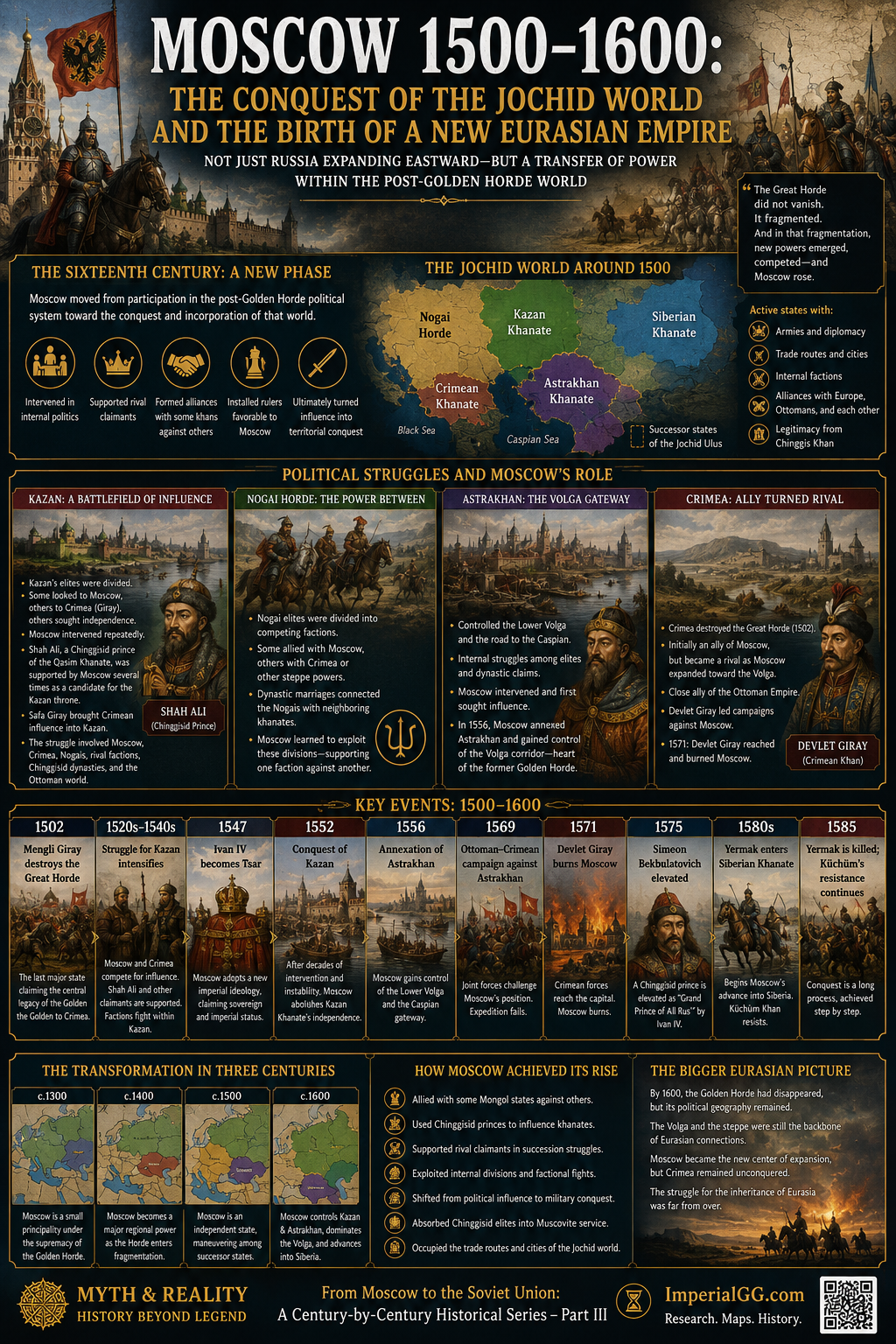
MOSCOW 1500–1600: The Conquest of the Jochid World and the Birth of a New Eurasian Empire From One
By Altanbagana Baatar
DBA Candidate| Independent Historian
ImperialGG Historical Research Seriers
17 July 2026
1500–1600: Moscow and the Transformation of the Post-Golden Horde World
At the beginning of the sixteenth century, the political world of northern Eurasia remained deeply shaped by the legacy of the Mongol Empire. The Golden Horde had fragmented, but the Jochid political world had not disappeared. The Crimean Khanate, Kazan Khanate, Astrakhan Khanate, Siberian Khanate, the Nogai Horde, and other steppe powers continued to control enormous territories, trade routes, cities, and populations across Eurasia, while many of their rulers claimed political legitimacy through descent from Chinggis Khan.
Moscow was another rising power within this changing world. Its rulers had spent generations interacting with the khans of the Golden Horde, receiving political recognition from them, competing for their support, collecting tribute within the Horde’s political system, and eventually learning to exploit divisions among its successor states. During the sixteenth century, however, Moscow moved beyond this earlier strategy. It began intervening directly in the internal politics of the Mongol successor states, supporting rival claimants to their thrones, forming alliances with some khans against others, and attempting to install rulers favorable to Moscow. When political influence was no longer sufficient, it increasingly turned toward permanent territorial conquest.
The history of 1500–1600 is therefore not simply the story of “Russia expanding eastward.” It is the story of a fundamental redistribution of power within the post-Golden Horde world, as a state that had itself risen within the Jochid political order increasingly began to intervene in, conquer, and absorb the successor states of that same Eurasian system.
1500: The Jochid World Was Still Alive
Around 1500, no single political power dominated the former territories of the Golden Horde. The Crimean Khanate controlled much of the northern Black Sea steppe, Kazan dominated the Middle Volga, Astrakhan controlled the Lower Volga and access toward the Caspian Sea, the Nogai Horde remained an important steppe confederation between the Volga and the Ural regions, and farther east the Siberian Khanate participated in the political networks of western Siberia.
These states were not merely dying fragments of a vanished empire. They conducted diplomacy, fought wars, controlled trade routes, and formed alliances with Lithuania, Poland, Moscow, the Ottoman Empire, and one another. Most importantly, they competed among themselves over the political inheritance of the Jochid Ulus. Moscow’s rise occurred within this complex political competition rather than outside it.
1502: The Great Horde Falls — But Not to Moscow Alone
One of the decisive events of the early sixteenth century occurred in 1502, when the Great Horde, which had continued to claim much of the central political inheritance of the Golden Horde, was defeated by Mengli Giray of Crimea. This event fundamentally altered the balance of power and demonstrates why it is misleading to imagine that Moscow simply destroyed the Golden Horde and inherited its position. The destruction of the Great Horde was itself largely the result of conflict within the Jochid world, and Crimea emerged as one of the strongest heirs of the former Golden Horde.
Moscow benefited from this transformation because Ivan III and Mengli Giray had developed a strategic alliance against common rivals. Thus, at the beginning of the sixteenth century, Moscow’s growing independence was closely connected to the success of one Mongol successor state against another. Yet such alliances were never permanent. As Moscow expanded southward and eastward, yesterday’s strategic ally would gradually become tomorrow’s principal rival.
Kazan: The Political Battlefield Between Moscow and Crimea
No state better demonstrates the complexity of sixteenth-century Eurasian politics than the Kazan Khanate. Located at the center of the Middle Volga world, Kazan possessed a diverse population and commercial connections extending across the Volga region, the steppe, the Urals, and Central Asia. Its ruling elite was divided among competing political factions: some favored closer relations with Moscow, others looked toward Crimea, while still others sought greater political independence from both powers.
The struggle over the Kazan throne therefore became part of a much larger geopolitical contest, and Moscow increasingly attempted to influence who would rule the khanate. Kazan was not simply a frontier enemy waiting to be conquered; for decades, it was an independent political arena in which Moscow, Crimea, local elites, Nogai factions, and competing Chinggisid dynasties struggled for influence.
Shah Ali and Moscow’s Strategy of Dynastic Intervention
One of the most important figures in this process was Shah Ali, a Chinggisid prince associated with the Qasim Khanate, whom Moscow repeatedly supported as a candidate for the Kazan throne. This reveals an important feature of early Muscovite expansion: Moscow did not initially seek to abolish Chinggisid political legitimacy but instead attempted to use it. A Chinggisid ruler favorable to Moscow could provide political influence over a neighboring khanate without requiring direct territorial annexation.
This strategy represented a transition between the older world of steppe diplomacy and the emerging politics of Muscovite imperial expansion. Yet Kazan’s political elites did not consistently accept Moscow’s preferred rulers, and Shah Ali’s position remained fragile. Political intervention therefore failed to create stable Muscovite control, and the struggle over Kazan continued.
The Giray Connection: Crimea Enters the Kazan Struggle
Crimea also sought influence over Kazan, and the rise of Safa Giray brought the Kazan throne more directly into the wider political orbit of the Giray dynasty. This intensified the rivalry between Moscow and Crimea and transformed the struggle over Kazan into a wider Eurasian contest.
The conflict was therefore never simply Moscow against Kazan. It simultaneously involved Moscow’s struggle against Crimean influence, competing factions within Kazan, rival Chinggisid dynastic claims, Nogai political interests, and increasingly the wider strategic presence of the Ottoman Empire. The fate of Kazan was being shaped by an interconnected Eurasian political system.
The Nogai Horde: The Forgotten Power Between Empires
The Nogai Horde played an especially important role in this changing balance of power. Located across the steppe between the Volga and the Ural regions, the Nogais were deeply involved in the politics of Kazan, Astrakhan, Crimea, and Moscow. Nogai elites were themselves divided into competing factions: some maintained relations with Moscow, while others cooperated with Crimea or other steppe powers, and marriage alliances connected Nogai elites with the ruling dynasties of neighboring khanates.
Moscow increasingly learned to exploit these internal divisions. This became a recurring pattern of Muscovite imperial expansion: establish relations with one faction, support it against another, intervene in succession disputes, create political dependency, and eventually transform political influence into territorial control.
1533–1547: Moscow Faces Its Own Political Crisis
The rise of Moscow was not uninterrupted. After the death of Vasily III in 1533, his son Ivan IV was still a child, and Muscovite elites competed intensely for influence during his minority. Meanwhile, the neighboring khanates remained active and militarily powerful.
This period is important because it demonstrates that Moscow’s later conquest of Kazan was not inevitable. The balance of power could still shift, and the political future of the region remained uncertain. The great Eurasian empire that Moscow would later become had not yet been created.
1547: Ivan IV Becomes Tsar
In 1547, Ivan IV was crowned Tsar, marking an important transformation in Moscow’s political ideology. Byzantine traditions certainly contributed to the development of Muscovite imperial thought, but the broader Eurasian political context must also be remembered. For centuries, the Rus’ principalities had encountered traditions of supreme sovereign authority through both the Byzantine imperial world and the khans of the Mongol Empire.
Across the steppe, legitimate supreme rule remained closely associated with Chinggisid descent, something Ivan IV could not claim. Moscow therefore developed a different ideological foundation for imperial sovereignty by combining Rus’ dynastic tradition, Orthodox Christianity, Byzantine political symbolism, and the authority created by its expanding territorial power. The ruler of a state that had once been one principality among many was now presenting himself as an imperial sovereign.
1540s–1552: The Final Struggle for Kazan
The final years before the conquest of Kazan were characterized by intense political instability. Moscow repeatedly intervened in the khanate’s internal affairs, rulers were installed and removed, pro-Moscow and anti-Moscow factions struggled for control, Crimean influence remained important, and Nogai alliances continued to shift. The death of Safa Giray in 1549 further destabilized the political situation, and Moscow eventually attempted once again to establish Shah Ali as ruler.
When this political arrangement collapsed, Ivan IV’s government moved away from the strategy of indirect control. Moscow’s policy toward Kazan was transformed from an effort to influence the khanate into a decision to conquer it permanently.
1552: The Conquest of Kazan
In 1552, Moscow launched its decisive campaign against Kazan, and the city fell after a major siege. The event marked a fundamental break with the previous political order. Moscow had intervened in Kazan’s politics for decades, supported Chinggisid rulers, and attempted to establish dependent governments, but it now abolished the khanate as an independent state and permanently incorporated its territory.
This was not merely another frontier war. For the first time, Moscow had permanently conquered one of the principal successor states of the Golden Horde. The consequences extended far beyond Kazan: the conquest transformed the balance of power throughout the Volga region, increased pressure on Astrakhan, altered Moscow’s relations with the Nogais, threatened Crimean strategic interests, and opened the way for further expansion toward the east. The year 1552 therefore marked a decisive transition in Moscow’s relationship with the Jochid successor states—from political participation and dynastic intervention toward direct imperial incorporation.
Astrakhan and the Struggle for the Lower Volga
After Kazan, the struggle moved south toward Astrakhan, which occupied an extraordinarily important strategic position near the Caspian Sea. The khanate controlled the Lower Volga and stood at the intersection of trade and political routes connecting northern Eurasia, Central Asia, the Caucasus, and the Caspian world.
Like Kazan, Astrakhan experienced internal political struggles in which Moscow intervened and supported rulers favorable to its interests. Once again, however, political influence gradually gave way to direct control, and in 1556 Moscow annexed Astrakhan. With both Kazan and Astrakhan under its authority, Moscow now controlled most of the Volga corridor. This represented one of the greatest geopolitical transformations of the sixteenth century: the Volga had been a central artery of the Golden Horde, and Moscow was now taking possession of that imperial geography.
Crimea and the Ottoman Empire Respond
The conquest of Kazan and Astrakhan fundamentally changed Moscow’s relationship with the Crimean Khanate. Crimea was not an isolated steppe state but belonged to a larger Black Sea political system and maintained a close relationship with the Ottoman Empire. From the Crimean and Ottoman perspective, Moscow’s advance toward the Lower Volga represented a major strategic threat because control of Astrakhan affected communications and political connections between the Black Sea, the Caspian region, and Central Asia.
In 1569, an Ottoman-Crimean campaign attempted to challenge Moscow’s position around Astrakhan but ultimately failed. Nevertheless, the campaign demonstrated that the struggle for the Volga was no longer merely a regional conflict. Moscow’s expansion into the former Jochid world had become part of a much larger international contest across Eurasia.
1571: Devlet Giray Burns Moscow
The greatest demonstration of continuing Crimean military power came in 1571, when Khan Devlet I Giray led his forces northward, reached Moscow, and burned much of the city. The destruction was enormous and must be included in any serious account of sixteenth-century Russian expansion. Only nineteen years after the conquest of Kazan, the capital of the emerging Muscovite empire had been devastated by the army of a Chinggisid khan.
The event demonstrates that the balance of power remained uncertain. Moscow had conquered major territories, but the steppe remained militarily formidable. The following year, another Crimean campaign was stopped at the Battle of Molodi, yet the struggle between Moscow and Crimea would continue for generations.
The Siberian Khanate and the Rise of Küchüm
While Moscow expanded along the Volga, another political transformation was occurring farther east. The Siberian Khanate was experiencing its own dynastic struggles, and in the 1560s Küchüm Khan, a Chinggisid ruler, seized power and attempted to strengthen his authority across western Siberia. Relations between his khanate and Moscow became increasingly hostile.
Moscow’s advance into Siberia, however, did not initially begin as a massive centralized state invasion. Commercial interests, frontier expansion, the ambitions of the Stroganov family, Cossack military activity, and the strategic interests of the Muscovite state gradually converged. The conquest of Siberia was therefore a prolonged historical process rather than the result of a single campaign.
The 1580s: Yermak Enters the Siberian Political World
Yermak’s campaign in the early 1580s marked the beginning of a new stage in Moscow’s eastward expansion. His forces defeated Küchüm’s troops in several engagements and captured Qashliq, one of the principal centers of the Siberian Khanate. Yet Küchüm was not immediately defeated and continued his resistance, while Yermak himself was killed in 1585.
The Siberian Khanate continued to resist, and Moscow established permanent control only gradually through further military expansion and the construction of fortified settlements. The process continued beyond 1600. Once again, a familiar pattern emerged: Moscow entered an existing political struggle, established military positions, exploited internal divisions, and gradually transformed temporary intervention into permanent territorial expansion.
Chinggisid Princes Inside the Muscovite State
The relationship between Moscow and the Mongol political world was not simply one of conquest. Chinggisid princes increasingly entered Muscovite service, received estates, commanded armies, and occupied positions of extraordinary prestige. The clearest demonstration of the continuing symbolic power of Chinggisid legitimacy came in 1575, when Ivan IV temporarily elevated Simeon Bekbulatovich, a Chinggisid prince, as “Grand Prince of All Rus’.”
Whatever Ivan’s precise political motives, the episode reveals something remarkable. More than three centuries after the first Mongol conquest of the Rus’ principalities, Chinggisid descent still carried exceptional political prestige inside Moscow itself. The political traditions of the Mongol imperial world had not simply disappeared; elements of them were being absorbed and transformed within the emerging Muscovite state.
A Century of Reversed Power
The scale of the transformation becomes clear when three centuries are compared. Around 1300, Moscow was a small principality whose rulers operated under the political supremacy of the Golden Horde. Around 1400, it was becoming a major regional power while the Horde experienced fragmentation. Around 1500, Moscow was an independent state maneuvering among competing Mongol successor states. By 1600, it had destroyed the independence of Kazan and Astrakhan, controlled most of the Volga corridor, and begun expanding into western Siberia.
Yet this transformation was not simply the result of Moscow becoming stronger while all its neighbors became weaker. It was achieved through sustained participation in the politics of the post-Golden Horde world. Moscow formed alliances with Mongol rulers, employed Chinggisid princes, supported rival candidates for khanates, exploited factional struggles, intervened in succession disputes, and ultimately replaced political influence with permanent territorial annexation.
The Greater Eurasian Transformation
By 1600, the political map of northern Eurasia had fundamentally changed. The Golden Horde had disappeared as a unified state, but its political geography remained. The Volga continued to function as a strategic artery, the steppe remained a major geopolitical corridor, and the former Jochid territories remained home to diverse peoples and political traditions. What had changed was the center of expanding power: Moscow was increasingly occupying territories and strategic networks that had once belonged to the political world of the Golden Horde.
Yet this transfer of power remained incomplete. One major Mongol successor state, the Crimean Khanate, remained unconquered and militarily formidable, while beyond Moscow’s expanding eastern frontier lay the enormous territories of Siberia and, farther south and east, powerful Central Asian states. The struggle over the political geography inherited from the Mongol imperial age was far from over.
1500–1600: The Century in One View
1502 — Mengli Giray defeats the Great Horde.
Early 1500s — Moscow and Crimea gradually move from strategic partnership toward rivalry.
1510–1521 — Moscow absorbs Pskov and Ryazan while consolidating the Rus’ lands.
1520s–1540s — Moscow and Crimea compete for influence over Kazan.
1547 — Ivan IV adopts the title of Tsar.
1552 — Moscow conquers the Kazan Khanate.
1556 — Moscow annexes the Astrakhan Khanate.
1569 — Ottoman-Crimean forces challenge Moscow’s control of Astrakhan.
1571 — Devlet Giray reaches and burns Moscow.
1572 — Crimean forces are stopped at Molodi.
1575 — Chinggisid prince Simeon Bekbulatovich is elevated by Ivan IV.
1580s — Yermak’s campaign begins a new stage of Moscow’s advance into the Siberian Khanate.
1585 — Yermak is killed while Küchüm’s resistance continues.
By the end of the sixteenth century, Moscow had not simply “expanded eastward.” It had entered, manipulated, conquered, and begun absorbing large parts of the political world that had emerged from the fragmentation of the Jochid Ulus. The transformation was not the simple disappearance of one empire followed by the spontaneous rise of another, but a long redistribution of political and territorial power within the same interconnected Eurasian world.
By 1600, that transfer of power was well underway.
But it was far from complete.
MYTH & REALITY — History Beyond Legend
From Moscow to the Soviet Union: A Century-by-Century Historical Series
ImperialGG.com — Research. Maps. History.